
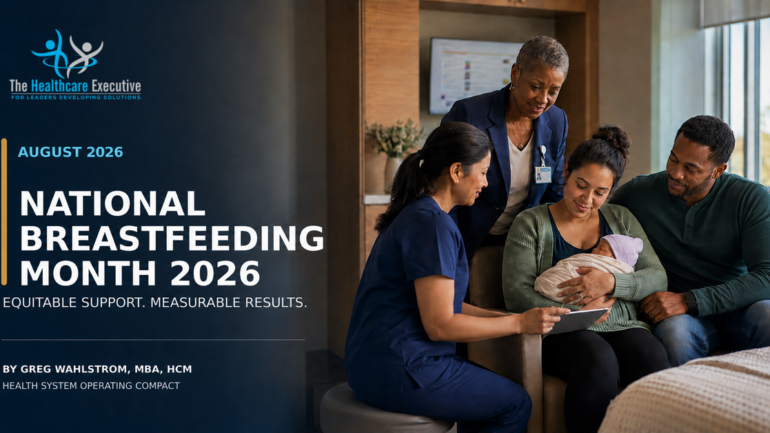

National Breastfeeding Month 2026: An Executive Lactation Support Compact
The 2026 theme, RISE: Resilience, Interdependence, Self-Determination, Empowerment, should move health systems beyond awareness messaging. The executive assignment is to build a measurable, culturally responsive continuum that helps every family pursue its informed infant-feeding goals without pressure, delay, or stigma.
Executive signal: support is a system, not a slogan
Breastfeeding initiation has improved in the United States, but continuation and equitable support remain unfinished work. The CDC reports that 86% of babies started breastfeeding in 2023, while only about 30% were exclusively breastfed at six months. It also reports that 79% of Black infants were ever breastfed, below the national average.
Hospital practice is part of the gap. In 2024, 53% of hospitals implemented more than half of the recommended maternity-care practices supportive of breastfeeding, up from 44% in 2018. Progress is real, but a board should not confuse an observance campaign with reliable prenatal counseling, bedside skill, discharge coordination, culturally concordant care, or workplace accommodation.
One month, distinct community-led action windows
These observances should not become separate, competing content campaigns. Use one enterprise operating plan and let each week create a distinct listening, partnership, and accountability window.
- All AugustNational Breastfeeding MonthRISE: Resilience, Interdependence, Self-Determination, Empowerment.
- August 1-7World Breastfeeding Week and National WIC Breastfeeding WeekStrengthen proven practices and connect eligible families to WIC peer support.
- August 8-14Indigenous Milk Medicine Week“We Keep the Fires Lit: Rising Through Milk Medicine” centers sovereignty, continuity, kinship, and community-led care.
- August 15-21AANHPI Breastfeeding Week“Better Data, Better Care for AANHPI Families” calls for disaggregated data, language access, and culturally grounded support.
- August 25-31Black Breastfeeding Week“We All We Got” recognizes community, care, collective power, and the need for trusted Black-led infrastructure.
- September 1-7Workplace Lactation Week“Work. Pump. Advance.” is the operational bridge from maternity care to retention, benefits, scheduling, and lawful accommodation.
The executive lactation support compact
1. Make the clinical pathway reliable
Adopt the WHO and UNICEF Ten Steps as a gap-assessment framework. Standardize informed prenatal conversations, immediate postpartum support when clinically appropriate, bedside help with common difficulties, and a documented discharge plan. Preserve safe access to formula and pasteurized donor human milk when medically indicated or chosen.
Operating test: can a family experience the same respectful standard on nights, weekends, transfers, and high-volume days?
2. Build a closed-loop community continuum
Referral is not continuity. Create warm handoffs to WIC, community lactation professionals, primary care, pediatric care, milk banks, and peer networks. The CDC defines continuity as coordinated, seamless support from pregnancy until a family is no longer breastfeeding.
Operating test: does the receiving partner confirm contact, and can the health system see where handoffs fail?
3. Fund equity as infrastructure
Do not ask Indigenous, AANHPI, or Black leaders to donate cultural labor. Establish paid advisory roles, service agreements, and shared measures with community-led organizations. Disaggregate AANHPI data where sample size and privacy allow; provide qualified language access; and expand recruitment and sponsorship for lactation professionals who reflect the communities served.
Operating test: who holds decision rights, receives resources, interprets the data, and defines success?
4. Treat lactation support as workforce design
Audit every facility and shift for functional pumping space, privacy, break access, safe milk storage, manager knowledge, and a rapid accommodation path. The U.S. Department of Labor explains federal break-time and space protections. Strong employers should make access workable for nurses, physicians, trainees, hourly staff, remote workers, and mobile teams.
Operating test: can an employee use the policy without losing pay opportunity, patient coverage, credibility, or privacy?
Board-ready lactation support dashboard
Use a small set of measures with clear denominators. Stratify results by race, ethnicity, preferred language, payer, geography, and care site when data quality and privacy permit. Pair rates with patient narratives so small populations do not disappear.
| Domain | Core measure | Executive question |
|---|---|---|
| Informed choice | Documented goal-concordant infant-feeding conversation and patient-reported respect | Are families informed without pressure or stigma? |
| Clinical reliability | Timely skilled support, staff competency, and evidence-based supplementation documentation | Where does reliability change by shift or site? |
| Continuity | Discharge with scheduled follow-up and confirmed community handoff | Did the next provider actually connect? |
| Equity | Goal attainment and experience gaps across disaggregated groups | Which barriers are hidden by the average? |
| Workforce | Accommodation response time, usable space, break access, and employee experience | Does policy work during real staffing conditions? |
A 90-day executive agenda
Days 1-30: establish truth
Name an accountable clinical and workforce executive dyad. Map the current journey from prenatal care through return to work. Review maternity practice, referral, language-access, community-contract, and accommodation data. Hold paid listening sessions with families and community-led partners.
Days 31-60: prove the model
Pilot one standardized pathway across an obstetric site, newborn service, pediatric clinic, and employee population. Train managers and care teams, translate priority materials, establish a closed-loop WIC and community referral, and test escalation for clinical concerns and workplace barriers.
Days 61-90: govern and scale
Review the first dashboard with the quality and workforce committees. Correct gaps by shift and population. Fund community capacity, define expansion criteria, and publish a concise internal progress report. Carry the work into Workplace Lactation Week and the annual operating plan.
Operational recommendations
- Assign joint accountability to clinical operations and human resources, with quality, equity, and community partnership at the table.
- Protect informed choice. Audit consent language, supplementation workflows, marketing conflicts, and escalation protocols.
- Purchase culturally and linguistically responsive services instead of relying on volunteer goodwill.
- Make every community referral and employee accommodation a trackable service request with a defined response standard.
- Report progress at least quarterly and treat disparities as system defects that require owners, resources, and deadlines.
Executive conclusion
National Breastfeeding Month 2026 is a governance test. Families do not experience clinical care, community support, benefits, staffing, language access, and workplace policy as separate departments. They experience one system. Leaders should use RISE to create that same unity inside the organization: resilient services, interdependent partners, respect for self-determination, and measurable empowerment.
The durable outcome is not a month of posts. It is a trustworthy pathway that helps each family feed its infant safely and pursue its own informed goals, with the right clinical help, cultural respect, community connection, and workplace support at the right time.
Authoritative sources
- U.S. Breastfeeding Committee: 2026 National Breastfeeding Month and observances
- WHO: World Breastfeeding Week 2026
- CDC: current U.S. breastfeeding indicators
- CDC: Maternity Practices in Infant Nutrition and Care
- USDA WIC: peer counseling
- Indigenous Milk Medicine Collective: 2026 observance
- Asian Pacific Islander Breastfeeding Task Force
- Black Breastfeeding Week: 2026 observance
Planning note: This executive brief supports organizational planning and does not replace individualized medical advice. Infant-feeding decisions should reflect family preferences, clinical circumstances, and qualified professional guidance.