
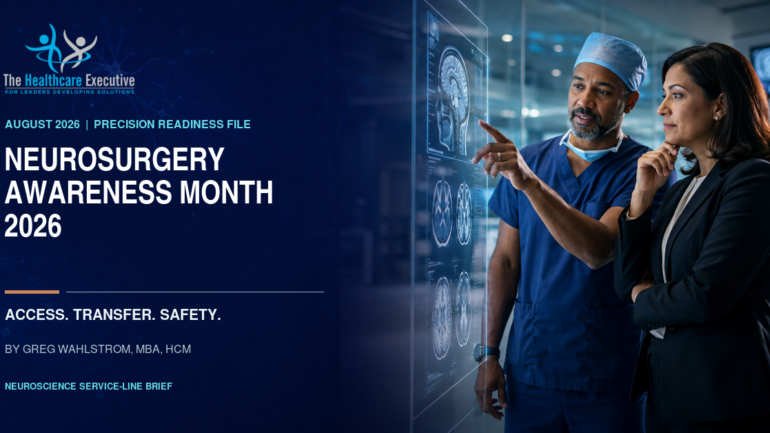

Neurosurgery Awareness Month 2026: The Executive Precision Readiness Brief
The 2026 campaign theme, Precision That Changes Lives, gives healthcare leaders a direct operating question: can the organization deliver the right neurosurgical decision, team, technology, and destination at the moment each patient needs them?
Executive signal: precision depends on the system around the surgeon
Neurosurgery serves patients with brain tumors, vascular disorders, traumatic injuries, spine disease, functional conditions, congenital disorders, and peripheral nerve problems. Technical excellence in the operating room matters, but organizational reliability begins earlier and continues long after the procedure.
The American Association of Neurological Surgeons leads Neurosurgery Awareness Month each August to elevate the specialty’s expertise, innovation, and patient impact. Executives should use that visibility to examine the complete pathway: community recognition, emergency stabilization, imaging, consultation, transfer, operating-room readiness, neurocritical care, rehabilitation, and follow-up.
The need is substantial. The CDC reports approximately 214,110 traumatic brain injury hospitalizations in 2020 and 68,663 TBI-related deaths in 2023. Those figures exclude many injuries treated outside an inpatient setting or never treated. A month of awareness is useful only if it produces faster access, safer transitions, and more dependable recovery support.
The neurosurgical readiness spine
A reliable neuroscience service line connects five operating layers. Each layer needs a named executive owner, a defined standard, and an escalation route that works at night, on weekends, and during simultaneous emergencies.
Make the first decision fast and visible
Define triggers for neurosurgical consultation, image exchange, transfer-center activation, acceptance, transport, and escalation. Maintain current capability by site, including operating-room, anesthesia, blood, imaging, intensive care, and specialty coverage. Align the pathway with CMS EMTALA obligations and state requirements.
Plan for a team, not a single specialty
Model demand across neurosurgeons, advanced practice clinicians, neuroanesthesia, nursing, imaging, rehabilitation, pharmacy, perfusion when applicable, and neurocritical care. Track call burden, vacancies, burnout signals, credentialing time, competency, and backup coverage. The healthcare workforce strategy should protect scarce expertise while creating sustainable training and succession pathways.
Standardize the high-risk handoffs
Test preoperative imaging availability, implant and equipment readiness, antibiotic timing, positioning, blood access, intraoperative monitoring, specimen control, and the transition to intensive care. Use an explicit handoff that transfers information, authority, and contingency plans. AHRQ’s I-PASS resource provides an evidence-based structure that organizations can adapt.
Govern precision tools as clinical systems
Navigation, robotics, imaging, neuromonitoring, remote consultation, and decision support require validation, downtime plans, training, cybersecurity, maintenance, and post-implementation surveillance. Link adoption to patient and workflow outcomes. The goal is not a technology inventory; it is a dependable clinical capability supported by the right analytics and governance.
Measure the life patients return to
Plan rehabilitation, pain management, medication reconciliation, functional assessment, caregiver education, behavioral health support, transportation, and follow-up before discharge. Monitor whether patients can reach the next level of care without avoidable delay. A patient-centered culture treats function, understanding, and family readiness as operating outcomes.
Operating controls for precision care
Run a monthly transfer stress test
Trace one emergency case from referring facility to definitive care. Time consultation, image exchange, acceptance, bed placement, transport, and clinical handoff. Resolve the longest waits and repeat the test on an off-shift.
Protect schedule integrity
Review cancellations, late starts, add-on delays, equipment conflicts, and intensive-care capacity together. Separate unavoidable clinical changes from recurring operational defects that leaders can remove.
Build a precision safety review
Examine returns to surgery, infections, thromboembolic events, unplanned intensive-care escalation, device issues, and communication failures. Include human factors, staffing, technology, and handoffs in every review.
Close the recovery loop
Confirm follow-up, rehabilitation connection, symptom escalation instructions, medication access, and caregiver understanding. Track failed contacts and delayed placements as service-line defects, not isolated discharge problems.
Board-ready neurosurgical reliability dashboard
Use a compact dashboard with stable definitions. Review results by site, shift, urgency, diagnosis, payer, race and ethnicity, preferred language, and geography when sample size and privacy allow. Pair rates with case review so the board sees both performance and consequence.
| Domain | Core measure | Executive question |
|---|---|---|
| Emergency access | Consult response, acceptance decision, image availability, and transfer time | Where does a patient wait for authority, information, transport, or capacity? |
| Workforce | Coverage gaps, call burden, vacancy, turnover, competency, and backup activation | Can the model sustain nights, weekends, and simultaneous demand? |
| Perioperative reliability | Cancellation, delay, equipment readiness, handoff completion, and protocol adherence | Which defects recur across teams or sites? |
| Clinical outcomes | Risk-adjusted complications, infection, reoperation, mortality, and unplanned escalation | Which outcomes require immediate learning and standardization? |
| Recovery and equity | Functional status, rehabilitation delay, follow-up completion, experience, and outcome gaps | Who has less access to recovery support, and why? |
| Value | Length of stay, avoidable days, supply variation, denials, and 30-day utilization | Does operational discipline improve outcomes and resource use together? |
Dashboard governance should specify the data owner, denominator, refresh cadence, threshold, and action required for every measure.
A 90-day executive action agenda
Establish operational truth
Name an executive and clinical dyad. Map emergency and elective pathways, inventory coverage and capabilities, validate transfer contacts, and baseline dashboard measures. Interview patients, caregivers, referring clinicians, and frontline teams about recurring delays and uncertainty.
Test the critical pathway
Run transfer and perioperative simulations on day and off-shifts. Standardize consultation triggers, image exchange, acceptance, handoffs, equipment checks, and discharge escalation. Correct two high-frequency defects and measure whether response time and reliability improve.
Govern, scale, and sustain
Review outcomes with quality, operations, workforce, and finance leaders. Approve coverage, capital, training, and partnership decisions. Publish service standards internally, add unresolved risks to the enterprise register, and set the next quarterly improvement cycle.
Operational recommendations
- Assign one executive owner for the end-to-end neurosurgical pathway, supported by a multidisciplinary clinical council.
- Maintain a real-time capability matrix and a single transfer escalation pathway that every referring and receiving team can use.
- Protect specialty workforce capacity through sustainable call models, cross-site protocols, succession planning, and verified competency.
- Require outcome, workflow, cybersecurity, downtime, and training controls for every precision technology investment.
- Place function, rehabilitation access, caregiver readiness, and disparities beside traditional surgical and financial measures.
Executive conclusion
Neurosurgery Awareness Month 2026 should become a readiness review, not a communications exercise. Precision in neurosurgery is created by highly trained clinicians, but it is either strengthened or constrained by the organization’s coverage, transfer, operating-room, intensive-care, technology, rehabilitation, and governance systems.
Leaders honor the campaign when patients encounter one coordinated pathway from recognition to recovery. The durable result is measurable: faster access to expertise, fewer preventable delays, safer handoffs, more dependable technology, sustainable teams, equitable recovery support, and clearer accountability for every critical transition.
Authoritative sources
- American Association of Neurological Surgeons: Neurosurgery Awareness Month 2026
- Centers for Disease Control and Prevention: Traumatic Brain Injury Data
- American College of Surgeons: Resources for Optimal Care of the Injured Patient
- Centers for Medicare & Medicaid Services: EMTALA
- Agency for Healthcare Research and Quality: I-PASS Handoff Tool
- National Institutes of Health: National Institute of Neurological Disorders and Stroke
Planning note: This executive brief supports health-system planning and does not replace clinical judgment, emergency protocols, applicable law, accreditation standards, or individualized medical advice.