
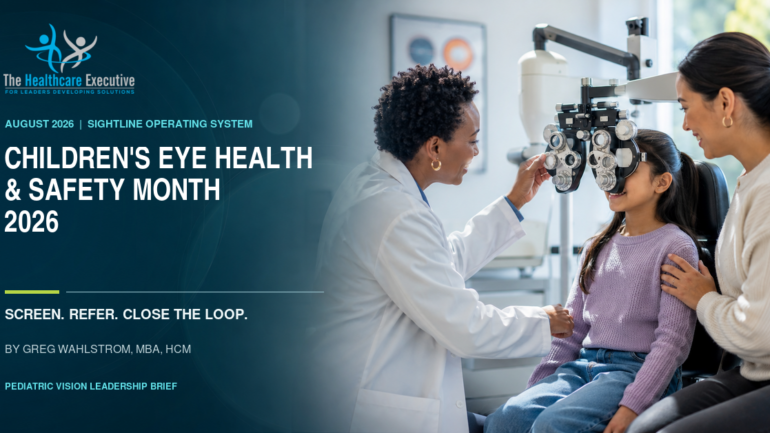

Sightline Operating System
Children’s Eye Health and Safety Month 2026: A Sightline Operating System
Build a reliable pathway that detects vision concerns early, closes referrals, prevents avoidable injuries, and shows leaders where children are still being lost to follow-up.
The leadership signal: vision is an access, safety, and learning issue
Children’s Eye Health and Safety Month 2026 is observed throughout August. Prevent Blindness identifies amblyopia, strabismus, signs of possible eye problems, general eye health, and childhood eye-injury prevention as central topics. For healthcare executives, the observance creates a practical test: can the organization move a child from initial screening to needed care without delay, confusion, or inequitable loss to follow-up?
The Centers for Disease Control and Prevention reports that amblyopia, often called lazy eye, is the most common cause of vision loss among children and affects about 2 to 3 of every 100 children. The CDC also emphasizes that untreated amblyopia can persist into adulthood. That makes early identification more than a preventive-service metric. It is a time-sensitive operating responsibility that crosses pediatrics, primary care, school health, specialty access, family communication, and payer navigation.
Design one accountable pathway from detection to protection
A vision screening identifies children who may need additional eye care, but it is not a comprehensive eye examination. The CDC’s guidance for families explains that screenings may be conducted by pediatricians, family physicians, school nurses, or other trained professionals, with referral for a comprehensive examination when concerns are found. The American Association for Pediatric Ophthalmology and Strabismus similarly describes repeated childhood screening as a way to find eye alignment, vision development, refractive, cataract, pupil, glaucoma, and eyelid concerns that require further evaluation.
Detect
Use age-appropriate, standardized methods and document complete, incomplete, and untestable results.
Communicate
Explain the result, urgency, next step, and support available in the family’s preferred language.
Close
Track referral acceptance, appointment completion, diagnosis, and treatment initiation.
Protect
Embed protective eyewear, injury response, and safe home, school, and sports practices.
AAPOS recommendations provide age-specific referral criteria and advise repeat screening every one to two years after age five. Leaders should not translate clinical guidance into one universal workflow. Instead, they should ensure that the approved protocol identifies which test is appropriate by age and developmental ability, when instrument-based screening is used, what constitutes a failed or untestable screen, and who owns follow-up. Clinical leaders must approve the protocol and update it when professional guidance changes.
Six operating recommendations for executive teams
1. Establish one pediatric vision standard
Align pediatric practices, urgent care, school partnerships, community events, and referral teams around a single clinical protocol. Standardize equipment checks, staff competency, result coding, rescreen rules, parent notification, and escalation. Audit a small sample quarterly to detect variation between sites and screeners.
2. Build a closed-loop referral work queue
Create statuses for referral ordered, family reached, appointment scheduled, visit completed, diagnosis received, and treatment started. Assign an owner and aging threshold to each status. A failed screening without completed follow-up should remain visible, not disappear into a general referral list.
3. Remove family-level access barriers
Stratify completion by age, race, ethnicity, preferred language, insurance, geography, and referral destination. Offer interpretation, scheduling assistance, transportation connections, and clear cost information. Partner with schools and community organizations when they can reach families more effectively than the health system alone.
4. Treat untestable screens as actionable
Repeatedly untestable children need a defined next step. Leaders should monitor the untestable rate by screener, setting, age, and method. The goal is to distinguish expected developmental limitations from training, equipment, workflow, or communication problems and then route each child appropriately.
5. Make injury prevention operational
The American Academy of Ophthalmology states that most serious sports-related eye injuries can be prevented with appropriate protective eyewear. Include eye protection in sports physicals, discharge education, school partnerships, employee-family outreach, and community sponsorships. Use sport-appropriate products that meet applicable safety standards rather than ordinary street eyewear.
6. Prepare a rapid eye-injury response
Educate staff and families not to underestimate trauma. AAO guidance advises prompt evaluation by an ophthalmologist or other medical doctor even when an injury appears minor. Emergency, urgent care, nurse advice, and school-health pathways should share clear triage instructions, specialty contacts, and transfer expectations.
Key takeaways for the executive team
- Screening volume is an input; completed evaluation and treatment are the meaningful outcomes.
- Every failed or repeatedly untestable result needs a visible owner, due date, and escalation rule.
- Equity must be assessed at each handoff, because an acceptable systemwide average can hide serious completion gaps.
- Eye-injury prevention belongs in the same operating model as detection, referral, and treatment.
A dashboard that measures completed care
Use a small set of measures that reveal reliability, equity, and speed. Review process failures monthly at the operating level and summarize trend, variation, and corrective action for the quality committee or board. Targets should reflect local baseline, clinical policy, payer requirements, and community need.
| Domain | Executive measure | Required stratification | Response trigger |
|---|---|---|---|
| Reach | Eligible children screened on schedule | Age, site, insurance, race, ethnicity, language | Gap from target or widening disparity |
| Reliability | Incomplete and repeatedly untestable screens | Method, screener, age, setting | Outlier rate or missing disposition |
| Referral | Abnormal screens with completed eye examination | Referral destination, geography, payer, language | Overdue referral or falling completion |
| Timeliness | Median days from failed screen to completed examination | Urgency, site, referral source | Delay beyond approved clinical threshold |
| Treatment | Children beginning recommended treatment | Diagnosis, therapy type, referral destination | Documented plan without initiation |
| Safety | Pediatric eye injuries and documented prevention counseling | Cause, setting, sport, protective eyewear use | Recurring mechanism or preventable cluster |
The 90-day executive agenda
Days 1-30: Map and baseline
- Map every handoff from eligibility and screening through treatment initiation.
- Validate clinical protocols, documentation fields, referral destinations, and escalation rules.
- Baseline six dashboard measures and identify the largest completion disparity.
Days 31-60: Repair and test
- Launch a dedicated work queue for failed and repeatedly untestable screenings.
- Test family navigation in one high-gap population or site.
- Train staff on injury prevention, urgent warning signs, and referral communication.
Days 61-90: Scale and govern
- Compare completion, timeliness, equity, and staff burden with baseline.
- Scale the effective workflow and correct any unintended burden downstream.
- Report results, accountable owners, and the next quarter’s targets to governance.
Executive conclusion
Children’s Eye Health and Safety Month 2026 should leave the organization with more than educational posts. It should produce a clearer pathway, faster referral closure, better family communication, safer environments, and a dashboard that shows where children are still waiting.
The governing question is simple: when a child has a possible vision problem or an eye injury, can the system reliably deliver the right next step? Executives can answer yes only when clinical standards, data, ownership, family support, specialty capacity, and prevention work as one operating system. August is the moment to inspect that system. The next 90 days are the opportunity to strengthen it.
Leadership resources
Continue on The Healthcare Executive
Authoritative primary sources
Editorial note: This executive brief supports leadership education and operational planning. It does not replace individualized clinical judgment, emergency evaluation, professional vision-screening guidance, or applicable legal and payer requirements.