Stabilizing the Hospital Nursing Workforce: Work Design, Leadership, Scheduling, and Retention Strategies—a Narrative Review


NARRATIVE REVIEW 07 · NURSING WORKFORCE
Stability is built
into the shift.
Stabilizing the Hospital Nursing Workforce: Work Design, Leadership, Scheduling, and Retention Strategies—a Narrative Review
DETECT RISK BEFORE RESIGNATION

- Posted by Greg Wahlstrom, MBA, HCM
- Posted in Article, Workforce & Culture
Narrative Review 07 · Nursing Workforce
Stability is built
into the shift.
Stabilizing the Hospital Nursing Workforce: Work Design, Leadership, Scheduling, and Retention Strategies—a Narrative Review
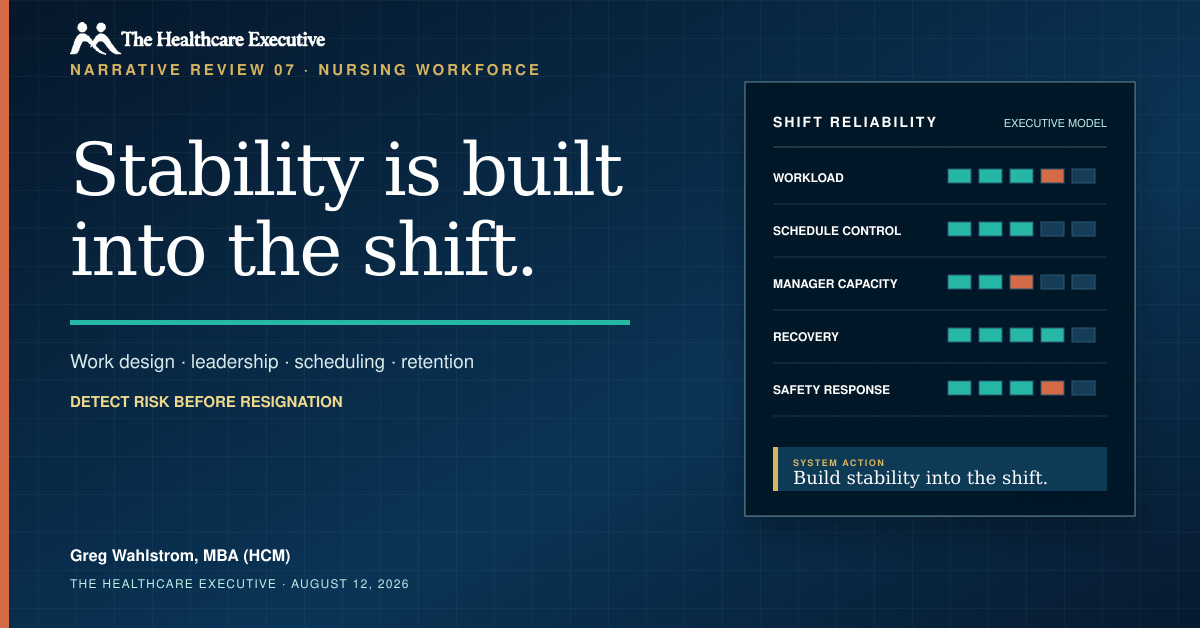
Shift reliabilityExecutive control model
Workload
Schedule control
Manager capacity
Recovery
Safety response
System actionDetect risk before resignation.
Executive abstract
Recruitment cannot repair a broken operating system.
Background and Objective: Hospital nursing instability is often described as a labor-supply problem, yet the evidence also identifies modifiable features of work: workload, schedule design, supervisory behavior, team climate, administrative friction, and exposure to violence. This narrative review examines how hospital executives can combine work design, leadership, scheduling, and retention practices into a coherent operating strategy.
Methods: PubMed/MEDLINE, authoritative government and intergovernmental websites, and publisher pages were searched through 12 August 2026. Search concepts combined hospital nursing with staffing, workload, burnout, work environment, scheduling, turnover, violence, leadership, and retention. Priority was given to systematic reviews, multicenter outcome studies, policy evaluations, national workforce reports, and operational guidance. Seminal evidence published before 2000 was considered when it defined a still-relevant construct. Findings were narratively synthesized around mechanisms that hospital leaders can influence.
Key Content and Findings: Better registered-nurse staffing and professional practice environments are consistently associated with safer care, lower burnout, and stronger retention, although observational designs predominate. A prospective evaluation of minimum staffing ratios in Queensland linked improved staffing to lower mortality, readmissions, and length of stay, with avoided costs exceeding added staffing costs. Long shifts, low schedule control, chronic understaffing, workplace violence, weak frontline leadership, and unnecessary administrative work compound one another. Therefore, isolated wellness programs or recruitment campaigns are unlikely to stabilize the workforce. A more credible strategy sets unit-level workload guardrails, gives nurses meaningful schedule control, builds manager capability, reduces low-value work, strengthens safety and peer support, and manages retention as a leading operational indicator. Measures should be stratified by unit, shift, tenure, and employment status to expose hidden instability.
Conclusions: Nursing stability is an enterprise reliability capability. Hospitals should govern it through a balanced scorecard linking patient demand, staffing capacity, work conditions, nurse experience, turnover, and patient outcomes. The strongest approach is a sequenced operating model that makes work safer and more sustainable before attempting to market the organization as an employer of choice.
Keywords: nursing workforce; nurse staffing; retention; work design; scheduling
Executive premise
Nursing stability is an enterprise reliability capability.
01
Introduction
Nurses are the largest occupational group in health care and the workforce most continuously present at the bedside. The World Health Organization reported 29.8 million nurses globally in 2023, but also substantial geographic maldistribution and a projected global shortage of 4.1 million by 2030 (1). In the United States, the National Academies has framed nursing capacity not only as a head-count issue but as a prerequisite for health equity, public health, and resilient delivery systems (2). For hospital executives, the practical problem is local: the right number and mix of nurses must be available on each unit and shift, with the physical and psychological capacity to deliver safe care.
Burnout and turnover are not interchangeable, but they are connected. In a national US analysis, leaving or considering leaving a nursing position because of burnout was associated with stressful work environments and inadequate staffing (3). Classic hospital studies linked higher patient-to-nurse workloads with mortality, failure to rescue, nurse burnout, and job dissatisfaction (4), while patient-level shift analyses found higher mortality risk after exposure to registered-nurse staffing below target (5). Cross-national evidence similarly associates staffing and nurse education with postoperative mortality (6). These studies do not establish that every additional nurse produces the same benefit in every context, but they establish that nursing capacity cannot be treated as a discretionary expense disconnected from clinical performance.
Hospitals often respond to instability with sign-on bonuses, agency labor, resilience training, or broad engagement campaigns. Each may have a limited role, but none repairs a work system that repeatedly overloads staff, changes schedules unpredictably, tolerates aggression, or asks managers to supervise large teams without time or training. The central executive question is therefore not simply how to recruit more nurses. It is how to design a hospital operating system in which nurses can reliably perform, recover, learn, and remain.
This review synthesizes evidence into an executive framework spanning staffing, work design, scheduling, leadership, safety, professional growth, and measurement. We present this article in accordance with the narrative review reporting checklist.
02
Methods
This narrative review was designed for hospital executives and operational leaders. It was not a systematic review and no meta-analysis was performed. Searches were completed on 12 August 2026. PubMed/MEDLINE was searched for peer-reviewed research; World Health Organization, National Academies, US Surgeon General, Occupational Safety and Health Administration, Agency for Healthcare Research and Quality, American Nurses Association, and Institute for Healthcare Improvement websites were searched for workforce data and implementation guidance. Publisher and DOI pages were used to verify bibliographic details. Reference lists of high-relevance reviews and multicenter studies were screened for seminal sources.
The synthesis was organized around a causal sequence: demand and staffing capacity shape work exposure; work design and leadership shape how that exposure is experienced; experience influences safety, burnout, absence, and intent to leave; those outcomes influence turnover and future capacity. Evidence was interpreted with attention to confounding, context, and the difference between association and intervention effect.
The completed evidence-synthesis exhibits are presented in Table 1, Table 2, Table 3, and Supplementary Table S1.
| Item | Completed approach |
|---|---|
| Date of search | 12 August 2026 |
| Sources | PubMed/MEDLINE; WHO; National Academies; US Surgeon General; OSHA; AHRQ; ANA; IHI; publisher and DOI pages |
| Search concepts | (“nurse staffing” OR “nursing workforce” OR “practice environment”) AND (hospital OR acute care) AND (mortality OR quality OR burnout OR turnover OR retention); (“nurse scheduling” OR “shift length” OR “schedule control”); (“workplace violence” AND nurse); (“nurse manager” AND retention) |
| Timeframe | Primarily January 2000–12 August 2026; seminal earlier organizational evidence eligible |
| Inclusion criteria | English-language systematic or narrative reviews, multicenter observational studies, prospective policy evaluations, national reports, and operational guidance directly relevant to hospital nursing work and retention |
| Exclusion criteria | Studies limited to students or non-hospital settings without transferable findings; opinion without a described evidence base; recruitment marketing without work-design outcomes |
| Selection process | Title/abstract and executive-summary screening for relevance; full-source review for material used; purposive narrative selection emphasizing stronger designs and triangulation |
| Additional considerations | Citation chaining from key studies; bibliographic verification against PubMed, DOI, publisher, or official organizational records; no pooled effect estimate |
The evidence search was completed on August 12, 2026.
03
Why nursing instability is an operating-system problem
Turnover is a lagging result of many preceding failures. A vacancy may appear in a human-resources report months after the nurse first experienced an unsafe assignment, an inflexible schedule, a violent event, or repeated inability to complete essential care. Replacing the departed nurse addresses the vacancy but not the conditions that produced it. Systematic review evidence confirms both economic and noneconomic consequences of hospital nurse turnover, including recruitment and temporary-labor costs, disrupted work groups, worsened staffing, and adverse nurse outcomes (7). A separate review found that inadequate staffing is consistently associated with actual turnover; evidence about specific scheduling practices is less mature, but schedule design remains a plausible and modifiable exposure (8).
The relationship is recursive. Vacancies increase overtime, float assignments, and workload for remaining staff. Those exposures increase fatigue and dissatisfaction, which may create additional absences and departures. Agency labor can restore coverage quickly but may raise coordination demands where unfamiliar clinicians, local workflows, and team norms intersect. The relevant unit of analysis is therefore the care team and shift—not merely the enterprise vacancy rate.
Executives should distinguish five forms of instability: funded vacancies; unplanned absence; within-system transfers; external turnover; and effective capacity loss when nurses are present but diverted by non-nursing work, poor technology, or unavailable support services. An organization can report improving vacancies while worsening effective capacity if experienced nurses leave high-acuity units, orientation cohorts are large, or work is redistributed without acuity adjustment.
Operating-system failure loop 01
Turnover is the last visible failure, not the first.
The actionable signals appear earlier in assignments, schedules, recovery, safety, and the effective capacity of the team.
04
Staffing as a patient-safety control
Nurse staffing should be governed as a safety control with explicit escalation rules. The strongest evidence does not support one universal ratio across every unit and shift; patient acuity, admissions and discharges, observation intensity, skill mix, and unit layout matter. It does support avoiding chronic workload levels at which surveillance, coordination, and timely intervention become unreliable. Needleman and colleagues demonstrated associations between registered-nurse hours and outcomes across millions of discharges (9), and later patient-level work linked exposure to below-target shifts with mortality (5). Aiken and colleagues found a dose-response relationship between workload and both patient and nurse outcomes (4).
Policy evaluation provides a useful counterpoint to purely observational evidence. Queensland hospitals subject to minimum nurse-to-patient ratio legislation improved staffing relative to comparison hospitals; mortality and readmissions decreased and length of stay improved. Estimated avoided costs from fewer readmissions and shorter stays were more than twice the cost of additional staffing (10). This does not mean that legislated ratios are the only solution, or that results automatically transfer to every market. It does show that staffing improvement can produce measurable clinical and economic value when implemented at scale.
A practical hospital model uses a baseline staffing plan, acuity and workload modifiers, and a real-time variance response. Baseline plans should incorporate direct-care hours, required competencies, predictable peaks, admissions and discharges, and protected charge-nurse capacity. Real-time huddles should identify variance between planned and required capacity, with preauthorized options such as internal resource nurses, workload redistribution, temporary closure of capacity, or escalation to an accountable executive. Asking frontline staff to “make it work” is not an escalation pathway.
Skill mix also requires discipline. Substitution can be appropriate when tasks and accountability are deliberately redesigned, but it is not equivalent to replacing registered-nurse surveillance with lower-cost hours. Staffing dashboards should show registered nurses, licensed practical/vocational nurses, nursing assistants, novice-to-expert distribution, and agency share separately. Aggregate hours can conceal a unit where nominal coverage is adequate but experience and competence are thin.
Patient-safety control 02
Plan capacity. Detect variance. Escalate with authority.
Staffing reliability depends on acuity, admissions, discharges, competencies, and protected charge-nurse capacity, not a single aggregate number.
05
Work design: remove friction before adding wellness
Burnout research in nursing consistently identifies high workload, long shifts, low control, time pressure, role conflict, poor interprofessional relationships, and weak leader support as antecedents (11). Nurse-level evidence also links burnout with organizational and position turnover (12). These findings favor primary prevention: redesign the conditions generating strain before relying on individuals to recover from them.
Work-design improvement begins with observing a complete shift. Leaders should quantify time spent on medication access, searching for equipment, locating transport, duplicate documentation, avoidable calls, supply defects, and work that could safely be performed by another role. Removing ten small barriers can be more credible than launching one large well-being campaign. Nurses should co-design changes because work as imagined by executives often differs from work as performed at the bedside.
Technology deserves the same scrutiny. Documentation or communication tools that add clicks, alerts, or parallel workarounds consume nursing capacity. Automation should eliminate a verified burden or reduce variation; it should not merely move administrative work to the nurse. Any digital deployment affecting nursing should establish a baseline for task time, usability, interruptions, and workarounds, then measure the same outcomes after implementation.
Professional practice environments provide a broader view of work design. The Practice Environment Scale measures participation in hospital affairs, foundations for quality, manager ability and support, staffing and resource adequacy, and nurse–physician relations (13). Research across hospitals has linked better environments with lower burnout and greater job satisfaction. The instrument is useful when results are resolved to the unit and paired with action; an enterprise average alone can mask units with persistently poor conditions.
Work-design recovery 03
Return nursing capacity by removing work that should not exist.
Primary prevention begins with observing a complete shift and redesigning the conditions that generate strain.
Design objectiveProtect direct-care capacity.Technology and automation must remove verified burden, not transfer administrative work to the nurse.
06
Scheduling and recovery
Scheduling converts workforce supply into lived experience. Twelve-hour shifts may support continuity and reduce commuting days, but long shifts and overtime can also increase fatigue and burnout. A multi-country study associated shifts of 12 hours or longer with burnout, job dissatisfaction, and intention to leave (14). US evidence found that longer shifts were associated with nurse burnout and patient dissatisfaction (15). Because many nurses prefer longer shifts, the executive response should not be a blunt prohibition. It should be guardrails: limits on consecutive long shifts, rest between shifts, overtime monitoring, fatigue escalation, and alternatives for nurses at different life stages.
Schedule control is a retention intervention when operationally bounded. Self-scheduling can improve autonomy, yet inequitable access to preferred shifts or late manager changes can erode trust. Effective systems publish rules, use transparent rotation for undesirable shifts, set stable posting deadlines, and track changes initiated by the organization. Flexibility options can include reduced full-time equivalents, weekend programs, seasonal contracts, phased return, internal float pools, and predictable part-time roles. The design objective is reciprocal reliability: nurses can plan their lives and the hospital can cover demand.
Recovery must be designed into work. Meal breaks, hydration, decompression after traumatic events, and access to confidential mental-health support should be treated as operational provisions. The US Surgeon General’s workplace mental-health framework emphasizes protection from harm, connection, work–life harmony, mattering, and growth (16). These domains can be translated into concrete unit practices rather than a generic benefits list.
Reciprocal reliability 04
Schedule control works when fairness and coverage are visible.
The hospital needs reliable coverage. Nurses need enough control and predictability to plan work, life, and recovery.
07
Leadership at the point of work
Frontline nurse managers translate enterprise policy into daily experience. They allocate work, respond to conflict, recognize performance, support development, and decide whether concerns receive action. Yet manager spans often expand while administrative support shrinks. A retention strategy that does not protect manager capacity is internally inconsistent.
Hospitals should define a manageable supervisory span, provide scheduling and analytic support, and train managers in staffing decisions, coaching, just culture, conflict resolution, and stay interviews. Manager performance should be evaluated with a balanced set of measures—not turnover alone, which is affected by labor markets and unit acuity. Relevant indicators include regrettable turnover, internal mobility, absence, safety-culture items, schedule changes, onboarding progress, and timely closure of staff concerns.
Psychological safety matters because nurses must be able to report hazards, near misses, and overload without humiliation or retaliation. Team learning research shows that a climate safe for interpersonal risk supports learning behavior (17). In health care, leader inclusiveness is particularly important across professional-status differences (18). Unit leaders can operationalize it through structured huddles, closed-loop escalation, visible follow-up, and consistent response to speaking up.
Recognition is strongest when specific and linked to professional contribution. Career ladders, specialty certification support, shared governance, preceptor development, and access to improvement work can increase meaning and growth. However, additional committee or preceptor responsibilities should include workload protection and compensation; otherwise, development becomes another demand placed on the most committed staff.
Leadership at the point of work 05
A retention strategy fails when manager capacity is unprotected.
Frontline managers translate policy into assignments, conflict response, coaching, growth, and whether concerns receive action.
08
Safety from violence and moral injury
Workplace violence is a workforce and patient-safety risk. US occupational guidance identifies health care and social assistance workers as facing elevated risk and recommends comprehensive prevention programs including management commitment, worksite analysis, hazard controls, training, and recordkeeping (19). Hospitals should integrate violence prevention with security, clinical operations, facilities, human resources, and post-event care. Reporting should be simple, nonpunitive, and connected to action. Units should review environmental risks, staffing during high-risk encounters, alarm and communication reliability, visitor policies, and response-team availability.
After an event, injured staff need clinical care, psychological support, transparent investigation, and reliable communication about corrective actions. A culture that normalizes assault as “part of the job” converts an avoidable hazard into a retention mechanism. Similarly, moral distress should not be reduced to personal resilience when nurses repeatedly cannot provide care they judge necessary because of staffing, resource, or policy constraints. Leaders should track recurring sources and use ethics, operations, and quality structures to remove them.
Workforce safety response 06
Violence prevention must end in visible corrective action.
Management commitment, hazard analysis, controls, training, simple reporting, and post-event care operate as one prevention system.
09
From initiatives to a retention operating model
Retention requires sequencing. First, establish data integrity and identify units with unsafe or unstable patterns. Second, stabilize immediate workload and safety risks. Third, redesign schedules and remove friction. Fourth, strengthen manager capability and professional growth. Recruitment and employer branding can then amplify a credible employee experience.
Measurement should avoid perverse incentives. A manager might suppress incident reporting to improve a dashboard or delay transfers to reduce apparent turnover. Measures therefore need counterbalances and audit. Higher near-miss reporting can signal a healthier reporting culture. Increased internal mobility can be positive if it retains nurses in the system. A balanced scorecard should include patient, workforce, process, and financial dimensions.
Financial analysis should move beyond vacancy counts. It should incorporate premium labor, overtime, orientation, preceptor time, lost productivity during onboarding, manager time, and quality effects. The economic value of professional nursing includes avoided complications and shortened stays, not only salary expense (20). The finance and nursing teams should share one definition of turnover cost and one benefit-realization method for retention investments.
Governance should sit with an executive steering group co-led by the chief nursing officer and an operations leader, with finance, human resources, quality, information technology, security, and frontline representation. The board should receive a small number of interpretable measures plus a narrative explaining variance and corrective action. Annual targets should be unit-sensitive; a single turnover target can penalize units with deliberate development pipelines or conceal deterioration in scarce specialties.
Retention operating model 07
Repair the work before marketing the employer.
Sequencing protects credibility and prevents recruitment from feeding a system that continues to deplete capacity.
| Domain | Minimum operating standard | Leading indicators | Lagging outcomes |
|---|---|---|---|
| Demand and staffing | Acuity- and activity-informed plan with named escalation authority | Variance from plan; admissions/discharges per nurse; uncovered hours; charge nurse in assignment | Patient harm; mortality; length of stay; turnover |
| Schedule and recovery | Published schedules, transparent rules, fatigue guardrails, protected breaks | Late schedule changes; overtime; consecutive long shifts; missed breaks | Absence; burnout; intent to leave |
| Work design | Quarterly frontline burden review and removal plan | Time on non-nursing work; documentation burden; equipment/supply defects | Productivity; engagement; safety events |
| Leadership | Manageable span, manager training, monthly stay conversations | Concern-closure time; coaching completion; manager vacancies | Regrettable turnover; internal transfers |
| Safety and team climate | Violence-prevention program and speaking-up response | Violence reports; response time; psychological-safety items | Injury, lost time, claims, departures |
| Growth and inclusion | Transparent clinical ladder and equitable development access | Certification, preceptor support, promotion and development by demographic group | Retention of experienced and underrepresented nurses |
Workforce stability should be governed with leading indicators and patient, workforce, process, and financial outcomes.
10
Retention intelligence, onboarding, and implementation reliability
Hospitals need earlier signals than resignation. A monthly retention dashboard should combine vacancy, time to fill, acceptance rate, pre-employment loss, first-year turnover, internal transfer, unplanned absence, overtime, agency share, safety incidents, schedule changes, and intent-to-stay items. Results should be available by unit, shift, tenure band, employment status, and specialty. A rising pattern of short-notice absences and internal transfer requests may identify deterioration before external turnover rises. Statistical thresholds should prompt structured review, not automatic blame.
Exit interviews alone provide incomplete intelligence because participation is selective, accounts may be softened, and action arrives after the relationship has ended. Hospitals should add standardized stay interviews at predictable career points: after orientation, at 90 and 180 days, annually, after a significant schedule or leadership change, and following return from leave. Questions should identify what helps the nurse stay, what interferes with safe work, which change would matter most, and whether the nurse is considering another role. Managers should not promise changes they cannot deliver; issues need an escalation channel and visible closure.
First-year retention deserves separate governance. Newly licensed and newly hired experienced nurses face different transition risks. Orientation should be competency based, with protected preceptor time, stable assignments, progressive workload, and explicit escalation when readiness or unit conditions are inadequate. Preceptors need selection standards, preparation, workload protection, and feedback. Counting a nurse as productive before independent practice is safe creates a misleading staffing gain and transfers hidden work to the team.
Onboarding reliability should be measured beyond completion of modules. Useful indicators include preceptor continuity, number of last-minute assignment changes, competency progression, psychological-safety items, medication or documentation support needs, and the proportion of shifts staffed above the minimum needed to protect learning. Leaders should review first-year turnover by cohort and unit rather than attributing departure to generational preference. Chronic understaffing during the COVID-19 period illustrated how pre-existing capacity deficits can collide with extraordinary demand and intensify risk (21); organizations should not normalize crisis orientation conditions as routine.
Implementation must treat the workforce strategy as a portfolio of tested changes. Each pilot should define the target population, baseline, intervention, owner, adoption measure, outcome, balancing measure, duration, and decision rule for scaling. For example, a self-scheduling pilot should track schedule control, fill rate, overtime, perceived fairness, late changes, and turnover—not satisfaction alone. A virtual-nursing pilot should quantify which tasks were displaced, new communication burden, equipment reliability, patient experience, and whether bedside nurses actually gained capacity.
National guidance reinforces a systems approach. The National Academies argues that clinician burnout requires organizational redesign rather than placing responsibility on individual clinicians (22). Professional staffing principles emphasize patient needs, nurse competencies, evidence, and organizational accountability rather than a single administrative number (23). The IHI joy-in-work framework offers a structured process for identifying what matters to staff and removing impediments (24). TeamSTEPPS provides standardized tools for briefs, huddles, handoffs, and mutual support that can strengthen coordination when integrated into real work (25). These resources are not interchangeable programs; they can serve as design inputs within one local operating model.
Change fatigue is a material risk. Units with the greatest instability are often assigned the most initiatives. The steering group should maintain a unit-level change load showing concurrent technology, policy, staffing, construction, and quality projects. Leaders should sequence work, pause lower-value changes, and provide implementation support. A technically sound intervention can fail when a unit lacks the time, staffing, or trust to adopt it.
Finally, communication should make tradeoffs visible. If a hospital cannot immediately achieve its desired staffing level, leaders should explain current risk, temporary controls, recruitment progress, and the conditions under which capacity will be curtailed. Credibility comes from matching words with decisions. Asking nurses to report unsafe conditions while continuing to open beds without staff teaches that reporting has no consequence.
Retention intelligence 08
Govern the signals that appear before resignation.
Monthly review should expose hidden instability and distinguish a staffing gain on paper from safe independent capacity in practice.
| Phase | Executive actions | Deliverables |
|---|---|---|
| Days 0–60: diagnose | Validate vacancy, turnover, agency, overtime, absence, acuity, and safety data by unit and shift; identify three highest-risk units; conduct shift observations | Baseline scorecard; risk register; immediate safety controls |
| Days 61–120: stabilize | Implement workload escalation, resource-pool rules, schedule posting standards, violence-response fixes, and manager support | Unit stabilization plans; escalation audit; staff communication loop |
| Months 5–8: redesign | Remove high-burden tasks, pilot schedule options, adjust spans of control, protect preceptors, standardize onboarding | Measured pilots with nurse co-design and equity review |
| Months 9–12: scale | Compare outcomes with baseline and balancing measures; scale effective components; stop ineffective programs | Board report; benefit realization; next-year workforce capacity plan |
Each phase includes auditable deliverables before broader scale.
11
Equity and workforce segmentation
Nurses are not a homogeneous labor pool. Career stage, caregiving responsibilities, disability, commute, specialty, employment status, and exposure to bias shape what makes work sustainable. Global workforce evidence emphasizes both gender inequities and international maldistribution (1). Hospitals recruiting internationally should use ethical recruitment, provide transition support, and avoid creating a two-tier workforce.
Workforce measures should be stratified, with appropriate privacy protections, to test whether schedule access, promotion, discipline, injuries, and turnover differ across groups. Listening processes should include night staff, float and agency nurses, part-time staff, and nurses on leave—not only day-shift committee participants. Equity is operational: if one group bears more undesirable shifts or has less access to development, instability will persist even when the overall engagement score improves.
Board assurance should distinguish commitment from capability. A policy stating that staffing will match patient need is a commitment; a unit-level staffing plan, validated acuity process, escalation authority, and record of action demonstrate capability. Quarterly board reporting should show the distribution of workload and instability rather than only an average. At minimum, directors should see the proportion of shifts below plan, premium-labor dependence, turnover by tenure, first-year retention, serious violence events, practice-environment trends, and the status of corrective actions. A narrative should explain what leaders changed and whether the change improved both nurse and patient outcomes.
Scenario testing can reveal whether workforce plans survive realistic pressure. One exercise might combine a respiratory surge, concurrent vacancies, high absence, and loss of agency availability. Another might test a unit with several novice nurses, two admissions arriving together, and a charge nurse already carrying patients. Participants should practice curtailing capacity, reallocating experienced staff, communicating with physicians and patients, and escalating to the accountable executive. The after-action review should identify where the plan depended on discretionary heroics or unavailable people.
Workforce risk should also enter capital and service-line decisions. Opening beds, expanding procedures, or acquiring new technology changes nursing demand, training, and workflow. A business case should state the required nursing capacity, lead time to competence, preceptor burden, and contingency if recruitment lags. Approving growth without a credible workforce plan transfers strategic risk to frontline teams. Conversely, reducing administrative friction, improving equipment reliability, and designing efficient units can create effective capacity without asking nurses to work faster.
The executive aim is a learning system. Units should be able to identify a defect, test a countermeasure, compare outcomes, and spread a successful change without waiting for annual engagement results. Staff should see evidence that raising a concern changes work. That feedback loop is itself a retention intervention because it replaces learned helplessness with agency and shared accountability.
Equity and workforce segmentation 09
Averages hide who carries the least sustainable work.
Career stage, caregiving, disability, commute, specialty, employment status, bias, and access to development shape retention.
12
Strengths and limitations
This review integrates patient-outcome research, workforce evidence, policy evaluation, and implementation guidance into one executive operating model. It emphasizes modifiable organizational exposures and balancing measures rather than a single intervention. The search and bibliographic verification were documented, and claims were calibrated to study design.
Limitations are substantial. This was a narrative, not systematic, review; selection was purposive and no formal risk-of-bias assessment or meta-analysis was performed. Much of the evidence is observational, so residual confounding and reverse causality remain possible. Studies use different measures of staffing, burnout, work environment, and turnover. Findings from one country, specialty, or labor market may not transfer directly. Evidence for specific scheduling options and multicomponent retention programs is weaker than evidence linking broad work conditions to outcomes. Finally, published studies may underrepresent unsuccessful organizational interventions.
13
Conclusions
Hospital nursing stability cannot be purchased through recruitment alone. It is produced—or depleted—by daily operating decisions about workload, schedules, technology, leadership, safety, and professional opportunity. Evidence supports treating adequate staffing and a strong practice environment as patient-safety infrastructure. It also cautions against substituting individual wellness activities for primary prevention of harmful work conditions.
Executives should establish unit-level workload guardrails, give nurses bounded schedule control, protect recovery, remove administrative friction, strengthen nurse-manager capacity, prevent violence, and make retention visible through a balanced scorecard. These actions should be implemented in sequence, tested with balancing measures, and governed jointly across nursing, operations, finance, quality, and human resources. The objective is not zero turnover. It is a stable, learning workforce with enough capacity and control to deliver reliable care.
R
References
- World Health Organization. State of the world’s nursing 2025: investing in education, jobs, leadership and service delivery. Geneva: World Health Organization; 2025.
- National Academies of Sciences, Engineering, and Medicine. The future of nursing 2020–2030: charting a path to achieve health equity. Washington (DC): National Academies Press; 2021. doi:10.17226/25982.
- Shah MK, Gandrakota N, Cimiotti JP, et al. Prevalence of and factors associated with nurse burnout in the US. JAMA Netw Open. 2021;4:e2036469. doi:10.1001/jamanetworkopen.2020.36469.
- Aiken LH, Clarke SP, Sloane DM, et al. Hospital nurse staffing and patient mortality, nurse burnout, and job dissatisfaction. JAMA. 2002;288:1987-1993. doi:10.1001/jama.288.16.1987.
- Needleman J, Buerhaus P, Pankratz VS, et al. Nurse staffing and inpatient hospital mortality. N Engl J Med. 2011;364:1037-1045. doi:10.1056/NEJMsa1001025.
- Aiken LH, Sloane DM, Bruyneel L, et al. Nurse staffing and education and hospital mortality in nine European countries: a retrospective observational study. Lancet. 2014;383:1824-1830. doi:10.1016/S0140-6736(13)62631-8.
- Bae SH. Noneconomic and economic impacts of nurse turnover in hospitals: a systematic review. Int Nurs Rev. 2022;69:392-404. doi:10.1111/inr.12769.
- Bae SH. Assessing the impacts of nurse staffing and work schedules on nurse turnover: a systematic review. Int Nurs Rev. 2024;71:168-179. doi:10.1111/inr.12849.
- Needleman J, Buerhaus P, Mattke S, et al. Nurse-staffing levels and the quality of care in hospitals. N Engl J Med. 2002;346:1715-1722. doi:10.1056/NEJMsa012247.
- McHugh MD, Aiken LH, Sloane DM, et al. Effects of nurse-to-patient ratio legislation on nurse staffing and patient mortality, readmissions, and length of stay: a prospective study in a panel of hospitals. Lancet. 2021;397:1905-1913. doi:10.1016/S0140-6736(21)00768-6.
- Dall’Ora C, Ball J, Reinius M, et al. Burnout in nursing: a theoretical review. Hum Resour Health. 2020;18:41. doi:10.1186/s12960-020-00469-9.
- Kelly LA, Gee PM, Butler RJ. Impact of nurse burnout on organizational and position turnover. Nurs Outlook. 2021;69:96-102. doi:10.1016/j.outlook.2020.06.008.
- Lake ET. Development of the Practice Environment Scale of the Nursing Work Index. Res Nurs Health. 2002;25:176-188. doi:10.1002/nur.10032.
- Dall’Ora C, Griffiths P, Ball J, et al. Association of 12 h shifts and nurses’ job satisfaction, burnout and intention to leave: findings from a cross-sectional study of 12 European countries. BMJ Open. 2015;5:e008331. doi:10.1136/bmjopen-2015-008331.
- Stimpfel AW, Sloane DM, Aiken LH. The longer the shifts for hospital nurses, the higher the levels of burnout and patient dissatisfaction. Health Aff (Millwood). 2012;31:2501-2509. doi:10.1377/hlthaff.2011.1377.
- Office of the US Surgeon General. The US Surgeon General’s framework for workplace mental health and well-being. Washington (DC): US Department of Health and Human Services; 2022.
- Edmondson A. Psychological safety and learning behavior in work teams. Adm Sci Q. 1999;44:350-383. doi:10.2307/2666999.
- Nembhard IM, Edmondson AC. Making it safe: the effects of leader inclusiveness and professional status on psychological safety and improvement efforts in health care teams. J Organ Behav. 2006;27:941-966. doi:10.1002/job.413.
- Occupational Safety and Health Administration. Guidelines for preventing workplace violence for healthcare and social service workers. OSHA 3148-06R. Washington (DC): US Department of Labor; 2016.
- Dall TM, Chen YJ, Seifert RF, et al. The economic value of professional nursing. Med Care. 2009;47:97-104. doi:10.1097/MLR.0b013e3181844da8.
- Lasater KB, Aiken LH, Sloane DM, et al. Chronic hospital nurse understaffing meets COVID-19: an observational study. BMJ Qual Saf. 2021;30:639-647. doi:10.1136/bmjqs-2020-011512.
- National Academies of Sciences, Engineering, and Medicine. Taking action against clinician burnout: a systems approach to professional well-being. Washington (DC): National Academies Press; 2019. doi:10.17226/25521.
- American Nurses Association. Principles for nurse staffing. 3rd ed. Silver Spring (MD): American Nurses Association; 2019.
- Perlo J, Balik B, Swensen S, et al. IHI framework for improving joy in work. IHI White Paper. Cambridge (MA): Institute for Healthcare Improvement; 2017.
- Agency for Healthcare Research and Quality. TeamSTEPPS 3.0 curriculum. Rockville (MD): AHRQ; 2023.
Acknowledgments
None.
Article disclosures
Reporting Checklist: The author has completed the narrative review reporting checklist.
Funding: None.
Conflicts of Interest: The author has completed the ICMJE uniform disclosure form. The author is President and Chief Executive Officer of The Healthcare Executive. No other conflicts of interest are declared.
Ethical Statement: The authors are accountable for all aspects of the work in ensuring that questions related to the accuracy or integrity of any part of the work are appropriately investigated and resolved. This narrative review did not involve human participants or animals; institutional review board approval and informed consent were not applicable.
Data Sharing Statement: No original datasets were generated or analyzed for this narrative review. The completed search strategy is reported in the manuscript and supplementary material.
Disclaimer: This article is intended for executive education. It does not constitute legal, labor-relations, staffing, or clinical advice.
Open Supplementary Table S1 · Reproducible detailed search strategy
| Source | Search string or navigation path | Limits | Purpose |
|---|---|---|---|
| PubMed/MEDLINE | (("Nursing Staff, Hospital"[MeSH Terms] OR "nurse staffing"[Title/Abstract] OR "nursing workforce"[Title/Abstract]) AND (hospital*[Title/Abstract] OR "acute care"[Title/Abstract]) AND (mortality[Title/Abstract] OR safety[Title/Abstract] OR burnout[Title/Abstract] OR turnover[Title/Abstract] OR retention[Title/Abstract])) |
English; humans where indexed; through 12 Aug 2026 | Staffing, outcomes, burnout, and retention |
| PubMed/MEDLINE | ((nurse*[Title/Abstract]) AND ("shift length"[Title/Abstract] OR scheduling[Title/Abstract] OR "schedule control"[Title/Abstract] OR overtime[Title/Abstract]) AND (hospital*[Title/Abstract])) |
English; through 12 Aug 2026 | Scheduling and recovery evidence |
| PubMed/MEDLINE | ((nurse*[Title/Abstract]) AND ("practice environment"[Title/Abstract] OR leadership[Title/Abstract] OR "psychological safety"[Title/Abstract]) AND (turnover[Title/Abstract] OR burnout[Title/Abstract] OR satisfaction[Title/Abstract])) |
English; through 12 Aug 2026 | Work environment and leadership |
| PubMed/MEDLINE | ((nurse*[Title/Abstract]) AND ("workplace violence"[Title/Abstract] OR assault*[Title/Abstract]) AND (hospital*[Title/Abstract] OR healthcare[Title/Abstract])) |
English; through 12 Aug 2026 | Workforce safety |
| WHO/National Academies/Surgeon General | Nursing workforce, clinician burnout, workplace well-being | Current and foundational official publications | Workforce scale and systems guidance |
| OSHA/AHRQ/ANA/IHI | Workplace violence, TeamSTEPPS, nurse staffing principles, joy in work | Current and foundational guidance | Operational implementation sources |
Supplementary evidence-synthesis record.
Build a workforce that can perform, recover, learn, and remain.
Stabilizing the Hospital Nursing Workforce · Narrative Review 07

Executive Analysis
Workforce
Leadership Capacity by Design: Nurse-Manager Span of Control, Workload, and Safer Care
Assess nurse-manager span of control, workload, decision authority, and support to build leadership capacity and safer care without a universal staffing ratio.
Read analysis
Narrative Review
Workforce
Healthcare Workforce Diversity: Inclusive Leadership, Representation, and Executive Accountability, a Narrative Review
A current peer-reviewed narrative review of workforce diversity, inclusive leadership, representation, integration, equity, retention, and hospital performance.
Read analysis
Executive Analysis
Workforce
New Approaches to Healthcare Workforce Training and Development in 2024
Build a healthcare workforce training strategy with role-based pathways, protected learning time, talent pipelines, and decision-grade metrics.
Read analysis