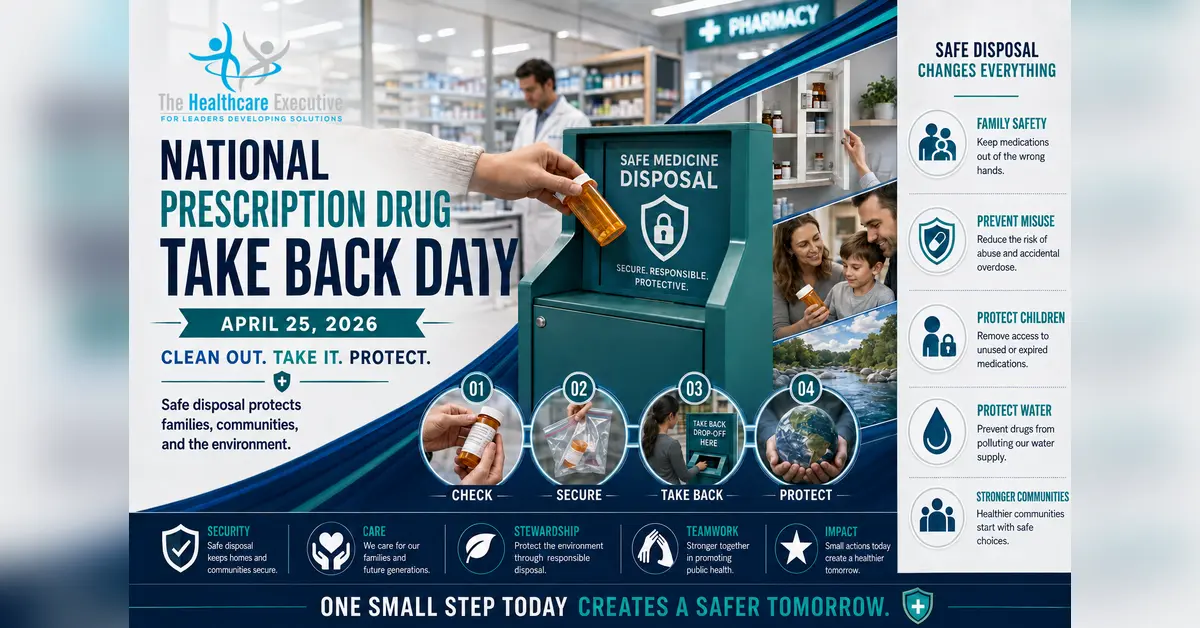


National Prescription Drug Take Back Day, April 25, 2026
An executive-guidance framework for access, qualified response, handoffs, escalation, and learning.
National Prescription Drug Take Back Day can serve as an executive operating checkpoint.
The production tracker lists National Prescription Drug Take Back Day for April 25, 2026 and points to the tracker-designated observance source. This brief uses only that tracker-recorded identity and timing. It does not add an annual theme, history, prevalence statement, outcome statistic, or clinical recommendation.
Awareness activity should not create an unsupported promise of service. Leaders can align public communication with actual entry points, qualified response capacity, emergency procedures, transition ownership, and a clear method for escalating unresolved needs.
Start by distinguishing what is known from what the organization still needs to learn. A campaign plan, communication volume, or meeting count does not establish that a route is usable. Leaders need direct listening, clear ownership, locally defined measures, and a method for keeping exceptions visible.
Build one visible operating route for National Prescription Drug Take Back Day.
Use this route as a discussion framework. Replace each stage with the organization’s approved process, qualified roles, current service capacity, and applicable requirements. Do not infer a clinical protocol from the observance title.
- 01
Make access clear
Use respectful, plain-language instructions that identify approved contact options and what a person can expect next.
- 02
Protect privacy
Review channels, spaces, documentation, and role access against organizational policy and applicable requirements.
- 03
Protect respectful continuity
Align clear access, privacy, qualified response, approved escalation, and transition ownership without making assumptions about any person.
- 04
Hold the transition
Confirm acceptance when responsibility moves, and use approved escalation when the next owner is unavailable.
- 05
Learn without stigma
Review delays, drop-offs, repeat contacts, and experience feedback to improve the system rather than judge the person.
Reliability rule: Every stage needs a named owner, an observable status, an approved escalation path, and a defined signal that shows whether responsibility moved or remained unresolved.
Use a small dashboard to expose friction and ownership.
Do not publish a number until the organization defines its numerator, denominator where relevant, owner, source system, exclusions, review cadence, and limits. The candidates below are management prompts, not benchmarks or reported results.
Access clarity
Can people understand where to begin and what will happen after contact?
Privacy reliability
Do channels, roles, and spaces support organizational privacy expectations?
Respectful continuity
Can people reach qualified support and remain connected through transitions without stigma or unowned work?
Experience and learning
Can people and staff identify barriers without stigma or futility?
Close the loop across teams, settings, and partners.
A handoff is reliable only when the sending party knows who is expected to receive the work, the receiving party acknowledges responsibility, and any unresolved exception remains visible. Local policy and qualified judgment control the actual process.
From message to accepted ownership
- Confirm the approved message and intended audience.
- Publish the actual entry point and receiving role.
- Acknowledge receipt using the locally approved method.
- Escalate when ownership or response remains unclear.
From accepted ownership to verified follow-through
- Record the next accountable owner and visible status.
- Use the approved private channel, name the qualified receiver, and preserve visibility under local escalation policy.
- Keep unresolved work visible across boundaries.
- Confirm closure or document the continuing exception.
Give leaders one view of route reliability and improvement.
The scorecard keeps review focused on decisions. Leaders should set definitions locally, examine variation without overclaiming cause, and pair quantitative signals with the experience of people who use and operate the route.
| Operating signal | Executive question | Candidate owner | Suggested review point |
|---|---|---|---|
| Access clarity | Can people understand where to begin and what will happen after contact? | Executive sponsor and operational lead | At campaign launch and close |
| Privacy reliability | Do channels, roles, and spaces support organizational privacy expectations? | Operational owner and participating teams | At a locally defined cadence |
| Respectful continuity | Can people reach qualified support and remain connected through transitions without stigma or unowned work? | Sending and receiving owners | At a locally defined cadence |
| Experience and learning | Can people and staff identify barriers without stigma or futility? | Improvement owner and executive sponsor | Until action is verified |
Turn the observance into one sustained operating change.
The time boxes below are a management framework, not a clinical timeline. Adjust them to risk, scope, governance, resources, stakeholder participation, and applicable review requirements.
See the current route
- Name an executive sponsor and an operational owner.
- Listen to people using the route and representative frontline teams.
- Map how National Prescription Drug Take Back Day communications connect to real entry points, owners, transitions, and escalation.
- Select one recurring barrier that the organization can responsibly address.
Build the reliable path
- Define the trigger, receiving owner, required information, acknowledgment, escalation, and closure signal.
- Validate the design with every sending and receiving team involved.
- Test one respectful access-to-qualified-support handoff and remove a verified privacy, clarity, or ownership barrier.
- Test the route in more than one representative setting or operating period where practical.
Make the change visible
- Launch the redesigned route with a small set of locally defined measures.
- Review unresolved work and recurring friction using a learning approach.
- Correct implementation barriers and record who owns each remaining dependency.
- Report what changed, what evidence was reviewed, and what still requires live oversight.
Make National Prescription Drug Take Back Day a starting point, not an endpoint.
Recognition matters. It becomes durable when leaders also listen, clarify the route, support the people operating it, close an identified gap, and report the result without claiming more than the evidence supports.
Turn National Prescription Drug Take Back Day into accountable action.
An executive-guidance framework for access, qualified response, handoffs, escalation, and learning.
Leadership focus
Use this observance to examine psychological safety, timely connection, privacy, and continuity. Select one verified barrier, assign an accountable owner, and carry the improvement beyond the campaign window.
Workforce lens
Ask whether staffing, role clarity, training, tools, workload, and escalation support the people operating the support, referral, privacy, escalation, and continuity pathway.
Patient and community lens
Make the approved first step clear. Test whether a person can move from information to an acknowledged next action without navigating conflicting instructions.
Equity and access lens
Review stigma, language, cultural safety, disability access, geography, cost, and digital barriers without assuming the same experience for every person.
Inspect the operating sequence
Listen with people seeking support, behavioral health teams, emergency pathways, primary care, and community partners. Find one stigma, unclear ownership, a failed connection, or a privacy concern, then test the locally approved route from entry through acknowledged follow-through.
- 01Make access clear
- 02Protect privacy
- 03Protect respectful continuity
- 04Hold the transition
- 05Learn without stigma
Leadership actions for this week
- Name an executive sponsor and frontline operating owner.
- Ask people using and operating the pathway where ownership becomes unclear.
- Test one representative route from first question to acknowledged next step.
- Select one barrier that can be corrected without overstating the evidence.
- Set a review date and define how completion will be verified.
Candidate measures
Define every numerator, denominator where relevant, owner, data source, exclusions, cadence, and limitation locally. These are management prompts, not external benchmarks.
- Locally defined contact, routing, response, and repeat-contact signals.
- Reported privacy barriers, process exceptions, training needs, and corrective-action status.
- Locally defined access barriers, repeat contacts, unaccepted transfers, escalation, and experience feedback.
Department readiness checklist
- The public and staff entry points match the actual approved process.
- A specific role accepts each request, referral, or escalation.
- Handoffs include acknowledgment and a visible unresolved state.
- Language, disability, digital, transportation, and trust barriers receive explicit review.
- Communications do not introduce unsupported themes, statistics, or clinical advice.
- A named leader will review what changed after the observance.
Intended audiences
- Executive and Operational Leaders
- Public Health and Community Partners
- Patient Experience and Access Leaders
Staff communication template
During National Prescription Drug Take Back Day, our organization will connect awareness with a practical review of the support, referral, privacy, escalation, and continuity pathway. Use approved information, identify the correct entry point, confirm ownership when work moves, protect privacy, and escalate unresolved barriers through local channels.
Community communication template
National Prescription Drug Take Back Day is an opportunity to share trustworthy information and make the next step easier to find. Use our approved channels for information and support. If a request changes hands, our goal is to keep ownership and follow-through visible.
Measurement worksheet
- Signal
- What observable condition will show whether the route works?
- Definition
- What is included, excluded, and counted?
- Owner
- Who reviews the signal and acts on exceptions?
- Cadence
- When will leaders review it?
- Equity check
- Which differences require protected, locally appropriate review?
- Closure
- What evidence will confirm the improvement was completed?
Authoritative resources
- Observance source recorded in the production tracker
- 2026 healthcare observances calendar recorded in the production tracker
Source ledger: The offline package includes a machine-readable ledger mapping the observance identity and exact start and end dates to the tracker row and URLs above. No theme, history, prevalence, incidence, outcome statistic, or topic-specific clinical recommendation was generated.
Media handoff: The hero URL in this offline HTML is provisional. Replace it with the actual WordPress attachment URL after media upload and verify it in the live preview.
Use note: Reviewed for offline production in August 2026. All operating models, measures, scorecard questions, and action steps are original executive guidance. This article supports leadership planning and education. It does not replace clinical judgment, emergency procedures, legal advice, professional standards, organizational policy, or applicable federal, state, and local requirements.