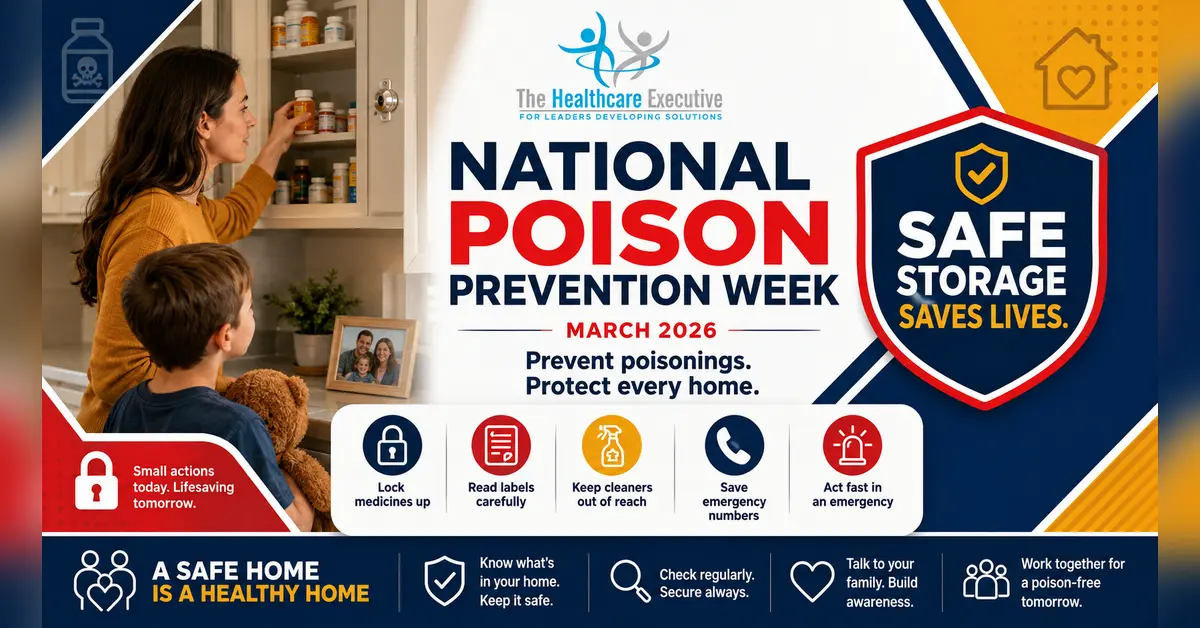


National Poison Prevention Week 2026
Make prevention, immediate expert advice, and emergency escalation easy to reach from every setting.
Poison readiness is a public access system, not only an emergency department responsibility.
National Poison Prevention Week should make two routes unmistakable: how to prevent common exposures and how to reach expert help immediately when an exposure may have occurred.
Health systems influence both routes through medication instructions, discharge education, community partnerships, employee training, website content, call-center scripts, and coordination with regional poison centers.
Test whether a patient, caregiver, employee, or community member can find the correct Poison Help or 911 response in under one minute from your most-used channels.
America's Poison Centers confirms the 2026 dates.
The national line connects callers to their local poison center.
Poison Help provides free, confidential expert guidance every day of the year.
Figures are summarized from the authoritative sources linked below. Definitions and denominators should be read with each source.
Connect prevention, recognition, expert guidance, escalation, and learning.
The route should work before symptoms appear and without requiring the caller to identify the exact toxin.
-
Prevent exposure
Use clear storage, labeling, dosing, disposal, and environmental instructions tailored to children, older adults, workers, and medication users.
-
Recognize concern
Encourage immediate action after a suspected exposure, medication error, bite, sting, or chemical contact even when symptoms are absent.
-
Reach expert help
Place 1-800-222-1222 and PoisonHelp.org where people actually look, including discharge materials and digital channels.
-
Escalate and learn
Activate emergency response for severe signs and use deidentified trends to improve local prevention.
Reliability rule: Do not route routine poisoning questions through a slow general message queue when immediate poison-center expertise is available.
Use a small set of signals to manage the route.
Review measures with stable definitions, named owners, and explicit action thresholds.
Instruction accuracy
Audit public and discharge instructions against current Poison Help guidance.
Contact visibility
Test whether users can find 1-800-222-1222 quickly on high-traffic channels.
Workforce readiness
Track whether selected teams know when to call Poison Help and when to call 911.
Prevention signal
Review recurring local exposure categories for targeted action.
Carry the exposure details and the specialist's guidance without distortion.
The receiver needs the person, substance if known, route, time, amount if known, symptoms, and actions already taken.
Caller to Poison Help
- Call promptly after a suspected exposure.
- Share the product or substance information if safely available.
- Follow the poison specialist's instructions exactly.
Poison Help to clinical care
- Transmit assessment and recommended monitoring or treatment.
- Document time-sensitive guidance and updates.
- Escalate new severe symptoms immediately.
Event to prevention
- Record the contributing system condition.
- Correct instructions, storage, workflow, or access defects.
- Share prevention learning without exposing private information.
Medication reconciliation and discharge education should include poison-prevention risks created by look-alike products, duplicate ingredients, dosing tools, and storage conditions.
Ask whether the system is reliable, reachable, and learning.
Use these questions in an existing operating review so the observance produces sustained accountability.
| Signal | Executive question | Accountable owner | Review cadence |
|---|---|---|---|
| Access | Can people find Poison Help immediately in every major channel? | Patient education and digital teams | Quarterly |
| Readiness | Do staff distinguish Poison Help consultation from 911 escalation? | Clinical education and emergency management | Quarterly |
| Prevention | Which recurring exposure pattern can the organization reduce? | Medication safety and community health | Monthly |
| Learning | Do exposure events change instructions or workflow when a system factor is found? | Quality and safety | Monthly |
Convert one campaign week into a durable operating improvement.
Keep the scope narrow enough to test and important enough to matter.
Map the work
- Audit Poison Help visibility across five high-use channels.
- Test staff response knowledge in two settings.
- Select one recurring exposure risk for improvement.
Align the system
- Correct instructions and escalation language.
- Partner with the regional poison center on education.
- Add exposure-learning review to an existing safety forum.
Improve and sustain
- Repeat usability and readiness tests.
- Measure the selected prevention intervention.
- Publish ownership and the next review date.
The best poison response starts with a number people can find and a system ready to listen.
Use the week to make expert help more visible and one preventable exposure less likely.
Make the observance visible in everyday operations.
National Poison Prevention Week becomes meaningful when families and staff know how to prevent exposures, recognize risk, contact expert help, and escalate emergencies without delay. The weak version is a message without an operating change. The stronger version defines what teams should see, who owns each transition, how exceptions escalate, and how leaders know that the pathway actually closed.
The principal failure mode is that prevention, storage, medication safety, exposure recognition, poison-center consultation, emergency care, and follow-up can operate as separate systems. Leaders should test the route with recent cases, frontline staff, patients or community partners, and the teams that receive the next handoff. That review should distinguish a written policy from reliable execution under real workload, staffing, access, and communication conditions.
Prevent exposure
Confirm the accountable owner, expected evidence, exception route, communication standard, and documented closure for this step.
Recognize concern
Confirm the accountable owner, expected evidence, exception route, communication standard, and documented closure for this step.
Reach expert help
Confirm the accountable owner, expected evidence, exception route, communication standard, and documented closure for this step.
Escalate and learn
Confirm the accountable owner, expected evidence, exception route, communication standard, and documented closure for this step.
Instruction accuracy
Confirm the accountable owner, expected evidence, exception route, communication standard, and documented closure for this step.
An equity review should review language, literacy, housing, medication complexity, childcare, disability, and access to immediate consultation. Aggregate performance can hide a pathway that works for people with the fewest barriers while failing those who need language support, accommodations, transportation, trusted outreach, flexible scheduling, or help navigating coverage. Stratified results and direct feedback should therefore guide the improvement plan.
Measurement should pair prevention reach, poison-center use, response interval, transfer quality, exposure patterns, and corrective action. Counts alone do not establish reliability. The executive review should examine time, completion, unresolved exceptions, patient or workforce experience, and variation across sites. A small set of stable measures is more useful than a large dashboard that no one owns.
Governance should connect pharmacy, pediatrics, emergency care, environmental services, education, and poison-center partners through one learning loop. The accountable owner should convene the relevant clinical, operational, access, quality, and community voices; remove barriers that frontline teams cannot solve; and return decisions to the people doing the work. The 90-day test is simple: show which failure point changed, what evidence confirms the change, and what still requires executive action.
Turn National Poison Prevention Week into accountable action.
Make prevention, immediate expert advice, and emergency escalation easy to reach from every setting.
Leadership focus
Use this observance to examine trustworthy information, prevention access, and community connection. Select one verified barrier, assign an accountable owner, and carry the improvement beyond the campaign window.
Workforce lens
Ask whether staffing, role clarity, training, tools, workload, and escalation support the people operating the information, access, coordination, and follow-through pathway.
Patient and community lens
Make the approved first step clear. Test whether a person can move from information to an acknowledged next action without navigating conflicting instructions.
Equity and access lens
Review language, disability, transportation, digital access, geography, trust, and other barriers using protected feedback and locally appropriate data.
Inspect the operating sequence
Listen with people using the pathway, frontline teams, operational leaders, and community partners. Find one a message, request, referral, or handoff that does not reach an accountable owner, then test the locally approved route from entry through acknowledged follow-through.
- 01Prevent exposure
- 02Recognize concern
- 03Reach expert help
- 04Escalate and learn
Leadership actions for this week
- Name an executive sponsor and frontline operating owner.
- Ask people using and operating the pathway where ownership becomes unclear.
- Test one representative route from first question to acknowledged next step.
- Select one barrier that can be corrected without overstating the evidence.
- Set a review date and define how completion will be verified.
Candidate measures
Define every numerator, denominator where relevant, owner, data source, exclusions, cadence, and limitation locally. These are management prompts, not external benchmarks.
- Current, approved instructions divided by materials reviewed
- Successful find rate in short usability tests
- Staff meeting the local response standard
Department readiness checklist
- The public and staff entry points match the actual approved process.
- A specific role accepts each request, referral, or escalation.
- Handoffs include acknowledgment and a visible unresolved state.
- Language, disability, digital, transportation, and trust barriers receive explicit review.
- Communications do not introduce unsupported themes, statistics, or clinical advice.
- A named leader will review what changed after the observance.
Intended audiences
- Executive and Operational Leaders
- Public Health and Community Partners
Staff communication template
During National Poison Prevention Week, our organization will connect awareness with a practical review of the information, access, coordination, and follow-through pathway. Use approved information, identify the correct entry point, confirm ownership when work moves, protect privacy, and escalate unresolved barriers through local channels.
Community communication template
National Poison Prevention Week is an opportunity to share trustworthy information and make the next step easier to find. Use our approved channels for information and support. If a request changes hands, our goal is to keep ownership and follow-through visible.
Measurement worksheet
- Signal
- What observable condition will show whether the route works?
- Definition
- What is included, excluded, and counted?
- Owner
- Who reviews the signal and acts on exceptions?
- Cadence
- When will leaders review it?
- Equity check
- Which differences require protected, locally appropriate review?
- Closure
- What evidence will confirm the improvement was completed?
Authoritative resources
- National Poison Prevention Week 2026, America's Poison Centers
- Poison First Aid, Poison Help
- Poison Help Hotline, America's Poison Centers
- Poison Control Program, Health Resources and Services Administration
- Medication Errors, U.S. Food and Drug Administration
Safety note: If someone has collapsed, had a seizure, has trouble breathing, or cannot be awakened, call 911 immediately. For a possible poisoning in the United States, call Poison Help at 1-800-222-1222 right away and do not wait for symptoms. Do not induce vomiting or use home remedies unless a poison specialist instructs you to do so.
Official identity and timing are taken from the named campaign source. Operational recommendations are original editorial guidance and must be reconciled with applicable law, policy, professional standards, and clinical judgment.