

Community Impact Ledger
National Health Center Week 2026: An Executive Operations Agenda
Turn a national observance into an operating commitment to access, workforce stability, quality, community trust, and measurable outcomes.
Executive signal: celebrate the mission by strengthening the model
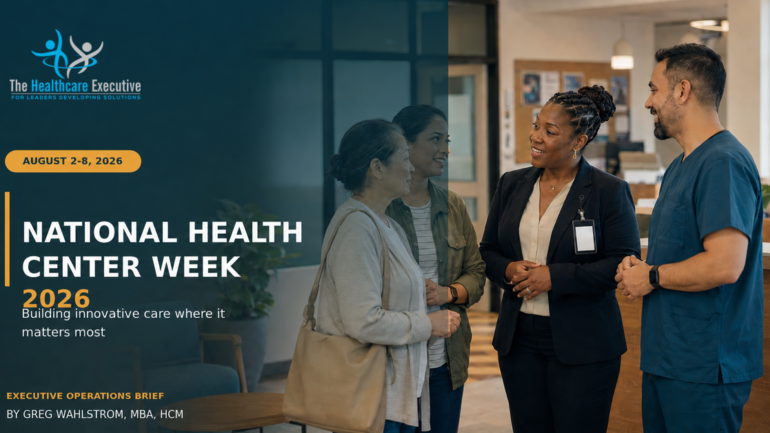
National Health Center Week 2026 runs August 2 through 8 under the theme “Building Innovative Care Where It Matters Most.” The observance recognizes community health center patients, staff, board members, partners, and supporters. For healthcare executives, its greater value is diagnostic. It creates a visible moment to test whether strategy, capacity, and community priorities are moving together.
The strongest celebration is not a one-week campaign. It is a board-supported operating agenda that makes access easier, protects the workforce, converts community voice into decisions, and closes performance gaps after the banners come down.
The latest HRSA Uniform Data System national summary reports that 1,356 Health Center Program awardees served 32,746,392 patients in 2025. The same data show the complexity inside that reach: 17.21% of patients were uninsured, 47.92% were covered by Medicaid or CHIP, and 89.97% of patients with known income were at or below 200% of the federal poverty guideline. Nearly 8.83 million patients were reported as having limited English proficiency.
Those numbers make one point clear: community health centers operate at the intersection of clinical care, social need, public accountability, and thin operational tolerance. Access failures can quickly become missed preventive care, avoidable emergency use, staff overload, or revenue disruption. Executives should treat National Health Center Week as a checkpoint for the whole care model, not as a communications assignment.
Five operating priorities for community-centered performance
1. Design access around real patient constraints
Map the complete access journey from appointment request through follow-up. Stratify third-next-available appointment, no-show rate, abandonment, and referral closure by site, service, language, payer, and ZIP code. Use the results to place evening hours, mobile services, interpretation, transportation support, and digital options where they remove verified friction. Growth without segmented access data can widen inequity while improving the average.
2. Protect the workforce as care infrastructure
Workforce planning should connect vacancy, time to fill, agency use, turnover, overtime, and team capacity to patient access and quality. Build panels and schedules around sustainable team-based care, not chronic individual heroics. Include medical assistants, community health workers, behavioral health staff, dental teams, interpreters, and enabling-services personnel in retention plans. Staff appreciation becomes credible when it is paired with manageable work, career pathways, psychological safety, and fast removal of workflow waste.
3. Make quality improvement visible to the board
HRSA’s Health Center Program Compliance Manual requires an ongoing quality improvement and quality assurance system, systematic review of patient records, attention to patient satisfaction and grievances, and at least quarterly assessments. Executives should translate that floor into a concise board dashboard with owners, targets, variation, and corrective actions. Every red measure should have a named operational response, not just an explanation.
4. Build one community partnership portfolio
Inventory partnerships with hospitals, public health agencies, schools, housing organizations, food programs, behavioral health providers, pharmacies, and local employers. For each relationship, define the patient problem, referral pathway, data-sharing boundary, accountable owner, and success measure. Retire ceremonial partnerships that do not produce access or outcomes. Expand those that improve closed-loop referrals, service reach, workforce pipelines, emergency preparedness, or continuity after hospital discharge.
5. Connect innovation to a measurable constraint
The 2026 theme calls attention to innovative care, but innovation should not mean technology for its own sake. Start with a constraint such as a long specialty queue, an interpretation gap, preventable no-shows, or an incomplete referral loop. Test the smallest safe intervention, track adoption and outcome measures, collect patient and staff feedback, and stop tools that add burden without value. HRSA’s performance improvement framework reinforces access, workforce, quality, and high-value care as connected aims.
Key takeaways for the executive team
Keep four decisions in view: where patients are losing access, which teams are carrying unsustainable load, which quality gaps have the greatest consequence, and which partnerships can close the gap faster than the health center acting alone. Set one accountable leader and one review cadence for each. The purpose is not more reporting. It is faster, clearer management action.
A small measurement set with executive value
Choose measures that expose variation and support action. HRSA’s 2025 national data offer useful context: blood pressure control reached 69.08%; colorectal cancer screening reached 44.89%; depression screening with a documented follow-up plan reached 75.32%; and the share of patients with diabetes in poor control was 26.28%, where lower is better. Local targets should reflect the organization’s population, baseline, contractual commitments, and quality plan.
| Domain | Board-level measure | Operational drill-down | Review cadence |
|---|---|---|---|
| Access | Third-next-available appointment | Site, service, language, payer, ZIP code | Weekly operations; monthly board trend |
| Workforce | Vacancy and 12-month turnover | Role, site, tenure, supervisor, schedule | Monthly |
| Quality | One preventive and one chronic-care gap | Race, ethnicity, language, payer, site | Monthly; formal quarterly QI review |
| Experience | Grievance closure and patient-reported access | Theme, language, channel, resolution time | Monthly |
| Partnerships | Closed-loop referral completion | Partner, service type, elapsed days | Monthly |
The 90-day executive agenda
Days 1-30: Listen and baseline
- Hold structured listening sessions with patients, frontline staff, board members, and community partners.
- Validate five baseline measures and disaggregate them for hidden variation.
- Identify one access bottleneck and one workforce friction point with executive sponsors.
Days 31-60: Redesign and test
- Launch a limited pilot tied to each selected constraint.
- Document the workflow, safety checks, training, data owner, and patient communication plan.
- Review early signals every two weeks and adjust quickly when burden shifts downstream.
Days 61-90: Decide and scale
- Compare outcomes, experience, cost, and staff burden with baseline.
- Scale, revise, or stop each pilot using predetermined decision rules.
- Report results to the board and community, including what did not work and what comes next.
Executive conclusion
National Health Center Week honors a model built around community need, patient voice, and comprehensive primary care. The executive obligation is to make that model easier to access and more durable. That means choosing a few consequential measures, seeing variation that averages hide, protecting the teams that make access possible, and giving partnerships enough structure to produce results.
The 2026 theme, “Building Innovative Care Where It Matters Most,” is best understood as an operating standard. Innovation matters when it reaches the patient who could not get an appointment, supports the employee who was carrying an unsafe workload, closes the referral that previously disappeared, or improves an outcome the board has committed to change. Use this week to celebrate. Use the next 90 days to prove the celebration changed the work.
Leadership resources
Continue on The Healthcare Executive
Authoritative sources
Editorial note: This executive brief is for leadership education and operational planning. It does not replace clinical guidance, legal advice, payer requirements, or the HRSA Health Center Program Compliance Manual.