
August 2-8, 2026 · Executive evidence brief
National Health Center Week 2026: Build Innovative Care Where It Matters Most
Turn community knowledge, team capacity, flexible access, and accountable partnerships into one reliable path from need to completed care.
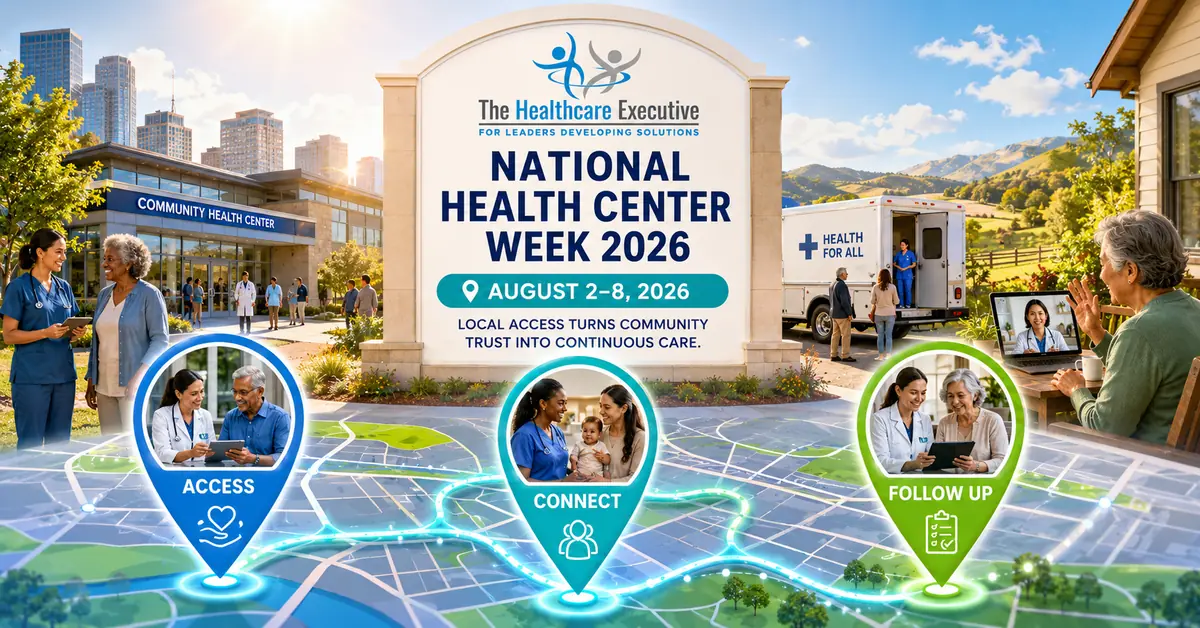
National Health Center Week, sponsored by the National Association of Community Health Centers, is observed August 2-8, 2026. The official theme, Building Innovative Care Where It Matters Most, recognizes solutions that meet people where they are and improve primary-care delivery, access, and outcomes. This brief translates that campaign into an executive operating agenda.
Leadership mandate
Define innovation by the problem it reliably solves
Innovation in a community health center is not valuable because it is new. It is valuable when it makes appropriate care easier to reach, safer to deliver, more continuous, and more responsive to the people a health center serves. A new portal that adds a password barrier is not access. A mobile unit without a route into longitudinal care is a temporary encounter. A screening campaign without diagnostic follow-up is an incomplete promise. A referral sent to a partner without acknowledgment is an open loop.
The official 2026 theme asks leaders to build innovative care where it matters most. The phrase should direct attention to place, time, trust, and ownership. Where do people already feel safe? When can they realistically receive care? Which language, modality, and relationship help them act? Who owns the next step when the need crosses a clinical, behavioral, pharmacy, specialty, public-health, transportation, food, housing, or benefits boundary? The answers cannot be designed entirely in an executive conference room.
Community knowledge is operational intelligence. Patient advisory groups, health-center boards, community health workers, front-desk teams, clinicians, interpreters, outreach staff, and partner organizations see different parts of the pathway. Their experience can reveal that a same-day slot exists but requires an impossible phone queue, that a specialist accepts a referral but not the patient's coverage, that transportation arrives after a clinic closes, or that a telehealth option is technically available but disrupts continuity with a trusted clinician. Leaders need a structured way to hear, validate, prioritize, and report back on those signals.
A 2026 qualitative study of 25 physicians and clinic leaders across Puerto Rico described layered resilience under financial, workforce, infrastructure, and disaster pressures. Clinics used multiple communication channels, home visits, municipal resources, telemedicine, multidisciplinary teams, and formal community partnerships. Transformative practices were concentrated in FQHCs, but individual clinician burden remained a major buffer against system failure.1 This is a cross-sectional qualitative study, so it does not prove that one strategy caused better outcomes. It does expose a leadership risk: resilience that depends on personal sacrifice is not a sustainable operating model.
The executive task is to convert improvisation into supported capability. That means establishing triggers, roles, capacity assumptions, information rules, response expectations, escalation routes, and measures. It also means deciding what work should be centralized and what must remain close to the patient. In a six-practice hypertension implementation study, centralized nurse-led coaching, documentation, and monitoring were delivered with high fidelity, while local identification, referral, and enrollment varied substantially.2 A center can therefore have a strong central program and still lose people before they enter it.
Innovation should begin with one bounded promise that can be observed from the patient's perspective. For example: every adult with an abnormal screening result in the pilot pathway will know the next step before leaving; an accountable person will track acceptance, scheduling, completion, and unresolved barriers; and failed contact or clinical risk will stay visible until it is safely resolved. The promise needs a denominator, an owner, a receiving partner, a recovery path, and an explicit boundary. It should never imply that all people must accept the same service or channel.
Board and executive oversight should ask whether access strategy protects continuity and trust. A national analysis averaging more than 353,000 patients across 186 community health centers each year found high continuity overall from 2019 through 2023, but perfect continuity was less likely for several patient groups, people with multimorbidity, those with a telehealth visit, and patients at larger clinics.11 The associations are not causal, and the continuity index is not a complete measure of relationship quality. The finding still warns against treating quick availability and relational continuity as interchangeable.
The strongest National Health Center Week commitment is concrete: choose a priority pathway with the community, make every ownership transfer visible, resource the workforce and partners who carry it, and review completion and experience by site and population. Innovation then becomes a disciplined method for correcting a documented barrier, not a collection of disconnected pilots.
Executive decision
Authorize one 90-day improvement cycle for a pathway with a known access or follow-through gap. Name the patient-centered outcome, accountable owners, partner capacity, escalation rule, and evidence needed to continue, adapt, or stop.
Evidence signal
Measure each handoff instead of averaging away the defect
The implementation-fidelity study of the ALTA hypertension intervention offers an unusually clear view of pathway variation. Across six practices in one FQHC, staff identified medication nonadherence among eligible patients, referred people to a centralized virtual nurse team, and supported home blood-pressure monitoring and coaching. The evaluation used EHR data, narrative reports, interviews, and established implementation frameworks over 12 months.2
Identification ranged from 49.0% to 57.9% by site. Referral ranged from 50.0% to 84.4%. Enrollment in coaching ranged from 20.8% to 88.5%. Once patients entered the centralized component, 91.4% received coaching and 94.5% received monitoring. These values use different process stages and denominators. They should not be added or treated as comparable clinical outcomes. Their value is diagnostic: the largest reliability opportunity sat at local interfaces before centralized delivery.
Averages can hide this pattern. If a dashboard reports only people who completed coaching, leaders may never see people who were not identified, referred, reached, or enrolled. If it reports a health-center-wide mean, it may conceal a site whose workflow, staffing, language access, training, or feedback loop performs differently. Reliable care requires both a pathway view and a site view.
Site-level entry components
Centralized delivery components
| Component | Reported fidelity | Operational question | Guardrail |
|---|---|---|---|
| Identify | 49.0% to 57.9% across sites | Can staff consistently recognize the eligible patient during real workflow? | Range reflects site variation in one intervention, not a universal benchmark. |
| Refer | 50.0% to 84.4% across sites | Is referral simple, expected, assigned, and supported by feedback? | A referral action does not establish receipt, enrollment, or benefit. |
| Enroll in coaching | 20.8% to 88.5% across sites | Are contact, explanation, language, trust, timing, and patient choice working? | Enrollment uses a later denominator and should not be compared directly with identification. |
| Centralized coaching | 91.4% of enrolled patients | Does the centralized team have capacity to deliver the accepted service? | High delivery fidelity among enrollees does not reveal who never entered the pathway. |
| Centralized monitoring | 94.5% | Are readings, goals, documentation, and follow-up maintained? | Process fidelity is not the same as comparative blood-pressure improvement. |
The study also reported six fidelity-consistent adaptations, including a simpler adherence screener and asynchronous training. Interviews emphasized team support, continuing practice facilitation, and feedback about patient progress. These details matter because variation is rarely solved by telling a busy team to try harder. Leaders should examine task burden, role clarity, tools, training, coverage, local confidence, patient contact routes, and whether staff can see that a referral produced a useful result.
Other studies reinforce the difference between reach and completion. A pragmatic cluster randomized trial mailed colorectal-screening tests to 5,127 patients in community health centers. Screening participation at 90 days was 27.9% with FIT-DNA and 22.6% with FIT, but only 36 of 100 people with an abnormal stool test completed colonoscopy within 180 days, even when navigation was available.6 A separate equity analysis of 3,734 FQHC patients found that a mailed FIT and navigation intervention increased screening without statistically significant differences in effect by race or ethnicity.7 Similar relative effects do not eliminate the need to examine absolute completion and downstream access.
The leadership lesson is simple and demanding. Define every stage, preserve its denominator, show variation, and assign action. Outreach sent, patient reached, service accepted, appointment scheduled, care completed, result communicated, and next step owned are different events. An organization cannot manage a pathway it records as one status.
Community-care pathway
Bring care closer without breaking the route back to continuity
Community health centers can offer care through fixed sites, school and community locations, home visiting, mobile units, virtual visits, telephone outreach, mailed services, and partner facilities. Each channel can reduce a barrier, but adding channels also creates interfaces. A person may begin on a mobile unit, receive laboratory work at a fixed site, speak with a pharmacist by phone, use telehealth for follow-up, and need a specialist outside the health-center network. Innovation succeeds only when the pathway remains understandable and owned across those moves.
A descriptive study of a large multisite FQHC's mobile health-unit pilot emphasized low-barrier primary care and enabling services for people facing transportation, insurance, and trust barriers. The authors described the importance of operational and technical infrastructure, logistics, community connection, and a deliberate route that strengthens engagement with longitudinal care.14 Because the study was observational and early, it cannot prove that the model improved long-term outcomes. It does clarify that a vehicle is only one part of the operating system.
A multisite Massachusetts evaluation provides a scale signal. Six mobile addiction programs recorded 17,887 harm-reduction encounters and 16,117 clinical encounters among 4,645 people from January 2022 through June 2024. Among 1,227 people who initiated buprenorphine, 15% remained in treatment at 180 days.5 The evaluation had no comparison group and faced cross-organization measurement challenges. Leaders should therefore hold two truths together: mobile services can reach people who encounter traditional barriers, and reach must be paired with a retention and continuity design.
- Listen locallyDefine the barrier with patients, communities, staff, and partners before choosing a channel.
- Offer the right doorMatch place, time, language, accessibility, modality, and urgency to the person's needs and choices.
- Name ownershipAssign the current task and the next handoff to accountable people, not generic departments.
- Deliver and documentProvide the service, record the outcome, and protect only the information needed for continuity.
- Confirm the next stepVerify receipt, scheduling, completion, result communication, and the patient's understanding.
- Recover and learnEscalate clinical risk, resolve failed contact, correct recurring defects, and report back to the community.

Virtual care needs the same discipline. A mixed-methods pilot tested six monthly virtual group diabetes-education sessions in an FQHC and a private nonprofit system. Of 97 eligible adults, 50 were reached, 11 enrolled, and 10 attended at least one session. Participants valued convenience, peer support, accountability, and education. Competing responsibilities and a belief that more education was unnecessary were more prominent enrollment barriers than technology in this small sample.4 The pilot was not large enough to establish effectiveness. It reminds leaders that digital strategy must address perceived value, schedule, trust, referral explanation, and workload, not only broadband and devices.
Patient journey mapping can expose disruptions that administrative process maps miss. At one Philadelphia FQHC, interviews with 16 patients who had sustained PrEP use and seven clinical staff described cyclical engagement, temporary disengagement, and re-linkage. Important supports included affirming communication, co-located phlebotomy, transportation assistance, help with insurance and pharmacy barriers, and coordinators who conducted outreach and linked multiple organizations.3 The small, condition-specific sample cannot estimate population effects. Its operational contribution is the recognition that a pathway must support recovery, not label every interruption as failure.
Every access channel should therefore answer five questions. What problem is this channel intended to solve? Which people may still be excluded? How will identity, consent, and clinical urgency be managed? How does the encounter connect to a usual team and future care? What signal will reveal that the connection failed? If those answers are unclear, expansion may increase activity while leaving continuity fragile.
Workforce and integration
Build team capability around the work patients actually need
Integrated care becomes real through schedules, scopes, relationships, documentation, supervision, consultation, and protected time. Primary care, behavioral health, oral health, pharmacy, nursing, community health work, care management, interpretation, eligibility, and social support may appear together on an organization chart while functioning as separate queues. Leaders should evaluate whether the patient experiences one coordinated team or a sequence of handoffs that require repeated explanations.
A mixed-methods evaluation of a Massachusetts team-training program involved 47 interdisciplinary community-health-center teams and 327 participants over six years. Participants reported improvements in leadership engagement, team-based care, evidence use, patient-centered interaction, access, and coordination. Increased perceived leadership engagement predicted greater improvement in clinic functioning.8 The pre-post design had no comparison group and relied partly on perceptions, so it does not prove improved patient outcomes. It supports a practical point: team transformation needs leadership participation and improvement skill, not one-time education.
A statewide Rhode Island effort to integrate pediatric behavioral health illustrates how financing affects sustainability. Early models placed financial responsibility for embedded behavioral-health clinicians on practices. Smaller practices struggled to sustain them despite clinical value, so the collaborative shifted to a model that reduced practice financial risk, expanded specialty skill-building, and added community health workers.9 This is a quality-improvement program report, not a controlled study. It shows why leaders must design payment, staffing, and shared infrastructure alongside clinical workflow.
Access design
- Hours and modality do not match daily life
- Language, disability, transport, cost, or trust barrier
- Outreach message does not explain value or choice
Workforce
- Task has no protected time or backup
- Scope and escalation are unclear
- Training is not reinforced with coaching and feedback
Data and technology
- Status changes are invisible across systems
- Duplicate entry displaces patient-facing work
- No shared definition of accepted, completed, or closed
Partner capacity
- Referral volume exceeds receiving capacity
- No acknowledgment, service standard, or escalation route
- Payment and accountability end at the organizational boundary

Workforce readiness should be tested in the pathway, not inferred from an attendance roster. A mixed-methods readiness assessment for genomic medicine at one Alabama FQHC involved 13 staff members and identified staffing, finance, and language as major barriers. Mission alignment, learning culture, and supportive leadership were facilitators. Patient and family involvement, tailored education, staff education, and a named leader were judged high-feasibility, high-impact strategies.13 The study was small and service-specific, but its method is broadly useful: before launching, ask whether the organization has the people, time, skills, language support, financing, and leadership ownership to carry the work.
Leaders should model demand and capacity at each step. Estimate how many patients will be identified, offered a service, accept it, need outreach, require interpretation, need escalation, and return for follow-up. Include non-visit work such as record review, insurance problem-solving, warm handoffs, documentation, partner calls, and missed-contact recovery. A program that funds the visit but not the coordination may shift hidden work to the most committed staff.
Practice facilitation and technical assistance should be tied to observed defects. The hypertension-fidelity study used continued support and feedback rather than assuming that an initial launch would standardize performance.2 A modified Delphi process involving eight experts and nine health-center care-management staff reached consensus on strategies for social-needs screening, referral, and tracking, including champions, QI capacity, technology training, tailored assistance, and a generally monthly support cadence.10 Delphi consensus is not proof of effectiveness. It offers a credible starting package that should be tested and adapted locally.
Capability also includes psychological safety. Staff need permission to say that a new workflow is unsafe, redundant, inaccessible, or under-resourced. Community health workers and peer staff need formal authority, compensation, supervision, and advancement, not symbolic inclusion. Interpreters and access staff should be involved before a communication process is finalized. Patient-facing teams should see whether the care they initiated was completed. Feedback is both a learning mechanism and a source of meaning in demanding work.
Accountable partnerships
Make organizational boundaries visible and manageable
Community health centers rarely control every resource required for a complete patient journey. Hospitals, specialists, diagnostic services, pharmacies, public-health departments, behavioral-health providers, schools, transportation organizations, housing and food partners, and local government may all hold a necessary step. Partnership language is easy. Operational accountability across separate organizations is harder.
A referral relationship needs a jointly defined pathway. The sending team should know eligibility, required information, capacity, language and accessibility options, expected response, and urgent alternatives. The receiving team should know who can clarify the referral, how to return status, what counts as completion, and what to do when the service is inappropriate or unavailable. Both parties need a privacy-appropriate method for unresolved work and an executive route for recurring barriers.
Patient navigation research makes these dependencies concrete. An implementation analysis from the PRECISE follow-up-colonoscopy study at a Washington FQHC used training reflections, navigator debriefs, adaptation tracking, technical assistance, and quality assurance. Navigators emphasized focused outreach, adequate staffing, continuing implementation support, partnerships with gastroenterology practices, and unified data tracking.12 The analysis came from one FQHC and focused on implementation rather than comparative effectiveness. Its core lesson travels: navigation cannot compensate indefinitely for insufficient specialty capacity or fragmented data.
A specialist-supported primary-care model at one Rhode Island community health center used a care-cascade framework for gestational diabetes. In a retrospective three-year chart review, 96.8% received recommended screening and 79.5% were linked to care.15 The single-site study cannot establish that the model caused these results. The difference between screening and linkage demonstrates why leaders should measure the full cascade and jointly manage the interface between primary and specialty care.

| Control | Sending owner | Receiving owner | Visible completion signal | Recovery rule |
|---|---|---|---|---|
| Eligibility and patient choice | Clinician or care-team designee confirms need, options, consent, language, and accessibility | Partner publishes current criteria and alternatives | Accepted, declined, deferred, or redirected status with reason | Unclear eligibility routes to designated clinical or access reviewer |
| Necessary information | Sender transmits the minimum accurate clinical and contact data | Receiver validates readable, actionable receipt | Timestamped acknowledgment tied to the correct person and request | Missing or mismatched data returns through a monitored exception queue |
| Capacity and response | Sender uses current service standards and urgent alternatives | Receiver reports capacity and expected response | Contact attempt, scheduled service, wait-list, or unavailable disposition | Capacity breach triggers escalation and an alternate patient plan |
| Service completion | Care coordinator monitors unresolved status | Partner returns completed, not completed, or changed-plan status | Result and recommended next step reach the authorized care team | Failed contact, missed service, or clinical concern remains active for review |
| Learning and equity | Health center stratifies pathway stages and investigates variation | Partner reviews shared defects and patient experience | Decision, owner, due date, retest, and report-back are recorded | Repeated defects move to joint executive governance and capacity planning |
Contracts and memoranda should follow the pathway rather than substitute for it. A document may specify responsibilities, but staff need a usable contact, shared definitions, protected time, and a routine forum to resolve exceptions. When technology cannot exchange a structured status, the organizations still need a safe interim process and a plan to reduce manual burden. When the receiving service lacks capacity, transparency is safer than a referral queue that creates false reassurance.
Partnership governance should include people who use the pathway. Their role is not to approve an already chosen design. They should help define what timely, respectful, and understandable service looks like, which tradeoffs are acceptable, and how organizations will communicate when resources are limited. Compensate community expertise, protect confidentiality, provide language and accessibility support, and report what changed because of the input.
Measurement and governance
Balance reach, continuity, completion, experience, workforce, and equity
National Health Center Week can produce useful visibility, but operating improvement requires measures that continue after the campaign. The scorecard should answer whether people could reach care, whether they maintained a trusted relationship, whether each next step was completed, whether the experience was respectful, whether the workforce and partners had sufficient capacity, and whether results varied in ways that demand action.
Start with definitions. Same-day availability, third-next-available appointment, successful call connection, completed visit, closed referral, and continuity are different measures. Define the denominator and clock for each. Explain exclusions. Show missing data. Pair the aggregate with site-level variation. Do not label a patient who declines or changes plans as a process failure. The failure is an unclear offer, unsafe disposition, lost handoff, preventable barrier, or unresolved clinical need.
Equity review should examine every stage, not only the final outcome. The screening equity analysis found similar intervention effects across racial and ethnic groups, but that does not prove equal access to every downstream step.7 The national continuity study found associations between perfect continuity and patient, visit, and clinic characteristics that can guide investigation.11 Identity data should be self-reported, governed with communities, protected from re-identification, and interpreted without deficit narratives.
| Domain | Candidate measure | Guardrail | Accountable owner |
|---|---|---|---|
| Reach | Eligible people offered the intended service by site, channel, language, time, and population | Available and offered are not the same; preserve the eligible denominator | Access executive and site leaders |
| Continuity | Usual-clinician or team continuity, care-plan visibility, and return connection after mobile or virtual care | Balance rapid access with relationship continuity; a single index cannot measure trust | Chief medical officer and primary-care operations |
| Follow-through | Identified, referred, accepted, contacted, scheduled, completed, resulted, and closed stages | Never collapse sent referral into completed care | Care-management leader and partner co-owner |
| Experience | Need heard, language respected, choice understood, help timely, instructions clear, and concern resolved | Provide confidential feedback routes and report how input changed the pathway | Patient-experience and community-governance leaders |
| Workforce | Demand, capacity, workload, vacancy, supervision, competency, psychological safety, and retention | Training attendance is not capability; include hidden coordination work | Chief people officer and operational leaders |
| Partner reliability | Acknowledgment, response time, completion status, capacity exceptions, and escalation closure | Do not hold one organization accountable for a step it cannot see or control | Contract executive and joint pathway owners |
| Equity and learning | Stable variation by site and population, recurring barriers corrected, retested, and reported back | Protect small groups, disclose missingness, and investigate systems rather than blaming communities | Quality, analytics, equity, privacy, and community leaders |
Measures should lead to decisions. A governance meeting that repeatedly reviews the same red indicator without changing staffing, workflow, technology, partner expectations, or capacity is not oversight. Every material variation should end in one of four dispositions: explained and accepted with a documented rationale, assigned for investigation, assigned for correction and retest, or escalated because the organization lacks authority or resources.
Patient stories can help leaders understand the pathway, but they require consent and privacy protection and should not be used as decoration. Combine narrative learning with structured data. Ask how a smooth journey worked, not only how a failure occurred. Positive-deviance review can identify local practices worth testing elsewhere while avoiding the assumption that one site's approach will transfer unchanged.
Board reporting should be compact enough to support action. Show the selected pathway, baseline, target, current stage distribution, site variation, experience signal, workforce capacity, partner exception, equity concern, open risk, and next decision. Include the known limitations. A transparent scorecard is more credible than an optimistic activity count.
90-day action plan
Test one pathway from community priority to closed-loop care
The following timeline is a management framework, not a clinical schedule or a promise of outcome improvement. Adjust it for local urgency, governance, procurement, privacy, labor, partner readiness, and community expectations. The objective is to learn whether a specific operating change makes a defined pathway more reliable and equitable.
Days 1-30: listen, choose, and trace
Name an executive sponsor, operational owner, clinical safety lead, community partner, data lead, and receiving-service co-owner. Compensate patient and community advisors. Select a pathway with a meaningful barrier and a feasible improvement boundary. Define what the person should experience, what completion means, which choices remain theirs, and what the project will not attempt to solve.
Trace recent journeys using privacy-protected records and voluntary interviews. Include a smooth path, an unsuccessful contact, a mobile or virtual encounter, a language or accessibility need, a partner-capacity problem, a clinical escalation, and a person who changed or declined the plan. Map every queue, inbox, phone number, form, portal, spreadsheet, role, wait, duplicate entry, work-around, and uncertainty. Establish a baseline for each pathway stage and model expected demand.
Review readiness before choosing technology. The genomic-readiness study found that mission and leadership could be strong while staffing, financing, language, stress, and available resources remained constraints.13 Decide whether the organization can safely carry the new work. If not, narrow the scope, add capacity, change the design, or stop. Responsible innovation includes declining to launch an under-resourced pathway.
Days 31-60: co-design, simulate, and prepare
Build the minimum reliable workflow. Define the trigger, patient explanation, consent, responsible role, necessary information, receiving owner, response expectation, next status, clinical escalation, failed-contact recovery, and closure signal. Configure the simplest technology that makes the work visible without creating unnecessary duplicate documentation. Agree on partner capacity and an alternate route when capacity is exceeded.
Simulate realistic cases. Test a person with limited English proficiency, a disability accommodation, no stable telephone, a missed appointment, an abnormal result, uncertain eligibility, a full specialist schedule, a virtual visit needing in-person follow-up, and a mobile encounter requiring longitudinal care. Observe staff performing the workflow. Correct role confusion and unsafe delays before launch.
Prepare the team through role-specific practice, not generic presentation slides. Give staff a concise standard-work guide, escalation contacts, and a method for reporting defects. Protect time for outreach and coordination. Establish practice facilitation, technical help, and rapid feedback. The social-needs Delphi study supports champions, QI capability, technology training, tailored assistance, and ongoing cadence as a reasonable implementation package to test.10
Days 61-90: launch, learn, and make a decision
Launch in a bounded site, service, or population with enough variation to expose real conditions. Review unresolved clinical risks immediately and operational exceptions frequently. Monitor each stage, experience, workforce demand, partner capacity, site variation, and protected equity dimensions. Ask staff and patients what the data miss. Correct small defects quickly and document adaptations.
At day 90, compare the intended pathway with what happened. Did more people reach the appropriate service? Did continuity remain visible? Were accepted referrals completed? Did staff workload stay safe? Did partners meet the agreed response? Did the experience remain understandable and respectful? Which populations or sites experienced different results? State the limitations and any unintended effects.
Make an explicit decision to adapt, expand, pause, or stop. Expansion should include funding, staffing, supervision, partner capacity, technology support, governance, and a schedule for continued review. Do not scale outreach faster than the receiving pathway can respond. Report the decision and the reasons to staff, partners, patients, and community advisors. National Health Center Week should leave behind a stronger operating relationship, not only a campaign artifact.
Board-level question
Can leaders show which community-defined barrier they chose, how every handoff is owned, whether access led to completed and continuous care, where results vary, what capacity was funded, and what the organization changed because patients, staff, and partners taught it something?
Leadership close
Build where trust, ownership, and follow-through meet
Community health centers are positioned to innovate because they are close to the people, places, and conditions that shape care. That position does not make implementation easy. Workforce shortages, financial constraints, fragmented technology, specialty capacity, social needs, disasters, and uneven payment can turn dedicated staff into the final buffer against system failure. The answer is not to celebrate endurance while leaving the operating conditions unchanged.
Leaders can honor National Health Center Week by making one improvement promise visible from the patient's point of view. Listen before choosing the intervention. Protect continuity while adding access channels. Measure the whole cascade. Resource the team and the receiving partner. Treat failed contact as a recoverable system condition. Examine variation without blaming communities. Keep clinical claims within the evidence. Report what changed, what did not, and what decision comes next.
The 2026 theme, Building Innovative Care Where It Matters Most, becomes meaningful when innovation is attached to reliable work. The goal is not more novelty. The goal is a community-informed path in which the appropriate person can reach care, understand the next step, remain connected to a trusted team, and rely on organizations to carry their part of the journey.
Scholarly references
Peer-reviewed evidence
References are ordered newest first. Each source was individually reviewed for peer-review status, methods, setting, applicability, and limitations.
- Alvarado G, Pérez-Dávila S, Mendoza-Graf A, et al. Organizational resilience in Puerto Rico's primary care clinics: absorbing, adapting, and transforming under stress. Frontiers in Health Services. 2026;6:1886937. doi:10.3389/frhs.2026.1886937
- Schoenthaler A, De La Calle F, D'aguilar N, et al. Bridging evidence and practice: multi-method evaluation of implementation fidelity of a multilevel hypertension intervention in a federally qualified health center. Frontiers in Health Services. 2026;6:1856884. doi:10.3389/frhs.2026.1856884
- Meanley S, Arnold EA, Listerud L, et al. Patient pathways to PrEP persistence: a qualitative resilience-focused journey mapping study with cisgender Black and Latino men who have sex with men and clinical PrEP staff at a federally qualified health center. Frontiers in Health Services. 2026;6:1794839. doi:10.3389/frhs.2026.1794839
- Panzardi M, Gomez A, Borsuk C, et al. Implementing virtual diabetes self-management education in two health systems (VIDA): a mixed-methods pilot study. Frontiers in Clinical Diabetes and Healthcare. 2026;7:1784495. doi:10.3389/fcdhc.2026.1784495
- Tschampl CA, Wicks JJ, Hodgkin D, et al. Multisite Mobile Addiction Services: Four-Year Outcomes. International Journal of Environmental Research and Public Health. 2026;23(6):756. doi:10.3390/ijerph23060756
- May FP, Brodney S, Tuan JJ, et al. Mailed Outreach for Colorectal Cancer Screening in Community Health Centers: The CARES Pragmatic Cluster Randomized Clinical Trial. JAMA Internal Medicine. 2026;186(6):703-712. doi:10.1001/jamainternmed.2026.1170
- Ganguly AP, O'Leary MC, Stradtman LR, et al. Equity Evaluation of an Intervention to Increase Colorectal Cancer Screening at Federally Qualified Health Centers. Annals of Family Medicine. 2026;24(3):231-234. doi:10.1370/afm.250634
- Sohn YJ, Schmitt HL, Pollack AA, et al. Building Community Health Center Teams: Evaluating the Impact of Team Training. Journal of General Internal Medicine. 2026;41(6):1523-1533. doi:10.1007/s11606-025-09523-5
- Cantor E, Burdette N, Cabral LM, Flanagan PJ, Lange EB. Pediatric Integrated Behavioral Health: A Primary Care Transformation Effort in Rhode Island. Rhode Island Medical Journal. 2026;109(5):17-21. PMID: 42048470.
- Cook N, Pisciotta M, Larson Z, et al. Using a Modified Delphi Process to Develop an Intervention to Support Care Coordination of Patient Social Needs in Primary Care. Journal of Advanced Nursing. 2026;82(4):3779-3787. doi:10.1111/jan.70109
- Goueth R, Der-Martirosian C, Cook N, et al. Continuity of Primary Care in Community Health Centers. Annals of Family Medicine. 2026;24(2):124-130. doi:10.1370/afm.250413
- Thompson JH, Schneider JL, Rivelli JS, et al. Implementing a successful patient navigation program for follow-up colonoscopy: Lessons from the PRECISE study. PLOS ONE. 2026;21(3):e0343659. doi:10.1371/journal.pone.0343659
- Heffernan EW, Das P, Hearld L, et al. Implementing Genomic Medicine in a Federally Qualified Health Center: Assessing Readiness through a Mixed-Methods Approach. Public Health Genomics. 2026;29(1):109-121. doi:10.1159/000551310
- Bifulco L, Rogers A, Hackerson C, Haddad MS, Damian AJ, Harding K. The Strategic Advantage of FQHCs in Implementing Mobile Health Units: Lessons Learned from a Pilot Initiative. International Journal of Environmental Research and Public Health. 2026;23(2):158. doi:10.3390/ijerph23020158
- Pearce CF, Ballester R, Siegert N, Pellowski J, Szkwarko D. Evaluation of Care Cascade Outcomes for Patients with Gestational Diabetes Mellitus in a Specialist-Supported Primary Care Model at a Community Health Center in Rhode Island. Rhode Island Medical Journal. 2025;108(11):37-43. PMID: 41150625.