
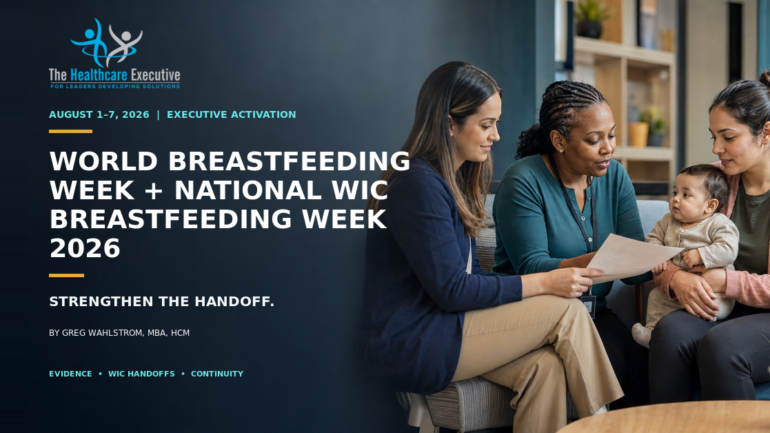

Seven-Day Executive Activation | August 1-7, 2026
World Breastfeeding Week and National WIC Breastfeeding Week 2026: Strengthen the Handoff
The 2026 global theme, “Breastfeeding for a sustainable start in life: strengthen what works,” gives healthcare leaders a precise assignment: identify proven support, connect it to WIC and community capacity, and make every transition visible enough to improve.
Two observances, one continuity test
World Breastfeeding Week
WABA’s 2026 campaign calls on the global “Warm Chain of Support” to track progress, learn from successful implementation, and improve what is not working. WHO translates that charge into proven levers: skilled counseling, Baby-Friendly practices, protection from inappropriate marketing, maternity protection, workplace support, and community action.
For an executive team, “strengthen what works” means funding reliable delivery, not merely restating evidence. Leaders should know which practices reach families, which populations experience gaps, and which results can be sustained across sites and shifts.
National WIC Breastfeeding Week
The USDA proclamation designates August 1-7, 2026, as National WIC Breastfeeding Week. WIC brings nutrition services, education, breastfeeding support, and, in many communities, trained peer counselors closer to families’ daily lives.
Hospitals should not treat WIC as a line on a resource sheet. A high-reliability partnership establishes consent-based referral, a named receiving contact, language access, escalation rules, and confirmation that the family connected. That is how a global evidence agenda becomes a local service.
The August 1-7 evidence-to-access activation
Use the observance as a controlled operational sprint. The sequence below can begin during the week and remain active until each commitment is completed.
- Establish the baseline. Review the hospital’s current CDC mPINC report, WIC referral volume, patient experience, lactation consult response, and post-discharge contacts. Stratify measures when privacy and data quality allow. Pair rates with family narratives.
- Observe the pathway. Follow one journey from prenatal counseling through birth, discharge, pediatric follow-up, and community support. Include nights and weekends. Ask where information is repeated, delayed, inaccessible, or lost.
- Test the WIC connection. With the family’s permission, place a real referral through the current workflow. Confirm what the local WIC agency receives, who responds, expected timing, and how urgent clinical concerns return to the health system.
- Activate peer and language support. Map WIC peer counseling and qualified language services by location and hours. Pay community advisers for expertise. Ensure materials support informed feeding decisions without shame, assumptions, or cultural stereotyping.
- Rehearse a difficult transition. Simulate a Friday discharge involving feeding concerns, transportation limits, an unavailable primary contact, or return-to-work pressure. Assign an owner and test the backup route before a family needs it.
- Close one defect. Choose a fix that can be completed quickly, such as embedding the WIC referral in discharge workflow, translating instructions, clarifying escalation, or adding a confirmation field. Train only the teams affected and observe whether the change works.
- Publish the next commitment. Name the executive sponsor, community partner, measure, resource, and completion date for the next 30 days. Share progress internally and with partners. The week ends, but the operating commitment should not.
The breastfeeding support handoff ledger
This ledger is a practical rounding tool. It respects each family’s informed choice and applies the same safety standard whether the plan includes direct breastfeeding, expressed human milk, donor milk when clinically available, formula, or a combination.
| Control point | Minimum reliable action | Evidence of completion | Executive owner |
|---|---|---|---|
| Prenatal | Offer unbiased, language-concordant counseling and screen for WIC interest or current participation. | Preference documented; consented referral initiated before delivery when possible. | Ambulatory and obstetric operations |
| Birth stay | Provide timely skilled help, respect the feeding plan, and use safe supplementation protocols when indicated or chosen. | Competency-based care documented across shifts; concerns escalated. | Nursing and medical leadership |
| Discharge | Confirm the next clinical appointment and transmit a consented warm referral to WIC or another selected partner. | Receiving contact, date, and backup route visible in the record. | Care management |
| Early follow-up | Check feeding, hydration, weight, pain, mental well-being, and access barriers within the clinically appropriate window. | Contact completed or outreach attempts tracked; urgent needs routed safely. | Pediatrics and postpartum care |
| Community continuity | Connect to WIC nutrition services, peer support where offered, lactation care, and practical resources. | Family reports that the connection was useful, respectful, and accessible. | Population health and partner agency |
Define a local service standard before promoting the referral
WIC capacity, hours, peer-counseling availability, and referral methods vary by state and local agency. Health systems should co-design the workflow with their actual WIC partner rather than promise services or response times that have not been confirmed. Document the minimum information required, the secure transmission method, who monitors failures, and how clinical concerns move back to an appropriate licensed professional.
Measure connection quality, not just referral volume. A small weekly review can show whether the family consented, the referral arrived, outreach occurred, the family reached a useful service, and barriers were resolved. Keep the data set limited, protect privacy, and share aggregate learning with community partners. USDA’s WIC nutrition-services standards emphasize data collection so agencies can assess trends and adjust breastfeeding promotion and support. A hospital partner should bring the same improvement discipline.
- Referral acceptance rate
- Time to first outreach
- Successful connection rate
- Family-reported usefulness
- Escalations resolved safely
- Results reviewed by population
Guardrails for communication, partnership, and measurement
Protect trust
- Present breastfeeding support as an offered service, not a compliance test. Document goals and respect informed decisions.
- Review sponsorships, samples, digital content, and vendor relationships against the International Code of Marketing of Breast-milk Substitutes and applicable policy.
- Do not use community stories or WABA campaign assets without appropriate consent, attribution, and rights review.
- Make qualified interpretation, disability access, and low-bandwidth options part of the service design.
The August 8 test
The best observance result is a stronger connection the day after the campaign ends. By August 8, leaders should be able to name one proven practice being scaled, one handoff defect being repaired, one WIC or community partnership being strengthened, and one outcome being reviewed with families.
That standard turns World Breastfeeding Week’s global evidence into local reliability and National WIC Breastfeeding Week’s recognition into real access. It also advances the wider work of maternal health leadership and disciplined healthcare change management.
Authoritative sources
- WABA: World Breastfeeding Week 2026 campaign and objectives
- WHO: World Breastfeeding Week 2026 evidence and theme
- WHO and UNICEF: 2026 joint statement
- USDA: 2026 National WIC Breastfeeding Week proclamation
- USDA WIC Works: National WIC Breastfeeding Week resources
- USDA WIC Breastfeeding Support: services and peer counselors
- CDC: 2024 mPINC national maternity-practices report
- CDC: continuity-of-care strategies for breastfeeding
Planning note: This executive brief supports organizational planning and does not replace individualized clinical assessment or medical advice. Apply current clinical guidance, respect family preferences, and use qualified professionals for feeding concerns.