

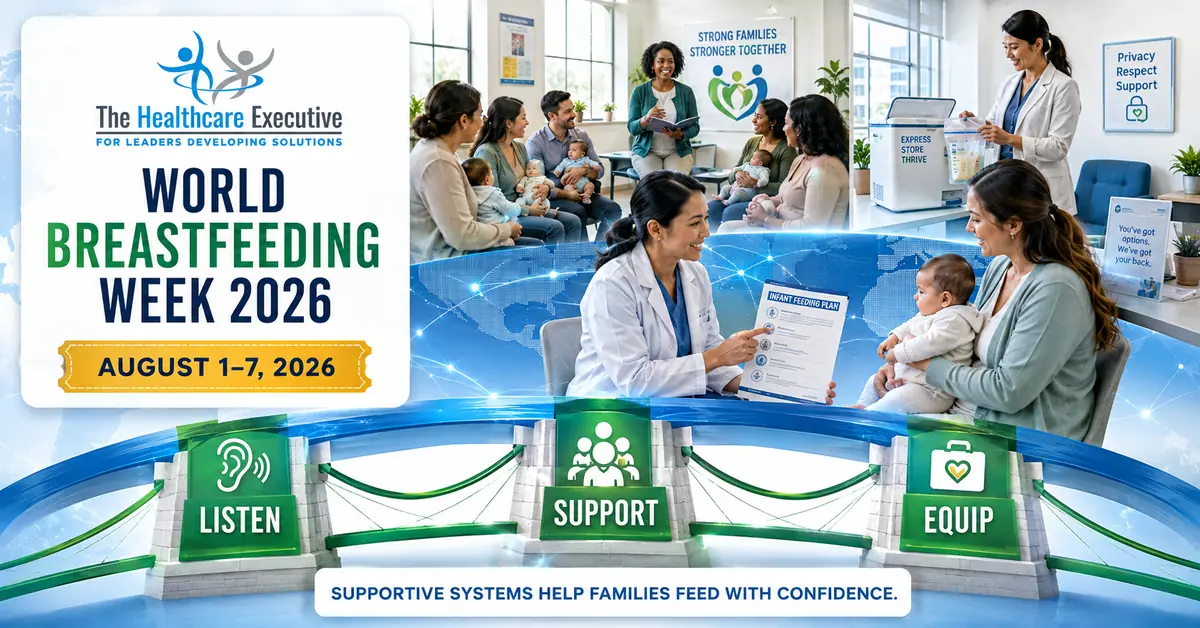
August 1-7, 2026 · Executive evidence brief
World Breastfeeding Week and National WIC Breastfeeding Week 2026
Strengthen what works by making respectful support, maternity practice, WIC connection, community continuity, workforce capability, and accountable learning visible across the full pathway.
The official 2026 World Breastfeeding Week campaign focuses on tracking progress, learning from successful implementation, and strengthening what works across the Warm Chain of Support. The National WIC Breastfeeding Week lens makes the U.S. service connection concrete. This brief translates both into an executive operating agenda while respecting every family's goals, circumstances, language, and right to informed choice.
Leadership mandate
Turn a global campaign into one accountable support pathway
The 2026 campaign asks leaders to track progress, evaluate impact, learn from successful implementation, and strengthen what works. That assignment is more demanding than publishing educational messages for one week. It requires leaders to identify which support practices are actually available, which families reach them, where ownership is lost, whether staff can deliver them consistently, and what happens when a person needs a different route.
Breastfeeding and chestfeeding support crosses settings that are often managed separately. Prenatal education may sit in obstetrics. Immediate postpartum support may depend on labor and delivery, postpartum nursing, anesthesia, neonatology, and lactation services. Discharge preparation may connect to pediatrics, primary care, WIC, community peer counselors, telehealth, home visiting, pharmacies, and employers. A family can receive excellent help in one encounter and still experience a broken pathway if the next team never accepts the handoff.
The executive goal is not to force uniform decisions. It is to make competent help easy to reach and safe to decline. A reliable pathway asks about the family's goals, explains options in understandable language, documents preferences, responds to clinical concerns, and confirms who owns the next step. If plans change, the system should adapt without treating the family as noncompliant. If breastfeeding is not possible, is not desired, or is interrupted, safe feeding support and respectful communication remain obligations.
A health-system analysis published in 2025 argues that hospital practice, community support, social protection, peer counseling, policy, and financing must work together rather than as isolated programs.8 The article is a systems analysis, not a new comparative trial, so it cannot establish the effect of any one local design. It does support the governance premise for this brief: the outcome of a support pathway depends on connections between institutions and on the conditions surrounding families after they leave a clinical setting.
Those connections need operational specificity. A hospital referral to WIC is not complete because a phone number appeared on a discharge document. The family needs consent-based referral, an accurate contact route, a receiving service with capacity, language and accessibility support, and a way to recover when the first contact fails. The hospital and community partner should agree on what information is necessary, what should not be shared, who acknowledges receipt, what constitutes completion, and how an urgent concern returns to qualified clinical care.
World Breastfeeding Week is also an opportunity to examine how success is defined. Initiation, exclusivity, duration, self-efficacy, experience, access, engagement, timely clinical response, goal concordance, and safe feeding are different measures. One cannot substitute for all the others. A program can raise one rate while leaving families feeling pressured. A digital tool can be available but rarely used. A peer counselor can be embedded in a clinic while the comparison remains vulnerable to selection and historical differences. Leaders should therefore build a balanced measurement set and keep the limitations visible.
The strongest local promise is bounded and testable: for one defined maternity-to-community pathway, every participating family will be offered respectful support, every accepted handoff will have a named owner and status, every urgent concern will have an escalation route, and leaders will review completion, experience, and variation without treating feeding decisions as performance failures.
Executive decision
Select one maternity-to-community support pathway, authorize a 90-day reliability cycle, and make the family's stated goals, the receiving owner, the next contact, the escalation route, and the completion signal visible to the people who need them.
Evidence signal
Separate improvement within a study from comparison across studies
Three studies illustrate why leaders need more than one implementation measure. In a 2026 single-NICU quality-improvement project in Northern India, four Plan-Do-Study-Act cycles combined counseling, visual prompts, breast pumps, wrist tags, and tailored education. The study reported early colostrum expression increasing from 15.57% at baseline to 56.63% after intervention and 75.67% in the sustainability phase. Exclusive breastfeeding at discharge also increased within the project.2 The project involved 432 participants, but it was conducted at one site, documentation was sometimes incomplete, milk volume was not measured, long-term infant outcomes were not assessed, and the sustainability phase lasted only four and a half months.
A 2024 quality-improvement study at one tertiary hospital in India used root-cause analysis and PDSA cycles to address early initiation after eligible vaginal births. Compliance increased from a 61% baseline to 100% during the intervention and was maintained during a three-month sustenance phase.12 The study excluded cesarean births and stable preterm infants and included relatively few normal deliveries. The result is useful for local workflow learning, not a guarantee that another setting will reproduce the same level.
A WIC texting pilot in the District of Columbia reveals a different implementation problem. Among 1,642 eligible recipients, 304 enrolled in the program and 60 of the enrollees used the two-way texting function.10 The tool created a route to peer counselors, but availability, enrollment, and active use were separate events. The pilot was limited to two sites and included self-selection. Leaders should not read lower uptake as evidence that families lacked interest in support. It is a prompt to investigate awareness, trust, timing, language, digital access, message burden, workflow, and whether the offered channel matched the need.
NICU early colostrum expression
Eligible vaginal births with early initiation
WIC peer-counselor texting
| Study | Population and setting | Reported signal | Interpretation guardrail |
|---|---|---|---|
| More et al., 20262 | 432 participants, one Level III NICU, Northern India | Early colostrum expression: 15.57% baseline, 56.63% post-intervention, 75.67% sustainability | Single-site pre/post QI study; no pooling with other rows; short sustainability period and documentation limits |
| Anil et al., 202412 | Eligible stable newborns after vaginal birth at one tertiary hospital | Early-initiation compliance: 61% baseline and 100% after intervention | Excluded cesarean and stable preterm births; small single-site QI context |
| Robert et al., 202410 | 1,642 eligible WIC recipients at two District of Columbia sites | 18.5% enrolled; 19.7% of enrollees used two-way texting | Different denominators; pilot uptake signals, not clinical outcomes or proof of demand |
The three examples point to a common executive discipline. First, define the denominator before celebrating a percentage. Second, separate reach, engagement, workflow completion, experience, and outcomes. Third, use time series or repeated review when possible so a temporary improvement is not mistaken for sustained reliability. Fourth, investigate who is missing from the measure. Finally, connect data review to a named decision rather than producing a dashboard that no one is authorized to act on.
Warm Chain continuity
Design the path from family goals to accepted community support
Continuity starts before birth. The first step is not a referral. It is an informed conversation about goals, questions, prior experience, cultural context, language, accessibility, and the types of support the family would find useful. The conversation should leave room for uncertainty and change. Documentation should make preferences visible to the next authorized team without creating a rigid label that follows the person when circumstances evolve.
During the birth hospitalization, the pathway should protect immediate clinical needs, family choice, competent assistance, and consistent communication across shifts. When an infant or parent requires higher-acuity care, separation, privacy limitations, pump access, equipment, and emotional stress become operational concerns. A 2026 qualitative study of 19 mothers of preterm newborns in two Brazilian NICUs found that bedside milk expression carried protective and relational meaning while discomfort, privacy, unfamiliarity, and the institutional environment shaped the experience.1 The study does not establish a universal response. It supports designing privacy, staff training, infrastructure, and emotional support as part of the service.
Discharge is a transfer of responsibility, not a document event. A complete handoff identifies the family's current goals, questions, clinical concerns, support already provided, the receiving person or service, contact timing, language and modality, escalation instructions, and what happens if connection fails. Information sharing must be consent-based and limited to what the receiving service needs. Community partners should not be expected to absorb demand without capacity planning, clear scope, compensation, and a route back to clinical teams.
Peer counseling evidence shows why the receiving relationship matters. The Breastfeeding Heritage and Pride program combined prenatal contact, hospital and home visits, telephone support, lactation-consultant guidance, and connection to health and social services for predominantly low-income Black and Hispanic mothers in Connecticut and Massachusetts.15 It is a program case study that draws on prior evaluations, not a universal blueprint. Its value is the continuum: peer support was connected to clinical expertise, social needs, and continuous monitoring rather than offered as an isolated conversation.
Clinic-based peer counseling can also bridge settings. A 2024 quasi-experimental time-series study described a peer counselor role that included classes, prenatal counseling, in-hospital assistance, and phone triage after discharge in a teaching-hospital prenatal clinic serving low-income patients.11 Historical comparisons and a single site limit causal inference. The operating model remains relevant because the role crossed the exact boundaries where families often repeat questions or lose access.
Digital support should reinforce, not replace, human continuity. A 2025 qualitative implementation study of the LATCH two-way texting intervention within WIC examined barriers, facilitators, adaptation, and scale-up.7 A 2026 randomized study of 60 primiparous women in one Turkish hospital reported higher self-efficacy, fewer breastfeeding problems, and higher six-month continuation with app-based counseling than routine care.3 The small, single-site trial limits generalizability. Together, the studies suggest that leaders should evaluate the clinical boundary, peer-counselor workload, supervision, response time, language, accessibility, privacy, escalation, and fit with existing care rather than treating an application as a standalone intervention.
- Ask and listenRecord goals, questions, language, accessibility, and preferred support without pressure.
- Assess and assistUse qualified clinical judgment, competent support, and safe feeding options appropriate to the situation.
- Offer connectionExplain WIC, peer, outpatient, digital, and community choices; obtain consent before referral.
- Transfer ownershipSend only needed information to a named receiver and make acceptance visible.
- Confirm contactVerify that the family reached support in the intended language, time, and modality.
- Escalate and learnReturn urgent concerns to qualified care, recover failed contacts, and review recurring barriers.

An urban pediatric practice partnered with WIC to integrate a peer counselor into newborn visits. The 2024 retrospective matched cohort included 111 supported dyads and 222 comparison dyads.9 The design cannot remove selection or site effects, and initial feeding method remained an important part of interpretation. The study is useful for executives because it relocates the community partner from a resource list into a clinical encounter where families are already present.
A reliable partnership agreement should therefore define service scope, eligibility, referral hours, contact expectations, language capability, documentation, privacy, urgent escalation, after-hours coverage, unsuccessful-contact handling, and capacity review. It should also include how families and peer counselors can report harmful or confusing experiences. Contracts and memoranda are incomplete if they define deliverables without funding the workforce needed to receive the work.
Respect, autonomy, and equity
Make support technically competent and relationally safe
Support can fail even when information is technically correct. Families may hear inconsistent advice across shifts, receive corrections without explanation, feel that their knowledge is discounted, or experience feeding as a performance test. These failures are not resolved by adding another brochure. They require communication standards, role clarity, supervision, privacy, time, and mechanisms for families to shape the design.
A 2026 analysis of 149 breastfeeding-related stories from an anonymous Well Child narrative platform in Aotearoa New Zealand described tension between embodied, relational knowledge and professional support that framed breastfeeding as a technical task requiring correction.4 Participants did not simply reject expertise. They negotiated it through selective disclosure, strategic compliance, and hybrid knowledge. Because the stories were anonymous and self-selected, leaders should not treat the themes as prevalence estimates. They do support an important operating standard: expertise should be offered as a partnership that explains reasoning, listens to experience, and supports informed decisions.
Inclusive support also requires clinicians and systems to ask which words and practices are appropriate for the person in front of them. A 2026 interpretive qualitative study of eight transgender men and non-binary people in Ontario identified knowledgeable practitioners, gender-affirming care, support systems, planning, and bodily autonomy as protective factors in chestfeeding experience.5 The sample was small and local. The leadership implication is concrete: update intake fields, education, scripts, referral directories, privacy practices, and staff training so gender-diverse parents are not forced to teach the organization while seeking care.
Family partnership should also be designed rather than presumed. Four community-based participatory focus groups with 30 Black fathers in Connecticut identified facilitators and barriers across individual, family, service, and community levels.6 The findings are not representative of all Black fathers. They show why leaders should include chosen support people, ask what role they want, share understandable information with permission, and avoid assuming that one family structure fits every household.
Equity is not achieved by directing more messages at populations labeled as lower performing. The organization must examine the conditions surrounding access. Does the appointment require unpaid time? Can a parent reach a peer counselor outside standard hours? Is interpretation available when the need occurs? Does digital support require a stable device, data plan, literacy level, or comfort with written messaging? Is a private pump space accessible to hourly staff, trainees, contractors, and people working nights? Are community partners compensated for the demand generated by hospital outreach?
Communication
- Conflicting advice
- Technical correction without listening
- Unclear reasoning
- Judgment or pressure
Environment
- Limited privacy
- Shared or unsuitable space
- Equipment not available
- Workflow interrupts support
Capability
- Uneven staff knowledge
- Peer role not supervised
- Gender-affirming skill gap
- No clinical escalation route
Access
- Hours do not fit
- Language mismatch
- Digital or transportation barrier
- Community capacity unknown
Work and policy
- Schedule inflexibility
- Supervisor resistance
- Policy is not understood
- Space exists without coverage
Experience and trust
- Bodily autonomy not respected
- Family expertise discounted
- Identity fields exclude people
- Feedback produces no change

Feedback must be safe and actionable. Offer confidential routes during and after care, including options accessible to people who do not use English or digital portals. Review feedback with trained patient-experience staff and community advisors. Separate individual service recovery from system improvement, but connect both to ownership. When leaders hear that advice is conflicting, do not respond only with more education for families. Examine staffing, standards, shift-to-shift communication, supervision, documentation, and whether teams have time to deliver the intended practice.
Accountable operating system
Give every transition an owner, acceptance signal, and recovery path
A Warm Chain becomes an operating system when responsibilities survive boundaries. Clinical teams retain authority for clinical assessment. Peer counselors provide education and support within defined scope. WIC and community programs bring trusted relationships and access. Digital channels extend reach. Employers control working conditions. Executives align contracts, capacity, information, quality review, and escalation so no role is asked to compensate invisibly for another role's missing process.
Workforce training is necessary but insufficient. A 2023 article described preparation of 25 community peer counselors to use a structured mobile curriculum in rural India.13 It is a curriculum description without comparative patient outcomes. Its value is implementation detail: peer work requires defined content, communication skill, technology preparation, supervision, and connection to expertise. A health system should therefore measure competency, support, workload, retention, and escalation rather than counting training attendance alone.
Digital scale also changes responsibility. If two-way messaging is offered, someone must monitor it, respond within a communicated window, protect privacy, recognize clinical boundaries, and escalate urgent concerns. If the service closes after hours, families need to know what it can and cannot do. Automated messages should never imply that a personal response occurred. Translation must be clinically and culturally reviewed, not assumed accurate because software produced it.
Community partnership requires bidirectional governance. Hospital leaders should share expected referral volume, not surprise partners with a campaign surge. Community organizations should have authority to report capacity limits and recurring referral defects. Data sharing should be minimal, consent-based, secure, and useful to the receiving work. Both parties should agree on whether a handoff is merely sent, accepted, contacted, scheduled, completed, or unresolved.
| Transition | Minimum control | Acceptance signal | Exception and recovery |
|---|---|---|---|
| Prenatal to birth setting | Goals, questions, language, accessibility, prior support, and current clinical plan available to authorized staff | Birth-setting team reviews and updates the plan with the family | Conflicting or missing information is reconciled without blaming the family |
| Postpartum or NICU to discharge | Assessment, equipment, education, safe feeding plan, written contacts, and red-flag instructions | Family can explain the next step and agrees to the offered connection | Unresolved clinical concern remains owned before discharge |
| Hospital to WIC or peer support | Consent, necessary referral information, named receiver, timing, language, and modality | Receiving service acknowledges the referral and records contact status | Failed contact returns to a visible work queue with an approved retry or alternate route |
| Community to clinical escalation | Scope boundary, urgent concern criteria, current clinical contacts, and after-hours route | Qualified clinical service accepts responsibility for assessment | Peer counselor is not left to manage clinical risk outside scope |
| Return to work | Private functional space, schedule and coverage plan, access instructions, supervisor preparation, and issue route | Parent confirms that the arrangement is usable in the actual shift or work pattern | Access, retaliation, or coverage concern reaches HR or another authorized owner promptly |
The ledger should sit inside normal work, not become a separate documentation burden that staff bypass. Use existing systems where they can safely show status and ownership. Add only the data necessary to coordinate and improve. Test the view with clinicians, peer counselors, access teams, privacy leaders, and families. A field that does not change a decision or support continuity may not belong.
Workforce and return to work
A room is not a support system
Return to work can expose the difference between written policy and usable support. A 2022 realist evaluation used 111 interviews across 14 workplaces in four Mexican cities. It identified schedule flexibility, counseling, previous experience, policy awareness, supervisor and coworker support, culture, and appropriate physical space as interacting conditions.14 The qualitative study sits within Mexico's legal and workplace context and does not establish a universal causal model. It clearly warns leaders not to treat a lactation room as the complete intervention.
Health systems have two responsibilities here. They can support patients and community members by including return-to-work planning in the continuity pathway. They are also employers of nurses, clinicians, technicians, environmental services staff, food-service workers, administrators, trainees, contractors, and others with different shifts and degrees of schedule control. An organization cannot credibly promote support in the community while its own employees cannot access time, coverage, or a functional space.
A practical workplace review begins with the lived shift. Can an employee reach the room without losing most of the available break? Is the space private, clean, secure, accessible, and available at night? Is refrigeration suitable? Can the employee reserve it without disclosing more information than necessary? Is there coverage for patient-facing or production work? Do supervisors know the policy and how to respond? Does the issue route protect against retaliation? Are temporary, hourly, and geographically dispersed workers included?
Policy training should use scenarios rather than recitation. A supervisor needs to know what to do when demand spikes, when two employees need the space, when a room is unavailable, when travel is required, or when a schedule request conflicts with current staffing. HR needs a way to see recurring defects without exposing private details. Facilities needs ownership for cleanliness, equipment, locks, and outages. Senior leaders need to decide whether staffing and coverage assumptions make the policy usable.

Workforce capability across the clinical pathway also needs maintenance. Competency should cover respectful language, family goals, clinical boundaries, equipment, documentation, privacy, handoff expectations, and escalation. Simulation can test a missed referral, a language-access failure, a conflicting instruction, a digital message with a clinical concern, a NICU privacy issue, or a supervisor who cannot release an employee. These scenarios reveal system barriers that a knowledge quiz will not.
Peer counselors need the same organizational respect given to other essential roles: clear scope, reasonable workload, training time, supervision, access to current resources, compensation, emotional support, and advancement. Leaders should examine whether community expertise is funded only during grant cycles or campaign periods. Continuity cannot be reliable if the most trusted part of the pathway is structurally precarious.
Measurement and governance
Track whether support is reachable, respectful, completed, and improving
The 2026 campaign's emphasis on tracking progress should not become a race for one favorable percentage. Leaders need a measurement system that distinguishes reach from engagement, process from outcome, and support from pressure. Every measure should have a definition, denominator, owner, data source, exclusion rule, review cadence, privacy control, and known limitation.
Start with the pathway denominator. It may be all births, families who express a particular goal, people offered a referral, those who accept, or those eligible for a defined service. Each answers a different question. Do not calculate a completion rate using only people who were easy to contact if the improvement goal is equitable access. Do not treat a declined referral as a defect when the offer was informed and respectful. Track the clarity and safety of the disposition.
Measure handoffs in stages: referral offered, consented, sent, accepted, first contact attempted, contact completed, service begun, concern escalated, and loop closed. The WIC texting pilot demonstrates why these stages matter.10 If leaders see only enrollment, they miss active two-way use. If they see only messages sent, they cannot know whether a question reached a person capable of responding.
Experience measures should ask whether goals were heard, language and terminology were respected, explanations were understandable, help was timely, advice was consistent, privacy was protected, and the family knew whom to contact. Avoid surveys that imply breastfeeding continuation is the only acceptable sign of success. Pair quantitative responses with qualitative review and explain how feedback changed operations.
Stratification can reveal variation, but it must be governed carefully. Identity data should be self-reported, terminology should be reviewed with communities, and small groups should be protected from re-identification. Analysts should disclose missingness and instability. A difference should prompt investigation of access, process, staffing, and structural conditions rather than a deficit narrative about a population.
| Domain | Candidate measure | Guardrail | Accountable owner |
|---|---|---|---|
| Offer and choice | Eligible families offered support in the intended language; accepted, declined, or deferred disposition documented | Never score a family's feeding choice as staff failure | Maternal-child clinical leader |
| Handoff reliability | Accepted referrals acknowledged, contacted, completed, unresolved, or escalated | Report every stage and denominator; sent is not completed | Hospital and WIC/community co-owners |
| Access | Time to support, unsuccessful contacts, interpreter availability, digital and transportation barriers | Review by site, shift, language, and pathway only when data are stable and protected | Access and equity leaders |
| Experience and autonomy | Goals heard, terminology respected, instructions understood, privacy protected, pressure or conflicting advice reported | Provide confidential and nonretaliatory feedback routes | Patient-experience leader |
| Workforce capability | Competency validation, supervision, coverage, workload, escalation use, and peer-counselor retention | Training attendance alone does not establish capability | Nursing, HR, and community-program leaders |
| Workplace usability | Space availability, schedule and coverage defects, supervisor response, and issue resolution | Protect employee privacy and include all shifts and worker groups | CHRO and operational leaders |
| Learning and closure | Recurring barriers assigned, corrected, retested, and reported back to families and partners | Use a learning approach; do not blame individuals for system defects | Executive sponsor and quality committee |
Governance should include clinical leaders, nursing, WIC and community partners, peer counselors, patient experience, analytics, privacy, HR, and people with lived experience. The group needs authority to correct barriers, not only review them. Each meeting should end with decisions, owners, due dates, unresolved dependencies, and a plan for communicating back to the people who provided input.
90-day action plan
Strengthen one pathway, prove the handoff, and keep learning visible
The implementation window below is a management framework, not a clinical timeline. Leaders should adjust it to local risk, policy, bargaining requirements, privacy review, technology, capacity, and partner readiness. The goal is to correct one material barrier without pretending that a 90-day project completes the broader work.
Days 1-30: listen, define, and trace
Name an executive sponsor and operational co-owners from the hospital and receiving community pathway. Include peer counselors and compensated family or community advisors. Define the pathway boundary and the family's decision rights. Trace a small, privacy-protected sample of recent journeys, including a smooth handoff, an unsuccessful contact, a language need, a NICU transition, a changing feeding plan, a clinical escalation, and a return-to-work barrier.
Document the current state from offer to closure. Identify every queue, phone number, inbox, portal, fax, spreadsheet, person, and informal workaround. Record where consent is obtained, what information moves, how receipt is acknowledged, what happens after hours, and how an unresolved concern becomes visible. Choose one barrier that is meaningful, correctable, and safe to test.
Days 31-60: co-design, simulate, and prepare
Build the minimum reliable handoff: trigger, consent, necessary information, receiving owner, acknowledgment, response expectation, escalation, and closure status. Align it with clinical scope, privacy, and partner capacity. Test it with families who use different languages and communication modes. Simulate a failed contact, capacity shortage, urgent clinical concern, conflicting advice, and changed family preference.
Prepare the workforce. Clarify which work belongs to clinicians, nurses, peer counselors, access staff, WIC teams, supervisors, HR, and community partners. Validate competency through observed practice and scenarios. Confirm coverage across shifts. Configure measurement so staff can see unresolved work without duplicating documentation.
Days 61-90: launch, review, and sustain
Launch in a bounded service, site, or population with enough variation to expose real workflow issues. Review active exceptions frequently at first. Use a learning approach and correct process defects quickly. Compare the intended pathway with family and staff experience. Track offer, acceptance, contact, completion, escalation, experience, and unresolved status with transparent denominators.
At day 90, decide whether to adapt, expand, pause, or stop. Report what changed, what did not, whose experience shaped the decision, which limitations remain, and when the next review will occur. Fund the community and workforce capacity required for sustainment. Do not scale a referral volume that the receiving system cannot safely absorb.
Board-level question
Can leaders show that a family's goals were heard, that accepted support moved to a named receiver, that failed contact or clinical concern stayed visible, that workforce and community capacity were funded, and that one documented barrier was corrected because the organization learned what worked?
Leadership close
Strengthen what works without turning support into pressure
World Breastfeeding Week and National WIC Breastfeeding Week create a shared window for global evidence, local services, and executive accountability. The most credible response is not a promise that every family will follow one path. It is a commitment that every family can reach accurate information, respectful communication, qualified clinical help, trusted peer and community support, and a safe alternative when goals or circumstances differ.
Leaders should leave the week with one tested handoff, one better-defined denominator, one workforce or capacity correction, and one method for hearing whether families experienced the change. The work should continue after August 7 through routine governance, partner funding, staff support, workplace implementation, and transparent review.
Related executive resources include National Breastfeeding Month 2026, AANHPI Breastfeeding Week 2026, and Black Breastfeeding Week 2026. Each should deepen the relevant equity and operating lens without substituting one community's experience for another.
Scholarly references
Peer-reviewed evidence
References are ordered newest first. Each source was individually reviewed for peer-review status, methods, setting, applicability, and limitations.
- Alves AKS, Façanha APM, Castro EM, et al. Social representations of bedside milk expression among mothers of preterm newborns in neonatal intensive care units. Journal of Advanced Nursing. 2026;82(6):6362-6372. doi:10.1111/jan.70228
- More JI, Singh S, Verma A, Mathur M, Bhatia A. Enhancing early colostrum administration and sustained breastfeeding practices in preterm neonates: a quality improvement initiative with long-term implications. Journal of Neonatology. 2026;40(3):262-271. doi:10.1177/09732179251413911
- İbis BK, Ertem G. The effect of breastfeeding counseling with smartphone app on breastfeeding self-efficacy, breastfeeding duration, and problems. Nigerian Journal of Clinical Practice. 2026;29(4):390-400. doi:10.4103/njcp.njcp_506_25
- Severinsen C, Breheny M, Reweti A. Contesting authority in breastfeeding support: maternal negotiation of professional and embodied knowledge. Journal of Health Psychology. 2026;31(5):1995-2011. doi:10.1177/13591053251383744
- Ziegler E, Chyzzy B, Kuri E, et al. “They didn't know how to support me”: the experiences of transgender men and non-binary people with chestfeeding. Journal of Human Lactation. 2026;42(1):94-104. doi:10.1177/08903344251401916
- Rios J, Frieson T, Ray N, et al. Black fathers' views on breastfeeding facilitators, barriers, and support services: insights from a qualitative community-based participatory research study. Maternal & Child Nutrition. 2025;21(2):e13776. doi:10.1111/mcn.13776
- Martinez-Brockman JL, Granner JR, Buchanan B, et al. Evaluation and adaptation of a two-way text messaging intervention in the WIC breastfeeding peer counseling program: a qualitative analysis. PLoS One. 2025;20(1):e0313779. doi:10.1371/journal.pone.0313779
- Zhu DT, Gupta T, Pérez-Escamilla R. Empowering global health systems to protect, promote and support optimal breastfeeding. Maternal & Child Nutrition. 2025;21(1):e13753. doi:10.1111/mcn.13753
- Engelbrecht A, Gruffi L, Silver M, et al. Initial feeding method, WIC-provided lactation support, and breastfeeding duration at an urban pediatric primary care practice. Journal of Community Health. 2024;49(6):1095-1100. doi:10.1007/s10900-024-01371-4
- Robert RC, Moody NG, Woody E, et al. Enrollment and use of a peer counselor mHealth texting program to support breastfeeding in low-income people: a pilot study in the District of Columbia. Public Health Nursing. 2024;41(4):829-835. doi:10.1111/phn.13316
- Awosemusi Y, Keenan-Devlin L, Martinez NG, et al. The role of clinic-based breastfeeding peer counseling on breastfeeding rates among low-income patients. BMC Pregnancy and Childbirth. 2024;24:312. doi:10.1186/s12884-024-06395-1
- Anil H, Patel S, Pujara R, Patel D, Nimbalkar S. Improving early initiation of breastfeeding in newborns delivered at a tertiary care hospital: a quality improvement study. Journal of Neonatology. 2024;38(1):7-14. doi:10.1177/09732179231202184
- Bellad RM, Mahantshetti NS, Charantimath US, et al. A training curriculum for an mHealth supported peer counseling program to promote exclusive breastfeeding in rural India. International Breastfeeding Journal. 2023;18(1):1-7. doi:10.1186/s13006-023-00546-4
- Hernández-Cordero S, Vilar-Compte M, Litwan K, et al. Implementation of breastfeeding policies at workplace in Mexico: analysis of context using a realist approach. International Journal of Environmental Research and Public Health. 2022;19(4):2315. doi:10.3390/ijerph19042315
- Rhodes EC, Damio G, LaPlant HW, et al. Promoting equity in breastfeeding through peer counseling: the US Breastfeeding Heritage and Pride program. International Journal for Equity in Health. 2021;20(1):1-12. doi:10.1186/s12939-021-01408-3