
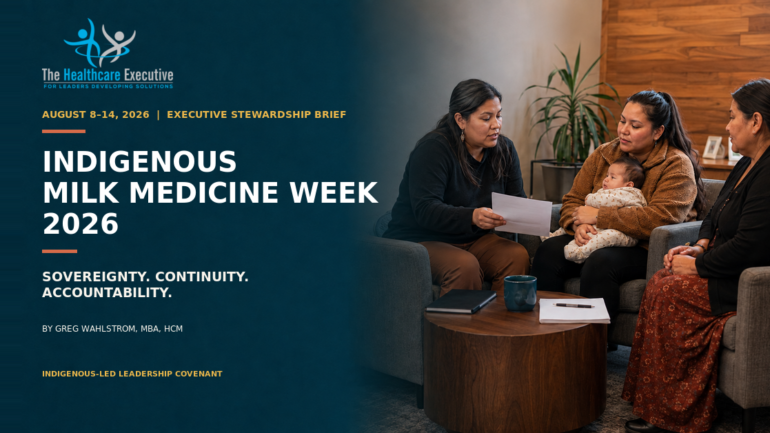

Indigenous-led observance | Executive stewardship brief
Indigenous Milk Medicine Week 2026: a leadership covenant for sovereignty and continuity
Healthcare leaders can honor this week by changing who holds decision rights, whose knowledge is valued, how community expertise is funded, and whether care remains connected from pregnancy through birth, home, community, and work. The assignment is not to speak for Indigenous peoples. It is to listen, partner, resource, and remain accountable.
Begin in the right leadership position
Indigenous Milk Medicine Week 2026 takes place August 8-14. The Indigenous Milk Medicine Collective, a grassroots Indigenous-led organization, describes this year’s theme as honoring the brilliance, continuity, and cultural strength carried through Indigenous lactation and community care. The observance began in 2019 and was formerly known as Native Breastfeeding Week. The official event page remains the source of truth for virtual programming, speakers, access details, and community offerings.
Milk Medicine is broader than a clinical feeding category. The Collective describes it through relationship, responsibility, cultural memory, healing, ceremony, story, sovereignty, and love. Executives should therefore resist reducing the week to a breastfeeding-rate campaign. Each Nation, community, and family is distinct. Preferred language also varies. Some people use breastfeeding, chestfeeding, nursing, lactation, a Nation-specific term, or Milk Medicine. Ask, listen, and mirror a person’s language without making assumptions.
Listen before design
Invite Tribal Nations, Indigenous birthworkers, families, and Urban Indian Organizations to define priorities before a program, metric, or message is selected.
Respect sovereignty
Treat Tribal Nations as governments and rights holders, not as one demographic audience or a generic community advisory group.
Pay for expertise
Use contracts, stipends, grants, and shared budgets so cultural knowledge, referral reach, and trust are not extracted as unpaid labor.
Protect informed choice
Support each family’s feeding goals without coercion, shame, commercial pressure, or a single definition of success.
A four-part operating covenant
The national observance is a focused action window within National Breastfeeding Month 2026. Its purpose should remain distinct: Indigenous leadership, kinship, continuity, sovereignty, and culturally grounded care. An executive covenant converts those principles into funded operations.
1. Governance with decision rights
Name an executive sponsor, but place Indigenous representatives in compensated decision-making roles. Define what is governed by a Tribal Nation, what is co-designed with an Indigenous organization, and what the health system owns. Document how recommendations are accepted, funded, or transparently declined. This is stronger than asking a general diversity council to validate a finished plan.
2. Clinically reliable, culturally safe care
Review prenatal counseling, immediate postpartum practice, supplementation, donor milk access, pain and medication guidance, discharge, and escalation with Indigenous clinicians, lactation professionals, birthworkers, and families. The Indian Health Service uses quality improvement to strengthen maternity and infant-feeding practices. Reliability must include respectful consent and support for every informed feeding decision.
3. Community continuity that closes the loop
CDC defines continuity of care as consistent, collaborative, seamless support beginning in pregnancy and continuing until a family is no longer breastfeeding. Build warm handoffs to Tribal health programs, Urban Indian Organizations, WIC, community lactation support, primary care, pediatrics, and trusted birthworkers. Track whether contact occurred, not merely whether a referral was sent.
4. Workforce and data stewardship
Recruit, retain, promote, and sponsor Indigenous clinicians, peer counselors, doulas, and lactation professionals. Audit every worksite and shift for usable pumping time, private space, coverage, milk storage, and manager response. For data, adopt written rules for consent, access, interpretation, small numbers, and publication. The federal Making Amends report calls for centering American Indian and Alaska Native communities as empowered leaders and decision makers, including in how data are collected, analyzed, used, and shared.
A seven-day leadership relay
Use the observance as a relay, not a campaign burst. Each day should transfer one concrete commitment to the accountable owner who will carry it forward.
A board-ready sovereignty and continuity scorecard
| Domain | Operating evidence | Executive question | Guardrail |
|---|---|---|---|
| Governance | Paid Indigenous leadership, defined decision rights, response log | Who can change the plan and the budget? | Do not treat representation as endorsement. |
| Experience | Patient-reported respect, informed choice, language honored | Did the family feel heard and free from pressure? | Pair numbers with consented narratives. |
| Clinical care | Timely skilled help, goal-concordant plan, safe escalation | Where does reliability change by site or shift? | Do not use feeding duration as the only success measure. |
| Continuity | Confirmed community connection and follow-up response | Did the next trusted helper connect? | Pay partners for closed-loop work. |
| Workforce | Indigenous recruitment, retention, advancement, lactation access | Can staff use policy without penalty or lost opportunity? | Review every location and employment group. |
| Data | Community-approved definitions, access rules, interpretation, release | Who benefits, who could be harmed, and who decides? | Protect small numbers and address misclassification. |
The table scrolls horizontally by keyboard or touch on smaller screens. Disaggregate only when data quality, consent, privacy, and community governance support it. A suppressed rate can be more ethical than a precise-looking number that exposes people or misrepresents a Nation.
From observance to accountable action
Eligible maternity hospitals also have a timely 2026 action: CDC’s mPINC survey closes September 10, 2026. Hospitals must complete it to receive a private hospital report and be included in state, regional, and national data. Use the report as one quality-improvement input, then interpret findings with community partners rather than treating a composite score as the full experience of Indigenous families.
Establish accountability
- Name executive, clinical, workforce, data, and community-partnership owners.
- Inventory existing Tribal, Urban Indian, WIC, birthworker, and lactation relationships.
- Fund a paid listening and design process with clear decision rights.
Repair one pathway
- Map prenatal care through postpartum, pediatric, community, and workplace support.
- Correct one high-friction handoff, consent, language, or accommodation failure.
- Complete mPINC and review results with context.
Report and resource
- Approve contracts, workforce investments, and data-governance guardrails.
- Review the scorecard with Indigenous partners before board presentation.
- Publish what changed, what remains open, and when leaders will report again.
Executive conclusion
Indigenous Milk Medicine Week 2026 asks healthcare organizations to recognize continuity and cultural strength without appropriating them. The most credible leadership response is durable infrastructure: Indigenous decision-making power, paid community expertise, culturally safe clinical practice, reliable referrals, lawful and workable employee support, careful data stewardship, and transparent follow-through.
The theme, We Keep the Fires Lit: Rising Through Milk Medicine, is not an invitation for institutions to center themselves. It is a call to protect what Indigenous communities already carry. Boards and executive teams can support that work by moving resources and authority closer to the people whose knowledge, relationships, and care sustain families across generations.
Planning note: This executive brief supports organizational planning and does not replace individualized medical guidance. Care should reflect family preferences, clinical circumstances, community knowledge, and qualified professional support.