

Artificial intelligence is moving from experimentation into the infrastructure of care. The governance question is no longer whether hospitals will use AI. It is whether leaders can prove that every system influencing care remains safe, fair, transparent, and accountable after deployment.
Adoption is not governance. A hospital may inventory approved tools without a reliable way to detect performance drift, unequal outcomes, inappropriate clinician reliance, or vendor changes that alter model behavior. Boards must therefore treat healthcare AI as both a clinical and enterprise risk category.
The accountability gap
The healthcare AI accountability gap is the distance between an algorithm’s influence and the organization’s ability to explain, supervise, and correct that influence. The gap widens when leaders cannot answer five basic questions:
- Who owns the clinical outcome affected by the system?
- What evidence supports its use in this patient population and care
setting? - How will the organization detect unsafe or unequal performance?
- Who can override or suspend it?
- How will patients and clinicians report harm or challenge an
output?
These questions cannot be assigned entirely to information technology. AI governance touches clinical quality, patient safety, medical staff leadership, nursing, compliance, privacy, cybersecurity, legal affairs, procurement, finance, and patient experience. A multidisciplinary committee may coordinate the work, but executives and the board must retain visible accountability.
ENTERPRISE GOVERNANCE MODEL
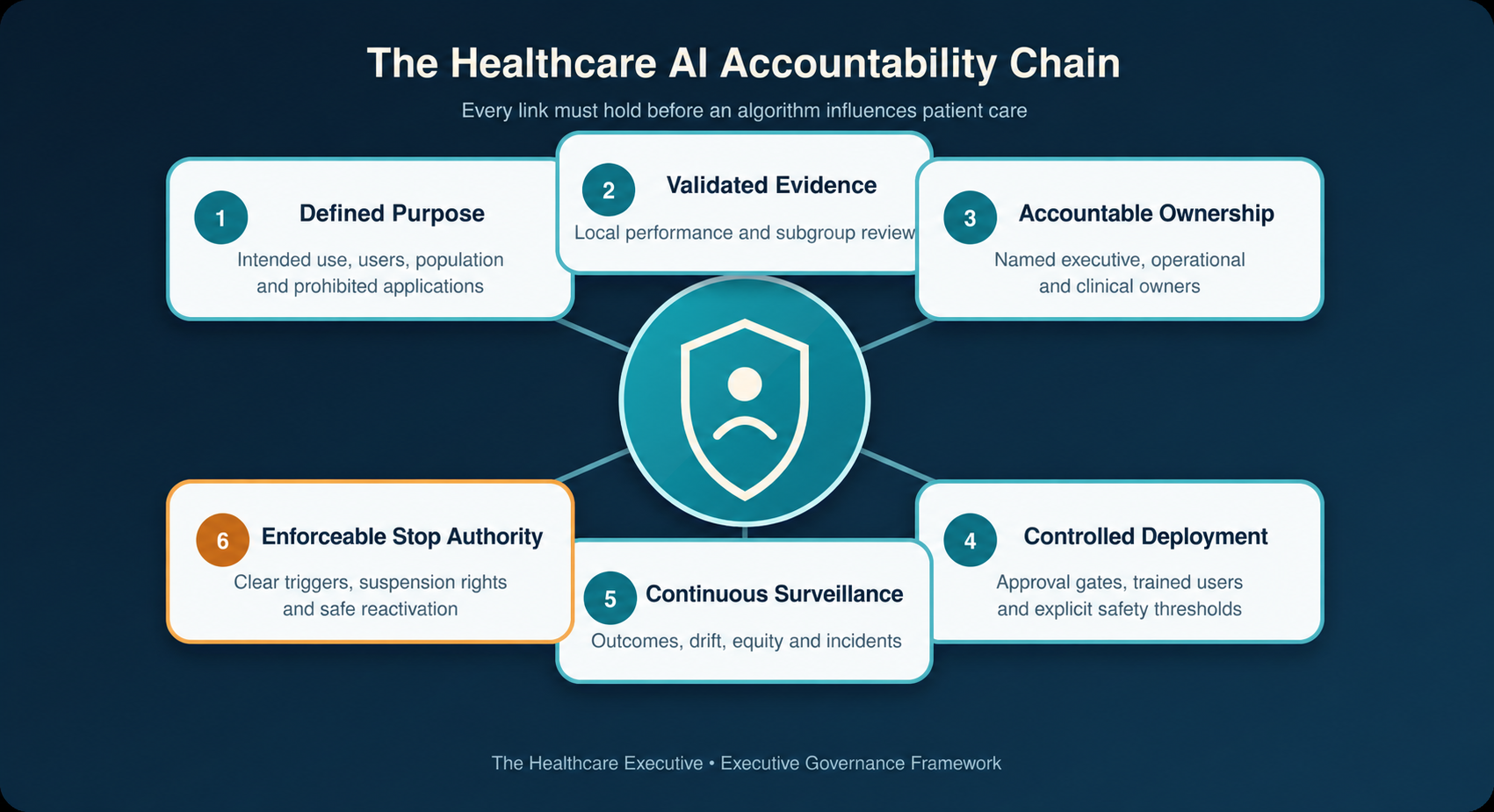
The Healthcare AI Accountability Chain
A practical governance model should connect six links. If one link fails, the organization should not assume that the remaining controls will compensate.
Defined purpose
Every AI system needs a documented clinical or business purpose, intended users, affected population, and prohibited uses. Leaders should reject descriptions such as “improve efficiency” when the tool may influence access, prioritization, diagnosis, treatment, discharge, or payment. The organization must define the decision being supported and the human role that remains.
Validated evidence
Vendor performance claims are only a starting point. The hospital should evaluate whether the evidence reflects its patients, workflows, technology environment, and prevalence of the condition being predicted. A model that performs well in an academic medical center may behave differently in a rural hospital, safety-net organization, pediatric setting, or population with different demographic characteristics.
Validation must examine more than overall accuracy. Leaders should require clinically meaningful measures, including false positives, false negatives, calibration, sensitivity, specificity, and performance across relevant patient groups. The appropriate measures will vary by use case, but the consequences of error must always be explicit.
Accountable ownership
Every system needs a named executive sponsor and operational owner. High-risk clinical tools should also have a physician, nursing, pharmacy, or other clinical owner appropriate to the decision being influenced. Ownership means responsibility for performance review, incident escalation, workflow changes, user education, and recommendations to continue, restrict, or retire the tool.
Controlled deployment
Deployment should proceed through defined approval gates. A limited pilot should specify eligible settings, trained users, baseline measures, success criteria, safety thresholds, and an end date. Leaders should not permit a pilot to become permanent through inertia.
Clinical users need to understand what the system does, what it does not do, and when its output may be unreliable. Training should address automation bias, the tendency to overvalue a computerized recommendation, as well as the opposite risk of ignoring useful alerts because of poor workflow design or alert fatigue.
Continuous surveillance
Predeployment validation cannot guarantee future performance. Patient populations change. Clinical practice changes. Data pipelines break. Vendors update models. Documentation patterns shift. These changes can create model drift or alter the consequences of an output.
The hospital should monitor performance at a frequency proportionate to risk. Surveillance should include clinical outcomes, override rates, subgroup performance, complaints, adverse events, downtime, cybersecurity events, and workflow burden. Material vendor updates should trigger reassessment rather than automatic acceptance.
Enforceable stop authority
Every AI system that can affect patient care needs a documented suspension process. The organization should define who can pause the system, what events trigger immediate review, how clinicians will operate during suspension, and who authorizes reactivation.
Bias, nondiscrimination, and vulnerable populations
AI can reproduce inequities contained in historical data or create new ones through design choices, incomplete variables, or uneven deployment. The National Institute of Standards and Technology identifies fairness with harmful bias managed as a characteristic of trustworthy AI. It also emphasizes validity, reliability, safety, security, resilience, accountability, transparency, explainability, interpretability, and privacy.
Healthcare leaders should require performance analysis across groups relevant to the use case. These may include race, ethnicity, sex, age, disability, language, insurance status, geography, and socioeconomic conditions. The purpose is not to assume that every difference proves discrimination. It is to determine whether a difference is clinically justified, statistically reliable, operationally meaningful, and ethically acceptable.
Federal nondiscrimination requirements add urgency. HHS has applied Section 1557 nondiscrimination principles to patient-care decision-support tools used in clinical care. Governance therefore needs a formal pathway to identify and mitigate discriminatory effects, not a general statement that a vendor designed the model responsibly.
Privacy, cybersecurity, and data stewardship
AI governance must address the full data lifecycle. Leaders should know what information enters the system, where it is processed, how long it is retained, whether it is used to train another model, which subcontractors can access it, and how data are deleted at the end of the relationship.
Generative AI creates additional risks when workforce members paste protected or proprietary information into tools that the organization has not approved. A policy alone is insufficient. Hospitals need approved alternatives, technical controls, workforce education, audit capability, and proportionate enforcement.
Cybersecurity review should cover the model, interfaces, application programming interfaces, hosting environment, identity controls, logs, and vendor incident-response obligations. A clinically useful algorithm can still create unacceptable risk if its data connections expand the organization’s attack surface.
Vendor accountability begins in the contract
Healthcare organizations should not accept a contract that limits their ability to govern a tool that can influence care. Contract review should address:
- the exact intended use and prohibited uses;
- validation evidence and known limitations;
- access to performance and audit information;
- advance notice of material model changes;
- data ownership, retention, secondary use, and deletion;
- cybersecurity standards and incident notification;
- cooperation in safety investigations and regulatory inquiries;
- service continuity, downtime, and exit support;
- indemnification, liability, and insurance;
- the hospital’s right to restrict or suspend use.
The contract should also clarify whether the tool is fixed, periodically updated, or continuously learning. Those designs create different monitoring obligations.
The board-level AI dashboard
The board does not need a technical inventory at every meeting. It needs a risk-focused view of the systems with the greatest potential to affect patients, employees, finances, compliance, or reputation.
A quarterly dashboard should show:
- active AI systems by risk tier;
- new approvals, restrictions, suspensions, and retirements;
- systems operating outside approved performance thresholds;
- patient-safety events and near misses involving AI;
- subgroup performance concerns and mitigation status;
- material vendor or model changes;
- unresolved privacy and cybersecurity findings;
- clinician overrides, complaints, and adoption patterns;
- value achieved compared with the original business case;
- overdue reviews and accountable owners.
Ten questions before approval
Before an AI system can influence patient care, executives and governance committees should be able to answer:
- What specific decision or workflow will this system influence?
- What happens to a patient when the output is wrong?
- Was the system validated for our population and setting?
- How does performance vary across relevant patient groups?
- Which clinician retains authority and responsibility?
- What information will patients and users receive?
- What data will the vendor collect, retain, or reuse?
- How will performance drift and safety events be detected?
- Who can suspend the system immediately?
- What evidence will justify renewal, expansion, restriction, or
retirement?
An unanswered question is not automatically a reason to reject innovation. It is a reason to delay influence over patient care until the uncertainty is controlled.
THE GOVERNANCE MANDATE
The board’s obligation
Healthcare AI can improve prediction, reduce administrative work, strengthen access, and help clinicians act earlier. Those benefits deserve disciplined pursuit. They do not justify weak oversight.
Boards should require management to establish an enterprise AI policy, a complete inventory, risk-tiering criteria, approval gates, accountable owners, ongoing surveillance, incident reporting, and stop authority. They should also ask whether patients, frontline clinicians, and affected communities have a meaningful voice in decisions that may alter their care.
The central principle is simple: the more an algorithm can influence a consequential healthcare decision, the stronger the human accountability around it must become. Responsible adoption is not slower adoption. It is the governance required to make innovation durable, defensible, and worthy of patient trust.
BOARD-READY ACTION PLAN
Executive Implementation Roadmap
- 01Establish board-approved AI governance and risk tolerance.
- 02Inventory every internally developed and externally supplied AI system.
- 03Assign each system a risk tier and named executive owner.
- 04Require clinical, safety, privacy, security, legal, and equity review.
- 05Validate performance in the local setting before expansion.
- 06Monitor outcomes and subgroup performance after deployment.
- 07Document vendor changes and trigger reassessment when necessary.
- 08Create incident reporting, escalation, suspension, and reactivation procedures.
- 09Review high-risk systems and the AI dashboard at the board level.
- 10Retire systems that cannot demonstrate safe, equitable, and valuable performance.
Authoritative AI governance sources
- ASTP/HealthIT.gov hospital predictive AI data brief for the national 71% adoption statistic and current hospital governance trends.
- NIST AI Risk Management Framework for governing, mapping, measuring, and managing AI risk.
- NIST Generative AI Profile for risks and controls specific to generative AI.
- FDA Artificial Intelligence-Enabled Medical Devices for authorized-device information and regulatory transparency.
- HHS Section 1557 nondiscrimination guidance for federal protections relevant to algorithm-supported decisions.
- World Health Organization guidance on large multi-modal models for ethical governance of generative AI in health.
THE LEADERSHIP STANDARD
Innovation earns trust through accountability
The stronger an algorithm’s influence over care, the stronger the human governance surrounding it must become.