

2026 Health Observance Executive Brief
Sexual Health Awareness Month 2026: Turn Awareness into an Accountable Care Route
A trustworthy sexual health route protects privacy, reduces avoidable access burden, supports informed choice, connects clinical and community services, and keeps results, referrals, treatment, and follow-through visible without asking patients to coordinate the system alone.
Can your organization show how a person enters one selected sexual health route privately, reaches qualified assessment, receives understandable options, completes the next appropriate step, and remains connected through results, referral, treatment, or an actively owned exception?
Leadership signal
Sexual Health Awareness Month should test whether confidential access, clinical judgment, communication, and follow-through operate as one dependable system.
Sexual health touches primary care, adolescent and young adult care, reproductive health, obstetrics, infectious disease, oncology, rehabilitation, behavioral health, pharmacy, laboratory services, community outreach, telehealth, and specialty programs. People may seek prevention, education, testing, contraception, treatment, counseling, assessment of symptoms, help after violence, fertility or menopause support, gender-affirming care, or discussion of sexual function and wellbeing. These needs differ. The operating obligation is consistent: create a respectful, private, clinically governed route in which the next responsibility is clear.
Awareness campaigns can increase questions and demand while leaving the service route unchanged. A web page may list phone numbers without showing which service is appropriate. A screening prompt may collect sensitive information without explaining who can see it. An order may be placed without confirming collection, result review, communication, and follow-up. A referral may be sent without acceptance. A telehealth option may improve convenience while creating new privacy, technology, or laboratory burdens. A dashboard may count completed tests while excluding people who could not enter, declined because confidentiality felt uncertain, or disappeared between stages.
Executives should therefore inspect the full route, not only campaign reach. Which populations and services are included? Where can a person ask a question privately? What information is truly necessary? Who explains confidentiality and its limits? Which role assesses clinical need and supports informed choice? How are urgent concerns handled under current policy? Who owns orders, collection, pending results, notification, treatment, referral, partner or public-health requirements when applicable, and follow-through? What happens when a person lacks transportation, insurance, a private device, safe contact information, language access, or confidence that disclosure will be respected?
This brief does not recommend a test, screening interval, medication, contraceptive method, diagnostic threshold, treatment regimen, partner-management action, or reporting decision. It does not replace emergency procedures, trauma-informed safeguards, informed consent, applicable privacy law, public-health requirements, current evidence-based guidance, or qualified clinical judgment. Its purpose is to help leaders make an approved route usable, private, observable, and accountable.
Make confidentiality an operating property.
Privacy is not a sentence in a notice. It depends on registration, proxy access, portals, billing, shared devices, interpreter workflows, waiting areas, contact preferences, result release, documentation, and staff behavior. Review the route from the patient’s perspective and test where sensitive information can become visible or misunderstood.
Measure the people who do not complete the route.
Include those who were eligible but not offered the route, were offered and declined, accepted but could not complete the next step, received an incomplete result, could not be contacted safely, waited for referral acceptance, or remained in an unresolved exception. A completion rate among successful users alone can hide the most consequential barriers.
Select one bounded sexual health access, assessment, testing, result, referral, or follow-through route. Define its complete denominator, privacy safeguards, clinical owner, current states, accepted handoffs, exception lane, equity review, and balancing measures. Then correct one verified condition that creates avoidable delay, exposure, stigma, burden, or loss of continuity.
Evidence with transfer limits
Academic evidence supports lower-barrier, integrated, private, and community-informed routes, but every result remains attached to its setting and implementation.
Price and convenience shape entry
A free counseling and testing program in Zurich drew 3,475 visits in its first year, including many first-time testers.1 The result supports access review, not direct prediction for another financing system.
Digital access does not close itself
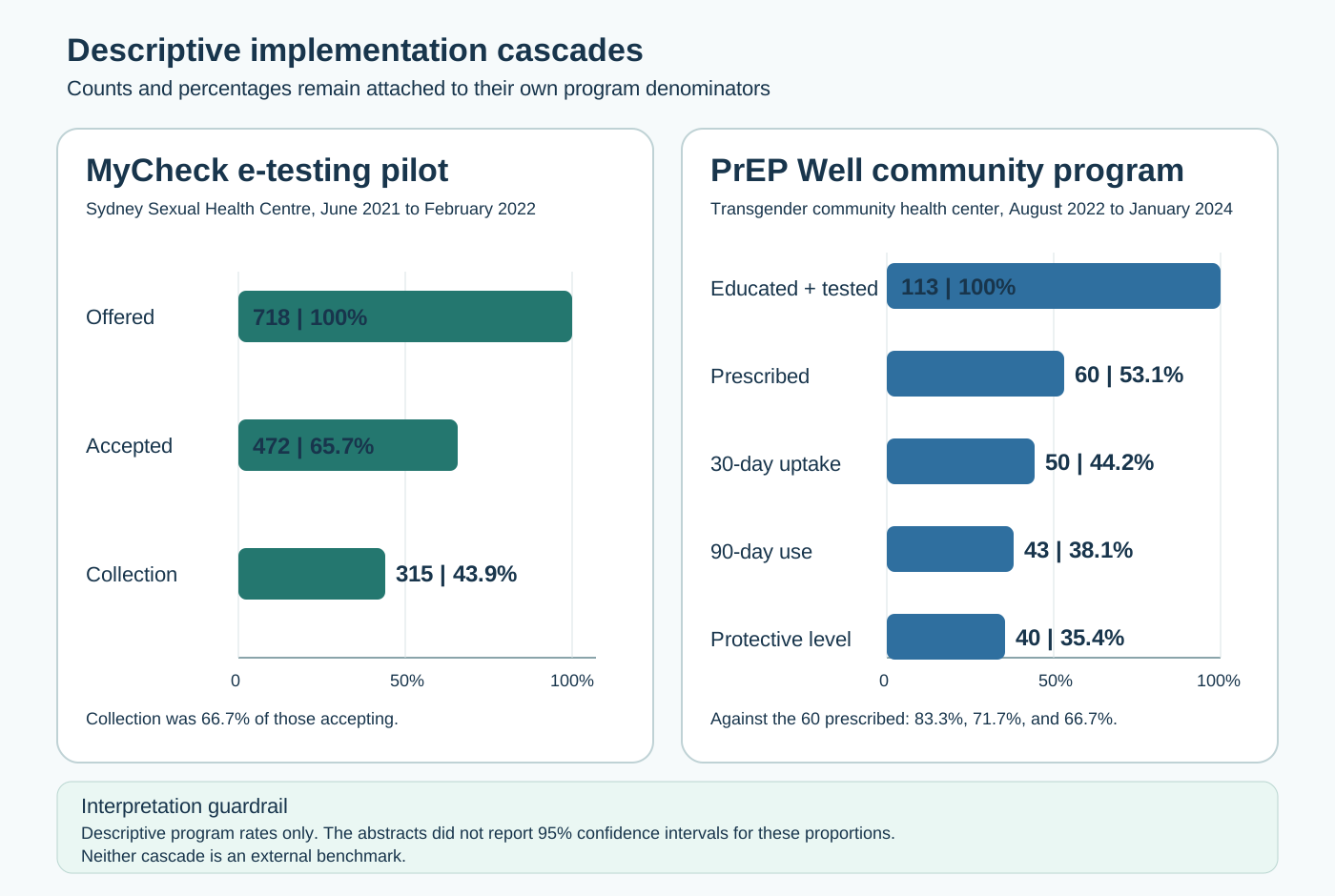
In an Australian e-testing pilot, 718 people were offered the route, 472 accepted, and 315 reached specimen collection.2 Convenience improved, but losses between states remained measurable.
Community leadership changes the route
A transgender community health center integrated education, testing, prescribing, and adherence support in one program.5 Its early results reflect that community-led model and population.
Figure 1. Two implementation cascades with visible denominators
Lowering an entry barrier can reveal unmet demand and new responsibility.
Arns-Glaser and colleagues examined the first year of free voluntary counseling and testing in Zurich for residents younger than 26 years or with low income. Among 3,475 visits, 2,866 people agreed to share routine data and 719 completed feedback. Thirty-nine percent of visits involved people without prior HIV testing. Chlamydia positivity was 4.5% and gonorrhea positivity was 2.5%.1 The observational design cannot isolate the effect of free access from communication, location, eligibility, counseling, or local context. It shows that removing price is an operational change that increases the duty to manage capacity, privacy, results, treatment, and follow-through.
An online service in major Thai cities recorded 158,639 visitors and 8,865 bookings, a 5.59% visit-to-booking rate. HIV testing represented 38% of booked services and STI screening 28%. Bangkok accounted for 74.5% of bookings, revealing geographic concentration even within a digital route.3 Digital reach is not equivalent to service completion, and traffic is not a denominator for clinical need. Leaders should track where users stop, whether local service capacity exists, how confidentiality is protected, and which populations remain underrepresented.
Every digital route needs a human, laboratory, data, and exception design.
MyCheck combined telehealth assessment, electronic referral to more than 500 pathology centers, and automated result entry. Staff offered the route to 718 of 7,340 eligible clients, 9.8%. Two-thirds of those offered accepted, and two-thirds of those accepting attended collection. Only about half of survey respondents rated support for questions about a safe, stigma-free environment and related concerns highly.2 The route illustrates that a technically available option can still depend on staff offering behavior, patient preference, travel to collection, ability to ask questions, result management, and escalation for complex needs.
Digitalization also expands confidentiality risk. Abakar and colleagues describe reproductive health information as especially sensitive and argue that cybersecurity, integrity, and reliability are components of clinical quality rather than only technical controls.6 An executive review should include identity verification, proxy access, minimum-necessary data, role-based permissions, audit trails, contact preferences, message previews, shared devices, third-party platforms, downtime, incorrect result matching, and recovery from a privacy incident.
Integration depends on governance and capacity, not co-location alone.
A qualitative case study of an integrated South Australian service found that co-location, multidisciplinary collaboration, internal referrals, shared training, inclusive culture, and leadership supported person-centered care. Funding instability, workforce capacity, digital systems, physical infrastructure, and reliance on informal external partnerships constrained continuity and visibility.11 The case does not prove that every integrated model produces better outcomes. It identifies conditions executives can inspect before labeling services integrated.
An integrative review of STI management guidance for people deprived of liberty examined 3,986 documents and retained nine. The review identified methodological limitations and emphasized that prevention, screening, diagnosis, and treatment require setting-specific design.4 Leaders should resist copying a general route into a population or setting where consent, safety, autonomy, confidentiality, movement, or access functions differently.
Training changes knowledge only when the work system supports use.
A virtual sexual health curriculum at a large urban safety-net system drew 52 pre-series respondents and 21 final respondents. Seventy percent of final respondents reported incorporating new information. Average knowledge scores changed from 60% before sessions to 63% after sessions, p=.03.10 Attrition, self-report, and the small change limit inference. Education is best treated as one component alongside prompts, time, referral capacity, clinical guidance, supervision, feedback, and measures of actual care.
Among 225 prenatal providers, more than 12% reported lacking awareness of STI screening guidance, with variation by practice setting and academic affiliation. Preferred dissemination sources included practice bulletins, professional organizations, and continuing education.7 Dissemination preference is not implementation. A governance plan should identify which current guidance applies, how updates reach each role, how obsolete content is retired, and how practice is reviewed without turning a guideline into an inflexible rule.
Structured intake can improve visibility while increasing privacy obligations.
A university health center introduced a self-administered electronic sexual health questionnaire organized around organ contact. Screening frequency, test diversity, and diagnoses increased compared with the preceding four years.8 The abstract does not establish causality or provide all denominators needed for transfer. The implementation raises practical questions: where the questionnaire is completed, what a patient can skip, how results are interpreted, who can see responses, how sensitive language is tested, and what happens when the intake identifies a concern outside the expected route.
A pediatric primary-care quality-improvement project implemented universal opt-out chlamydia screening with universal urine collection for patients aged 15 to 19 years. Screening increased from 7.8% to 34.1% across the pre- and post-implementation periods.16 The project shows feasibility in three sites, not a universal instruction. Leaders must preserve applicable consent and confidentiality rules, current clinical guidance, patient understanding, the ability to decline, and safe result communication.
Privacy, stigma, and power determine what becomes clinically visible.
Interviews with 20 female patients described tensions between openness and privacy, normality and uniqueness, emotional and objective communication, limited time, and unequal power in sexual health conversations.12 These accounts do not represent every patient. They show why a completed history field cannot prove that a person felt safe, understood the question, or disclosed what mattered.
Young adults in South Africa described stigma, employment constraints, financial dependence, health literacy, social support, and access during pregnancy as factors shaping treatment-seeking and adherence. Some stopped treatment after symptoms improved.15 A qualitative study among adolescent girls and young women in Mozambique identified provider attitudes, long waits, inaccessible services, limited skills, stockouts, fear of family discussion, and concerns about testing or contraception.13 These findings are context-specific. They support direct local listening and route design that does not assign system barriers to patient motivation.
Community partnership can connect entry, trust, and continued support.
PrEP Well was developed with a transgender community health center and served 113 primarily low-resourced transgender and nonbinary clients. Sixty received a prescription, 50 showed uptake at 30 days, 43 continued use at 90 days, and 40 had protective adherence at 90 days. Interviews and surveys described the program as acceptable, feasible, and sustainable while identifying ongoing barriers.5 The single-program, preliminary design limits transfer. Its contribution is the visible combination of community leadership, gender-affirming care, education, testing, prescribing, and adherence support.
A multi-college initiative worked with four colleges, two local health departments, and 16 community organizations. It tested 114 attendees and identified timing, communication, collaboration, logistics, and support as implementation concerns.17 Counts of participants and positive stakeholder views do not establish population impact. The initiative illustrates that partnership requires named roles, shared measures, clear follow-through, and planning for demand created by outreach.
Accountable care route
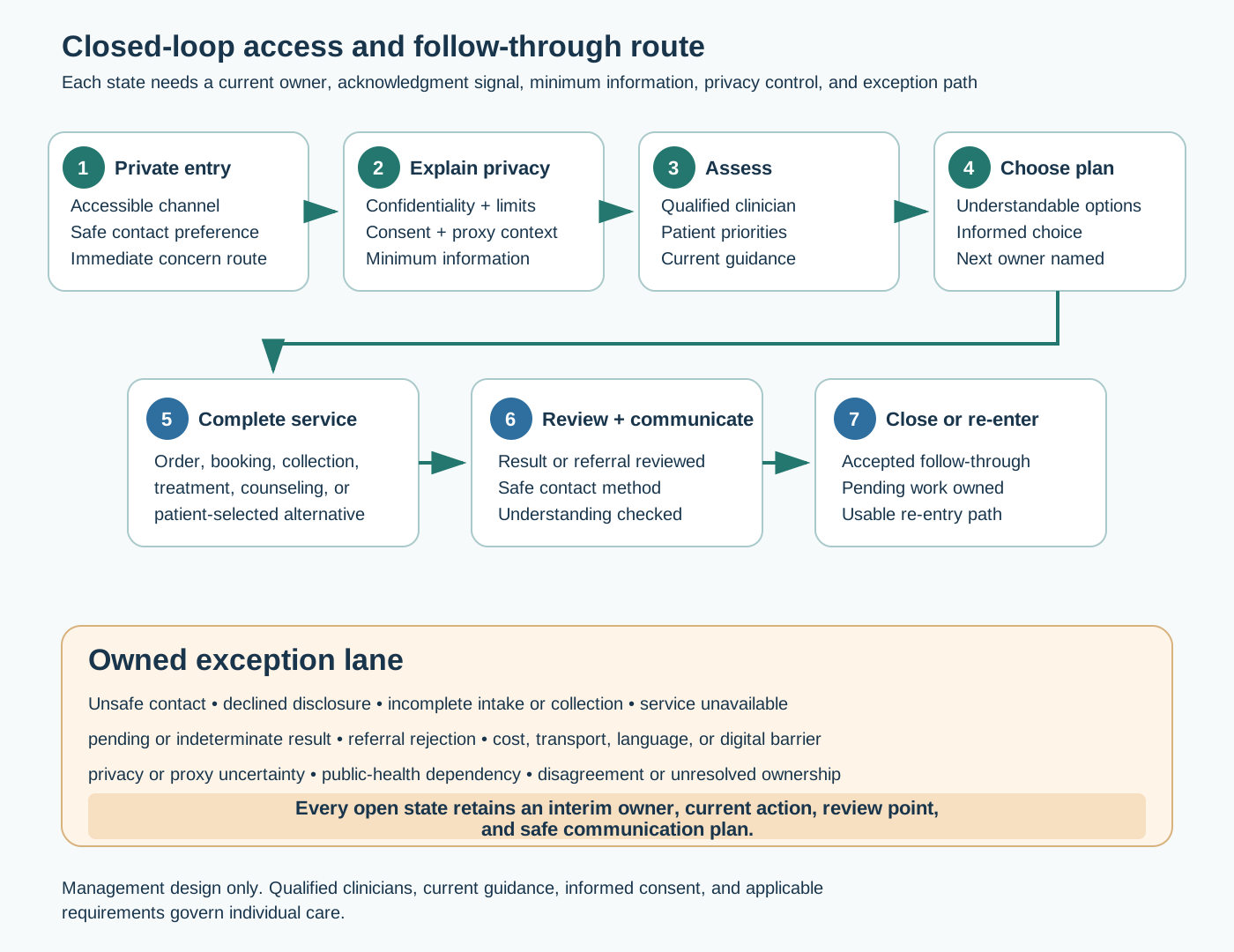
Define closure as a private, clinically appropriate next state with accepted ownership, or an unresolved exception that remains actively owned.
A question asked is not a confidential conversation. A questionnaire submitted is not qualified assessment. An order placed is not a specimen collected. A specimen collected is not a result reviewed. A result released is not necessarily understood. A referral sent is not accepted care. A prescription issued is not access, uptake, or continued support. Each transfer needs a current state, accountable owner, minimum information, safe communication method, and exception path.
Figure 2. Proposed closed-loop sexual health access and follow-through route
Start with one denominator that can be reconciled.
Choose a bounded route such as all patients offered a private sexual health intake in selected primary-care sites, all eligible users offered a defined e-testing option, all specimens collected through one program, all results requiring documented clinical review, all referrals from one service to another, all prenatal visits governed by one current screening workflow, or all people entering a community partnership program. State the population, locations, period, data source, exclusions, clinical governance, and review owner.
Then define each state. Entry may be requested, offered, declined, deferred, redirected, or unsafe because private communication cannot be assured. Assessment may be complete, incomplete, awaiting interpreter support, or transferred to a different clinical route. A service may be selected, declined after informed discussion, ordered, scheduled, collected, completed, canceled, or unavailable. A result may be pending, indeterminate, reviewed, communicated safely, or awaiting contact. A referral may be sent, accepted, declined, scheduled, completed, or open. Preserve clinical and patient choice instead of reducing every variation to noncompliance.
Explain confidentiality before requesting sensitive information.
Use plain language to explain who can see information, how it may appear in a portal or record, when a proxy or caregiver may have access, how billing or communications may create visibility, which disclosures are required by law or policy, and how the patient can select a safe contact method when possible. Verify understanding without forcing disclosure. Train registration, scheduling, clinical, laboratory, billing, health-information, and support teams because privacy can fail before or after the clinical encounter.
For adolescents, dependent adults, people experiencing violence or coercion, and anyone using shared devices or contact channels, the route should include approved safeguards and escalation. Do not improvise legal advice or promise absolute secrecy. Make the current policy easy for staff to find, maintain access to qualified privacy and safeguarding expertise, and review real exceptions with appropriate authorization.
Require acknowledgment at every transfer.
The sending role should know who is expected to receive the work. The receiving role should acknowledge the current state and next action. Until acceptance, an interim owner remains accountable. This standard applies to a clinician receiving a questionnaire flag, a laboratory receiving an order, a clinician receiving a result, a pharmacy or program supporting access, a specialist receiving a referral, a public-health or community partner receiving governed work, and a follow-up team receiving responsibility.
When the patient is expected to schedule, travel, pay, collect, upload, or contact another organization, label that burden explicitly. Patient action can be part of informed choice, but it should not erase organizational ownership. If completion does not occur, the route needs a governed review based on clinical need, consent, safety, and available contact methods.
Design the exception lane before launch.
Common exceptions include no private setting, unsafe contact information, patient preference not to disclose, language or accessibility need, incomplete intake, uncertainty about consent or proxy access, service not clinically appropriate, collection failure, mislabeled or insufficient specimen, indeterminate result, result not reviewed, contact attempt that could expose information, medication or supply constraint, referral rejection, unavailable appointment, transportation or cost barrier, public-health dependency, or disagreement about ownership.
Each exception should show an interim owner, current action, review point, escalation condition, privacy limitation, and patient communication plan. Review exceptions for system learning, not automatic blame. A person may appropriately decline a service or choose a different route. The goal is to distinguish informed choice and clinical variation from preventable access or continuity failure.
Privacy, dignity, and equity
Measure whether the route is equally usable, private, respectful, and complete across different opportunities and constraints.
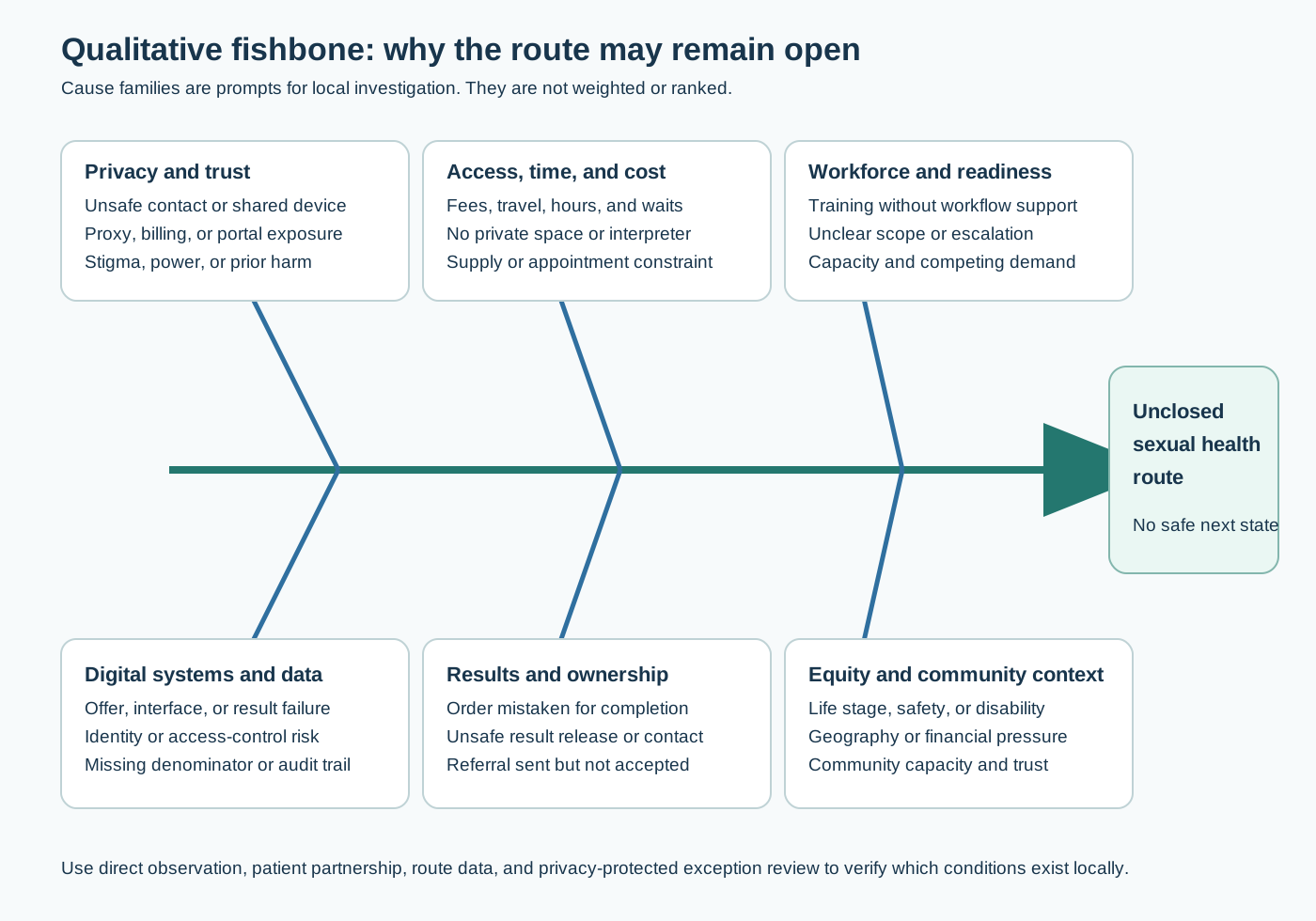
Figure 3. Qualitative fishbone for an unclosed sexual health route
Use a complete denominator before comparing groups.
Compare opportunity, offer, acceptance, completion, result review, safe communication, referral acceptance, and open exceptions. A subgroup may appear to have low utilization because members were offered the route less often, had less private access, faced longer waits, could not use the technology, or were more likely to receive a referral that never closed. Document missing demographic and outcome data. Apply small-number and privacy safeguards before reporting sensitive subgroup information.
During pandemic measures in Sweden, 17% of 1,138 sexually active respondents wanted HIV or STI testing, and 57% of that group reported reduced access. Among 568 people who usually used condoms, 23% reported reduced access. Effects differed by gender identity, sexual orientation, country of birth, and financial concern.9 The 2020 cross-sectional survey is not a current benchmark. It demonstrates why continuity planning should protect sexual health access during disruption and examine who absorbs the greatest burden.
Respect and waiting time are quality signals.
A facility-based study of 569 women in Ethiopia reported 79.2% satisfaction, 95% CI 72.1% to 84.5%. Respectful staff interaction was positively associated with satisfaction, adjusted odds ratio 1.62, 95% CI 1.02 to 2.53, while a waiting time of 30 to 60 minutes was negatively associated, adjusted odds ratio .38, 95% CI .17 to .86.14 The cross-sectional design, measurement, and setting limit transfer. Leaders can still measure respectful communication, wait-state visibility, abandonment, and time burden locally.
Design with people whose routes are most exposed to fragmentation.
Women who inject drugs in three Nigerian states described stigma, fear of disclosure, violence, and uneven availability across formal facilities, one-stop shops, outreach, informal locations, and peer networks. Some preferred peer or informal access because it offered convenience, anonymity, and less stigma.18 The study does not authorize unsafe or ungoverned substitution. It shows that service location, trust, and disclosure risk shape the route.
Involve patients, adolescents and young adults, LGBTQ+ communities, people with disabilities, people in rehabilitation or chronic care, survivors of violence, people with limited English proficiency, rural communities, uninsured or underinsured patients, and community partners in design where relevant. Compensate participation appropriately, protect confidentiality, explain how input will be used, and report what changed. Do not require anyone to disclose personal sexual history to contribute to service design.
Operating system
Coordinate access, assessment, diagnostics, treatment, referral, safeguarding, and follow-through around the person’s priorities and privacy.
Figure 4. Sexual health access and continuity operating system
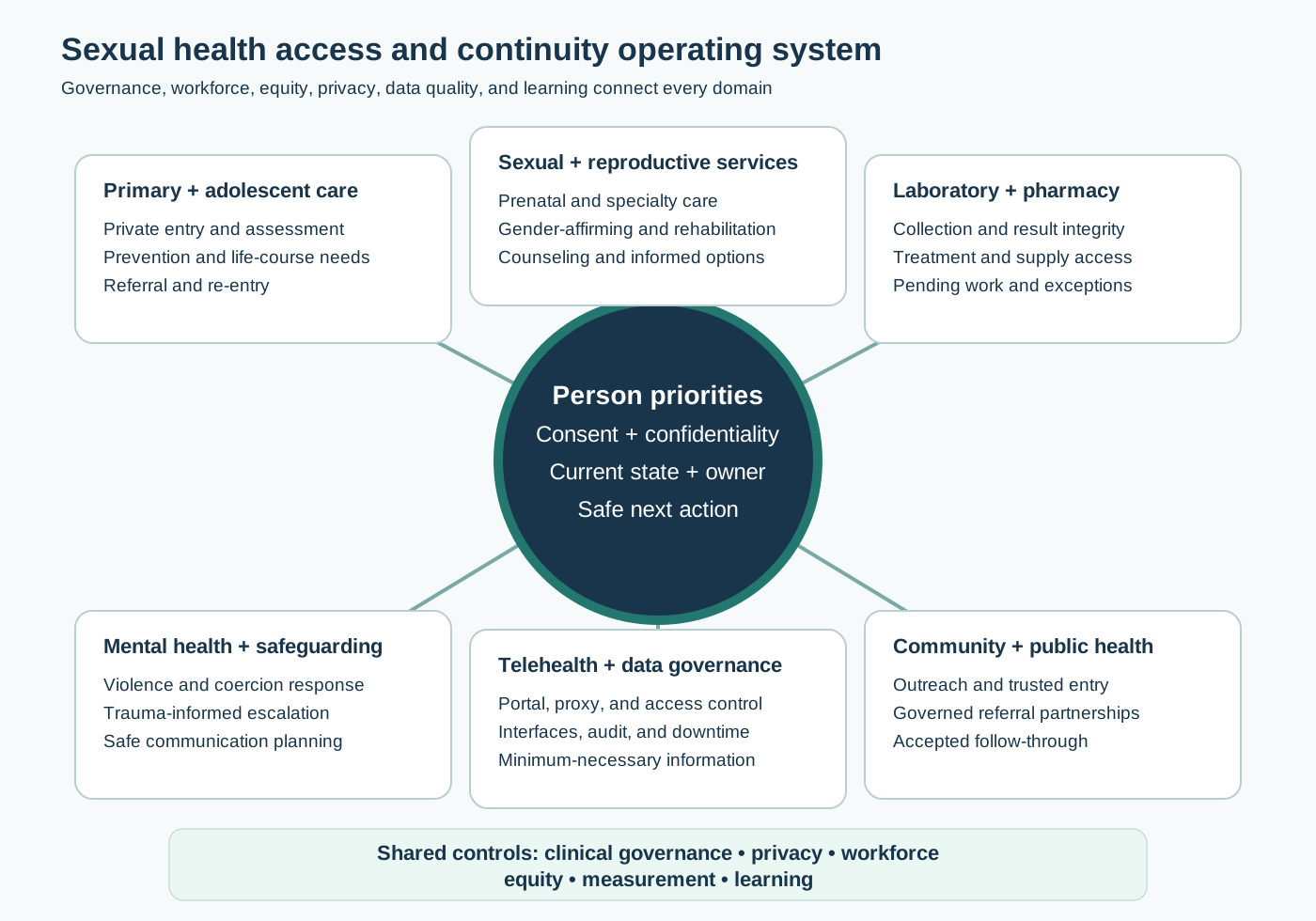
Govern the route as a shared service.
- Executive sponsor: resolves cross-service barriers, aligns resources, and protects the privacy and equity commitments.
- Clinical owner: maintains clinical governance, current guidance, escalation, and appropriate variation.
- Nursing and operations owners: make entry, intake, collection, communication, and handoffs workable across locations and operating periods.
- Privacy, safeguarding, and legal partners: maintain approved confidentiality, proxy, contact, documentation, reporting, and exception guidance.
- Laboratory and pharmacy owners: make orders, collection, result routing, access, supply constraints, and treatment dependencies visible.
- Digital and data stewards: validate interfaces, portals, access controls, identity, auditability, downtime, and denominator integrity.
- Community and patient partners: test whether communication, location, trust, and follow-through work outside the organization’s view.
Use one minimum information set.
The route should preserve the patient’s preferred name and communication method where permitted, current privacy and contact constraints, the governed clinical state, informed choices and declines, required follow-up, pending orders or results, responsible role, referral acceptance status, safety or accessibility needs, and the next review point. Limit information to what is necessary for the current responsibility. Do not copy sensitive details into places where they are not needed.
When responsibilities cross organizations, define what can be shared, through which approved channel, with whose consent or authority, and how receipt is acknowledged. A directory listing or memorandum of understanding is not a closed handoff. Test the route with real operating hours, referral criteria, capacity constraints, and response expectations.
Prepare for volume, complexity, and interruption.
An observance may increase requests. Forecast demand across scheduling, clinical time, interpreters, specimen collection, laboratory processing, pharmacy, counseling, referrals, and community partners. Decide how urgent concerns are escalated under current policy and how routine work is queued transparently. Monitor whether access improvement in one stage creates delay or privacy risk elsewhere.
Build downtime and continuity plans for portal failure, telehealth outage, laboratory interface interruption, staff shortage, supply constraint, community partner closure, and unsafe contact. The plan should identify interim owners and communication safeguards. Rehearse the exceptions rather than discovering them during a sensitive patient interaction.
Measurement architecture
Use a scorecard that keeps privacy, access, completion, equity, experience, workforce, and unintended burden visible.
Every measure needs a numerator, denominator, owner, source, review cadence, inclusion and exclusion rule, and limitation. Validate that a data field reflects real work before using it for accountability. Protect sensitive small groups and avoid reporting combinations that could identify individuals. A clinical action may be appropriately declined, not indicated, contraindicated, unavailable, or replaced by another plan. Preserve those distinctions.
Figure 5. Proposed sexual health route-reliability scorecard
| Domain | Measure | Denominator and owner | Review | Interpretation guardrail |
|---|---|---|---|---|
| Private entry | Eligible people offered a private, accessible entry option and confidentiality explanation | All eligible encounters; operations and privacy owners | Weekly | An offer does not prove safety, understanding, or willingness to disclose. |
| Assessment | Accepted entries reaching qualified assessment or a documented patient-selected alternative | All accepted entries; clinical owner | Weekly | Preserve consent, clinical variation, and appropriate decline. |
| Completion | Selected service completed, or exception state actively owned | All selected services; route owner | Twice weekly | An order, booking, or referral is not completion. |
| Results | Results reviewed and communicated through a safe, governed method | All results; clinical and data owners | Each operating day | Portal release alone does not prove review, safety, or understanding. |
| Handoff | Referrals and transfers with accepted ownership and next action | All outgoing handoffs; sending and receiving owners | Weekly | A sent message is not accepted responsibility. |
| Privacy | Proxy, portal, billing, contact, documentation, and disclosure exceptions reviewed | All privacy exceptions; privacy and safeguarding leads | Monthly | Use minimum-necessary review and protect incident confidentiality. |
| Equity | Offer, acceptance, completion, open-state, wait, and follow-through variation | Complete route denominator; equity and analytics leads | Monthly | Report missingness, small numbers, context, and uncertainty. |
| Balancing | Waits, staff workload, laboratory demand, false starts, duplicate testing, unsafe messages, and burden shifted to patients | Patients and participating teams; executive sponsor | Monthly | Improvement in one stage may move risk or workload elsewhere. |
Use cascades to expose where the route loses people.
Report counts and percentages for each state using both the initial denominator and the immediately preceding state. The MyCheck and PrEP Well cascades show why this matters. A high acceptance rate can coexist with a much lower initial-to-completion rate. A high 30-day uptake rate among people prescribed can coexist with a smaller proportion of the original group reaching that state. Show exclusions and missing data rather than silently removing them.
Pair quantitative data with representative accounts from people who completed, declined, deferred, could not access, experienced a privacy concern, waited for results, lost a referral, or returned after a gap. Ask what the dashboard cannot see. Seek appropriate authorization and avoid collecting more sensitive information than the improvement question requires.
Separate patient choice from system failure.
A person may choose not to answer, test, disclose, treat, or continue. Respectful care requires documenting informed choice without punitive labeling. A system failure is different: the person was not offered the route, could not obtain privacy, was given inaccessible information, encountered an unavailable service, received an unsafe message, waited without a visible owner, or had a referral rejected without a new plan. Design measures that distinguish these states.
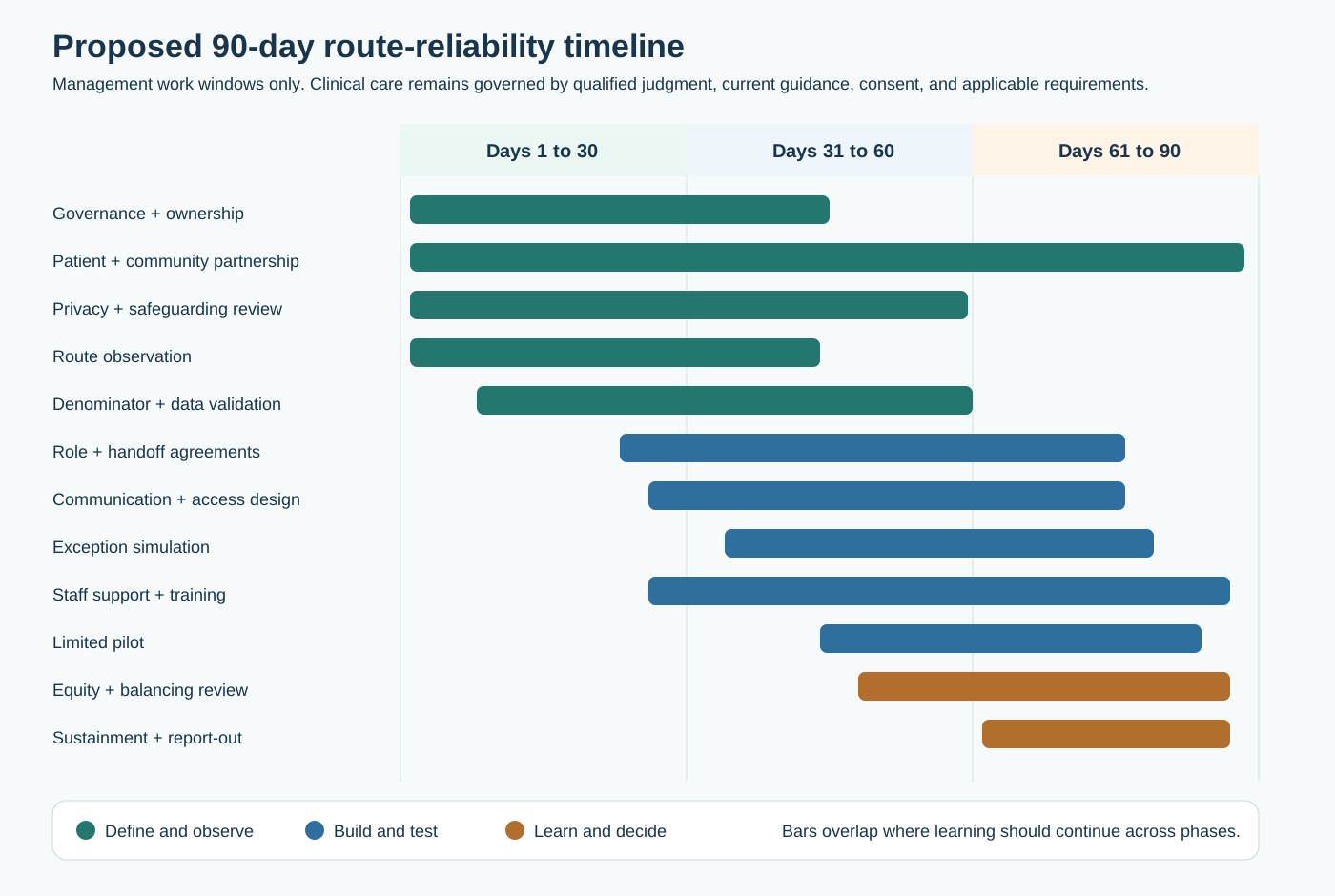
90-day executive agenda
Use the observance to test one bounded route, repair one verified barrier, and leave durable privacy and follow-through controls behind.
Days 1 to 30
Define and observe
- Name executive, clinical, nursing, operations, privacy, data, equity, and community owners.
- Select one bounded route and define its complete denominator.
- Document current consent, confidentiality, proxy, portal, billing, contact, safeguarding, and reporting rules.
- Observe work across representative sites, hours, and patient circumstances.
- Review offers, declines, incomplete states, referrals, results, privacy exceptions, and staff workarounds.
Days 31 to 60
Build and test
- Clarify the private entry point, clinical owner, minimum information, handoff acknowledgment, and interim ownership.
- Validate portal, interface, result, contact, and small-number privacy controls.
- Prepare plain-language explanations and accessible communication options.
- Simulate unsafe contact, incomplete disclosure, collection failure, indeterminate results, service unavailability, and referral rejection.
- Begin a limited pilot with rapid patient and frontline feedback.
Days 61 to 90
Learn and decide
- Reconcile the complete denominator and every open exception.
- Compare access, privacy, completion, equity, experience, workload, and capacity signals.
- Correct one verified work-system condition and retest the affected stage.
- Report what changed, what did not, and which evidence remains uncertain.
- Decide to adapt, expand, pause, or stop, and assign the sustainment review.
Figure 6. Proposed 90-day sexual health route-reliability timeline
Questions for the day-90 executive review
- Can the team produce the complete denominator, including people not offered the route, informed declines, incomplete states, lost referrals, unsafe contact situations, and unresolved exceptions?
- Which transfer of responsibility failed most often, and what verified system condition contributed?
- Did the route become more usable without increasing privacy exposure, staff burden, laboratory delay, duplicate work, or patient coordination burden?
- Were consent, clinical judgment, and patient choice represented accurately?
- Did offer, acceptance, completion, safe communication, or follow-through vary by age, language, gender identity, sexual orientation, disability, geography, insurance, service location, or other locally relevant opportunity? How complete and safe are the data?
- Did patients understand confidentiality, options, the current state, the next owner, and how to re-enter?
- Which improvement is reliable enough to sustain, and who owns the next review?
Leave the organization with a private entry standard, a complete denominator, an accepted-handoff rule, an actively owned exception lane, a privacy and equity review, a visible result and referral state, and one verified reliability improvement that remains after the observance ends.
Closing perspective
Awareness becomes accountable when privacy, choice, clinical responsibility, and continuity stay connected.
Sexual health needs cross services, technologies, life stages, and community boundaries. No campaign can remove clinical complexity, and no dashboard can replace trust or qualified judgment. Leadership can remove avoidable ambiguity. Executives can protect private entry, resource the people who receive sensitive questions, require acknowledgment, keep results and referrals visible, connect patients to the next accountable state, measure equity and unintended burden, and learn from routes that remain open.
The strongest observance message is an operating commitment: when a person enters the selected route, the organization can show how confidentiality was explained, who completed the qualified assessment, what informed choice followed, who owns the current responsibility, what exception remains, how communication will occur safely, and how the person can re-enter if needs or circumstances change.
Peer-reviewed evidence portfolio
References
- Arns-Glaser L, Farnham A, Hochstrasser K, et al. Lowering the barriers to sexual health services: Impacts of free counselling and testing for sexually transmitted infections in Switzerland, an observational study. PLoS One. 2026;21(4):e0327114.
- Patel P, Carrington N, Lu H, et al. Evaluation of a novel comprehensive sexual health e-testing pathway to inform state-wide roll out in New South Wales, Australia. BMC Infectious Diseases. 2025;25(1):1062.
- Phiphatkunarnon P, Phanuphak N, Janamnuaysook R, et al. Comprehensive analysis and leveraging online innovations to improve HIV and STI prevention and treatment services in major cities of Thailand. AIDS and Behavior. 2025;29(8):2543-2553.
- Nunes SF, Silva KN, Oliveira RA, et al. Protocols and guidelines for sexually transmitted infection management in people deprived of liberty: an integrative review. Escola Anna Nery. 2025;29:1-10.
- Storholm ED, Nacht CL, Opalo C, et al. Preliminary outcomes from PrEP Well: A community-led, multicomponent HIV prevention strategy implemented in a transgender community health center. Journal of Community Health. 2025;50(5):842-859.
- Abakar SMM, Alhalangy A, Alkhamis SA. Relevance of cybersecurity in maintaining the integrity of reproductive healthcare services. African Journal of Reproductive Health. 2025;29(Supplement):14-17.
- Kinard A, Johnson KC, Brosnan A, et al. Prenatal sexually transmitted infection screening guidelines: Current and future dissemination strategies. Advances in Public Health. 2026;2026:1-7.
- Maany V, Strauss J, Rieger RH, et al. The impact of implementing a self-administered electronic sexual health questionnaire on STI testing and diagnosis rates. Journal of American College Health. 2025;73(5):2109-2115.
- Hentges M, Kågesten AE, Brandén G, et al. Effects of COVID-19 measures on access to HIV/STI testing and condoms among adults in Sweden: a cross-sectional online survey. Scandinavian Journal of Public Health. 2024;52(3):299-308.
- King HL, Park E, Blanchard H, et al. Implementation of Sexual Health Curriculum Series: Educational initiative to increase STI screening and treatment in Dallas, Texas. Journal of Community Health. 2023;48(5):793-797.
- Gu F, Willis J, Lassi ZS, et al. Navigating care pathways: a case study of integrated sexual and reproductive health services at a statewide sexual and reproductive health agency in South Australia. Australian Journal of Primary Health. 2026;32(3):1-9.
- Hernandez R, Ebersole DS. Dialectics of disclosure: Communication Privacy Management in provider-patient conversations about sexual health. Sexual Health. 2026;23(1):1-8.
- Muchanga V, Moon TD, Munguambe K, et al. Barriers to access and use of sexual reproductive health and human immunodeficiency virus services among adolescent girls and young women in Maputo City, Mozambique. African Journal of Reproductive Health. 2026;30(11):72-86.
- Abame DE, Mengistu M, Sullamo D. Satisfaction with sexual and reproductive health services and associated factors among women visiting public health facilities of Kembata Zone, Ethiopia. Health Services Insights. 2026;19:1-10.
- Noluthando M, Mokgatle MM, Seretlo RJ. Treatment seeking behaviours for sexually transmitted infections among young adults in Ekurhuleni East, Gauteng, South Africa: a qualitative study. African Journal of Reproductive Health. 2026;30(7):15-28.
- Foppert L, Bowles W, Belardo H, et al. Adolescent chlamydia screening in pediatric primary care: A quality improvement project. Journal of Advanced Nursing. 2025;81(11):8028-8035.
- Marin-Cespedes S, Miller L, Elkins J, et al. Awareness in action: Methodology and assessment of a collaborative multi-college HIV/STI testing initiative in the Southern US. Journal of American College Health. 2026:1-10.
- Dadi AN, Arije O, Eruchalu K, et al. Understanding barriers to healthcare and harm reduction services among women who inject drugs in Nigeria: A qualitative assessment. PLoS Global Public Health. 2026;6(8):e0007008.