

· Executive field brief
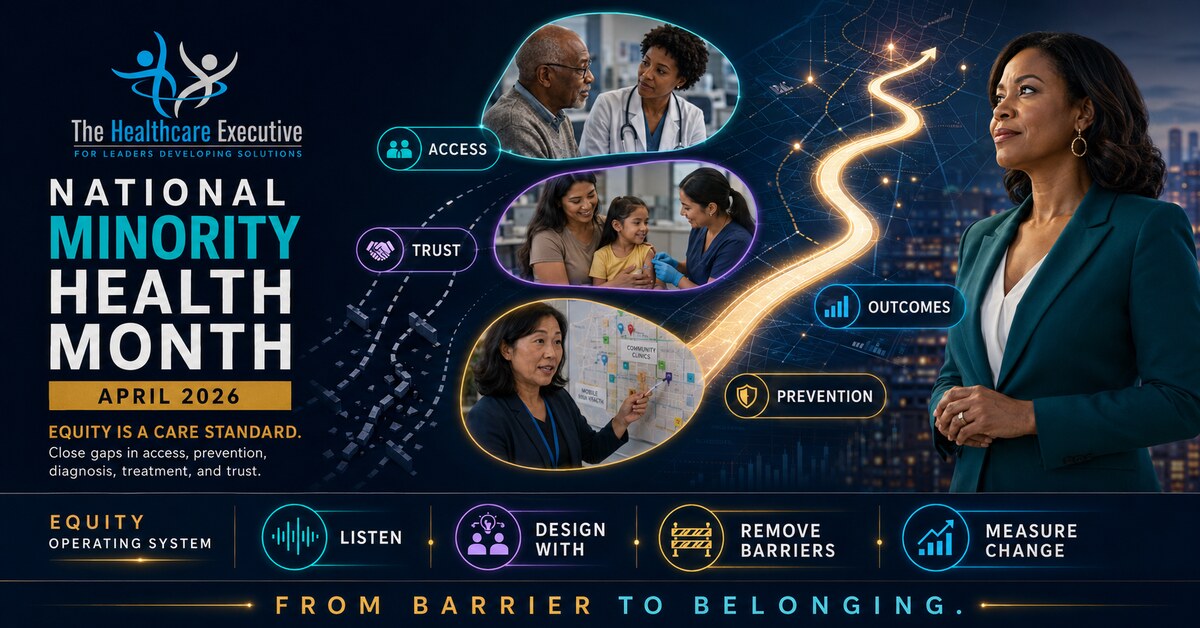
National Minority Health Month 2026
See the local pattern. Remove the barrier. Return the result to the community.
Editorial focus, not an official themeMake equity visible in the operating system.
The 2026 leadership signal
An average can hide the people your system is missing.
National Minority Health Month gives healthcare leaders a reason to replace broad awareness with local evidence. The HHS Office of Minority Health maintains federal data tools and population profiles that show why one organization-wide average is not enough. Access, communication, experience, safety, and outcomes can differ across populations, locations, languages, and care settings.
Precision matters. The National Institute on Minority Health and Health Disparities defines a health disparity as a measurable difference in health between specific population groups. That difference is a data-driven starting point. It does not, by itself, establish a cause. Leaders should quantify the gap, test data quality, investigate likely mechanisms with the people affected, remove a verified barrier, and measure again.
The Minority Health Index reinforces the local view. It combines more than 15 medical and non-medical factors across six themes and presents county-level information for planning. Its own guidance warns that a county measure does not describe every person within that county. The same discipline belongs inside a health system: group-level evidence can reveal a pattern, but it should never become a stereotype or a shortcut for individual care.
- StratifySeparate the average using lawful, reliable, meaningful categories.
- QuantifyDefine the denominator, comparison, uncertainty, and size of the gap.
- InvestigateTest likely causes with workflow evidence and community insight.
- RemoveChange one verified barrier with a named operational owner.
- RemeasureTrack benefit, burden, unintended effects, and gap closure.
System route
Move from pattern to proof without turning data into labels.
An equity route begins with a decision that matters to patients, not with a demographic dashboard in search of a use. Choose a specific care moment such as appointment access, diagnostic follow-up, medication reconciliation, discharge understanding, maternal warning-sign response, or chronic disease monitoring. Name the population, setting, measure, denominator, time period, and operational owner before comparing results.
Then test the pattern. Missing demographic data, unstable sample sizes, inconsistent category mapping, and changes in documentation can create an apparent gap or conceal a real one. Review privacy, suppression, consent, and governance requirements before displaying small groups. Combine quantitative findings with patient, family, workforce, and community input so the organization can distinguish a plausible explanation from a verified barrier.
- 01
- Frame the decisionName the patient journey, operational question, measure, and accountable executive.Proof: a written question with a defined use.
- 02
- Validate the dataCheck completeness, category mapping, denominators, sample size, time period, and missingness.Proof: data-quality findings and disclosure rules.
- 03
- Locate the patternStratify a meaningful access, process, experience, safety, or outcome measure.Proof: an interpretable comparison, not a raw count.
- 04
- Investigate the barrierObserve the workflow and ask affected patients, families, staff, and community partners what the data cannot show.Proof: a tested causal hypothesis.
- 05
- Change the operationRedesign scheduling, communication, transportation support, digital access, staffing, or another verified failure point.Proof: one owner, one action, one completion date.
- 06
- Return and learnRemeasure, report what changed, invite challenge, and decide whether to scale, revise, or stop.Proof: results returned in an understandable format.
Operating dashboard
Build a measurement page that can lead to action.
A useful dashboard connects each measure to an operational decision. It shows the overall result and the distribution across relevant population groups, while preserving privacy and displaying missing data. It also names a balancing measure so a faster process does not become less understandable, less safe, or more burdensome.
Do not set universal targets without local baseline review, statistical support, and clinical context. A small apparent difference may be unstable. A large persistent difference may still require investigation before attributing cause. The measures below are an executive starting set, not federal requirements.
| Lens | Measure to stratify | Decision it should inform | Balancing question |
|---|---|---|---|
| Access | Time from request to completed visit or service. | Where should scheduling capacity, navigation, or outreach change? | Did access improve without increasing no-shows or travel burden? |
| Communication | Qualified language assistance and communication support delivered when indicated. | Which shifts, sites, and digital channels lack reliable support? | Did the patient understand the plan in their own words? |
| Process | Completion of a clinically appropriate follow-up step within the defined interval. | Which handoff, referral, or documentation point needs redesign? | Were exclusions and patient choices recorded correctly? |
| Safety | Validated safety events, delays, or missed escalations by care setting and population. | Where should a control, escalation, or review process change? | Does reporting access differ across groups or locations? |
| Experience | Respect, listening, trust, and clarity using a tested patient-reported item. | Which interaction, instruction, or environment requires repair? | Who is not represented among respondents? |
| Outcome | A condition-specific outcome with a valid clinical denominator. | Which upstream process should be investigated first? | Are severity, access, follow-up, and missing data considered? |
Handoff workflow
Carry the evidence into the workflow, then carry the result back.
Equity work often fails at the handoff between analytics, operations, clinical leadership, community engagement, and frontline teams. A dashboard identifies a difference. It does not assign responsibility, confirm a mechanism, change a workflow, or tell the community what happened. Those actions require a closed-loop operating note.
Use one note for every disparity-improvement test. The analyst should not hand over a chart without its denominator and limitations. The operational owner should not announce a solution before the barrier has been tested. The community engagement lead should not be asked to validate a completed decision. Each role needs authority to question the evidence and stop an unsafe or poorly supported intervention.
Equity field note, required elements
- Pattern
- State the measured difference, denominator, period, comparison, missingness, and statistical limitations.
- People and place
- Name the population and care setting without assuming that group identity explains the result.
- Barrier hypothesis
- Describe the suspected workflow mechanism and the evidence still needed to confirm or reject it.
- Community evidence
- Record who was asked, how participation was supported, what was heard, and where perspectives differed.
- Action and owner
- Specify the operational change, responsible leader, resources, start date, safeguards, and escalation route.
- Return and closure
- Document the remeasurement date, result, unintended effects, next decision, and how findings will be returned.
Executive scorecard
Ask for evidence that the barrier changed, not activity counts.
Training attendance, listening-session counts, translated document totals, and dashboard launches may show effort. They do not prove that access, communication, safety, experience, or outcomes improved. The executive scorecard should connect governance and implementation to a measurable patient result.
| Question | Evidence to request | Weak answer to challenge |
|---|---|---|
| Can we trust the comparison? | Definitions, denominators, completeness, missingness, suppression, trend, and validation. | The dashboard shows a gap. |
| Do we understand the likely mechanism? | Workflow observation, patient and workforce insight, record review, and alternative explanations. | This population is hard to reach. |
| Is communication reliably accessible? | Language assistance, disability access, health literacy review, patient understanding, and after-hours availability. | Materials were translated. |
| Did the operating change occur? | Owner, completion, adoption, exceptions, frontline observation, and escalation closure. | Staff completed training. |
| Did the patient result improve? | Remeasured access, process, experience, safety, or outcome gap with balancing measures. | The project launched on time. |
| Did we return the result? | Understandable reporting, community response, open questions, and the next decision. | A summary is on the intranet. |
90-day plan
Complete one credible cycle before expanding the portfolio.
Choose one patient journey with enough volume, a meaningful outcome, an accountable operational owner, and a realistic opportunity to change. The goal is not a permanent committee. It is a complete learning cycle that demonstrates disciplined measurement, community partnership, workflow repair, and transparent return of results.
- Days 1 to 30Frame and verify
Select the journey and outcome. Establish the data definition, lawful stratification categories, denominator, missingness view, privacy rules, executive sponsor, operational owner, community partners, and patient-safety safeguards. Validate one baseline gap before proposing a remedy.
- Days 31 to 60Listen and redesign
Observe the workflow. Engage affected patients, families, staff, and community partners early enough to change the decision. Test likely causes. Select one verified barrier. Co-design the smallest operational change that could improve the result without shifting burden elsewhere.
- Days 61 to 90Pilot and return
Run the change in two settings or teams. Review exceptions weekly. Track adoption, balancing measures, and the stratified result. Decide whether to scale, revise, or stop. Return the findings in plain language, including what remains unresolved and when the next review will occur.
Leadership close
Equity becomes credible when the operating evidence closes the loop.
An average can improve while a gap widens. Leaders have to look at both.
National Minority Health Month should leave the organization with more than a campaign calendar. It should create a repeatable way to see who is missing, understand why a difference may exist, remove a confirmed barrier, and learn whether the change worked.
The work is neither demographic profiling nor a search for a single explanation. It is disciplined healthcare management. Use group-level evidence to identify a pattern. Use individual communication to understand the person. Use community partnership to test the system. Use remeasurement to hold the organization accountable.
Make one gap visible. Put one owner on the barrier. Return one result to the people whose experience made the work possible.
Authoritative resources
Start with current federal definitions, data, and service standards.
- HHS OMH
National ObservancesFederal observance context and current Office of Minority Health resources.
- HHS OMH
Minority Health IndexCounty-level mapping and data resource covering medical and non-medical factors.
- HHS OMH
Minority Health Index Frequently Asked QuestionsMethods, uses, data limitations, six themes, and warnings about interpreting county-level measures.
- HHS OMH
Population ProfilesFederal summaries for American Indian and Alaska Native, Asian American, Black and African American, Hispanic and Latino, and Native Hawaiian and Pacific Islander populations.
- HHS OMH
National CLAS StandardsFifteen action steps for culturally and linguistically appropriate services in health and health care.
- NIH NIMHD
What Are Health Disparities?Current definition, measurement principles, reference-group considerations, and the distinction between identifying a gap and attributing a cause.
- NIH NIMHD
NIMHD Research FrameworkA multilevel, life-course framework for considering determinants and outcomes without reducing disparities to one factor.
- HHS OMH
Resource Center and Knowledge CenterResearch assistance, literature, technical support, and information services related to minority health.