


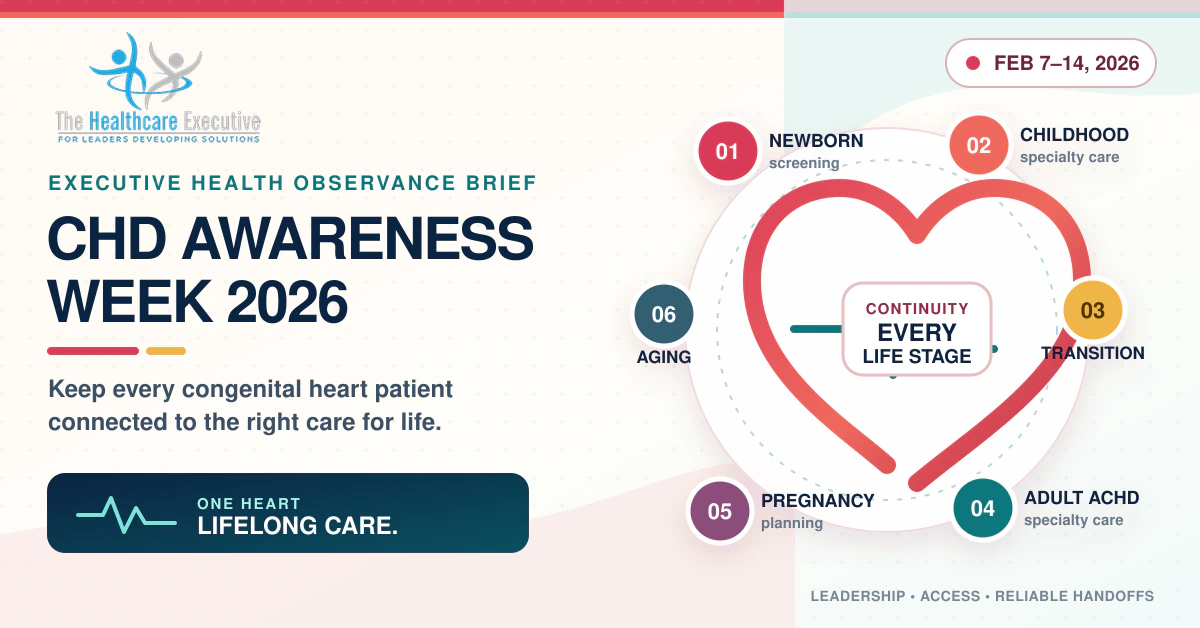
Health observance executive brief | February 7 to 14, 2026
CHD Awareness Week 2026: Keep every person born with a heart defect connected to the right care across a lifetime
Congenital heart disease becomes a lifelong operating responsibility when leaders connect detection, pediatric specialty care, transition preparation, adult congenital expertise, reproductive and mental health, acute care, and aging through one visible route.
Executive brief
CHD Awareness Week is a leadership test of lifetime continuity
CHD Awareness Week takes place February 7 to 14, 2026. In this article, CHD means congenital heart disease, an umbrella term for structural heart differences present at birth. The observance is an opportunity to recognize people, families, clinicians, and communities while asking a practical executive question: can every person born with a heart defect find the right care at the right life stage without having to rebuild the route alone?
Observance identity
Date: February 7 to 14, 2026. Public wording: CHD Awareness Week. Executive use: pair recognition with a measurable continuity commitment. Confirm current observance language and activities with the Adult Congenital Heart Association before publication.
For decades, better diagnosis, surgery, intensive care, catheter-based treatment, nursing, and follow-up have changed survival. That success creates a larger, more diverse population of children, adolescents, adults, and older adults living with repaired, palliated, or unrepaired congenital heart disease. Survival does not end the need for expertise. Anatomy, prior procedures, residual lesions, rhythm risks, ventricular function, medications, pregnancy considerations, mental health, neurodevelopment, exercise, preventive care, and noncardiac conditions can all change the care plan over time.
The central management risk is discontinuity. A person may be discharged from pediatric care before a relationship with adult congenital heart disease services is established. An adult may be seen only when symptoms become urgent. A primary care, emergency, obstetric, behavioral health, dental, or surgical team may not have a concise record of the person’s anatomy and prior interventions. Families may be told to encourage independence without receiving a clear plan for how responsibility will shift. Each gap can look small in one department while becoming consequential across a lifetime.
A systematic review and meta-analysis of 17 studies involving 6,847 young people estimated that 26.1% discontinued cardiac follow-up during the transition to adulthood, with a 95% confidence interval from 19.2% to 34.6%. Reported proportions ranged from 3.6% to 62.7%, and statistical heterogeneity was very high.14 The pooled value is not a target and should not be applied as a local forecast. It is a warning that continuity varies enough to require a defined pathway, a denominator, and direct measurement.
| Analysis | Studies and participants | Estimated discontinuity | 95% confidence interval | Important limitation |
|---|---|---|---|---|
| Overall random-effects meta-analysis of single proportions | 17 studies; 6,847 participants | 26.1% | 19.2% to 34.6% | Range 3.6% to 62.7%; I² = 97%; definitions and settings varied. |
| Simple CHD subgroup | Subgroup denominator not reported in the database abstract | 33.7% | 15.6% to 58.3% | Exploratory comparison; difference by complexity was not statistically significant, P = 0.2372. |
| Moderate CHD subgroup | Subgroup denominator not reported in the database abstract | 25.7% | 15.2% to 40.1% | Exploratory comparison with wide uncertainty. |
| Complex CHD subgroup | Subgroup denominator not reported in the database abstract | 22.3% | 16.5% to 29.4% | Lower point estimate does not prove lower individual risk. |
Figure note. Source: Moons et al. (2021).14 Values are percentages of young people with CHD discontinuing cardiac follow-up. The authors used a DerSimonian-Laird random-effects meta-analysis of single proportions. I² of 97% indicates very high heterogeneity. Subgroup denominators were not reported in the database abstract, so they are explicitly marked unavailable. The chart scale is visual support only; the accessible table contains the authoritative values. These estimates are not a quality benchmark, causal effect, or local forecast.
The executive promise
By the end of CHD Awareness Week, leaders should be able to state one bounded promise in operational terms. A useful example is: every adolescent with CHD who is approaching transfer will have an identified adult congenital heart disease destination, a portable clinical summary, documented readiness needs, and closed-loop confirmation of the first adult visit. Another organization may begin with reconnecting adults who have no recent specialty contact, improving pregnancy planning access, or ensuring emergency clinicians can find the lifelong plan.
The promise should name a population, an owner, a start event, an end event, a time expectation, an escalation rule, and an equity review. It should not depend on the patient remembering every prior procedure or knowing which specialty is appropriate. It should also recognize informed choice. Continuity means that the route is visible and responsive, not that every person must accept the same service.
Lifetime route
Build one route that changes with the person
A lifetime pathway is not a single clinic schedule. It is a coordinated set of relationships and information that can adapt as anatomy, risk, goals, capacity, and life circumstances change. The route begins with detection and diagnosis, continues through pediatric and adult congenital expertise, and connects the services that make daily life and preventive care possible.
- Detect and explainComplete newborn or later detection, confirm anatomy, explain uncertainty, and connect the family to the appropriate specialty team.
- Coordinate pediatric careTrack interventions, residual risks, development, school needs, medicines, preventive care, and family support.
- Prepare for transitionBuild knowledge and self-management skills gradually while supporting changing family roles and accommodations.
- Complete adult connectionIdentify the receiving adult congenital service, transfer the summary, and confirm a completed first encounter.
- Integrate life-stage careCoordinate reproductive, mental health, exercise, primary, dental, emergency, surgical, and noncardiac specialty care.
- Support aging and re-entryMonitor late effects and multimorbidity, update goals, and provide rapid reconnection after any lapse.
Figure note. This is a proposed operating flow synthesized from systematic reviews of transition, family experience, physical activity, reproductive care, neurodevelopment, behavioral health, and lifetime risk.2, 3, 4, 6, 9, 10, 11, 14 It is not a validated clinical protocol. Local teams must adapt decision points to anatomy, physiology, guideline recommendations, geography, capacity, and patient preference.
Start transition preparation before the transfer date
Transfer is the event when care moves to an adult setting. Transition is the developmental and operational process that prepares the young person, family, and receiving team. Treating the two as synonyms encourages a late administrative handoff. Effective design begins earlier and changes over time. A young person may need to learn their diagnosis, prior procedures, medicines, symptoms that require urgent attention, how to request refills, how insurance works, and how to contact the care team. Readiness should be assessed repeatedly and supported, not used as a pass-fail gate.
A 2023 systematic review of 59 studies reported an average loss to follow-up of 26.1%, rising to 31.9% in a worst-case analysis that treated untraceable patients as not receiving cardiac follow-up. The review emphasized planned transition, recall, primary care involvement, and close relationships between pediatric and adult congenital teams.10 The review brought together heterogeneous study designs and settings. Its percentages should prompt local measurement, not be copied into a performance target.
Family experience is essential. A 2025 qualitative systematic review included six studies, 39 findings, seven categories, and three synthesized themes. Parents described information as a prerequisite, wanted preparation tailored to maturity, and experienced ambivalence as their role changed.2 This evidence argues against abruptly excluding families in the name of independence. With the young person’s consent and appropriate privacy safeguards, teams can teach families how to shift from managing every task to coaching, supporting, and stepping in during risk.

Define a completed handoff
A referral order is an invitation to a process, not evidence that continuity was achieved. A completed handoff should include a named receiving service, confirmation that the referral was accepted, records available before the visit, a completed encounter or documented patient decision, and a clear owner for unresolved work. The portable summary should include the congenital diagnosis in precise language, relevant anatomy and physiology, prior operations and catheter procedures, implanted material or devices, current medications, allergies, recent testing, rhythm history, endocarditis guidance when applicable, exercise advice, reproductive considerations, and urgent contact information.
Leaders should test whether the summary can be found from emergency, primary care, inpatient, and obstetric workflows. A document that exists only in a specialty note may be technically complete and operationally invisible. Patient access matters too. The person should be able to view, download, print, and share a plain-language version without depending on a single portal session.
When an adult is identified after a lapse, do not recreate the adolescent transition pathway as a prerequisite. Create a rapid re-entry route that can triage urgency, retrieve prior records, identify an appropriate adult congenital service, and address insurance, transportation, work, or caregiving barriers. The measure is reconnection with the right service, not completion of a generic education checklist.
Connect neurodevelopment, school, work, and behavioral health
Congenital heart disease can affect more than the heart. A 2024 systematic review of meta-analyses found recurring cognitive vulnerabilities among children and young people with CHD, while emphasizing variation by diagnosis, treatment history, age, measures, and study quality.6 Another 2024 review synthesized 34 studies of school and cognitive domains of health-related quality of life, with 17 included in formal meta-analysis.8 These findings support reliable access to developmental screening, neuropsychology, school coordination, rehabilitation, and accommodations based on individual need.
A 2024 meta-analysis of 11 studies involving 296,741 participants estimated that children with CHD had higher odds of attention-deficit/hyperactivity disorder than reference groups, odds ratio 2.98 with a 95% confidence interval from 2.18 to 4.08. Heterogeneity was moderate, and observational data cannot prove that CHD caused an individual child’s diagnosis.9 Leaders should avoid deterministic messages. The operational response is to make assessment and support accessible when concerns emerge.
Behavioral outcomes are similarly nuanced. A 2023 meta-analysis of 24 studies reported small increases in internalizing and total behavior problems compared with healthy peers, no clear difference in externalizing problems, and significant unexplained heterogeneity. The authors rated the evidence as generally low quality.13 A pathway should therefore normalize screening, referral, and crisis response without implying that every person with CHD will experience a mental health condition.
Figure note. This qualitative fishbone is a proposed discovery tool, not a ranked causal model, risk score, or Pareto analysis. Categories synthesize themes from transition, family-experience, equity, cognitive, and behavioral reviews.2, 6, 7, 8, 9, 10, 13, 14 Validate local contributors with people living with CHD, families, community partners, and frontline teams before selecting interventions.
Make equity visible without blaming patients
A 2024 systematic review of race, ethnicity, and mortality in pediatric CHD included 38 studies. Eighteen of 26 studies that examined non-Hispanic Black patients reported increased mortality risk, while findings for Hispanic patients were heterogeneous.7 The review describes patterned differences, not biological explanations. Race and ethnicity are social classifications that can reveal unequal exposure to access barriers, quality differences, structural racism, socioeconomic conditions, and other system factors.
Equity review should begin with the pathway. Stratify referral acceptance, transfer completion, time to specialty care, records completeness, canceled appointments, urgent admissions, patient-reported plan clarity, and reconnection after lapse. Pair the data with interviews and workflow observation. Small-cell suppression and privacy protection are essential. When a difference appears, direct attention to scheduling, geography, language access, insurance navigation, trust, referral patterns, and capacity before attributing the gap to patient behavior.
Socioeconomic evidence reinforces this approach. A 2019 systematic review and meta-analysis found socioeconomic inequalities in mortality among children with CHD, although exposure definitions, populations, and outcome periods varied.16 A practical response is to build transportation, benefits navigation, interpretation, remote options, and community connections into the standard pathway. These supports should not be available only after repeated missed appointments.
Lifelong operating system
Connect specialty expertise with the services that shape daily life
Adult congenital heart disease care cannot function as an isolated destination clinic. People also need primary and preventive care, emergency response, mental health support, dental care, reproductive counseling, pharmacy, rehabilitation, social services, and noncardiac specialty care. The operating system should make specialty input available to these settings while preserving the role of local clinicians.

Plan reproductive and pregnancy care before urgency
Reproductive goals should be invited respectfully and revisited over time. Counseling may include contraception, inheritance, medication review, hemodynamic risk, fertility, preconception evaluation, pregnancy management, delivery planning, and postpartum follow-up. The pathway should support people who do not want pregnancy, people who are considering pregnancy, and people who arrive pregnant without prior specialty planning. It should not make care contingent on a single life choice.
A 2025 systematic review and meta-analysis of pregnancy in people with Fontan circulation included 18 studies, 400 pregnant women, and 1,260 pregnancies. The pooled incidence of maternal arrhythmia was 6.59%, with a 95% confidence interval from 3.22% to 10.83%. Maternal heart failure was 3.71%, with a 95% confidence interval from 0.94% to 7.67%. Preterm delivery was common at 57.31%, with a 95% confidence interval from 40.19% to 73.66%, and neonatal mortality was 4.38%, with a 95% confidence interval from 2.08% to 7.23%. No maternal deaths were reported in the included studies.3
These pooled estimates describe a selected high-risk population, not all people with CHD. The studies were observational, outcomes varied, and clinical selection affects who became pregnant. The executive implication is not a universal prohibition. It is to create timely access to adult congenital cardiology, maternal-fetal medicine, obstetric anesthesia, pharmacy, genetics when desired, and neonatal services, with a documented delivery and postpartum plan.
Treat mental health as part of congenital heart care
Anxiety, depression, trauma, uncertainty, body image, procedure fatigue, grief, and fear of future complications may arise at different points. Screening is useful only when positive results lead to an accessible response. Define who reviews results, the response interval, urgent escalation, referral options, and how the congenital heart team communicates with behavioral health.
The EMBRACE randomized wait-list study tested a six-week virtual mindfulness-based behavioral intervention for adults with CHD. Forty-one participants enrolled and 31 completed the study. The randomized groups did not differ in changes across outcomes. Within participants, anxiety, depression, resilience, and mindfulness measures improved after the intervention, and satisfaction was high.1 Because the sample was small, attrition occurred, and between-group differences were not demonstrated, the study supports feasibility and further evaluation rather than a definitive effectiveness claim.
A 2019 clinical review emphasized that anxiety and depression can be missed in adults with CHD and described practical referral considerations.15 Leaders should map local behavioral health access, including language, insurance, telehealth, and crisis pathways. A specialty clinic should not collect sensitive information unless it can explain how that information will be used and what support is available.
Support activity through individualized guidance
Overrestriction can reduce confidence, participation, and physical conditioning, while some people require specific limits or testing. A 2023 review of sports, exercise training, and physical activity in children with CHD found evidence of potential benefits but substantial variation across diagnoses, programs, measures, and study quality.11 The operational need is a reliable place to obtain individualized advice, school or sports documentation, rehabilitation when indicated, and reassessment after clinical change.
Exercise guidance should be written in plain language and carried into primary care, school, community, and rehabilitation settings. Generic statements such as “activity as tolerated” may not answer questions about intensity, symptoms, contact sports, devices, anticoagulation, or competitive participation. The plan should distinguish everyday movement, structured exercise, rehabilitation, and competitive sport, with clear signs for stopping and seeking help.
Prepare for aging, cancer prevention, and noncardiac disease
Longer survival increases the importance of preventive care and coordinated noncardiac treatment. A 2025 meta-analysis of six studies with 276,124 participants reported a pooled cancer hazard ratio of 1.71, with a 95% confidence interval from 1.28 to 2.28, for people with CHD compared with controls. Heterogeneity was very high at I² = 97%.4 The estimate does not establish an individual forecast and may reflect syndromes, prior exposures, surveillance, and other factors. It supports dependable primary care, evidence-based screening, radiation stewardship, risk communication, and coordination with oncology when needed.
A 2025 meta-analysis also examined endothelial dysfunction in adults with CHD and found evidence of impaired vascular function across selected measures, while studies and CHD populations were heterogeneous.5 This reinforces attention to blood pressure, lipids, diabetes, smoking, sleep, activity, renal function, and other modifiable risks without reducing congenital heart care to conventional cardiovascular prevention.
Aging pathways should include medication reconciliation, device and rhythm follow-up, heart failure, liver and kidney considerations where relevant, cognitive and functional assessment, frailty, falls, advance care planning, and caregiver support. Palliative care can be introduced based on needs and goals, alongside disease-directed care. Leaders should make these services available before a crisis, not only after repeated admissions.
Figure note. This proposed diagram describes functions, not a required reporting structure. It synthesizes evidence across transition, family experience, neurodevelopment, activity, reproductive care, behavioral health, equity, and lifetime risk.1–16 Local governance should assign a named owner to each handoff, define backup coverage, and avoid duplicate outreach from disconnected teams.
Make the data layer useful at the point of care
A registry can identify approaching transfers, overdue specialty contact, incomplete referrals, and adults who may need reconnection. It should not become a passive list. Every flagged record needs a work queue, owner, due date, contact strategy, clinical escalation rule, and documented outcome. Repeated outreach should be respectful and offer alternatives rather than assume noncompliance.
Interoperability should focus on the information that changes decisions. A concise congenital heart summary, current physiology, prior interventions, devices, medications, allergies, recent testing, and emergency considerations are more useful than hundreds of unfiltered pages. Teams should test the summary with clinicians who did not create it and with people living with CHD. If either group cannot find or understand the next action, the document is not ready.
Measurement
Measure relationships completed, not referrals generated
A small balanced portfolio can show whether the pathway works. Process measures should cover identification, referral acceptance, record transfer, first completed encounter, and closure of unresolved work. Patient-reported measures should cover plan clarity, confidence, respect, and burden. Balancing measures should watch workload, unnecessary duplication, wait times, and urgent utilization.
Every measure needs an eligibility rule, denominator, owner, cadence, and escalation response. An “overdue” definition should account for clinical risk and documented plans rather than impose one interval on every anatomy. A “completed transfer” should require evidence of a receiving encounter or a documented informed decision, not only a scheduled appointment. A “portable summary complete” measure should sample the exact fields that matter across settings.
| Measure | Operational definition and denominator | Owner | Cadence | Recommended stratifiers |
|---|---|---|---|---|
| Adult specialty destination identified | Eligible adolescents with a named receiving adult congenital service divided by all adolescents entering the locally defined transfer window. | Transition pathway owner | Weekly work queue; monthly trend | Age, CHD complexity, race and ethnicity, language, payer, geography, referring site |
| Transfer completed | Eligible people with a completed receiving encounter or documented informed decision within the agreed interval divided by all eligible transfer cases. | Pediatric and adult congenital dyad | Monthly cohort review | Same as above, plus travel distance and virtual or in-person route |
| Referral closure | Accepted referrals with disposition, records received, and unresolved tasks closed divided by all accepted referrals in the cohort. | Navigation lead | Weekly | Referral source, urgency, language, payer, destination service |
| Portable summary completeness | Audited summaries containing every required local field divided by all summaries sampled. Report field-level defects separately. | Clinical informatics and specialty lead | Monthly sample | Source site, EHR route, age group, CHD complexity |
| Urgent reconnection | Adults identified after a lapse who complete appropriate specialty triage within the locally defined risk-based interval divided by all adults eligible for urgent re-entry. | Adult congenital access lead | Weekly | Identification source, symptoms, geography, payer, language |
| Plan clarity | Respondents selecting the top two positive options to “I know who to contact and what happens next” divided by all respondents, with response rate shown. | Experience lead | Monthly | Age, language, disability, race and ethnicity, geography, digital access |
| Equity gap review | Absolute and relative differences in selected completion and experience measures across prespecified groups, with small-cell suppression and qualitative follow-up. | Quality and equity governance | Quarterly | Use locally lawful, community-informed variables |
Figure note. This is a proposed measurement set, not a validated scale or national benchmark. Denominators must include every eligible person, including those not reached. Time intervals should be risk-based and locally defined. Stratification should direct improvement resources, protect privacy, suppress small cells, and avoid treating a social category as a biological cause.
Use patient-reported measures only when the response is real
Readiness, mental health, symptoms, quality of life, financial strain, and plan clarity can help teams see needs that clinical testing does not capture. The response pathway must be designed before the survey launches. Define who reviews each result, what threshold creates a task, the required response time, backup coverage, documentation, and what patients should do in an emergency. Provide non-digital and language-accessible options.
Report the response denominator. A high average score among a small, digitally connected subset can hide the experience of people who did not respond. Pair quantitative results with interviews and open-text review. People living with CHD should help decide which questions are worth asking and whether the follow-up was useful.

90-day action plan
Turn one observance week into a bounded operating test
The safest starting point is one population and one handoff. A hospital may choose adolescents scheduled to leave pediatric cardiology in the next 12 months. An adult program may choose adults with no documented specialty encounter in three years. A health system may choose pregnant patients with CHD who enter obstetric care without a documented adult congenital plan. The pilot should be small enough to learn quickly and meaningful enough to expose real ownership, information, capacity, and equity problems.
During the first two weeks, define the population, baseline, completion event, and harm-prevention rules. In the next month, map the current process with patients and frontline teams, build the portable summary and work queue, and test with a handful of cases. The middle phase should run a short pilot with daily review of defects. The final month should stabilize the workflow, examine stratified results, resolve governance questions, and decide whether to adapt, stop, or scale.
Figure note. This is a proposed improvement timeline, not an implementation mandate. It assumes executive sponsorship, clinical and operational co-ownership, patient partnership, privacy review, and available receiving capacity. Pause expansion if the pilot identifies clinical risk, unsafe workload, unreliable escalation, or widening inequity.
Scope
- Name the exact cohort and exclusions.
- Define the clinical and operational owners.
- Specify the receiving service and capacity.
- Set one completion event that can be audited.
Safety
- Define urgent symptoms and escalation.
- Provide backup coverage and non-digital access.
- Review privacy, consent, and family participation.
- Do not let an alert replace clinical judgment.
Experience
- Co-design language with people living with CHD.
- Ask whether the next step is clear and feasible.
- Offer interpretation and accessible formats.
- Document informed choices, including deferral.
Learning
- Review defects weekly, not only averages.
- Show denominators and missing data.
- Stratify results with privacy protection.
- Scale only after ownership and capacity are stable.
Communicate with precision and respect
Public messaging should define CHD on first use, avoid portraying people as fragile, and recognize that experiences differ widely. Use “people living with congenital heart disease” or the language preferred by the community. Do not imply that every defect is repaired permanently, that all adults need the same frequency of care, or that a single awareness activity substitutes for clinical improvement.
Pair each communication with a useful action: confirm the adult congenital referral pathway, audit portable summaries, publish reconnection contacts, train emergency teams, expand language access, or fund patient partnership. If the organization invites people to seek care, confirm that the destination can respond. Awareness without access can increase frustration and risk.
References
Peer-reviewed evidence
References are listed newest first. They were individually verified as peer reviewed through subscribed academic databases. Public links use DOI or PubMed destinations and do not identify private research platforms.
- Freedenberg, V. A., Steury, R., Podolsky, R., & John, A. S. (2026). EMBRACE Study: Outcomes of a randomized, mindfulness-based intervention for adults with congenital heart disease. Pediatric Cardiology, 47(4), 1536–1551. https://doi.org/10.1007/s00246-025-03933-2
- Lykkeberg, B., Noergaard, M. W., & Bjerrum, M. (2025). Experiences and expectations of parents when young people with congenital heart disease transfer from pediatric to adult care: A qualitative systematic review. Journal of Child Health Care, 29(3), 716–733. https://doi.org/10.1177/13674935241231024
- Attachaipanich, T., Attachaipanich, S., Kaewboot, K., et al. (2025). Pregnancy outcomes in Fontan circulation: A systematic review and meta-analysis. Proceedings (Baylor University Medical Center), 38(4), 486–496. https://doi.org/10.1080/08998280.2025.2479406
- Ren, L., Feng, M., Luo, Y., & Chen, Y. (2025). Risk of cancer in patients with congenital heart disease: A systematic review and meta-analysis. Cardiology, 150(3), 303–310. https://doi.org/10.1159/000540443
- Baroutidou, A., Dimitroulas, T., Arvanitaki, A., et al. (2025). Endothelial dysfunction in adults with congenital heart disease: A systematic review and meta-analysis. European Journal of Clinical Investigation, 55(5), e14376. https://doi.org/10.1111/eci.14376
- Koushiou, M., & Jossif, A. (2024). Cognitive functioning in children and young people with congenital heart disease: A systematic review of meta-analyses. Healthcare, 12(24), 2594. https://doi.org/10.3390/healthcare12242594
- Sooy-Mossey, M., Matsuura, M., & Ezekian, J. E. (2024). The association of race and ethnicity with mortality in pediatric patients with congenital heart disease: A systematic review. Journal of Racial and Ethnic Health Disparities, 11(4), 2182–2196. https://doi.org/10.1007/s40615-023-01687-2
- Mamasoula, C., Pennington, L., Adesanya, A. M., & Rankin, J. (2024). A systematic review and meta-analysis of school and cognitive function domains of health-related quality of life measures for children and young adults with congenital heart disease. Birth Defects Research, 116(1), e2275. https://doi.org/10.1002/bdr2.2275
- Tang, J., Ou, J., Chen, Y., et al. (2024). The risk of attention-deficit hyperactivity disorder among children with congenital heart disease: A systematic review and meta-analysis. Child: Care, Health and Development, 50(1), 1–11. https://doi.org/10.1111/cch.13174
- Bassareo, P. P., Chessa, M., Di Salvo, G., Walsh, K. P., & McMahon, C. J. (2023). Strategies to aid successful transition of adolescents with congenital heart disease: A systematic review. Children, 10(3), 423. https://doi.org/10.3390/children10030423
- Dold, S. K., Haas, N. A., & Apitz, C. (2023). Effects of sports, exercise training, and physical activity in children with congenital heart disease: A review of the published evidence. Children, 10(2), 296. https://doi.org/10.3390/children10020296
- Watkins, S., & Gentles, T. L. (2023). What is known about critical congenital heart disease diagnosis and management experiences from the perspectives of family and healthcare providers? A systematic integrative literature review. Pediatric Cardiology, 44(2), 280–296. PubMed record
- Finkel, G. G., Sun, L. S., & Jackson, W. M. (2023). Children with congenital heart disease show increased behavioral problems compared to healthy peers: A systematic review and meta-analysis. Pediatric Cardiology, 44(1), 116–123. PubMed record
- Moons, P., Skogby, S., Bratt, E.-L., Zühlke, L., Marelli, A., & Goossens, E. (2021). Discontinuity of cardiac follow-up in young people with congenital heart disease transitioning to adulthood: A systematic review and meta-analysis. Journal of the American Heart Association, 10(6), e019552. https://doi.org/10.1161/JAHA.120.019552
- Roseman, A., & Kovacs, A. H. (2019). Anxiety and depression in adults with congenital heart disease: When to suspect and how to refer. Current Cardiology Reports, 21(11), 145. PubMed record
- Best, K. E., Vieira, R., Glinianaia, S. V., & Rankin, J. (2019). Socio-economic inequalities in mortality in children with congenital heart disease: A systematic review and meta-analysis. Paediatric and Perinatal Epidemiology, 33(4), 291–309. PubMed record