
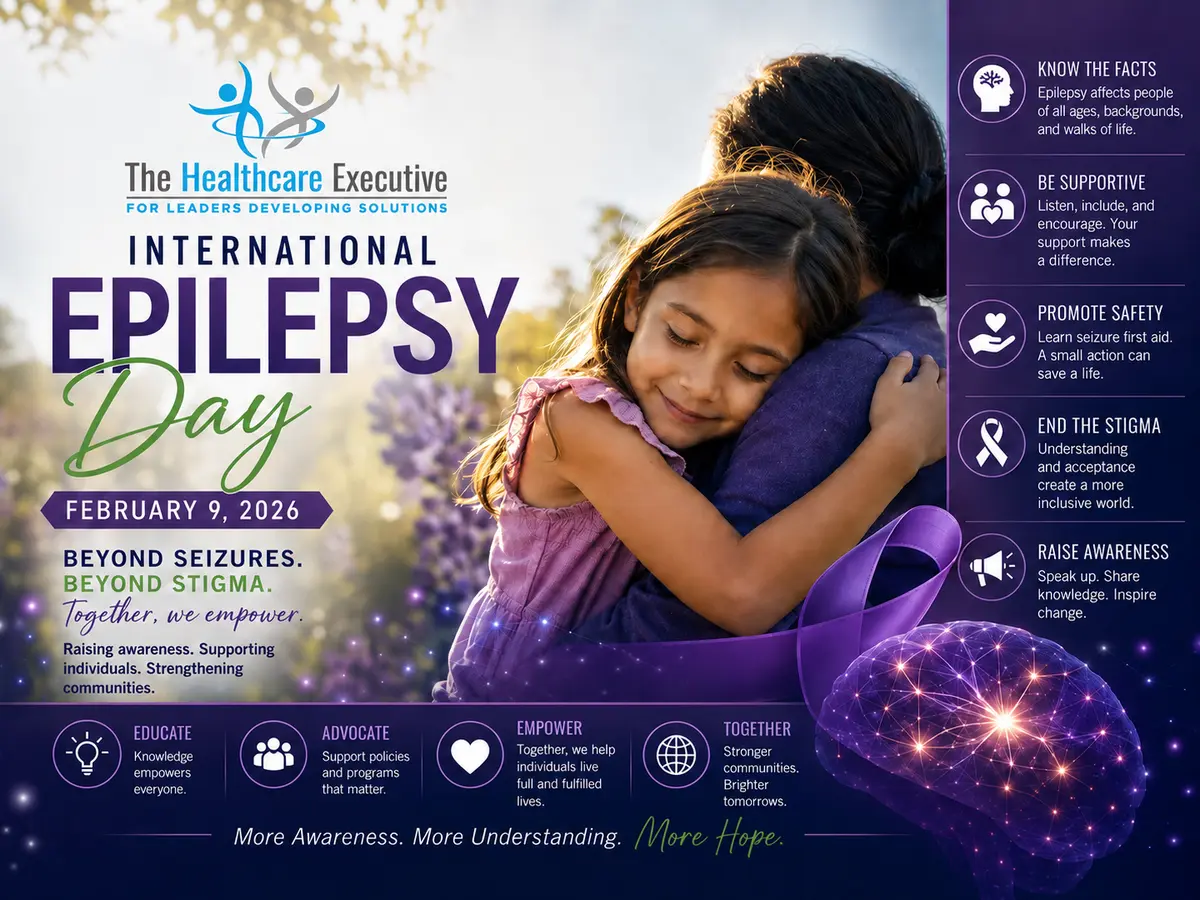

International Epilepsy Day 2026
Turn one pledge into a measurable improvement in seizure safety, access, inclusion, or continuity.
A pledge matters when the operating system changes.
Epilepsy care spans diagnosis, medication access, specialty care, seizure action plans, emergency response, education, employment, and protection from stigma.
The Epilepsy Pledge gives leaders a disciplined choice: select one concrete action, define the owner and measure, and keep it visible beyond the awareness day.
Epilepsy is not one uniform operating problem. Seizure types, frequency, recovery, treatment response, comorbidities, age, and daily-life risks vary. Measures therefore need a person-centered denominator and should not imply that one clinical outcome is appropriate or achievable for everyone. The pledge should improve a defined barrier or safety condition while preserving individualized clinical decisions.
First-aid readiness is a useful example because it reaches beyond neurology. Emergency departments, primary care, schools, behavioral health settings, employers, residential services, and public-facing teams may all encounter seizures. Training should be paired with a simple response standard, clear emergency thresholds, privacy guidance, and an accessible route for questions. Completion counts alone do not prove that responders can act safely.
Access reviews should separate the steps that are often collapsed into one referral measure: referral received, urgency assessed, appointment offered, appointment completed, testing completed, treatment plan communicated, and medication obtained. Seeing each step helps leaders distinguish capacity constraints from communication or navigation failures and assign the right owner.
The same discipline should apply to seizure action plans. A plan is only useful when it is current, understandable, available with consent, and paired with the supplies or rescue medication it references. Sampling plans across care settings can reveal outdated instructions, conflicting thresholds, or missing caregiver education before those gaps become an emergency.
Choose one pledge with people living with epilepsy, such as seizure first-aid readiness or faster specialty access, and make its owner, baseline, and 12-month target public internally.
WHO estimates that around 50 million people worldwide have epilepsy.
Nearly 80% of people with epilepsy live in low- and middle-income countries.
WHO estimates that up to 70% of people with epilepsy could live seizure-free if properly diagnosed and treated.
Figures are summarized from the authoritative sources linked below. Definitions and denominators should be read with each source.
Connect recognition, diagnosis, treatment, and everyday safety.
The route should work in clinics, emergency settings, schools, workplaces, and community spaces.
Recognize and respond
Teach seizure first aid, time the seizure, protect the person from injury, and use clear emergency thresholds.
Diagnose and classify
Create a timely path for first-seizure evaluation, appropriate testing, and specialist review based on clinical need.
Treat and monitor
Support medication access, adherence conversations, side-effect review, and escalation when seizures remain uncontrolled.
Include and support
Address stigma, safety planning, mental health, school or work accommodation, driving guidance, and caregiver needs.
Reliability rule: A seizure action plan must be accessible to the people expected to use it and aligned with the individual’s clinical plan.
Measure access, safety, and inclusion.
Use measures that reflect the chosen pledge and avoid treating seizure freedom as a simple performance target for every person.
First-seizure follow-up
Track the interval from acute evaluation or referral to the appropriate clinical follow-up.
Action-plan availability
Confirm that eligible people have a current, usable seizure action plan.
First-aid readiness
Measure trained staff in settings where seizure response is likely.
Access interruption
Monitor medication, specialist, testing, and transportation barriers.
Transfer the seizure story and the safety plan.
The receiving team needs an accurate event description, current medications, recovery course, and the agreed next action.
Community or EMS to emergency care
- Report seizure duration and observed features.
- Transfer injuries, breathing concerns, medications, and known history.
- Share the person’s action plan when available.
Emergency care to neurology or primary care
- Send testing, treatment, pending results, and urgency.
- Schedule or actively connect follow-up.
- Explain return precautions and safety guidance.
Clinical team to daily settings
- Create the plan with the person and caregiver.
- Share only with consent and protect privacy.
- Train the designated school, work, or community responders.
Privacy, autonomy, and safety should be designed together, not traded against each other without the person’s participation.
Ask whether the pledge is changing practice.
Review the pledge through an established quality or community-benefit forum.
| Signal | Executive question | Accountable owner | Review cadence |
|---|---|---|---|
| Access | Can people complete timely first-seizure and specialty follow-up? | Neurology and access leaders | Monthly |
| Safety | Are action plans current, understandable, and available where needed? | Clinical operations | Quarterly |
| Readiness | Have priority staff completed approved seizure first-aid training? | Education and safety | Monthly |
| Inclusion | Are stigma or accommodation barriers being identified and resolved? | Patient experience and community partners | Quarterly |
Deliver one Epilepsy Pledge in 90 days.
Make the commitment narrow enough to execute and meaningful enough to matter.
Write the pledge as a measurable service promise. Specify the population or setting, the concrete action, the baseline, the target date, the accountable owner, and how people with epilepsy will judge whether the change helped. Review unintended effects, including privacy concerns or policies that restrict participation in the name of safety. A strong pledge expands safety and inclusion together rather than improving one by sacrificing the other.
Choose with the community
- Listen to people with epilepsy and caregivers.
- Map current safety and access failures.
- Set one baseline and target.
Put the pledge into practice
- Pilot one action-plan or first-aid workflow.
- Assign open tasks to named owners.
- Review every exception for learning, not blame.
Keep the pledge
- Compare results with baseline.
- Extend the workflow to the next priority setting.
- Report progress and the next action to participants.
Epilepsy performance extends beyond seizure counts.
Current peer-reviewed evidence supports a system view that includes timely treatment, mental health, stigma, participation, medication continuity, safety, and access.
International Epilepsy Day creates a useful leadership deadline, but awareness activity is not the endpoint. Epilepsy is a chronic neurologic condition with clinical, psychological, social, educational, and occupational consequences. The effects differ by seizure type, treatment response, age, comorbidity, setting, and individual goals. A health system therefore needs a portfolio of measures rather than one headline number. A person may experience fewer seizures and still face medication adverse effects, depression, disrupted education, unsafe work restrictions, delayed specialty access, or fear of disclosure. Conversely, improved support, knowledge, and self-efficacy may matter even when complete seizure freedom is not currently achievable.3, 9, 12
Recent systematic reviews strengthen this wider interpretation. Qualitative evidence from adults in Western countries identifies tailored information, self-management support, disclosure decisions, stigma, and social participation as recurring concerns. A 2026 review of treatment and stigma found mixed results, especially when seizure control improved without equivalent psychosocial recovery. The operational implication is clear. Clinical treatment and social inclusion should be connected, but leaders should not assume that one automatically produces the other.1, 3
Evidence chart: pooled perceived stigma in one national evidence base
| Unit | Percent of people with epilepsy reporting stigma in the included Ethiopian studies |
|---|---|
| Evidence base | 9 studies, 4,723 participants; individual study samples ranged from 347 to 831 |
| Method | DerSimonian-Laird random-effects meta-analysis |
| Estimate | 44.65% pooled prevalence |
| Uncertainty | 95% confidence interval, 29.37% to 59.94% |
| Heterogeneity | I2 = 99.3%, P < 0.001 |
The evidence chart illustrates both the scale of the problem and the limits of transferability. It is tempting to convert a pooled prevalence into a local benchmark. That would be weak logic. Cultural context, measurement instruments, sampling, health-system access, and seizure burden differ. A better local approach is to use validated experience questions, stratify the results, and compare performance over time. The executive question is not whether the organization matches a distant pooled estimate. It is whether people using the organization’s services report safer, more respectful, and more usable care.

Make the next safe step visible at every transition.
The route must work after a first seizure, during medication changes, after emergency care, and when seizures remain uncontrolled.
A reliable pathway begins with recognition and safe response. It then connects acute evaluation, appropriate diagnostic work, specialty review, treatment, follow-up, and daily-life support. Each handoff needs a defined sender, receiver, time standard, minimum information set, and escalation route. Without those elements, a referral can be technically placed while the person remains functionally disconnected from care.
Executives should examine the full interval, not only the appointment queue. Useful milestones include referral receipt, clinical prioritization, first contact attempt, appointment offer, completed visit, testing completion, treatment-plan communication, medication access, and follow-up after a missed step. Stratification may reveal that transportation, language, digital access, insurance, geography, or workforce capacity affects different parts of the pathway. A 2026 systematic review of Latin American epilepsy-surgery programs found long diagnostic-to-surgery delays and structural barriers, but its regional findings should inform questions rather than serve as a direct U.S. benchmark.2
Process flow: accountable epilepsy-care route
Safe first aid, duration, recovery, emergency threshold
History, examination, testing, risk and urgency
Named receiving service and completed follow-up
Shared plan, medication access, adverse-effect review
Action plan, mental health, participation and escalation
Drug-resistant epilepsy deserves explicit escalation logic. Surgery, dietary therapies, devices, and other specialty approaches involve careful selection and individualized risk-benefit decisions. Evidence on dietary therapies in children, for example, shows potential short-term seizure reduction alongside tolerability and discontinuation concerns. Leaders should use such evidence to assure access to appropriate multidisciplinary review, not to convert a review-level finding into an automatic treatment rule.8
Train for calm, correct action without turning epilepsy into spectacle.
Readiness includes knowledge, practice, emergency thresholds, privacy, and confidence.
Seizure first-aid programs should teach responders to stay with the person, protect them from injury, time the seizure, support breathing and recovery as appropriate, and follow current emergency guidance. Training must clearly reject restraining the person or placing anything in the mouth. It should also distinguish a general readiness standard from an individualized action plan. The latter may contain clinical instructions and rescue medication directions that require authorization, training, consent, and secure availability.
A completion certificate is an exposure measure, not proof of readiness. Better evaluation samples scenario performance, knowledge retention, the availability of the action plan, and whether designated responders know how to obtain help. Schools, workplaces, residential settings, clinics, and public-facing sites need different implementation details. Qualitative education research shows that inadequate seizure-management knowledge can restrict participation and reinforce stigma. The same safety program should therefore protect people while avoiding blanket exclusions that are not based on individualized assessment.11, 14

Qualitative fishbone: contributors to an unreliable epilepsy pathway
Distance, cost, appointment capacity, transportation
Supply, formulation, adverse effects, affordability
Unclear instructions, language, weak teach-back
Concealment, discrimination, fear, misinformation
Fragmented records, unnamed receiver, missed follow-up
School, work, driving, caregiving, emergency readiness
Coordinate clinical control, mental health, medication, and participation.
No single department owns all the work.
Neurology leadership may own diagnostic and treatment standards, but primary care, emergency medicine, pharmacy, behavioral health, nursing, access, education, community benefit, patient experience, and information services control important interfaces. Pharmacy research suggests possible benefits from pharmacist-led support for adherence and quality of life, although the current intervention evidence base is small and heterogeneous. That limitation argues for disciplined pilots and measurement rather than overpromising results.6
Medication continuity requires more than reminding people to take medicine. A 2025 qualitative synthesis in children identified formulation, taste, swallowing, adverse effects, communication, stigma, trust, equity, and technology access as barriers or enablers. These findings support age-sensitive medication design, caregiver education, access troubleshooting, and prompt adverse-effect review. They do not justify blaming individuals for adherence failures.7
Mental health belongs in the routine pathway. Depression, anxiety, cognitive concerns, sleep, trauma, and social isolation can affect quality of life and treatment engagement. Screening without capacity is not an operating model. Leaders should define who reviews results, how urgent concerns escalate, where treatment occurs, and how the neurology and behavioral-health plans remain aligned. Region-specific meta-analyses may demonstrate the burden, but local screening and care-completion data are necessary for governance.
Operating-system diagram
Diagnosis, treatment, adverse effects, escalation
Appointments, testing, medication, navigation
School, work, driving, safety, disclosure
Measures, exceptions, feedback, improvement

Use a small scorecard that can expose delay and inequity.
Pair process, outcome, experience, and balancing measures.
A strong scorecard separates activity from completion. Referrals placed, training assigned, plans created, and messages sent are useful workload signals. They do not establish that follow-up occurred, responders retained the skill, plans were usable, or barriers were resolved. Each measure needs an explicit numerator, denominator, exclusion rule, data source, owner, review cadence, and stratification plan.
Start with a denominator audit. Leaders often discover that the organization cannot reliably identify the population it intends to improve. Diagnostic codes may mix active epilepsy, historical seizures, seizure-like events, and evaluations that did not establish epilepsy. A specialty-clinic list may exclude people managed in primary care, emergency departments, pediatrics, obstetrics, behavioral health, rehabilitation, or outside networks. Pharmacy records may capture prescriptions without confirming that a medication was obtained or taken. The first implementation task is therefore to state exactly who is included, why, and from which source. A smaller, auditable denominator is more useful than a broad estimate that cannot support action.
Next, define time in operational terms. “Timely follow-up” is not measurable until the start event, stop event, calendar convention, urgency class, exclusions, and responsibility for scheduling are explicit. A first-seizure referral may need a different standard from routine follow-up or presurgical review. Median time alone can hide a long tail, so leaders should examine the 90th percentile and the number of people still waiting beyond the standard. Completed visits should be distinguished from appointments offered. When a visit does not occur, the review should separate patient choice, clinical redirection, unreachable contact information, transportation, coverage, capacity, and process failure. These categories should support improvement, not blame.
Action-plan measurement needs equal care. Counting a document as present can create false reassurance. A usable plan should be current, consistent with the clinical record, written in understandable language, available to the person, and shared with designated responders only with appropriate consent. If rescue medication is prescribed, the plan should align with medication availability and authorized administration. Sampling a small number of plans with people who use them may produce more insight than a large automated count. Leaders should ask whether the plan helped the person feel safer and more included, whether responders understood it, and whether privacy preferences were respected.
Experience measures should avoid framing people as passive recipients. Questions can assess whether clinicians listened to goals, explained options, addressed medication concerns, discussed safety without unnecessary restriction, and connected the person with support. Employment and education evidence shows why this matters. Fear of discrimination can shape disclosure and participation, while poorly informed restrictions can reduce opportunity. Organizations should create a route for individualized accommodation questions and review whether policies exceed clinical or legal requirements. Awareness campaigns that increase knowledge but leave exclusionary practices unchanged should not be reported as complete success.5, 9, 11
Financial and capacity measures also belong in the review. Missed work, transportation, medication cost, specialist concentration, and repeated emergency use can shift burden to patients and families. A health system may improve one access interval while creating more visits, forms, or travel. The scorecard should therefore include at least one burden or balancing measure chosen with people living with epilepsy. Examples include the number of separate contacts required to complete a referral, unresolved medication barriers, travel distance, time away from work or school, or the proportion of people who receive coordinated appointments when multiple services are needed. These are operating measures, not assumptions about individual preference.
Finally, treat every exception as information. A delayed referral may expose limited capacity, an unclear urgency rule, missing records, or an inaccessible communication channel. A failed medication handoff may reveal formulary differences, prior authorization, stock shortages, or unclear ownership. A privacy complaint may show that a well-intended safety process shared more information than the person authorized. Reviewing a small, structured sample of exceptions each month helps leaders find system causes before they become normalized. The review should identify one corrective action, one owner, and one date for reassessment. Without that loop, a dashboard becomes a display rather than a management tool.
Governance should also specify when the pledge ends, expands, or changes. If the pilot improves the selected measure without unacceptable burden, leaders can standardize it and choose the next priority. If performance does not improve, the organization should revisit the theory of change, data quality, staffing, and community feedback before scaling. Continuing an ineffective activity because it is visible is not accountability.
| Measure | Unit | Numerator | Denominator | Owner | Cadence | Data source | Resources | Interpretation limit |
|---|---|---|---|---|---|---|---|---|
| Completed follow-up | Percent within the locally defined standard | Eligible referrals completing the defined visit within standard | All eligible referrals received in the period | Access and neurology | Monthly | Referral, scheduling, and completed-visit records | Data analyst and referral-workflow owner | Depends on valid eligibility, urgency, start, and stop definitions |
| Current action plan | Percent current and usable in the sampled population | Eligible people with a reviewed, usable plan | Eligible active patients sampled | Clinical operations | Quarterly | Record review plus patient or caregiver confirmation | Clinical abstractor and patient-partner review | Documentation alone does not prove real-world availability or usability |
| Demonstrated readiness | Percent passing the defined scenario check | Priority responders passing a scenario check | Priority responders assessed | Education and safety | Quarterly | Training roster and scenario assessment | Instructor, mannequin, assessment time, and remediation | Simulation performance may not predict every real emergency |
| Medication barrier closed | Percent resolved within the local standard | Documented barriers resolved within local standard | Barriers identified during the period | Pharmacy and navigation | Monthly | Navigation log and pharmacy resolution record | Pharmacist and navigator follow-up capacity | Undocumented affordability, trust, and adverse-effect barriers are missed |
| Respect and inclusion | Percent favorable among valid respondents | Respondents reporting care respected preferences and participation goals | Valid survey respondents | Patient experience | Quarterly | Accessible experience survey | Survey operations, language access, and safe small-number handling | Nonresponse and small samples can distort comparisons |
Figure 5 evidence note. This is a proposed measurement structure, not a validated instrument. Local definitions, resources, data quality, privacy review, and community priorities determine applicability.3, 6, 9
Stratification should be selected with affected communities and privacy leaders. Depending on volume and data quality, relevant views may include age, race and ethnicity, language, payer, geography, disability, site, service line, and digital access. Small numbers require suppression or aggregation. A difference should trigger investigation, not an assumption about cause. Leaders should also monitor balancing measures such as inappropriate emergency utilization, burdensome documentation, delays created by new approval steps, privacy complaints, and exclusions justified too broadly as safety.
Proposed 90-day implementation sequence
| Workstream | Accountable owner | Dependency and review gate | Days 1–30 | Days 31–60 | Days 61–90 |
|---|---|---|---|---|---|
| Co-design and baseline | Patient experience and neurology | Community partners, defined population, and approved baseline | Listen, map, define | Validate the baseline and target | Review benefit and burden with participants |
| Workflow build | Clinical operations and access | Eligibility, urgency, handoff, and escalation rules approved | Assign owners and map exceptions | Pilot the route | Standardize or revise after gate review |
| Training | Education and safety | Approved scenario, consent and privacy guidance, remediation route | Design the scenario and assessment | Practice and assess | Close gaps and recheck performance |
| Measurement | Quality and analytics | Stable definitions, data access, privacy review, and small-number rules | Specify data and audit the denominator | Audit cases and balancing measures | Report, decide, and adapt |
The board or executive team should receive a concise report: the pledge, population, baseline, target, owner, current performance, stratified findings, exceptions, and next corrective action. Stories may illustrate friction, but they should not substitute for denominators. Likewise, numbers should not erase lived experience. The most credible review uses both.
Turn stories into one accountable action.
International Epilepsy Day 2026 asks organizations to move from awareness to a pledge that can be seen, measured, and sustained.
Scholarly references
- Sharma M, Singh MB, Bisht R, et al. Impact of medical and surgical treatment on stigma among people with epilepsy: a systematic review. Epileptic Disorders. 2026.
- Estupiñan-Pepinosa DF, Correa-Molina N, Niño-Muñoz PA, et al. Barriers to care in epilepsy surgery clinics in Latin America: a systematic review of social-economic impact. Neurosurgical Review. 2026;49(1):114.
- Hjelle EG, Pinxsterhuis I, Sveen U, et al. Living with epilepsy: what characterizes the everyday life of adults with epilepsy in Western countries? Epilepsy & Behavior. 2026;175:110828.
- Mwesige AK, Kajumba MM, Njeru PN, et al. Community perspectives and recommendations to reduce epilepsy stigma and enhance effective management of epilepsy in Uganda. Epilepsy & Behavior. 2026;180:111021.
- Vicente-Herrero MT, Ramírez-Iñiguez de la Torre MV, Capdevila-García L, et al. Impact of epilepsy-related stigma on employability: a review of the evidence for primary care practice. Semergen. 2026;52(7):102815.
- Petrides M, Peletidi A, Nena E, et al. The role of pharmacists in enhancing epilepsy care: a systematic review of community and outpatient interventions. Journal of Pharmaceutical Policy and Practice. 2025;18(1):2487046.
- Kyeremaa EAA, Scott S, Smith C, et al. Barriers and enablers to antiseizure medication adherence in children with epilepsy: a systematic review using meta-ethnography. Seizure. 2025;130:115-134.
- Devi N, Madaan P, Kandoth N, et al. Efficacy and safety of dietary therapies for childhood drug-resistant epilepsy: a systematic review and network meta-analysis. JAMA Pediatrics. 2023;177(3):258-266.
- Kwon CS, Jacoby A, Ali A, et al. Systematic review of felt and enacted stigma in epilepsy and determining factors and attitudes toward persons living with epilepsy. Epilepsia. 2022;63(3):573-597.
- Fite RO, Guta MT. Stigma and associated factors among people with epilepsy in Ethiopia: a systematic review and meta-analysis. Epilepsy & Behavior. 2021;117:107872.
- Quereshi C, Standing HC, Swai A, et al. Barriers to access to education for young people with epilepsy in Northern Tanzania. Epilepsy & Behavior. 2017;72:145-149.
- Chong L, Jamieson NJ, Gill D, et al. Children’s experiences of epilepsy: a systematic review of qualitative studies. Pediatrics. 2016;138(3).
- Sonvenso DK, Itikawa EN, Santos MV, et al. Systematic review of the efficacy in seizure control and safety of neuronavigation in epilepsy surgery. Seizure. 2015;31:99-107.
- Benson A, O’Toole S, Lambert V, et al. To tell or not to tell: a systematic review of the disclosure practices of children living with epilepsy and their parents. Epilepsy & Behavior. 2015;51:73-95.
- Begley CE, Shegog R, Iyagba B, et al. Socioeconomic status and self-management in epilepsy: comparison of diverse clinical populations in Houston, Texas. Epilepsy & Behavior. 2010;19(3):232-238.
- Birbeck G, Chomba E, Atadzhanov M, et al. The social and economic impact of epilepsy in Zambia: a cross-sectional study. Lancet Neurology. 2007;6(1):39-44.
Research was screened through University of Phoenix Library subscribed databases with the peer-reviewed limiter active. References are ordered newest first. Some 2026 records were available online ahead of final issue assignment, so DOI and pagination should be rechecked against the publisher record before any later republication.
Authoritative resources
- International Epilepsy Day 2026, International League Against Epilepsy
- International Epilepsy Day, International Bureau for Epilepsy and International League Against Epilepsy
- Epilepsy Fact Sheet, World Health Organization
- First Aid for Seizures, Centers for Disease Control and Prevention
- Epilepsy Health and Safety Concerns, Centers for Disease Control and Prevention
Safety note: Call 911 if a seizure lasts longer than five minutes, another seizure starts soon after, the person has trouble breathing or waking, is injured, is in water, is pregnant, has diabetes with loss of consciousness, or has never had a seizure before. Do not restrain the person or put anything in the mouth.
ILAE and IBE confirm Monday, February 9, 2026 and the official theme, The Epilepsy Pledge. Emergency thresholds are summarized from CDC seizure first-aid guidance.