
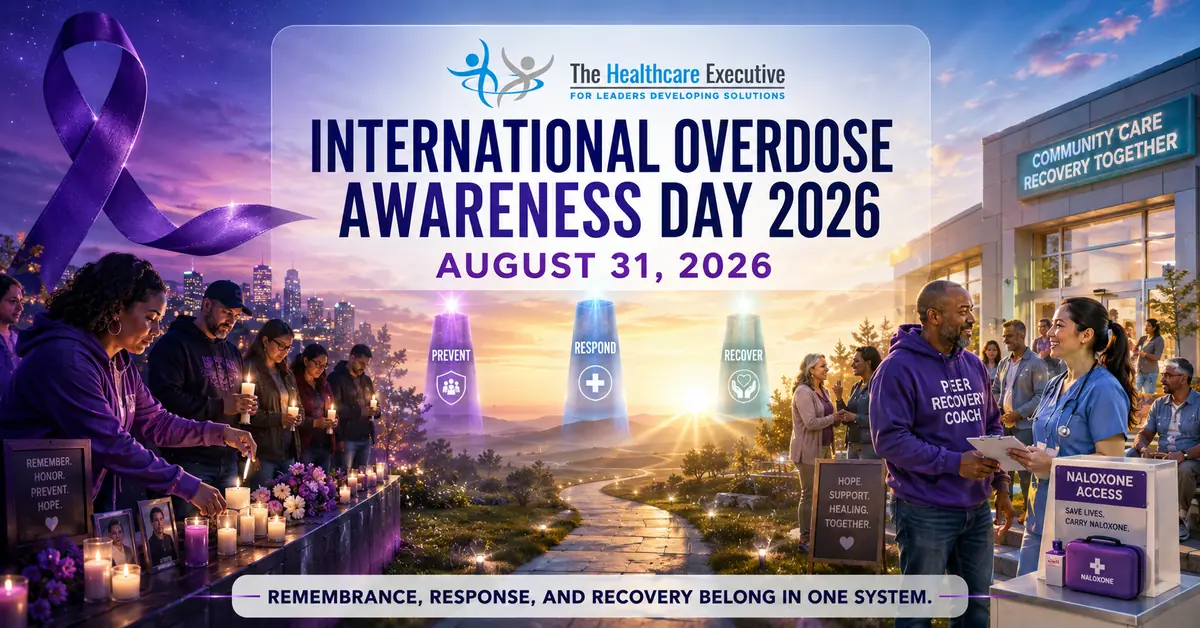
International Overdose Awareness Day | August 31, 2026
International Overdose Awareness Day 2026: Make Access, Ownership, and Continuity Visible
A credible observance makes lifesaving access easier, treats every nonfatal overdose as a time-sensitive transition, and gives executives a clear view of whether the system completes the next step.
Observance identity: International Overdose Awareness Day is observed on August 31. This executive brief uses the date to examine access, operational reliability, dignity, and continuity. It does not create a clinical protocol, endorse one product or service model, or treat awareness activity as proof of outcome.
A leadership signal, not a one-day campaign
Make the route visible before awareness increases demand
International Overdose Awareness Day can honor people who have died, recognize grief, reduce stigma, and make prevention resources easier to find. For a hospital or health system, however, the observance also exposes an operating question: what happens after someone notices the message? A poster, social post, educational event, or press release can increase attention. If the access route is confusing, the supply is unavailable, the eligible locations are closed, or an overdose survivor leaves without an accepted next step, the campaign may reveal a reliability gap rather than close it.
The executive responsibility is not to turn every employee into a substance-use specialist. It is to ensure that clinical, pharmacy, nursing, emergency, public-health, navigation, community, information-technology, communications, compliance, and finance functions can see the same pathway. Each role needs to know where responsibility begins, when it transfers, how acceptance is confirmed, and what happens when the expected destination cannot respond.
The newest evidence supports a systems view. A 2026 emergency-department study of 10,313 encounters found that a documented intravenous drug-use risk indicator and activation of a clinical-decision-support alert were associated with higher odds of naloxone distribution, although the alert’s contribution was modest and the study could not determine whether observed patterns represented equitable access.1 A national school-nurse survey found that most respondents reported naloxone stock, yet restrictions on access and limited student training remained.2 Availability and usability are therefore different conditions.
Leaders should define the observance as a reliability test across three linked promises. First, a person can obtain the right resource without avoidable administrative or geographic friction. Second, an overdose-related encounter triggers an appropriate offer and a respectful, acknowledged handoff. Third, the organization reviews completion, experience, equity, safety, and workload rather than counting impressions, flyers, or prescriptions alone.
Reachable
Naloxone and approved information can be found at the time, place, language, and level of privacy people need.
Respectful
Care and communication use person-centered language and do not make help conditional on shame, disclosure, or a single treatment choice.
Owned
A named sender remains responsible until a receiving role accepts the handoff or a safe alternative is arranged.
Reviewable
Executives can see supply, offers, receipt, connection, exceptions, disparities, experience, safety, and workload together.
A reliable pathway also separates distinct decisions. Naloxone access is a lifesaving emergency-preparedness function. Overdose education is a communication and readiness function. Medication for opioid use disorder, behavioral-health care, primary care, infectious-disease services, peer support, housing support, and other services are clinical or social destinations that require their own consent, scope, capacity, and quality controls. Putting them on one diagram can improve coordination, but it must not imply that every person needs every destination or that receiving naloxone commits someone to treatment.

Newest evidence with controlled claims
Use the evidence to design a local system, not a universal promise
The 17-record evidence set includes emergency-department analyses, national and state surveys, program evaluations, community practice reports, qualitative and mixed-methods research, guidelines, a scoping review, and a quality-improvement initiative. Settings include hospitals, schools, pharmacies, jails, permanent supportive housing, universities, community distribution programs, Veterans Affairs research infrastructure, public-health collaborations, and hospitalist services. These settings share an access problem but do not share one population, outcome, denominator, or implementation environment.
That variation is useful. It shows that overdose prevention is not owned by one department or one physical site. It also limits comparison. The article therefore does not combine percentages from different studies into a ranking, does not estimate a pooled effect, and does not present a national program result as a local performance target. Quantitative findings appear only where their numerator, denominator, setting, or interpretation is clear enough to support the claim.
| Survey item | Reported share | Executive interpretation |
|---|---|---|
| School stocked naloxone | 90% | Inventory is necessary, but it does not establish immediate access or readiness. |
| Restrictions on access or administration | 37% | Policy and role design can create friction even when stock is present. |
| Student naloxone training | 6% | Training scope and audience require deliberate local governance. |
Source and limitation: Calihan and colleagues surveyed 462 school nurses from 44 states; the reported response rate was 23%. The items are selected results from one cross-sectional survey, are not mutually exclusive, and are not a national hospital benchmark.2
Distribution should follow risk and reach, not convenience alone
A Rhode Island analysis compared community naloxone distribution using kits per fatal overdose, per nonfatal overdose, per 100,000 residents, and a published demand-based recommendation. Distribution differed substantially across regions, including among regions with similar overdose burden, and three of ten regions consistently ranked lowest across the four saturation measures.3 The lesson is not that every health system should copy those ratios. It is that leaders need more than a total kit count. They need a geographic and population view that links distribution to locally defined need while protecting privacy.
Other 2026 records reinforce the value of varied channels. A Rhode Island community-distribution analysis found differences in receipt by method and demographic group, with in-person, mobile, mail, and distance patterns contributing different forms of reach.7 A North Carolina survey examined demographic variation across no-cost naloxone distribution programs.16 A university vending-machine study and an adolescent-access review show why campuses, schools, age-related policy, confidentiality, and youth-appropriate education require explicit attention rather than assuming that adult pharmacy access solves every problem.811
Passive education does not equal uptake
In a Los Angeles County jail-release study, 19% of 528 participants reported taking naloxone from a no-cost vending machine and 27% reported viewing an overdose-education video. The investigators found no overall association between video viewing and naloxone uptake, although exploratory analyses suggested variation by substance-use history.5 This does not mean education is unimportant. It means a passive content exposure should not be treated as a completed access outcome. Placement, privacy, timing, trust, readiness, product availability, and the conditions of release can all affect whether a resource becomes usable.
A mixed-methods study of why people who use drugs did not carry naloxone similarly supports listening before redesign. Reasons for non-carrying are not reducible to a lack of knowledge, and an organization should not interpret refusal or non-carrying as indifference.13 Measure what people encounter, ask what made the offer useful or unusable, and preserve the option to re-enter later.
Low-barrier access with operational discipline
Design access as a portfolio of channels with one accountability standard
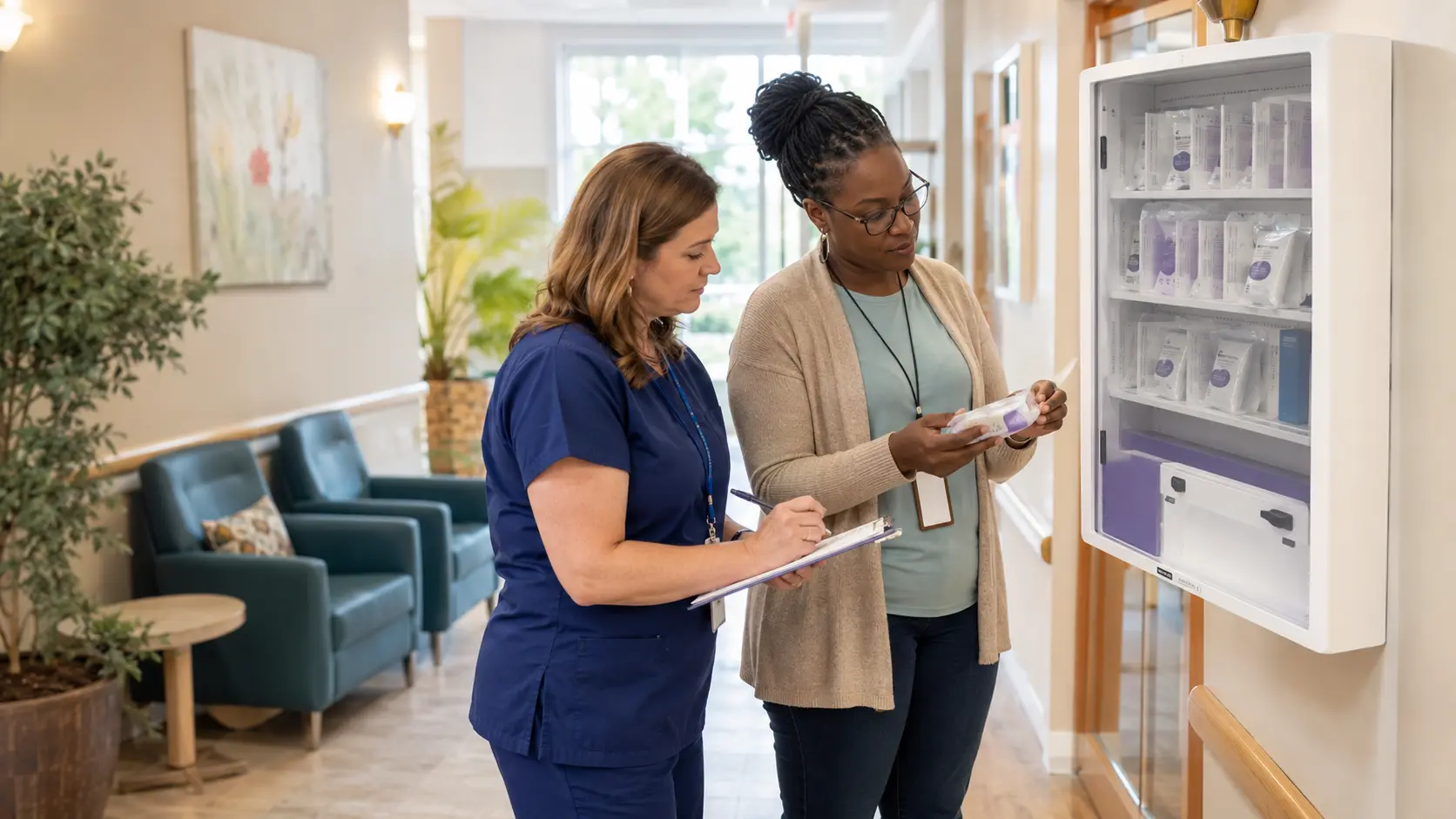
A strong access portfolio can include emergency-department take-home distribution, outpatient and hospital-discharge workflows, retail and health-system pharmacies, community outreach, schools and campuses, supportive housing, mobile programs, mail delivery, justice-transition settings, and public cabinets or vending machines. Not every organization will operate every channel. The governance question is whether each selected channel has a clear population, source of supply, replenishment process, training boundary, emergency instructions, hours, accessibility standard, and accountable owner.
Channel variety matters because barriers differ. A person may need anonymity, evening access, proximity, mobility accommodation, a no-cost option, language support, or a trusted human conversation. Another person may prefer a pharmacy or a routine clinical visit. An employee or family member may want a resource without creating a clinical record. A school or housing program may need policies about who can retrieve and administer naloxone. One channel cannot carry every access objective.
Proposed future-state design: This pathway organizes responsibilities. It does not replace emergency protocols, medication instructions, clinical assessment, or jurisdiction-specific requirements. Local leaders must define every decision point and owner.
Control the supply chain people actually experience
A cabinet that is empty, locked, too high, difficult to locate, or stocked with expired product is not a functioning access point. The operational design should name who checks inventory, how often, what minimum level triggers replenishment, where backup stock is held, how temperature and product requirements are maintained, how recalls are handled, and how a failure is escalated. The same discipline applies to take-home kits at discharge. Leaders should measure offers, product actually handed to the person, reasons product was not available, and the time required to restore supply.
A pharmacist-led program reported an 84% increase in naloxone distribution and training for 3,466 community members across an emergency-department and outreach model.4 The program illustrates the value of multidisciplinary pharmacy participation and community education. Its local funding, supply, data, and follow-up limitations matter. A health system should use the study to ask who can extend reach and maintain quality, not to promise the same increase.
Pair broad availability with tailored implementation
School nurses, campus advocates, supportive-housing teams, jail-release programs, community organizations, pharmacies, and hospital services work under different conditions. Age, consent, confidentiality, staffing, building access, community trust, and legal authority can change the design. The adolescent narrative review identifies multi-level barriers and facilitators, while the school-nurse survey describes restrictions and training gaps.211 These findings support youth-specific policy and community engagement rather than simply placing an adult-designed resource in a youth setting.
The handoff after an overdose-related encounter
Keep ownership visible until the next role accepts it
A nonfatal overdose can create a brief period in which a person is in contact with emergency clinicians, first responders, family members, peers, pharmacists, or community programs. The moment may also include withdrawal, pain, fear, grief, stigma, legal concerns, transportation problems, fatigue, or a strong desire to leave. A pathway that depends on a long conversation, a remote appointment, repeated intake, or the person calling several numbers may fail even when every team member technically completed a task.
The scoping review on prevention and treatment of opioid overdose mapped evidence on early detection, community management, and post-overdose care and identified research gaps.15 A national guideline effort addressed prevention and management of opioid use disorder and overdose within a multidisciplinary evidence process.10 These sources support a continuum, but they do not erase local clinical judgment or person choice. The executive design should make several voluntary destinations available and establish who stays responsible when the preferred destination is not immediately reachable.
Define a completed handoff in observable terms
A referral order, printed list, portal message, or voicemail is not the same as an accepted handoff. With consent, the sending role should communicate the minimum necessary information, confirm that the receiving role can respond, tell the person what will happen next, and retain an exception route. Acceptance can be documented as a scheduled contact, a live introduction, a receiver acknowledgment, a completed warm transfer, or another locally approved state. If the receiver declines or has no capacity, responsibility returns to the sender or navigator rather than falling back on the person.
Possible destinations include medication for opioid use disorder, primary care, behavioral health, pain care, infectious-disease services, wound care, peer support, housing and benefits navigation, family support, transportation, or other community services. Not every destination is appropriate for every person. A respectful decline is a valid outcome when urgent concerns are addressed and a re-entry route remains visible. Performance systems must not reward coercion or penalize staff when a person makes an informed choice not to continue.
Use peers as partners with scope, support, and authority
Peer roles can add trust, practical knowledge, and persistence to a transition. The role should not be treated as an informal add-on. Define training, supervision, compensation, documentation, caseload, hours, emotional support, escalation, and the difference between peer work and licensed clinical care. Patient-engagement infrastructure in the Veterans Affairs research network illustrates the value of sustained partnership rather than episodic consultation.9 The same principle applies to implementation: involve people with lived and living experience in governance, workflow testing, communication, and interpretation of results.

An overdose-prevention reliability system
Connect access, response, continuity, learning, and executive action
A reliable system is not a single clinical pathway. It is a set of interfaces that keep the person and community at the center while different teams perform different work. Communications makes the route findable. Pharmacy and operations maintain supply. Emergency and clinical teams manage immediate care within scope. Peers and navigators support voluntary connection. Community partners extend trust and reach. Technology makes ownership and exceptions visible. Quality and equity teams interpret performance. Executives remove recurring barriers that frontline teams cannot solve alone.
Operating rule: No distribution point is assumed available until stock is verified, and no handoff is assumed complete until the receiving role acknowledges responsibility.
Design boundary: The diagram describes an accountable future-state interface model. It does not claim that any specific organization already has these relationships or that every listed service is required locally.
Use clinical decision support as one control, not the entire strategy
The emergency-department study found that alert activation was associated with a modest increase in the odds of naloxone distribution after adjustment, while documented risk was a stronger predictor.1 An alert can remind, standardize, and expose missed opportunities. It can also misfire when data are incomplete, when clinicians experience alert fatigue, when the workflow cannot supply the product, or when equity monitoring is absent. Review who triggers the alert, who does not, whether the recommended action is possible, and what occurs when staff override it.
Build place-based implementation with real facilitation
The permanent supportive housing overdose-prevention project described a six-month intervention across 20 buildings that included an implementation toolkit, tailored practice-facilitation sessions, monthly learning collaboratives, and tenant champions. Nineteen buildings continued, participation in planned facilitation was high, and most sessions included the planned content.6 The study establishes feasibility of delivering the intervention, not a proven reduction in overdose. For executives, the practical lesson is that place-based implementation needs protected time, facilitation, resident or tenant authority, and learning infrastructure rather than a toolkit alone.
Create an escalation path for recurring barriers
Frontline staff should not repeatedly improvise around the same empty cabinet, closed referral service, transportation gap, coverage denial, inaccessible form, language barrier, or after-hours failure. Define thresholds that move an issue from individual problem solving to operational review. A named leader should be able to authorize temporary supply, alternate staffing, transportation support, contract changes, workflow repair, or transparent service limitations. Track the time from barrier identification to durable correction.
Equity, trust, and workforce conditions
Diagnose interacting barriers before adding another message
Low uptake does not prove low need. A person may already have naloxone, may not see themselves as likely to witness an overdose, may distrust the setting, may fear disclosure or legal consequences, may not know the product is free, may not be able to reach the location, or may avoid carrying it because of stigma. The mixed-methods Rhode Island analysis of non-carrying provides a direct reason to ask people rather than assume motivation.13
Community distribution data also show that different methods can reach different groups.716 A community practice brief from King County describes the implementation challenges of naloxone programming designed with and for Black, Indigenous, and other people of color, emphasizing interdisciplinary and community partnership.14 Leaders should not treat identity as a proxy for preference. They should fund trusted participation, examine the route with affected communities, and review whether apparently neutral rules create unequal friction.
Qualitative tool: The branches are evidence-informed hypotheses, not frequencies, rankings, or causal estimates. Validate them locally with people who accepted, declined, used, or could not reach services.
Use fatality review as a learning system, not a blame process
Overdose fatality review teams bring together public health, treatment, social support, criminal-legal, medical, and other partners to identify prevention recommendations. A 2026 study found variation in knowledge and attitudes across institutional domains among members of 18 Indiana teams.12 Cross-sector participation does not automatically create a shared mental model. Teams need common definitions, orientation, lived-experience participation, facilitation, conflict rules, confidentiality, recommendation ownership, and a method for tracking whether recommendations were implemented.
Protect the workforce that carries the route
Emergency clinicians, nurses, pharmacists, peers, community health workers, school staff, housing teams, first responders, and navigators may encounter repeated overdose, grief, moral distress, time pressure, and resource limits. Training is necessary but insufficient when staff cannot obtain stock, reach a receiver, or get operational support. Build supervision, debriefing options, protected learning time, role clarity, and rapid escalation into the model. Participation in peer support or debriefing should be voluntary and confidential.
Workforce measurement should remain separate from discipline. An alert override, missed offer, or incomplete handoff may reflect an individual action, a broken workflow, or both. Review the surrounding conditions before assigning cause. Measure time, staffing, supply, competing priorities, documentation burden, and receiver capacity. The objective is to make the right action easier and the exception visible, while preserving professional accountability and patient choice.
Decision-grade measurement
Measure access, receipt, handoff, experience, equity, safety, and burden together
A one-day dashboard may report events, social reach, training attendance, or kits ordered. Those figures are useful for communications and logistics, but they do not establish that access improved or continuity worked. Executives need a measurement architecture that follows the operating states. Define the opportunity, offer, receipt, availability, acceptance, connection, barrier, respectful decline, and safe closure states before launch. Report missing data. Use balancing measures so an improvement in one part of the route does not hide delay, coercion, staff burden, or unequal reach elsewhere.
| Domain | Example measure | Required denominator and owner | Balancing or equity check |
|---|---|---|---|
| Availability | Access points verified in stock and usable | All scheduled access-point checks; pharmacy or operations owner | Site, shift, accessibility, language, closure duration, backup use |
| Offer | Eligible encounters with a documented offer | Locally defined eligible encounters; clinical service owner | Alert performance, override reason, age, race and ethnicity, language, payer |
| Receipt | Offers resulting in product handed to the person | All documented offers; pharmacy and clinical owner | Out of stock, prescription only, refusal, already has product, cost |
| Handoff | Consented referrals accepted or safely redirected | All consented referrals; navigation owner | Receiver wait, rejection, repeated intake, transportation, after-hours failure |
| Connection | Agreed next step completed or respectfully declined | All accepted handoffs due for follow-up; receiving-service owner | Unwanted outreach, no contact, re-entry, urgent event, workload |
| Experience | Route was understandable, respectful, private, and useful | Voluntary respondents plus nonresponse; experience owner | Language, disability, setting, small-cell suppression, complaint review |
| Equity | Differences in opportunity, offer, receipt, and connection | Approved stratified denominators; equity and privacy owner | Data completeness, re-identification risk, structural context, community review |
| Workforce | Time, training, supervision, and escalation were usable | Eligible participating staff; operational leader | Overtime, caseload, moral distress, alert burden, turnover, peer-role scope |
No universal target is implied. Baselines, thresholds, exclusions, review frequency, stratification, suppression, and urgent triggers require local approval.
Keep denominators aligned with the decision
A total distribution count answers how many products moved. It does not answer whether high-burden locations received adequate supply, whether an eligible encounter included an offer, or whether the person obtained the product. Geographic saturation measures can guide distribution planning when definitions and local burden data are sound.3 Demographic and method-specific analyses can reveal who different channels reach.716 Do not compare rates with different opportunity definitions as if they were one performance ranking.
Separate process reliability from clinical outcome
A completed offer, receipt, or handoff is a process outcome. It can be necessary and valuable without proving that a subsequent overdose was prevented. Conversely, a person may benefit from naloxone obtained through another channel that the organization cannot observe. Use mortality, nonfatal overdose, emergency use, and treatment outcomes only with an appropriate design, data authority, time horizon, attribution statement, and uncertainty analysis. Do not convert a one-day campaign into a causal claim.
Use improvement methods without turning targets into quotas
A hospitalist-focused quality-improvement initiative addressed naloxone coprescribing for high-risk opioid prescribing and defined a specific reduction goal for discharges without naloxone on the medication list.17 Local teams can use a similar method to define an opportunity, test workflow changes, and review exceptions. A target must not become a coercive quota. Clinical appropriateness, patient choice, medication access, data quality, and balancing measures remain visible.
A bounded 90-day executive agenda
Start with one route important enough to expose the real system
A useful pilot is small enough to understand and consequential enough to test supply, workflow, handoffs, community participation, equity, data, and executive escalation. One starting point might be emergency-department discharge after an opioid-related overdose, naloxone access in a defined group of outpatient clinics, a hospital-supported community distribution partnership, or a supportive-housing interface. Select the route with community and frontline participation. Do not select it only because the data are easy to collect.
Illustrative plan: Phases show proposed work, owners, dependencies, and review points. They do not promise completion or clinical effect within 90 days.
Days 1–20: establish authority and expose the current route
Name an executive sponsor, operational owner, clinical owner, pharmacy or supply owner, navigation owner, community partner lead, data steward, privacy lead, and person with lived or living experience who has real decision authority. Define the pilot population, settings, hours, products, exclusions, emergency boundary, consent, documentation, data, and stop conditions. Map the current route by walking it: find the public information, check stock, simulate an eligible encounter, test an after-hours exception, call the receiving service, and identify where responsibility becomes unclear.
Build a baseline using opportunity-based denominators. Review stock failures, offer and receipt states, referral rejection, response time, complaints, staff time, and available equity variables. Hold listening sessions with people who used, declined, or could not reach services, as well as frontline staff and partners. The purpose is not to defend the current process. It is to identify the barriers the pilot must either remove or make visible.
Days 21–40: co-design, stock, train, and rehearse
Choose the exact access channel and handoff model. Assign replenishment and backup supply. Write plain-language information that states where, when, cost, privacy, accessibility, emergency limits, and next-step options. Define the completed-handoff state and the response when a receiver has no capacity. Configure decision support or documentation only after the workflow is stable enough to support it. Test the path with staff and community participants who were not involved in the initial design.
Training should cover person-centered language, emergency boundaries, role scope, product and supply procedures, consent, privacy, warm handoff, respectful decline, escalation, and documentation. Use brief scenarios that include an empty access point, an alert for someone who already has naloxone, a person who declines further care, a language need, a closed receiving service, a youth or school setting, and an after-hours request. A training completion record is a readiness input, not evidence that the pathway works.
Days 41–70: run the live pilot with short learning cycles
Begin with a controlled launch. Review stock, offers, receipts, handoffs, barriers, adverse events, complaints, and workload frequently enough to correct early failures. Keep a visible exception log that excludes unnecessary identifying details. Meet with partners and people with lived experience, not only internal project staff. When a barrier repeats, assign it to an operational owner with a due date. Do not wait until day 90 to address an empty cabinet, broken data feed, inaccessible form, or receiving service that routinely declines.
Continue ordinary safety and quality reporting. The pilot should not create a parallel structure that hides incidents or bypasses clinical governance. Protect staff and peer navigators from excessive caseload. Monitor whether the workflow increases delay for other patients or creates unwanted outreach. Communicate honestly when capacity is limited.
Days 71–90: decide with evidence and community interpretation
Compare the pilot with its baseline using the definitions approved at launch. Review data completeness and who is missing. Pair counts and rates with interviews or a brief experience process. Examine whether reach improved for groups facing the greatest barriers, whether staff could perform the workflow, whether partners absorbed uncompensated work, and whether supply and handoff failures became less frequent. Document unexpected harms and benefits.
The final decision should be explicit: scale, adapt, pause, or stop. Scaling requires evidence that the operating controls can travel to another setting. Adapting requires a named change and another test. Pausing is appropriate when safety, privacy, supply, workforce, or partner capacity is not ready. Stopping is responsible when the model is ineffective, harmful, unsustainable, or unable to meet its stated boundary. Awareness should create permission to learn, not pressure to preserve a weak program.
The executive standard
Make every promise visible at the point where it can fail
International Overdose Awareness Day should be more than a message about a crisis. It should be a disciplined review of whether people can reach lifesaving resources, whether staff can perform the intended workflow, whether a nonfatal overdose opens a respectful next step, whether community partners have authority and capacity, and whether executives respond when the route breaks.
The strongest commitment is not the largest event. It is a system in which stock is verified, offers are understandable, product receipt is distinguished from a prescription, handoffs are acknowledged, refusal is respected, re-entry remains possible, disparities are investigated, workforce burden is visible, and recurring barriers move to leaders with authority to act. That standard supports dignity on August 31 and reliability throughout the year.
Verify
Test every promoted location, handoff, emergency boundary, and after-hours route.
Listen
Include people who used, declined, or could not reach the pathway in interpretation and redesign.
Repair
Assign repeated supply, policy, data, capacity, and equity barriers to leaders with due dates.
Report
Share what changed, what remains uncertain, and whether the organization will scale, adapt, pause, or stop.
Related pathways and public resources
Connect the observance to year-round work
Resource boundary: External and internal resources support awareness and planning. Local clinical, emergency, legal, medication, privacy, and partnership requirements remain controlling.
Peer-reviewed evidence
Scholarly references
The references are ordered newest first. DOI links identify the public scholarly records; no private research-platform links are displayed.
- Miller, A. D. (2026). Clinical decision support and the naloxone equity exception: Insights from an emergency department. Journal of Emergency Nursing. https://doi.org/10.1016/j.jen.2026.07.003
- Calihan, J. B., Herrera, M. C., Jinks-Chang, S., et al. (2026). Naloxone access in schools: A national survey of school nurses in the United States. Substance Use: Research and Treatment, 20, 29768357261478395. https://doi.org/10.1177/29768357261478395
- Shin, J., Hallowell, B. D., Marshall, B. D. L., Krieger, M. S., & St John, K. (2026). Using naloxone saturation measures and opioid overdose burden to optimize geographic distribution of naloxone in Rhode Island. Journal of Substance Use and Addiction Treatment, 191, 210091. https://doi.org/10.1016/j.josat.2026.210091
- Adintori, E., Pham, T., Beckerman, S., et al. (2026). Enhancing opioid overdose education and naloxone distribution through pharmacist-led community outreach. American Journal of Health-System Pharmacy, 83(16), 818–821. https://doi.org/10.1093/ajhp/zxag092
- Herrera, A., Bluthenthal, R., Wagner, K., Gaines, T., & Davidson, P. (2026). Engagement with overdose education and naloxone uptake at jail release: Evidence from a vending machine-based naloxone-on-release program in Los Angeles County. Drug and Alcohol Dependence, 287, 113317. https://doi.org/10.1016/j.drugalcdep.2026.113317
- Doran, K. M., Velez, L., Spiers, A., et al. (2026). The permanent supportive housing overdose prevention project. Drug and Alcohol Dependence, 287, 113302. https://doi.org/10.1016/j.drugalcdep.2026.113302
- Ahern, C., St John, K., Koziol, J., & Jacobson, A. (2026). Demographic differences in access to community-based naloxone distribution in Rhode Island, 2024. Journal of Public Health Management and Practice. https://doi.org/10.1097/PHH.0000000000002397
- Paa, A., Chahal, H., Walters, J., Ngo, G., & Lovell, M. (2026). Deploying health vending machines to increase access to naloxone and emergency contraceptives at a large Midwestern University (October 2024–May 2025). Journal of American College Health, 74(7), 1871–1875. https://doi.org/10.1080/07448481.2026.2626140
- Sides, T. L., Argust, M. M., Jensen, A. C., et al. (2026). Building and sustaining patient engagement infrastructure focused on overdose prevention within a US Veterans Affairs national research network. Health Expectations, 29(4), e70774. https://doi.org/10.1111/hex.70774
- Bertin, C., Dupouy, J., Authier, N., et al. (2026). French national guidelines for the appropriate use of opioids: Analgesia, opioid use disorder, and overdose prevention—Part 2: Prevention and management of opioid use disorder and overdose. Pain and Therapy, 15(4), 957–981. https://doi.org/10.1007/s40122-026-00852-9
- Ramos, C. R., Krause, K. H., Joseph, V. M., et al. (2026). Barriers and facilitators to naloxone access for adolescents: A narrative review. Substance Use: Research and Treatment, 20, 29768357261472425. https://doi.org/10.1177/29768357261472425
- Ray, B., Gillenwater, L. A., Dir, A., et al. (2026). Variation in knowledge and attitudes among overdose prevention collaborations: Insights from fatality review teams. Drug and Alcohol Dependence, 286, 113287. https://doi.org/10.1016/j.drugalcdep.2026.113287
- Ledingham, E. M., Shin, J., Reichley, N., et al. (2026). The decision to not carry naloxone among people who use drugs in Rhode Island: A mixed-methods analysis of Harm Reduction Surveillance System survey data, 2021 to 2024. Substance Use & Addiction Journal, 29767342261464479. https://doi.org/10.1177/29767342261464479
- Agostini, T., Herrera, A., Paulson, E., et al. (2026). Addressing challenges in a pilot naloxone distribution program for BIPOC communities in King County, Washington: A community practice brief. Journal of Public Health Management and Practice. https://doi.org/10.1097/PHH.0000000000002426
- Ghosh, A., Choudhury, S., Mahintamani, T., Clark, N., & Krupchanka, D. (2026). Scoping evidence review on the prevention and treatment of opioid overdose. Harm Reduction Journal. https://doi.org/10.1186/s12954-025-01372-z
- Marley, G., Shubel, C., Annis, I. E., et al. (2026). Evaluating demographic variation in no-cost naloxone distribution in North Carolina: A cross-sectional survey study. Harm Reduction Journal. https://doi.org/10.1186/s12954-026-01505-y
- Rueda Prada, L., Lester, P. R., Runjaic, S., Berguido de la Guardia, M., & Miller, H. L. (2026). Increasing naloxone coprescription for high-risk opioid prescribing: A hospitalist-focused quality improvement initiative. Journal for Healthcare Quality. https://doi.org/10.1097/JHQ.0000000000000534
Use note: Reviewed for executive planning in August 2026. This article supports leadership education and local system design. It does not replace emergency response, clinical judgment, medication instructions, professional standards, legal advice, or applicable federal, state, local, and organizational requirements.