
January 1–31, 2026 · Why I Give
Turn a month of gratitude into a blood-ready operating system.
National Blood Donor Month can honor donors and still ask a harder leadership question: can the organization connect community trust, collection capacity, donor health, antigen diversity, inventory visibility, clinical stewardship, and emergency continuity before a shortage becomes a patient-safety event?
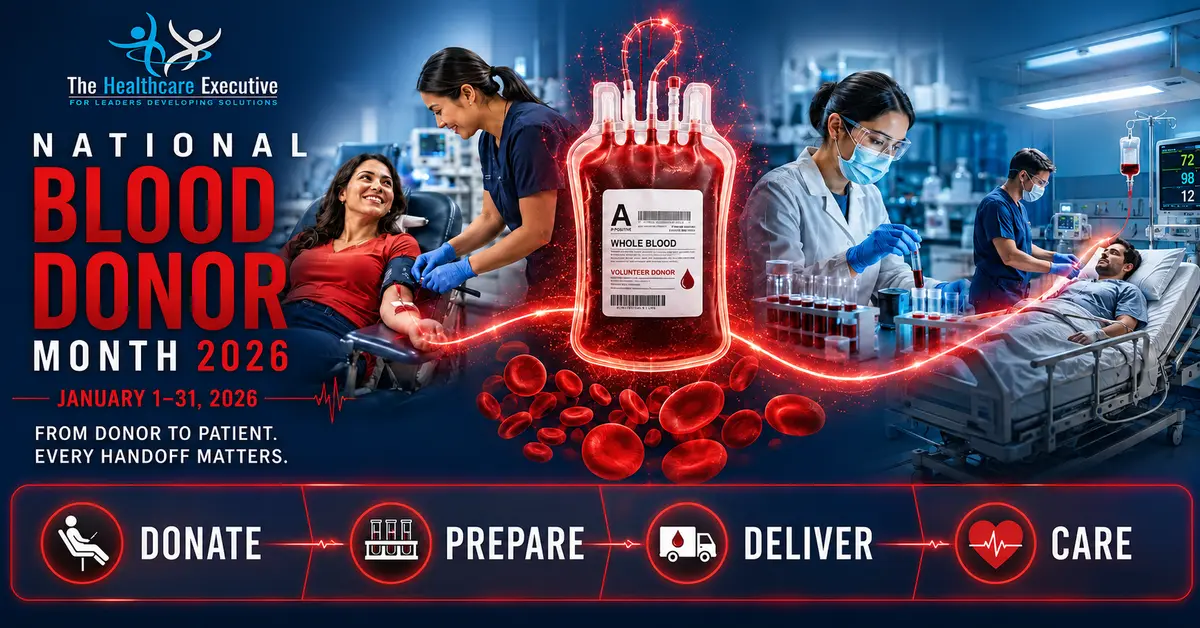
National Blood Donor Month is observed from January 1 through January 31. The 2026 campaign at BloodDonorMonth.org presents the public-facing idea Why I Give. The AABB observance page places the month within a national effort to recognize donors and encourage donation. These are useful invitations to communicate. They are not, by themselves, an operating plan.
For healthcare executives, blood readiness reaches beyond the blood center. It includes whether people can learn about donation through trusted channels, determine eligibility without unnecessary friction, reach a collection site, have a safe and respectful experience, return when eligible, and see their community represented in the donor base. It also includes how components are tested, transported, inventoried, issued, conserved, and connected to patient blood management.
The 21 peer-reviewed sources reviewed for this article include studies of donor motivation, racialized and systemic barriers, individual eligibility assessment, culturally relevant word-of-mouth, platelet-donor experience, donor iron status, infectious risk, blood-group distribution, patient blood management, clinical-data monitoring, accessibility, and inventory policy. Most were published in 2026, with additional qualitative evidence from 2025 and 2022. They span different countries, donor populations, component types, and health systems. That breadth helps identify recurring operating questions, but it does not produce a universal intervention effect. Every local action still requires clinical, regulatory, legal, analytic, community, and operational review.
The leadership signal
Blood availability is a relationship and capacity problem, not only a recruitment problem.
Leaders often encounter the blood supply as an inventory message: days on hand, units by type, pending allocations, emergency releases, or an appeal for donors. Those measures matter, but they are late signals. The conditions that create or prevent a shortage begin earlier, with trust, eligibility, convenient access, a safe donor experience, repeat participation, component-specific collection, testing, processing, transport, and clinical demand.
A 2026 study of 22,128 blood and plasma donors in the Netherlands identified four motivational classes: moderately motivated donors, exceptionally motivated donors, unfulfilled donors, and confident habitual donors. People could move between classes, and class membership predicted long-term lapse. The analysis was conducted in one national donor setting and does not establish that a particular message will move a donor from one class to another. It warns against treating every donor as if the same appeal, appointment experience, or recognition strategy will sustain participation.1
Supply also depends on how well the donor base aligns with the patients being served. A 2026 multicenter retrospective study compared ABO and RhD frequencies among 467,748 patients, 719,211 California donors, and 7,449,831 U.S. donors. The distributions differed significantly, and the authors described implications for recruitment, inventory management, and policy. These data do not identify the right recruitment target for every market, and ABO/RhD alone does not capture the full complexity of clinically significant antigens. They show why a broad donor count can hide a mismatch in the components and types the clinical system actually needs.2
Inventory policy is therefore both technical and relational. A 2026 operations study proposed heuristic platelet-issuing policies for an integrated ABO blood-bank system under heterogeneous demand. A model can clarify tradeoffs among compatibility, expiration, shortage, and patient priority, but a model remains dependent on assumptions, local data quality, clinical rules, and governance. It cannot replace professional judgment or local validation.19
Donor motivational classes in one longitudinal analysis
| Motivational class | Reported share |
|---|---|
| Moderately motivated | 33% |
| Exceptionally motivated | 18% |
| Unfulfilled | 23% |
| Confident habitual | 26% |
Donor experience and retention
Design the return journey before asking for the first appointment.
Recruitment is only one conversion point. A prospective donor must notice the message, trust the messenger, understand eligibility, find an available time, reach the site, complete screening, tolerate the collection, receive appropriate aftercare, and decide whether to return. A single weak interface can turn willingness into delay, deferral, noncompletion, or lapse.
A 2026 cross-sectional study of 120 voluntary platelet donors across five public hospital donation units in Greece reported high overall satisfaction, with interpersonal aspects such as politeness, respect, and attentiveness among the strongest areas. The study also examined access, convenience, and technical dimensions. Its sample was modest and limited to current platelet donors, so it cannot explain why former or prospective donors did not participate. It supports treating service design, staff interaction, and practical access as measurable retention infrastructure.7
Word-of-mouth can help trusted social networks carry the invitation. Six focus groups with 35 Chinese and Indian donors in Australia explored what encouraged or inhibited positive conversations about blood donation. The qualitative design identifies mechanisms and language, not population prevalence or a guaranteed recruitment effect. It suggests that organizations should understand when donors feel confident sharing their experience, what makes a conversation culturally appropriate, and what information or stigma may suppress it.5
Studies of students and the general public show why knowledge and willingness must be separated from completed action. A 2026 study of 419 medical laboratory science students in Ghana examined knowledge, attitudes, and practices.6 Another cross-sectional study of 191 first-year engineering students in Nepal examined the same domains.10 A separate Ghanaian analysis focused on factors associated with unwillingness among students, including knowledge, sociocultural influences, and institutional and logistical conditions.12 These settings and samples differ, and cross-sectional relationships do not prove what will change behavior. Together, they caution leaders against reading a favorable attitude as confirmed capacity.

Leaders should therefore measure the journey as a sequence. Useful stages include campaign reach, eligibility inquiry, appointment offered, appointment accepted, arrival, completed screening, successful donation, donor adverse event, deferral with understandable next steps, invitation to return, repeat appointment, and repeat donation. The organization should also know how much time passes between stages, which sites and channels create friction, and whether the pattern differs across communities.
That measurement must protect privacy and dignity. A donor is not a unit of inventory. Deferral, noncompletion, or lapse may reflect clinical safety rules, travel, caregiving, work schedules, transportation, fear, prior treatment, language, technology access, or a changing health condition. The purpose of a conversion view is to improve the service and learn where the system loses willing participants. It should not pressure people to donate or imply that donation is appropriate for everyone.
One connected blood-readiness pathway
Make every handoff visible from public invitation to hemovigilance.
A blood-ready pathway begins before an appointment and ends after learning from transfusion and donor outcomes. The route crosses organizations, professional boundaries, information systems, transport networks, and regulatory requirements. No single visual can represent every clinical branch, but executives need a common operating view that reveals where responsibility changes hands.
The process should define what minimum information travels, who acknowledges receipt, what timing is expected, how urgent exceptions are escalated, and how the upstream team learns whether the next step occurred. The same discipline applies to a community partner sending someone to a mobile drive, a collection site sending components for testing, a blood center allocating units, a hospital receiving a shipment, and a clinical team requesting or transfusing a component.
Proposed blood-readiness process flow
- Invite and listenOwner: outreach and community partnersUse trusted messengers, accurate information, accessible channels, and feedback from underrepresented communities.
- Assess eligibilityOwner: qualified collection teamApply current rules consistently, protect privacy, explain deferral, and identify an appropriate next step.
- Collect and careOwner: donor servicesDeliver safe collection, respectful interaction, adverse-event response, aftercare, and a usable return route.
- Test and prepareOwner: laboratory and blood centerComplete required testing, processing, labeling, release, and traceability under approved standards.
- Allocate and transportOwner: blood center and logisticsMatch demand, compatibility, shelf life, urgency, route reliability, and contingency capacity.
- Issue and transfuseOwner: transfusion service and clinical teamUse approved ordering, identification, compatibility, administration, and patient blood management practices.
- Learn and improveOwner: hemovigilance and executive governanceReview donor and patient events, wastage, shortages, exceptions, inequities, experience, and unresolved risk.
Trust, equity, and eligibility
Do not interpret an access failure as an absence of generosity.
Participation is shaped by the design of the institution as well as the intention of the individual. Hours, distance, transportation, work, caregiving, digital access, language, privacy, religious or cultural considerations, past discrimination, trust in the blood system, and clarity about how donated blood is used can all affect whether an invitation becomes a donation.
In a 2026 qualitative study, researchers interviewed 42 Black adults in Canada and identified themes describing systemic racial barriers to blood donation. Qualitative themes do not quantify how often each barrier occurs or determine the right intervention in every community. The study’s executive value is its insistence that participation cannot be explained by individual motivation alone. Governance, institutional history, representation, communication, and the experience of being valued all belong in the improvement conversation.3
A 2026 community-based study worked with South Asian communities in Ontario to identify strategies for systemic barriers. Community-based evidence is context-specific and should not be treated as a universal checklist. It supports a durable practice: involve communities in defining the problem, selecting messengers, testing materials, choosing sites and hours, and interpreting results before expanding a campaign.8
Eligibility policy is another trust interface. A national cross-sectional study of gay, bisexual, and other men who have sex with men in Aotearoa New Zealand estimated eligibility under an individual donor-assessment policy and examined characteristics of newly eligible people. The survey-based design and national context limit transferability. Together with a 2026 systematic review of modeling studies on donor exclusion criteria, it shows why policy changes require more than an announcement. Leaders need accurate training, respectful screening, compliance monitoring, safety surveillance, transparent explanation, and evaluation of both participation and residual risk under the applicable regulatory framework.4, 16

Unranked contributors to insufficient equitable blood readiness
Trust and representation
Past harm, racialized assumptions, limited representation, unclear use of donations, and weak community partnership.
Access and communication
Hours, distance, transportation, language, digital-only routes, work, caregiving, and confusing information.
Eligibility and deferral
Outdated understanding, inconsistent explanation, privacy concerns, policy transitions, and no usable next step.
Donor experience and health
Waits, respect, staff interaction, adverse events, iron depletion, aftercare, recognition, and return planning.
Inventory and logistics
Type mismatch, shelf life, forecasting, allocation, transport disruption, wastage, and emergency reserves.
Clinical demand and stewardship
Untreated anemia, variable ordering, incomplete patient blood management, and weak feedback to clinical teams.
Data and governance
Incompatible systems, unclear denominators, delayed visibility, unowned exceptions, and inequities hidden in averages.
Donor health, safety, and continuity
A sustainable supply protects the people who make it possible.
Repeat donation is valuable only when the donor’s health remains central. A 2026 longitudinal cohort study of 538 plateletpheresis donors examined latent iron deficiency among high-frequency donors. The authors reported that hemoglobin screening alone can miss depleted iron stores and studied the relationship between latent deficiency, deferral, and attrition. The single-region retrospective design and its specific frequency categories limit generalization. It demonstrates why donor safety dashboards should look beyond completed collections and routine hemoglobin thresholds when local standards, clinical leadership, and regulations support broader monitoring.14
Safety also depends on surveillance for transfusion-transmitted infection. A 2026 cross-sectional analysis used records from 2,667 donors at a Zambian hospital blood bank and assessed bloodborne pathogens and associated factors. Local epidemiology, testing platforms, donor selection, and health-system resources shape these results. The study should not be used to infer risk in another population. It reinforces a general operating responsibility: infectious-risk surveillance, testing quality, donor communication, traceability, and learning must stay connected to recruitment and supply decisions.15
Emergency readiness requires more than a nominal reserve. A 2026 systematic review of blood and blood-product accessibility in sub-Saharan Africa identified barriers and facilitators across the path from donation to clinical use. Because included studies varied in setting, methods, products, and health-system capacity, the review cannot supply a single operational prescription. Its system-wide perspective is useful: equipment, workforce, financing, transport, cold chain, clinical practice, policy, and geography can each determine whether a unit reaches the patient when needed.18
A 2025 qualitative study in South Kivu included interviews and focus groups with donors and non-donors. Fear could encourage or discourage donation, expectations were shaped by local meaning and material conditions, and participants expressed concern about access to transfusion. The study is context-specific and qualitative. It reminds executives that asking people to contribute to a system they do not trust to serve them is a governance problem, not a messaging problem.20
Continuity planning should connect scenario, threshold, authority, and action. Leaders need to know which service lines are most sensitive to specific component shortages, what conservation practices are already approved, how emergency release and substitution decisions are governed, where alternative suppliers or transport routes exist, how communication moves across clinical teams, and when executive escalation occurs. Tabletop exercises should test weekends, severe weather, information outages, transport delays, workforce constraints, and sudden demand, not only the average day.
Clinical stewardship
Protect supply by improving the patient pathway as well as the donor pathway.
Donation strategy and clinical stewardship should not compete. They manage different parts of the same readiness obligation. Patient blood management seeks to improve care by addressing anemia, reducing avoidable blood loss, supporting appropriate transfusion decisions, and monitoring practice. Its purpose is patient-centered care, not simply reducing units. When implemented well, it can also make the blood supply more resilient.
A 2026 narrative review examined perioperative anemia, transfusion practice, and patient blood management through lessons from the COVID-19 pandemic. It described iron therapy, erythropoiesis-stimulating agents, antifibrinolytic strategies, and blood-conservation techniques within the reviewed evidence. As a narrative review, it is not a single comparative effect estimate and should not be treated as a clinical protocol. It supports executive alignment among preoperative services, surgery, anesthesia, laboratory medicine, pharmacy, transfusion committees, nursing, and quality improvement.9
Implementation becomes more accountable when performance can be reviewed. A 2026 case study described producing patient blood-management quality reports from a graph-based clinical data warehouse at Grenoble Alpes University Hospital. The report was brief and describes one technical approach, not a validated universal dashboard. It illustrates an important design principle: turn guidelines into transparent, reviewable measures that clinical teams can examine with their local definitions, exclusions, and data-quality limitations.11
Executives should protect this work from a simplistic cost narrative. A lower transfusion rate can reflect better anemia management and appropriate practice, or it can reflect underuse, access barriers, incomplete documentation, case-mix change, or supply constraint. Decision-grade stewardship pairs utilization with clinical indication, patient outcomes, balancing measures, adverse events, equity, and professional review.
The operating model
Put one accountable hub around distributed blood-readiness work.
Blood readiness is distributed by design. Community organizations, employers, schools, faith communities, blood centers, laboratories, couriers, hospitals, transfusion services, clinical teams, emergency management, and public agencies may all hold part of the pathway. Distributed work still requires shared definitions, explicit interfaces, and a forum with authority to resolve cross-boundary constraints.
The hub should connect demand forecasting with donor and collection strategy. It should review inventory by clinically meaningful category, not only total units. It should connect donor health with retention. It should connect eligibility policy with training and experience. It should connect shortage signals with approved conservation and escalation. It should connect patient blood-management measures with clinical outcomes. It should connect community feedback with decisions about sites, hours, messages, and partnerships.
Blood-readiness operating-system diagram
Donor communities
Trust, lived experience, accurate information, accessible participation, representation, and partnership.
Collection services
Eligibility, appointment capacity, staff interaction, safe collection, donor health, deferral, and return.
Laboratory and blood center
Testing, processing, compatibility, component preparation, allocation, traceability, and safety.
Hospital transfusion service
Receiving, storage, issue, emergency release, inventory control, utilization feedback, and hemovigilance.
Clinical teams and PBM
Anemia management, blood conservation, appropriate ordering, administration, outcomes, and learning.
Logistics, data, and governance
Forecasts, transport, thresholds, continuity, definitions, dashboards, exceptions, equity, and accountability.

Decision-grade measurement
Measure readiness without reducing donors or patients to inventory.
Campaign impressions, page views, events, pledges, and appointment requests describe activity. They do not establish safe collections, repeat participation, representative donor capacity, compatible inventory, timely delivery, appropriate transfusion, or patient outcomes. A leadership scorecard should connect early signals with meaningful transitions and balancing measures.
Every measure needs a stable definition, numerator, denominator, data source, owner, cadence, review rule, and limitation. A donor-conversion measure should distinguish eligibility, self-deferral, clinical deferral, incomplete screening, unsuccessful collection, completed collection, and return eligibility. An inventory measure should specify component, blood group or antigen category, age, location, reservation status, inbound units, expected demand, emergency minimum, and the time at which the measure is taken.
Stratification is necessary but must be governed carefully. Differences by geography, site, referral channel, age, sex, race and ethnicity, language, disability, digital access, or other locally appropriate factors can point to a system-design question. They do not, by themselves, explain cause. Privacy, small-cell suppression, community interpretation, clinical context, and data completeness must shape review.
Proposed executive blood-readiness scorecard
| Domain | Decision question and possible measure | Numerator and denominator | Owner and cadence | Required limitation |
|---|---|---|---|---|
| Donor journey | Where does willingness fail to become a safe completed donation and an appropriate return? | Report each conversion stage ÷ the immediately prior stage and the original eligible inquiry cohort | Donor services and community partners, weekly during campaign | Deferral and noncompletion may be appropriate; channel and consent rules affect denominators. |
| Donor health | Are repeat donors protected and informed under approved clinical and regulatory standards? | Defined monitoring, follow-up, and adverse-event measures ÷ eligible donor encounters | Medical director and donor safety, monthly | Protocols, component types, frequency, and applicable rules differ. |
| Representative capacity | Does available donor and antigen capacity align with the patient population and clinical demand? | Locally defined compatible or typed capacity ÷ locally defined demand by category | Blood center and transfusion service, monthly | ABO/RhD alone is incomplete; race and ethnicity must never be used as a clinical proxy. |
| Inventory resilience | Can the system see shortage risk early enough to act safely? | Units meeting approved availability threshold ÷ forecast demand, reported by component and type | Transfusion service and logistics, daily or more often | Forecast error, reserved units, shelf life, inbound supply, and emergencies affect interpretation. |
| Clinical stewardship | Are patient blood-management practices visible with outcomes and balancing measures? | Locally approved adherence or outcome numerator ÷ eligible clinical cohort | PBM and transfusion committee, monthly | Case mix, indication, missing data, underuse, and supply constraint must be reviewed. |
| Experience and equity | Do people understand eligibility, feel respected, reach a usable service, and see concerns resolved? | Defined survey, interview, or complaint measure ÷ eligible respondents, with response rate | Experience, equity, and community partners, quarterly | Nonresponse, language, trust, privacy, and qualitative context affect interpretation. |
| Continuity | Do shortage, outage, transport, or surge scenarios trigger the approved response on time? | Scenarios meeting notification and action criteria ÷ scenarios tested or activated | Emergency management and executive sponsor, quarterly | An exercise result is not proof of real-event performance. |
The 90-day executive agenda
Use National Blood Donor Month to repair one readiness interface.
Choose one interface where the organization already sees delay, variation, inequity, safety concern, or fragility. The focus might be the route from a community invitation to a completed first donation, the experience after a temporary deferral, return among eligible platelet donors, alignment of donor types with patient demand, transfer of inventory data across organizations, shortage escalation, or adherence to an approved patient blood-management practice.
During days 1 through 30, name an executive sponsor and operating owner. Trace representative donor and patient journeys. Listen to donors, former donors, people who chose not to donate, community partners, frontline staff, laboratory teams, couriers, transfusion-service staff, and clinicians. Define the eligible cohort, failure state, baseline, data gaps, constraints, safety requirements, and unowned exceptions. Select a narrow problem that is important enough to matter and specific enough to test.
During days 31 through 60, co-design the future state. Specify the trigger, receiving role, minimum information, acknowledgment, time expectation, escalation, closure signal, and balancing measures. Test materials and workflows with language access, privacy, compliance, information technology, scheduling, clinical leadership, and community representatives as appropriate. Simulate ordinary demand and exception cases. Revise the design when the receiving team lacks capacity to accept the demand the campaign may create.
During days 61 through 90, implement at controlled scale. Monitor adoption, donor and patient safety, workload, waits, unresolved exceptions, experience, equity, inventory effects, and clinical balancing measures. Review results at least weekly during the test. Compare early signals with baseline, while avoiding a durable outcome claim from a short implementation. Decide whether to adapt, expand, pause, or stop based on the approved decision rule.
Gantt-style timeline for a 90-day blood-readiness cycle
Milestone one
One cohort, failure state, baseline, safety boundary, and accountable owner are approved.
Milestone two
The tested interface passes clinical, regulatory, capacity, usability, privacy, access, and equity review.
Milestone three
Leaders verify adoption, exceptions, early signals, limitations, and the next accountable action.
Questions for the next executive review
Ask whether the system can see and act before the appeal becomes urgent.
Community and donor experience: Which communities are missing from participation, and what do those communities say about trust, eligibility, access, respect, and the meaning of donation? Can leaders distinguish lack of awareness from a service barrier? Does a temporarily deferred donor receive a clear explanation and, when appropriate, a safe route back?
Donor health: Which component types and donation frequencies create distinct monitoring needs? Are adverse events, iron risk, incomplete collections, recovery questions, and attrition reviewed together? Can a donor choose not to return without pressure?
Representative capacity: Does the donor base and typed inventory align with patient demand, especially for frequently constrained or clinically significant categories? How does the organization avoid using race or ethnicity as a biological shortcut while still addressing historical and structural barriers to representative participation?
Inventory and continuity: Which measures provide early warning? Who can release contingency supply, activate conservation, change transport, or escalate a shortage? When was the last exercise across organizational boundaries, and what unresolved dependency did it reveal?
Clinical stewardship: Are patient blood-management measures connected to indications, outcomes, adverse events, and balancing measures? Do clinical teams receive timely, credible feedback? Are preoperative anemia and avoidable blood loss treated as pathway problems?
Governance: Is there one forum where community feedback, donor health, collection capacity, inventory, logistics, clinical demand, patient blood management, safety, equity, and emergency readiness can be reviewed together? Does that forum have authority to change capacity, policy implementation, data definitions, or partner agreements?
Evidence boundaries
Use the evidence to frame local tests, not to erase context.
The reviewed evidence includes cross-sectional surveys, qualitative interviews and focus groups, a longitudinal donor analysis, retrospective cohorts, modeling and operations research, systematic reviews, a narrative review, and a data-warehouse case study. These designs answer different questions. Qualitative themes explain experience and mechanism but do not estimate prevalence. Cross-sectional associations do not establish cause. Modeling results depend on assumptions. Retrospective data can be affected by selection and documentation. Reviews inherit variation and limitations from included studies.
Several studies were conducted outside the United States. Their findings may reveal transferable questions about trust, access, donor motivation, safety, and system design, but local regulation, epidemiology, culture, infrastructure, workforce, and financing differ. Even the U.S. ABO/RhD study was based on five California academic medical centers and one national blood center. Leaders should validate the local population, service network, and clinical demand before setting targets.
This article does not provide donor-eligibility, collection, testing, blood-bank, transfusion, emergency-release, or clinical-treatment guidance. Those decisions belong to qualified professionals operating under current laws, regulations, standards, evidence-based guidelines, and institutional policy. The executive task is to make the approved system reliable, connected, respectful, and measurable.
National Blood Donor Month 2026
Honor the reason people give by building a system worthy of that trust.
A public campaign can invite gratitude, reflection, and participation. Executive leadership adds the operating discipline that protects donors, serves patients, and keeps the system ready. The most credible National Blood Donor Month commitment is not a larger message alone. It is one repaired interface with a named owner, a safe workflow, visible capacity, community partnership, decision-grade measures, and a documented next action.
Related executive observances include World Blood Donor Day 2026, National Donate Life Month 2026, National Donate Life Blue & Green Day 2026, and World Health Day 2026.
Evidence reviewed
Scholarly references
References are listed newest first. Each peer-reviewed record was checked individually for publication details, study design, population, findings, and limitations.
- Schröder JM, Ramondt S, Spekman M, Merz EM. From unfulfilled to exceptionally motivated: motivational types, change, and retention of blood and plasma donors. Psychology & Health. 2026;41(9):1289–1320. https://doi.org/10.1080/08870446.2025.2519113
- Allen ES, Bakhtary S, Barnhard SE, et al. ABO and RhD blood group antigen frequencies in patients and blood donors: implications for the U.S. blood supply. PLOS ONE. 2026;21(8):e0356683. https://doi.org/10.1371/journal.pone.0356683
- Cénat JM, et al. “Our blood is not pure enough”: a qualitative study to understand systemic racial barriers to blood donation for Black people in Canada. CMAJ. 2026;198(29):E1143–E1152. https://doi.org/10.1503/cmaj.250123
- Saxton PJ, Tan C, et al. Eligibility to donate blood under an individual donor assessment policy: a national cross-sectional study of gay, bisexual and other men who have sex with men in Aotearoa, New Zealand. PLOS ONE. 2026;21(7):e0354717. https://doi.org/10.1371/journal.pone.0354717
- El-Higzi F, Chell K, et al. Blood donation word-of-mouth behavior among Chinese and Indian donors: an exploration with Australian donors. Blood Transfusion. 2026;24(4):268–277. https://doi.org/10.2450/BloodTransfus.1253
- Duneeh RV, Jocuyve NB, Banahene KK, et al. Knowledge, attitudes and practices regarding blood donation among medical laboratory trainees at a Ghanaian Health University. Discover Public Health. 2026;23(1):1–14. https://doi.org/10.1186/s12982-026-02505-w
- Karakolias S, et al. Understanding platelet donor experience in Greece: satisfaction drivers, service gaps, and implications for service design. Journal of Patient Experience. 2026;13:23743735261463445. https://doi.org/10.1177/23743735261463445
- Holloway K, Joshi P, Nadkarni SC, et al. Identifying strategies to address systemic barriers to blood donation for South Asian communities in Ontario: a community-based approach. Healthcare. 2026;14(11):1462. https://doi.org/10.3390/healthcare14111462
- Ionescu A, Mihăilescu A, Dumache R, et al. Perioperative anemia, transfusion practices, and patient blood management: lessons from the COVID-19 pandemic. Hematology Reports. 2026;18(3):37. https://doi.org/10.3390/hematolrep18030037
- Teli B, et al. Knowledge, attitude, and practice on blood donation among undergraduate first-year engineering students in Nepal. PLOS ONE. 2026;21(5):e0349219. https://doi.org/10.1371/journal.pone.0349219
- Beaudoin PA, Godon A, Marquet S, Boulier T, Moreau-Gaudry A. Monitoring adherence to PBM guidelines from clinical data warehouse: a case study. Studies in Health Technology and Informatics. 2026;336:1935–1936. https://doi.org/10.3233/SHTI260579
- Amponsah-Manu F, Badu A, et al. Factors associated with students’ unwillingness to voluntarily donate blood in the Eastern Region of Ghana. PLOS ONE. 2026;21(5):e0348094. https://doi.org/10.1371/journal.pone.0348094
- Altilasi SI, Hamze D, Elsarrag M, Sajid MR, Aldosari S. Knowledge, attitudes, motivations, and practices of blood donation among the population of Saudi Arabia. Healthcare. 2026;14(9):1143. https://doi.org/10.3390/healthcare14091143
- Jin L, Zhang B, et al. Latent iron deficiency as a silent driver of donor attrition in high-frequency plateletpheresis donors: a longitudinal cohort study. Annals of Hematology. 2026;105(5). https://doi.org/10.1007/s00277-026-06992-4
- Mapipo M, Maleti A, et al. The burden and correlates of bloodborne pathogens in a Zambian blood donor cohort. PLOS ONE. 2026;21(4):e0346680. https://doi.org/10.1371/journal.pone.0346680
- Mosselmans L, Janssen MP, et al. Effect of donor exclusion criteria on blood safety and volume of donations: a systematic review of modelling studies. Bulletin of the World Health Organization. 2026;104(4):234–245. https://doi.org/10.2471/BLT.25.294318
- Khadeeja, Selna A, Yoosuf AK, Wesley H. Pulse of generosity: a qualitative insight into the knowledge, attitudes, and motivations of voluntary blood donors at a tertiary care hospital, Maldives. BioMed Research International. 2026;2026:9999689. https://doi.org/10.1155/bmri/9999689
- Oreh A, Ajayi KV, Okoroiwu HU, et al. Facilitators and barriers to blood and blood product accessibility and use in sub-Saharan Africa: a systematic review. Frontiers in Health Services. 2026:1–41. https://doi.org/10.3389/frhs.2026.1837188
- Chithraponnu R, Umamaheswari S. Heuristic platelet issuing policies for an integrated ABO blood bank system under heterogeneous demand: towards patient-centric management. Frontiers in Health Services. 2026:1–25. https://doi.org/10.3389/frhs.2026.1813185
- Mbaka Ngunza S, Aujoulat I. Factors involved in the recruitment and retention of voluntary blood donors in South Kivu (Democratic Republic of Congo), results from a qualitative study. Discover Public Health. 2025;22(1):1–17. https://doi.org/10.1186/s12982-025-00420-0
- Siu JYM, Chan EA, Li ASC, Lee YM. Motivations and deterrents of blood donation among blood donors during the COVID-19 pandemic in Hong Kong. Health Expectations. 2022;25(6):3192–3201. https://doi.org/10.1111/hex.13626