
National Children’s Dental Health Month · February 1–28, 2026
Connect prevention, primary care, schools, and dentistry before pain disrupts childhood and learning
A healthy smile depends on more than a good message. It depends on a reliable system that helps every child receive prevention, reach a dental home, obtain timely treatment, and return to learning without avoidable pain.
Each February, the American Dental Association sponsors National Children’s Dental Health Month to promote the benefits of good oral health. The 2026 observance runs February 1–28. The public materials emphasize daily healthy behaviors and regular dental care. For healthcare executives, those messages create a starting point, not an endpoint.
Families experience oral health as one journey even when services are divided among pediatric practices, dental offices, schools, community programs, insurers, emergency departments, and public agencies. A child may receive a screening but no completed referral. A school program may deliver preventive care without a usable handoff to a dental home. A pediatric practice may identify risk but lack a documented pathway for urgent treatment. Awareness becomes meaningful when leaders connect these transitions and measure whether the loop actually closes.
Leadership signal
Children’s oral health is a whole-system performance question
Dental caries is common, preventable, and unequally distributed. It can affect eating, sleeping, speech, concentration, attendance, confidence, and family routines. Yet leaders should resist a simplistic story in which poor outcomes result only from weak knowledge or individual behavior. Access to prevention, transportation, insurance participation, workforce capacity, language services, school policies, disability accommodations, referral design, and trust all shape what a family can complete.
A 2026 narrative review found that multilevel interventions such as community fluoridation, school-based programs, primary-care integration, culturally responsive engagement, and workforce innovation were generally more promising for equity than education alone. The authors also cautioned that the evidence varies by setting and often reports average improvement rather than a demonstrated reduction in disparity gaps.8 That limitation matters. A campaign can raise awareness while leaving the hardest access barriers unchanged.
The executive question is therefore not “Did we distribute materials?” It is “Could children move from prevention to completed care?” The answer requires a denominator. Count children eligible for the pathway, not only those who successfully arrived. Examine who received risk assessment, fluoride varnish or sealants when appropriate, referral support, urgent access, definitive treatment, and follow-up. Pair the numbers with family and frontline experience.
Recent evidence also argues against treating all children as one homogeneous group. Studies involving Indigenous children, children in foster care, children with autism, children with special healthcare needs, orphaned children, and children with type 1 diabetes describe different risks and implementation needs.1–3, 7, 9, 11 Equity work should respond to those differences without stereotyping a child or assuming that group averages determine individual need.
Governance should match the pathway’s reach. A pediatric executive may own the medical entry point, but cannot alone solve dental capacity, school consent, transportation, or coverage. Create a small cross-sector group with authority to define the minimum handoff, approve urgency rules, review safety events, and remove operational barriers. Include a caregiver or community representative with meaningful preparation and compensation when possible. Keep the agenda centered on unresolved children and family burden. The useful governance test is whether the group can change a workflow, resource, contract, or escalation rule when the data reveal a failure.
School fluoride-varnish programs reduced caries initiation in a 2025 systematic review
| Dentition | Reduction in caries initiation | Evidence base | Interpretation limit |
|---|---|---|---|
| Permanent teeth | 32% reduction | 19 studies, 25,826 students | Programs and populations varied; the estimate is not a local guarantee. |
| Primary teeth | 25% reduction | 12 studies, 4,304 students | Most evidence came from students at elevated caries risk. |
System route
Put oral health into the places children already receive care
A child’s first oral-health signal may appear during a well-child visit, school screening, emergency visit, chronic-disease appointment, foster-care examination, or community outreach event. The pathway should accept all of these entry points without forcing families to restart the story. A shared minimum dataset can include symptoms, visible concerns, caries-risk factors, prior dental contact, urgency, communication preferences, accessibility needs, and consent for coordination.
Primary care can support risk assessment, anticipatory guidance, preventive services within scope, and referral. A 2026 qualitative study with 50 nondental primary-care professionals serving Indigenous children identified management support, training, electronic-record integration, standardized documentation, culturally safe relationships, supplies, transportation, and financial arrangements as connected implementation conditions.1 The finding is not a universal recipe, but it shows why training alone cannot carry an integration strategy.
Schools can extend prevention to children who face barriers to office-based care. The systematic review in Figure 1 supports school fluoride-varnish programs in studied populations, while an adaptive school-intervention trial protocol illustrates a newer question: what should happen when a child does not respond to the first preventive approach?6, 12 Leaders should distinguish proven interventions from protocols that are still testing outcomes.
A closed-loop route from first signal to sustained oral health
- Entry pointRecognizeHome, pediatric care, school, community program, specialty care, or emergency setting.
- Risk and urgencyAssessIdentify symptoms, visible concern, prevention status, barriers, and red flags.
- Immediate preventionProtectDeliver appropriate education and preventive service within role and scope.
- Dental-home connectionRouteMatch the child with an accessible dental practice and a usable appointment pathway.
- Family navigationEnableAddress language, transportation, coverage, disability, scheduling, and caregiver questions.
- Care completedTreatConfirm evaluation and needed preventive, urgent, or restorative care.
- ReconciliationCloseReturn the plan to the referring team, monitor exceptions, and schedule continued prevention.

Referral reliability
Make the dental referral usable for the family and receiving practice
A referral is not complete when a phone number is handed to a caregiver. Completion requires a receiving practice, appointment pathway, information transfer, family understanding, barrier response, and confirmation of the outcome. The pathway also needs an exception queue for children who cannot be reached, lose coverage, miss appointments, need sedation or disability accommodations, or require a level of care that the first practice cannot provide.
Urgency must be visible. A study of 778 children in protective custody found that 53% had at least one abnormal dental finding and 24% required an urgent dental referral; 92% of urgent referrals were related to caries.9 Those numbers come from one urban foster-care clinic and should not be generalized to every population. They do demonstrate how a medical encounter can reveal substantial oral-health need and why urgent findings require tracked escalation.
The handoff should tell the receiving team why the child is being referred, how urgency was determined, what preventive services were delivered, and what accessibility or communication needs were identified. The referring team needs a response that confirms whether the child was seen and what follow-up is needed. Consent and privacy requirements should be built into the workflow, not improvised after a failed exchange.
Families should receive plain-language information in the language and format they use. The message should distinguish prevention, routine care, urgent evaluation, and emergency symptoms. Navigation should not assume that internet access, paid leave, transportation, or a stable phone number are available. These are operating conditions that the pathway must accommodate.
Track the effort required from the family as a balancing measure. A referral that closes only after repeated calls, multiple days away from work, long travel, or duplication of forms may look successful in a completion report while still representing a fragile pathway. Sample completed referrals and ask how many contacts, transfers, appointments, and miles were required. Review unsuccessful attempts with the same curiosity. The goal is not to judge a caregiver’s persistence. It is to identify avoidable steps that the organization can remove, combine, translate, schedule differently, or support through navigation.
Conditions that can break the prevention-to-care pathway
Access and coverage
Network participation, transportation, clinic hours, authorization, and workforce capacity do not match family need.
Referral design
No named receiver, unclear urgency, incomplete information, or no confirmation of acceptance.
Communication
Language, literacy, hearing, cognitive, or digital access needs are not supported.
Clinical workflow
Risk assessment, prevention, documentation, and escalation compete with visit time and unclear roles.
School and community
Consent, calendars, parent contact, supplies, and linkage to longitudinal dental care are fragmented.
Continuity
Results remain in separate systems, ownership changes, or missed appointments disappear from view.
Prevention delivery
Standardize the work without pretending one intervention fits every child
Evidence supports several preventive and minimally invasive approaches, but appropriate selection remains clinical. A 2026 randomized trial involving 165 children and 139 early-stage lesions in first permanent molars reported six-month arrest outcomes of 88.1% with one silver-diamine-fluoride approach and 65.6% with fluoride varnish.4 The result applies to the studied protocol, population, lesion criteria, and follow-up. It should not be turned into a blanket product rule.
A separate 2026 economic systematic review included 23 studies and found wide uncertainty around the comparative cost-effectiveness of fluoride varnish. The pooled incremental net monetary benefit did not show a significant difference from other preventive interventions.5 This challenges a common weak assumption that a clinically familiar service is automatically the most cost-effective in every setting. Local payer rules, workforce, delivery volume, disease risk, comparison service, and perspective all matter.
Primary-care implementation evidence is more operational. A 2025 workflow and cost analysis across six Georgia practices estimated that fluoride-varnish application and related activities required about 2.5 minutes during a well-child visit. The authors described positive annual margins under stated 2024 Medicaid reimbursement assumptions for practices applying varnish at least once per day.10 Leaders should not import the dollar figure as a forecast. They can use the study to map who prepares supplies, explains the service, applies varnish, documents, bills, and resets the room.
Qualitative research on integrating silver diamine fluoride into well-child visits identified approval, billing, education, training, workflow time, dental workforce, and professional-scope perceptions as barriers.13 The study included 12 participants, so it does not estimate how common each barrier is. It helps leaders ask better implementation questions before expecting clinicians to add another task.
Operating model
Build one child-centered system across organizational boundaries
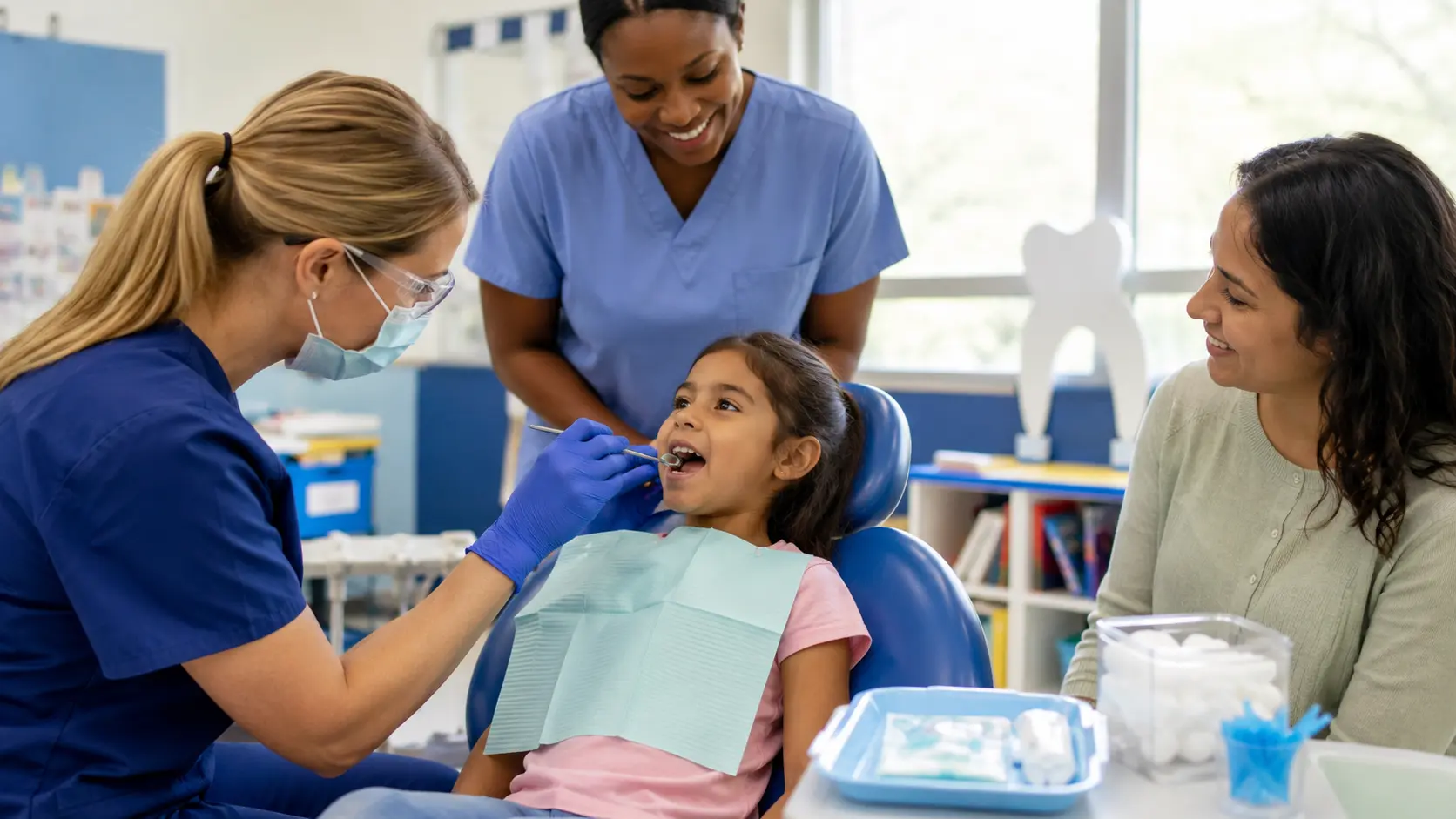
Medical-dental integration succeeds when it changes the work, not merely the meeting calendar. A Wisconsin case study described dental hygienists embedded in pediatric and prenatal care across nine clinics, with more than 15,000 medical visits including hygienist-delivered oral-health services from 2019 to 2023.16 The experience demonstrates feasibility in that policy and organizational context. It does not prove that the same staffing model will produce the same outcomes everywhere.
Learning collaboratives can also support practice change. An evaluation of a pediatric oral-health knowledge network found that 41 of 72 invited participants completed a survey and 11 participated in interviews; respondents described changes in training, clinical practice, and integration.18 Self-selection and self-report limit causal conclusions, but the model highlights the value of shared problem solving, expert access, and practical tools.
Data connection does not require every partner to use one electronic record. It does require an agreed child identifier, consent approach, referral status vocabulary, escalation contact, and reconciliation process. Define what “referred,” “accepted,” “scheduled,” “seen,” and “care completed” mean before building a dashboard. Assign a source of truth for each transition and a method for correcting mismatches. When interfaces are unavailable, a secure work queue with named ownership can be safer than an ambitious integration that leaves exceptions invisible. Privacy and minimum-necessary exchange should shape the design from the start.
Six capabilities surrounding one child-centered plan
Risk and urgency
Use consistent assessment, red-flag escalation, and documented clinical ownership.
Prevention access
Deliver evidence-informed services in dental, medical, school, and community settings.
Dental home
Maintain an accessible network for routine, urgent, specialty, and disability-responsive care.
Navigation
Address communication, transportation, coverage, scheduling, caregiver, and consent needs.
Data connection
Track children across programs, referrals, encounters, and unresolved exceptions.
Learning and equity
Review gaps with families and staff, test changes, and protect privacy in small groups.
Equity and experience
Design for different needs without lowering expectations
A comparative school study of 610 students found different patterns between students in special-purpose and mainstream schools. Students in special-purpose schools were less likely to have visited a dentist in the previous year and less likely to brush twice daily, while untreated caries was more common in the mainstream group.11 The mixed pattern is a useful warning against assuming that one setting or diagnosis explains all risk.
A 2026 meta-analysis of 25 studies found no significant group differences for most caries indicators between children and adolescents with and without autism, although one surface-level severity measure was higher in the autism group.2 Heterogeneity and observational designs limit interpretation. The practical priority is individualized accommodation, not a generalized prediction based on diagnosis.
Children with chronic conditions may need oral health incorporated into specialty pathways. A 2026 literature review described oral-health considerations among children with type 1 diabetes, but variation among studies limits universal conclusions.7 Executives can use such evidence to strengthen coordination while leaving diagnosis and treatment to qualified clinicians.
Experience measures should ask whether the family understood the plan, could schedule care, received accommodations, and knew whom to contact. Offer collection methods that do not require a portal or high literacy. Review nonresponse. A perfect survey score from a small, self-selected group can coexist with major access barriers among families who never reached the survey.
- Can every entry point identify urgent dental symptoms?
- Does the family receive an actual route, not only a phone number?
- Are language and disability accommodations recorded?
- Can schools reconcile prevention with dental-home follow-up?
- Who monitors referrals that are not accepted?
- Can families report pain after hours?
- Are small-group equity data privacy protected?
- Does the pathway learn from every failed handoff?
Operating dashboard
Measure the complete journey, not the volume of outreach
Activity measures are easy to collect. They include posters displayed, children screened, varnish applications, sealants placed, and referrals issued. These numbers matter, but they do not reveal whether care reached the intended population or whether a child’s need was resolved. A balanced dashboard must connect reach with completion, timeliness, experience, equity, and unintended burden.
Statewide school programs need unique-child tracking and longitudinal records. A Wisconsin field report described a system that catalogued more than 548,000 sealant-program services and linked student encounters across 47 programs.17 The report demonstrates reporting capability rather than clinical effectiveness. Its leadership value is the principle that large service counts should not conceal duplicate encounters or unresolved needs.
Stratification should guide action without turning descriptive differences into unsupported explanations. Start with variables that are relevant, reliable, ethically appropriate, and connected to an intervention the organization can change. Examine missingness before interpreting a gap. Protect privacy when group sizes are small, especially in schools, foster care, rural communities, and disability-related categories. Pair rates with counts, wait-time distributions, and qualitative review. If one group has lower referral completion, investigate appointment supply, communication, transportation, coverage, and workflow before attributing the pattern to family behavior.
A structured children’s oral-health scorecard
| Domain | Example measure | Definition guardrail | Leadership question |
|---|---|---|---|
| Reach | Eligible children receiving risk assessment or prevention | Use the eligible population as denominator; report missing eligibility data. | Who never reaches the service? |
| Dental home | Children with an identified source of longitudinal dental care | Define active relationship, not a name entered years earlier. | Can the practice accept routine and urgent needs? |
| Referral closure | Accepted referrals completed within locally defined urgency bands | Separate issued, accepted, scheduled, attended, and treated. | Where does the handoff stop? |
| Prevention | Appropriate preventive service completed and documented | Use clinical eligibility and consent; do not reward indiscriminate delivery. | Does prevention reach higher-risk children? |
| Experience | Caregivers who understand the plan and contact route | Offer multilingual, accessible, non-digital response options. | Is the pathway usable outside the organization? |
| Equity | Completion and wait measures stratified by relevant variables | Suppress small cells, protect privacy, and avoid causal claims from descriptive gaps. | Who experiences repeated friction? |
| Balancing | Emergency visits, repeated screening, missed school, rework, and family travel | Review clinical and social context; not every event is preventable. | Did improvement shift burden elsewhere? |
A 90-day plan
Use February to improve one transition and make the change durable
Begin with one transition where children are commonly lost. Examples include well-child visit to dental home, school screening to urgent dental evaluation, emergency visit to definitive follow-up, or prevention program to longitudinal care. Choose a scope narrow enough to test, but broad enough to include the teams and families who experience the entire handoff.
During the first month, map current work and validate the denominator. Review several successful journeys and several incomplete ones. During the second month, test a minimum dataset, named owner, acceptance confirmation, family-navigation step, and escalation rule. During the third month, review outcomes and balancing measures, correct defects, document coverage, and establish sustainment.
Three phases from pathway visibility to sustained closure
Days 1–30 · Assess
Define the population, map handoffs, validate timestamps, review exceptions, and listen to children, caregivers, and frontline teams.
Days 31–60 · Test
Pilot one referral package, named owner, confirmation step, navigation response, and escalation rule.
Days 61–90 · Sustain
Review equity and balancing measures, refine the workflow, train coverage roles, and establish monthly learning.

Executive close
Make the next oral-health step easier to reach and harder to lose
National Children’s Dental Health Month gives organizations a visible reason to talk about brushing, fluoride, healthy eating, regular dental care, and prevention. Leaders can honor that public-health purpose while asking a harder operational question: after a child’s need becomes visible, does the system help the family complete the next step?
A strong February commitment is specific. It names one population, one transition, one accountable owner, one exception route, and one review cadence. It does not promise that every child will receive the same intervention or that a short project will eliminate structural inequity. It promises that the organization will see the pathway more clearly, act on failures, and keep learning after the observance ends.
Publish the definition and denominator. Share what families said. Report the longest waits alongside the median. Explain what changed and what remains unresolved. If the first test reveals limited dental capacity, incomplete records, or coverage barriers, treat that as evidence for the next leadership decision. Awareness becomes credible when it produces a more reliable route to prevention and care.
Durability also depends on coverage for ordinary disruptions. Test what happens when the navigator is absent, a participating dental practice closes its panel, school is out, a family changes coverage, or a child moves between caregivers. Build backup ownership, maintain a current network directory, and review aged exceptions after the campaign ends. February can launch the improvement, but the control plan should name who audits the pathway in March, who reports to governance, and how families and frontline staff can signal that a supposedly fixed handoff is failing again.
This leadership synthesis includes systematic reviews, randomized trials, observational studies, qualitative research, implementation reports, and a trial protocol. Settings and populations differ, and several studies have small samples or noncomparative designs. The article should not be used to diagnose disease or select treatment for an individual child.
Authoritative resources
Official information for families, schools, and healthcare teams
Continue exploring
Related leadership resources
Evidence base
Peer-reviewed references
References are ordered newest first. Links open publisher or DOI records.
- Olatosi OO, Schroth RJ, DeMaré D, et al. Recommendations for integrating caries risk assessment into primary care for Indigenous children. JDR Clinical & Translational Research. 2026;11(3):388–400. doi:10.1177/23800844251372545.
- da Motta TP, da Mota DG, Bitencourt FV, et al. Dental caries of individuals with autism spectrum disorder: a systematic review and meta-analysis. Journal of Autism and Developmental Disorders. 2026;56(7):2735–2751. doi:10.1007/s10803-025-06754-7.
- Jahanbakhti Z, Momeni Z. Association of oral health knowledge, attitudes, and practice with dental caries status among 6–12-year-old Iranian orphaned children using the CAST index: a cross-sectional study. PLoS ONE. 2026;21(7):e0332983. doi:10.1371/journal.pone.0332983.
- Sabino E Andrade R, Piovesan ÉTA, Queiroz IQD, et al. Effectiveness of silver diamine fluoride and fluoride varnish in arresting caries lesions in permanent molars: a randomized controlled trial. Journal of Dentistry. 2026;169:106647. doi:10.1016/j.jdent.2026.106647.
- Kumar RS, Gupta A, Sharda S, et al. Fluoride varnish for preventing dental caries among children: a systematic review and meta-analysis of cost-effectiveness studies. Journal of Dentistry. 2026;167:106562. doi:10.1016/j.jdent.2026.106562.
- Ruff RR, Godín TB, Huang S. Building Adaptive School-Based Interventions for Caries: study protocol for a sequential, multiple-assignment, randomized trial. Trials. 2026;27(1). doi:10.1186/s13063-026-09588-5.
- Dămășaru MS, Dămășaru E, Caraiane A, et al. Clinical studies on the effect of type 1 diabetes on oral health in children and adolescents aged 6–17 years: a literature review. Medicine and Pharmacy Reports. 2026;99(1):5–15. doi:10.15386/mpr-2889.
- Mir F. Oral health disparities: a narrative review of global public health interventions. Journal of Pioneering Medical Sciences. 2026;15(Special Issue):128–133. doi:10.47310/jpms202515S0125.
- Simonton K, Patel V, Eismann EA, et al. Oral health of children in foster care. Clinical Pediatrics. 2025;64(9):1234–1243. doi:10.1177/00099228251343949.
- Scherrer C, Naavaal S, Keyser R, et al. Integrating fluoride varnish delivery in primary care: insights from a workflow and cost analysis. Academic Pediatrics. 2025;25(7):102865. doi:10.1016/j.acap.2025.102865.
- Wong G, Cheng K, Kumar T, et al. Special needs, special risks? A comparative oral health study in children and adolescents. Australian Journal of Primary Health. 2025;31(5):1–12. doi:10.1071/PY25097.
- Griffin SO, Lin M, Scherrer CR, et al. Effectiveness of school fluoride delivery programs: a Community Guide systematic review. American Journal of Preventive Medicine. 2025;69(1):107633. doi:10.1016/j.amepre.2025.04.003.
- Deretti RN, Vannah C, Boyd LD. Medical-dental integration: barriers to implementing silver diamine fluoride into primary care well-child visits. Journal of Dental Hygiene. 2025;99(4):18–31.
- Jena D, Kumar N, Lal P, et al. Effectiveness of different agents in ceasing early childhood caries: a clinical study. Journal of Pharmacy & Bioallied Sciences. 2025;17(Suppl 5):S3515–S3517. doi:10.4103/jpbs.jpbs_337_25.
- Chou R, Bougatsos C, Griffin J, et al. Screening, referral, behavioral counseling, and preventive interventions for oral health in children and adolescents aged 5 to 17 years: a systematic review for the US Preventive Services Task Force. JAMA. 2023;330(17):1674–1686. doi:10.1001/jama.2023.20435.
- Linden JE, Gundacker CLU, Deinhammer L, Crespin M. Medical dental integration in Wisconsin: integrating dental hygienists into pediatric well-child visits and prenatal care. Journal of Dental Hygiene. 2023;97(3):13–20.
- Shimpi N, Glurich I, Hegde H, et al. DentaSeal: a school-based dental sealant efficiency assessment tool to support statewide monitoring and reporting: a field report. Technology and Health Care. 2023;31(4):1279–1291. doi:10.3233/THC-220568.
- Jiang T, Savageau JA, Russinof H, Riedy CA, Silk H. Evaluation of the Oral Health Knowledge Network’s impact on pediatric clinicians and patient care. Annals of Family Medicine. 2023;21(Suppl):S39–S48. doi:10.1370/afm.2921.
Evidence was reviewed through August 2026. Inclusion in this leadership synthesis does not endorse a product, treatment, technology, organization, or universal benchmark.