


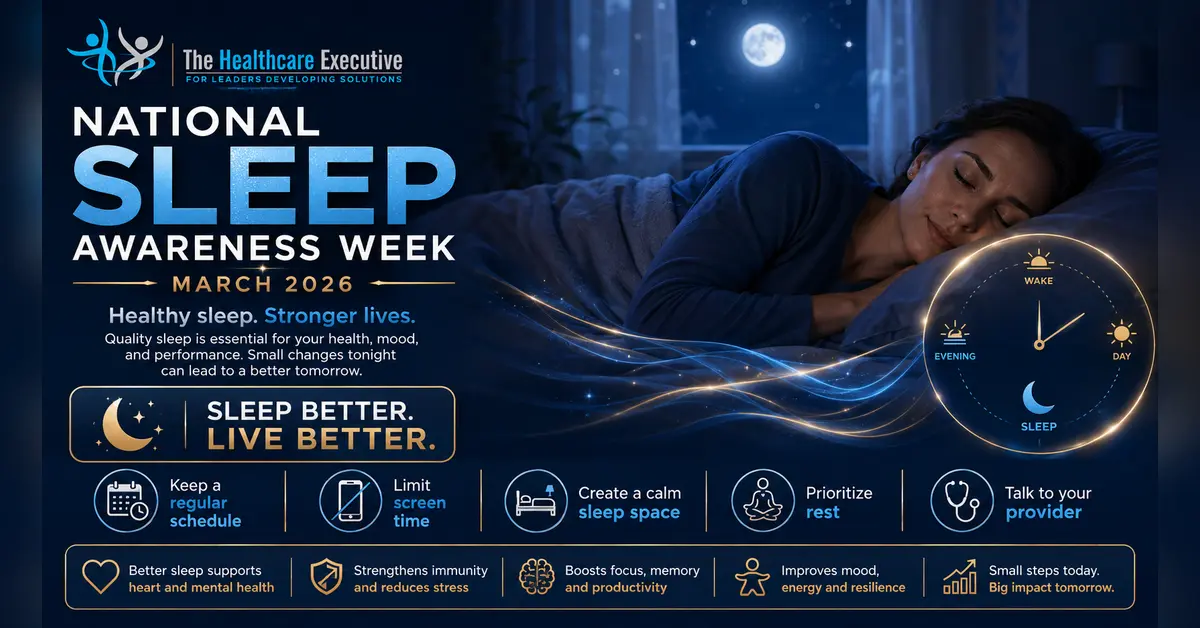
Sleep Awareness Week 2026
Treat sleep health and fatigue risk as part of access, safety, workforce, and family well-being.
Sleep belongs in the operating model because fatigue and untreated symptoms cross every care setting.
Sleep Awareness Week gives leaders a useful lens on two connected responsibilities: helping patients reach appropriate sleep-health support and designing workforce practices that do not normalize preventable fatigue risk.
The response should avoid one-size-fits-all wellness messaging. A reliable system distinguishes healthy sleep education from symptom screening, clinical evaluation, treatment access, and urgent safety escalation.
Choose one population and one workforce process, then map where sleep-related risk is recognized, routed, and followed to resolution.
The National Sleep Foundation confirms the 2026 dates.
NSF describes 2026 as the campaign's 28th year.
The 2026 Sleep in America Poll highlights sleep across children and families.
Figures are summarized from the authoritative sources linked below. Definitions and denominators should be read with each source.
Connect education, recognition, evaluation, treatment, and follow-up.
Use separate pathways for general sleep health, suspected disorders, and immediate safety risk.
-
Promote routines
Offer clear, evidence-informed guidance on consistent schedules, light, activity, and the sleep environment without implying that habits resolve every disorder.
-
Recognize symptoms
Standardize when snoring, witnessed breathing pauses, insomnia, excessive sleepiness, shift-work concerns, or medication effects need further evaluation.
-
Route appropriately
Connect primary care, behavioral health, sleep medicine, testing, and treatment with visible referral status.
-
Follow outcomes
Confirm that the person received the plan, can use it, and has an owner for persistent symptoms or access barriers.
Reliability rule: Education is not a substitute for evaluation when symptoms, impairment, or safety concerns persist.
Use a small set of signals to manage the route.
Review measures with stable definitions, named owners, and explicit action thresholds.
Screening reach
Track appropriate screening in the selected high-risk population.
Referral completion
Show whether accepted referrals become completed evaluations.
Access delay
Measure wait time for testing, specialty assessment, or treatment initiation.
Fatigue risk
Monitor a workforce fatigue signal tied to an action threshold.
Make sleep-related risk visible when responsibility changes.
The person and the receiving team need the same reason for referral, next action, and safety plan.
Patient to first contact
- Capture the symptom, duration, daily impact, and safety concern.
- Identify medications, work schedule, and barriers that matter.
- Explain the expected next step and timing.
Primary care to specialty
- Transmit the clinical question and relevant history.
- Confirm testing and referral requirements before sending.
- Track acceptance and recover rejected or incomplete referrals.
Plan back to daily life
- Explain the diagnosis or working assessment in plain language.
- Confirm treatment access and practical use.
- Assign follow-up for persistent symptoms and safety-sensitive work or driving concerns.
A completed test is not a closed loop if the person never receives an understandable plan or cannot carry it out.
Ask whether the system is reliable, reachable, and learning.
Use these questions in an existing operating review so the observance produces sustained accountability.
| Signal | Executive question | Accountable owner | Review cadence |
|---|---|---|---|
| Recognition | Are high-risk patients asked about sleep symptoms and functional impact? | Primary care and population health | Monthly |
| Access | Where do referrals, tests, or treatment starts wait longest? | Sleep service operations | Weekly |
| Continuity | Do results and treatment plans return to the referring team and patient? | Clinical operations | Monthly |
| Workforce | Which schedules or units repeatedly exceed the chosen fatigue-risk threshold? | Workforce safety and operations | Monthly |
Convert one campaign week into a durable operating improvement.
Keep the scope narrow enough to test and important enough to matter.
Map the work
- Select one patient population and one fatigue-risk workflow.
- Map screening, referral, testing, treatment, and follow-up.
- Baseline access delay and unresolved referral counts.
Align the system
- Standardize the clinical question and minimum referral data.
- Define an escalation path for severe impairment or safety risk.
- Align one scheduling policy with the chosen fatigue signal.
Improve and sustain
- Pilot the route in one clinic or workforce setting.
- Review misses with patients and frontline staff.
- Publish results and decide what to spread next.
Healthy sleep needs more than a message. It needs a route that people can use.
Sleep Awareness Week can connect public education with practical access and safer operations when leaders make the next step visible.
Make the observance visible in everyday operations.
Sleep Awareness Week becomes meaningful when screening and symptom recognition lead to appropriate evaluation, safety counseling, treatment, and reassessment. The weak version is a message without an operating change. The stronger version defines what teams should see, who owns each transition, how exceptions escalate, and how leaders know that the pathway actually closed.
The principal failure mode is that sleep concerns are easily normalized or fragmented across primary care, behavioral health, neurology, cardiology, workplace health, and specialty services. Leaders should test the route with recent cases, frontline staff, patients or community partners, and the teams that receive the next handoff. That review should distinguish a written policy from reliable execution under real workload, staffing, access, and communication conditions.
Promote routines
Confirm the accountable owner, expected evidence, exception route, communication standard, and documented closure for this step.
Recognize symptoms
Confirm the accountable owner, expected evidence, exception route, communication standard, and documented closure for this step.
Route appropriately
Confirm the accountable owner, expected evidence, exception route, communication standard, and documented closure for this step.
Follow outcomes
Confirm the accountable owner, expected evidence, exception route, communication standard, and documented closure for this step.
Screening reach
Confirm the accountable owner, expected evidence, exception route, communication standard, and documented closure for this step.
An equity review should evaluate shift work, caregiving, housing, coverage, geography, language, disability, and access to diagnostic services. Aggregate performance can hide a pathway that works for people with the fewest barriers while failing those who need language support, accommodations, transportation, trusted outreach, flexible scheduling, or help navigating coverage. Stratified results and direct feedback should therefore guide the improvement plan.
Measurement should pair screen-positive follow-up, diagnostic completion, treatment initiation, adherence support, and symptom reassessment. Counts alone do not establish reliability. The executive review should examine time, completion, unresolved exceptions, patient or workforce experience, and variation across sites. A small set of stable measures is more useful than a large dashboard that no one owns.
Governance should give a cross-service clinical leader authority to define referral criteria, urgent safety routes, and closed-loop follow-up. The accountable owner should convene the relevant clinical, operational, access, quality, and community voices; remove barriers that frontline teams cannot solve; and return decisions to the people doing the work. The 90-day test is simple: show which failure point changed, what evidence confirms the change, and what still requires executive action.
Turn Sleep Awareness Week into accountable action.
Treat sleep health and fatigue risk as part of access, safety, workforce, and family well-being.
Leadership focus
Use this observance to examine trustworthy information, prevention access, and community connection. Select one verified barrier, assign an accountable owner, and carry the improvement beyond the campaign window.
Workforce lens
Ask whether staffing, role clarity, training, tools, workload, and escalation support the people operating the information, access, coordination, and follow-through pathway.
Patient and community lens
Make the approved first step clear. Test whether a person can move from information to an acknowledged next action without navigating conflicting instructions.
Equity and access lens
Review language, disability, transportation, digital access, geography, trust, and other barriers using protected feedback and locally appropriate data.
Inspect the operating sequence
Listen with people using the pathway, frontline teams, operational leaders, and community partners. Find one a message, request, referral, or handoff that does not reach an accountable owner, then test the locally approved route from entry through acknowledged follow-through.
- 01Promote routines
- 02Recognize symptoms
- 03Route appropriately
- 04Follow outcomes
Leadership actions for this week
- Name an executive sponsor and frontline operating owner.
- Ask people using and operating the pathway where ownership becomes unclear.
- Test one representative route from first question to acknowledged next step.
- Select one barrier that can be corrected without overstating the evidence.
- Set a review date and define how completion will be verified.
Candidate measures
Define every numerator, denominator where relevant, owner, data source, exclusions, cadence, and limitation locally. These are management prompts, not external benchmarks.
- Eligible people screened using one defined process
- Completed evaluations divided by accepted referrals
- Median and 90th-percentile days by step
Department readiness checklist
- The public and staff entry points match the actual approved process.
- A specific role accepts each request, referral, or escalation.
- Handoffs include acknowledgment and a visible unresolved state.
- Language, disability, digital, transportation, and trust barriers receive explicit review.
- Communications do not introduce unsupported themes, statistics, or clinical advice.
- A named leader will review what changed after the observance.
Intended audiences
- Executive and Operational Leaders
- Public Health and Community Partners
Staff communication template
During Sleep Awareness Week, our organization will connect awareness with a practical review of the information, access, coordination, and follow-through pathway. Use approved information, identify the correct entry point, confirm ownership when work moves, protect privacy, and escalate unresolved barriers through local channels.
Community communication template
Sleep Awareness Week is an opportunity to share trustworthy information and make the next step easier to find. Use our approved channels for information and support. If a request changes hands, our goal is to keep ownership and follow-through visible.
Measurement worksheet
- Signal
- What observable condition will show whether the route works?
- Definition
- What is included, excluded, and counted?
- Owner
- Who reviews the signal and acts on exceptions?
- Cadence
- When will leaders review it?
- Equity check
- Which differences require protected, locally appropriate review?
- Closure
- What evidence will confirm the improvement was completed?
Authoritative resources
- Sleep Awareness Week 2026, National Sleep Foundation
- 2026 Dates for Sleep Awareness Week, National Sleep Foundation
- Sleep Deprivation and Deficiency, National Heart, Lung, and Blood Institute
- About Sleep, Centers for Disease Control and Prevention
- Worker Fatigue, National Institute for Occupational Safety and Health
Source note: Healthgrades uses “National Sleep Awareness Week.” The National Sleep Foundation's registered campaign name is “Sleep Awareness Week®,” and its official 2026 announcement confirms March 8–14. Use the organizer's campaign name and dates.
Safety note: Severe breathing difficulty, chest pain, stroke signs, collapse, or inability to stay awake safely requires urgent evaluation. People with suicidal thoughts can call or text 988 in the United States. This brief does not diagnose or treat a sleep disorder.
Official identity and timing are taken from the named campaign source. Operational recommendations are original editorial guidance and must be reconciled with applicable law, policy, professional standards, and clinical judgment.