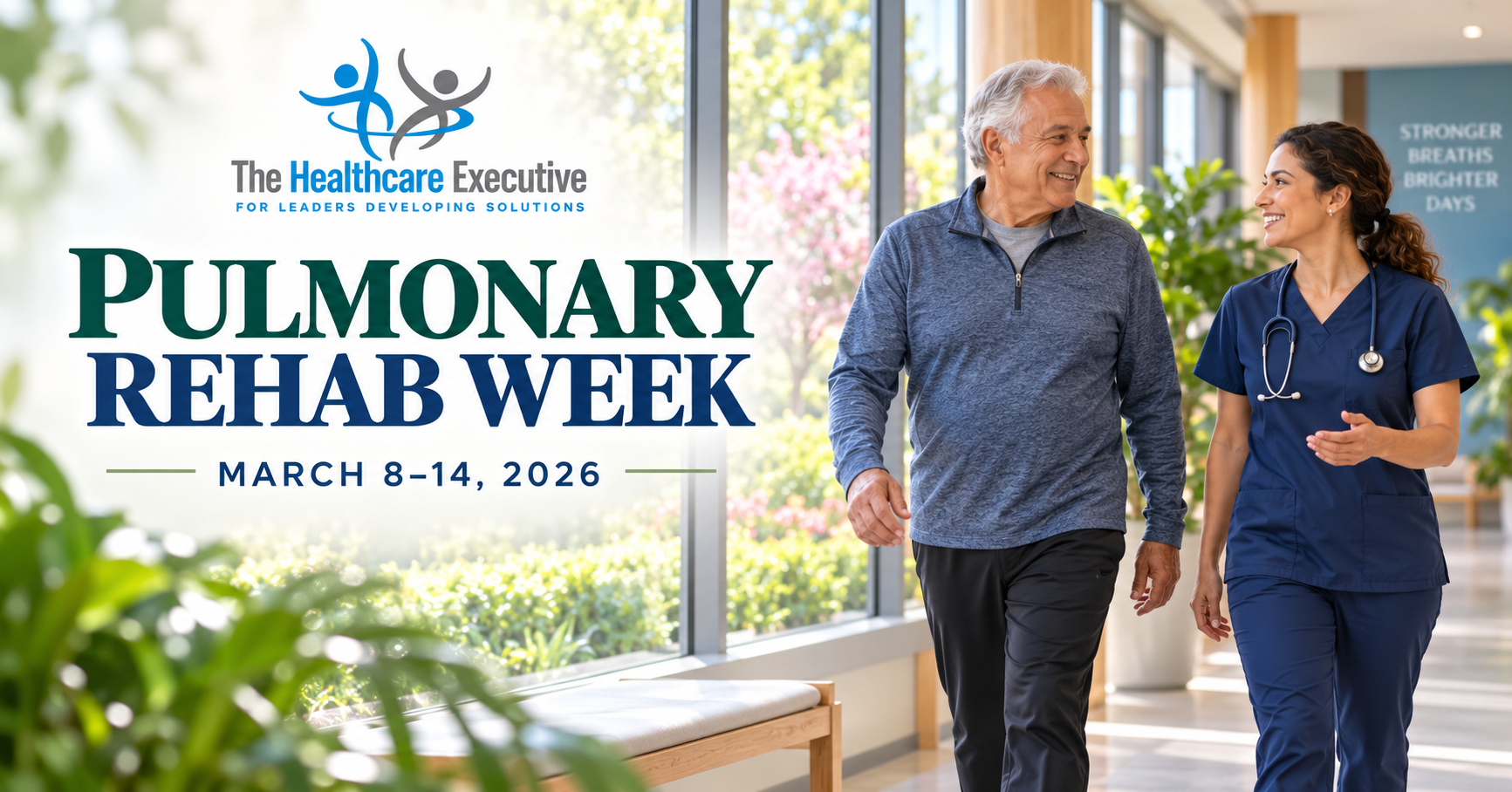


Pulmonary Rehab Week 2026
Turn every eligible referral into a visible route to assessment, enrollment, and sustained participation.
A referral is not a rehab program.
CDC reports that nearly 16 million U.S. adults have COPD and that many more do not know they have it. WHO reports that COPD is the third leading cause of death worldwide. Pulmonary rehabilitation is one of the ways health systems help people with chronic lung disease breathe easier, stay active, and manage daily life, but its value depends entirely on whether people actually reach and complete it.
NHLBI describes pulmonary rehabilitation as a program of breathing techniques, education, exercise training, nutritional counseling, and psychological counseling, usually delivered as 2 or 3 weekly sessions over several weeks or months. That structure makes it a sustained commitment for patients and a capacity commitment for programs. Every step, from referral to the final session, is a point where people can drop out of the route.
The losses are usually operational. Eligible patients leave the hospital after a COPD admission without a referral. Referrals arrive incomplete or sit unscheduled. Intake assessments are delayed. Session times conflict with work or caregiving, transportation is hard, and no one notices when attendance fades. None of these problems requires new clinical evidence to fix; each requires an owner and a measure.
Leaders should look at pulmonary rehabilitation as a funnel with visible stages: eligible, referred, assessed, enrolled, attending, completed. Most organizations can count referrals. Fewer can say how many eligible patients were never referred, how long assessment takes, or how many enrolled patients finish the program. Those gaps are where improvement lives.
AACVPR invites programs to mark Pulmonary Rehab Week 2026, March 8–14, by drawing attention to the role pulmonary rehabilitation plays in the lives of people with lung disease. The most useful response from a health system is to make the route visible and to commit to turning every eligible referral into assessment, enrollment, and sustained participation.
Build a single report that follows eligible patients from identification through referral, assessment, enrollment, and completion, and review it monthly with pulmonary, hospital medicine, and rehabilitation leaders.
CDC reports that nearly 16 million U.S. adults have COPD, and many more do not know they have it.
WHO reports that COPD is the third leading cause of death worldwide, causing 3.4 million deaths in 2023.
NHLBI notes that pulmonary rehabilitation is usually a series of 2 or 3 weekly sessions lasting several weeks or months.
Figures are summarized from the authoritative sources linked below. Definitions and denominators should be read with each source.
The route from eligibility to sustained participation
Four steps turn a referral into a completed program.
-
Identify and refer
Flag patients who may be eligible during admissions, specialty visits, and primary care, and make referral a standard part of discharge and follow-up planning.
-
Assess promptly
Protect intake capacity so referred patients complete their initial assessment without long waits or repeated scheduling attempts.
-
Enroll with a plan
Agree on goals with the patient and address schedule, transportation, cost, and caregiving barriers before the first session.
-
Sustain participation
Monitor attendance, reach out early when sessions are missed, and share progress with the referring clinician.
Reliability rule: No referral to pulmonary rehabilitation closes until the person has enrolled or a documented, shared decision explains why not.
What leaders should watch
Four instruments show where people leave the route.
Referral capture
Measure how often eligible patients leave a hospital stay or specialty visit with a referral in place.
Referral-to-assessment interval
Track how long referred patients wait for their intake assessment.
Enrollment conversion
See how many assessed patients begin the program.
Program completion
Monitor whether enrolled patients finish the planned course.
Handoffs that keep people in the program
Most losses happen between teams, so each handoff needs a defined package.
From hospital discharge to pulmonary rehabilitation
- Place the referral before discharge with diagnosis, recent history, and relevant results.
- Tell the patient the referral was sent and how the program will contact them.
- Note known barriers such as transportation, oxygen needs, or caregiving.
From the referring clinician to the rehab team
- Share current medications, oxygen prescription, and any activity precautions.
- State the goals the patient and clinician hope to address.
- Name who to contact with clinical questions.
From the rehab team back to ongoing care
- Send a summary of attendance, progress, and the home exercise plan.
- Flag symptoms or concerns that need clinician follow-up.
- Recommend next steps for maintaining activity after completion.
A handoff is complete when the receiving team confirms it can act, not when a referral is transmitted.
A quarterly scorecard for pulmonary rehabilitation
Four questions keep leadership attention on the full route.
| Signal | Executive question | Accountable owner | Review cadence |
|---|---|---|---|
| Referral | Are eligible patients consistently referred at discharge and in specialty and primary care? | Pulmonary, hospital medicine, and primary care leaders | Monthly |
| Access | Can referred patients complete an intake assessment within our local target? | Rehabilitation and access leaders | Monthly |
| Completion | Do enrolled patients complete the planned program? | Pulmonary rehabilitation program leaders | Quarterly |
| Equity | Do referral, enrollment, and completion differ by payer, language, geography, or transportation access? | Health equity and analytics leaders | Quarterly |
A 90-day plan
Use Pulmonary Rehab Week to launch one measurable improvement cycle.
Choose one referral source to start, such as hospital discharges after a COPD admission. Measure the current funnel before changing anything. Fix the handoffs and scheduling barriers before adding capacity. Review results every month with the clinicians, schedulers, and program staff who run the route.
Days 1–30: See the funnel
- Agree on local eligibility criteria with pulmonary and rehabilitation leaders.
- Establish baselines for referral capture, assessment interval, enrollment, and completion.
- Interview recent patients who did not enroll or did not finish.
Days 31–60: Fix the handoffs
- Build referral into discharge workflows for the chosen patient group.
- Protect intake assessment slots and standardize outreach to referred patients.
- Test practical supports such as flexible session times or transportation help.
Days 61–90: Sustain and report
- Review funnel measures with the program team and referring clinicians.
- Identify equity gaps and assign owners.
- Publish a short progress summary to executive leadership.
Rehab works only when people get there and stay.
Pulmonary Rehab Week is a reminder that pulmonary rehabilitation helps people with lung disease only when referrals become assessments, enrollments, and completed programs. That route can be measured and managed.
Turn Pulmonary Rehab Week into accountable action.
Turn every eligible referral into a visible route to assessment, enrollment, and sustained participation.
Leadership focus
Turn every eligible referral into a visible route to assessment, enrollment, and sustained participation.
Workforce lens
Give hospital, specialty, and primary care teams simple eligibility prompts and a referral workflow that fits discharge and follow-up routines.
Patient and community lens
Make sure people know why they were referred, how the program will contact them, and what support exists for scheduling and transportation.
Equity and access lens
Stratify referral, enrollment, and completion by payer, language, geography, and transportation access, and act on the gaps.
Inspect the operating sequence
Pulmonary rehabilitation depends on a multi-week commitment that many patients never start or finish. This quarter we will measure the full route from eligibility to completion and fix the handoffs where people are lost.
- 01Identify and refer
- 02Assess promptly
- 03Enroll with a plan
- 04Sustain participation
Leadership actions for this week
- Name an executive sponsor and frontline operating owner.
- Ask people using and operating the pathway where ownership becomes unclear.
- Test one representative route from first question to acknowledged next step.
- Select one barrier that can be corrected without overstating the evidence.
- Set a review date and define how completion will be verified.
Candidate measures
Define every numerator, denominator where relevant, owner, data source, exclusions, cadence, and limitation locally. These are management prompts, not external benchmarks.
- Share of locally defined eligible patients with a completed referral
- Median and 90th-percentile days from referral to completed assessment
- Share of assessed patients who attend a first exercise session
Department readiness checklist
- The public and staff entry points match the actual approved process.
- A specific role accepts each request, referral, or escalation.
- Handoffs include acknowledgment and a visible unresolved state.
- Language, disability, digital, transportation, and trust barriers receive explicit review.
- Communications do not introduce unsupported themes, statistics, or clinical advice.
- A named leader will review what changed after the observance.
Intended audiences
- Executive and Operational Leaders
- Public Health and Community Partners
Staff communication template
During Pulmonary Rehab Week, our organization will review how reliably eligible patients reach and complete pulmonary rehabilitation. Please use the referral workflow at discharge and follow-up so every eligible patient has a clear next step.
Community communication template
Pulmonary Rehab Week highlights programs that help people with chronic lung disease stay active and manage daily life. If you live with a lung condition, ask your healthcare provider whether pulmonary rehabilitation is right for you.
Measurement worksheet
- Signal
- What observable condition will show whether the route works?
- Definition
- What is included, excluded, and counted?
- Owner
- Who reviews the signal and acts on exceptions?
- Cadence
- When will leaders review it?
- Equity check
- Which differences require protected, locally appropriate review?
- Closure
- What evidence will confirm the improvement was completed?
Authoritative resources
- PR Week Marketing Toolkit, American Association of Cardiovascular and Pulmonary Rehabilitation
- About COPD, Centers for Disease Control and Prevention
- Chronic obstructive pulmonary disease (COPD) fact sheet, World Health Organization
- Pulmonary Rehabilitation, National Heart, Lung, and Blood Institute
- Living With COPD, National Heart, Lung, and Blood Institute
Safety note: NHLBI advises people with COPD to call their healthcare provider if symptoms worsen or signs of infection such as fever appear, and to seek emergency care for a severe flare-up. It also notes that heart attacks, strokes, and other cardiovascular events are more likely during and after a COPD flare-up.
Verification note: AACVPR’s PR Week Marketing Toolkit confirms Pulmonary Rehab Week 2026 as March 8–14 under the heading “Share the Value of Pulmonary Rehab”; the page does not label that phrase as an official theme, so it is not presented as one here.