

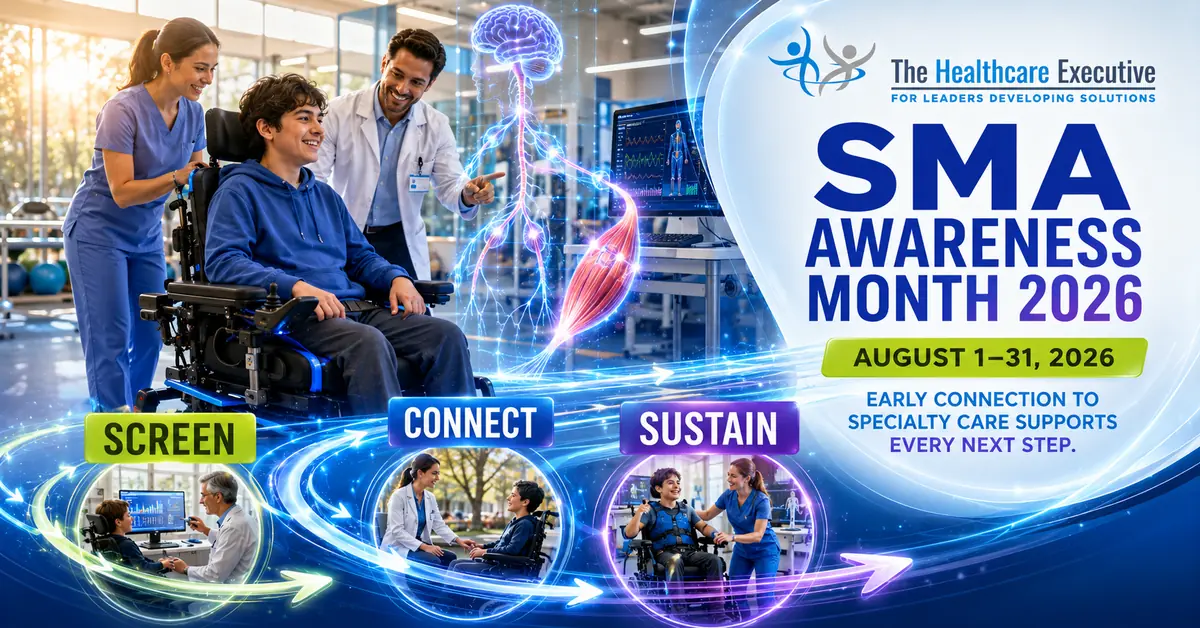
August 1-31, 2026 · Executive evidence brief
SMA Awareness Month 2026
Make every transition visible: prompt newborn-screen follow-up, coordinated clinical assessment, understandable choices, practical access, family-centered support, participation-focused care, and accountable learning across the lifespan.
Cure SMA recognizes August as SMA Awareness Month. This executive brief uses the observance to examine how healthcare organizations can strengthen the route from a screening signal or clinical concern to coordinated, equitable, and sustained support.
Leadership mandate
Build an accountable route, not a month of disconnected messages
SMA Awareness Month can increase recognition, but recognition is only the front door. A healthcare organization still has to receive a newborn-screen notification or clinical concern, reach a family, communicate uncertainty without abandoning urgency, connect the right clinical expertise, support informed decisions, navigate access, coordinate multidomain care, and maintain follow-through as needs change. Each step can work well on its own while the route between steps remains fragile. The executive task is to make the route observable from end to end.
That task matters because time, information, access, and trust converge at the same moment. A family receiving an unexpected screening result may be learning a new vocabulary while teams are arranging assessment, confirming details, and considering next actions. A child, young person, or adult already living with SMA may be managing appointments, respiratory needs, nutrition, mobility, education, work, insurance, equipment, caregiving, and future planning across organizations that do not share one operating view. Reliability requires more than good intentions. It requires named ownership, closed-loop communication, defined exception paths, and support that fits daily life.
Recent evidence describes the human stakes of that design. A 2026 scoping review of illness narratives from children and young people with SMA included 21 articles and identified themes involving everyday life, rights, access, information, coverage, and limited institutional support.1 A 2025 qualitative evidence review of late-onset SMA and families described complex symptoms, uncertainty, psychosocial effects, caregiving, loss, anticipatory grief, and end-of-life experience across seven studies.12 Neither review measures how often an experience occurs. Together, they show why a pathway should carry information, emotional support, and the person's goals alongside clinical work.
Leadership should begin with a bounded improvement question. One organization may focus on the interval from newborn-screen notification to an accepted specialty handoff. Another may focus on authorizations and access across payers. A pediatric service may examine respiratory, nutrition, mobility, rehabilitation, and family-support coordination after the care plan changes. An adult service may examine transition from pediatric care, preservation of participation, or how people reenter the pathway when function or goals change. A defined population and transition make ownership and measurement possible.
The route should not imply that every person needs the same appointments, interventions, or outcome measures. SMA is heterogeneous, evidence continues to evolve, and family circumstances differ. Reliability means the right questions are addressed, not that every chart contains the same answer. It means a positive screen reaches the responsible clinical pathway, communication is understandable, options and uncertainties are discussed, practical barriers are not mistaken for refusal, urgent concerns have a governed route, and unresolved work remains visible to someone who can act.
Patient-centered assessment should also be distinguished from patient burden. A 2026 modified Delphi study brought together 12 representatives of patient organizations across 12 European member states for three rounds on health technology assessment scope. The resulting priorities included eligibility, shared decisions, caregiver perspective, outcomes, and treatment burden.10 The study does not establish clinical effectiveness, and its European policy context should not be transferred uncritically. It does reinforce an operational principle: a decision process is incomplete when the record captures a product or procedure but not the goals, tradeoffs, burden, and experience that matter to the person and family.
An executive sponsor can convert that principle into a small number of enforceable commitments. Every new signal has an accountable receiver. Every family knows the next contact and what remains uncertain. Every referral is tracked to acceptance or a safe alternate disposition. Every access barrier has an owner and an escalation point. Every multidisciplinary plan identifies which team owns each component. Every scorecard pairs speed and completion with safety, experience, equity, and burden. These commitments can be audited without prescribing one clinical decision.
Executive decision
Select one high-friction SMA transition and govern it as a complete route. Define the entry event, responsible receiver, family communication, clinical handoff, access owner, exception path, completion signal, and learning review before adding more awareness activity.
Evidence signal
Measure participation and quality of life as deliberately as impairment and function
A pathway reveals its values through what it measures. A 2026 scoping review mapped 71 reports of rehabilitation approaches for children with SMA using the F-words framework. Half of intervention targets focused on impairment, while 15% focused on functioning, 8% on participation, and 27% on environment. Reported outcome domains were distributed differently: 42% impairment, 43% functioning, 9% participation, and 6% quality of life.2 These percentages describe the reviewed literature. They do not compare intervention effectiveness and should not be interpreted as a recommended allocation.
The mapping is useful because it surfaces domains that can disappear from an executive dashboard. A service may report appointments, assessments, authorizations, and motor measures while failing to ask whether a child can join a chosen activity, whether equipment arrives in time for school, whether the family understands who to call, or whether a plan is feasible at home. Clinical measures remain important, but leaders need complementary signals about participation, environment, family experience, and quality of life.
| Literature category | Domain | Share | Interpretation boundary |
|---|---|---|---|
| Intervention target | Impairment | 50% | Describes what reviewed interventions targeted, not benefit or priority. |
| Intervention target | Functioning | 15% | Different reports and approaches were mapped, not pooled for effect. |
| Intervention target | Participation | 8% | A smaller literature share does not mean the domain matters less to families. |
| Intervention target | Environment | 27% | Environmental work can involve several settings and supports. |
| Outcome domain | Impairment | 42% | Outcome-domain frequency does not establish responsiveness or validity. |
| Outcome domain | Functioning | 43% | Reported measures varied across the reviewed literature. |
| Outcome domain | Participation | 9% | Participation requires context and a person's chosen goals. |
| Outcome domain | Quality of life | 6% | Quality of life should not be inferred from motor measures alone. |
Executives can use this evidence signal to review local balance. A clinical service might pair a clinically appropriate motor or functional measure with a goal chosen by the person, a participation question, an access measure, a caregiver or self-reported burden measure, and a balancing measure. The choice of instruments remains a clinical and governance decision. The leadership objective is to avoid treating what is easiest to count as the complete outcome.
Early powered mobility offers one example of why experience adds information. A 2025 qualitative study captured the perspectives of nine parents after structured powered-mobility training for children with SMA type I. It explored family experiences rather than proving a universal clinical benefit.13 For an executive team, the transferable lesson is that equipment pathways should assess readiness, training, home and school context, maintenance, transport, communication, and the child's opportunity to participate. Delivery of a device is an operational milestone, not the end of the pathway.
Nutrition and swallowing require the same discipline. A 2026 cross-sectional study of 24 children in a Turkish tertiary center examined clinical characteristics, feeding duration, tube feeding, and several anthropometric measures.7 A separate 2026 pilot study extended the Oral and Swallowing Abilities Tool to 52 children with type I SMA older than 24 months. The group included 27 children fed orally, 19 exclusively by tube, and 6 receiving tube feeding with some oral intake.5 The pilot requires further validation, and neither small study supports a universal threshold or feeding plan. They illustrate why nutrition, swallowing, growth, safety, family workload, and communication among teams belong in a coordinated route.
Evidence about treatment response must also be bounded. A 2026 retrospective real-world cohort in China enrolled 62 people with SMA types 1 through 3 receiving nusinersen, and 32 completed motor assessments. Among the available data, the median observed time to response was about two months.4 This treatment-specific, incomplete, single-country cohort is not a universal response clock. A system should not use it to promise benefit, discontinue care automatically, or establish an individual monitoring schedule. It can prompt a governance question: does the organization have a clearly owned, clinically appropriate process to record baseline, monitor response and burden, discuss uncertainty, and reassess the plan?
A balanced portfolio protects against two errors. The first is overclaiming that a process measure proves an outcome. The second is overlooking a meaningful outcome because it is not captured in the main clinical system. Referral speed, treatment access, respiratory events, nutritional status, function, participation, experience, and caregiver burden answer different questions. Leaders should identify which decisions each measure supports, who can interpret it safely, and what remains outside the data.
Reliable route
Close the loop from a screening signal to sustained support
Newborn screening has changed the entry point for many families, but a screening program is a chain rather than a laboratory event. The chain includes specimen collection and transport, analysis, notification, family contact, confirmatory and clinical assessment, care planning, access work, and ongoing support. The specific tests, timeframes, and clinical actions are governed by the responsible public-health and clinical programs. The executive role is to ensure that every transition has a receiver and that unresolved exceptions do not disappear.
A 2026 claims-based analysis examined the timeliness of SMA detection among insured U.S. infants from 2016 through 2023 as state screening expanded. Detection by one month increased from 18% in 2017 to 61% in 2021, with a projected 75% in 2022.9 The 2022 value was projected, claims codes do not show every clinical event, and detection is not the same as treatment initiation or long-term outcome. The study supports examining timeliness while preserving each boundary.
Implementation reports from other settings add process insight without providing a U.S. benchmark. A regional program in Campania, Italy screened 62,801 infants and identified 13 positive screens, with motor follow-up available for a small subset.8 A 2026 feasibility report described first steps for newborn screening in the Republic of Moldova, while a 2025 paper reported the first year of Quebec's program.6, 11 Local laws, laboratory networks, clinical capacity, coverage, and geography differ. The transferable value is implementation logic: define notification, handoff, documentation, backup, and case review before volume exposes a weak link.
- 1. Screening result receivedResult enters a monitored queue with identity checks, timestamp, responsible role, and backup.
- 2. Family notificationA prepared clinician communicates what is known, what remains uncertain, the next contact, and support options.
- 3. Confirmatory and clinical assessmentThe responsible specialists follow the governed pathway and record questions, status, and urgency.
- 4. Multidisciplinary planThe family and team identify goals, options, responsibilities, sequencing, and an understandable contact route.
- 5. Access and treatment operationsAuthorization, pharmacy, scheduling, travel, training, and alternative plans are owned to resolution.
- 6. Ongoing support and monitoringClinical response, safety, function, participation, nutrition, respiratory needs, experience, and burden are reassessed.
The first reliability test is receipt. A result sent by one system must be visibly accepted by another. A fax confirmation or electronic transmission flag may prove transport, but not clinical ownership. A safer workflow identifies the person or team responsible for reviewing the result, the backup when that person is unavailable, the route for incomplete contact information, and the escalation point when receipt or action cannot be confirmed. The record should show both the current state and the next accountable action.
The second test is communication. A 2025 qualitative study interviewed 13 parents after positive newborn screens across SMA, Pompe disease, and X-linked adrenoleukodystrophy. Themes included disclosure of results, movement toward diagnosis and treatment, communication, and holistic support.14 The small multi-condition sample cannot determine frequency, and one model will not fit every family. It does show why leaders should prepare communicators, reduce contradictory messages, support questions, and provide a reachable contact after the first conversation.

The third test is a clinically owned handoff. Scheduling staff, public-health personnel, laboratory teams, genetic counselors, neurologists, primary care clinicians, nurses, and access teams may all participate, but the family should not have to reconcile their roles alone. Local policy should specify which team accepts the case, which information is required, how urgency is assigned, who orders or interprets clinically necessary work, and who informs the family when the plan changes. A warm handoff can include direct team-to-team communication and confirmation that the family has a reachable next contact.
The fourth test is access. A clinical decision does not become care until the required service, medication, equipment, training, or support is actually obtainable. Authorization requests, specialty-pharmacy routing, benefit documentation, scheduling constraints, travel, lodging, work leave, sibling care, language access, and technology can all shape completion. The pathway should record the barrier type, accountable owner, next action, due date, and alternate clinical route when the original plan cannot proceed. The system should never create the appearance of refusal by closing a case after an unsuccessful contact or an administrative denial.
The fifth test is continuity. Clinical needs and family goals change. The route should permit planned follow-up, urgent reentry, age-related transition, equipment replacement, school or workplace coordination, and reassessment after a treatment or functional change. Continuity does not mean continuing the same plan indefinitely. It means that change is reviewed, communicated, and supported rather than becoming an unowned gap.
Closed-loop reporting makes the chain governable. A multidisciplinary huddle can review new signals, families not yet reached, cases awaiting assessment, access exceptions, and urgent concerns. A weekly operational view can show counts and aging without exposing unnecessary personal information. A monthly governance review can examine recurring failure modes, equity patterns, experience, and workload. Each level needs a clear purpose so that reporting leads to action rather than duplicative meetings.
Family experience and choice
Make information, participation, and support part of the care infrastructure
Families and people living with SMA often carry the integration work that fragmented organizations do not perform. They maintain histories, coordinate appointments, explain needs to new teams, manage equipment, observe changes, navigate insurance, and translate advice into daily routines. Some people welcome a family member's involvement; others prefer to lead decisions independently. An accountable system asks who should participate, obtains permission for information sharing, and avoids assuming that every household has the same capacity or structure.
The illness-narrative scoping review highlights access, information, rights, everyday life, and the limits of institutional support in accounts from children and young people.1 Because the evidence was concentrated in the Global North and synthesized narrative material, it cannot define a universal experience. It can guide local listening questions: Is information understandable and timely? Can the young person participate directly? Does the care plan account for school, friendships, mobility, communication, privacy, and chosen activities? Does the organization respond when the family identifies an inaccessible process?
A patient-centered encounter makes uncertainty explicit without turning it into abandonment. The team can distinguish what is known, what is being assessed, what decisions are pending, what symptoms require an urgent clinical route, and when the family will hear next. Plain language and a written summary can reduce the work of remembering a high-stakes conversation. Qualified interpreters, accessible formats, communication supports, and time for questions should be designed into the workflow rather than improvised after confusion occurs.
Shared decision-making is also an operating process. It requires clinically appropriate options, expected benefits and uncertainties, practical burdens, monitoring needs, possible alternatives, and the person's priorities. The modified Delphi panel on patient-centered health technology assessment emphasized eligibility, shared decisions, caregiver perspective, outcomes, and treatment burden.10 These priorities do not dictate an individual choice. They show what can be lost when organizational review reduces a decision to acquisition cost or a single clinical endpoint.
A 2026 cost-of-illness study in Singapore reviewed records for 61 people with SMA and interviewed 15 caregivers. It identified burdens involving healthcare, equipment, transportation, and productivity.3 Monetary values and delivery arrangements from Singapore should not be transferred to another system. The useful leadership question is whether local access review captures the full work required to use a plan. A service may be covered while travel, parking, time away from work, device transport, home modification, or caregiving make it inaccessible.
A 2025 online survey of 44 parents and caregivers recruited through one patient organization in Greece described experiences involving recognition, travel, out-of-pocket costs, emotional response, quality of life, and caregiver burden.15 The selected sample and national context prevent generalization. The themes can inform a local interview guide, not a prevalence claim. Leaders should ask affected families which steps consume time, create repeat work, require out-of-pocket spending, or depend on personal advocacy.

Support should adapt across the lifespan. New parents may need rapid information and a reliable contact while a clinical pathway unfolds. School-age children may need coordination with educators, therapists, equipment providers, and transportation. Adolescents may want a stronger voice, privacy, peer connection, and preparation for adult services. Adults may be coordinating employment, independent living, relationships, personal assistance, respiratory and nutritional needs, and long-term planning. A static pediatric checklist cannot cover every transition.
The qualitative review of late-onset SMA and families described the simultaneous work of planning for the future and confronting loss, uncertainty, and mortality.12 Executives should not interpret this as a single emotional trajectory. Some people may seek detailed advance planning, while others may not want that conversation at a particular time. Systems need trained professionals, appropriate behavioral-health and palliative-care capacity, clear consent, and respect for timing. Support is not achieved by adding a difficult topic to a checklist without the relationships and resources to respond.
Experience measurement must be actionable. A short question linked to a specific stage can be more useful than a long annual survey. Examples include whether the family understood the next step after notification, knew whom to contact, could attend the planned visit, received equipment training, or felt included in goal setting. If the organization asks about distress, safety, discrimination, or unmet need, it must define privacy protections and a response route. Collecting sensitive information without response capacity can damage trust.
Co-design should be compensated, accessible, and specific. A standing advisory group can identify recurring burdens, but it should not become the only source of input. Organizations can combine advisory participation with interviews, journey mapping, complaint review, interpreter feedback, community partnerships, and outreach to people who disengaged. Participation from one family or advocacy organization should not be treated as universal representation.
The goal is not to transfer operational responsibility to families. The organization remains responsible for coherent information, safe clinical decisions, accessible communication, accountable handoffs, and follow-through. Family expertise should shape the route, while system design reduces the amount of personal advocacy required to make routine work happen.
Barrier review
Investigate conditions around the gap before assigning responsibility
When follow-through fails, organizations often see only the final event: an appointment was missed, a call was not returned, a form was incomplete, or a plan was not started. That event can reflect many conditions. The family may have received conflicting messages, been unable to travel, lost work time, lacked an interpreter, waited for authorization, encountered a pharmacy transfer, needed equipment support, or believed another team owned the next step. A useful review reconstructs the route rather than labeling the person.
The fishbone below presents six unranked categories for local investigation. It is a quality-improvement prompt, not a validated causal model. The categories draw on implementation reports, caregiver studies, narrative reviews, and patient-centered assessment priorities. They should be tested through local data review, case reconstruction, and listening before an intervention is chosen.
Unranked conditions to investigate: notification and handoff; clinical capacity; access and authorization; communication and family support; multidisciplinary coordination; and data or governance gaps. These are hypotheses for local review, not prevalence estimates.
Notification and handoff review starts with the actual message trail. Who generated the result, who received it, when was it reviewed, how was the family contacted, and where did responsibility change? The review should include nights, weekends, staff absence, incorrect demographic information, and failed first contacts. It should distinguish transport confirmation from clinical acceptance. Program reports from Moldova, Italy, and Quebec illustrate different implementation contexts, but each supports attention to pathway design around the screening event.6, 8, 11
Clinical-capacity review asks whether the intended destination can respond. A referral rule cannot create specialty appointments, genetic counseling, respiratory support, nutrition assessment, rehabilitation, behavioral health, palliative care, or equipment expertise. Leaders should compare demand, urgency, staffing, backup arrangements, geographic reach, and consultation options. Expanding screening or referral without corresponding response capacity can move the queue without shortening the family's wait.
Access review follows the plan until it is usable. The Singapore burden study and Greek caregiver survey illustrate how healthcare, equipment, travel, time, and family work can interact, but their amounts and frequencies should not be transferred.3, 15 Local teams can track authorization cycle time, denial reason, pharmacy routing, scheduling, travel support, missed work, equipment delivery, interpreter availability, and the point at which an alternate clinical plan was considered.
Communication review should examine consistency, comprehension, accessibility, and timing. The parental genetic-counseling study suggests that result disclosure, movement toward diagnosis, treatment discussion, communication, and holistic support are interdependent experiences.14 Leaders can audit whether families receive a plain-language summary, a named contact, interpreter or communication support, and an opportunity to ask questions after the first conversation. They should also examine whether staff have scripts and escalation support without forcing every conversation into rigid language.
Coordination review focuses on role clarity. When several specialties and support services participate, work can be duplicated or omitted. A respiratory concern may be documented in one note without reaching the responsible team. A nutrition plan may not be visible to school services. Equipment may arrive without training or fitting coordination. A treatment change may not reach the rehabilitation team. The solution is not necessarily a larger meeting. It may be a shared plan, explicit routing rules, a case coordinator for defined situations, or a concise cross-team status view.
Data and governance review asks whether the organization can distinguish waiting, declined, unreachable, denied, clinically deferred, completed elsewhere, and no longer indicated. Collapsing these states into one closed status hides both risk and workload. The governance group should define states, aging rules, privacy controls, and case-review triggers. A dashboard should make unresolved work visible without exposing more personal information than the decision requires.
Do not equate silence with refusal
Separate informed decline from failed contact, language barriers, access friction, coverage problems, unresolved questions, and communication that never reached the intended person.
Do not equate detection with outcome
Timely detection is a pathway measure. It does not establish treatment initiation, clinical response, participation, experience, or long-term benefit.
Do not generalize small samples
Use pilot, qualitative, cross-sectional, and selected caregiver studies to generate local questions, not universal prevalence or effect claims.
Do not optimize speed alone
Pair timeliness with communication quality, clinical appropriateness, safety, equity, family burden, workload, and a safe exception route.
Operating system
Coordinate around the person while keeping accountability explicit
Multidisciplinary care is not a room full of specialists. It is a system in which the right expertise is available, responsibilities are visible, information travels, and the person and family can understand the plan. Some needs can be managed in one center, while others require a network across hospitals, clinics, public health, schools, community services, home-care organizations, equipment suppliers, pharmacies, payers, and employers. The operating model should fit geography and capacity without making the family the default coordinator.
The person and invited family members sit at the center because goals, symptoms, communication preferences, participation, and feasibility cannot be inferred from the record. Centering the person does not transfer accountability to them. Clinical teams remain responsible for safe assessment and decisions. Operational teams remain responsible for handoffs, access work, and clear status. Executives remain responsible for capacity, governance, privacy, and improvement.
The newborn-screening and public-health domain needs a reliable interface with clinical care. Responsibilities may differ by jurisdiction, but the local map should show how results enter, how urgent and routine communications are distinguished, who confirms family contact, which team accepts the clinical handoff, and what information returns to the program. Duplicate tracking should be minimized, yet no case should disappear because one organization assumed another had taken ownership.
Neuromuscular and genetics teams integrate assessment, counseling, options, monitoring, and changing goals. Their work must connect with primary care and other clinicians rather than displacing them. Primary care may coordinate preventive services, common acute concerns, vaccinations, and care outside the specialty pathway, while specialty teams address condition-specific questions. Local policy should define how urgent concerns, routine questions, and after-hours issues are routed.
Respiratory, nutrition, swallowing, rehabilitation, mobility, communication, behavioral-health, social-work, palliative-care, and other expertise may be involved at different times. The 2026 rehabilitation scoping review shows how impairment, function, participation, environment, and quality of life occupy different parts of the literature.2 The nutrition and OrSAT studies illustrate the need for multidomain assessment while remaining too small or preliminary for universal thresholds.5, 7 An operating system should make consultation and escalation possible without requiring every person to attend every service.
Pharmacy, payer, scheduling, finance, and navigation teams influence whether an agreed plan is feasible. Their work should be visible to clinicians and families without exposing internal complexity. A status such as "pending authorization" is incomplete unless someone owns the next action and knows when to escalate. If the intended route is not available, the clinical team needs timely notice so that an appropriate alternative can be discussed. Administrative staff should not be placed in the position of making clinical substitutions.
Governance connects these domains. The executive sponsor should establish a decision forum with clinical, operational, data, privacy, access, and patient or family perspectives. The forum should review capacity, unresolved exceptions, safety signals, equity patterns, experience, and staff workload. It should be able to change policy, allocate resources, and remove recurring obstacles. A committee that can observe but not act will not create reliability.
Information architecture is part of care. The shared view should show the active plan, accountable team, next milestone, unresolved barrier, urgent route, and relevant goals without requiring clinicians to search long narrative notes. Families need an understandable version with contact information and pending steps. Access should follow role and consent, especially where public health, pediatrics, adult care, schools, and community organizations intersect.
Transitions deserve explicit design. Pediatric-to-adult transition is not a single referral near a birthday. It involves readiness, records, medication and equipment continuity, adult-service capacity, primary care, insurance, self-management preferences, family roles, and the young adult's goals. School transitions, geographic moves, payer changes, hospital discharge, changes in respiratory or nutritional support, and equipment replacement can also destabilize care. A transition checklist is useful only when each item has a receiver and unresolved issues remain visible.
Reliable coordination should reduce repeated storytelling and duplicate assessments while preserving the chance to update preferences. It should make it easy for a person to reenter after a gap without shame. It should also protect staff from relying on memory and personal relationships as the only way to solve routine problems. Standard work creates the foundation; professional judgment adapts it to the person.
Measurement and governance
Distinguish reach, timeliness, access, care, experience, and outcome
A useful scorecard follows the pathway decision leaders are trying to improve. If the question is newborn-screen follow-up, the scorecard can separate result receipt, clinical review, family contact, accepted handoff, assessment, and unresolved exceptions. If the question is access, it can separate the clinical decision, submission, authorization, dispensing or scheduling, training, alternate plan, and completion. If the question is continuity, it can show planned follow-up, urgent reentry, monitoring, changes, and gaps with known reasons.
Every measure needs a written definition: numerator, denominator, exclusions, time window, data source, accountable owner, missingness rule, stratification plan, and interpretation boundary. "Time to diagnosis" may begin with specimen collection, result availability, notification, first clinical encounter, or a coded claim. Those definitions cannot be combined. The U.S. claims analysis measured coded detection and included a projected 2022 value; it did not measure every clinical step or long-term outcome.9
| Stage | Accountable owner | Decision signal | Balancing or boundary signal |
|---|---|---|---|
| Signal received | Screening program or front-door clinical operations | Verified receipt, review timestamp, correct routing, backup engaged when needed | Transport confirmation is not clinical acceptance; urgent concerns use governed procedures |
| Family communication | Prepared clinical communicator | Contact completed, uncertainty explained, next contact named, questions and support needs recorded | Do not treat one attempted call or portal message as completed communication |
| Clinical handoff | Sending and receiving clinical teams | Case accepted, urgency assigned, assessment arranged, alternate disposition documented | A positive screen is not a final diagnosis; clinical details follow the responsible pathway |
| Shared plan | Clinical lead with person and family | Goals, options, uncertainty, monitoring, responsibilities, and contact route documented | Documentation supports conversation but does not prove understanding or agreement |
| Access | Pharmacy, payer, scheduling, equipment, and navigation teams | Status, barrier type, owner, next action, due date, completion or alternate plan | Coverage approval does not prove that care was obtained or feasible |
| Coordinated continuity | Neuromuscular team and designated coordinator | Follow-up, monitoring, domain referrals, equipment, transitions, and reentry route | Do not infer quality of life or participation from one clinical measure |
| Learning | Executive sponsor and improvement team | Exceptions reviewed, cause tested, change assigned, decision to sustain, adapt, or stop | Local quality measures are not national benchmarks and do not establish cause |
Timeliness measures should be paired with communication and safety. Faster family contact is not better if the information is confusing, inaccessible, or delivered without a reachable next contact. Faster assessment is not better if the receiving team lacks the necessary information or capacity. A target should be clinically governed and should include an exception process for weekends, transfers, incomplete specimens, incorrect contact information, or families who need communication accommodations.
Access measures should distinguish administrative states. Useful categories may include awaiting documentation, submitted, approved, denied, appealed, transferred to another pharmacy, scheduled, delivered, trained, started, clinically changed, declined after informed discussion, and unresolved. The categories must match local work and protect privacy. A simple open-or-closed field can make persistent delay look like completion.
Outcome measurement needs clinical oversight and multiple domains. The rehabilitation review supports attention to impairment, function, participation, environment, and quality of life without recommending one instrument.2 The nusinersen cohort illustrates why treatment-specific observations with incomplete assessments should not become a universal monitoring standard.4 Clinical teams should choose appropriate measures, timing, and interpretation for the person and intervention. Executives should ensure the data system can preserve context and missingness.
Experience and burden measures should be brief, specific, accessible, and tied to a response. The narrative and caregiver studies suggest questions about information, access, travel, emotional support, rights, daily life, and institutional responsiveness.1, 3, 12, 15 These themes are not prevalence estimates. Local leaders should test which questions matter, who is missing from the sample, and what action follows an answer.
| Measure | Definition to lock before use | Useful review lens | Stop or review condition |
|---|---|---|---|
| Result acknowledgment | Named receiver verifies identity, reviews the signal, and accepts responsibility within the governed interval | Source, day and time, transfer route, contact-data completeness | Electronic delivery is counted as clinical review without a responsible person |
| Family communication completed | Prepared communicator reaches the authorized person and documents explanation, questions, next contact, and support needs | Language, format, accessibility, failed-contact route | A voicemail or unread portal message is counted as complete |
| Accepted clinical handoff | Receiving team confirms responsibility, urgency, next step, and alternate disposition if the route is inappropriate | Sending site, geography, capacity, referral completeness | An order is closed without acceptance or a safe redirect |
| Plan made usable | Required authorization, scheduling, dispensing, equipment, training, or support is complete, or an alternative is agreed | Payer, pharmacy, travel, work hours, equipment, interpreter need | Approval is treated as access when the person still cannot obtain or use the plan |
| Participation goal reviewed | A person-selected activity or life goal is recorded and revisited at a defined point | Age, setting, communication method, environmental support | The measure becomes a required goal that does not reflect the person's priorities |
| Experience concern resolved | Concern enters a protected response process with owner, action, feedback, and learning review | Pathway stage, language, accessibility, source of concern | Sensitive feedback is collected without privacy protection or response capacity |
Equity review should examine the route, not only the final service count. Stratification may include geography, language, payer, race and ethnicity, age, disability-related access needs, digital access, referral source, or care setting when lawful, ethical, and analytically appropriate. Small groups can create reidentification risk and unstable estimates. Governance should define access controls, suppression, minimum cell sizes, and protected case-review methods. Missing data should remain visible as missing.
Quantitative patterns do not explain themselves. A longer interval for one group may reflect distance, capacity, coverage, referral completeness, communication access, or measurement error. Leaders should validate the source, reconstruct cases, and listen to affected people before choosing an intervention. International burden and caregiver studies can broaden the question set, but their rates and costs should not be imported into a local business case.3, 15
Evidence maturity belongs on the scorecard. Scoping reviews map literature but do not compare effectiveness. Qualitative studies illuminate experience but not frequency. Cross-sectional studies describe one point in time. Retrospective cohorts and claims analyses can show patterns while remaining vulnerable to incomplete data and confounding. Pilot tools require further validation. Implementation reports describe a specific system. A transparent evidence label helps leaders use each study for the decision it can support.
Governance also needs stop rules. Pause a workflow change if urgent cases are delayed, families receive contradictory messages, privacy is compromised, staff workload becomes unsafe, an equity gap widens, or a measure begins driving behavior that harms care. Improvement is not a one-way expansion. The team should be able to sustain, adapt, narrow, or stop a change based on evidence and experience.
90-day action plan
Use August to launch one governed reliability cycle
A 90-day cycle is long enough to map a route, test a limited change, and decide what to do next. It is not long enough to prove long-term clinical outcomes. The scope should be narrow enough that the team can follow real cases while broad enough to include the critical handoffs. A reasonable starting point may be all new SMA newborn-screen signals received by one network, one cross-team access process, one pediatric-to-adult transition cohort, or one equipment pathway.
During days 1 through 30, establish the charter and baseline. Name an executive sponsor, clinical lead, operational lead, data steward, privacy partner, and patient or family advisors. Define the population, entry event, completion signal, urgent route, and exclusions. Walk several recent cases from beginning to end. Record waits, repeat work, unclear ownership, missing information, access barriers, communication needs, and workarounds. Validate which data fields are reliable before setting a target.
During days 31 through 60, test one change at small scale. The change may be a monitored receipt queue, a prepared notification workflow, a warm-handoff standard, an access exception board, a one-page shared plan, or a structured transition review. Train the people doing the work, define backup coverage, and observe the workflow directly. Track time, completion, family experience, staff workload, safety concerns, and unintended effects. Keep clinical decisions within existing qualified governance.
During days 61 through 90, evaluate and decide. Compare the test with the baseline while noting changes in volume and case mix. Review every unresolved or adverse exception. Ask families and staff whether the change reduced confusion and work. Examine whether access improved across relevant groups and whether a new bottleneck appeared. Decide to sustain, adapt, narrow, stop, or expand. Document what remains unknown.
Days 1-30 · See the route
- Choose one population and transition.
- Name clinical, operational, data, and executive owners.
- Map actual cases, including failures and workarounds.
- Define states, measures, privacy rules, and stop conditions.
- Identify capacity and access constraints before setting a target.
Days 31-60 · Test the route
- Co-design one limited change with families and staff.
- Train responsible roles and backup coverage.
- Track timeliness, completion, safety, experience, equity, and workload.
- Review unresolved cases frequently enough to act.
- Keep treatment and monitoring decisions under clinical governance.
Days 61-90 · Govern the route
- Compare results with the validated baseline.
- Review every safety concern and unowned exception.
- Check whether burden moved elsewhere in the system.
- Decide to sustain, adapt, narrow, stop, or expand.
- Publish owners, next review date, and remaining uncertainty.
The charter should define a small set of decision measures. For a screening follow-up route, those may include verified result receipt, completed family communication, accepted clinical handoff, unresolved cases by age, and a communication-experience question. Balancing measures may include duplicate contacts, staff time, weekend burden, privacy concerns, and urgent escalations. These are examples, not national targets.
Case review should preserve dignity. Discuss the design condition, not blame the family or an individual staff member. Ask what information was available, what the workflow expected, which tools were used, what made the next action difficult, and how the system responded. Separate a reasonable clinical exception from an operational failure. Share only the minimum information necessary for improvement.
Family participation should be practical. Offer accessible times, remote options, interpreters, communication supports, compensation, and a clear explanation of how input will be used. Do not ask families in active crisis to carry the entire co-design process. Combine their perspective with staff observation, data, and protected case review. Report back what changed and what could not yet be changed.
Capacity planning should accompany every pathway promise. A shorter notification target can increase after-hours work. A wider referral criterion can overwhelm specialty clinics. A new experience survey can generate needs that require response. Equipment access work can shift labor to nurses or navigators. The improvement team should estimate workload, define protected time, and track whether the change creates a new unsafe queue.
Technology can support the route, but it does not own the route. Alerts, dashboards, shared plans, and electronic referrals should make status and responsibility clearer. They should be tested with the people doing the work, include downtime procedures, and avoid exposing sensitive information. An alert without a receiver or response capacity adds noise. A dashboard without a governance decision adds observation rather than improvement.
Sustainment requires more than a successful pilot. Put the workflow in policy, orientation, role descriptions, backup schedules, data definitions, and routine review. Monitor for drift and changing capacity. Preserve a way for families and staff to report when the standard route does not fit. Revisit the evidence as new studies, therapies, screening practices, and service models emerge.
Leadership commitment
By the end of 90 days, the organization should be able to name who owns each step, show where every active case is in the selected route, explain how families receive understandable support, demonstrate how access exceptions are resolved, and state which evidence is strong, limited, local, or still unknown.
Beyond August
Awareness becomes meaningful when the next step is reliable
SMA Awareness Month can invite attention to screening, treatment, participation, family experience, and the work of coordinated care. Its lasting value comes from what an organization changes after the campaign ends. A family should not need extraordinary persistence to learn who owns the next step. A clinician should not need personal workarounds to close a handoff. A young person or adult should not have to choose between being heard and fitting the workflow.
The evidence reviewed here supports an operating agenda with clear limits. Screening expansion has changed the timing of detection in U.S. claims data, but detection is not treatment or outcome.9 Rehabilitation literature attends unevenly to impairment, function, participation, environment, and quality of life, but mapping does not establish comparative effectiveness.2 Qualitative and caregiver studies reveal questions about communication, access, burden, identity, and future planning, but they do not measure universal frequency.1, 12, 14, 15
The leadership opportunity is therefore precise: build one accountable route, measure the domains that matter, learn from exceptions, support the people doing the work, and keep clinical decisions individualized. That is how an observance can become a durable improvement in access, trust, participation, and follow-through.
References
Peer-reviewed sources are listed newest first. Study designs and interpretation limits are identified in the article so descriptive, qualitative, pilot, retrospective, claims, and implementation evidence are not treated as universal clinical guidance.
- Gonzalez-Aguero M, et al. The illness narratives of children and young people with spinal muscular atrophy: a scoping review. Journal of Advanced Nursing. 2026;82(9):8375-8390. doi:10.1111/jan.70468.
- Mortenson P, Cushen N, Zwicker JG. Rehabilitation approaches used for children with spinal muscular atrophy: a scoping review based on the F-words framework. Journal of Pediatric Rehabilitation Medicine. 2026;19(3):151-164. doi:10.1177/18758894261443738.
- Lim ZZ, et al. Economic burden of spinal muscular atrophy in Singapore: a societal perspective cost-of-illness study. PharmacoEconomics Open. 2026;10(4):721-731. doi:10.1007/s41669-026-00655-w.
- Wu Y, et al. Defining when nusinersen starts to work: time to clinical benefit in patients with SMA types 1-3 from a real-world cohort in China. Diagnostics. 2026;16(12). doi:10.3390/diagnostics16121828.
- Stanca G, et al. Oral and Swallowing Abilities Tool in individuals with type I SMA older than 24 months: a pilot study. Children. 2026;13(6). doi:10.3390/children13060773.
- Coliban I, et al. Newborn screening for spinal muscular atrophy in the Republic of Moldova: a feasibility study and first steps. International Journal of Neonatal Screening. 2026;12(2):38. doi:10.3390/ijns12020038.
- Carman KB, et al. A cross-sectional study to evaluate the clinical characteristics and nutritional status of children with spinal muscular atrophy. Journal of Pediatric Research. 2026;13(2):107-115. doi:10.4274/jpr.galenos.2026.42223.
- Bitetti I, et al. Clinical experience of timing treatment in newborns with spinal muscular atrophy: a call for standardized screening practices in Italy. International Journal of Neonatal Screening. 2026;12(1). doi:10.3390/ijns12010016.
- Grosse SD, et al. Trends in the timeliness of spinal muscular atrophy detection in US infants, 2016-2023. International Journal of Neonatal Screening. 2026;12(1). doi:10.3390/ijns12010009.
- Arca E, et al. Enhancing patient-centered health technology assessment: a modified Delphi panel for PICOS scoping in spinal muscular atrophy. Journal of Market Access & Health Policy. 2026;14(1):6. doi:10.3390/jmahp14010006.
- Groulx-Boivin E, et al. Quebec spinal muscular atrophy newborn screening program: the first year experience. International Journal of Neonatal Screening. 2025;11(4):89. doi:10.3390/ijns11040089.
- Chrastina J, Harokova M. Planning for dying while planning for the future: a qualitative evidence review of late-onset spinal muscular atrophy and families. Omega. 2025. doi:10.1177/00302228251388825.
- Diaz-Lopez CI, et al. Families' experiences and perspectives on early powered mobility in children with spinal muscular atrophy type I. Disability and Rehabilitation: Assistive Technology. 2025;20(8):2821-2829. doi:10.1080/17483107.2025.2473021.
- Hricovec M, et al. A qualitative study on parental experiences with genetic counseling after a positive newborn screen for recently added RUSP conditions. International Journal of Neonatal Screening. 2025;11(4). doi:10.3390/ijns11040101.
- Souliotis K, et al. Caring for children with spinal muscular atrophy in Greece: parents' and caregivers' experience with the healthcare system. Frontiers in Health Services. 2025;5:1612270. doi:10.3389/frhs.2025.1612270.