

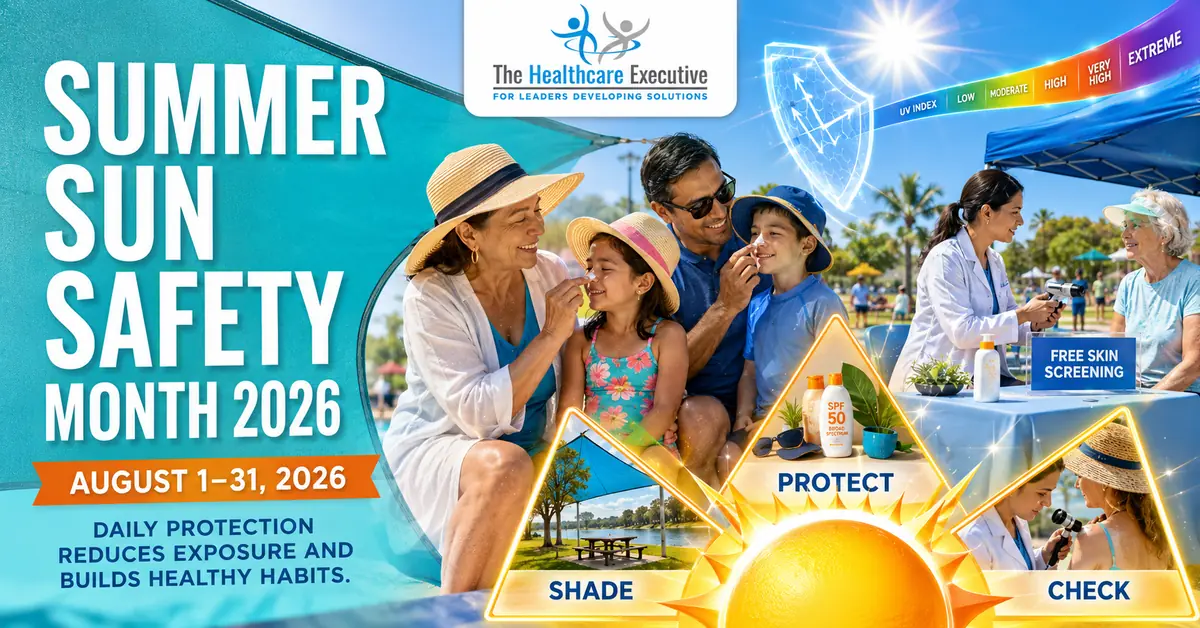
August 1-31, 2026 · Executive evidence brief
Summer Sun Safety Month 2026
Build protection into outdoor work, schools, clinical touchpoints, community spaces, and public communication so safer choices are accessible, practical, accountable, and able to improve.
The Skin Cancer Foundation uses August to reinforce Summer Sun Safety Month. This executive brief uses the observance to examine how healthcare organizations and partners can make prevention more reliable without reducing the work to a product campaign or one-time message.
Leadership mandate
Turn an awareness month into a dependable prevention system
Summer Sun Safety Month can prompt attention, but attention is only the first control. A dependable system also asks where exposure occurs, who can change the environment, which protections are available, whether people can use them during real work or school routines, how guidance reaches different audiences, and how leaders will know whether the system is functioning. A poster, newsletter, or sunscreen giveaway may be useful. None can carry the full responsibility for prevention.
The operating challenge spans many settings. Employees may work outdoors, travel between facilities, support events, manage parking areas, maintain grounds, transport patients, or respond to emergencies. Students and families use playgrounds, sports fields, bus lines, gardens, camps, and community programs. Patients and caregivers may wait outside, walk across exposed campuses, or receive prevention information during a clinical visit. Public-health, facilities, occupational-safety, school, parks, procurement, communications, and clinical teams may each own part of the solution. Without a shared map, important work can remain everybody's concern and nobody's accountable task.
Recent research supports a broad approach. A systematic review of 16 studies involving 12,268 participants found occupational solar ultraviolet exposure associated with several adverse health outcomes and documented wide variation in protection practices.10 The review used a descriptive synthesis because methods differed and publication bias was possible. It does not provide one universal exposure threshold or prove that every strategy works equally well. It does support a leadership conclusion: occupational sun safety belongs within risk management, policy, and work design, not only personal education.
Community infrastructure matters for the same reason. A 2026 review described tree shade as a community-level opportunity for cancer prevention and control.1 Shade is not a complete solution, and a review does not provide one guaranteed effect size. It broadens the executive question from whether a person received advice to whether public spaces, campuses, walking routes, play areas, and gathering places make protection possible. Facilities and community investment can shape the exposure conditions that individual messages cannot reach.
Leadership should begin with a bounded improvement aim. One health system may focus on outdoor employees at three high-exposure sites. A school partnership may focus on shade, uniforms, hats, eyewear, and scheduling during recess or athletics. A community initiative may focus on parks, transit stops, summer events, and trusted communication. A clinical network may focus on consistent prevention conversations for defined populations and a reliable route for concerns. Naming the population, setting, exposure window, and accountable owner makes the work observable.
The design should use a hierarchy of controls. First ask whether exposure can be reduced by changing timing, duration, location, shade, or task sequencing. Then make protective clothing, hats, eyewear, and other appropriate options available and workable. Add reminders, training, and communication as reinforcement. Personal protective behavior remains important, but the organization should not transfer every decision and every cost to the individual when leaders can change conditions around the choice.
Cost and access can alter behavior. A 2026 economic evaluation using 2025 prices from one online retailer found large variation in sunscreen unit price and modeled annual expense, with costs also changing when clothing strategies were included.11 Those prices are not current or universal. The operational lesson is more durable: a program built around one retail product can create avoidable cost and access barriers. Organizations should assess affordability, procurement, placement, clothing options, shade, and job design together.
Equity must be designed rather than appended. A cross-sectional survey of 257 adults, including 160 Hispanic and Latino respondents, found that socioeconomic and occupational conditions were more informative for many reported prevention behaviors than acculturation alone.12 The local sample cannot define an entire population. It warns against cultural shorthand. Leaders should ask about exposure, control over schedules, income, language, transportation, shade, equipment, fit, comfort, trust, and access instead of assuming that ethnicity predicts one behavior or one message preference.
An executive sponsor can translate the aim into six commitments. Exposure is assessed in the actual setting. Environmental and administrative controls are considered before education is treated as the solution. Protection is affordable and available where needed. Messages are understandable, credible, and responsive to questions. Concerning events and clinical questions have a safe route. Measurement pairs implementation with experience, equity, workload, and learning. These commitments are specific enough to govern and flexible enough to fit different organizations.
Executive decision
Select one setting where outdoor exposure and preventable friction are both visible. Name an operational owner, map current controls, listen to the people who use them, and authorize a 90-day cycle that can change the environment as well as the message.
Evidence signal
Knowledge, memory, and the work environment can fail at the same time
A 2025 survey of 195 agricultural-industry workers recruited through the Pennsylvania Farm Show found a gap between recognition and reported practice. Although 80.0% considered unprotected exposure harmful, 71.8% reported infrequent sunscreen use. Forgetting was identified by 49.2%, and 59.0% said their workplace lacked built-in sun protection.14 The convenience sample came from one event, used self-report, and should not be generalized to all agricultural or outdoor workers.
The pattern is useful because it challenges a narrow explanation. If leaders look only at awareness, they may conclude that people need more information. If they look only at the final behavior, they may assign responsibility to the worker. The survey instead presents three different operating questions. Is the protective action convenient and compatible with the work? Do cues and routines make it easier to remember? Has the workplace provided shade, scheduling flexibility, clothing, supplies, or another built-in control? Each question leads to a different intervention.
| Survey signal | Reported share | Executive question | Interpretation boundary |
|---|---|---|---|
| Infrequent sunscreen use | 71.8% | Is the option affordable, accessible, compatible with the task, and supported by a workable routine? | Self-report from a convenience sample; not a universal rate or a product recommendation. |
| No built-in workplace protection | 59.0% | Which environmental, administrative, clothing, or supply controls are missing? | Respondents' report of workplace conditions; the survey did not audit every worksite. |
| Forgetting as a barrier | 49.2% | Can prompts, placement, team routines, and shift design reduce reliance on memory? | One reported barrier can coexist with cost, comfort, culture, or workload barriers. |
A second agricultural study illustrates both opportunity and restraint. A 2026 farm-show outreach project included only 20 participants and found short-term changes in knowledge and intention after a brief intervention.2 The small sample and pre/post design cannot demonstrate sustained behavior or reduced disease. It can support testing brief outreach in a trusted setting, especially when the outreach connects people to practical resources. It cannot justify replacing workplace controls with a handout.
Evidence among people with prior melanoma also shows that elevated risk does not automatically produce consistent action. A pooled national survey analysis matched 249 melanoma survivors with 498 adults without a cancer history and found overall sun-protection use below 50% in both groups.6 Because the analysis was observational and self-reported, it cannot establish why behavior differed or which counseling strategy would work. It supports a practical principle: awareness of risk, prior diagnosis, and access to healthcare do not eliminate usability, communication, habit, and social barriers.
Executives should not use one behavior as the only performance measure. A program can distribute supplies while shade remains unavailable. It can install shade while supervisors continue scheduling optional work at the most exposed time. It can change a policy while workers lack comfortable sizes or culturally acceptable options. It can deliver training while people do not trust the messenger. A balanced review considers the environment, administrative practices, access, behavior, communication, and outcomes without claiming that any single measure proves prevention.
Prevention route
Move from exposure assessment to learning in six accountable steps
A reliable route begins before the message is written. Leaders need to understand who is outside, when, for how long, with what degree of schedule control, and under which environmental conditions. The route then matches controls to that setting, assigns roles, makes protection usable, communicates in ways people can act on, watches for burden or failure, and changes the design when evidence or experience identifies a gap.
- 1. Assess exposureMap people, places, tasks, timing, duration, current controls, and points where individuals have little choice.
- 2. Design controlsConsider scheduling, duration, shade, route, clothing, equipment, procurement, and policy before relying on education.
- 3. Make protection usablePlace options where work happens, address fit and comfort, remove unnecessary cost, and define replenishment.
- 4. Communicate and trainUse plain language, trusted messengers, practical demonstrations, and respectful responses to recurring questions.
- 5. Monitor performanceCheck availability, use, exposure conditions, experience, workload, exceptions, and response to concerns.
- 6. Learn and adjustReview cases and feedback, test one change, document tradeoffs, and spread only after local confirmation.
Step one is a real-world exposure assessment. Job titles are not enough. A worker categorized as indoor may spend part of every shift directing traffic or walking between buildings. A clinical employee may support outdoor screening events. A student may experience most exposure during transportation, athletics, or after-school activities. A family may wait in an uncovered pickup area. The assessment should include temporary staff, contractors, volunteers, patients, caregivers, and visitors where the organization has a duty or opportunity to act.
Environmental monitoring can add context, but it must be interpreted carefully. A 2026 study of 161 outdoor military workers in South Africa combined a cross-sectional survey with five days of monitoring. Peak irradiance occurred around noon to 1 p.m., and temperatures frequently exceeded 35 C.7 This setting cannot be transferred directly to another workforce. It illustrates why time of day, heat, task demands, and combined protections belong in an exposure review. Sun safety and heat safety may interact operationally, even when their clinical guidance and measures differ.
Step two applies the hierarchy of controls. A team may shift discretionary outdoor tasks, rotate duties, shorten exposed intervals, add a shaded staging area, improve covered walking routes, choose a different event location, provide appropriate workwear, or update procurement. Some exposure cannot be eliminated, and not every control will fit emergency or patient-care operations. The objective is to document what was considered, what is feasible, who owns the decision, and how an exception is handled.
Step three makes the design usable. Availability on paper is not the same as access at the point of work. Supplies may be locked away, shade may be distant, hats may conflict with required equipment, clothing may be too warm or unavailable in the right sizes, and breaks may be technically allowed but practically discouraged. Usability testing should involve the people doing the work. It should ask about placement, timing, comfort, fit, storage, cleaning, replenishment, and the social signals sent by supervisors and peers.
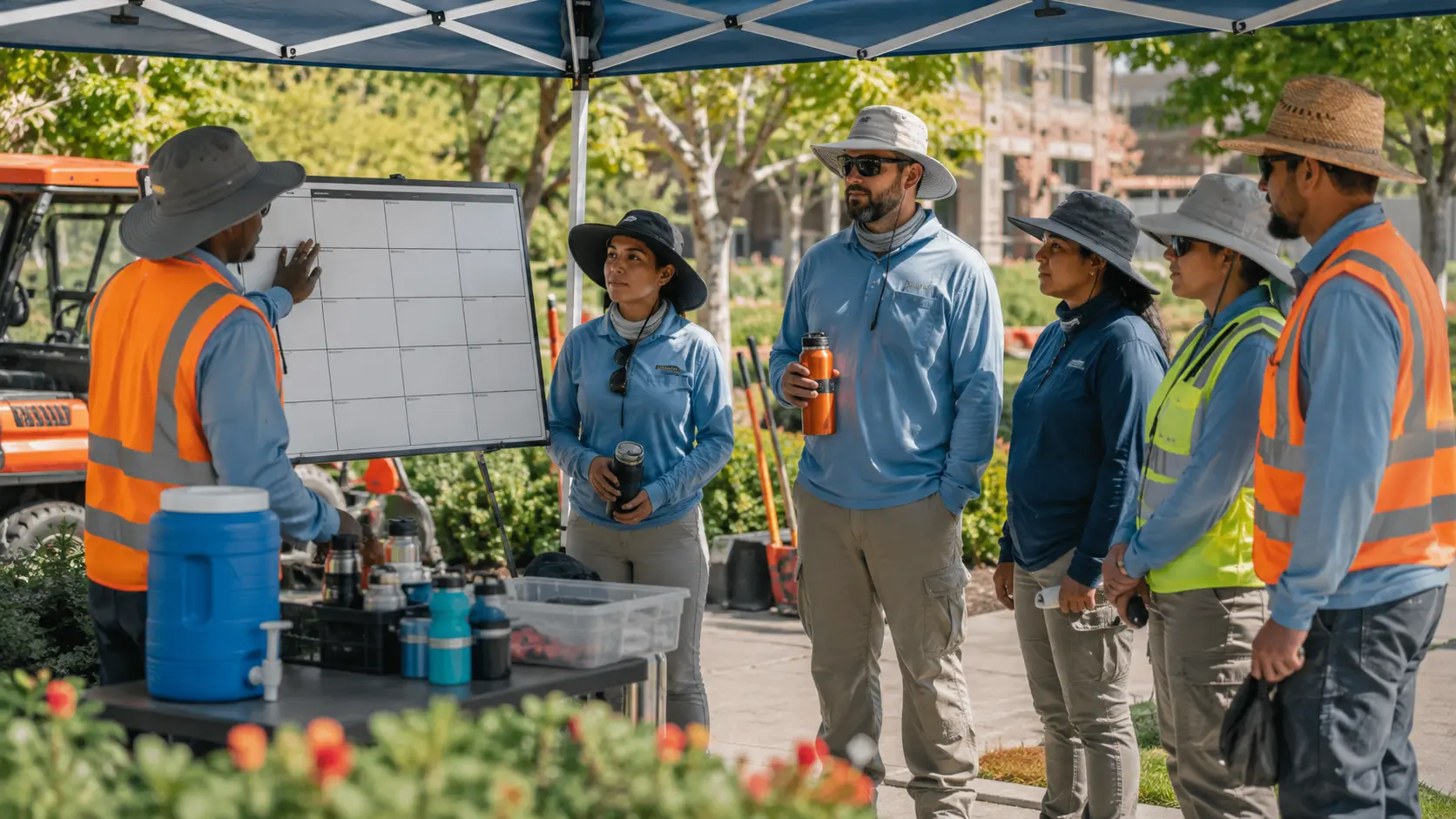
Step four treats communication as an operating function. Messages should explain what the organization is changing, what people can do, where resources are located, how to raise a concern, and which questions require clinical guidance. They should be available in appropriate languages and formats. Supervisors, school staff, community partners, nurses, and clinicians need concise supporting material so that answers do not depend on one communications specialist.
Digital communication requires active listening. A 2026 content analysis of 971 highly viewed TikTok videos found that 86.8% promoted sunscreen and only 6.0% contained critiques. Critique-only posts nonetheless attracted significantly more likes, shares, and comments, while view-count differences were not significant.5 The platform sample does not show what an entire community believes or prove that engagement changes behavior. It suggests that a small amount of contrarian content can demand a disproportionate share of attention. Organizations should monitor recurring questions and respond with clarity and respect rather than assuming that volume equals prevalence.
Step five monitors implementation and burden. Leaders can inspect shade availability, supply stockouts, completion of site reviews, schedule exceptions, employee feedback, school compliance, communication reach, and routing of clinical concerns. They should also watch for unintended effects: extra heat burden from clothing, interference with equipment, stigma, unequal access, workload shifted to frontline staff, or policies that are written but not supported.
Step six closes the learning loop. A local review may show that the planned control is technically available but rarely used, that a message is misunderstood, that one site cannot follow a systemwide standard, or that an access problem concentrates in a particular shift. The response should be a testable change with a named owner. Progress means fewer unresolved conditions and a more usable route, not simply more materials distributed.
Settings
Adapt one prevention logic to different places, roles, and constraints
A common prevention logic can unite the work, but the implementation must fit the setting. An outdoor worker may need schedule and equipment changes. A school may need policy, shade, staff modeling, family communication, and supplies. A community program may need venue selection, water and shade plans, multilingual outreach, and a weather or exposure decision process. A clinical team may need a brief prevention conversation, medication awareness, documentation, and a safe route for concerns. The same poster cannot solve all four problems.
Schools illustrate the difference between policy presence and policy completeness. A 2025 study reviewed 11 sun-safety policy components across 102 Texas independent school districts. Sunscreen and hat policies were common, appearing in 94% and 92% of districts. Resource allocation, shade, protective clothing, accountability, and adult modeling were far less consistently represented, and no district in the sample had policies for UV-protective clothing, accountability, or modeling.15 The cross-sectional content analysis cannot establish how policy caused behavior or outcomes. It shows why leaders should examine the full operating package rather than counting the presence of one policy statement.
An Australian national survey offers a complementary implementation signal. Only 11.1% of participating primary schools reported encouraging protective eyewear, and the study identified differences by school type and advantage.13 This is an international, self-reported school context and should not be used as a U.S. benchmark. It can help a local team ask whether uniforms, shade, hats, eyewear, sunscreen access, scheduling, and staff practice work together or leave predictable gaps.
Education has a role when it is integrated and paired with the environment. A 2026 study in one independent girls' secondary school found gains in skin-health knowledge following a curriculum-integrated intervention.3 The study had no control group, relied on self-report, and does not establish long-term behavior. A separate pilot delivered two 45-minute cancer-education sessions to 24 Pennsylvania middle-school students and also found short-term knowledge gains.4 The pilot was small and did not measure sustained outcomes. Together, the studies support feasibility and curriculum integration, not the claim that a lesson alone produces lasting protection.
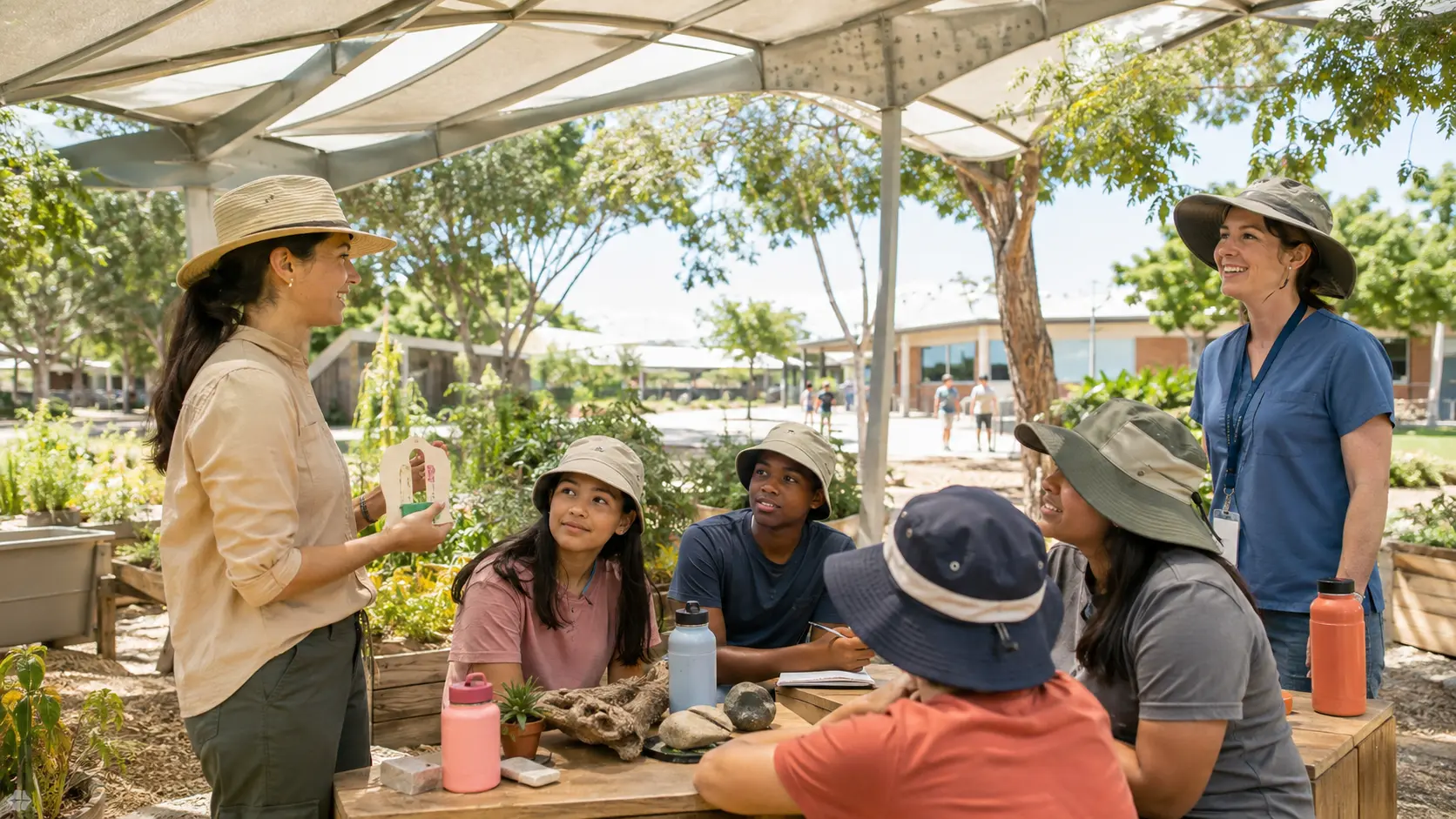
Family and household patterns also matter. An observational study of 368 melanoma survivor-child dyads found that reported sun protection, tanning, and sunburn were associated between survivors and their children. Several family factors, including risk perception and problem-solving skills, were related to child outcomes.8 Associations do not prove that one family behavior caused another. They support designing family-centered conversations that help people solve practical problems together rather than addressing each person in isolation.
Interactive reinforcement may support learning. A randomized Solomon four-group study of 152 community-dwelling women in North Cyprus/Turkiye found improvements in knowledge and reported sun-protection behavior after a 12-week, nurse-led WhatsApp program.9 Digital access, gender, culture, and delivery setting limit direct transferability. The executive implication is not to adopt one platform. It is to consider repeated, interactive contact and a credible facilitator when testing communication, while preserving privacy and providing alternatives for people who cannot or do not wish to use a particular channel.
Community design can reduce the work placed on individuals. Tree shade requires planning, funding, maintenance, accessibility, and time to mature. Built shade requires siting, engineering, upkeep, and integration with how spaces are used. Event planning requires a decision about time, route, queuing, volunteer protection, and respite. None is achieved by telling visitors to plan better. Public health, parks, facilities, transportation, schools, health systems, employers, and community organizations can align capital and operating decisions around exposure reduction.
| Setting | Exposure and usability questions | Accountable partners | Example implementation evidence |
|---|---|---|---|
| Outdoor work | When and where is exposure highest? Can tasks, routes, shade, breaks, clothing, or supplies change? | Operations, occupational safety, supervisors, facilities, procurement, workers | Site assessment completed; controls available at point of work; exceptions reviewed. |
| Schools and youth programs | Do policy, curriculum, shade, uniforms, hats, eyewear, sports, transportation, and adult modeling align? | School leaders, nurses, educators, athletics, facilities, families, students | Policy components implemented; shade and supplies usable; student and staff feedback reviewed. |
| Clinical settings | Which populations need prevention conversations or individualized guidance? Where do concerns route? | Primary care, dermatology, pharmacy, nursing, patient education, access services | Appropriate conversation documented; accessible materials offered; concern route completed. |
| Community spaces and events | How do timing, queuing, transit, shade, tree canopy, language, and trusted messengers affect access? | Public health, parks, planners, community groups, event teams, health systems | Exposure considered in event plan; shaded access present; community feedback changes design. |
The table is a governance prompt, not a standard requiring every organization to own every domain. Partners should clarify scope, authority, funding, backup, and escalation. A health system may not control a public park, but it can contribute clinical expertise, community benefit funding, data stewardship, or trusted communication. A school may not provide clinical care, but it can create a reliable route to the appropriate professional when a student, family, or employee raises a concern.
Barrier review
Investigate the conditions around the gap before assigning responsibility
When prevention fails, the organization often sees only the last event. A worker did not use the available option. A student forgot a hat. A family did not follow guidance. A community event lacked shade. A social post attracted skeptical comments. Each event can have several causes, and the visible behavior may be the final link in a longer chain. A useful review reconstructs the setting, choice architecture, access, communication, and governance before it labels the person.
The fishbone below presents six unranked categories for local investigation. It is a quality-improvement prompt, not a validated causal model. The categories are drawn from occupational reviews, school studies, platform analysis, economic modeling, and surveys of workers and communities. They should be tested through observation, interviews, policy review, and local data before leaders choose an intervention.
Unranked conditions to investigate: policy and ownership; scheduling and exposure; shade and equipment; communication and trust; culture and comfort; and data or governance. These are hypotheses for local review, not prevalence estimates.
Policy and ownership review begins with authority. Who can change work schedules, add shade, approve clothing, purchase supplies, modify a school rule, or respond to misinformation? A policy without budget, operational authority, and a named reviewer can create an appearance of action while leaving frontline staff to negotiate every exception. The Texas school-district analysis found common sunscreen and hat policies but substantial gaps in resources, shade, accountability, modeling, and protective clothing.15 Local review should ask whether the same gap exists in implementation, even when the policy language differs.
Scheduling and exposure review should follow the actual day. Which activities are discretionary? Which are clinically or operationally fixed? Can an outdoor briefing move under cover? Can a route change? Can a high-exposure task be shared? Are volunteers and contractors included? The South African military-worker study supports attention to time of day and bundled strategies, but its associations do not dictate a universal schedule.7 Local exposure, climate, job requirements, and safety obligations must guide decisions.
Shade and equipment review asks whether controls exist where people need them. Tree shade and built shade can support community-level prevention, yet each requires planning and maintenance.1 Clothing and equipment require fit, comfort, compatibility, cleaning, and replacement. Sunscreen access requires procurement, placement, replenishment, and consideration of cost. The economic evaluation demonstrates how price and concurrent clothing strategies can change modeled expense, but its retailer-specific values should not be transferred.11
Communication and trust review should include the questions people are actually asking. A social-media dashboard that counts reach without reading comments may miss the content generating the most interaction. The TikTok analysis found that critique-only content was uncommon yet received disproportionate engagement on several measures.5 Leaders should prepare short, evidence-bounded responses, equip trusted messengers, and know when to route a question to a clinician. They should not amplify fringe claims unnecessarily or assume that disagreement indicates hostility.
Culture and comfort review considers what it feels like to use the control. A worker may avoid a garment that increases heat burden or conflicts with safety equipment. A student may avoid an option that draws attention. A family may receive guidance that does not fit transportation, schedule, or cost. Research involving Hispanic and Latino adults cautions against reducing these issues to acculturation, because socioeconomic and occupational conditions may be more relevant.12 Local listening should include people with different skin tones, ages, languages, roles, incomes, and degrees of schedule control.
Data and governance review asks whether leaders can see the system. The absence of a complaint does not prove the absence of a barrier. Organizations can combine site audits, stockout logs, schedule reviews, staff and student feedback, training records, communication questions, and case review. Data collection should be proportionate, privacy-conscious, and tied to action. If the organization asks about a safety concern, discrimination, or clinical issue, it must define who responds and how quickly.
Do not equate knowledge with access
A person may understand the guidance while lacking shade, schedule control, affordable supplies, compatible clothing, or a safe way to raise a concern.
Do not equate policy with implementation
Confirm resources, placement, role clarity, supervision, exception handling, and whether people can use the protection during actual work or school routines.
Do not generalize limited samples
Use pilot, cross-sectional, convenience, international, and platform studies to generate local questions, not universal prevalence or effect claims.
Do not optimize one behavior alone
Pair individual behavior with exposure, environmental controls, administrative practice, access, experience, equity, workload, and learning.
Operating system
Coordinate around the person while keeping institutional accountability explicit
Sun safety crosses organizational boundaries. Occupational safety can change work controls but may not own public communication. Facilities can build shade but may not define clinical guidance. Schools can implement routines but need family partnership and a clinical route for individual questions. Clinicians can counsel but cannot redesign every worksite or park. A reliable operating system makes these roles visible and creates a common method for deciding, escalating, measuring, and learning.
The person, worker, student, or family sits at the center because exposure, comfort, preferences, communication needs, and feasibility cannot be inferred from policy. Centering the person does not transfer responsibility to them. Organizations remain accountable for safe environments, appropriate clinical practice, accessible communication, and fair processes. The center node in the map below represents participation in design and feedback, not an expectation that individuals coordinate every partner.
Occupational safety and operations own the connection between policy and the day of work. Their questions include whether exposure is assessed, discretionary tasks are scheduled thoughtfully, supervisors model expectations, controls are available, and workers can report problems without penalty. The systematic review of occupational UV exposure supports policy-level attention, while the Pennsylvania and South Dakota worker studies illustrate gaps between awareness, intention, and conditions.2, 10, 14 None provides a universal program design. Together, they justify local observation and iterative testing.
Clinical care and public health provide evidence stewardship and a safe response route. A clinician may address individual risk, medication sensitivity, concerning changes, or a personal protection plan. Public health may coordinate population messaging, surveillance, community partnerships, and environmental strategy. Leaders should define which questions can be answered through general education and which require an individualized clinical encounter. Messaging should encourage appropriate help without creating alarm or implying that every person needs the same service.
Schools, community organizations, and parks translate policy into daily environments. Curriculum-integrated interventions show that education can fit routine learning, while policy studies show that implementation requires more than a rule.3, 4, 13, 15 Programs should include youth and family perspectives, but one advisory participant or one school should not be treated as representative of everyone. Listening methods can include short interviews, observation, student councils, family groups, interpreter feedback, and outreach to people who do not attend formal meetings.
Facilities and procurement shape the practical choice set. Tree-canopy and shade decisions may require capital planning, site analysis, accessibility review, maintenance, and collaboration with local government.1 Procurement should not focus only on the lowest unit cost. It should consider fit, compatibility, replenishment, location, ease of use, environmental conditions, and whether frontline teams have capacity to maintain the program. A product that is unavailable at the moment of exposure has limited operational value.
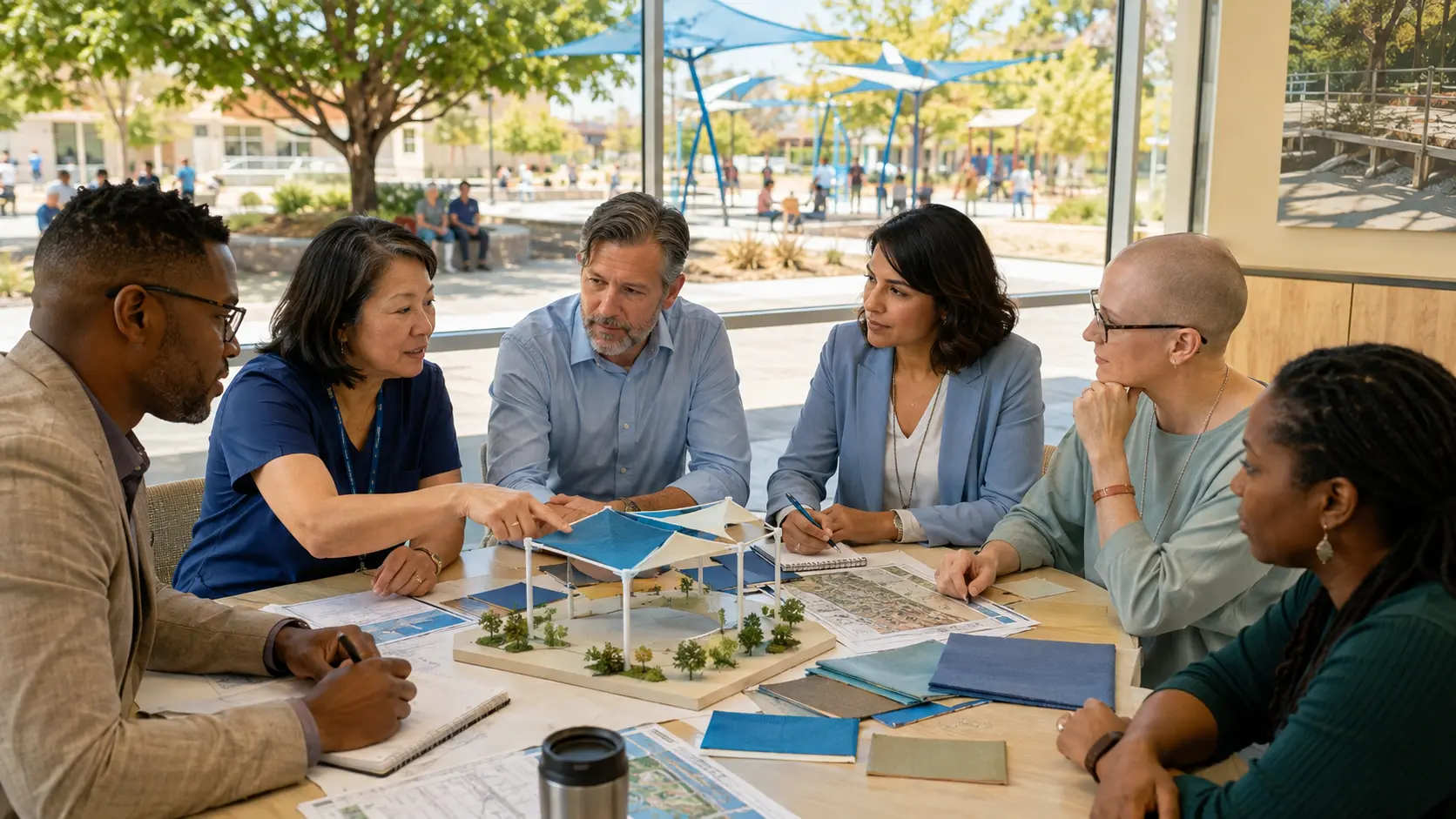
Governance, data, and communication hold the domains together. The governance group does not need to be large. It needs authority, operational representation, a defined population and setting, a short measure set, privacy rules, and a method for reviewing exceptions. Communications should participate because misinformation and trust affect implementation. Data and equity expertise should participate because averages can hide who lacks shade, schedule control, language access, or affordable options.
The group should define a small number of nonnegotiable interfaces. Every target site has an exposure owner. Every selected control has a maintenance or replenishment owner. Every policy exception has a safe escalation route. Every clinical concern reaches the appropriate service rather than being answered by a general campaign. Every public message has an evidence review and a feedback channel. Every dashboard pairs reach or completion with usability and equity. These interfaces turn collaboration from a meeting into an operating system.
Measurement
Use a balanced scorecard that can detect access, burden, and false reassurance
Measurement should begin with the decision, not the data already available. If leaders need to know whether environmental controls are present, an email-open rate will not answer the question. If they need to know whether a policy is usable, a signed attestation will not capture fit, comfort, cost, or supervisor behavior. If they need to know whether communication is trusted, total impressions will not reveal unanswered questions. A small balanced scorecard can keep the program honest.
Start with an exposure and implementation measure. Examples include the percentage of target sites with a current exposure review, the percentage of defined outdoor tasks with an approved control plan, shade availability at specified locations, supply availability at the point of use, or the percentage of school policy components implemented with supporting resources. The denominator must be explicit. A systemwide percentage can hide that night shift, rural sites, contractors, or one school lack the same support.
Add a process measure that reflects closed-loop work. This might be the percentage of identified gaps assigned to an owner by a defined time, the percentage of stockouts resolved, the percentage of schedule exceptions reviewed, or the percentage of recurring public questions with an approved response and clinical escalation route. Process measures show whether the operating system moves work. They do not by themselves prove reduced exposure or improved health.
Add an experience and usability measure. A two-question pulse can ask whether people could access the selected protection when needed and whether it fit the task or setting. A school may ask students and staff whether shade is available where activities actually occur. A community event can ask whether people could find respite and understood where to get help. A family-centered program can ask whether guidance was understandable and feasible. Responses should be available by relevant site, role, language, or schedule category when privacy and sample size permit.
Add an equity view. The 2026 survey of Hispanic and Latino adults suggests that socioeconomic and occupational conditions can shape reported behavior more strongly than a simple cultural explanation.12 Equity review can examine differences in exposure, schedule control, access, stockouts, language, fit, cost, and experience. It should avoid turning identity categories into explanations. When a difference appears, local inquiry should test the conditions around it.
Add balancing measures. Clothing changes may increase heat discomfort. Added documentation may reduce clinical time. Supply placement may create cleaning or allergy questions. A scheduling change may delay important operations. Misinformation monitoring may unintentionally amplify low-prevalence content. Balancing measures help teams see whether an intervention shifts burden or risk elsewhere. They should be reviewed with frontline staff and affected communities, not only by the governance group.
Clinical outcomes require qualified interpretation and are rarely appropriate as immediate proof of a short improvement cycle. Sunburn reports, concerning lesions, diagnoses, healthcare use, or occupational-health events can be important, but trends may reflect reporting, access, case mix, weather, and long latency. The occupational systematic review describes a broad range of outcomes across heterogeneous studies and calls for more robust research.10 Leaders should avoid claiming that a 90-day campaign changed disease incidence.
| Measure domain | Example question | Possible local indicator | Interpretation boundary |
|---|---|---|---|
| Exposure and environment | Have we changed conditions around the choice? | Target sites with current exposure review and usable shade or control plan. | Presence does not prove use, adequacy, or health benefit. |
| Implementation | Does identified work move to resolution? | Gaps with named owner, due date, and verified closure. | Closure should require verification, not a status change alone. |
| Access and usability | Can people use the control during real work or school routines? | Pulse response on availability, fit, comfort, timing, and cost. | Self-report needs context and a safe feedback route. |
| Communication and trust | Are messages understood, credible, and responsive? | Recurring questions resolved; people know where to seek individualized guidance. | Reach and engagement do not equal understanding or behavior. |
| Equity | Who has less control or access? | Differences by site, shift, language, role, geography, or relevant population. | Small cells, privacy, and context must guide interpretation. |
| Balancing | Did the change create new burden or risk? | Heat discomfort, equipment conflict, workload, delays, stockouts, or stigma. | A balancing signal should trigger review, not automatic abandonment. |
Baseline matters. The team should collect enough pre-change information to understand current variation, but it should not delay obvious low-risk corrections such as restocking a missing resource or moving an outdoor briefing under existing shade. For complex or costly changes, baseline observation can include different days, times, and weather conditions. The goal is a credible comparison, not a research study disguised as improvement work.
Run charts and annotated case review can reveal change over time. A simple monthly average may hide repeated failures at one site. Leaders should annotate policy changes, supply interruptions, extreme weather, school breaks, staffing changes, and communications releases. When a number moves, ask what else changed. Statistical methods should match the data and sample size. Small programs may learn more from a concise case series and repeated observation than from an unstable percentage.
Experience data should lead to action. If the organization asks whether clothing is usable and learns that it conflicts with required equipment, someone must be able to convene occupational safety and procurement. If students report that shade is unavailable during the activity that matters, facilities and school operations need a response route. If a community question requires clinical judgment, communications staff should not improvise. Measurement without response capacity can reduce trust.
Finally, report uncertainty. Label whether a measure comes from audit, self-report, observation, administrative data, or a platform metric. State missingness and small denominators. Separate descriptive signals from outcomes. Avoid converting the Pennsylvania convenience sample, the Texas policy analysis, the Australian school survey, or the TikTok content analysis into universal targets.5, 13, 14, 15 Transparent boundaries make the scorecard more useful, not less persuasive.
90-day action plan
Start with one exposed setting, learn quickly, and build a credible case for spread
A 90-day cycle is long enough to observe the setting, test a small package, and review early implementation. It is not long enough to prove prevention of skin cancer or every UV-related outcome. The purpose is to improve the operating conditions that leaders can directly influence: ownership, exposure assessment, environmental and administrative controls, access, communication, feedback, and exception handling.
Days 1-30 · Understand
- Name the sponsor, operational owner, setting, population, and authority.
- Map exposure, current controls, workarounds, supply locations, and exception routes.
- Listen to people across shifts, roles, languages, skin tones, and degrees of schedule control.
- Collect a minimal baseline and correct obvious low-risk gaps.
Days 31-60 · Test
- Test a small package that includes at least one environmental or administrative control.
- Make clothing, equipment, shade, or supplies usable at the point of need.
- Train trusted messengers and establish a safe clinical escalation route.
- Review access, workload, heat, fit, trust, and other balancing signals weekly.
Days 61-90 · Learn
- Verify whether controls are present, used, maintained, and equitable.
- Reconstruct exceptions and unresolved cases without blaming individuals.
- Decide what to sustain, stop, adapt, or study further.
- Spread only with a documented owner, resource plan, and local adaptation method.
During days 1 through 30, scope protects the project from becoming a generic campaign. The sponsor should choose one setting where leaders have enough authority to act and where affected people can participate. The team maps the day rather than relying only on policy documents. It observes where people wait, walk, work, play, or gather. It notes which controls exist, who maintains them, how people learn about them, and what happens when the normal plan does not work.
The first month should include several listening methods. Outdoor workers may speak more openly in a brief crew conversation than in a formal survey. Students may identify the exact unshaded place missed by an adult site walk. Community partners may explain why a message conflicts with local experience. Clinical staff may identify questions that should never be answered by a campaign. Listening should be compensated when appropriate, accessible, and connected to a decision. One participant should not be asked to represent an entire population.
During days 31 through 60, test a package rather than a single message. A workforce test might shift one discretionary task, add a shaded staging location, improve access to compatible clothing or supplies, train supervisors, and add a weekly usability pulse. A school test might address a policy gap, shade one activity, involve students in routine design, and integrate a short lesson. A community event test might change timing, add covered queues, equip volunteers, prepare multilingual messages, and define an escalation point.
The test should preserve evidence boundaries. A curriculum-integrated school study and a small pilot support the feasibility of education but not a guarantee of lasting behavior.3, 4 A digital randomized trial supports interactive reinforcement in one context but not a universal platform choice.9 A worker survey identifies barriers but does not tell every worksite which control will fit.14 Local testing is how an organization turns directional evidence into a credible operating choice.
During days 61 through 90, the team compares observed implementation with the baseline and the people’s experience. Did shade move closer to where work happens? Did stockouts decline? Did a scheduling change hold across all shifts? Did workers or students report better usability? Did supervisors understand the exception path? Did communication questions change? Did any group experience less access? Were heat, workload, stigma, or equipment conflicts introduced?
The governance review should make four decisions: sustain, adapt, stop, or study further. Sustain when the control is usable, owned, resourced, and supported by the local evidence. Adapt when the direction is sound but the design is unreliable. Stop when burden or risk exceeds benefit or the intervention does not address the actual barrier. Study further when uncertainty is material and local data are insufficient. None of these decisions should be treated as failure. Disciplined learning is the purpose of the cycle.
Spread is a new implementation decision, not a copy-and-paste step. Another site may have different exposure, facilities, staffing, labor rules, climate, school schedules, community partners, language needs, or procurement. A spread package should identify the nonnegotiable purpose, the elements that can adapt, the minimum governance and measurement requirements, and the conditions that require clinical or safety review.
Board and executive checkpoint
By day 90, require evidence that one defined setting has a named owner, a documented exposure review, at least one tested environmental or administrative control, usable access to supporting options, an evidence-reviewed communication route, a balanced scorecard, and a decision to sustain, adapt, stop, or study further.
Leadership close
Make the safer choice visible in the environment, not only in the message
Summer Sun Safety Month is most useful when it reveals what the organization can change. Leaders can reduce discretionary exposure, build and maintain shade, improve work and school routines, remove cost and placement barriers, support trusted communication, and create a safe route for individual questions. They can also measure whether the design works for the people with the least schedule control and the greatest practical burden.
The evidence does not support one universal program. It supports a disciplined operating method. Assess the setting. Use environmental and administrative controls. Make personal options practical. Communicate with humility. Monitor access, burden, and trust. Learn from exceptions. Keep clinical decisions individualized. Spread only after local confirmation. That is how an observance becomes a reliable prevention system.
References
Peer-reviewed evidence is ordered newest first. Findings are paraphrased and bounded to study design and setting.
- Holman DM, Mallen ES, Reza A, Townsend JS, Kava CM. The Benefits of Community-Level Efforts to Increase Tree Shade Availability for Cancer Prevention and Control. Public Health Reports. 2026;141(5):650-656. doi:10.1177/00333549261432082. PMID: 41933898.
- Naasz L, Thelen K, Eisenbraun E, Zeigler C. Skin Cancer Prevention Outreach for Agricultural Workers: A Farm Show Survey. South Dakota Medicine. 2026;79(7):302-304. PMID: 42536787.
- Jefferson RS, Bentley-Spuur KM, Chinkwo K, et al. A curriculum-integrated sun safety intervention to improve adolescent skin health knowledge in an independent girls' secondary school. PLoS One. 2026;21(6):e0350659. doi:10.1371/journal.pone.0350659. PMID: 42361047.
- Bailey NI, Bucolo J, Bucolo K, et al. Small-Scale School-Based Cancer Education to Improve Awareness and Risk Reduction Knowledge Among Adolescents: A Pilot Study. International Journal of Environmental Research and Public Health. 2026;23(7):823. doi:10.3390/ijerph23070823. PMID: 42512129.
- Marcon A, Zenone M, Boniface V, Peters CE, Caulfield T. Sunscreen is overwhelmingly promoted on TikTok, but content with misinformation exhibits proportionally high levels of audience interaction. PLOS Digital Health. 2026;5(6):e0001440. doi:10.1371/journal.pdig.0001440. PMID: 42313716.
- Xie J, Kiuru M, Pollock BH, Keegan THM. Sun protection behaviors, healthcare access, and smoking among melanoma survivors. Journal of Cancer Survivorship. 2026;20(3):1264-1273. doi:10.1007/s11764-024-01727-8. PMID: 39652141.
- Galawe SD, Rathebe PC, Lebelo K. Characterising Occupational Solar UVA Exposure Intensity and Self-Reported Health Outcomes Among Outdoor Military Workers in Lohatla, South Africa. International Journal of Environmental Research and Public Health. 2026;23(6):715. doi:10.3390/ijerph23060715. PMID: 42354246.
- Wu YP, Stump TK, Deboeck PR, et al. Sun protection, sunburn, tanning, and family factors among melanoma survivors and their minor children. Journal of Health Psychology. 2026;31(6):2241-2256. doi:10.1177/13591053251378226. PMID: 41067748.
- Bebiş H, Gül Z. Effectiveness of a Nurse-Led, WhatsApp-Based, Interactive Educational Intervention on Skin Cancer Knowledge and Sun Protection Behaviors: A Randomized, Controlled, Solomon Four-Group Study. Asian Pacific Journal of Cancer Prevention. 2026;27(5):1725-1734. doi:10.31557/APJCP.2026.27.5.1725. PMID: 42169579.
- Rocha R, Guedes J, Santos J, Carvalhais C. A systematic review of the health effects of occupational exposure to ultraviolet radiation. Discover Public Health. 2026;23(1):1-21. doi:10.1186/s12982-026-01745-0.
- Mundada M, Schneider J, Wei ML. Sunscreen Costs in Association With Sun Protective Behaviors. JAMA Dermatology. 2026;162(4):402-405. doi:10.1001/jamadermatol.2025.6150. PMID: 41706462.
- Andrade LF, Lalama MJ, Abdi P, et al. Hispanic and Latino Ethnicity and Acculturation: Influences on Skin Cancer Prevention Attitudes and Behaviors. Journal of Clinical and Aesthetic Dermatology. 2026;19(4):16-17. PMID: 42239841.
- Lissner K, Stevenson A. Sun Safety Policy Implementation in Australian Primary Schools. Australasian Journal of Dermatology. 2025;66(5):268-278. doi:10.1111/ajd.14461. PMID: 40125889.
- Moeckel C, Bower R, Long C, et al. Sun Protection Knowledge and Behaviors Among Agricultural Industry Workers in Pennsylvania. Journal of Agromedicine. 2025;30(3):529-545. doi:10.1080/1059924X.2025.2470963.
- Ahmad N, Bartley B, Zhang S, et al. Assessing Sun Protection Policies in Texas School Districts Located in Counties With the Lowest and Highest Melanoma Risk: Content Analysis and Cross-Sectional Study. Cancer Control. 2025;32:10732748251352702. doi:10.1177/10732748251352702. PMID: 40550782.