


Give stopping work a place on the executive agenda
A hospital can accumulate improvement work faster than it can absorb it. A new screening requirement, dashboard, order set, meeting, or checklist may arrive with a sponsor and a launch date. The work it replaces can remain active, leaving staff to reconcile overlapping instructions. Executives then hear that the organization lacks implementation capacity, even as its own processes consume that capacity. A decision to stop something deserves the same attention to evidence, ownership, resources, and follow-through as a decision to introduce something.
The clinical evidence is encouraging but conditional. A 2025 systematic review of 140 randomized trials in primary care found moderate-certainty evidence that provider education combined with audit and feedback reduced targeted low-value care. Its findings do not establish that the same combination will work equally well on an inpatient unit. An overview of 46 systematic reviews found more consistent reductions for medication use than for laboratory testing or imaging. Context, intervention design, and the outcome being measured matter. [1, 2]
An analysis of 121 randomized de-implementation studies likewise found that many interventions reduced the targeted practice, without identifying one universally superior type or number of intervention components. Executives should therefore resist purchasing a standard change package and assuming that it will solve every form of overuse. A useful first question is what keeps the practice in place here: uncertainty, workflow defaults, professional expectations, patient concerns, financial arrangements, or a combination of these. [3]
The purpose of a hospital de-implementation program is to improve the appropriateness of care and the use of finite capacity. A budget reduction can be a consequence, but it should not substitute for the clinical argument. When leaders begin with a financial target and work backward to the evidence, clinicians and patients have reason to question whether appropriate care will remain available. Begin with the patient benefit and harm boundary, then assess the operational and financial consequences.
Define the practice before measuring its disappearance
Low-value care is context dependent. A test can be useful for one patient and unnecessary for another. The proposal must therefore identify the practice, the eligible population, the clinical indication, the circumstances in which the practice adds little benefit or creates avoidable harm, and the circumstances in which it remains appropriate. “Reduce testing” is an incomplete instruction. A usable instruction states which testing, for whom, under what conditions, and with which exceptions.
This distinction is also a measurement problem. A scoping review of 227 randomized trials found that total care volume was reported far more often than care judged specifically to be low value. The review also identified frequent risks of bias and relatively little tailoring to local context. A falling count can reflect less inappropriate care, but it can also reflect fewer eligible patients, changes in coding, or reduced access. The hospital must know which explanation is plausible before declaring success. [4]
Evidence assessment should be multidisciplinary. A clinical owner establishes the indication and exception logic. Nursing and allied professionals describe how the practice functions during actual care. Quality staff examine adverse consequences and evidence strength. Information services determine whether the intended population can be identified reliably. Compliance and legal staff check requirements that cannot simply be removed. Patients or family advisors test whether the explanation is understandable and whether the proposed alternative addresses what matters to them.
The outcome of this work should be a short, versioned decision statement that can survive handoffs between committees. It should identify what is changing, what is still available, who may exercise an exception, how that exception is documented, and when the evidence will be reconsidered. A long evidence attachment is useful, but a clinician ordering care at night needs a concise, actionable rule with a reachable escalation route.
Treat resistance as information about the system
Research on determinants of de-implementation identifies recurring obstacles: doubts about the evidence, established norms, patient preferences, and the difficulty of sustaining stakeholder support. A multimethod study combining a literature review with critical-care interviews found substantial overlap between published determinants and the experiences of clinicians and decision-makers. The implication is practical: the reason a practice persists should inform the intervention selected to change it. [5]
A separate scoping review found determinants at patient, professional, organizational, external-context, and process levels. Patient expectations and fear of malpractice were particularly relevant. Calling every objection “resistance to change” discards information about the risks people believe they are managing. A clinician may retain an order because a consultant expects it, a receiving unit requires it, or a previous adverse event made omission feel unsafe. Each explanation requires a different response. [6]
The portfolio owner should distinguish disagreement about the evidence from disagreement about the implementation. A professional may accept that routine use is unnecessary while reasonably objecting that the alternative is unavailable overnight. Resolve that operational problem before attributing continued use to attitude. Similarly, if a policy contradicts the new evidence, change the policy through the proper authority. Asking staff to disregard an active requirement creates an avoidable accountability conflict.
Strategy taxonomies can organize the response, but they should not become shopping lists. A scoping review identified 71 distinct de-implementation strategies, most of which could be mapped to established implementation strategies, with additional attention to workflow redesign and accountability or communication tools. The useful output is a mechanism: this change addresses this identified barrier, is delivered by this owner, and should produce this observable behavior. [7]
Include patients in the decision to do less
Patients often encounter de-implementation as a change in what a clinician offers. If the explanation is simply that a test is no longer available, the patient may reasonably interpret the change as restricted access or reduced concern. The conversation should explain the expected benefit, possible harm, appropriate alternative, and signs that would justify reassessment. A decision to omit a low-value intervention should still leave the patient with a coherent plan.
A systematic review and meta-analysis found that interventions engaging patients within the clinical encounter could reduce low-value care, although the studies were heterogeneous. Educational material and shared decision-making tools were common approaches. This supports involving patients in the change process; it does not justify treating a leaflet as sufficient for every difficult conversation or every clinical circumstance. [8]
Patient participation should also occur before launch. Advisors can identify language that sounds dismissive, unclear alternatives, and practical obstacles to follow-up. If a proposed alternative requires a second appointment, internet access, transportation, or an unaffordable purchase, the hospital has not necessarily reduced the burden of care. It may have transferred it to the patient. The business case should identify those transfers explicitly and decide whether the alternative is realistic for the people affected.
The organization should make respectful exceptions possible without creating a hidden route available only to well-connected patients. Exception criteria, decision-makers, and response times should be visible to the clinical team. Audit the use of that route by relevant patient groups. An exception process that exists on paper but cannot be reached during routine care is not a meaningful safeguard.
Make nursing work visible in the portfolio
De-implementation should include practices carried out by nurses and other professionals, not only physician orders. A systematic review of low-value nursing procedures found substantial heterogeneity and insufficient evidence to identify one best strategy, even though many successful interventions included education. This is a reason to investigate the practice and its work context carefully, rather than assume that an educational campaign will be enough. [9]
A hospital prioritization review found that consultation, ranking, and evidence review were common elements of initiatives to identify low-value care. Patient involvement and evaluation of the prioritization process were much less common. A locally popular list is therefore a starting point, not proof that the selected practices are the most important or that removing them will improve outcomes. [10]
Invite frontline teams to nominate both questionable clinical activity and administrative duplication, but keep the evidence standards appropriate to each. A repeated report that nobody uses can be investigated through a workflow and decision-use audit. A clinical intervention requires a clinical evidence and safety assessment. These categories can share a governance process without being treated as the same kind of problem. Staff inconvenience alone does not establish that a clinical practice lacks value.
Early de-adoption literature documented inconsistent terminology and a range of frameworks, while later work continued to emphasize multiple levels of influence. These reviews support a deliberate change process, but they do not supply a validated hospital-wide prioritization formula. Leaders should use a transparent deliberation record, explain their judgments, and avoid assigning precise numerical scores to uncertain benefits merely to make the portfolio appear objective. [11, 12]
THE FRAMEWORK IN APPLICATION
A duplicate report with a hidden safeguard
Watch the two-minute applied case on YouTube. Captions and the full transcript are available.
Consider an illustrative shift-handoff workflow. Staff copy information from the official record into a second report. A field-by-field review finds that the second report also names the escalation owner. Removing the report before preserving that field would remove a safeguard as well as duplicate work.
The proposed change is to redesign the handoff record, preserve required documentation and an approved downtime route, assign a receiving owner, and test acknowledgment. A bounded pilot then retires the duplicate template and shortcut. When an acknowledgment fails in the scenario, staff flag the exception, the manager pauses the change, and the team uses the approved fallback while investigating.
The executive review examines missing information, handoff delays, staff time, and work transferred elsewhere. Released time and cash savings remain separate questions. This fictional case applies the article’s proposed governance framework. It reports no measured results and does not justify withdrawal of clinical care.
Read the two-minute applied-case narration
Two reports. One handoff. What would happen if we stopped one?
This fictional hospital case examines duplicate paperwork, not withdrawal of clinical care.
At shift change, staff copy the same information into a second report.
First, the team compares each field and asks who uses it.
Most match. But only the old report names an escalation owner.
Deleting that report now would remove a safeguard.
The team moves that field into the official handoff record.
A receiving owner is assigned, and the acknowledgment is tested.
Clinical, quality, records, and operational owners approve the pilot.
Required documentation and a usable downtime route must remain.
The approved pilot begins on one unit.
Retire the duplicate template and shortcut. Show staff the new route.
Watch the handoff. The receiving team acknowledges the record and its owner.
That confirms this transfer, not the success of the whole pilot.
Now test an exception. The receiving acknowledgment does not arrive.
The nurse flags the missing handoff. The manager pauses the change.
Staff use the approved fallback while the team investigates.
A lower report count must not hide a new communication failure.
The review checks missing information, handoff delays, staff time, and work moved to other teams.
These are measures to collect, not invented results.
Finance checks what capacity was actually released and how it was used.
Time saved is not automatically a payroll saving.
The accountable team decides whether to adapt, continue, or reverse the change.
Clinical interventions need separate evidence and safety review.
Read The Work We Should Stop at The Healthcare Executive.
Find the framework, diagrams, and control register in the article.
Choose the right form of change
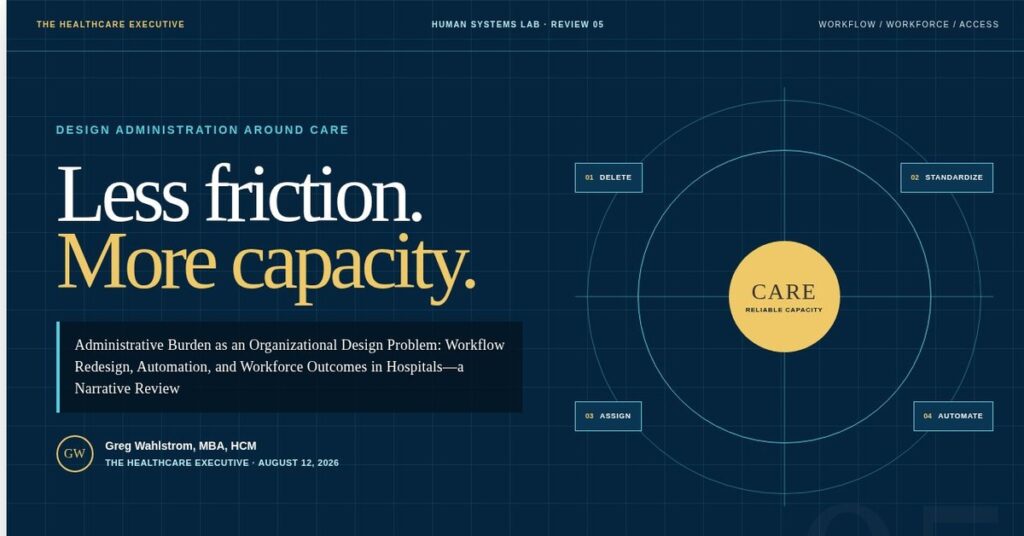
The proposed framework distinguishes four decisions. Stop when the defined practice has no justified role in the specified circumstances. Restrict when it remains appropriate for a narrower population or indication. Substitute when a better-supported alternative should replace it. Redesign when the underlying objective remains valid but the workflow creates unnecessary effort, repetition, or risk. These categories are executive decision aids proposed here, not categories proven to predict success.
The decision should include the work that must start or expand as a result. Restricting a test may require better documentation of indication. Substituting a clinical approach may require training, supplies, or follow-up capacity. Removing a duplicative form may require changing how another department receives essential information. If the replacement work is unnamed, it will often appear later as an unplanned burden for the people closest to the patient.
Assign an accountable executive sponsor and an operational owner who can change the actual workflow. The sponsor resolves conflicts across services and protects the patient-benefit purpose. The owner maintains the eligibility rule, implementation plan, exception route, and monitoring register. Clinical leaders retain responsibility for clinical judgment. Finance verifies economic assumptions. This allocation should be clear enough that a department cannot approve removal while leaving another department responsible for an unsupported substitute.
The approval record should also distinguish a reversible pilot from a permanent policy change. Some changes can be stopped quickly if an unexpected problem appears. Others require time to restore equipment, contracts, staffing, or skills. The greater the recovery difficulty, the stronger the preimplementation evidence and contingency planning should be. Reversibility is a design consideration, not an excuse to test an inadequately justified clinical withdrawal.
Follow the consequences beyond the targeted service
Economic evidence is often thinner than the implementation narrative suggests. A review of 227 trials found that relatively few reported the direct costs of de-implementation or its effects on healthcare costs. A hospital cannot safely assume that a reduction in a targeted service produces equivalent cash savings. Training, analytic support, substitute care, and transition costs may absorb part of the apparent benefit. [13]
The consequences can also move between settings. A 2026 observational evaluation of reductions in tonsillectomy and Dupuytren’s contracture release in England examined subsequent primary-care use, referrals, and time to surgery. It found different patterns across the two conditions, including increased repeat primary-care visits for tonsillitis. The study does not prove that the policy caused every observed change, but it shows why a narrow surgical-volume dashboard can miss relevant effects. [14]
For each proposal, map the next likely action when the targeted practice is not performed. Does the patient receive another treatment, another appointment, observation, advice, or no further intervention? Who carries the workload? What information is needed to make that alternative safe? Which organization pays? An operating model that answers only the first of these questions is incomplete.
This map should inform the monitoring period. A same-day process measure may show whether staff follow a new order rule. It will not capture delayed referrals, repeat visits, patient confusion, or a later need for treatment. Select a follow-up period that matches the plausible consequence, and document which outcomes the hospital cannot observe because care occurs elsewhere. Missing visibility should be reported as a limitation, rather than treated as evidence that no harm occurred.
Use implementation examples without promising their results
The RITE-Size quality-improvement study examined a multicomponent approach to reducing testing before selected low-risk operations at three Michigan hospitals. It demonstrated feasibility and a reduction in testing during the study. The work included local preparation, consensus, decision support, coaching, and feedback. Its contribution is a concrete account of implementation, with a limited sample and a design that does not establish the effect of each component separately. [15]
A contrasting example is the 2026 NUDG-ED cluster randomized trial. Patient-facing information and clinician-facing electronic nudges did not significantly reduce the trial’s low-value-care outcome for emergency-department encounters involving low back pain. That result matters for executives because reminders are relatively easy to purchase and deploy. Ease of deployment does not establish effectiveness, and an attractive digital intervention can leave the underlying determinants unchanged. [16]
Together these studies argue for a testable local explanation rather than an intervention fashionable elsewhere. Before implementing a reminder, establish whether the problem is forgotten evidence, a disputed indication, a handoff requirement, time pressure, or lack of an alternative. A reminder can help someone remember. It cannot create missing follow-up capacity or resolve contradictory organizational instructions by itself.
Do not convert an illustrative study into a treatment protocol. The clinical populations, eligibility criteria, endpoints, and safeguards must be reviewed by the responsible clinical service. The executive task is to ensure that this review happens, that the change has an owner and resources, and that implementation findings are reported with their uncertainty intact.
Make the electronic record support the new practice
The electronic record can preserve yesterday’s work long after a committee has approved a change. Old favorites, copied templates, automatic renewals, and department-specific order sets can all maintain a targeted practice. A scoping review of EHR-based de-implementation in primary care identified alerts, order sets and preference lists, documentation templates, and communication tools, with variable results and limitations in intervention rationale and outcome validity. [17]
An informatics review should therefore trace every route by which the practice is initiated, repeated, or required. Changing the main order set while leaving personal preference lists untouched may create an uneven intervention. Removing an order without explaining the exception route may generate calls, workarounds, or delays. The clinical rule and the software behavior should be tested together using representative, nonidentifiable scenarios before launch.
Prefer controls proportionate to the evidence and risk. A contextual explanation may be suitable when legitimate variation is common. A stronger restriction may be justified when the practice is clearly inappropriate under a tightly defined condition. The article does not prescribe which control to use for a particular intervention. That choice requires clinical governance, usability assessment, and a review of what happens when the system is unavailable.
Track both intended and unintended user behavior. Override frequency may identify necessary exceptions, poor rule design, or continued inappropriate use. It cannot distinguish these explanations without review. If users create new workarounds, investigate the purpose those workarounds serve before making the system more restrictive. A technically enforced rule that shifts risk into undocumented activity is an operational warning.
Separate unnecessary care from misallocated work
A systematic assessment of Dutch nursing guidelines identified both low-value recommendations and higher-value alternatives, with different priorities across care sectors. This pairing is useful: a team needs to know what good care should look like after a practice is removed. Recommendations drawn from one country’s guidelines still require review against the hospital’s patient population, evidence base, professional standards, and applicable requirements. [18]
Caregiver interviews during a bronchiolitis monitoring de-implementation initiative showed that previous experiences and knowledge shaped perceptions of monitoring. The small qualitative sample cannot establish safety or quantify the effect of education, but it offers a reminder that a device can represent reassurance to a family as well as a clinical measurement. An implementation plan should address both meanings without equating reassurance with clinical necessity. [19]
A survey of surgical nurses in four Dutch hospitals examined low-value nursing practices and non-nursing tasks as distinct issues. Habit, protocols, and requests from other professionals helped explain continued practice; respondents also described administrative and cleaning duties. These findings identify work-design questions, not a basis for assuming that every task outside a preferred role can disappear. Essential work must remain assigned, staffed, and verified. [20]
When leaders redesign responsibility, the receiving team must agree that the work is appropriate, feasible, and supported. Removing a task from nursing while overloading environmental services, pharmacy, or clerical staff is a transfer of burden. Record the receiving owner, necessary training, response expectations, and the mechanism for reporting a failed handoff. The aim is reliable care with less avoidable effort across the system.
Build a control register that can challenge the business case
The register should connect each proposed change to an executive decision. The following fields are recommended as a local governance tool. They are not a validated scale, and they should not generate an automatic approval score.
| Control | What the owner must establish | What would trigger reconsideration |
|---|---|---|
| Evidence and indication | Defined practice, patient group, benefit-harm assessment, and exceptions | New evidence or a misclassified eligible population |
| Authority and workflow | Clinical approval, accountable owner, updated policies, and reachable escalation | Conflicting instructions, inaccessible exceptions, or unsafe workarounds |
| Alternative and capacity | The next care pathway and the team able to deliver it | Delays, unmet need, or unresourced transfer of work |
| Effect and safety | Appropriateness measure paired with patient, access, and workload measures | Deterioration beyond locally agreed review thresholds |
| Economics and sustainability | Implementation costs, substitution, recoverable savings, and maintenance work | Savings assumptions unsupported by actual activity or cost data |
Qualitative research on health technology reassessment in Sweden found that evidence alone was insufficient to produce de-implementation. Stakeholder involvement, organizational decisions, monitoring, and continued funding all influenced what happened after reassessment. The register should therefore expose whether an approved evidence decision has been translated into the policies, incentives, and resources that govern daily work. [21]
The executive review should ask who can challenge the proposal and what evidence would change the decision. If no plausible finding could lead to modification, the activity is functioning as a predetermined budget exercise. If every objection indefinitely prevents action, it is functioning as a discussion forum. A useful governance process makes an accountable decision under uncertainty and defines how that uncertainty will be reduced.
Measure appropriateness, access, workload, and recovery
The primary measure should reflect the intended clinical change within the eligible population. Report the numerator, denominator, exclusions, data source, and review period. If the organization can measure only total volume, say so and use chart review or another feasible method to determine whether the change is affecting the intended care. Check whether coding or documentation changes are altering eligibility counts.
Pair that measure with balancing measures selected for the specific risk. Possibilities include delay to indicated treatment, repeat contacts, escalation, patient-reported understanding, unplanned use of alternative services, staff time, or the availability of clinically appropriate exceptions. These are candidate domains, not a universal measure set. A proposal should include only measures that can inform an actual decision and that the organization can interpret reliably.
A multinational physician survey found variation in perceived barriers across countries, with time pressure, fear of error, and patient expectations commonly identified. Its low response rate limits generalization, but the findings support testing local conditions. An intervention may appear clinically acceptable while failing because the required conversation or follow-up cannot fit into routine work. [22]
Patient-demand research similarly identifies multiple influences, including emotion, expectations, knowledge, economic circumstances, and the patient-clinician interaction. Monitoring complaints alone will not reveal all these effects. Offer a way for patients and clinicians to report uncertainty or access problems before those concerns become a formal grievance or an avoidable return visit. [23]
Define a recovery plan before launch. It should identify who can pause the intervention, how urgent exceptions are handled, how staff are informed, and how affected patients are reviewed if a defect is discovered. The threshold for an urgent safety review should not depend on waiting for a monthly dashboard. At the same time, avoid automatic reversal for every variation in a small sample; investigate the clinical meaning and data quality first.
Be precise about savings and released capacity
Separate accounting savings, released staff time, available service capacity, and patient benefit. They may be related, but they are not interchangeable. A reduction in supply consumption may produce a direct expense reduction. A few minutes released in many encounters may improve working conditions without reducing payroll. A released appointment slot becomes useful capacity only if the scheduling and staffing system can deploy it safely.
A modeling study of de-implementation costs and benefits emphasized substitution and the broader societal perspective, while noting the difficulty of estimating context-specific implementation costs. This supports a more complete business case, with explicit assumptions and sensitivity analysis. It does not support applying an external savings estimate unchanged to a different hospital or procedure. [24]
Finance should verify which costs vary with activity, which remain fixed, and which new expenses the change creates. Report gross avoided activity separately from net financial impact. If staff capacity is the intended return, describe the work it will support and measure whether that work actually occurs. Avoid booking the same released time as both a staffing reduction and a new service expansion.
The organization should also decide how a fair share of the benefit returns to the teams doing the change. This may be simpler workflow, protected improvement time, better support, or reduced avoidable demand. If every successful reduction is followed by an unrelated workload increase, staff may conclude that improvement only makes space for more work. The sustainability plan should address that foreseeable response.
Start with a bounded portfolio and learn before expanding
Choose an initial practice with a credible evidence boundary, a meaningful local burden, available data, and an owner able to change the workflow. Selection should consider patient importance and implementation feasibility together. The easiest item is not always the most valuable, and the largest projected saving may require capabilities the organization does not yet possess.
Use a preparation period to validate the eligible population, review examples of appropriate and inappropriate use, map the substitute pathway, and listen to frontline and patient concerns. Then pilot within a defined service or population, with explicit decision rights and rapid access to support. The duration and review thresholds should be set locally according to clinical risk and outcome timing; no universal timetable is implied here.
During the pilot, review implementation fidelity and consequences together. A null result may mean that the proposed mechanism was ineffective, that the intervention was not delivered as intended, or that the measurement did not capture the relevant change. Distinguishing those explanations is more useful than labeling the team unsuccessful. A positive result also needs scrutiny for selection effects, changes in case mix, and unmeasured transfer of work.
Recent qualitative research with Swedish primary-care physicians mapped proposed strategies across organizational and wider system levels, with relatively few directed only at individuals. The setting differs from inpatient care, but the management implication is relevant: clinicians cannot independently change contracting, funding, cross-service rules, or enterprise information systems. Executive accountability is necessary where the relevant authority sits above the unit. [25]
After a favorable review, expand deliberately and repeat the checks in the new setting. Preserve the exception route, maintain the clinical rule, retire obsolete materials, and assign an evidence-review date. The final executive question is whether the hospital has made appropriate care easier and avoidable work less likely to recur. A lower count is one signal within that judgment.
Evidence boundaries
This is a focused narrative synthesis, not an exhaustive systematic review or a pooled estimate of hospital-wide benefit. The included research spans primary care, inpatient services, different professions, and several health systems. Findings from one setting may not transfer to another without adaptation. Reviews may include overlapping primary studies, so their findings should not be counted as independent replications.
Many studies measure utilization, acceptability, or implementation rather than patient health, long-term sustainability, equity, or total cost. Qualitative research identifies experiences and plausible mechanisms; observational evaluations cannot eliminate all alternative explanations. Even randomized studies may have limited follow-up, few clusters, or intervention-specific results. The operating framework, control register, and implementation agenda presented here are reasoned recommendations for local testing.
Clinical services must establish the appropriateness of any specific change. The article does not authorize removal of legally required documentation, necessary staffing, indicated treatment, or professional safeguards. A defensible program joins current evidence to accountable local judgment and remains willing to revise its decisions as consequences become visible.
References
- Raudasoja A, Parpia S, Mustonen JMJ, Vernooij R, Falkenbach P, Aoki Y, et al. Effectiveness of different de-implementation strategies in primary care: systematic review and meta-analysis. BMJ medicine. 2025;4(1):e001343. doi: 10.1136/bmjmed-2025-001343.
- Kien C, Daxenbichler J, Titscher V, Baenziger J, Klingenstein P, Naef R, et al. Effectiveness of de-implementation of low-value healthcare practices: an overview of systematic reviews. Implementation science : IS. 2024;19(1):56. doi: 10.1186/s13012-024-01384-6.
- Heus P, van Dulmen SA, Weenink JW, Naaktgeboren CA, Takada T, Verkerk EW, et al. What are Effective Strategies to Reduce Low-Value Care? An Analysis of 121 Randomized Deimplementation Studies. Journal for healthcare quality : official publication of the National Association for Healthcare Quality. 2023;45(5):261-271. doi: 10.1097/jhq.0000000000000392.
- Raudasoja AJ, Falkenbach P, Vernooij RWM, Mustonen JMJ, Agarwal A, Aoki Y, et al. Randomized controlled trials in de-implementation research: a systematic scoping review. Implementation science : IS. 2022;17(1):65. doi: 10.1186/s13012-022-01238-z.
- Leigh JP, Sypes EE, Straus SE, Demiantschuk D, Ma H, Brundin-Mather R, et al. Determinants of the de-implementation of low-value care: a multi-method study. BMC health services research. 2022;22(1):450. doi: 10.1186/s12913-022-07827-4.
- Augustsson H, Ingvarsson S, Nilsen P, von Thiele Schwarz U, Muli I, Dervish J, et al. Determinants for the use and de-implementation of low-value care in health care: a scoping review. Implementation science communications. 2021;2(1):13. doi: 10.1186/s43058-021-00110-3.
- Ingvarsson S, Hasson H, von Thiele Schwarz U, Nilsen P, Powell BJ, Lindberg C, et al. Strategies for de-implementation of low-value care—a scoping review. Implementation science : IS. 2022;17(1):73. doi: 10.1186/s13012-022-01247-y.
- Sypes EE, de Grood C, Whalen-Browne L, Clement FM, Parsons Leigh J, Niven DJ, et al. Engaging patients in de-implementation interventions to reduce low-value clinical care: a systematic review and meta-analysis. BMC medicine. 2020;18(1):116. doi: 10.1186/s12916-020-01567-0.
- Rietbergen T, Spoon D, Brunsveld-Reinders AH, Schoones JW, Huis A, Heinen M, et al. Effects of de-implementation strategies aimed at reducing low-value nursing procedures: a systematic review and meta-analysis. Implementation science : IS. 2020;15(1):38. doi: 10.1186/s13012-020-00995-z.
- Tyack Z, Carter H, Allen M, Senanayake S, Warhurst K, Naicker S, et al. Multicomponent processes to identify and prioritise low-value care in hospital settings: a scoping review. BMJ open. 2024;14(4):e078761. doi: 10.1136/bmjopen-2023-078761.
- Niven DJ, Mrklas KJ, Holodinsky JK, Straus SE, Hemmelgarn BR, Jeffs LP, et al. Towards understanding the de-adoption of low-value clinical practices: a scoping review. BMC medicine. 2015;13:255. doi: 10.1186/s12916-015-0488-z.
- Nilsen P, Ingvarsson S, Hasson H, von Thiele Schwarz U, Augustsson H. Theories, models, and frameworks for de-implementation of low-value care: A scoping review of the literature. Implementation research and practice. 2020;1:2633489520953762. doi: 10.1177/2633489520953762.
- Falkenbach P, Raudasoja AJ, Vernooij RWM, Mustonen JMJ, Agarwal A, Aoki Y, et al. Reporting of costs and economic impacts in randomized trials of de-implementation interventions for low-value care: a systematic scoping review. Implementation science : IS. 2023;18(1):36. doi: 10.1186/s13012-023-01290-3.
- Glynn J, Jones T, Creavin S, Conefrey C, Falco J, Farrar N, et al. Exploring spillover effects following surgical de-implementation: an observational evaluation of primary care, referrals, and time to surgical intervention following reductions in the use of tonsillectomy and Dupuytren’s contracture. Implementation science communications. 2026;7(1):49. doi: 10.1186/s43058-026-00857-7.
- Mott NM, Greene D Jr, Kim E, Mefford V, Cuttitta A, Jacobson-Davies F, et al. Right-Sizing Testing Before Elective Surgery for Patients With Low Risk. JAMA network open. 2025;8(10):e2535750. doi: 10.1001/jamanetworkopen.2025.35750.
- Altinger G, Sharma S, Maher CG, Cullen L, McCaffery K, Linder JA, et al. Behavioural nudges to reduce low-value care for low back pain in the emergency department (NUDG-ED): a 2 × 2 factorial, pragmatic cluster randomized trial. CMAJ : Canadian Medical Association journal = journal de l’Association medicale canadienne. 2026;198(13):E486-E499. doi: 10.1503/cmaj.251595.
- Nguyen OT, Vo SD, Nguyen D, Katoju SV, Kunta AR, Ford JH 2nd, et al. The role of electronic health records systems in de-implementing low-value care in primary care: a scoping review. Implementation science communications. 2025;6(1):138. doi: 10.1186/s43058-025-00826-6.
- Bahlman-van Ooijen W, Giesen J, Bakker-Jacobs A, Vermeulen H, Huisman-de Waal G. Low‐value and high‐value care recommendations in nursing: A systematic assessment of clinical practice guidelines. Journal of nursing scholarship : an official publication of Sigma Theta Tau International Honor Society of Nursing. 2025;57(3):486-499. doi: 10.1111/jnu.13029.
- Wolk CB, O’Brien CS, Bonafide C, Beidas RS, Schisterman EF, Albanowski K, et al. Caregiver experiences with deimplementation of continuous pulse oximetry monitoring for children hospitalized with bronchiolitis: A qualitative study. Journal of hospital medicine. 2026;21(1):27-33. doi: 10.1002/jhm.70123.
- Bahlman-van Ooijen W, Roosen C, de Jong D, de Reuver P, van Goor H, Vermeulen H, et al. Surgical Nurses’ Perspectives on Low‐Value Care and Non‐Nursing Tasks: A Cross‐Sectional Study. Journal of clinical nursing. 2026;35(3):1303-1317. doi: 10.1111/jocn.70094.
- Ingvarsson S, Hasson H, von Thiele Schwarz U, Nilsen P, Roczniewska M, Augustsson H. Evidence is not enough: health technology reassessment to de-implement low-value care. Health research policy and systems. 2024;22(1):159. doi: 10.1186/s12961-024-01249-w.
- Raudasoja A, Tikkinen KAO, Bellini B, Ben-Sheleg E, Ellen ME, Francesconi P, et al. Perspectives on low-value care and barriers to de-implementation among primary care physicians: a multinational survey. BMC primary care. 2024;25(1):159. doi: 10.1186/s12875-024-02382-9.
- Fraser GRL, Lambooij MS, van Exel J, Ostelo RWJG, van Harreveld F, de Wit GA. Factors associated with patients’ demand for low-value care: a scoping review. BMC health services research. 2024;24(1):1656. doi: 10.1186/s12913-024-12093-7.
- Rotteveel AH, Klein PPF, Rodriguez MJ, Jansen ME, Klaassen MM. Estimating the societal costs and benefits of de-implementation of low-value care: developing a modelling approach through case assessment. BMC health services research. 2025;25(1):783. doi: 10.1186/s12913-025-12948-7.
- Öfverström HA, Ingvarsson S, Rundgren EH, Roczniewska M, Hasson H, Nilsen P, et al. Physician-suggested strategies for deimplementing low-value care in Swedish primary care: a qualitative analysis across system levels. Implementation science communications. 2026;7(1):75. doi: 10.1186/s43058-026-00947-6.
Disclaimer
This Management Atlas article provides evidence-informed executive education. It does not provide medical, legal, or regulatory advice and does not replace organization-specific professional review.