

Awareness matters only when the route to prevention and follow-up works
Cervical Health Awareness Month gives healthcare executives a visible moment to examine a preventable source of illness through the lens of enterprise performance. The central leadership question is not whether the organization can publish a January message. It is whether a person who encounters that message can move through an understandable, respectful, clinically appropriate route from prevention to screening, from a result to an explanation, and from an abnormal finding to completed follow-up. That route crosses departments, technologies, professional roles, payer rules, community relationships, and personal realities. When those elements do not connect, a well-intended campaign can create interest without creating access.
The 2026 evidence base sharpens this distinction. Current research is increasingly focused on implementation: how self-collection can expand screening choice, how nursing and community teams can support adoption, how structural barriers shape participation, and how gaps after testing can prevent an access innovation from producing a completed care episode. A global bibliometric analysis of 824 articles describes a field moving toward implementation, equity, digital support, and cross-disciplinary collaboration.[1] A worldwide review of screening policy inequality across 77 countries similarly concludes that availability and written policy do not by themselves guarantee equitable access or implementation.[5] For executives, the implication is direct: the observance should be treated as a governance checkpoint for the entire pathway, not as a narrow communications event.
This approach does not ask the C-suite to practice medicine. Clinical eligibility, testing modality, intervals, interpretation, and treatment belong within current evidence-based guidance, organizational policy, and qualified professional judgment. Executive leadership is responsible for the conditions that allow those decisions to be carried out reliably. Those conditions include adequate appointment supply, clear entry points, accessible information, trained staff, laboratory capacity, result routing, patient navigation, escalation standards, data visibility, and an accountable owner for unresolved work. A strong observance strategy therefore brings clinical, operational, equity, digital, finance, communications, and community leaders to the same table.
The most useful executive stance is to think in terms of a prevention continuum rather than a campaign funnel. People do not enter at the same point or face the same barriers. One person may need trusted education about HPV prevention; another may be overdue for screening; another may prefer self-collection but worry about using the kit correctly; another may receive a high-risk result and need language support, transportation, paid time away from work, or rapid scheduling. Still another may have had a previous harmful healthcare experience and need a trauma-informed interaction before any clinical step feels safe. A reliable system recognizes these differences without lowering the standard for timely resolution.
The executive outcome is not awareness delivered. It is an accountable route that people can enter, understand, complete, and trust.
That reframing also protects the organization’s reputation. Public messages that promise prevention while the operating system remains difficult to navigate can deepen distrust. Messages that acknowledge choice, explain next steps plainly, and connect to a functioning route can strengthen credibility. Throughout January, executives should ask what happens after every call to action. Where does the person land? Who responds? What does the person need to do next? What happens if the first appointment is missed, a result is not acknowledged, or the referral does not close? These are not secondary details. They are the substance of a healthcare executive’s observance strategy.
What the newest research changes for leaders in 2026
The newest scholarship does not support a one-size-fits-all campaign. It supports a portfolio of access strategies held together by reliable follow-through. HPV self-collection is a prominent example. A 2026 community outreach study in Oregon reported that among 129 survey respondents, 90.7% found the self-collection kit easy to use and 88.4% said they would recommend it to friends or family.[2] Those findings are encouraging because convenience, privacy, and autonomy can help address barriers associated with clinic-based screening. At the same time, the study’s population and outreach setting matter. Executives should not convert a positive acceptability result into an assumption that every group, site, or workflow will perform identically.
Implementation research also makes clear that a new option requires new operating support. A qualitative study of 18 nurses working across 18 rural clinics found motivation to offer self-collection after a national policy change, but it also identified limits in funding and organizational structures that affected equitable implementation.[3] The leadership lesson is that policy permission is only the beginning. Teams need training, time, supplies, clear roles, a laboratory process, patient-facing materials, documentation standards, and a defined next step for every possible result. Without that infrastructure, organizations may offer choice inconsistently or shift additional coordination work onto already constrained frontline teams.
A 2026 editorial review of the path from scientific evaluation to screening-program implementation further emphasizes that self-collection becomes meaningful through careful integration into organized programs.[4] That integration should include quality controls and an explicit plan for communicating results and arranging follow-up. Executives should therefore evaluate the full service line before launching a January activation. Can the laboratory absorb expected volume? Are orders and results mapped correctly in the electronic record? Does the positive-result queue have a named owner? Are patient communications written in plain language and available in the languages people actually use? Are staff prepared to explain what self-collection can and cannot do?
Evidence from structurally marginalized populations demonstrates why this full-pathway view matters. In the EMPOWER study, 87 unhoused participants completed self-collection, yet only 52.9% received their results, and four of 21 participants with high-risk HPV findings had completed colposcopy at the reported point in follow-up.[6] The small, specific study should not be generalized to all programs, but its operational message is powerful: access to a test is not the same as access to resolution. A program can succeed at the first step and still fail participants later if contact information changes, transportation is unavailable, scheduling is inflexible, or responsibility for outreach becomes diffuse.

This public-domain Pap test photomicrograph shows cellular findings associated with a high-grade squamous intraepithelial lesion. It is used here to illustrate why screening must connect to timely interpretation, communication, and indicated follow-up.
Image source and credit: CDC Public Health Image Library, PHIL 19477. Educational context only, not diagnostic guidance.Three implementation signals, shown separately
These values come from different study groups and should not be read as one funnel.
The 2026 executive agenda should therefore balance innovation with closure. Self-collection can add a valuable choice, particularly for people who experience privacy, access, stigma, disability, trauma, or scheduling barriers. It is not a standalone campaign product. It is one entry point into an organized care pathway. Leaders should approve implementation only when the organization can describe the workflow after collection with the same clarity used to promote the kit itself. That means budgeting for navigation and follow-up, not simply procurement and advertising.
Current research also cautions leaders against confusing reach with equity. A program can increase overall participation while leaving the most burdened groups behind. The worldwide policy review found persistent differences related to national resources and implementation capacity.[5] Within any health system, the analogous question is whether access, completion, and resolution differ by location, language, insurance status, disability, race and ethnicity, or other locally relevant factors. Those differences should be reviewed with privacy protections, adequate sample sizes, and community interpretation. Equity measurement is not a ranking exercise; it is a disciplined method for finding where the route fails differently and directing improvement to those points.
Connect HPV prevention, screening, results, and follow-up as one system
A cervical health strategy becomes stronger when executives stop assigning its parts to isolated departments. HPV prevention may involve pediatrics, primary care, pharmacy, community health, sexual health, and public education. Screening may involve primary care, gynecology, laboratory services, outreach teams, mobile units, community partners, and self-collection workflows. Diagnostic follow-up may involve colposcopy services, pathology, referral management, navigation, financial counseling, transportation support, and specialty care. The person experiencing the pathway does not see an organizational chart. She sees whether the next step is clear and whether someone remains accountable.
This continuum should begin with an inventory of entry points. Executives should know where patients currently receive information, how eligibility is identified, which appointment types are available, and how underserved communities access services outside conventional clinic hours. The inventory should include digital scheduling, call centers, community health workers, primary care reminders, specialist referrals, and community-based events. It should also identify points that look like access but create hidden friction, such as a phone line with long hold times, an online portal available in only one language, or a self-collection program that requires multiple separate visits to complete follow-up.
The same review should connect cervical health with existing cancer-prevention and women’s-health strategy. The organization already has relevant internal leadership resources on International HPV Awareness Day, National Cancer Prevention Month, and advancing women’s health initiatives. Linking these pages creates an editorial pathway for readers, but the deeper opportunity is operational: the same owners, navigation standards, data definitions, and trust practices can support more than one observance. January should launch a year-round improvement cycle rather than an isolated burst of content.
Executives should also distinguish between an awareness target and a care target. Impressions, email opens, social engagement, and event attendance can show whether the message traveled. They do not show whether an eligible person obtained an appointment, completed screening, received a result, understood the next step, or completed indicated follow-up. A balanced plan measures communication because communication matters, but it places operational outcomes closer to the center. This is especially important when a campaign creates new demand. If appointment supply, staffing, or diagnostic capacity cannot absorb that demand, promotion may increase delay and frustration.
The continuum also needs exceptions. A person with symptoms, a complex history, or a prior abnormal result may require a different route from routine outreach. The public page should never imply that one screening message substitutes for individual evaluation. Patient-facing communication can clearly state that the observance offers education and access while encouraging people to use qualified clinical guidance for personal decisions. Internally, staff should know how to route urgent concerns, where to escalate uncertainty, and how to document when the standard campaign pathway is not appropriate.
Finally, the continuum must extend through experience. A technically completed visit may still undermine trust if the person feels dismissed, stigmatized, misgendered, uninformed, or pressured. Research with structurally marginalized people emphasizes privacy, autonomy, trauma-informed communication, gender-affirming care, and clear instructions as implementation requirements rather than optional refinements.[8] Leaders should include these experience standards in training, audits, and community feedback. Prevention is more likely to become durable when people can see that the system respects both their clinical needs and their dignity.
Use self-collection to expand informed choice, not to transfer system work to the patient
Self-collection is one of the most visible developments in cervical screening, and its appeal is understandable. It can reduce some barriers associated with examination, travel, scheduling, privacy, discomfort, and past trauma. Research in community outreach and marginalized populations indicates that many participants value autonomy and convenience.[2][8] Yet an executive strategy should resist presenting self-collection as a simple replacement for clinic-based care. It is a different workflow that must be designed, staffed, governed, and explained.

This conceptual editorial image depicts a clinician-patient conversation. It does not demonstrate collection technique, eligibility, or individual clinical guidance.
Original conceptual editorial illustration for The Healthcare Executive.Begin with informed choice. Public messaging should explain the available pathways without implying that one option is universally preferable or appropriate. Staff need concise, approved language for explaining how collection works, what the result means, what it does not mean, and what may happen next. In a qualitative study of vulnerable Romanian women, fear, shame, limited health literacy, and logistical and financial concerns shaped perceptions of screening and self-sampling; clear instructions helped reduce uncertainty.[9] Although the setting differs from U.S. health systems, the communication principle travels well: convenience without comprehension is not true access.
Next, design for sample integrity and operational reliability. The workflow should specify how kits are stored and distributed, how identity and consent are confirmed, how samples are labeled and transported, how inadequate samples are handled, how results enter the record, and who monitors exceptions. Laboratory, information technology, compliance, clinical, and patient-experience teams should test the process together. Every handoff needs an expected completion time and an escalation route. If kits are offered through community partners, those partners need defined roles, training, and a direct contact for questions rather than being left to improvise clinical explanations.
Federally qualified health center perspectives highlight the importance of adapting implementation to populations that may face cost, access, language, and continuity barriers.[7] For executives, adaptation should be systematic. Before launch, conduct listening sessions with patients and frontline staff; test instructions with representative users; review reading level and language quality; and simulate what happens when the result is positive, negative, indeterminate, delayed, or never returned. A program that works only when every step goes as expected is not ready for scale.
The organization must also decide who owns nonresponse. A mailed kit may never be returned. A result message may not be opened. A telephone number may be disconnected. A follow-up appointment may be missed. Each exception should enter a work queue with a defined owner, safe contact protocol, attempt standard, documentation requirement, and escalation decision. The system should avoid punitive language or assumptions about motivation. Noncompletion often reflects competing priorities, cost, transportation, work schedules, caregiving, housing instability, fear, or previous experiences with care. Navigation should respond to the barrier rather than merely repeat the reminder.
Funding decisions should include the complete pathway. A narrow business case may count kits distributed and tests completed while excluding navigation time, interpreter services, appointment supply, diagnostic capacity, transportation assistance, and technology configuration. That accounting makes an initiative look less expensive by hiding essential work. A responsible executive budget prices the full episode and identifies which costs are fixed, which rise with volume, and which investments reduce preventable loss to follow-up. The business case should pair financial measures with quality, equity, and experience measures so that growth does not reward incomplete care.
Self-collection also offers an opportunity for disciplined learning. Start with a bounded implementation in a setting where leadership can observe the route closely. Define eligibility and exclusions with clinical leaders. Establish baseline screening and follow-up measures. Gather patient and staff feedback. Review exceptions weekly during the pilot. Compare performance across sites and groups only when data are adequate and privacy is protected. Then refine the workflow before expansion. This approach treats innovation as an operating change rather than a communications novelty and gives the board a credible account of what the organization learned.
Design around the people most likely to encounter friction
Cervical cancer inequity does not arise from a single barrier, and it will not be corrected by a single outreach message. The research describes overlapping differences in screening access, historical and present-day mistrust, geography, disability, migration, language, income, transportation, insurance, housing stability, health literacy, stigma, and continuity of care. An executive equity strategy should translate this complexity into specific operating questions. Which groups are less likely to receive an invitation? Which receive an invitation but cannot schedule? Which complete screening but do not receive results? Which receive results but encounter delay before diagnostic follow-up? The answers may differ, and each pattern requires a different response.
A systematic review focused on African American women identified 23 intervention studies and found that approaches combining education with navigation or community health workers were associated with higher screening participation; the reported pooled odds ratio was 2.43, with a 95% confidence interval of 1.47 to 4.02.[13] The review also noted uneven integration of equity considerations. Executives should read that combination carefully. Education can be important, but the stronger intervention model pairs information with human support that helps people act. Community health workers and navigators can bridge trust, language, scheduling, transportation, and system complexity, provided the organization gives them authority, training, integration, and sustainable funding.
A 2024 scoping review of cervical cancer disparities among American Indian and Alaska Native women identified a substantial body of published work but also emphasized limitations in research rigor and representation across diverse communities.[14] Leadership should avoid treating American Indian and Alaska Native populations as one uniform group or using national patterns as a substitute for local partnership. Strategy should be developed with tribal and community leadership, honor data governance expectations, and recognize differences in geography, service delivery, culture, and history. Community engagement is not a late-stage message review. It belongs in problem definition, workflow design, interpretation, and accountability.
Disability requires equally specific design. A systematic review of ten studies found evidence of screening disparities across disability subgroups and highlighted inconsistent measurement approaches.[15] Accessible care is more than a building entrance. It may include height-adjustable equipment, transfer support, adequate appointment time, communication accommodations, sensory considerations, caregiver policies that preserve autonomy, accessible digital tools, and staff competence. Executives should ask people with disabilities to test the actual route from invitation through follow-up. Compliance review is essential, but lived experience can reveal friction that a checklist misses.
Immigrant, refugee, and migrant populations may encounter language, unfamiliarity with the health system, cost, documentation concerns, transportation barriers, and different experiences of preventive care. A systematic review of U.S. immigrant screening interventions found that patient navigation generally improved breast, cervical, and colorectal screening, with education, scheduling support, and language assistance appearing repeatedly across the included studies.[10] A broader systematic review and meta-analysis of refugee and migrant populations synthesized 92 studies and reported persistent cultural, financial, and social barriers.[11] These findings support investment in trusted messengers and practical assistance, not merely translated slogans.

This image documents a woman entering the Women’s Hospital in La Paz during a cervical screening capacity initiative. Its global setting reinforces a leadership principle that applies across systems: written policy is not the same as a route people can reach, understand, and complete.
Photo: Analía Romina Stormo, CDC Public Health Image Library, PHIL 19400. Public domain.Structurally marginalized people with a cervix may also face gendered assumptions and clinical environments that do not recognize their identity or safety needs. Focus groups in Ontario described fear, stigma, mistrust, logistics, and lack of information as barriers, while participants valued the privacy and autonomy of self-sampling and expressed concerns about correct use and follow-up.[8] Executives can act on this by requiring inclusive language, gender-affirming staff practices, privacy protections, trauma-informed options, and patient instructions that are tested rather than merely translated. The goal is not cosmetic inclusivity. It is a route that more people can use without avoidable harm.
Equity measurement should preserve humanity. Stratified data can identify differences, but small numbers can create privacy risks or unstable conclusions. Leaders should define minimum reporting thresholds, review results with knowledgeable community partners, and pair quantitative patterns with qualitative experience. A low completion rate may indicate appointment supply, cost, communication, trust, transportation, or several barriers at once. The dashboard should prompt investigation and action, not label communities as difficult to reach. When leadership discusses disparity, the language should locate responsibility in the design and performance of systems.
Funding should follow the evidence of friction. Equal distribution of resources may preserve unequal results if some sites or populations face greater barriers. Executives can use a transparent prioritization method that considers burden, access gaps, community input, readiness, and potential benefit. Investments might include evening clinics, mobile access, navigation, accessible equipment, interpretation, transportation support, community partnerships, or additional diagnostic capacity. The exact portfolio should be local, but the principle is consistent: equity becomes credible when budgets, owners, and timelines align with the stated commitment.
Patient navigation is the connective tissue between an invitation and a completed pathway
Navigation is sometimes treated as a helpful add-on after the clinical workflow has been designed. The research suggests a more central role. In screening programs serving immigrants, navigation commonly combines education, scheduling, language support, reminders, problem solving, and connection to services. A 2025 systematic review of 18 U.S. studies found that navigation generally increased cancer-screening participation, with education, scheduling assistance, and language support appearing repeatedly across the interventions.[10] The operational insight is that navigators need a defined place in the care model, not an informal expectation to repair every gap without authority.

The navigator’s value is not measured by contact attempts alone. The operating model must give navigation clear scope, escalation authority, sustainable caseloads, and access to the services needed to remove barriers.
Original conceptual editorial illustration for The Healthcare Executive.Executives should specify the navigation scope. Does the navigator contact people who are overdue, help schedule, identify practical barriers, communicate preparation instructions, track results, support follow-up, or all of these? Which tasks require clinical licensure? Which situations must be escalated? What documentation is required? What information can be shared with community partners? Clarity protects patients and staff while preventing work from disappearing between departments. It also allows leaders to estimate caseload, training, supervision, and technology needs realistically.
Navigation should be matched to risk and need. A universal low-intensity layer may provide plain-language reminders and easy rescheduling. A higher-intensity layer can support people with abnormal findings, unstable contact information, language needs, transportation barriers, disability accommodations, or complex referrals. This tiered approach uses resources responsibly without assuming that all patients need the same service. It also creates a visible escalation path when a routine reminder is not enough.
Communication quality is part of navigation. Result messages should state what is known, what remains uncertain, what the next step is, who will help, and when the person should expect contact. Automated messages can support speed, but sensitive or complex findings may require qualified human communication under organizational policy. Leaders should test whether portal language is understandable on a mobile device, whether interpreter workflows function outside standard hours, and whether staff can answer common questions without stigmatizing language. A technically accurate message that leaves the recipient frightened and unsure what to do is operationally incomplete.
Navigation performance should be evaluated through more than contact attempts. Useful measures include successful contact, scheduled follow-up, completed follow-up, time to resolution, barrier categories, patient-reported understanding, and unresolved cases by age. Workforce measures also matter: caseload, time per case, escalation volume, emotional burden, and access to supervision. If navigators are expected to carry the moral weight of systemic failure without adequate resources, turnover will weaken the pathway. Sustainable navigation requires visible executive sponsorship, interdisciplinary respect, and a feedback loop that converts recurring barriers into system redesign.
Give every transition an owner, a standard, and an escalation route
A dependable cervical health pathway can be described as a series of transitions. An eligible person is identified. An invitation is delivered. An appointment or kit is obtained. A sample is collected. A result is produced. The result is reviewed and communicated. Indicated diagnostic follow-up is scheduled and completed. Each transition has a potential failure mode, and each needs an owner. Enterprise accountability does not mean one executive personally manages every case. It means leadership creates a system in which responsibility is explicit and unresolved work remains visible.
Start with a cross-functional route map built from actual practice. Include frontline staff and patients, not only leaders who know the policy. Document where information enters, which system holds the source of truth, how work moves, what counts as completion, and what happens when the expected step does not occur. Compare the formal process with what people really do. Workarounds often reveal missing capacity, unclear roles, technology problems, or policies that are difficult to execute. The goal is not to eliminate useful judgment. It is to eliminate ambiguity about who acts next.
The route map should identify a small set of critical handoffs. One handoff might be from outreach to scheduling. Another may be from the laboratory result to the ordering team. A third may be from an abnormal result to diagnostic services. For each, define the sender, receiver, required information, expected time, confirmation signal, exception queue, and escalation owner. Closed-loop communication means the sender can see that the work was accepted or completed; it does not rely on the assumption that placing an order or sending a message finishes the task.
Technology should support this model without becoming the model. Electronic health record reminders, registries, portals, text messaging, and analytics can make work visible and reduce manual burden. They can also create duplicate lists, alert fatigue, language gaps, and false reassurance if data definitions are weak. Executives should require a data and workflow review before adding another tool. Who maintains eligibility logic? How are outside results reconciled? Can staff distinguish routine outreach from urgent follow-up? What happens during downtime? Which tasks are automated, and who remains accountable for the outcome?
Capacity planning must extend beyond screening appointments. If the organization succeeds in reaching more people, laboratory volume, results communication, colposcopy access, pathology, navigation, and specialty care may all experience additional demand. Model expected ranges rather than one optimistic forecast. Identify the first likely bottleneck and the threshold that triggers staffing, extended hours, referral partnerships, or campaign pacing. Leaders should never solve a screening access problem by creating a diagnostic access problem downstream.
Implementation research from Uganda is not directly transferable to U.S. operations, but its focus on policy, stakeholder roles, resources, and implementation gaps reinforces a universal governance point: written commitments need delivery structures.[12] At the health-system level, the board should see the connection between strategy and operating capability. Management should be able to identify an executive sponsor, a clinical leader, an operational owner, a data steward, and a community or patient-engagement lead. Each role should have a clear decision right and reporting cadence.
Finally, build a learning rhythm. During January, operational owners can review new demand, appointment availability, kit returns, result queues, and unresolved follow-up weekly. After the observance, monthly review can continue until the improvement work is stable. The team should examine exceptions without blame, identify repeat failure modes, test changes on a limited scale, and report whether the change improved completion or experience. This turns a calendar event into a durable management practice.
Measure reach, reliability, resolution, experience, and equity together
Executives need a concise scorecard that describes the pathway without collapsing it into one number. A single screening rate can hide whether invitations reach intended populations, whether appointments are available, whether results are communicated, and whether abnormal findings receive completed follow-up. The scorecard should therefore organize measures into five domains: reach, access, reliability, resolution, and experience. Equity should be examined across these domains rather than isolated as a separate public-relations metric.
Reach
Reach measures describe who is identified and contacted. Examples include the proportion of the eligible population represented in the registry, successful outreach by channel, event participation, and kit distribution. Definitions should account for duplicate records, people receiving care elsewhere, and individuals for whom outreach is not appropriate. Communication metrics such as page views and email engagement can be included, but they should be labeled as communication, not care.
Access
Access measures show whether a person can obtain the next step. Track time to appointment, abandoned calls, scheduling conversion, available capacity, kit return, accommodation requests fulfilled, and the proportion of people receiving their preferred available pathway when clinically appropriate. Review by site and relevant population characteristics. A low average wait can conceal a site with severe delay or a subgroup encountering a different route.
Reliability
Reliability measures show whether the system performs expected work consistently. These may include adequately labeled samples, completed laboratory interfaces, results routed to the correct queue, results reviewed within the organizational standard, and successful communication. The denominator must be explicit. A result communication rate calculated only among people reached will look stronger than a rate calculated among all completed tests. Leaders should select the definition that reflects the risk they intend to manage and publish it internally.
Resolution
Resolution measures are essential because they prevent the scorecard from rewarding incomplete activity. Track abnormal results with an assigned owner, follow-up scheduled, follow-up completed, median and upper-percentile time to resolution, unresolved cases by age, and documented disposition when care occurs elsewhere or the person declines. The EMPOWER study’s gap between sample collection, receipt of results, and completed colposcopy illustrates why these stages should remain visible.[6] The goal is not to pressure individuals. It is to identify where the organization has not completed its responsibility.
Experience and equity
Experience measures can include understanding of results, respect, privacy, confidence using a kit, ease of scheduling, and trust in the next step. Qualitative comments and community listening should accompany survey scores. Equity review should stratify key process and outcome measures when data quality and privacy allow, but leaders must interpret differences with context. The 2025 studies of structurally marginalized and vulnerable women show that fear, shame, mistrust, logistics, and information quality can shape participation.[8][9] The dashboard should help teams connect these experiences to redesign.
Every measure needs a name, definition, owner, source, review cadence, threshold, and action. Avoid decorative dashboards that collect numbers without decisions. A metric becomes useful when leaders know what they will do if it changes. For example, an aging abnormal-result queue might trigger a daily huddle, temporary capacity, an outreach review, or escalation to a specialty partner. A growing kit-return gap might prompt instruction testing, partner feedback, or a different reminder cadence. A disparity in appointment completion might lead to listening sessions and targeted barrier removal.
The board should receive a small number of outcome and risk measures with trends, explanations, and management actions. Operating teams need more detailed queues and process measures. Public reporting requires an additional review for accuracy, context, privacy, and the risk of misleading comparisons. Executives should resist declaring success based on a short observance window. Screening and diagnostic follow-up may extend beyond January. Report early activity as early activity, then return with completion and resolution results at an appropriate interval.
Market the route with clarity, dignity, and evidence
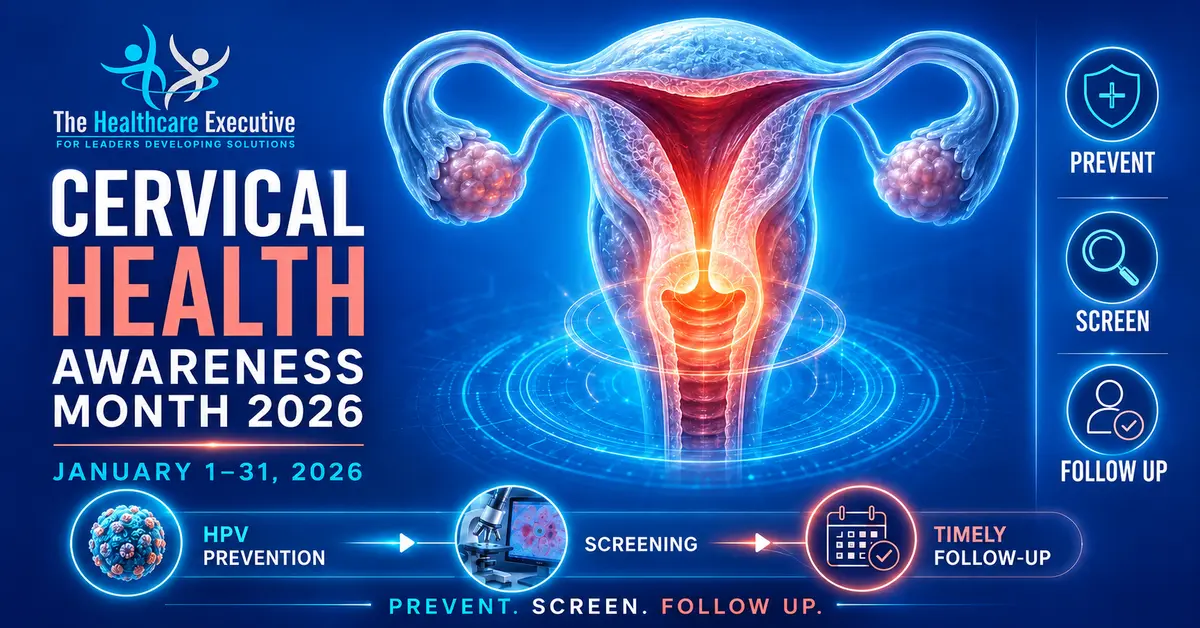
A professional observance page should capture attention, but its authority comes from what it helps the reader understand and do. The approved hero can establish a strong visual identity at the top of the page. The editorial body should then shift into a readable, bright environment where research, executive decisions, and visual aids carry the story. Repeating the hero image inside the article would weaken its impact and make the body feel like a campaign template. The better approach is to extend the hero’s themes through subtle visual language: a prevention-to-resolution pathway, precise line work, biological or systems-inspired diagrams, and small accent marks that support rather than compete with the content.

Effective observance materials are co-designed across communications, clinical, accessibility, patient-experience, and community expertise. Every call to action should lead to a destination that works.
Original conceptual editorial illustration for The Healthcare Executive.Language should be direct without being alarmist. Avoid shame, blame, promises, and unsupported superlatives. Use person-centered terms and acknowledge that not everyone who needs cervical health information identifies as a woman. Explain that screening and follow-up decisions depend on individual history and qualified guidance. If the page describes self-collection, distinguish availability from eligibility and state that the organization’s approved process determines the route. Communications, clinical, legal, compliance, accessibility, and patient-experience teams should review high-stakes language together.
Every call to action should connect to a real destination. “Get screened” is incomplete if it sends the reader to a general homepage. A stronger call to action names the next step: check eligibility, find an appointment, ask about available collection options, speak with a navigator, or learn what to expect after a result. Contact methods should work on mobile devices, support accessible use, and provide alternatives for people who cannot use a portal. If availability varies by location, say so plainly.
Community partners should receive materials that fit their role. A trusted community organization may help share information, host an event, identify barriers, or connect people to navigation. It should not be expected to interpret clinical results without an appropriate agreement and qualified staff. Provide partners with approved messages, a direct referral route, escalation contacts, language options, and feedback mechanisms. Compensate community expertise when it contributes to design and delivery. Trust is damaged when organizations ask communities to lend credibility but do not share decision-making or resources.
The executive voice can add weight when it is specific. A CEO message should not simply praise awareness. It can name the operational commitment: expanding appointment access, funding navigation, improving result communication, acquiring accessible equipment, or publishing a follow-up improvement goal. Leaders should avoid announcing outcomes before data mature. Credibility grows when the organization states what it will do, assigns ownership, reports what happened, and acknowledges what remains unfinished. The organization’s broader guidance on trust as a strategic asset and building trust in healthcare leadership provides a useful companion framework.
Turn January attention into a measurable operating improvement
A 90-day agenda gives the observance enough structure to produce learning without pretending that enterprise change will be completed in one month. The plan should begin before January when possible, but it can also be used as a recovery sequence if the observance is already underway. Choose one meaningful pathway, define its boundaries, and make one executive sponsor accountable for removing cross-functional barriers. Do not launch several disconnected initiatives simply to create the appearance of activity.
Days 1–30
See the real route
- Name the executive sponsor, clinical leader, operational owner, data steward, and community lead.
- Map the pathway from eligibility and outreach through results and indicated follow-up.
- Establish a baseline for reach, access, reliability, resolution, experience, and equity.
- Listen to patients, navigators, nurses, laboratory teams, schedulers, and community partners.
Days 31–60
Repair one transition
- Select one high-value failure point, such as scheduling, kit return, result receipt, or diagnostic follow-up.
- Define the handoff standard, accountable owner, confirmation signal, and escalation route.
- Test messages, instructions, accessibility, and workflow with representative users.
- Model downstream capacity before promoting additional demand.
Days 61–90
Learn and commit
- Run the redesigned route on a bounded scale and review exceptions weekly.
- Compare performance with baseline and investigate differences rather than celebrating activity alone.
- Report the result, limitations, unresolved risk, and next investment to the executive team and board.
- Set the year-round cadence that carries the work beyond the observance.
During the first 30 days, leaders should resist designing solutions before seeing the work. The pathway map should include the formal policy, the technology, and the workarounds staff use to keep care moving. Listen for places where the patient becomes the messenger between departments, where staff maintain private spreadsheets because an enterprise queue is missing, or where community partners cannot obtain a response. Establish baseline measures before changing the process so the organization can distinguish improvement from anecdote.
During days 31 through 60, select one transition with meaningful risk and a realistic opportunity for change. If self-collection is being considered, the transition might be from kit distribution to return or from a positive result to completed diagnostic follow-up. If clinic-based screening is the priority, it might be from outreach to appointment or from result posting to patient understanding. Co-design the change with people who perform and experience the work. Specify the new standard, train the team, and test edge cases before expanding.
During days 61 through 90, run the change at a scale that allows close observation. Review a small set of measures weekly, including unresolved cases and staff burden. Ask what failed, why it failed, and whether the solution created new friction elsewhere. If the change improves one step but increases delay downstream, adjust the operating model. If performance differs across groups, investigate access and experience rather than assuming individual noncompliance. The objective is not a flawless pilot. It is reliable evidence for the next executive decision.
At the end of 90 days, leadership should make an explicit choice: standardize, revise, expand, pause, or stop. That decision should be based on effectiveness, equity, safety, experience, feasibility, and resource requirements. Report the limitations alongside the results. The 2026 literature repeatedly shows that implementation context matters, from rural nursing structures to outreach populations and marginalized communities.[3][6][8] A responsible organization does not conceal that complexity; it uses it to design a stronger route.
The board’s role is to govern the commitment, not manage the queue. Directors should ask whether management has defined the population, mapped the full pathway, resourced downstream capacity, protected privacy, included patient and community voice, and selected measures that show completion. They should ask what remains unresolved and what investment is required. A concise board report can show the baseline, the targeted transition, early results, disparities requiring review, management actions, and the date of the next report.
Make follow-through the signature of the observance
Cervical Health Awareness Month can be visually powerful and operationally serious at the same time. A distinctive hero earns attention. A modern editorial design sustains reading. Scholarly evidence gives the page authority. Yet the leadership value of the observance is realized only when the organization connects that public attention to a care route people can use. Prevention, screening, results, navigation, and diagnostic follow-up are not separate promises. Together, they form one institutional commitment.
The research reviewed for this feature points toward choice, community partnership, navigation, accessibility, and implementation discipline. Self-collection can reduce important barriers, but it does not eliminate the need for explanation, quality control, result communication, and follow-up.[1][2][4] Navigation can improve participation, but navigators need clear roles and resources.[10] Equity requires tailored design and community authority, not generic outreach.[13][14][15] Implementation must be evaluated across the full route, especially where a positive result creates a new and urgent need for coordinated care.[6]
Executives can begin with five questions. Do eligible people have more than one usable entry point? Can staff explain the available options accurately and respectfully? Does every result reach a named owner? Can the organization see unresolved follow-up before delay becomes harm? Are communities experiencing the pathway differently, and has leadership funded the response? These questions move the observance from symbolic support to accountable governance.
The standard should be visible in the page itself. Readers should encounter a clear hierarchy, readable text, purposeful visual aids, current evidence, transparent references, and internal routes to related leadership content. They should not have to interpret decorative complexity, struggle with low contrast, or encounter the same hero repeated through the article. The design should feel contemporary because it respects attention. The writing should feel executive because it converts evidence into decisions. The strategy should feel credible because it does not promise more than the operating system can deliver.
January is the invitation. The deeper work continues through every appointment created, every sample processed correctly, every result explained, every barrier addressed, and every indicated follow-up completed. Healthcare leaders do not control every individual outcome, but they do control whether the organization learns from incomplete pathways and makes ownership visible. That is the opportunity of Cervical Health Awareness Month in 2026: to make follow-through not an afterthought, but the defining expression of leadership.