
Falls Prevention Awareness Week | September 21–25, 2026
Falls Prevention Awareness Week 2026: Make Safety Ownership Visible
A credible observance helps healthcare organizations connect respectful case finding, multifactorial assessment, medication review, movement and balance support, home safety, clinical-community referral, and confirmed follow-through for older adults.
Observance identity: The National Council on Aging identifies September 21–25 as Falls Prevention Awareness Week in 2026. This brief does not claim an official 2026 campaign theme. Review the official NCOA observance toolkit.
Recognition connected to reliable prevention
Use the week to test whether prevention works as one understandable route
Falls Prevention Awareness Week can be more than a seasonal message about caution. For healthcare executives, September 21–25 is a prompt to examine whether the organization can recognize a concern early, understand the person’s priorities and risks, assemble the right actions, and stay accountable until the next step is accepted or deliberately declined. The public message becomes credible only when the receiving system is ready.
The route often crosses primary care, emergency services, rehabilitation, pharmacy, nursing, home health, community programs, vision care, and social services. Each team may complete its own task while the total experience remains fragmented. A screening result can sit in a record without an assessment. A medication concern can reach no prescriber. A referral can be sent without acknowledgment. A home-safety recommendation can be financially or practically unreachable. The operational question is therefore not only whether an intervention exists. It is whether the person can reach it through a visible chain of responsibility.
Global guideline authors recommend opportunistic case finding for community-dwelling older adults and a comprehensive multifactorial assessment with personalized multidomain intervention for people at high risk.17 The guideline combines evidence and international expert consensus. It is not a substitute for local clinical policy, but it offers a useful architecture: advice for all, proportionate assessment, and care matched to identified need rather than a one-size-fits-all campaign.
That architecture depends on listening. In qualitative interviews with 15 older adults at a rural United States hospital, participants described extensive personal strategies for maintaining balance and explained how staff actions could support or disrupt those efforts.9 The small single-site sample does not estimate how common any view is. It does show why leaders should treat older adults as partners with existing knowledge, not passive recipients of warnings.
Respectful
The conversation protects autonomy, avoids blame, and asks what the person wants to preserve in daily life.
Reachable
Assessment, medication review, movement support, home-safety help, and community programs are accessible in practice.
Individualized
Actions respond to the person’s risks, goals, preferences, environment, resources, and clinical context.
Accountable
Every handoff has a sending owner, receiving acknowledgment, escalation path, and completion signal.
Leaders should resist the idea that awareness automatically produces prevention. A 2026 component network meta-analysis of 69 randomized studies found that outcomes differed across intervention components and combinations. Its synthesis suggested value in combining risk assessment and advice with exercise and environmental modification, while also showing that isolated or conventionally delivered components cannot be assumed to help in every configuration.5 Network and component models depend on assumptions about comparability, trial quality, and how interventions were classified. The responsible executive lesson is to design a coherent bundle and monitor local delivery, not to copy one effect estimate into a business case.
Before promoting the observance, verify what happens after someone asks for help. Confirm service hours, eligibility rules, transportation, language and disability access, digital alternatives, community-program capacity, home-visit coverage, medication-review ownership, urgent escalation, and the method for returning status to the referring team. If the route cannot be explained in plain language, narrow the campaign call to action until the receiving system can support it.

Evidence with controlled claims
Use a mixed evidence set to build the system without manufacturing certainty
The selected evidence set contains 18 peer-reviewed records individually reviewed through the University of Phoenix Library and listed newest first. Five records primarily inform intervention or program effectiveness; six inform implementation, referral, or workflow; three inform decision support or screening; and four inform lived experience, access, or guidance. The categories describe each record’s main use in this brief. They are not quality grades, effect sizes, or mutually exclusive descriptions of everything a study contributes.
| Evidence group | Count | Appropriate use | Do not infer |
|---|---|---|---|
| Intervention and program effectiveness | 5 | Identify candidate components, delivery options, and evaluation questions. | That one bundle will produce the same effect in every population or setting. |
| Implementation, referral, and workflow | 6 | Define ownership, training, handoffs, partner roles, refreshment, and feedback. | That implementation activity alone proves fewer falls or injuries. |
| Decision support and screening | 3 | Design prompts, structured capture, review triggers, and usability tests. | That a completed alert or screen is an assessment, diagnosis, or resolved risk. |
| Lived experience, access, and guidance | 4 | Shape respectful communication, participation, remote choices, and pathway architecture. | That themes from a limited sample describe every older adult. |
Chart boundary: The bars count selected records by their primary implementation role. They do not represent study quality, certainty, prevalence, effect magnitude, or the relative importance of a domain.
Exercise and environmental support belong inside an individualized bundle
Exercise evidence is often compelling, but it still requires careful translation. A 2026 meta-analysis of randomized trials examined the Otago Exercise Program and fall-related physical-function outcomes.1 A separate single-arm trial evaluated a virtual Tai Chi program for older adults with mobility disabilities.3 The meta-analysis combines heterogeneous trials, and functional outcomes are not interchangeable with observed falls or injuries. The Tai Chi study lacked a concurrent control group. These records support offering evidence-informed movement options through qualified professionals and testing remote access, but not promising that any class will prevent a fall for an individual.
Home context matters as well. A systematic review considered home modifications that support aging in place, but differences in intervention content, populations, and outcomes limit a single summary claim.13 A randomized clinical trial involving 44 older adults with dementia reported lower post-intervention home fall-risk scores after modifications.16 Its small sample and specific population limit transferability. Leaders can use these findings to strengthen access to qualified home assessment and practical modification support, while preserving clinical judgment, consent, affordability, caregiver context, and local housing constraints.
Scaling a program requires maintenance, not only launch
A large retrospective evaluation linked data for 39,014 people, including 7,964 participants in the community-based Stepping On program and matched controls. Patterns suggested that benefits in service use may be sustained for a limited period and that ongoing program refreshment deserves attention.4 Propensity matching cannot remove all confounding, and the analysis was not a randomized trial. It does, however, challenge a common operational assumption: completing one program cycle does not guarantee durable capability. Leaders should define how participants reconnect, refresh skills, or receive reassessment when health, medications, confidence, or living conditions change.
Decision support is useful only when it changes reliable work
A 2026 systematic review and meta-analysis examined clinical decision support for fall prevention across practitioner adherence, medication, and patient outcomes.8 Variation in systems, workflows, and outcomes limits a universal conclusion. A user-centered design study of ADFICE_IT described a decision-support approach combining fall-risk prediction, deprescribing guidance, and joint medication management.14 It informs design and usability rather than proving that the tool reduces falls. An outpatient primary-care project used an audio computer-assisted self-interview to support STEADI-related screening and data capture.18 As a small implementation report without a DOI in the reviewed record, it should be treated as feasibility evidence.
The executive implication is simple: do not measure success by the number of alerts fired or forms completed. A useful tool fits the clinical context, produces information that can be interpreted, directs work to an accountable role, and shows whether the action was accepted, completed, declined, or escalated. Alert burden, duplicate documentation, missing services, and false reassurance are balancing concerns, not afterthoughts.
Medication review requires decisions, monitoring, and continuity
A focused review on falls, frailty, polypharmacy, and prescribing recommends medication review when older adults present after a fall and emphasizes age-related pharmacologic complexity, practical deprescribing barriers, and communication between hospital and community services.10 This is a narrative clinical review, not a comparative effectiveness trial. It supports a structured medication pathway but does not justify stopping medication solely because it appears on a risk list. Indication, benefit, alternatives, withdrawal or disease risk, monitoring, preferences, and prescriber responsibility must remain explicit.
Experience and access shape participation
Qualitative research in Pakistan explored barriers to reporting fear of falling and participating in prevention strategies.12 The cultural and resource context limits direct transfer to another health system, but the work reinforces the need to avoid shame and invite concerns through language that connects to independence, confidence, and daily goals. In another implementation evaluation, 22 provider interviews examined four evidence-based fall-prevention programs adapted for remote delivery, with attention to rural populations, disability, and communities of color.15 Provider perspectives do not substitute for participant outcomes. They help leaders identify technology support, adaptation, reach, and sustainability questions before treating remote access as solved.
A closed-loop prevention continuum
Build one visible route while preserving individualized clinical judgment
The pathway begins when an older adult, caregiver, clinician, emergency responder, or community partner notices a fall, near fall, balance concern, mobility change, fear, medication issue, or environmental barrier. It must also work during routine care when the person has not volunteered a concern. The first team does not need to perform every assessment. It does need an approved first step, a clear escalation rule, and a receiving owner.
Learning loop: older-adult feedback, failed referrals, delayed actions, access differences, medication concerns, capacity signals, and new falls return to the pathway owner for correction.
Process boundary: This is an operating model, not a clinical algorithm. Urgency, assessment, diagnosis, treatment, exercise, medication change, home intervention, and reassessment depend on current guidance, individual circumstances, local policy, and qualified professional judgment. People may enter, pause, decline, or return at different points.
Respectful entry and proportionate assessment
Use language that invites participation. Asking what the person wants to keep doing can open a more useful conversation than presenting a generic warning. Explain why questions are being asked, what will happen with the information, and which choices are available. A positive screen or reported concern should not be labeled a diagnosis. It should trigger the locally approved next step, with urgent findings routed promptly and nonurgent work placed with a visible owner.
Implementation research in outpatient physical therapy identified barriers and facilitators to making STEADI routine care for older adults, while a related evidence-based quality-improvement study described co-developing implementation strategies with partners.76 Both studies are tied to outpatient physical therapy and implementation context. They do not prove a clinical effect. They support involving the people who will operate the pathway, fitting the work to real roles, and testing implementation strategies rather than assuming a toolkit will implement itself.
Individualized action bundle
The action plan should distinguish recommendations from agreed actions. Depending on assessment and professional judgment, the bundle may include movement or balance support, medication review, home-safety evaluation, clinical management, vision care, footwear or assistive-device review, education, caregiver support, and community connection. Each action needs a responsible role, expected time window, monitoring or follow-up plan, and a way for the person to report difficulty.
A community-based interprofessional screening program used the STEADI toolkit with occupational therapy and physical therapy students, healthcare professionals, and community-dwelling older adults.2 The paper primarily addresses experiential education and collaboration, not comparative patient outcomes. Its operational value is to show how professional training and community partnership can be connected. Leaders should still verify supervision, scope of practice, referral capacity, documentation, and responsibility for findings.
Warm connection and confirmed follow-through
A referral is not complete when an order is placed. Define the information the receiving team needs, how consent is recorded, when acceptance appears, what happens if the service is unavailable, and who contacts the person. A mixed-methods evaluation of a paramedic-led fall-referral program in Nova Scotia found only 289 referrals over the studied period and no significant difference in subsequent fall-related emergency calls between referred participants and matched controls. Paramedics described limited education, weak feedback, low systematization, and patient reluctance as barriers.11 The observational comparison cannot establish the program’s causal effect, but the finding makes a strong implementation point: the referral mechanism and feedback loop require deliberate design.
Completion should include an accepted, completed, declined, deferred, or escalated disposition. Declining a service is not automatically a failure. The system should confirm that the person understood the option, preserve autonomy, provide an appropriate alternative or return path, and keep urgent concerns visible. When services have waitlists or restrictive eligibility, do not hide the gap inside a closed referral status.
Qualitative root-cause structure
Investigate contributors to an unresolved prevention route before choosing a fix
Teams should not assume that every missed step has the same cause. A person may choose not to report fear, may not recognize the relevance of a program, may be unable to reach a service, or may receive conflicting advice. Staff may lack time, training, feedback, or a place to route the result. Community partners may receive referrals without enough information or capacity. The fishbone below is an unranked hypothesis map for local investigation, not a causal model or a statement about any person.
Interpretation boundary: These categories synthesize themes and operating implications from the selected literature. They are not ranked, exhaustive, or suitable for diagnosing an individual. Validate them with older adults, caregivers when invited, frontline teams, and community partners.
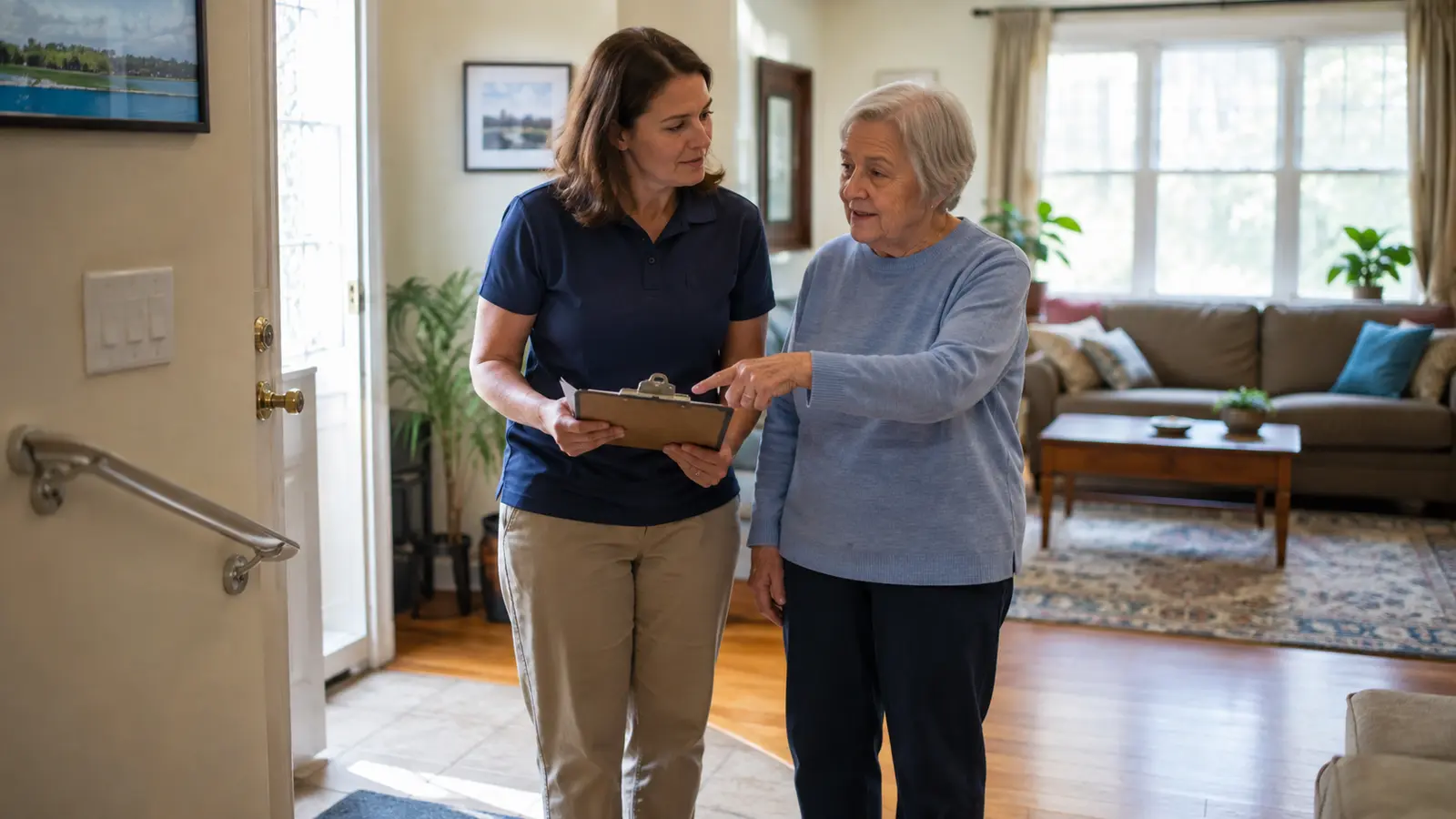
Use protected case review and structured listening to test the map. Select a small sample of real episodes and trace what happened from first signal to disposition. Include completed and incomplete routes. Ask the older adult whether the conversation was respectful, the purpose was clear, the recommended action fit daily life, and the next owner was visible. Ask frontline staff where they created workarounds. Ask receiving partners which referrals could not be used and why.
Do not turn root-cause review into a search for an individual to blame. Choose one recurring failure mode and repair the condition that made it likely. The change may be a defined owner, simpler script, shared medication-review trigger, protected assessment time, transportation support, home-visit option, community-service agreement, feedback to referrers, or a visible exception queue. Then test whether the route changed and whether new burden or risk appeared elsewhere.
Person-centered operating architecture
Connect six capabilities around one accountable plan
A reliable fall-prevention system does not require every service to sit in one department. It requires shared goals, defined decisions, timely information, reachable expertise, and a way to resolve exceptions. The older adult’s priorities remain at the center. The surrounding capabilities can be distributed across the health system and community, but none can assume that another team will close the loop.
Reliability rule: Every transition has a sending owner, receiving owner, acknowledgment, escalation path, and completion signal.
Design boundary: This is a governance framework, not a staffing standard or clinical protocol. Team composition, scope of practice, information exchange, consent, escalation, and timing must reflect local resources, law, policy, professional standards, and community input.
Make shared work explicit
Define which role interprets screening findings, who leads multifactorial assessment, which prescriber owns a medication decision, who develops and progresses a movement plan, who handles home-safety needs, who connects community services, and who confirms completion. Shared ownership is useful only when the handoff rules are visible. The person’s plan should state the agreed actions, responsible roles, expected time windows, monitoring, and what to do if a concern changes.
Design for constrained capacity
Screening can cause harm if it creates work without response capacity. Model likely demand before launch. Review rehabilitation access, pharmacy time, primary-care availability, home-visit coverage, transportation, community-program enrollment, interpretation, accessible digital support, data capacity, and after-hours pathways. If the route cannot absorb demand, select a narrower cohort or one setting and make it reliable before expanding.
Keep community services inside the governance conversation
Community programs are not an unlimited downstream resource. Agreements should define eligibility, referral content, consent, accessibility, response times, waitlist handling, data exchange, funding, and feedback. The clinical team should know when a program cannot accept a participant. The community partner should know whom to contact about a clinical concern. Neither side should carry hidden risk created by ambiguous responsibility.
Decision-grade measurement
Measure whether the route is usable, owned, complete, and sustainable
Campaign reach is not pathway reliability. Impressions, event attendance, distributed checklists, and completed screens describe activity. They do not show whether a high-risk concern received assessment, whether an action plan was agreed, whether a referral was accepted, or whether the person reached the service. A pilot dashboard should pair process, access, safety, experience, equity, and workforce signals while keeping definitions visible.
| Signal | Local specification | Owner and cadence | Source | Interpretation caution |
|---|---|---|---|---|
| Respectful case finding | Eligible pilot encounters with the locally approved question or screen, documented response, and proportionate next step | Clinical operations lead, weekly | Structured record fields and sampled audit | Completion does not prove the conversation was respectful or correctly interpreted. |
| Assessment connection | Positive or concerning results with accepted qualified assessment, urgent disposition, documented decline, or escalation within the local time window | Clinical pathway owner, weekly | Referral, scheduling, and exception records | Acceptance does not show that assessment was completed or appropriate. |
| Agreed action bundle | Completed assessments with documented priorities, agreed actions, responsible roles, timing, and reassessment plan | Clinical owner, monthly | Care-plan fields and sampled review | A filled template does not establish individualized clinical quality. |
| Medication-plan alignment | Selected cases with reconciled lists, reviewed indications and risks, prescriber decisions, monitoring, and communication | Pharmacy lead, weekly | Reconciliation and intervention records | More medication actions can reflect better detection or greater baseline complexity. |
| Closed-loop connection | Accepted rehabilitation, home, vision, or community referrals with completed, declined, deferred, or escalated disposition | Navigation lead, weekly | Referral queue and partner feedback | Completion does not prove that the service met the person’s goal. |
| Person-reported usability | Brief approved questions on respect, clarity, burden, fit, access, and whether the next owner was visible | Experience lead, monthly | Survey and structured interviews | Small or nonresponse-prone samples are not prevalence estimates. |
| Access and equity review | Selected entry, delay, completion, and experience measures examined across locally governed access dimensions | Equity and data leads, monthly | Linked operational data with small-cell protection | Differences do not explain cause and may reflect missing or misclassified data. |
| Safety and workforce burden | Urgent escalations, new falls reported to the pilot, alert burden, rework, overtime signals, unavailable services, and staff friction reviewed together | Quality sponsor, weekly | Safety reports, staffing, queues, and team pulse | Short-term changes may reflect reporting, demand, or case-mix shifts rather than intervention effect. |
Measurement boundary: These are candidate pilot specifications, not national benchmarks. Denominators, exclusions, time windows, targets, privacy controls, data-quality rules, and response expectations require local approval. Never use the dashboard to grade individual patients or to pressure participation.
Define the denominator before interpreting movement
A percentage has meaning only when the eligible population, observation window, exclusions, and missing data are defined. Decide whether the denominator is eligible visits, people with a positive screen, completed assessments, agreed actions, accepted referrals, or participants enrolled in a program. Keep the definition beside the result. If the pilot expands or outreach changes who enters, annotate the change rather than comparing rates as though the population stayed constant.
Pair operational data with structured listening
Data can show where a referral stopped but not always why. Ask older adults whether the conversation supported dignity and independence, the plan fit daily life, the service was reachable, and the next owner was clear. Ask staff which steps created rework, alerts without action, or unresolved responsibility. Ask community partners whether referrals arrived with consent, usable information, and realistic expectations. Report themes as themes, preserve contradictory experiences, and avoid converting a small convenience sample into a rate.
A bounded implementation agenda
Use 90 days to map, test, learn, and make an explicit decision
The pilot should repair one bounded route, not attempt to solve every risk factor in every setting. A practical scope might be older adults discharged after a fall, primary-care patients with a concerning screen, people receiving outpatient physical therapy, or emergency-service encounters that do not result in transport. The charter should name an executive sponsor, clinical owner, pharmacy partner, rehabilitation lead, nursing or transitions representative, community partner, navigation support, data and privacy leads, and a meaningful method for older-adult participation.
| Window | Primary owners | Dependencies | Milestone |
|---|---|---|---|
| Days 0 to 30 | Sponsor, clinical lead, pharmacy, rehabilitation, nursing, community, navigation, data, privacy, older-adult partners | Approved scope; current guidance; service inventory; accessibility, capacity, and urgent-path review | Signed charter, current-state route, ownership map, definitions, scenarios, and stop rules |
| Days 31 to 60 | Operational lead, clinicians, pharmacy, rehabilitation, navigators, community partners, quality team | Training complete; queues active; receiving services, alternatives, and escalation contacts confirmed | Bounded launch with weekly exception review and documented repairs |
| Days 61 to 90 | Sponsor, quality, equity, privacy, workforce, finance, clinical, community, and older-adult partners | Sufficient data quality; feedback; capacity and balancing-measure review | Documented scale, adapt, pause, or stop decision with named owners and dates |
Timeline boundary: Ninety days is an implementation learning window, not a promise of fewer falls, injuries, emergency visits, or admissions. Reduce scope, extend, or pause when clinical governance, workforce, data quality, service capacity, accessibility, or patient-safety prerequisites are not met.
Days 0 to 30: define the route and expose dependencies
Select the cohort and trace the current journey from first signal to reassessment. Include older adults in a protected, compensated, and meaningful design role when feasible. Inventory screening and assessment capacity, rehabilitation access, pharmacy support, home-safety services, community programs, vision and clinical referral routes, transportation, interpretation, disability access, digital alternatives, after-hours contacts, and urgent escalation.
Approve the minimum operating tools: a respectful conversation guide, the locally approved case-finding method, clinical review boundaries, medication-review workflow, shared action plan, warm-handoff standard, receiving-team response expectations, visible exception queue, and dashboard dictionary. Test realistic scenarios. Include a first fall after a medication change, a near fall with fear and no injury, rural distance, limited broadband, cognitive impairment, language access, home constraints, a service waitlist, and a person who declines the recommended next step.
Days 31 to 60: launch small and review every exception
Start with the bounded population and review unresolved work weekly. Examine delayed assessments, referral rejections, unacknowledged medication questions, inaccessible programs, home visits that cannot be scheduled, transportation failures, incomplete documentation, technology problems, urgent escalations, and staff workarounds. Repair the route with version control over scripts, forms, roles, service agreements, escalation paths, and definitions. If demand exceeds capacity, narrow the pilot rather than allowing hidden queues to grow.
Conduct brief structured listening. Ask whether the purpose was clear, the conversation felt respectful, the plan matched the person’s priorities, and the service was reachable. Ask staff where duplicate work or uncertainty appeared. Ask receiving partners whether the information and consent were usable. Treat responses as explanatory evidence unless the sampling design supports broader inference.
Days 61 to 90: evaluate the whole system and decide
Review respectful case finding, assessment connection, individualized action plans, medication-plan alignment, closed-loop referrals, person-reported usability, access differences, safety, unresolved work, and workforce burden together. Examine denominator stability and missing data before interpreting change. A short uncontrolled pilot can show feasibility, adoption, process reliability, and burden. It usually cannot establish that the pathway caused fewer falls or injuries.
Make the decision explicit. Scale when the route is safe, respectful, used, owned, reachable, measurable, and supported by capacity. Adapt when the core idea is sound but a tool, role, handoff, service agreement, or access assumption failed. Pause when safety, workforce, privacy, or data quality prevents responsible operation or interpretation. Stop when burden or risk exceeds likely value. Every decision should name the next owner, resources, date, and conditions for reconsideration.

Leadership close: awareness is credible when safety ownership is visible
Falls Prevention Awareness Week can make balance, confidence, medication safety, mobility, home conditions, and available support more visible. Visibility matters, but it is not the final deliverable. The final deliverable is a respectful route that people can find and use, where action is proportionate to need, services are reachable, and responsibility does not disappear when work crosses a boundary.
The evidence does not offer one universal blueprint. Meta-analyses combine heterogeneous programs. Guidelines require local adaptation. Qualitative work illuminates experience but does not estimate prevalence. Implementation studies show barriers without proving clinical effect. Small trials and single-arm studies are not guarantees. Large observational evaluations retain confounding. The executive opportunity is to choose a bounded route, make ownership visible, test it with the people who use and operate it, and carry the learning beyond September 25.
For practical implementation resources, review the CDC STEADI initiative and the CDC Falls Prevention Interventions and Programs compendium. Related executive observance briefs include Older Americans Month 2026, National Senior Health & Fitness Day 2026, and National Rehabilitation Awareness Week 2026.
Peer-reviewed evidence
References
The references are listed newest first. Each record was individually checked in the University of Phoenix Library for peer-reviewed status, citation metadata, abstract or record details, design, population or setting, and limitations. DOI links lead to public publisher or resolver records.
- Tang Y, Shi J, Meng Z, Zhang Y. Effects of the Otago Exercise Program on Physical Function Performance Related to Falls in the Elderly: A Meta-Analysis of Randomized Controlled Trials. Healthcare. 2026;14(14):2187. doi:10.3390/healthcare14142187.
- Rider JV, Martin S, Nash J. Instructional Insights: From Classroom to Community: Interprofessional Learning Through Fall Prevention Screening. Occupational Therapy in Health Care. 2026;40(3):799-810. doi:10.1080/07380577.2025.2558853.
- Mitzner TL, Remillard ET, Mumma KT, Boyce MW. A Virtual Tai Chi Intervention for Older Adults with Mobility Disabilities: Results from a Single-Arm Clinical Trial with the TechSAge Tele Tai Chi Program. Healthcare. 2026;14(12):1756. doi:10.3390/healthcare14121756.
- Dolja-Gore X, Paul SS, Clemson L, et al. Evaluation of a Scaled-Up Fall Prevention Community Program in Older Adults With Previous Hospitalization. Home Health Care Management & Practice. 2026;38(2):101-110. doi:10.1177/10848223251345743.
- Luo Y, Miao Y, Zhao Y, Li J, Guo R, Wu Y. Effectiveness of Multifactorial and Exercise Programs in Preventing Falls Among Older Adults: A Systematic Review and Component Network Meta-Analysis. Worldviews on Evidence-Based Nursing. 2026;23(2):1-11. doi:10.1111/wvn.70136.
- Vincenzo JL, et al. Co-developing implementation strategies to support STEADI for older adult fall prevention in outpatient physical therapy. Innovation in Aging. 2026;10(7):igag036. doi:10.1093/geroni/igag036.
- Vincenzo JL, et al. Implementing STEADI for routine falls prevention of all older adults attending outpatient physical therapy: key partner perspectives. Frontiers in Health Services. 2026;5:1718490. doi:10.3389/frhs.2025.1718490.
- Solli R, et al. Effectiveness of clinical decision support in fall prevention among older adults: A systematic review and meta-analysis. PLOS ONE. 2026;21(1):e0340025. doi:10.1371/journal.pone.0340025.
- Dolan H, Daniels A, Coon DW. “It’s Common Sense”: Older Adults’ Personal Strategies to Prevent Falls in the Hospital. A Qualitative Descriptive Study. Journal of Clinical Nursing. 2026;35(1):434-445. doi:10.1111/jocn.70018.
- Umapathy M, et al. Medication Management to Reduce Falls, With Particular Focus on Frailty, Polypharmacy and Prescribing. British Journal of Hospital Medicine. 2025;86(12):1-16. doi:10.12968/hmed.2024.0989.
- Duignan L, Opra I, Carter AJE, et al. Evaluating a Paramedic-Led Fall-Referral Program in Nova Scotia: a Mixed-Methods Study. Canadian Geriatrics Journal. 2025;28(4):336-342. doi:10.5770/cgj.28.886.
- Nazir S, et al. Barriers to reporting fear of falling and participation in fall prevention strategies among older adults in Pakistan: a qualitative study. BMC Geriatrics. 2025;25(1):837. doi:10.1186/s12877-025-06555-8.
- Cha SM. A Systematic Review of Home Modifications for Aging in Place in Older Adults. Healthcare. 2025;13(7):752. doi:10.3390/healthcare13070752.
- Groos SS, et al. Development of the ADFICE_IT clinical decision support system to assist deprescribing of fall-risk increasing drugs: A user-centered design approach. PLOS ONE. 2024;19(9):e0297703. doi:10.1371/journal.pone.0297703.
- Kohn MJ, et al. Adapting Evidence-Based Falls Prevention Programs for Remote Delivery: Implementation Insights through the RE-AIM Evaluation Framework to Promote Health Equity. Prevention Science. 2024;25(Suppl 1):163-173. doi:10.1007/s11121-023-01519-z.
- Dalvand H, Setoudeh H, Namazi Shabestari A, Vahabi Z, Almasi-Hashiani A. The effectiveness of home modifications on the risk of falling in older adults with dementia: A randomized clinical trial. British Journal of Occupational Therapy. 2024;87(1):6-14. doi:10.1177/03080226231201739.
- Montero-Odasso M, van der Velde N, Martin FC, et al. World guidelines for falls prevention and management for older adults: a global initiative. Age and Ageing. 2022;51(9):1-36. doi:10.1093/ageing/afac205.
- Ogbuokiri U, Ahaghotu E. Using an Audio Computer-Assisted Self-Interview to Screen Older Adults for Fall Risk in an Outpatient Primary Care Setting. Online Journal of Nursing Informatics. 2022;26(2):10-21.