

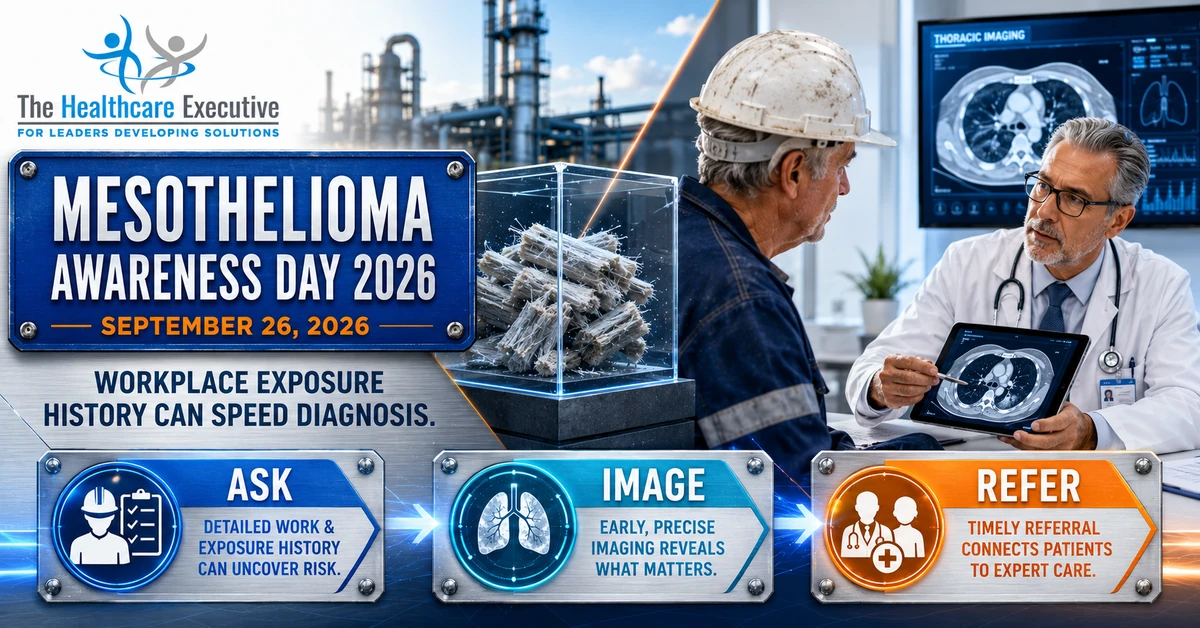
Mesothelioma Awareness Day · September 26, 2026
Build a reliable route from exposure history to coordinated care
Awareness becomes operational when a health system can prevent avoidable exposure, recognize a relevant history, reduce diagnostic drift, connect people with specialist multidisciplinary expertise, and sustain support for patients and caregivers.
Observance context. The Mesothelioma Applied Research Foundation identifies September 26 as Mesothelioma Awareness Day. The observance was established by community members in 2004 to increase awareness and advance action. This executive brief focuses on organizational reliability. It does not diagnose mesothelioma, recommend screening, select a treatment, interpret an exposure, establish universal referral thresholds, or replace qualified clinical, occupational-health, public-health, legal, facilities, or emergency judgment.
The executive accountability case
Turn a rare-cancer observance into a reliability test
Mesothelioma Awareness Day can attract attention to a cancer strongly associated with asbestos exposure and marked by a long interval between exposure and disease. The executive question is what happens after that attention lands. A retired worker may remember a shipyard, construction, manufacturing, power-generation, maintenance, military, or other exposure. A family member may recall contaminated work clothing or an environmental source. A patient may already be moving through repeated visits for nonspecific symptoms. A clinician may need rapid access to pathology, radiology, thoracic, peritoneal, surgical, oncology, pulmonary, nursing, rehabilitation, palliative, and psychosocial expertise. A facilities leader may be planning work in an older building that contains regulated material. These are different situations, but each reveals whether the organization can convert a concern into an accountable next step.
Mesothelioma is not one uniform disease. It can arise in the pleura, peritoneum, pericardium, or other rare sites, and treatment options differ by site, histology, stage, patient condition, goals, available expertise, and evolving evidence. That complexity matters operationally. A generic cancer route may not reliably connect the right diagnostic material, specialist review, treatment discussion, supportive services, and follow-through. A rare-disease route also cannot be built around one highly specialized clinician who has no backup, no navigation capacity, and no shared view of pending work.
Recent evidence supports a pathway focus. A 2025 United Kingdom mixed-methods study of peritoneal mesothelioma found diagnostic delay related to nonspecific symptoms and differential-diagnosis challenges. Its authors called for better communication, smoother pathways, referral to specialist multidisciplinary teams, and participation in decisions.7 A 2026 single-center retrospective study described a structured multidisciplinary algorithm for epithelioid peritoneal mesothelioma, but its small cohort and referral-center design limit generalization.1 These studies do not define a universal model. Together, they show why leaders should make access to appropriate expertise visible and why pathway variation deserves governance.
The accountability begins before a diagnosis. Population surveillance studies show that mesothelioma patterns can follow past occupational and environmental exposure. Italian mortality surveillance linked areas of excess risk with asbestos-cement plants, mines, shipyards, petrochemical and chemical facilities, refineries, textile facilities, and naturally occurring fibers.15 Canadian work found regional variation and overrepresentation of some construction trades in high-rate areas.17 Brazilian and Colombian surveillance initiatives illustrate the information, implementation, and continuity challenges involved in following exposed workers and communities.16,18 None of those studies substitutes for a local exposure assessment. They demonstrate that prevention, history-taking, surveillance, and care coordination are connected system functions.
Board-level question
Can the organization show a dependable route from exposure concern or unexplained symptoms to appropriate assessment, specialist multidisciplinary review, a shared plan, supportive care, and closed-loop follow-through, while also protecting workers, patients, visitors, and contractors from avoidable exposure?
A reliable route does not mean treating every concern as mesothelioma. It means taking relevant history seriously, using approved diagnostic processes, protecting timely access to qualified expertise, and clearly communicating what happens next. It also means defining boundaries. Emerging blood biomarkers and alternative sample methods are active research areas, not automatic screening programs. A 2026 prospective proteomics study reported a five-marker panel with an area under the curve of 0.91 in one cohort but 0.88 and not statistically significant in another; the authors called for larger multi-cohort validation.4 A 2026 proof-of-concept study found dried plasma spots feasible for calretinin measurement in 47 cases and 47 matched asbestos-exposed controls, but feasibility is not equivalent to evidence for population deployment.2 Executives should protect innovation while preventing premature operational use.
Current evidence
See the clinical path and the human workload together
Mesothelioma pathways carry two forms of complexity. The first is technical: a rare cancer, nonspecific presentation, histologic distinctions, imaging and pathology interpretation, evolving treatment evidence, and decisions that may depend on a specialist center. The second is lived: breathlessness, pain, fatigue, coughing, weakness, uncertainty, travel, work disruption, practical tasks, psychological distress, and caregiving. A system that measures only technical completion can overlook the workload placed on the patient and family.
A 2024 symptom-measurement study used longitudinal data from 239 patients with malignant pleural mesothelioma to develop a five-symptom composite covering pain, fatigue, shortness of breath, muscle weakness, and coughing. The composite correlated strongly with longer symptom instruments in that study, but it was developed for a clinical-trial context and is not a universal operational standard.12 Its leadership value is conceptual: symptoms should be visible enough to inform care, yet every questionnaire must have a purpose, a responsible reviewer, a response pathway, and an escalation plan.
A 2024 scoping review described rehabilitation approaches that may support functioning and quality of life, including exercise, psychological support, pain management, and nutrition, while emphasizing gaps in the evidence.10 A 2025 systematic review of 14 articles found recurring psychological distress and information needs among people with asbestos-related disease and their families, but the included literature focused on malignant mesothelioma and varied in design.6 The appropriate operational response is not to promise a specific benefit. It is to make assessment, rehabilitation, psychosocial support, palliative care, and caregiver resources part of the pathway instead of optional referrals that depend on chance.
Figure 1 · Evidence chart
Caregiver context reported in one cross-sectional study of malignant pleural mesothelioma
Horizontal scale: 0% to 100%. Study sample: 291 caregivers in France, Italy, Spain, and the United Kingdom.
| Reported characteristic or screening result | Study denominator | Reported percentage | Interpretive boundary |
|---|---|---|---|
| Women | 291 caregivers | 83% | Descriptive characteristic, not a burden measure |
| Lived with the patient | 291 caregivers | 82% | Descriptive characteristic, not a burden measure |
| Zarit score described as indicating risk of developing depression | 291 caregivers | 74% | Screening interpretation, not a clinical diagnosis of depression |
| Spouse or partner | 291 caregivers | 71% | Descriptive relationship, not a burden measure |
The same caregiver study reported more than five hours of daily emotional or physical support, mean activity impairment of 40%, and work effects among employed caregivers.14 These findings were collected in particular health systems and should not be applied as a local forecast. They do establish that the caregiver is often part of the operating model. Appointment design, travel, education, benefits navigation, symptom escalation, care transitions, and end-of-life communication can all transfer work to families when organizational responsibilities are unclear.

Use emerging evidence with explicit boundaries
Diagnostic and surveillance innovation is important because long latency and nonspecific symptoms complicate early recognition. Yet promising performance in a small or selected cohort can change when the test is used in a different population. The 2025 fibulin-3 study included 90 people undergoing thoracoscopic biopsy, including 32 with malignant pleural mesothelioma. Plasma fibulin-3 showed high specificity at the reported cut point but low sensitivity, limiting its stand-alone value.8 The 2026 dried-plasma-spot study addressed sample handling and assay comparability, not the effectiveness of a screening program.2 The 2026 proteomics study used two small prospective cohorts and explicitly called for larger validation.4
Leaders can support research without confusing study participation with standard care. Governance should define who evaluates evidence, how laboratory-developed or emerging tests are reviewed, how consent and data use are handled, what analytic and clinical validation is required, how equity is assessed, and how research communications avoid overstatement. A biomarker result should never be marketed as certainty. An innovation pathway should include stopping rules, independent review, patient communication, and a plan for incidental or uncertain findings.
Imaging evidence carries similar boundaries. A 2026 retrospective study of 91 postoperative PET/CT scans from 45 patients reported that uptake patterns changed with time and surgical approach and that PET/CT identified some recurrences not seen on conventional CT.3 This supports specialized interpretation and awareness of postoperative context. It does not authorize a universal surveillance schedule. Local protocols belong to qualified clinical teams using current guidance, technology, patient factors, and available expertise.
Prevention and exposure readiness
Make asbestos control an operating discipline, not a historical assumption
Healthcare executives influence exposure risk as employers, facility owners, purchasers, project sponsors, educators, and community institutions. Older hospitals, clinics, laboratories, residences, and support buildings may contain regulated materials. Renovation, demolition, drilling, maintenance, utility work, emergency damage, and contractor activity can disturb materials if planning and controls fail. Responsibility is distributed across facilities, environmental health and safety, infection prevention, occupational health, procurement, legal, risk, emergency management, communications, and executive oversight.
The correct control strategy depends on law, regulation, material condition, location, work scope, and qualified assessment. An observance article should not instruct readers how to handle suspected material. The executive requirement is to ensure that the organization has an up-to-date inventory or assessment process where required, qualified expertise, defined permit and contractor controls, clear stop-work authority, incident reporting, exposure documentation, communication protocols, and medical or public-health follow-up consistent with applicable requirements.
Surveillance studies reinforce why prevention remains current. Italy banned asbestos in 1992, yet investigators still recorded 15,446 mesothelioma deaths during 2010 through 2019, reflecting long latency and historical exposure patterns.15 Canadian regional analysis linked geographic variation to past production, use, and workforce patterns.17 The Brazilian Datamianto system was designed to monitor exposed workers and communities, support cooperation among health services, and produce near-real-time epidemiologic reports, but its authors emphasized that usefulness depends on implementation and sustained improvement.16 A Colombian study likewise focused on practical ways to overcome surveillance limitations in lower-resource settings.18
The operational lesson is that data require stewardship. Exposure records may be incomplete, distributed, legally sensitive, and difficult to connect across decades. A health system should define what it collects, why it collects it, who can see it, how corrections are handled, how long it is retained, how employees and contractors receive information, and how concerns are routed. The organization should distinguish facility-control records, occupational-health records, clinical histories, research data, compensation or legal documentation, and public-health reporting. These records can inform one another, but they are not interchangeable.
Figure 2 · Qualitative fishbone
Why exposure concerns and possible cases can lose momentum
A useful readiness review begins with a real scenario. Suppose construction unexpectedly identifies suspect material, a worker reports a possible disturbance, or an older former employee asks how to document a past exposure. Who stops work? Who protects the area? Who confirms the material and applicable requirements? Who records potentially affected people? Who communicates without speculation? Who connects a person with occupational-health or clinical assessment? Who reports externally if required? Who reviews what failed? If any step depends on memory or a single individual, the system is not ready.
Procurement and capital governance are equally important. Contracts can define credentialing, material surveys, work permits, documentation, incident notification, subcontractor accountability, and record transfer. Capital approval can require environmental due diligence and contingency planning. Executive review can track overdue corrective work without asking the board to manage technical controls. The goal is a clear chain of responsibility, not a new layer of approval that delays urgent safety action.
Strategic continuum
Connect recognition, specialist judgment, and accountable follow-through
The care route should be simple enough to explain and specific enough to operate. Public communications need a verified destination. Primary and emergency care need approved access to advice. Diagnostic teams need complete clinical context and a defined mechanism for resolving discordant findings. Specialist centers need reliable transfer of images, pathology, notes, and authorization. Patients and caregivers need to know who owns the next step and how to raise a concern if it does not occur.
Figure 3 · Proposed process flowchart
A closed-loop exposure-to-care route for executive review
- Prevent and prepareOwner: facilities, safety, occupational health. Maintain qualified controls, incident readiness, and reliable records.
- Recognize and enterOwner: approved entry service. Capture relevant history and symptoms, communicate boundaries, and direct urgent concerns appropriately.
- Assess and diagnoseOwner: responsible clinical team. Coordinate imaging, pathology, procedures, exclusions, communication, and unresolved results.
- Review with specialistsOwner: named multidisciplinary service. Obtain complete materials, clarify options, and document a shared recommendation.
- Deliver and supportOwner: treating team and navigator. Coordinate treatment, rehabilitation, symptom support, palliative care, caregiver needs, and access barriers.
- Follow through and learnOwner: pathway governance. Reconcile transitions, close open work, review experience and equity, and act on recurring failure modes.
The specialist-review step needs more than a meeting on the calendar. It needs a complete case packet, the right disciplines, an assigned presenter, a record of the recommendation and uncertainty, a clear communication route to the patient and referring clinician, and responsibility for the next action. The 2026 peritoneal mesothelioma cohort described how diagnostic laparoscopy, multidisciplinary evaluation, and reassessment were used in a structured center pathway.1 Because it was retrospective and included 43 patients at one center, it should not be generalized as a treatment algorithm. It demonstrates the value of a defined decision process and systematic reassessment.

Pathology and histologic interpretation can influence prognosis and treatment discussion. A 2025 analysis of 132 nonepithelioid mesothelioma cases found that transitional and pleomorphic patterns were associated with poorer outcomes and emphasized standardized diagnostic support.9 As a retrospective pathology study, it does not dictate a local treatment decision. It supports reliable specimen handling, qualified review, structured reporting, and access to consultation when a rare diagnosis or pattern is uncertain.
Operational design should also respect lung preservation, function, and quality of life. A 2024 review of surgery within multimodality treatment emphasized selection, specialist expertise, and the importance of approaches that preserve function where appropriate.13 Executives should avoid converting such literature into case-level rules. Their role is to support multidisciplinary time, referral relationships, credentialed capacity, perioperative coordination, rehabilitation, patient education, and transparent discussion of uncertainty.
Cross-system transfers are a common point of failure. Images may arrive without prior comparisons. Pathology slides or blocks may be delayed. Payer authorization may not align with the appointment. The patient may repeat a story across disconnected portals. A dependable transfer bundle should define required elements, an acceptance signal, a receiving owner, a method for requesting missing material, and a visible completion status. The referring organization remains accountable for communicating while the transfer is pending; the specialist service becomes accountable when it accepts the work. Those decision rights should be written.
Person and caregiver support
Integrate rehabilitation, palliative care, and psychosocial support early enough to help
Supportive care should not be treated as an endpoint or as a signal that disease-directed care has stopped. People may need symptom management, physical or respiratory rehabilitation, nutrition support, psychological care, social work, financial navigation, spiritual care, palliative expertise, and caregiver support at different points. The service mix should follow individual assessment and qualified judgment. Operationally, the pathway should make those services visible, easy to request, and coordinated with the main plan.
The 2024 rehabilitation scoping review found promising approaches but limited and heterogeneous evidence.10 The correct response is a measured service model: assess needs, set person-defined goals, monitor function and symptoms, coordinate with the treating team, and document when a plan changes. Do not promise that a generic exercise or rehabilitation program will improve survival. Do not impose participation. Do not create a referral that disappears into a queue without acknowledgment.
Psychosocial needs also vary. A 2024 mixed-methods study included 36 people with pleural mesothelioma and 25 family carers. Half of the patient participants met frailty criteria, and 20% of carers scored in a range indicating risk for prolonged grief disorder. Interviews identified needs for tailored information, help coordinating treatment tasks, social and peer support, and effective psychological services.11 The small, selected sample limits generalization. The findings still offer a strong design principle: ask rather than assume, and make a response available.
End-of-life and bereavement experiences show why timing matters. A 2022 qualitative study interviewed 14 caregivers, 11 of whom were bereaved. Participants described information gaps, prognostic uncertainty, navigation difficulty, grief, and late palliative-care referral.19 Another 2022 qualitative study with 16 mesothelioma clinical nurse specialists highlighted the boundary-spanning role of specialist nurses in generalist and specialist palliative care.20 Neither study establishes a universal staffing ratio. Both support a named coordinating role and earlier communication about supportive options.

Caregiver support should be designed as a legitimate service need, not a courtesy. At minimum, the pathway can identify the caregiver the patient wants involved, document communication preferences, offer role-specific education, explain escalation routes, assess practical and emotional strain, connect benefits or employment support, and provide bereavement resources. Consent and privacy remain essential. The caregiver is not automatically a proxy decision maker, and the patient controls who receives information unless law or an authorized arrangement provides otherwise.
Travel and time deserve explicit attention because rare-disease expertise may be distant. Organizations can review where a specialist visit truly requires travel, where local testing can be accepted, where virtual consultation is clinically and legally appropriate, and how scheduling can consolidate visits. Financial assistance, lodging, transportation, language access, disability accommodation, and digital support should be part of navigation. Equity review should examine who never reaches the specialist route, not only who completes it.
Operating model
Give the pathway an owner, a queue, and a learning loop
A reliable system has an accountable executive sponsor, a clinical owner, an operational owner, named partners, and a governance cadence. The executive sponsor removes barriers and protects resources. The clinical owner maintains evidence boundaries and decision standards. The operational owner manages queues, handoffs, capacity, and escalation. Occupational-health and facilities leaders govern exposure readiness. Patient, caregiver, worker, and community representatives help test whether the route is understandable and usable.
Figure 4 · Proposed operating-system diagram
A coordinated system around the person, caregiver, and worker
The queue is where strategy becomes observable. It can include suspected exposure events, incomplete referrals, missing diagnostic materials, specialist reviews awaiting acceptance, unresolved authorization, supportive-care requests, transition actions, and overdue communication. The queue should not become a shadow medical record. It should contain the minimum operational information needed to show status, ownership, due date, and escalation, with appropriate access controls and links back to the authoritative record.
Capacity planning should distinguish demand types. An awareness campaign may produce information requests, employee questions, clinical concerns, media inquiries, and facility reports. These do not belong in one phone line without triage rules. Before September 26, leaders should verify destinations, staffing, scripts, escalation contacts, language support, accessibility, and after-hours coverage. Communications must avoid implying that a remembered exposure predicts disease or that a symptom proves a diagnosis.
The learning loop should bring together pathway data and lived experience. A monthly review might examine unresolved work, repeated diagnostic transfers, referral rejection reasons, supportive-care access, complaints, safety events, small-cell equity signals, and patient or caregiver narratives. Each recurring barrier needs an owner and a testable action. Closing an action item is not the same as improving the pathway. The team should check whether the failure recurs and whether the change creates a new burden elsewhere.
Research and clinical trials may be especially important in a rare cancer, but access must be handled carefully. A system can maintain a current route to trial information, eligibility review, consent support, and travel or financial navigation. It should disclose uncertainty and conflicts, protect voluntary choice, and avoid presenting participation as the only responsible option. People who decline or are ineligible still need high-quality care and support.
Measurement
Measure whether the next step happened, not only whether awareness spread
Campaign metrics and pathway metrics answer different questions. Reach may include page views, event participation, training completion, or inquiries. Reliability includes accepted referrals, complete diagnostic material, timely review, documented communication, closed transitions, resolved barriers, and incident follow-up. Experience includes whether people understood the next step and knew whom to contact. Equity review asks whether access and completion differ by geography, language, disability, age, sex, race or ethnicity where legally and ethically appropriate, payer, digital access, or other locally validated dimensions.
Figure 5 · Structured measurement table
Candidate measures for an exposure-to-care reliability portfolio
| Question | Candidate measure | Denominator or scope | Accountable owner | Cadence | Interpretive caution |
|---|---|---|---|---|---|
| Are prevention controls current? | Required asbestos-management, contractor, or work-control reviews completed by due date, percentage | Locally defined required reviews and projects | Facilities and environmental health and safety | Monthly, project checkpoint | Completion does not prove field compliance or absence of risk |
| Are reported events closed? | Potential exposure events with required assessment, documentation, communication, and follow-up completed, percentage | Events meeting the approved reporting definition | Safety, occupational health, and risk | Per event, quarterly aggregate | Legal requirements and privacy may limit aggregation |
| Can people enter the route? | Information or clinical requests acknowledged with an appropriate next step, percentage and median time | Eligible inbound requests by defined channel | Access and navigation | Weekly | Acknowledgment is not diagnosis or completed care |
| Is diagnostic work complete? | Cases reaching specialist review with required images, pathology, history, and authorization available, percentage | Cases accepted for specialist review | Diagnostic and referral operations | Weekly | Required elements vary by case and service |
| Is the recommendation communicated? | Specialist-review decisions documented and communicated to the patient and referring team with next owner, percentage | Completed specialist reviews | Multidisciplinary service | Weekly | Documentation does not prove understanding |
| Are support needs addressed? | Identified rehabilitation, symptom, palliative, psychosocial, or caregiver needs with an accepted action, percentage | Patients with a documented need and consent | Clinical and supportive-care operations | Monthly | Need, preference, and clinical appropriateness vary |
| Are barriers unequal? | Parent reliability measures segmented by validated equity dimensions | The same denominator used for each parent measure | Quality, equity, and privacy leaders | Quarterly | Missing data and small cells can mislead or create privacy risk |
| Does learning close? | Recurring pathway failures with an assigned action, due date, completion, and post-change review, percentage | Failures accepted into the improvement log | Executive pathway owner | Monthly | Action closure does not prove sustained improvement |
Time measures require careful start and stop points. “Time to diagnosis” can mean first symptom, first healthcare contact, first relevant test, first suspicion, pathology confirmation, or patient communication. These are not interchangeable. A broad interval may be meaningful for research but difficult to use for operational accountability. Start with intervals the organization can influence and define, such as receipt-to-acceptance, acceptance-to-complete-material, complete-material-to-review, and review-to-communication.
Experience measures should be concise and actionable. Ask whether the person understands the next step, knows who is responsible, knows how to raise an urgent concern, received information in a usable form, and was included in decisions to the desired degree. Caregiver questions require patient consent and separate interpretation. Worker or contractor concerns require occupational-health and safety protections. Do not merge these populations into a single satisfaction score.
Executive dashboards should display limitations. Missing exposure history may reflect that the question was not asked, the record field was unavailable, the person did not know, or the information was not relevant. Referral completion may look lower at a center that receives more complex or incomplete cases. Small numbers can change percentages dramatically. A rare-cancer dashboard needs counts, denominators, trends, narrative review, and privacy protection.
90-day executive agenda
Correct one visible gap before expanding the program
A ninety-day agenda should be narrow. Choose one concrete segment, such as facility work-control readiness, transfer of diagnostic material to a specialist center, referral acknowledgment, supportive-care navigation, or follow-up after an occupational concern. Define the population, start and stop events, owners, safety boundaries, and what would cause the pilot to pause. Do not claim enterprise transformation from a short project.
Figure 6 · Proposed Gantt-style timeline
A 30/60/90-day mesothelioma pathway reliability sequence
Text equivalent
Days 0–30 establish owners, scope, boundaries, current-state mapping, stakeholder listening, and measure definitions. Days 31–60 pilot one queue, transfer bundle, escalation route, and accessible communication destination while reviewing weekly results. Days 61–90 strengthen backup coverage, return findings, analyze limitations, and decide whether to sustain, scale, or redesign.
Days 0–30: define and listen
Confirm the post and observance destination, but begin with the operating gap. Assemble the smallest team with authority to act. Map the current route using recent de-identified cases or events where permitted. Include the perspectives of a patient or caregiver, frontline clinician, occupational-health professional, facilities or safety leader, navigator, diagnostic partner, and receiving specialist service. Identify where responsibility changes and what evidence shows that the receiving party accepted the work.
Create the control record before building the dashboard. Define the exact pilot population, inclusion and exclusion rules, numerator, denominator, time points, data sources, privacy approach, owner, review cadence, and escalation criteria. Verify that public content directs people to an operational destination and that staff know what they can and cannot say.
Days 31–60: test the smallest closed loop
Pilot one improvement with a manageable volume. For a referral-transfer project, use a standard bundle, acceptance signal, missing-item escalation, patient communication step, and weekly review. For a facilities-readiness project, test a defined work-control checkpoint and incident communication drill with qualified leaders. For supportive care, test one needs-assessment and referral loop with explicit consent and follow-up.
Review failures weekly. Look for unintended delay, duplicate work, privacy concerns, alert fatigue, inequitable access, or excessive dependence on one person. Adjust staffing and standard work quickly. Keep clinical and safety decisions with qualified roles. The executive sponsor should remove obstacles, not override case-level judgment.
Days 61–90: evaluate, return, and decide
Compare the pilot with the pre-defined measures and limitations. Report counts as well as percentages. Examine who did not enter or complete the route. Return findings to the people who contributed and explain what will change. Decide whether to sustain, scale, redesign, or stop. A stopped pilot can be a responsible outcome when burden exceeds benefit or safety boundaries are unclear.
Use Mesothelioma Awareness Day to communicate what the organization is ready to support. A strong message may be modest: an updated staff education resource, a verified occupational-health contact, a clearer referral destination, a new transfer checklist, or a caregiver-support route. Credibility comes from a real service behind the message.
Closing perspective
Awareness should leave the pathway stronger
Mesothelioma Awareness Day honors people affected by a preventable exposure and a rare, complex cancer. Healthcare organizations can respect that purpose by doing more than publishing facts. They can maintain disciplined exposure controls, make occupational and environmental history easier to capture, shorten avoidable handoff delay, protect access to specialist multidisciplinary judgment, integrate supportive care, include caregivers with consent, and review whether the next step actually occurred.
The most credible observance campaign is backed by a named owner, an accessible destination, a visible queue, qualified expertise, and a learning loop. On September 26, 2026, the message can be simple: concerns deserve a safe route, people deserve clear next steps, and every organization can strengthen one part of that route now.
Scholarly references
Current peer-reviewed evidence
References are listed newest first. Evidence was individually reviewed for publication type, population, design, result, and limitations. Clinical and operational decisions should use current qualified guidance and local review.
- D'Annibale, G., Santullo, F., Barberis, L., Lodoli, C., Partipilo, T., La Manna, G. G., Strippoli, A., Spring, A., Pacelli, F., & Abatini, C. (2026). Navigating the foggy landscape of epithelioid peritoneal mesothelioma: A proposed standardized institutional algorithm for multimodal management. Cancers, 18(13), 2123. https://doi.org/10.3390/cancers18132123
- Gleichenhagen, J., Kaiser, N., Brüning, T., Johnen, G., & Weber, D. G. (2026). Assessment of dried plasma spots as an appropriate sample matrix for the measurement of circulating calretinin, a biomarker for mesothelioma: A proof-of-concept study. Journal of Clinical Laboratory Analysis, 40(11), e70271. https://doi.org/10.1002/jcla.70271
- Boo, S. H., Kwon, S. J., Moon, S. W., Kim, Y.-S., Hong, S.-H., & Yoo, I. R. (2026). FDG PET/CT for postoperative surveillance in malignant pleural mesothelioma: Temporal evolution of postsurgical metabolic activity and diagnostic performance for recurrence detection. Cancers, 18(12), 2000. https://doi.org/10.3390/cancers18122000
- Herman, E. J., Allione, A., Viberti, C., Manfredi, M., Russo, A., Sana-Hafeez, K., Kaiser, N., Johnen, G., Brüning, T., Mirabelli, D., Dianzani, I., Agudo, A., Weiderpass, E., Simeon, V., Kaaks, R., Turzanski-Fortner, R., Tumino, R., Milani, L., Gálvez-Navas, J. M., et al. (2026). A proteomics approach to identify predictive blood biomarkers for pleural mesothelioma in prospective cohorts. Clinical and Experimental Medicine, 26(1). https://doi.org/10.1007/s10238-026-02058-x
- Roy, P., Raheja, A., Prajapati, K., Roy, S., Bardhan, M., & Frank, A. L. (2025). Challenges in identifying and diagnosing asbestos-related diseases in emerging economies: A global health perspective. Annals of Global Health, 90(1), 65. https://doi.org/10.5334/aogh.4871
- Franzoi, I. G., Sauta, M. D., Bonafede, M., Francioso, G., De Luca, A., Barbagli, F., & Granieri, A. (2025). Psychological distress in patients with asbestos-related diseases and their families: A systematic literature review. Psycho-Oncology, 34(1), e70051. https://doi.org/10.1002/pon.70051
- Westbrook, S., Ejegi-Memeh, S., Sherborne, V., Warnock, C., Wood, E., Stanford, S., Taher, R., Creech, L., Squibb, L., Twist, C., Gardiner, C., & Xiao, Y. (2025). Variation in the diagnostic and treatment pathway in peritoneal mesothelioma: A mixed-methods study in the United Kingdom. European Journal of Cancer Care, 2025, 1–11. https://doi.org/10.1155/ecc/8875835
- Adamic, K., Malovrh, M. M., Stojkovic, U. B., & Rozman, A. (2025). Fibulin-3 in plasma and pleural effusion as a biomarker of mesothelioma. Radiology & Oncology, 59(2), 225–232. https://doi.org/10.2478/raon-2025-0024
- Fortarezza, F., Pezzuto, F., Maniglio, S., Marzullo, A., d'Amati, A., Cavone, D., Romano, D. E., Pentimone, F., De Palma, A., Marulli, G., Lettini, T., Caporusso, C., Barbarino, M., Salzillo, C., Quaranta, A., Calabrese, F., Serio, G., & Vimercati, L. (2025). Adverse prognostic impact of transitional and pleomorphic patterns in pleural nonepithelioid mesothelioma: Insights from comprehensive analysis and reticulin stain. Archives of Pathology & Laboratory Medicine, 149(4), 347–353. https://doi.org/10.5858/arpa.2023-0523-OA
- Lippi, L., de Sire, A., Aprile, V., Calafiore, D., Folli, A., Refati, F., Balduit, A., Mangogna, A., Ivanova, M., Venetis, K., Fusco, N., & Invernizzi, M. (2024). Rehabilitation for functioning and quality of life in patients with malignant pleural mesothelioma: A scoping review. Current Oncology, 31(8), 4318–4337. https://doi.org/10.3390/curroncol31080322
- Breen, L. J., Same, A., Peddle-McIntyre, C. J., Sidhu, C., Fitzgerald, D., Tan, A. L., Carey, R. N., Wilson, C., & Lee, Y. C. G. (2024). Psychosocial needs of people living with pleural mesothelioma and family carers: A mixed methods study. Psycho-Oncology, 33(11), e70031. https://doi.org/10.1002/pon.70031
- Cleeland, C. S., Keating, K. N., Cuffel, B., Elbi, C., Siegel, J. M., Gerlinger, C., Symonds, T., Sloan, J. A., Dueck, A. C., Bottomley, A., Wang, X. S., Williams, L. A., & Mendoza, T. R. (2024). Developing a fit-for-purpose composite symptom score as a symptom burden endpoint for clinical trials in patients with malignant pleural mesothelioma. Scientific Reports, 14(1), 14839. https://doi.org/10.1038/s41598-024-62307-5
- Kondo, N., & Hasegawa, S. (2024). Optimal surgery for resectable malignant pleural mesothelioma in the setting of multimodality treatment. Surgery Today, 54(7), 663–669. https://doi.org/10.1007/s00595-023-02723-8
- Moore, A., Bennett, B., Taylor-Stokes, G., & Daumont, M. J. (2023). Caregivers of patients with malignant pleural mesothelioma: Who provides care, what care do they provide and what burden do they experience? Quality of Life Research, 32(9), 2587–2599. https://doi.org/10.1007/s11136-023-03410-4
- Fazzo, L., Minelli, G., De Santis, M., Ceccarelli, E., Iavarone, I., & Zona, A. (2023). The epidemiological surveillance of mesothelioma mortality in Italy as a tool for the prevention of asbestos exposure. International Journal of Environmental Research and Public Health, 20(11). https://doi.org/10.3390/ijerph20115957
- Buralli, R. J., Pinheiro, R. D. C., Susviela, L. L., Duracenko, S. R. C., De Capitani, E. M., Savaris, A., & Algranti, E. (2023). The Brazilian system for monitoring workers and general population exposed to asbestos: Development, challenges, and opportunities for workers' health surveillance. International Journal of Environmental Research and Public Health, 20(5). https://doi.org/10.3390/ijerph20054295
- Slavik, C. E., Demers, P. A., Tamburic, L., Warden, H., & McLeod, C. (2023). Do patterns of past asbestos use and production reflect current geographic variations of cancer risk? Mesothelioma in Ontario and British Columbia, Canada. Cancer Causes & Control, 34(4), 349–360. https://doi.org/10.1007/s10552-023-01672-4
- Ramos-Bonilla, J. P., Giraldo, M., Marsili, D., Pasetto, R., Terracini, B., Mazzeo, A., Magnani, C., Comba, P., Lysaniuk, B., Cely-García, M. F., & Ascoli, V. (2023). An approach to overcome the limitations of surveillance of asbestos-related diseases in low- and middle-income countries: What we learned from the Sibaté study in Colombia. Annals of Global Health, 89(1), 1–14. https://doi.org/10.5334/aogh.4166
- Lee, J. T., Mittal, D. L., Warby, A., Kao, S., Dhillon, H. M., & Vardy, J. L. (2022). Dying of mesothelioma: A qualitative exploration of caregiver experiences. European Journal of Cancer Care, 31(5), 1–8. https://doi.org/10.1111/ecc.13627
- Gardiner, C., Harrison, M., Hargreaves, S., & Taylor, B. (2022). Clinical nurse specialist role in providing generalist and specialist palliative care: A qualitative study of mesothelioma clinical nurse specialists. Journal of Advanced Nursing, 78(9), 2973–2982. https://doi.org/10.1111/jan.15277