

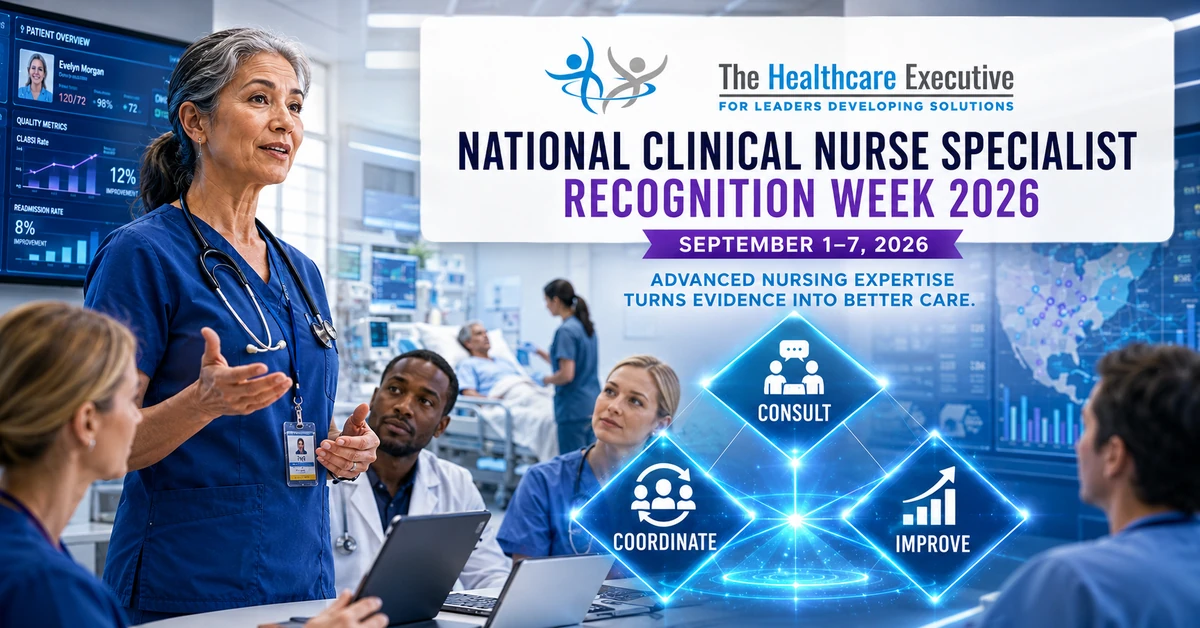
· Executive Brief
National Clinical Nurse Specialist Recognition Week 2026
Recognize the people while reviewing the operating conditions that help them contribute safely and effectively.

Leadership signal
Recognition becomes useful when leaders inspect the real route.
A workforce observance gives leaders a defined point to compare formal role expectations with the work people actually perform. The review can surface invisible coordination, inconsistent escalation, avoidable rework, and tools that require staff to compensate for system gaps.
Start by distinguishing what is known from what the organization still needs to learn. A campaign plan, communication volume, or meeting count does not establish that a route is usable. Leaders need direct listening, clear ownership, locally defined measures, and a method for keeping exceptions visible.
Executive opening
Clinical nurse specialists are an operating asset few systems measure
National Clinical Nurse Specialist Recognition Week honors advanced practice nurses whose work spans patients, nursing staff and the systems around them. Clinical nurse specialists translate evidence into protocols, lead quality improvement, coach newer nurses and help units sustain safer practice. Much of that work is indirect, which makes it easy to overlook in budgets and easy to cut in lean years. The improvement a specialist designs often appears in another manager’s metrics.
The research gathered for this brief shows both the value and the visibility problem. Nurse leaders and staff nurses in a U.S. interview study described the role as providing clinical and financial value through developing novice nurses, enhancing practice environments and improving patient outcomes.[14] Yet a scoping review of 11 studies found that implementing the role in hospitals is cyclical, variable, context-dependent and multifactorial.[13]
Public understanding is limited as well. In a survey of 200 adults in Israel, 25.5% reported familiarity with the clinical nurse specialist role, although 26.5% expressed interest in its educational pathway.[3] Where the role is new, its scope, regulation and evaluation have to be built deliberately, as a national expert consensus process in Taiwan illustrates.[2] Even where the role is established, many organizations have never written down what success looks like.
The workforce context adds urgency. Retention of newly graduated nurses is linked to structured mentoring and to support during their first two years of practice.[4][6] The sections that follow add evidence on role design, transitions, access, equity, onboarding and measurement to the operating route on this page. Several studies concern advanced practice nursing or nurse-led improvement more broadly, and the brief names them as such. Most are observational or single-site, so they show direction more than precise effect sizes.
Current evidence
What the research says about the specialist’s role and reach
Role implementation follows recognizable stages. The scoping review grouped its findings into the framework, process, components and evaluation of implementing the clinical nurse specialist role.[13] It concluded that implementation can be assessed with indicators of structure, process and outcome.[13] That gives executives a ready template for asking whether the role has been resourced, how it operates day to day and what changes it produces. Few organizations report all three for their specialist roles.
Staff describe the role in organizational terms rather than as a list of tasks. The 24 nurse leaders and staff nurses in the U.S. interview study identified five themes, including a unit culture of quality and evidence-based practice, interdependence among roles and associative capacity.[14] The findings frame the specialist as a connector who shapes culture and relationships, not only as an individual clinical expert.[14] The authors concluded that the role adds value partly through the professional development of novice nurses.[14]
Patients also experience the role directly, particularly in specialties with long treatment courses. A qualitative systematic review of 7 studies in cancer care generated 31 themes, synthesized into four categories.[15] All included studies highlighted a positive impact of the clinical nurse specialist role on patients’ knowledge, skills and ability to self-manage.[15] As cancer care moves toward a chronic care model, that self-management support becomes a capacity question for oncology services.[15]
Broader advanced practice nursing evidence points in the same direction. A Korean study used nationwide claims data to match 1507 long-term care residents with nursing needs.[11] Residents who received advanced practice nurse visiting services had lower risks of acute hospital admission (hazard ratio 0.62) and long-term care hospital admission (hazard ratio 0.52).[11] There was no difference in emergency department visits.[11] The study did not isolate clinical nurse specialists, but it shows the kind of outcome evidence advanced practice roles can generate when they are measured.[11]
Across these studies, the common thread is that specialist value appears at the level of units and systems. Leaders who look only for individual patient outcomes attributed to one nurse will undercount it, and may cut a role whose effects show up in other people’s results. Attribution needs to be planned at the start of each project, not reconstructed at budget time.
Figure 1
Workforce signals around the specialist role
Percent of each study population with the reported characteristic or outcome. Values are copied from the cited studies [3], [5], [12]; none is estimated.
Data note. The first two bars come from one survey; the others come from different countries, populations and measures, so any comparison across them is an indirect comparison.
Limitation. Intention to leave is not actual turnover, and the fellowship figure does not include clinical nurse specialists.
Figure data (4 rows)
| Measure | Value | Population, setting and year as reported | Source |
|---|---|---|---|
| Adults familiar with the clinical nurse specialist role | 25.5% | Survey of 200 adults in Israel | [3] |
| Adults interested in the clinical nurse specialist pathway | 26.5% | Same survey of 200 adults in Israel | [3] |
| New nurses intending to leave at both one and two years | 39.2% | 448 newly graduated nurses in a South Korean cohort, 2020 to 2023 | [5] |
| Post-fellowship retention at the training site | 79% | Nurse practitioner and physician assistant fellows at one academic medical center, 2019 to 2023 | [12] |

Continuum of care
Where specialist practice supports transitions and sustained improvement
Transitions are where protocols and teaching matter most. In a 200-bed urban medical center, registered nurses used a standardized script to call patients within 24 to 72 hours of discharge.[10] Among 287 patients receiving standard care, 17% were readmitted within 30 days, compared with 3.5% of 112 patients who received the structured calls.[10] The design was a before-and-after quality improvement study, so part of the difference may reflect other changes.[10] The calls followed a published discharge toolkit and covered health status, medications, follow-up appointments and home support.[10] Designing and auditing such scripts is typical specialist work.
The first months after a move into long-term care are another vulnerable transition. The Korean visiting service targeted the early period after facility admission, when registered nurses are often not available on site.[11] A lower risk of acute admission was observed among residents with high functional dependence, with a hazard ratio of 0.56 for the most dependent grade.[11] The benefit appeared strongest where care needs were highest, which is where scarce advanced practice time is usually best spent.
Inside the hospital, specialist-led improvement can be hard to sustain, even when the evidence behind it is strong. A clinical nurse specialist and a medical critical care unit council led an 8-week project on spontaneous awakening and breathing trials.[1] Ventilator-associated events decreased by 33.3%, but the change was not statistically significant.[1] Spontaneous awakening trial compliance rose from 75.7% to 83.0%, while spontaneous breathing trial compliance fell from 88.4% to 70.4%.[1]
That mixed result is informative. The project audited only 23 and 34 charts, and none of these changes reached statistical significance.[1] The unit council’s overall survey score also dropped 9.8%, with only 9 nurses responding after the intervention.[1] Executives should give specialist-led projects enough time and data to test whether a change holds, and should treat a non-significant result as a reason to refine rather than abandon. The authors called for future initiatives that sustain a comprehensive approach to reducing ventilator-associated events.[1]
Nurse-led follow-up in cancer care illustrates the same principle across a longer horizon. The qualitative review found value in nurse-led follow-up services that empower patients to manage their condition and improve overall well-being.[15] The continuum, in other words, extends well past discharge. Specialist roles that stop at the hospital door leave much of their potential unused.
Figure 3
Why the pathway breaks
People
- Too few qualified candidates
- Experienced nurses leaving the bedside
- High early-career turnover
Process
- Role implemented without a structured plan
- Short improvement projects without sustainment
- Onboarding support spread evenly rather than targeted
Technology
- Audit data not fed back in real time
- No dashboard linking specialist projects to outcomes
- Manual follow-up processes after discharge
Environment
- Low public awareness of the role
- Social stigma and limited bedside recognition
- Units with limited relational support
Policy
- No certification or funded pipeline
- Unclear scope and appointment rules
- Retention strategies relying only on career progression
Measurement
- No structure, process and outcome indicators
- Retention not linked to onboarding support
- Patient-level outcomes rarely examined
Unranked qualitative cause-and-effect diagram for the outcome in the box: Clinical nurse specialist expertise does not reliably reach units, new nurses and patients, and its impact goes unmeasured Causes are assembled from the cited literature [1], [2], [3], [4], [5], [7], [8], [9], [13]; categories are not weighted and their order carries no meaning.
Data note. Qualitative; no frequencies are implied.
Limitation. Causes drawn from published studies may not all apply locally; validate them with frontline teams.
Figure data (6 rows)
| Category | Causes drawn from the cited literature |
|---|---|
| People | Too few qualified candidates; Experienced nurses leaving the bedside; High early-career turnover |
| Process | Role implemented without a structured plan; Short improvement projects without sustainment; Onboarding support spread evenly rather than targeted |
| Technology | Audit data not fed back in real time; No dashboard linking specialist projects to outcomes; Manual follow-up processes after discharge |
| Environment | Low public awareness of the role; Social stigma and limited bedside recognition; Units with limited relational support |
| Policy | No certification or funded pipeline; Unclear scope and appointment rules; Retention strategies relying only on career progression |
| Measurement | No structure, process and outcome indicators; Retention not linked to onboarding support; Patient-level outcomes rarely examined |
Access
Building access to specialist expertise
Access to specialist expertise starts with a defined system that says who qualifies, where they work and how they are evaluated. In Taiwan, a mixed-methods process with 30 expert panelists in two Delphi rounds produced a clinical nurse specialist framework of 19 articles in six chapters.[2] Convergence reached 94.0% to 94.3% for feasibility and 93.6% to 95.8% for appropriateness.[2] The framework covered appointment, core competencies and responsibilities, selection, continuing education and performance evaluation.[2]
The Taiwan authors recommended an appropriately funded certification system and the inclusion of specialist content in graduate-level nursing education.[2] Without those pipelines, organizations compete for a small pool of qualified candidates and fill roles inconsistently. The authors also called for stronger interprofessional support to make the system feasible in practice.[2] Physicians, pharmacists and managers need to understand what the role does before they can use it well.
Supply also depends on who chooses the career. In the Israeli survey, self-efficacy, career motivation and gender predicted interest in the clinical nurse specialist pathway.[3] Women were more likely to favor the role, while men showed greater interest in the physician associate role.[3] The authors called for clear role definitions and targeted outreach to address gendered perceptions.[3] They also noted that both roles are relatively new and underrecognized in Israel, which makes early communication especially important.[3]
Structured postgraduate pathways can turn interest into retained specialists and shorten the time to full productivity. An academic medical center’s fellowship for nurse practitioners and physician assistants enrolled 30 fellows across 8 specialty tracks between 2019 and 2023.[12] Of those 30 participants, 28 fellows graduated with successful program completion.[12] Ninety-six percent were employed in specialty care at graduation or within six months, and post-fellowship retention at the training site was 79%.[12] The program did not include clinical nurse specialists, so its results apply to them only by analogy.[12] A fellowship advisory board defined entry criteria, curriculum and clinical placements, and the curriculum was revised when monthly experience scores fell below 70%.[12]
Access to the role is therefore a pipeline question with three parts: a defined scope, a training route and a reason to stay. Each part has an owner inside the organization, and each can be reviewed annually alongside vacancy and turnover data. Gaps in any one of them will show up first as unfilled positions.
Executive guidance · System route
Map the path from first contact to verified follow-through.
Use this route as a discussion framework. Replace each stage with the organization’s approved process, qualified roles, current service capacity, and applicable requirements. Do not infer a clinical protocol from the observance title.
The route at a glance
- See the work
- Clarify the role
- Align role and capacity
- Strengthen handoffs
- Learn with staff
Reliability rule: Every stage needs a named owner, an observable status, an approved escalation path, and a defined signal that shows whether responsibility moved or remained unresolved.
See the work
Map formal responsibilities, actual demand, recurring interruptions, coordination load, and work that arrives through informal channels.
Clarify the role
Align expectations, training, authority, support, and escalation with organizational policy and locally applicable requirements.
Align role and capacity
Compare formal expectations with actual demand, tools, dependencies, backup coverage, and escalation across representative shifts and settings.
Strengthen handoffs
Define what the role sends, receives, acknowledges, escalates, and documents when work crosses a boundary.
Learn with staff
Give the professionals closest to the work a regular voice in reviewing friction, testing changes, and confirming results.
Figure 2
The system route as one flow
The five stages of the system route described in this brief, drawn as one flow with a learning loop back to the start. The stages are the page’s original executive guidance, not a clinical protocol.
Data note. Shows sequence and handoffs only; it carries no counts or rates.
Limitation. Local processes may add, merge or reorder stages under organizational policy.
Figure data (5 rows)
| Stage | What the stage requires |
|---|---|
| See the work | Map formal responsibilities, actual demand, recurring interruptions, coordination load, and work that arrives through informal channels. |
| Clarify the role | Align expectations, training, authority, support, and escalation with organizational policy and locally applicable requirements. |
| Align role and capacity | Compare formal expectations with actual demand, tools, dependencies, backup coverage, and escalation across representative shifts and settings. |
| Strengthen handoffs | Define what the role sends, receives, acknowledges, escalates, and documents when work crosses a boundary. |
| Learn with staff | Give the professionals closest to the work a regular voice in reviewing friction, testing changes, and confirming results. |
Equity and trust
Equity, role clarity and whose voice counts
Role clarity is also an equity issue for nurses themselves. A grounded theory study interviewed 33 participants in Western Saudi Arabia, including 19 newly qualified nurses.[8] The nurses described forward escaping: staying in nursing while moving toward roles with more autonomy, social legitimacy and advancement.[8] Departure from bedside nursing reflected social stigma, limited role clarity and constrained career pathways rather than professional disengagement.[8] The setting is specific, but the dynamic is familiar wherever bedside work carries less recognition than advanced roles.
The authors warned that relying mainly on career progression as a retention lever risks neglecting persistent bedside conditions.[8] For specialist roles, the lesson is that creating advanced positions should not drain the bedside of experienced nurses without also improving bedside work itself. Specialists are well placed to do both, because their work improves the bedside environment that newer nurses experience.
Gendered perceptions shape the pipeline too, in ways that recruitment teams can address. Women in the Israeli survey favored the clinical nurse specialist role and men the physician associate role.[3] The authors recommended that nurses use clinical encounters to explain these roles and build trust.[3] Recruitment that reaches only one group will narrow the future specialist workforce and the perspectives it brings. Outreach materials and recruitment panels should be checked for that imbalance.
Support should also be targeted, because risk of leaving is not evenly distributed. In a Korean cohort of 448 newly graduated nurses, lower academic performance, low readiness for practice and weaker nursing values during education were baseline predictors of persistent intention to leave.[5] The authors highlighted collegial relationships and targeted support for high-risk nurses.[5] Specialist coaching can be directed toward those nurses rather than spread evenly across every new hire. Doing so requires early identification during onboarding and a confidential way to offer extra support without stigma.
Patient equity follows from staff equity, because the least experienced teams often serve the most complex patients. A specialist who designs onboarding and protocols for every unit, not only the best-resourced ones, extends evidence-based care to patients who might otherwise receive the least consistent practice. Executives can check this by reviewing which units receive specialist time and which do not. Night shifts, smaller sites and units with high vacancy rates are common blind spots.

Human infrastructure
Specialists as coaches for the next generation of nurses
Mentoring is one of the strongest levers for early-career retention, and specialists frequently design or support it. An umbrella review synthesized 13 systematic and integrative reviews of mentoring programs.[4] Retention among newly graduated nurses ranged from 72% to 100% at one year and 70% to 98% at two years.[4] Post-intervention turnover ranged from 3.5% to 20%, compared with pre-intervention rates of up to 50%.[4] Programs integrating structured education and preceptorship models most often reported significant improvements.[4]
The need is large. In the Korean cohort, the largest group, 39.2%, intended to leave at both one and two years after graduation.[5] Only 14.0% intended to stay at both points.[5] Higher workplace relational support from coworkers and managers was observed among nurses who moved from intending to leave to intending to stay.[5] The authors described that relational climate as a potentially modifiable correlate of reconsidering leaving.[5]
Early preparation and early support work together. In a longitudinal study of 743 new graduate nurses, readiness for practice before graduation directly influenced job embeddedness two years later.[6] Change in the transition experience between the first and second years partially mediated that relationship, accounting for 24.8% of the total effect.[6] The authors identified the first 2 years of practice as a crucial intervention window.[6] Specialist coaching that ends after orientation week misses most of that window.
Program design varies widely, which makes local evaluation essential. An umbrella review of 14 reviews found that transition programs commonly use one-on-one preceptorship with supernumerary practice, simulation and active learning methods, lasting from a few days to 12 months.[7] Competence and confidence were consistently reported, but retention evidence was mixed and patient-level outcomes were rarely examined.[7] The authors called for standardized indicators to evaluate transition programs across settings.[7] An organization can adopt its own standard set now rather than wait.
These studies place clinical nurse specialists close to the center of workforce strategy. Specialists often design orientation curricula, coach preceptors and teach evidence-based practice. Linking that effort to retention data is one of the clearest ways to show the role’s value to finance and governance leaders. Replacing a nurse who leaves in the first year is costly, so even modest retention gains matter.
Executive guidance · Operating dashboard
Measure whether the operating route works as intended.
Do not publish a number until the organization defines its numerator, denominator where relevant, owner, source system, exclusions, review cadence, and limits. The candidates below are management prompts, not benchmarks or reported results.
Four operating signals
Each signal pairs an executive question with one candidate local measure, set out below.
Executive guidance · Signal
Role clarity
Are expectations, authority, support, and escalation understood by the role and its partners?
- Candidate local measure
- Locally defined scope questions, misroutes, reassignment, and escalation signals.
Executive guidance · Signal
Capacity resilience
Can the operating model absorb predictable demand and planned absences without unsafe workarounds?
- Candidate local measure
- Coverage gaps, schedule stability, overtime, backlog, and backup activation under local definitions.
Executive guidance · Signal
Role-capacity alignment
Does the operating model match demand while preserving clear role, support, and escalation?
- Candidate local measure
- Locally defined workload, backlog, coverage gaps, reassignment, escalation, and staff feedback.
Executive guidance · Signal
Voice and improvement
Can staff raise concerns and help redesign the work with visible follow-through?
- Candidate local measure
- Improvement ideas, assigned owners, response status, completed changes, and staff feedback.
Figure 4
The operating system behind the dashboard
The four operating signals from this brief’s dashboard, each tied to the candidate owner named in the executive scorecard, around one accountable route. Drawn from the page’s original executive guidance.
Data note. Structural diagram; no measured values.
Limitation. Owners are candidates to be confirmed locally.
Figure data (4 rows)
| Operating signal | Candidate owner |
|---|---|
| Role clarity | Executive sponsor and operational lead |
| Capacity resilience | Operational owner and participating teams |
| Role-capacity alignment | Sending and receiving owners |
| Voice and improvement | Improvement owner and executive sponsor |
Executive guidance · Handoff workflow
Keep work owned when it crosses a boundary.
A handoff is reliable only when the sending party knows who is expected to receive the work, the receiving party acknowledges responsibility, and any unresolved exception remains visible. Local policy and qualified judgment control the actual process.
How responsibility moves
Lane A
From message to accepted ownership
- Confirm the approved message and intended audience.
- Publish the actual entry point and receiving role.
- Acknowledge receipt using the locally approved method.
- Escalate when ownership or response remains unclear.
Lane B
From accepted ownership to verified follow-through
- Record the next accountable owner and visible status.
- State what the role sends, receives, acknowledges, escalates, and documents at each operating boundary.
- Keep unresolved work visible across boundaries.
- Confirm closure or document the continuing exception.
Executive guidance · Executive scorecard
Ask questions that connect intent, ownership, and results.
The scorecard keeps review focused on decisions. Leaders should set definitions locally, examine variation without overclaiming cause, and pair quantitative signals with the experience of people who use and operate the route.
Who reviews what
- Executive sponsor and operational lead
- Operational owner and participating teams
- Sending and receiving owners
- Improvement owner and executive sponsor
Candidate owners named in the scorecard, confirmed locally.
| Operating signal | Executive question | Candidate owner | Suggested review point |
|---|---|---|---|
| Role clarity | Are expectations, authority, support, and escalation understood by the role and its partners? | Executive sponsor and operational lead | At campaign launch and close |
| Capacity resilience | Can the operating model absorb predictable demand and planned absences without unsafe workarounds? | Operational owner and participating teams | At a locally defined cadence |
| Role-capacity alignment | Does the operating model match demand while preserving clear role, support, and escalation? | Sending and receiving owners | At a locally defined cadence |
| Voice and improvement | Can staff raise concerns and help redesign the work with visible follow-through? | Improvement owner and executive sponsor | Until action is verified |
Figure 5
Control points for an effective clinical nurse specialist program
| Control point | Risk if missing | Owner | Evidence of control |
|---|---|---|---|
| Written role scope, appointment and evaluation criteria | Role varies by unit and is easy to cut | Chief nursing officer | Approved role framework and annual performance evaluation |
| Structure, process and outcome indicators for specialist work | Value goes unrecognized in budget reviews | Director of nursing quality | Quarterly indicator report reviewed by the quality committee |
| Specialist-supported onboarding for new graduates | Early-career turnover remains high | Director of professional development | First- and second-year retention by unit |
| Targeted coaching for high-risk new nurses | Nurses at highest risk of leaving receive no extra support | Clinical nurse specialist team lead | Share of identified nurses with a coaching plan |
| Real-time audit feedback on key protocols | Gains fade after education ends | Clinical nurse specialists with infection prevention | Audit compliance trends and infection rates |
| Pipeline and certification support | Vacancies persist for lack of candidates | Chief nursing officer and human resources | Internship enrollment and time to fill specialist roles |
Control points derived from the cited evidence [2], [4], [5], [9], [13] and this brief’s executive guidance.
Data note. Each row is a control to verify, not a measured result.
Limitation. Owners and evidence of control must follow local policy and applicable requirements.
Public communication
Making the specialist’s impact visible
Measurement and feedback are themselves a communication strategy, and specialists are often the people who build them. In a Belgian acute hospital, 6718 peripheral catheter audits moved from an infection prevention nurse to a structured nurse-led peer audit model with real-time digital dashboards.[9] Insertion site visibility compliance rose from 12.7% in 2023 to more than 90% in 2024 and 2025.[9] Associated bloodstream infection incidence declined from 0.81 to 0.29 per 10,000 patient-days between 2022 and 2025.[9]
The authors reported that the strategy enhanced ownership and actionable feedback, while documentation and time-dependent processes improved less.[9] Sharing data visibly with front-line staff is a design principle that specialists can apply to almost any protocol. Several wards in the Belgian hospital achieved sustained infection-free periods exceeding 90 days.[9]
Explaining the role to the public matters as well, because people cannot ask for expertise they do not know exists. With only 25.5% of surveyed adults familiar with clinical nurse specialists, the authors recommended awareness campaigns, training incentives and curricular integration.[3] Recognition week is a natural moment for that explanation, ideally with concrete examples of improvements specialists have led. Patients and families are more likely to seek out and trust a role they can name.
Inside organizations, colleagues describe the specialist’s contribution in terms of relationships and culture.[14] Those descriptions are persuasive to nurses but rarely to budget committees. Translating those descriptions into structure, process and outcome indicators, as the scoping review suggests, makes the contribution legible to finance and governance leaders.[13] A one-page annual report per specialist, listing projects, indicators and results, is a simple start.
Communication with patients can carry the same rigor, and it gives patients a direct view of specialist-designed care. Patients reported improved satisfaction and confidence in managing their care after the structured follow-up calls.[10] Communication that nurses design, script and measure can be both a patient experience tool and a safety tool. Recognition week messages can highlight that link for staff, patients and the board alike. The most credible message pairs thanks with one specific result and one commitment for the coming year.

Executive guidance · 90-day plan
Move from listening to a verified improvement in 90 days.
The time boxes below are a management framework, not a clinical timeline. Adjust them to risk, scope, governance, resources, stakeholder participation, and applicable review requirements.
Ninety days, three moves
- Days 1–30See the current route
- Days 31–60Build the reliable path
- Days 61–90Make the change visible
Days 1–30 · Listen and map
See the current route
- Name an executive sponsor and an operational owner.
- Listen to people using the route and representative frontline teams.
- Map how National Clinical Nurse Specialist Recognition Week communications connect to real entry points, owners, transitions, and escalation.
- Select one recurring barrier that the organization can responsibly address.
Days 31–60 · Design and test
Build the reliable path
- Define the trigger, receiving owner, required information, acknowledgment, escalation, and closure signal.
- Validate the design with every sending and receiving team involved.
- Ask the professionals closest to the work to select and test one role, tool, workload, or handoff improvement.
- Test the route in more than one representative setting or operating period where practical.
Days 61–90 · Implement and verify
Make the change visible
- Launch the redesigned route with a small set of locally defined measures.
- Review unresolved work and recurring friction using a learning approach.
- Correct implementation barriers and record who owns each remaining dependency.
- Report what changed, what evidence was reviewed, and what still requires live oversight.
Figure 6
The 90-day plan on one timeline
The 90-day plan from this brief drawn as a timeline: each action sits in the 30-day window the plan assigns it. The full wording of each action is in the figure data and in the plan above.
Data note. Time boxes are a management framework, not a clinical timeline.
Limitation. Durations are uniform 30-day windows; real tasks may span windows.
Figure data (12 rows)
| Window | Action |
|---|---|
| Days 1–30 · Listen and map | Name an executive sponsor and an operational owner. |
| Days 1–30 · Listen and map | Listen to people using the route and representative frontline teams. |
| Days 1–30 · Listen and map | Map how National Clinical Nurse Specialist Recognition Week communications connect to real entry points, owners, transitions, and escalation. |
| Days 1–30 · Listen and map | Select one recurring barrier that the organization can responsibly address. |
| Days 31–60 · Design and test | Define the trigger, receiving owner, required information, acknowledgment, escalation, and closure signal. |
| Days 31–60 · Design and test | Validate the design with every sending and receiving team involved. |
| Days 31–60 · Design and test | Ask the professionals closest to the work to select and test one role, tool, workload, or handoff improvement. |
| Days 31–60 · Design and test | Test the route in more than one representative setting or operating period where practical. |
| Days 61–90 · Implement and verify | Launch the redesigned route with a small set of locally defined measures. |
| Days 61–90 · Implement and verify | Review unresolved work and recurring friction using a learning approach. |
| Days 61–90 · Implement and verify | Correct implementation barriers and record who owns each remaining dependency. |
| Days 61–90 · Implement and verify | Report what changed, what evidence was reviewed, and what still requires live oversight. |
Executive guidance · Leadership close
Carry one accountable improvement beyond the campaign window.
Recognition matters. It becomes durable when leaders also listen, clarify the route, support the people operating it, close an identified gap, and report the result without claiming more than the evidence supports.
Leadership commitment
Listen to the people closest to the route, assign one barrier, and verify the change.
Executive action kit · Week observance
Turn National Clinical Nurse Specialist Recognition Week into accountable action.
Recognize the people while reviewing the operating conditions that help them contribute safely and effectively.
Leadership focus
Use this observance to examine role clarity, capacity, teamwork, and dependable handoffs. Select one verified barrier, assign an accountable owner, and carry the improvement beyond the campaign window.
Workforce lens
Ask whether staffing, role clarity, training, tools, workload, and escalation support the people operating the role, coverage, workload, and escalation pathway.
Patient and community lens
Make the approved first step clear. Test whether a person can move from information to an acknowledged next action without navigating conflicting instructions.
Equity and access lens
Review whether shift, location, employment status, language, disability, or digital access changes who can use the pathway or receive support.
Five-minute briefing
Inspect the operating sequence
Listen with professionals performing the work, operational leaders, and the teams that depend on them. Find one unclear responsibility, hidden workload, or an unsupported handoff, then test the locally approved route from entry through acknowledged follow-through.
- See the work
- Clarify the role
- Align role and capacity
- Strengthen handoffs
- Learn with staff
Leadership actions for this week
- Name an executive sponsor and frontline operating owner.
- Ask people using and operating the pathway where ownership becomes unclear.
- Test one representative route from first question to acknowledged next step.
- Select one barrier that can be corrected without overstating the evidence.
- Set a review date and define how completion will be verified.
Candidate measures
Define every numerator, denominator where relevant, owner, data source, exclusions, cadence, and limitation locally. These are management prompts, not external benchmarks.
- Locally defined scope questions, misroutes, reassignment, and escalation signals.
- Coverage gaps, schedule stability, overtime, backlog, and backup activation under local definitions.
- Locally defined workload, backlog, coverage gaps, reassignment, escalation, and staff feedback.
Department readiness checklist
- The public and staff entry points match the actual approved process.
- A specific role accepts each request, referral, or escalation.
- Handoffs include acknowledgment and a visible unresolved state.
- Language, disability, digital, transportation, and trust barriers receive explicit review.
- Communications do not introduce unsupported themes, statistics, or clinical advice.
- A named leader will review what changed after the observance.
Intended audiences
- Executive and Operational Leaders
- Nursing and Clinical Leaders
- Workforce and Human Resources Leaders
Staff communication template
During National Clinical Nurse Specialist Recognition Week, our organization will connect awareness with a practical review of the role, coverage, workload, and escalation pathway. Use approved information, identify the correct entry point, confirm ownership when work moves, protect privacy, and escalate unresolved barriers through local channels.
Community communication template
National Clinical Nurse Specialist Recognition Week is an opportunity to share trustworthy information and make the next step easier to find. Use our approved channels for information and support. If a request changes hands, our goal is to keep ownership and follow-through visible.
Measurement worksheet
- Signal
- What observable condition will show whether the route works?
- Definition
- What is included, excluded, and counted?
- Owner
- Who reviews the signal and acts on exceptions?
- Cadence
- When will leaders review it?
- Equity check
- Which differences require protected, locally appropriate review?
- Closure
- What evidence will confirm the improvement was completed?
- Editorial review
- Completed
- Source records
- 2 listed under Authoritative resources
- Review standard
- Sourced facts remain separated from original executive guidance
- Clinical boundary
- No new statistical or clinical claim was added by this action kit
Sources and content boundary
Authoritative resources
Use note: All operating models, measures, scorecard questions, and action steps are original executive guidance. This article supports leadership planning and education. It does not replace clinical judgment, emergency procedures, legal advice, professional standards, organizational policy, or applicable federal, state, and local requirements.
Peer-reviewed references
References
Fifteen peer-reviewed sources, newest first. Each was individually verified through authenticated academic research databases. Bracketed numbers in the text link here; the original executive guidance on this page carries no citations because it is guidance, not a sourced claim. Sources last checked in those databases on .
- 1.Gilmore LK, Russ C. Impact of Empowerment of Nursing Unit Council in a Medical Critical Care Unit on Ventilator-Associated Events and Ventilator Days. Critical Care Nurse. 2026;46(3):16-23. https://doi.org/10.4037/ccn2026189
- 2.Chen SH, Chen SL, Kao SH, Chiu TM, Liao MN. Developing a Clinical Nurse Specialist System in Taiwan: A Mixed-Methods Study. Journal of Nursing. 2026;73(2):1-16. https://doi.org/10.6224/jn.26207
- 3.Ben Natan M, Ben Zeev Y, Bezelanski N. Public Perceptions and Career Intentions Regarding Clinical Nurse Specialist and Physician Associate Roles: A Cross-Sectional Survey. International Nursing Review. 2026;73(1):e70145. https://doi.org/10.1111/inr.70145
- 4.Södergård E, Juntunen J, Kuivila H, Tomietto M, Mikkonen K. THE Effect of Mentoring Programmes on Newly Graduated Nurses’ Retention and Turnover: An Umbrella Review. Journal of Advanced Nursing. 2026;82(7):6948-6969. https://doi.org/10.1111/jan.70326
- 5.Lee T, Yoon YS, Ji Y. Changes in retention intention across the student-to-nurse transition: A prospective longitudinal cohort study. Nurse Education Today. 2026;167:N.PAG-N.PAG. https://doi.org/10.1016/j.nedt.2026.107234
- 6.Lee T, Kim E, Ji Y. How Changes in New Graduate Nurses’ Transition Experience Mediate the Link Between Readiness for Practice and Job Embeddedness. Journal of Advanced Nursing. 2026:1. https://doi.org/10.1111/jan.70717
- 7.Torre M, Arrigoni C, Caruso R, Staffa AMG, Lucà D, Magon A. Conceptual Plurality in Transition Programmes for Newly Hired Nurses: An Umbrella Review. Nursing Reports. 2026;16(5):163. https://doi.org/10.3390/nursrep16050163
- 8.Aldosari N, Pryjmachuk S, Cooke H, Feng W. Beyond Transition: A Substantive Grounded Theory of Forward Escaping Among Newly Qualified Nurses. Journal of Nursing Management. 2026;2026:1-8. https://doi.org/10.1155/jonm/3450332
- 9.Bogaert C, De Greve A, Verfaillie C. Nurse-led peer audits as a driver for improved peripheral intravenous catheter care and reduced bloodstream infections. Journal of Hospital Infection. 2026;173:211-218. https://doi.org/10.1016/j.jhin.2026.04.013
- 10.Wright MR. Structured, Nurse‐Led Post‐Discharge Follow‐Up Calls to Reduce 30‐Day Hospital Readmissions: A Quality Improvement Initiative. Worldviews on Evidence-Based Nursing. 2026;23(3):1-9. https://doi.org/10.1111/wvn.70142
- 11.Park YS, Hong D, Shin JH, Park S, Jeong S, Kang B. The association between advanced practice nurse visiting services and acute healthcare utilization in long-term care residents: A retrospective cohort study with propensity score matching. International Journal of Nursing Studies. 2026;185:105709. https://doi.org/10.1016/j.ijnurstu.2026.105709
- 12.Seaters DJ, Wright A, Gjerde L, Picinich C, Tan C, Wilson D, et al. Long-term retention outcomes of a specialty care fellowship program. Journal of the American Association of Nurse Practitioners. 2026;38(5):366-373. https://doi.org/10.1097/jxx.0000000000001210
- 13.Bachiller-Barquín A, Martín-Martín J, Vázquez-Calatayud M. Implementing the Clinical Nurse Specialist Role in Hospital Settings: A Scoping Review. Clinical Nurse Specialist. 2025;39(2):65-81. https://doi.org/10.1097/nur.0000000000000884
- 14.Yoder A, Minchhoff R, Swavely D. Role of the clinical nurse specialist in impacting quality of care: a qualitative exploratory interview study utilising complexity theory. Nursing Management. 2025;32(5):10-17. https://doi.org/10.7748/nm.2025.e2152
- 15.Lanfear C, Harding S. The Perceived Effectiveness of the Clinical Nurse Specialist in Supporting Self‐Management of Patients With Cancer: A Systematic Review of Qualitative Data. Journal of Clinical Nursing. 2025;34(10):3995-4004. https://doi.org/10.1111/jocn.17836
Claim-to-source matrix
What each source supports
Every sourced claim in the new sections maps to the references that support it, the section where it is used, and the limitation a reader should keep in mind. Original executive guidance carries no sources because it is guidance, not a finding.
| Claim group | Sources | Years | Used in | Limitation |
|---|---|---|---|---|
| Implementing the clinical nurse specialist role in hospitals | [13] | 2025 | Current evidence | Scoping review of 11 heterogeneous studies; no pooled effect. |
| Staff perceptions of the specialist role in quality improvement | [14] | 2025 | Current evidence | Qualitative interviews with 24 U.S. nurse leaders and staff nurses. |
| Specialist support for self-management in cancer care | [15] | 2025 | Current evidence | Qualitative systematic review of 7 studies in secondary cancer care. |
| Advanced practice nurse visiting services and acute utilization | [11] | 2026 | Current evidence | Korean claims data; advanced practice nurses broadly, not clinical nurse specialists specifically. |
| Structured nurse-led post-discharge calls and readmissions | [10] | 2026 | Continuum of care | Single-site before-and-after quality improvement study over 12 weeks. |
| Specialist-led critical care project on ventilator-associated events | [1] | 2026 | Continuum of care | Eight-week project with small samples; changes not statistically significant. |
| National framework for the clinical nurse specialist role | [2] | 2026 | Access | Expert consensus in Taiwan; implementation outcomes not yet measured. |
| Public awareness and career interest in specialist roles | [3] | 2026 | Access | Survey of 200 adults in Israel; convenience sample. |
| Postgraduate fellowship and retention for advanced practice clinicians | [12] | 2026 | Access | Single academic medical center; nurse practitioners and physician assistants only. |
| Newly qualified nurses moving away from bedside roles | [8] | 2026 | Equity and trust | Grounded theory with 33 participants in two Saudi institutions. |
| Predictors of retention intention across the student-to-nurse transition | [5] | 2026 | Equity and trust | Secondary analysis of a Korean cohort; intention, not actual turnover. |
| Mentoring programs and new graduate retention | [4] | 2026 | Human infrastructure | Umbrella review; included reviews vary in quality and definitions. |
| Readiness for practice, transition experience and job embeddedness | [6] | 2026 | Human infrastructure | Longitudinal new-nurse panel; self-reported measures. |
| Typologies and outcomes of nurse transition programs | [7] | 2026 | Human infrastructure | Umbrella review with highly heterogeneous program models and outcomes. |
| Nurse-led peer audits, digital feedback and catheter infections | [9] | 2026 | Public communication | Single Belgian hospital; multimodal strategy without a control group. |
About the author
Greg Wahlstrom
MBAHCM
President and Chief Executive Officer, The Healthcare Executive
View Greg’s profile©2014 – 2026 The Healthcare Executive. All rights reserved.