

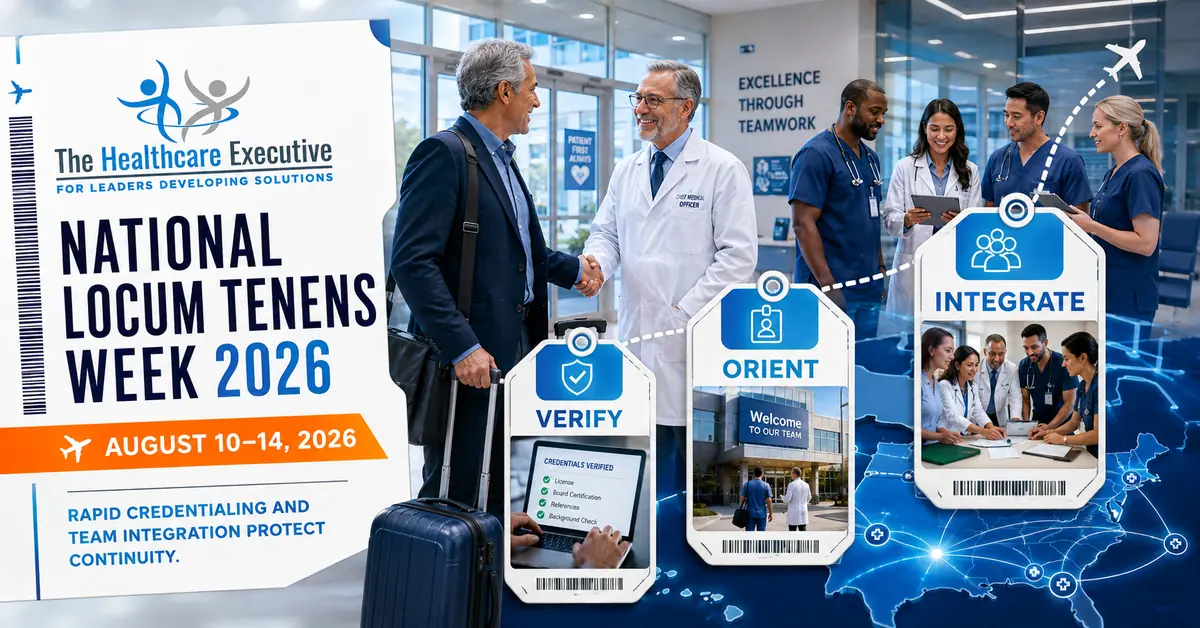
National Locum Tenens Week | August 10-14, 2026
National Locum Tenens Week 2026: Build a Reliable Temporary-Clinician Integration System
An executive evidence brief for converting temporary coverage into reliable access, prepared teams, safe handoffs, and accountable continuity before, during, and after every assignment.
The National Association of Locum Tenens Organizations identifies August 10-14 as National Locum Tenens Week 2026, the tenth annual observance. Its theme, Temporary Providers, Permanent Impact, is an invitation to recognize clinicians who provide temporary coverage and to examine the operating conditions that shape that impact.
Make the assignment temporary, not the accountability.
Locum tenens physicians can protect access when a position is vacant, a clinician is on leave, demand rises, or a community cannot recruit enough permanent staff. That contribution is real. So is the risk of treating a signed contract or approved credentialing file as the end of implementation. A temporary clinician still enters a local medication system, escalation structure, documentation environment, team culture, call schedule, transfer network, and patient population. The assignment becomes safe and useful only when those connections work.
The strongest recent direct evidence supports a systems view. A 2024 mixed-method program of research on locum doctors in English primary and secondary care found that locums were an important source of flexibility and capacity. It also concluded that adverse quality and safety consequences were more likely to arise from organizational settings and working arrangements than from locum physicians themselves.5 This distinction matters. Leaders should neither romanticize temporary coverage nor stigmatize temporary clinicians. They should design the work so that competent clinicians can succeed.
That means defining accountability across the whole assignment life cycle. Before arrival, someone must verify readiness beyond the existence of a license or privilege. On arrival, the clinician needs role clarity, local protocols, access to critical systems, and a reliable person to ask. During the assignment, the organization must monitor workload, schedule changes, escalation use, documentation completion, and team concerns. At closeout, outstanding results, referrals, messages, procedures, and follow-up obligations must transfer to a named receiving owner.
The 2026 theme, Temporary Providers, Permanent Impact, should therefore be read as an operational statement. The impact of a single shift can persist in a patient's treatment plan, a diagnostic result, a family conversation, an antibiotic course, a handoff, a transfer decision, or a follow-up appointment. Positive impact persists when the assignment expands access and leaves a clear record. Harm can persist when unfinished work becomes nobody's work.
Executives can begin with three questions. First, what access problem is the assignment intended to solve? Second, what local knowledge and support does the clinician need to solve it safely? Third, who owns continuity after the clinician leaves? If any answer is vague, the staffing plan is incomplete. The appropriate response is not to place the burden on the arriving physician to discover the system alone. It is to make local expectations, resources, and receiving responsibility visible.
Executive starting point
Approve temporary coverage only with a named operational owner, a readiness standard, a first-day integration plan, an active escalation route, and a closeout process that assigns every unresolved patient-care obligation.
Use direct locum evidence first, then apply adjacent evidence with discipline.
The recent evidence base is useful but uneven. Direct studies include a large mixed-method program, a systematic review of recruitment and retention, qualitative work on patient experience, analyses of workforce data, a prospective hospitalist cohort, a study of temporary providers in federally qualified health centers, and a narrative review of the evolving model.5689121315 These sources span different countries, specialties, organizations, measures, and time periods. They do not support one pooled effect or a universal comparison between locum and permanent physicians.
The evidence does support several leadership directions. Locum use varies substantially by organization and geography. In the English research program, overall averages concealed wide local variation, and awareness of national guidance was limited.5 English general-practice workforce data also showed that locum use was not evenly distributed across practices or areas.12 In the United States, slightly more than one-third of federally qualified health centers used temporary primary care providers during the 2013-2017 study period, with changing patterns by profession and organizational characteristics.15 Those figures describe their own settings. They should not be imported as current national benchmarks for a different organization.
Patient experience evidence adds a relational dimension. Interviews with locums, colleagues, and patients identified questions about whether temporary status was understood, how continuity was maintained, and whether the physician could know the patient and the local system.6 The study does not imply that every patient prefers a permanent physician or that a locum cannot establish trust. It shows why introductions, access to relevant history, clear follow-up, and honest explanation of the care route should be designed rather than left to chance.
Outcome evidence requires equal care. A single-center prospective cohort compared teaching internal medicine, employed hospitalist, and locum hospitalist services. Patients seen exclusively by locum hospitalists had shorter adjusted stays and lower costs in that setting, without statistically significant differences in readmission or mortality.13 The result challenges assumptions that temporary status automatically means worse care. It does not prove locum care is universally superior or equivalent. Observational assignment, one center, local staffing models, and residual confounding limit transfer.
| Evidence signal | Population and design | Decision use | Transfer boundary |
|---|---|---|---|
| Working arrangements and organizational setting can shape quality and safety more than temporary status alone.5 | Mixed-method research across English primary and secondary care | Audit assignment design, local support, access, escalation, and continuity. | Different health systems, labor models, and regulations limit direct transfer. |
| Patients and staff described visibility, local knowledge, relationships, and continuity as important features of the locum experience.6 | Qualitative interviews with 130 locums, coworkers, and patients | Design introductions, history access, communication, and receiving ownership. | Qualitative themes explain experience, not effect size or prevalence. |
| Recruitment and retention strategies include financial, career, personal, clinical-support, mentorship, and family factors.8 | Systematic review retaining 12 studies plus a separate grey-literature review | Build a whole-assignment value proposition and support model. | Small, heterogeneous literature limits confidence in any single strategy. |
| A single tertiary-center cohort did not find worse readmission or mortality for locum hospitalist care and reported shorter adjusted stays and lower costs.13 | Prospective observational cohort of 1,273 adult admissions | Challenge stigma and examine local outcomes with risk-aware definitions. | One center and observational assignment do not establish universal equivalence or superiority. |
| Team familiarity develops through communication, time, trust, respect, and social interaction.7 | Ethnographic work in four intensive care units | Create rapid introductions, shared rounds, and dependable local contacts. | Mechanism evidence is not a direct trial of locum onboarding. |
| Structured handoff tools may improve information transfer when training, workflow fit, and implementation are addressed.123 | Recent systematic and scoping reviews across nursing and perioperative settings | Standardize assignment-start, shift, transfer, and closeout communication. | Heterogeneous, often nursing-led evidence does not prove a locum-specific outcome effect. |
Adjacent evidence is valuable when the mechanism is named accurately. Physician onboarding literature can inform role clarity, social connection, system access, and early feedback.14 Interprofessional familiarity research can inform team design.711 Handoff reviews can inform the structure of transferred information.123 None should be relabeled as proof that a specific locum program will reduce harm.
Maintain a claim ledger as the article becomes a local plan. For each proposed action, record the supporting source, population, design, limitation, local question, responsible owner, and test measure. If the evidence is descriptive, do not promise an outcome. If evidence comes from another profession or setting, state the analogy. If a workflow is proposed by the organization, label it proposed. This discipline protects clinicians and patients from a well-designed graphic being mistaken for a validated standard.
Create one credential-to-care pathway with explicit gates and owners.
Credentialing and privileging are essential, but they are not the complete pathway from recruitment to reliable care. A file can be approved while badge access is missing, electronic prescribing is delayed, transfer contacts are unknown, specialty boundaries are misunderstood, or the first shift begins without a local clinical contact. The solution is not to blur legal or medical staff responsibilities. It is to connect those responsibilities to operational readiness through visible gates.
The proposed pathway begins with a defined service need. Leaders should state whether coverage protects an emergency department, fills a call gap, supports a seasonal surge, stabilizes a rural clinic, adds specialty capacity, or bridges recruitment. That purpose determines the privileges, schedule, expected volume, support services, follow-up route, and measures. An assignment requested simply as more coverage is too vague to govern.
The next gate verifies professional and contractual requirements through the organization's existing processes. The operational team should never bypass or reinterpret those controls. It should receive a clear readiness signal, know which questions remain open, and avoid scheduling clinical work before required approvals are complete. Expedited processes still need defined authority, documentation, and stop conditions.
Clinical readiness then tests whether the assignment can function in its actual setting. The clinician needs usable system access, local protocols, formulary and prescribing information, emergency and transfer routes, documentation standards, call expectations, supervision or consultation arrangements where applicable, and a clear method for reporting a safety concern. A first-day checklist that records completion is stronger than a bundle of links sent by email.
- Define the service needScope, population, site, schedule, expected volume, and access objective
- Complete required approvalsContract, verification, credentialing, privileging, licensing, and compliance controls
- Pass the readiness gateSystems, local protocols, equipment, access, schedule, contacts, and stop conditions
- Integrate the clinicianIntroductions, role clarity, first-shift support, team norms, and escalation
- Operate and monitorWorkload, documentation, safety concerns, schedule changes, and rapid support
- Close the assignmentOpen results, messages, referrals, orders, procedures, and follow-up obligations
- Learn and decidePatient continuity, clinician and team experience, exceptions, and next coverage choice
Integration is the pathway's center, not a courtesy after the real work is done. The arriving physician should know how the local team communicates, when to call, how to obtain specialty help, which decisions require additional review, and what happens when capacity is exceeded. The permanent team should know the clinician's scope, schedule, handoff expectations, and point of contact for administrative problems. This shared understanding reduces dependence on guesswork.
Monitoring should be proportionate and useful. A temporary clinician should not be subjected to a stigmatizing parallel surveillance system. The same safety culture, reporting routes, clinical standards, and learning processes should apply to everyone. Additional assignment-specific monitoring should focus on predictable integration risks, such as failed access, incomplete local orientation, schedule mismatch, lack of response from a named support person, or open work at departure.
Closeout begins before the final shift. The clinician and receiving owner need time to reconcile outstanding diagnostic results, consultations, procedures, inbox items, patient messages, medication monitoring, certificates, referrals, and return plans. The organization should distinguish work that is complete, work that has been accepted by another owner, and work that requires escalation. Simply disabling access at the end date can make unfinished obligations harder to find.
Hold a readiness huddle before access failure becomes clinical delay.
A readiness huddle is a short cross-functional review held before the assignment starts. It is not a substitute for credentialing or a meeting that reopens approved decisions. Its purpose is to confirm that independent work can begin as scheduled. The huddle brings together the operational owner, a local clinical leader, and the functions responsible for access, scheduling, and required support. The locum physician should receive the outcome and participate when unresolved clinical questions remain.

The huddle should use observable readiness criteria. Has the clinician received a final schedule with site, service, call, and reporting details? Are required privileges active for the work assigned? Do identity, network, electronic record, prescribing, imaging, dictation, messaging, and remote-access tools function? Are needed devices, workspace, transportation, housing, or travel arrangements confirmed? Has the local clinical contact accepted the role? Are high-risk local workflows, emergency routes, and transfer arrangements understood? What unresolved item would stop independent care?
A green status means the defined work can begin. An amber status means a controlled workaround exists, an owner and deadline are documented, and the workaround does not violate a required approval or create unsafe dependency. A red status means the start, site, schedule, or scope must change. Red should not be treated as failure by the clinician. It is the system doing what a gate is designed to do.
The readiness owner should communicate one version of the truth. Different departments should not tell the clinician that access is ready, the schedule is final, and privileges are complete when those statements conflict. A concise readiness record can list the item, status, evidence, owner, deadline, and decision. Sensitive credentialing material remains in its authorized system. The operational record needs the status and accountable next step, not unnecessary personal documentation.
Readiness also includes continuing learning. A Danish survey of general practitioners found multiple barriers to participation in continuing medical education, including constraints that differed across patterns of use.4 That evidence is not locum-specific and should not be generalized to every market. It does remind organizations that sending a module does not prove learning access. Required education should be relevant, available before or during paid work as appropriate, technically accessible, and limited to what the clinician needs for the assignment.
Travel and fatigue belong in the review. A schedule that assumes an overnight arrival followed by immediate complex duty may satisfy a coverage spreadsheet while creating avoidable risk. Contracting, clinical, and operational leaders should define arrival buffers, rest expectations, weather contingencies, after-hours entry, and what happens if travel disruption makes the planned start unsafe. These rules should be clear before the clinician is in transit.
Design rapid familiarity without pretending trust can be downloaded.
Temporary clinicians often enter teams whose members already share routines, shortcuts, relationships, and unspoken knowledge. The locum physician may bring substantial clinical experience while lacking local context. The team may understand the local context while knowing little about the physician's experience, preferred communication style, or decision boundaries. Reliability requires a fast way to make essential knowledge mutual.
Ethnographic research in intensive care units described familiarity as a relational product of communication, time working together, social interaction, trust, and respect.7 A randomized trial that increased familiarity between medical residents and nurses found measure-specific effects on team performance, communication, and psychological safety rather than a simple universal benefit across every outcome.11 These studies are not direct tests of locum integration. They support a practical inference: organizations can create conditions for faster working relationships, but a badge photo and email biography are not a relationship.
Interrupted access, care, or follow-through
A first-shift integration should include names and functions, not just faces. The clinician needs to know who can answer a clinical policy question, who coordinates bed flow, who resolves electronic record access, who owns scheduling, who receives safety concerns, and who takes open patient work at closeout. The local team needs to know when the locum is present, which service and locations are covered, how urgent questions should be routed, and which leader can resolve a scope or support conflict.

Use a brief operating compact. It can cover how rounds work, which channel is used for urgent versus routine communication, how orders and verbal communication are closed, when a second review is expected, how the clinician can stop unsafe work, and how the team handles disagreement. The compact should not invent special rules for locums. It should make existing expectations accessible to someone who has not accumulated local knowledge over months or years.
Handoff structure should fit the setting. A 2026 systematic review of SBAR and ISBAR-based nursing handovers reported generally favorable communication and safety signals but also mixed findings and contextual variation.1 Reviews of patient-inclusive bedside handover and postanesthesia transfer also found potential benefits alongside workload, privacy, implementation, and heterogeneity concerns.23 The executive lesson is not to mandate one acronym everywhere. It is to define the minimum information, receiving confirmation, training, workflow fit, and audit process required at each high-risk transition.
Psychological safety should be observable. Can the temporary physician say that a privilege, protocol, support arrangement, or patient volume is unclear without being labeled difficult? Can a nurse question a plan without assuming the clinician will leave before the issue matters? Can the team report that the assignment design is failing without converting the concern into a judgment about the person? Leaders should review how quickly concerns are answered and whether retaliation or stigma is reported by any team member.
Operate one temporary-clinician system across the assignment life cycle.
Many organizations split temporary coverage across recruiting, contracting, credentialing, medical staff services, clinical departments, scheduling, information technology, finance, and the staffing firm. Each function can complete its task while the assignment still fails at the seams. A reliable model does not erase functional ownership. It adds one cross-functional operating system with a visible assignment owner and common status.
Shared foundationOne accountable owner, common status, safe reporting, minimum data, defined measures, and regular learning
The assignment owner coordinates the route but does not personally approve every item. The owner knows which function holds each decision, maintains the integrated status, escalates conflicts, communicates with the clinician and department, and confirms closeout. A service chief may own clinical scope. Medical staff services may own credentialing workflow. Information technology may own system access. The assignment owner makes those dependencies visible and prevents the clinician from becoming the project manager.
A common status should be small enough to use. It can include service and site, assignment dates, readiness status, unresolved dependencies, clinical contact, operational owner, next decision, and closeout status. Do not duplicate sensitive credentialing records or personal information into a broad operational tracker. Link authorized users to the system of record and expose only what others need to know.
| Control point | Accountable function | Required evidence | Stop or escalation condition | Close signal |
|---|---|---|---|---|
| Service authorization | Executive sponsor and clinical department | Defined access need, scope, site, schedule, budget, and expected demand | Purpose, funding, supervision, or receiving service is unclear | Named department and assignment owner accept the plan |
| Professional readiness | Authorized legal, medical staff, compliance, and contracting functions | Required approvals completed under local policy | Any required approval is incomplete, expired, disputed, or mismatched to planned work | Authorized readiness signal is recorded |
| Operational readiness | Assignment owner with site operations and information technology | Working access, final schedule, equipment, location, contacts, travel, and first-day plan | No safe workaround exists for a critical dependency | Green readiness or documented approved amber plan |
| Clinical integration | Local clinical leader | Role, protocols, escalation, consultation, team communication, and documentation expectations reviewed | Scope conflict, unsupported work, or inability to obtain local help | Clinician and local contact confirm readiness to begin |
| Assignment monitoring | Clinical and operational owners | Access incidents, schedule changes, workload exceptions, safety concerns, and response times reviewed | Repeated workaround, unresolved concern, excessive demand, or missing support | Issues resolved or held by a named escalation owner |
| Closeout and continuity | Departing clinician and receiving clinical owner | Open results, messages, referrals, procedures, orders, follow-up, and documentation reconciled | Any patient-care obligation lacks an accepting owner | Receiving ownership confirmed before access ends |
The operating cadence can be light for a short, familiar repeat assignment and more intensive for a new service, remote site, high-acuity role, or clinician new to the organization. Risk tiering should be based on the work and integration complexity, not a presumption that temporary clinicians are unsafe. A returning physician with current access and strong local familiarity may need a brief change review. A new physician covering multiple sites with complex call responsibilities may need a detailed readiness and simulation process.
Close the feedback loop with the clinician and the team. Ask what information arrived too late, which local rule was hard to find, where access failed, what prevented delay, what patients needed after the assignment, and which support person was effective. Compensate required feedback time when appropriate. Report back which changes were made. Repeatedly collecting the same frustration without action teaches people that the review is ceremonial.
Protect rural and underserved access without transferring the coordination burden.
Temporary clinicians can be essential to rural emergency departments, health centers, critical-access hospitals, specialty outreach, and communities with prolonged vacancies. The access benefit should be defined in service terms: avoided closure hours, maintained appointment capacity, call coverage, reduced wait, restored specialty days, or continuity during recruitment. Counting assignment days alone cannot show whether patients reached care.
Research on rural emergency department staffing in Ontario describes how workforce distribution and practice patterns matter for health human resource planning, especially when shortages threaten temporary closure.10 U.S. federally qualified health center data show that temporary primary care provider use is common enough to deserve operational attention and varies with organizational factors.15 Neither study establishes the current need of a particular U.S. rural site. They support measuring where and why temporary coverage is used.

Rural readiness includes travel, weather, lodging, transport between sites, after-hours entry, local diagnostics, blood products, pharmacy capacity, transfer availability, telehealth reliability, and the time required to reach a higher level of care. A protocol designed at an urban referral center may assume resources that are not present. The temporary clinician needs a current, site-specific view and the ability to confirm it with local staff.
Telehealth can extend consultation and follow-up but should not be used as a decorative promise. Define which encounters are appropriate, who is present locally, how consent and privacy work, which devices and connections are reliable, what happens when the link fails, how examination or testing is arranged, and who owns follow-up. The locum physician should not discover during an urgent encounter that a promised telehealth or transfer resource is unavailable.
Patients should not carry the coordination load created by changing clinicians. Appointment reminders, referral tracking, result communication, medication monitoring, and next-contact instructions should persist across the assignment boundary. A patient who hears that the doctor was only covering should still receive a named route for questions. Leaders can connect this work with the broader access and partnership focus in the National Health Center Week 2026 executive brief while keeping the locum-specific assignment controls visible.
Recruitment and retention evidence suggests that financial incentives matter, but so do education and career factors, personal facilitators, clinical support and mentorship, and family considerations.8 An organization that repeatedly depends on temporary coverage should review why clinicians accept, extend, decline, or leave assignments. It should also distinguish a healthy flexible staffing model from chronic reliance caused by preventable workplace or recruitment conditions.
Measure access, readiness, integration, continuity, and experience as one system.
A locum scorecard should begin with purpose. If the assignment exists to prevent emergency department closure, measure covered service hours and interrupted hours. If it bridges a primary-care vacancy, measure usable appointment capacity and continuity for open results and follow-up. If it adds specialty access, measure completed visits, procedures, and accepted next steps. Cost belongs in the review, but cost without access, quality, continuity, and burden can reward an incomplete system.
Definitions are essential. For a readiness rate, define which assignments are eligible, what counts as ready, when the assessment occurs, and how approved workarounds are classified. For a handoff rate, define the required information and what counts as receiving acceptance. For continuity, define the patient-care obligations included and how long open items remain tracked. Report the numerator and denominator, not only a percentage.
Patient outcomes should be risk-aware and interpreted cautiously. The prospective hospitalist study included adjusted length of stay, cost, mortality, and readmission, but its results belong to one tertiary center and one assignment model.13 A local organization can compare its own outcomes by service model when case mix, assignment, sample size, and confounding are addressed. It should not assume that any difference is caused by temporary status.
Experience measures should include patients, locum clinicians, and permanent team members. Patient questions can address whether the clinician introduced the care arrangement clearly, knew the relevant history, explained next steps, and provided a reachable follow-up route. Clinician questions can address readiness, local support, workload, psychological safety, and closeout. Team questions can address role clarity, communication, reliability, and coordination burden. Short measures should be paired with a protected route for urgent concerns.
| Domain | Candidate measure | Definition discipline | Balancing check |
|---|---|---|---|
| Access | Planned service hours, visits, call periods, or specialty sessions delivered | Define eligible capacity, cancellation, closure, and substitution. | Review wait, transfer, unmet demand, and whether coverage reached the intended population. |
| Readiness | Assignments meeting all required readiness criteria before the first scheduled clinical duty | List required items, assessment time, approved amber conditions, and red stop rules. | Track last-minute work, delayed starts, repeated workarounds, and burden on the clinician or local team. |
| Integration | Assignments with a confirmed local clinical contact, operating compact, and first-shift check-in | Confirmation requires named people and completed contact, not an email sent. | Review response time, unresolved questions, psychological safety, and team-reported role confusion. |
| Continuity | Open patient-care obligations accepted by a receiving owner before assignment close | Define included results, messages, referrals, procedures, orders, and follow-up. | Track late discoveries, reopened items, patient callbacks, and access disabled before reconciliation. |
| Quality and safety | Locally selected clinical and process measures reviewed by service model with appropriate adjustment | Document population, exclusions, case-mix method, sample size, and analytic limits. | Avoid causal claims from descriptive differences and watch for reporting bias or stigma. |
| Experience | Patient, locum, and team reports of clarity, support, respect, and usable follow-through | Use accessible questions, confidentiality protection, and a defined action route. | Review nonresponse, small groups, retaliation concerns, and repeated issues without action. |
| Sustainability | Repeat assignments, extension decisions, permanent recruitment progress, and preventable vacancy drivers | Separate planned flexibility from unplanned dependency. | Review fatigue, travel disruption, premium cost, uncompensated coordination, and local workforce impact. |
Stratification can reveal where the system fails, but privacy and fairness come first. Useful views may include site, specialty, shift, assignment type, new versus returning clinician, weekday versus weekend, and rural versus urban service. Small numbers can identify individuals, particularly in a rare specialty or remote site. Set suppression rules, limit access, and avoid public comparisons that invite blame without supporting valid inference.
Use run charts or simple trend views only when definitions and denominators remain stable. A sudden increase in reported access incidents may indicate a failing system, or it may reflect improved reporting after a new route becomes trusted. Pair numbers with exception review. Ask what happened, what protected the patient, what made the workaround necessary, and which change would remove recurrence.
Do not create a Pareto chart from unrelated studies or anecdotal categories. The retained literature does not provide one common denominator for credentialing delay, access failure, team confusion, handoff problems, or patient experience. The qualitative fishbone in Figure 5 is intentionally unranked. A local organization may build a valid Pareto after it defines event categories, captures a sufficient period consistently, verifies data quality, and chooses a denominator that supports the question.
Report learning at the level where action can occur. Executives need a concise view of access protected, red readiness events, unresolved continuity items, recurrent failure modes, experience signals, and decisions requiring support. Departments need case-level workflow detail. Clinicians need timely feedback and correction. Patients need reliable follow-up, not an abstract dashboard.
Use 90 days to test one complete assignment route.
A 90-day improvement cycle should not attempt to redesign every contract, credentialing policy, specialty workflow, and staffing relationship at once. Select one service with recurring temporary coverage and a willing clinical owner. Choose a scope where access matters, baseline data are available, and the assignment life cycle can be observed from request through closeout. State which problems are inside the test and which require a separate legal, policy, labor, or enterprise decision.
During days 1 through 30, map the current assignment journey. Include recruiting, contracting, required approvals, scheduling, system access, first-day entry, clinical integration, escalation, monitoring, and closeout. Interview recent locum clinicians and permanent team members. Review a small set of successful starts, delayed starts, urgent workarounds, and assignments that ended with open work. Identify who currently solves problems informally and how much time that coordination consumes.
Confirm the baseline. Measure the number of assignments, service hours protected, first-duty delays, critical access failures, missing local contacts, schedule changes, unresolved issues at closeout, and available experience feedback. Use counts and denominators. Do not create precision that the source systems cannot support. If data are absent, the first outcome may be a feasible definition and collection process.
During days 31 through 60, co-design the minimum reliable pathway. Define the assignment owner, readiness criteria, green-amber-red decision rules, local clinical contact, first-shift integration, operating compact, issue route, and closeout ledger. Review the design with medical staff, legal, information security, human resources, compliance, and clinical leaders as appropriate. Simulate a new clinician, a returning clinician, a delayed flight, a failed login, an unexpected schedule change, a transfer problem, and an abnormal result that returns after the last shift.
Test the handoff with the people who do the work. A template that takes too long, duplicates documentation, or requires unavailable information will be bypassed. Define the minimum data needed for safety and continuity. Make the receiving owner's acknowledgment visible. Decide who follows up when acknowledgment does not occur. Protect patient privacy and keep sensitive employment or credentialing material out of broad operational tools.
During days 61 through 90, launch the pathway for a limited number of assignments. Hold short readiness reviews and frequent exception huddles. Resolve high-risk failures immediately. Track burden as well as completion. Ask the locum physician and local team whether the process helped, what arrived too late, and what should be removed. Review every closeout for unaccepted patient-care work before access ends.
At day 90, make an explicit decision. Continue if the pathway is usable and shows early reliability. Adapt if staff rely on workarounds, data definitions are weak, or one function carries excessive burden. Pause if required approvals, privacy protections, or clinical ownership remain unresolved. Expand only after the service confirms that the process improves readiness and continuity without adding waste or stigma.
The executive sponsor should remove barriers that frontline teams cannot resolve. Examples include funding paid onboarding time, establishing response expectations for critical access issues, protecting a clinical contact's availability, integrating scheduling and readiness status, and delaying access termination until closeout is complete. Sponsorship should be visible in these decisions, not only in observance communications.
Recognition belongs in the plan. Thank the locum clinicians who step into unfamiliar settings, the permanent teams that share local knowledge, and the staff who coordinate invisible work across systems. Then improve the conditions under which they work. Appreciation without a reliable operating model leaves the same people to compensate for preventable gaps.
Leadership commitment
Define the access purpose, prepare the assignment before the first shift, integrate the clinician into the local team, keep escalation usable, and transfer every unresolved patient-care obligation to a named owner before the assignment ends.
References
Fifteen peer-reviewed sources are ordered newest first. Findings are applied within the population, method, setting, and limitations described in this brief. The official observance name, dates, sponsor, anniversary, and 2026 theme are supported separately by the National Association of Locum Tenens Organizations.
- Rasiya, A., & Raheem, U. A. (2026). Shift transition communication among nurses: A systematic review of ISBAR and SBAR-based structured handover tools. Nursing Open, 13(7), e70655. https://doi.org/10.1002/nop2.70655
- Maher, A., Hsu, H., Ebrahim, M. E. B. M., Vukasovic, M., & Coggins, A. (2025). Implementation of bedside handover that includes patients or carers in hospital settings: A systematic review. Journal of Evaluation in Clinical Practice, 31(6), e14223. https://doi.org/10.1111/jep.14223
- Martins, F. Z., de Lima, L. B., Trevilato, D. D., Hemesath, M. P., & de Magalhaes, A. M. M. (2025). Protocols for postanesthesia care unit handoff and patient safety: A scoping review. Journal of Advanced Nursing, 81(7), 3528-3544. https://doi.org/10.1111/jan.16673
- Ibsen, H., Ahrenfeldt, L. J., Lykkegaard, J., Sondergaard, J., Svab, I., & Kjaer, N. K. (2024). Barriers for continuous medical education: A cross-sectional questionnaire study among Danish GPs. BJGP Open, 8(3). https://doi.org/10.3399/BJGPO.2023.0228
- Allen, T., Ashcroft, D., Ferguson, J., Grigoroglou, C., Kontopantelis, E., Stringer, G., & Walshe, K. (2024). The use of locum doctors in the NHS: Understanding and improving the quality and safety of care. Health and Social Care Delivery Research, 12(37), 1-266. https://doi.org/10.3310/CXMK4017
- Ferguson, J., Stringer, G., Walshe, K., Donnelly, A., Grigoroglou, C., Allen, T., Kontopantelis, E., & Ashcroft, D. M. (2024). 'None of them know me': A qualitative study of the implications of locum doctor working for patient experience. Health Expectations, 27(4), e14156. https://doi.org/10.1111/hex.14156
- Costa, D. K., Boltey, E. M., Mosley, E. A., Manojlovich, M., & Wright, N. C. (2024). Knowing your team in the intensive care unit: An ethnographic study on familiarity. Journal of Interprofessional Care, 38(4), 593-601. https://doi.org/10.1080/13561820.2024.2329968
- Ferreira, N., McKenna, O., Lamb, I. R., Campbell, A., DeMiglio, L., & Orrantia, E. (2024). Approaches to locum physician recruitment and retention: A systematic review. Human Resources for Health, 22(1), 24. https://doi.org/10.1186/s12960-024-00906-z
- Jotte, R., Gaddis, G., Lewis, L., & Schwarz, E. (2023). Locum tenens: An evolving paradigm of care. Missouri Medicine, 120(5), 333-337.
- Randle, T., Garg, A., Mago, V., Choudhury, S., Ohle, R., Strasser, R., Moore, S. W., Kernick, A., & Savage, D. W. (2023). Staffing rural emergency departments in Ontario: The who, what and where. Canadian Journal of Rural Medicine, 28(2), 73-81. https://doi.org/10.4103/cjrm.cjrm_51_22
- Iyasere, C. A., Wing, J., Martel, J. N., Healy, M. G., Park, Y. S., & Finn, K. M. (2022). Effect of increased interprofessional familiarity on team performance, communication, and psychological safety on inpatient medical teams: A randomized clinical trial. JAMA Internal Medicine, 182(11), 1190-1198. https://doi.org/10.1001/jamainternmed.2022.4373
- Grigoroglou, C., Walshe, K., Kontopantelis, E., Ferguson, J., Stringer, G., Ashcroft, D. M., & Allen, T. (2022). Locum doctor use in English general practice: Analysis of routinely collected workforce data 2017-2020. British Journal of General Practice, 72(715), e108-e117. https://doi.org/10.3399/BJGP.2021.0311
- Mustafa Ali, M. K., Sabha, M. M., Mustafa, S. K., Banifadel, M., Ghazaleh, S., Aburayyan, K. M., Ghanim, M. T., Awad, M. T., Gekonde, D. N., Ambati, A. R., Ramahi, A., Elzanaty, A. M., Nesheiwat, Z., Shastri, P. M., Al-Sarie, M., & McGready, J. (2021). Hospitalization and post-hospitalization outcomes among teaching internal medicine, employed hospitalist, and locum tenens hospitalist services in a tertiary center: A prospective cohort study. Journal of General Internal Medicine, 36(10), 3040-3051. https://doi.org/10.1007/s11606-020-06578-4
- Magana, C., Harsh, C., Baez, J., Ahmad, F., Conroy, R., Esposito, E., Junk, C., & Olayiwola, J. N. (2021). 'Thank you for not letting me crash and burn': The imperative of quality physician onboarding to foster job satisfaction, strengthen workplace culture, and advance the quadruple aim. Journal of Clinical Outcomes Management, 28(2), 57-61. https://doi.org/10.12788/jcom.0039
- Han, X., Chen, C., & Pittman, P. (2021). Use of temporary primary care providers in federally qualified health centers. Journal of Rural Health, 37(1), 61-68. https://doi.org/10.1111/jrh.12424