

· Executive Brief
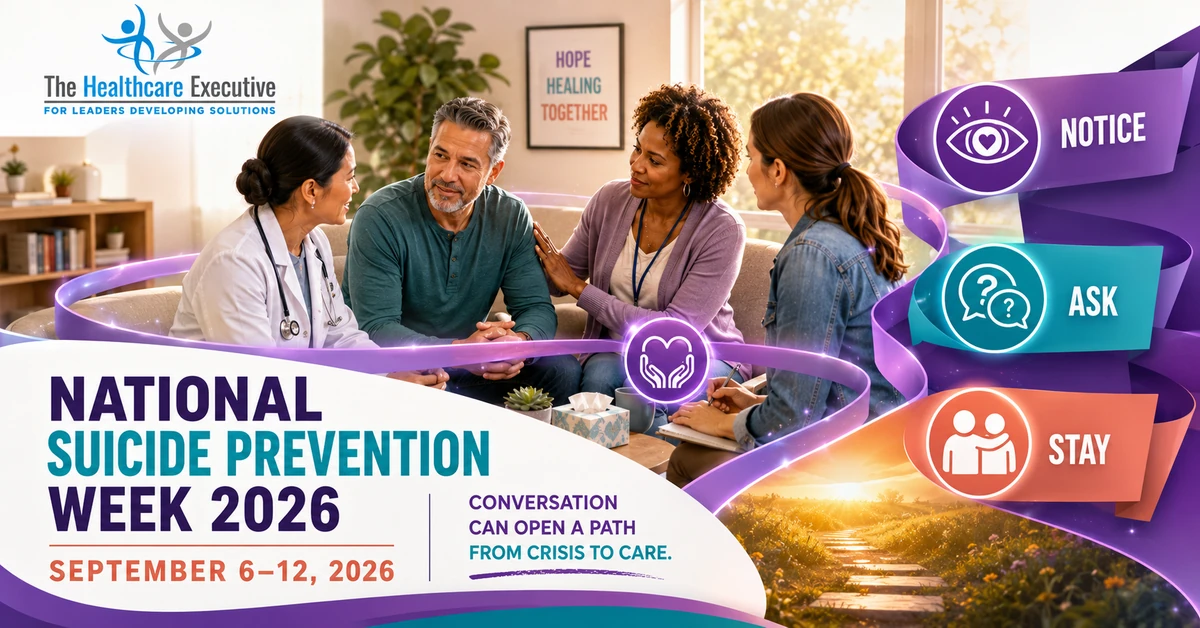
National Suicide Prevention Week 2026
Turn awareness into a clear operating route that protects dignity and keeps unresolved needs visible.

Leadership signal
Use National Suicide Prevention Week to examine the system behind the message.
Leaders can use the observance to review the experience of seeking help without making assumptions about any individual. The operating questions are practical: Is the entry point understandable, is privacy protected, does a qualified team accept the request, and does responsibility remain visible through transitions?
Start by distinguishing what is known from what the organization still needs to learn. A campaign plan, communication volume, or meeting count does not establish that a route is usable. Leaders need direct listening, clear ownership, locally defined measures, and a method for keeping exceptions visible.
Executive opening
Suicide prevention is a follow-through problem as much as a detection problem
Suicide prevention reaches health systems through emergency departments, primary care, behavioral health clinics, pharmacies, crisis lines and digital services. Each door can identify risk, and each door can also lose a person before the next step happens. Between 2016 and 2022, there were an estimated 1,100,785 suicidality-related emergency department visits among U.S. children and adolescents aged 5 to 19.[3] Visits rose significantly among young people aged 10 to 14 across every diagnosis category studied.[3] Suicide attempt visits also rose significantly among adolescents aged 15 to 19.[3]
Recent evidence shows that the operating system around a screen matters as much as the screen itself. In one safety-net health system, suicide risk was identified in 0.7% of encounters before universal screening and 3.5% after it, across 5,219,858 encounters.[1] Identification creates new work. Someone must complete a safety plan, arrange follow-up and keep the person connected. In the Veterans Health Administration, 44.2% of patients with recent suicidal ideation or behavior completed an initial safety plan within 30 days of screening positive.[2]
Those findings frame the executive problem for National Suicide Prevention Week. Detection can scale quickly once screening is universal, but follow-through depends on staffing, workflow, technology and trust. Gaps between those steps rarely appear on a single dashboard. They sit between departments, shifts and organizations, where no one may own the next contact. A screen that is completed but never followed up can look like success on a compliance report.
The sections that follow summarize recent peer-reviewed evidence on burden, screening, safety planning, crisis lines, caring contacts, telehealth capacity, equity and workforce. They add a factual base to the executive guidance already on this page. They are written for system design and governance decisions, not for individual clinical care. Each section notes the limits of its evidence, so leaders can judge how far a finding travels to their own setting.
Current evidence
What the research says about burden and identification
The emergency department remains a central point of contact for young people in crisis. In national data on suicidality-related visits by children and adolescents, female patients accounted for 74.7% of visits.[3] Depression (45.3%) and anxiety (21.6%) were the most common co-occurring conditions.[3] The authors call for earlier community-based mental health interventions and stronger follow-up care after emergency visits.[3]
Universal screening changes how much risk a system sees. In the safety-net study, the adjusted odds of identifying suicide risk were 5.8 times higher after universal screening began.[1] Relative increases were greatest among older adults, patients with charity or self-pay status, Black patients and outpatient encounters.[1] The authors describe universal screening as a scalable strategy for equitable detection.[1] Identification is a process measure here, and the study did not report what happened after a positive screen.[1]
Screening practice is still uneven among clinicians. In a national survey of 5,003 pediatricians, 36.7% reported using standardized suicide risk screening.[4] Emergency medicine physicians were more likely than general pediatricians to use standardized tools, with an adjusted odds ratio of 2.83.[4] Knowledge of professional recommendations was also associated with screening, with an adjusted odds ratio of 1.53.[4] Among pediatricians who screened, 73.1% used a universal approach for children aged 12 years and older.[4]
How a screen is scored also matters. In a multisite emergency department study of 6,411 adolescents, those who chose not to answer screening questions had intermediate risk of later suicidal ideation.[5] Their adjusted odds ratio was 2.14, compared with 4.35 for adolescents who screened positive.[5] For later suicide attempts, the nonresponse estimate was 2.82, with a confidence interval that crossed one.[5] The authors caution that clinicians should not default to treating nonresponse as a negative screen.[5] That is a design question for screening logic, alert rules and quality measures, not only a clinical one.
Risk ratings gathered outside clinical settings also carry signal. Among Veterans Crisis Line contacts in 2020, veterans rated at high or moderate risk had higher odds of later suicidal self-directed violence than those rated low risk.[14] The odds ratio over the following year was 4.12.[14] Risk rating and prior attempt history combinations were each independently associated with that outcome.[14] For executives, crisis line ratings are therefore useful information to carry into the next handoff, not a closed record.
Figure 1
Each step of the suicide prevention pathway reaches only part of its population
Percent of the reported study population completing or showing a prevention pathway step, as reported in each study. Values are copied from the cited studies [2], [4], [9], [13]; none is estimated.
Data note. These values come from different studies, populations, settings and years, so this is an indirect comparison; the bars show where the pathway leaks, not how one step performs relative to another.
Limitation. Each value has its own denominator; the screening value is self-reported, the safety plan values come from health records and a small cohort, and the referral value comes from written hypothetical cases.
Figure data (4 rows)
| Measure | Value | Population, setting and year as reported | Source |
|---|---|---|---|
| Pediatricians reporting standardized suicide risk screening | 36.7% | 5,003 U.S. pediatricians in a 2023 national certification survey | [4] |
| Completed an initial safety plan within 30 days of a positive screen | 44.2% | 86,913 Veterans Health Administration patients with recent suicidal ideation or behavior, December 2021 to February 2023 | [2] |
| Still had their personalized safety plan one month later | 68.8% | Patients still participating in a Paris cohort after hospitalization for a suicide attempt, 2022 to 2023 | [9] |
| Pharmacy staff making 988 Lifeline referrals after training | 74% | Community pharmacy staff in a cluster randomized trial, written cases immediately after training (49% at baseline) | [13] |

Continuum of care
Safety planning, follow-up and caring contacts across transitions
Safety planning is the most widely adopted bridge between identification and follow-up. In a national study of 86,913 veterans with recent suicidal ideation or behavior, 69.4% were offered a safety plan.[2] Beyond the 44.2% who completed a new plan, another 7.2% reviewed a previously completed plan and made no changes.[2] Among patients covered by a policy mandate, 97.9% completed the plan within the required time frame.[2] Most plans were completed in outpatient mental health settings (52.4%) or inpatient and residential settings (27.0%).[2] That distribution raises a practical question about settings outside specialty mental health care.
Completing a plan does not guarantee the next visit. A mandated emergency department safety planning initiative in Veterans Affairs was studied across 14,743 first visits by patients screened as at risk, including 7,024 discharged home.[15] Safety planning was associated with 26% lower odds of death from any cause within one year.[15] It was not associated with higher attendance at mental health encounters within 30 days.[15] The follow-up appointment therefore needs its own owner and its own measure.
Patients also need to keep and use the plan. In a Paris cohort of patients hospitalized after a suicide attempt, 85.4% of those still participating remembered their safety plan one month later, and 68.8% still had it.[9] At six months, 25.0% of the 40 patients contacted had made another attempt, and 70.0% of them had sought emergency care.[9] The small sample limits generalization, but the authors support revisiting prevention strategies throughout follow-up.[9]
Low-cost contacts can extend continuity after a crisis. The Veterans Crisis Line caring letters program cost a total of $1,624,190 from January 2020 to May 2022.[8] That equaled about $10.94 per veteran and $1.22 per veteran-letter, and the forecast cost to sustain it stayed below $1.40 under every usage scenario.[8] Executives can use those figures when deciding whether to fund caring contacts as routine work rather than as a time-limited project.
More intensive follow-up can also be organized as a pathway. In a trial of 301 youth, stratified stepped care added to Zero Suicide quality improvement did not significantly change 12-month suicide attempt rates (8.09% versus 9.59%).[11] It was associated with less total self-harm, with a relative risk of 0.46, and with less depression.[11] Within the stepped-care arm, 90% of youth were assigned a care level, and 96% received care at their original assigned level.[11]
Figure 3
Why the pathway breaks
People
- Frontline staff unsure how to ask directly or refer
- Too few clinicians trained in suicide-specific therapies
- Role uncertainty when digital alerts arrive
Process
- Screening applied by clinician discretion rather than universally
- Nonresponse treated as a negative screen
- No owner for the first follow-up contact after discharge
Technology
- Digital screening results not integrated with the record
- Alert volume exceeds response capacity
- Crisis line contacts not routed to local follow-up teams
Environment
- Rural distance from suicide-specific treatment
- Emergency departments without behavioral health consultation
- Digital divide for remote screening
Policy
- Safety planning mandates limited to some settings
- Caring contacts not funded as routine work
- Crisis response protocols not defined for after-hours alerts
Measurement
- Identification counted without follow-up completion
- No review of completion by group or department
- Reattempt and return visits not linked to the original screen
Unranked qualitative cause-and-effect diagram for the outcome in the box: People identified as at risk for suicide do not complete a safety plan or reach follow-up care after the first contact Causes are assembled from the cited literature [1], [2], [4], [5], [6], [7], [12], [13], [15]; categories are not weighted and their order carries no meaning.
Data note. Qualitative; no frequencies are implied.
Limitation. Causes drawn from published studies may not all apply locally; validate them with frontline teams.
Figure data (6 rows)
| Category | Causes drawn from the cited literature |
|---|---|
| People | Frontline staff unsure how to ask directly or refer; Too few clinicians trained in suicide-specific therapies; Role uncertainty when digital alerts arrive |
| Process | Screening applied by clinician discretion rather than universally; Nonresponse treated as a negative screen; No owner for the first follow-up contact after discharge |
| Technology | Digital screening results not integrated with the record; Alert volume exceeds response capacity; Crisis line contacts not routed to local follow-up teams |
| Environment | Rural distance from suicide-specific treatment; Emergency departments without behavioral health consultation; Digital divide for remote screening |
| Policy | Safety planning mandates limited to some settings; Caring contacts not funded as routine work; Crisis response protocols not defined for after-hours alerts |
| Measurement | Identification counted without follow-up completion; No review of completion by group or department; Reattempt and return visits not linked to the original screen |
Access
Telehealth, centralized consultation and digital front doors
Suicide-specific psychotherapies are difficult to reach, especially in rural areas. The Veterans Affairs Suicide Prevention 2.0 Clinical Telehealth program delivers four of these therapies by telehealth through 18 regional hubs.[12] Its primary referral criterion is a recent history of suicidal self-directed violence.[12] By April 2023, services were available in 139 of 139 Veterans Affairs health care systems.[12] By the end of September 2024, the program had received 23,628 referrals nationwide, and referral rates rose year over year.[12]
Centralized models can extend scarce expertise into emergency departments. One health system launched a telehealth safety planning and follow-up service for suicidal patients across eight hospitals.[7] Implementation over 14 months required 1,824 staff hours and cost $163,329, or $20,416 per emergency department.[7] Most resources (84%) supported one-time centralized work, such as electronic referral and system-wide workflow design.[7] Only 16% supported site-specific activities such as local workflow adaptation and go-live meetings.[7] The authors describe the workforce investment as substantial but time-limited.[7]
Digital channels widen access but add new operating demands. Nine behavioral health organizations that adopted remote, asynchronous suicide screening reported challenges in operational, technical, clinical and systemic domains.[6] Operational challenges centered on workflow integration, staff training and protocol development.[6] Technical challenges included record integration, digital divide concerns and alert volume.[6] Systemic challenges included resource constraints, crisis response protocols and staff capacity.[6]
Crisis lines are part of the same access system. Risk information collected during a crisis call is only useful if the receiving service can act on it. The Veterans Crisis Line findings show that call-based ratings identify people at higher risk over the following year.[14] Leaders should therefore ask how crisis line contacts reach local follow-up teams, and how quickly.
Across these programs, access depends on whether a referral reaches a person who can act within a defined time. Telehealth and digital screening widen the front door. They work only when the receiving team has capacity, a protocol and clear escalation for positive results that arrive outside clinic hours. Executives should treat alert routing and after-hours response as access design, not as an information technology detail. A positive screen that waits in an inbox overnight is an access failure, even when the screening rate looks strong.
Executive guidance · System route
Connect the week to an accountable system route.
Use this route as a discussion framework. Replace each stage with the organization’s approved process, qualified roles, current service capacity, and applicable requirements. Do not infer a clinical protocol from the observance title.
The route at a glance
- Make access clear
- Protect privacy
- Protect respectful continuity
- Hold the transition
- Learn without stigma
Reliability rule: Every stage needs a named owner, an observable status, an approved escalation path, and a defined signal that shows whether responsibility moved or remained unresolved.
Make access clear
Use respectful, plain-language instructions that identify approved contact options and what a person can expect next.
Protect privacy
Review channels, spaces, documentation, and role access against organizational policy and applicable requirements.
Protect respectful continuity
Align clear access, privacy, qualified response, approved escalation, and transition ownership without making assumptions about any person.
Hold the transition
Confirm acceptance when responsibility moves, and use approved escalation when the next owner is unavailable.
Learn without stigma
Review delays, drop-offs, repeat contacts, and experience feedback to improve the system rather than judge the person.
Figure 2
The system route as one flow
The five stages of the system route described in this brief, drawn as one flow with a learning loop back to the start. The stages are the page’s original executive guidance, not a clinical protocol.
Data note. Shows sequence and handoffs only; it carries no counts or rates.
Limitation. Local processes may add, merge or reorder stages under organizational policy.
Figure data (5 rows)
| Stage | What the stage requires |
|---|---|
| Make access clear | Use respectful, plain-language instructions that identify approved contact options and what a person can expect next. |
| Protect privacy | Review channels, spaces, documentation, and role access against organizational policy and applicable requirements. |
| Protect respectful continuity | Align clear access, privacy, qualified response, approved escalation, and transition ownership without making assumptions about any person. |
| Hold the transition | Confirm acceptance when responsibility moves, and use approved escalation when the next owner is unavailable. |
| Learn without stigma | Review delays, drop-offs, repeat contacts, and experience feedback to improve the system rather than judge the person. |
Equity and trust
Who is asked, who is reached and who keeps using support
Equity in suicide prevention starts with who is asked and who is identified. After universal screening began in the safety-net system, the largest relative increases in identification occurred among older adults, Black patients and encounters with charity or self-pay status.[1] Outpatient encounters also showed some of the largest relative gains.[1] For executives, the practical lesson is consistency: the same question, asked the same way, at every eligible encounter.
Completion also varies by group, and not always in expected directions. In the Veterans Health Administration, younger, middle-aged, Black, female, Hispanic or Latine, and urban-residing patients were more likely to complete a safety plan.[2] Patients at higher suicide risk were also more likely to complete one.[2] Leaders can use such patterns to check which groups in their own population are reached less often. Because most plans were completed in mental health settings, patients who rely mainly on primary or emergency care deserve explicit review.
Some populations need added support to keep using a plan. Emerging adult sexual and gender minorities experience disproportionately high rates of suicide.[10] In a pilot trial with 64 participants, safety planning was combined with a mobile application and peer mentorship.[10] At two months, monthly plan use was 39% in that group, compared with 15% for safety planning alone.[10] The program was highly acceptable, although a fully powered effectiveness trial is still needed.[10] Both study groups showed reductions in suicidal ideation over time.[10]
Equity applies to the risk tools used by crisis services as well. In 2020 Veterans Crisis Line data, the link between risk ratings, prior attempts and later self-directed violence did not differ by gender (p = 0.6247).[14] The authors concluded that risk assessment was relatively stable across women and men.[14] The authors still describe gender-sensitive prevention programming for women veterans as crucial.[14]
Variation across clinical settings is another equity issue. Standardized screening varied significantly across pediatric subspecialties, as did the tools that pediatricians used.[4] A child who sees a subspecialist rather than a general pediatrician may meet a different screening process. Reviewing screening reliability by department, not only by population, helps leaders find those gaps. Geography matters too. Suicide-specific psychotherapies are even harder to access in rural areas, according to the authors of the national telehealth program.[12]

Human infrastructure
Training, hiring and retaining the people who carry the pathway
Suicide prevention depends on many staff who are not behavioral health specialists. In a cluster randomized trial, 162 community pharmacy staff were randomized to two versions of gatekeeper training, and 120 provided usable baseline data.[13] On written cases, the share of participants who asked directly about suicide rose from 7% before training to 71% after it.[13] The share who made referrals to the 988 Lifeline rose from 49% to 74%.[13]
Training reach needs tracking over time. Retention in the pharmacy trial was 73% after training and 58% at one-month follow-up.[13] Gains in knowledge, self-efficacy and preparedness were maintained at one month among those who responded.[13] Interactive video cases did not add measurable gains over the standard training, and the two groups did not differ significantly.[13]
Specialist capacity has to be hired, trained and kept. The Veterans Affairs telehealth program hired 137 therapists and retained 78.10% in their roles.[12] All of its therapists were trained in two or more suicide-specific psychotherapies.[12] Hiring, training and retention were each tracked as implementation measures rather than assumed. The program also accessed new funding, provided consultation and created new clinical teams as implementation strategies.[12] Matching care to risk requires similar depth. In the stepped-care trial, youth were triaged to suicide-specific treatments using care-stratification algorithms, allowing more intense care at higher risk levels.[11]
Implementation itself consumes skilled time. In the emergency department consultation service, the clinical consultant, implementation lead and center clinicians accounted for 71% of implementation costs.[7] Clinician consultation, workflow development and training made up three-quarters of total costs, and preparation activities made up 62.5%.[7] Health system leaders and clinical staff also carried additional opportunity costs.[7] Those roles are often shared across many priorities. Protected time for consultants and implementation leads is therefore a real budget line, not an assumption.
Staff attitudes change as programs mature. In organizations at an advanced stage of digital screening, 48% of providers expressed very supportive sentiments and 32% moderately supportive sentiments.[6] Earlier stages were marked by anxiety and role uncertainty.[6] Planning for that early period, including role clarity and alert workflows, belongs in workforce design. Executives should expect that period and fund coaching through it rather than reading early hesitation as failure.
Executive guidance · Operating dashboard
Review reliability, not campaign activity alone.
Do not publish a number until the organization defines its numerator, denominator where relevant, owner, source system, exclusions, review cadence, and limits. The candidates below are management prompts, not benchmarks or reported results.
Four operating signals
Each signal pairs an executive question with one candidate local measure, set out below.
Executive guidance · Signal
Access clarity
Can people understand where to begin and what will happen after contact?
- Candidate local measure
- Locally defined contact, routing, response, and repeat-contact signals.
Executive guidance · Signal
Privacy reliability
Do channels, roles, and spaces support organizational privacy expectations?
- Candidate local measure
- Reported privacy barriers, process exceptions, training needs, and corrective-action status.
Executive guidance · Signal
Respectful continuity
Can people reach qualified support and remain connected through transitions without stigma or unowned work?
- Candidate local measure
- Locally defined access barriers, repeat contacts, unaccepted transfers, escalation, and experience feedback.
Executive guidance · Signal
Experience and learning
Can people and staff identify barriers without stigma or futility?
- Candidate local measure
- Feedback themes, assigned improvements, response status, and verified changes.
Figure 4
The operating system behind the dashboard
The four operating signals from this brief’s dashboard, each tied to the candidate owner named in the executive scorecard, around one accountable route. Drawn from the page’s original executive guidance.
Data note. Structural diagram; no measured values.
Limitation. Owners are candidates to be confirmed locally.
Figure data (4 rows)
| Operating signal | Candidate owner |
|---|---|
| Access clarity | Executive sponsor and operational lead |
| Privacy reliability | Operational owner and participating teams |
| Respectful continuity | Sending and receiving owners |
| Experience and learning | Improvement owner and executive sponsor |
Executive guidance · Handoff workflow
Transfer responsibility with acknowledgment and visibility.
A handoff is reliable only when the sending party knows who is expected to receive the work, the receiving party acknowledges responsibility, and any unresolved exception remains visible. Local policy and qualified judgment control the actual process.
How responsibility moves
Lane A
From message to accepted ownership
- Confirm the approved message and intended audience.
- Publish the actual entry point and receiving role.
- Acknowledge receipt using the locally approved method.
- Escalate when ownership or response remains unclear.
Lane B
From accepted ownership to verified follow-through
- Record the next accountable owner and visible status.
- Use the approved private channel, name the qualified receiver, and preserve visibility under local escalation policy.
- Keep unresolved work visible across boundaries.
- Confirm closure or document the continuing exception.
Executive guidance · Executive scorecard
Connect operating signals to accountable executive review.
The scorecard keeps review focused on decisions. Leaders should set definitions locally, examine variation without overclaiming cause, and pair quantitative signals with the experience of people who use and operate the route.
Who reviews what
- Executive sponsor and operational lead
- Operational owner and participating teams
- Sending and receiving owners
- Improvement owner and executive sponsor
Candidate owners named in the scorecard, confirmed locally.
| Operating signal | Executive question | Candidate owner | Suggested review point |
|---|---|---|---|
| Access clarity | Can people understand where to begin and what will happen after contact? | Executive sponsor and operational lead | At campaign launch and close |
| Privacy reliability | Do channels, roles, and spaces support organizational privacy expectations? | Operational owner and participating teams | At a locally defined cadence |
| Respectful continuity | Can people reach qualified support and remain connected through transitions without stigma or unowned work? | Sending and receiving owners | At a locally defined cadence |
| Experience and learning | Can people and staff identify barriers without stigma or futility? | Improvement owner and executive sponsor | Until action is verified |
Figure 5
Control points for a reliable suicide prevention pathway
| Control point | Risk if missing | Owner | Evidence of control |
|---|---|---|---|
| Universal screening at every eligible encounter | Risk goes unidentified in groups and departments that screen selectively | Chief medical officer with department leaders | Screening rate and identification rate by department and population |
| Defined handling of nonresponse and declined screens | People who do not answer are treated as low risk | Behavioral health clinical lead | Written rule in screening logic and audit of nonresponse follow-up |
| Safety plan completion within a set time | Positive screens close without a plan | Service line operational owner | Share of positive screens with a completed plan by setting |
| Owned first follow-up after emergency or inpatient care | Plan is completed but no follow-up visit occurs | Transitions of care lead | Follow-up contact completion and time to contact |
| Routing of crisis line and digital alerts | Alerts arrive outside hours with no responder | Behavioral health access director | Alert response time log and after-hours escalation tests |
| Caring contacts after a crisis | People lose connection after discharge or a crisis call | Population health or crisis services lead | Contacts sent per eligible person and cost per contact |
| Trained and retained frontline and specialist workforce | Staff cannot ask, refer or deliver suicide-specific care | Chief nursing officer and human resources | Training completion, follow-up retention and specialist vacancies |
Control points derived from the cited evidence [2], [5], [6], [8], [12], [13], [15] and this brief’s executive guidance.
Data note. Each row is a control to verify, not a measured result.
Limitation. Owners and evidence of control must follow local policy and applicable requirements.
Public communication
Messages that match what the system can deliver
Public communication during the week should match what the system can deliver. Messages that invite people to ask for help create demand at crisis lines, emergency departments, pharmacies and clinics. The evidence on this page shows that the step after the first contact is where many people are lost. Communication plans should therefore be reviewed alongside follow-up capacity, not separately. When a campaign drives calls that the receiving service cannot answer promptly, it can erode the trust it was meant to build.
Messages of support after a crisis are a form of communication with measurable value. The caring letters program mailed messages of support to veterans who had contacted the crisis line.[8] It was associated with increased use of mental health services among recipients.[8] The authors suggest its relatively low per-veteran cost means such contact may be feasible to sustain in comparable settings.[8]
Patients judge the system by how it treats them. In the stepped-care trial, youth receiving the stratified intervention reported greater satisfaction with care than those receiving quality improvement alone.[11] Within that arm, 95% received at least one intervention contact.[11] In the Paris cohort, most patients still remembered their safety plan one month after it was completed.[9] Of those patients, 68.8% still had the written plan, a simple and measurable sign of engagement.[9]
Screening communication must also respect people who are not ready to answer. Youth who chose nonresponse were more likely than negative screeners to receive later mental health care, with an unadjusted odds ratio of 3.42.[5] Positive screeners had an unadjusted odds ratio of 9.88 for the same outcome.[5] Scripts, forms and digital tools should explain why questions are asked and what happens next, without treating silence as safety.
Frontline staff are also communicators. After training, pharmacy staff were more likely to ask directly about suicide and to refer to the crisis line in written cases.[13] Clinicians in digital screening programs raised concerns about therapeutic rapport.[6] Staff and community messages should use plain language, name the approved next step and describe what a person can expect after reaching out. Messages about the 988 Lifeline should be paired with clear local follow-up options, so that a call is not the only step offered.

Executive guidance · 90-day plan
Use 90 days to correct one visible operating barrier.
The time boxes below are a management framework, not a clinical timeline. Adjust them to risk, scope, governance, resources, stakeholder participation, and applicable review requirements.
Ninety days, three moves
- Days 1–30See the current route
- Days 31–60Build the reliable path
- Days 61–90Make the change visible
Days 1–30 · Listen and map
See the current route
- Name an executive sponsor and an operational owner.
- Listen to people using the route and representative frontline teams.
- Map how National Suicide Prevention Week communications connect to real entry points, owners, transitions, and escalation.
- Select one recurring barrier that the organization can responsibly address.
Days 31–60 · Design and test
Build the reliable path
- Define the trigger, receiving owner, required information, acknowledgment, escalation, and closure signal.
- Validate the design with every sending and receiving team involved.
- Test one respectful access-to-qualified-support handoff and remove a verified privacy, clarity, or ownership barrier.
- Test the route in more than one representative setting or operating period where practical.
Days 61–90 · Implement and verify
Make the change visible
- Launch the redesigned route with a small set of locally defined measures.
- Review unresolved work and recurring friction using a learning approach.
- Correct implementation barriers and record who owns each remaining dependency.
- Report what changed, what evidence was reviewed, and what still requires live oversight.
Figure 6
The 90-day plan on one timeline
The 90-day plan from this brief drawn as a timeline: each action sits in the 30-day window the plan assigns it. The full wording of each action is in the figure data and in the plan above.
Data note. Time boxes are a management framework, not a clinical timeline.
Limitation. Durations are uniform 30-day windows; real tasks may span windows.
Figure data (12 rows)
| Window | Action |
|---|---|
| Days 1–30 · Listen and map | Name an executive sponsor and an operational owner. |
| Days 1–30 · Listen and map | Listen to people using the route and representative frontline teams. |
| Days 1–30 · Listen and map | Map how National Suicide Prevention Week communications connect to real entry points, owners, transitions, and escalation. |
| Days 1–30 · Listen and map | Select one recurring barrier that the organization can responsibly address. |
| Days 31–60 · Design and test | Define the trigger, receiving owner, required information, acknowledgment, escalation, and closure signal. |
| Days 31–60 · Design and test | Validate the design with every sending and receiving team involved. |
| Days 31–60 · Design and test | Test one respectful access-to-qualified-support handoff and remove a verified privacy, clarity, or ownership barrier. |
| Days 31–60 · Design and test | Test the route in more than one representative setting or operating period where practical. |
| Days 61–90 · Implement and verify | Launch the redesigned route with a small set of locally defined measures. |
| Days 61–90 · Implement and verify | Review unresolved work and recurring friction using a learning approach. |
| Days 61–90 · Implement and verify | Correct implementation barriers and record who owns each remaining dependency. |
| Days 61–90 · Implement and verify | Report what changed, what evidence was reviewed, and what still requires live oversight. |
Executive guidance · Leadership close
Pair recognition with a system people can trust.
Recognition matters. It becomes durable when leaders also listen, clarify the route, support the people operating it, close an identified gap, and report the result without claiming more than the evidence supports.
Leadership commitment
Connect the message to one usable, measured, and sustained operating change.
Executive action kit · Week observance
Turn National Suicide Prevention Week into accountable action.
Turn awareness into a clear operating route that protects dignity and keeps unresolved needs visible.
Leadership focus
Use this observance to examine psychological safety, timely connection, privacy, and continuity. Select one verified barrier, assign an accountable owner, and carry the improvement beyond the campaign window.
Workforce lens
Ask whether staffing, role clarity, training, tools, workload, and escalation support the people operating the support, referral, privacy, escalation, and continuity pathway.
Patient and community lens
Make the approved first step clear. Test whether a person can move from information to an acknowledged next action without navigating conflicting instructions.
Equity and access lens
Review stigma, language, cultural safety, disability access, geography, cost, and digital barriers without assuming the same experience for every person.
Five-minute briefing
Inspect the operating sequence
Listen with people seeking support, behavioral health teams, emergency pathways, primary care, and community partners. Find one stigma, unclear ownership, a failed connection, or a privacy concern, then test the locally approved route from entry through acknowledged follow-through.
- Make access clear
- Protect privacy
- Protect respectful continuity
- Hold the transition
- Learn without stigma
Leadership actions for this week
- Name an executive sponsor and frontline operating owner.
- Ask people using and operating the pathway where ownership becomes unclear.
- Test one representative route from first question to acknowledged next step.
- Select one barrier that can be corrected without overstating the evidence.
- Set a review date and define how completion will be verified.
Candidate measures
Define every numerator, denominator where relevant, owner, data source, exclusions, cadence, and limitation locally. These are management prompts, not external benchmarks.
- Locally defined contact, routing, response, and repeat-contact signals.
- Reported privacy barriers, process exceptions, training needs, and corrective-action status.
- Locally defined access barriers, repeat contacts, unaccepted transfers, escalation, and experience feedback.
Department readiness checklist
- The public and staff entry points match the actual approved process.
- A specific role accepts each request, referral, or escalation.
- Handoffs include acknowledgment and a visible unresolved state.
- Language, disability, digital, transportation, and trust barriers receive explicit review.
- Communications do not introduce unsupported themes, statistics, or clinical advice.
- A named leader will review what changed after the observance.
Intended audiences
- Executive and Operational Leaders
- Public Health and Community Partners
- Patient Experience and Access Leaders
Staff communication template
During National Suicide Prevention Week, our organization will connect awareness with a practical review of the support, referral, privacy, escalation, and continuity pathway. Use approved information, identify the correct entry point, confirm ownership when work moves, protect privacy, and escalate unresolved barriers through local channels.
Community communication template
National Suicide Prevention Week is an opportunity to share trustworthy information and make the next step easier to find. Use our approved channels for information and support. If a request changes hands, our goal is to keep ownership and follow-through visible.
Measurement worksheet
- Signal
- What observable condition will show whether the route works?
- Definition
- What is included, excluded, and counted?
- Owner
- Who reviews the signal and acts on exceptions?
- Cadence
- When will leaders review it?
- Equity check
- Which differences require protected, locally appropriate review?
- Closure
- What evidence will confirm the improvement was completed?
- Editorial review
- Completed
- Source records
- 2 listed under Authoritative resources
- Review standard
- Sourced facts remain separated from original executive guidance
- Clinical boundary
- No new statistical or clinical claim was added by this action kit
Sources and content boundary
Authoritative resources
Use note: All operating models, measures, scorecard questions, and action steps are original executive guidance. This article supports leadership planning and education. It does not replace clinical judgment, emergency procedures, legal advice, professional standards, organizational policy, or applicable federal, state, and local requirements.
Peer-reviewed references
References
Fifteen peer-reviewed sources, newest first. Each was individually verified through authenticated academic research databases. Bracketed numbers in the text link here; the original executive guidance on this page carries no citations because it is guidance, not a sourced claim. Sources last checked in those databases on .
- 1.Childs B, Hudgens O, Livingstone J, Treacher A, Naeem J, Khan F, et al. Universal Suicide Risk Screening in a Safety-Net Health System: Findings From 5.2 Million Encounters. Psychiatric Services. 2026:appi.ps.20260003. https://doi.org/10.1176/appi.ps.20260003
- 2.Khazanov GK, Cidav T, Wilson M, Roberts CB, Barry C, McKay JR, et al. National Implementation of Suicide Safety Planning in the Veterans Health Administration. Psychiatric Services. 2026;77(6):507-515. https://doi.org/10.1176/appi.ps.20240571
- 3.Coskun AK, Palakollu MK, Dilsaver DB, Siva R, Horan M, Tampi RR. Suicidality-Related Emergency Department Visits Among US Children and Adolescents, 2016-2022. JAACAP Open. 2026;4(5):823-832. https://doi.org/10.1016/j.jaacop.2026.06.006
- 4.Huttle A, Gasper G, Green CM, Leslie LK, Leyenaar JK. Variation in Suicide Risk Screening by Pediatricians Across Subspecialties. Pediatrics. 2026;157(5):e2025071208. https://doi.org/10.1542/peds.2025-071208
- 5.Boyd SD, King CA, Brent D, Casper TC, Bridge JA, Webb M, et al. Suicide Risk Among Youth Who Choose “No Response” on Emergency Department Suicide Risk Screenings. Suicide and Life-Threatening Behavior. 2026;56(3):e70102. https://doi.org/10.1111/sltb.70102
- 6.Beverly B, Miclette M, Kaufman H, Holley D, Brooks A, Zaubler T. Implementing Digital Suicide Risk Screening in Behavioral Health: a Mixed-methods Study of Organizational Adaptation. Community Mental Health Journal. 2026. https://doi.org/10.1007/s10597-026-01647-0
- 7.Nezir F, Reilly ME, Steinberg M, Green KL, Jager-Hyman S, Wolk CB, et al. Workforce Investments in Telehealth Suicide Prevention in Emergency Departments: Implementation Costs of a Centralized Behavioral Health Consultation Service. The Journal of Behavioral Health Services & Research. 2026. https://doi.org/10.1007/s11414-026-10006-6
- 8.Shen YJ, Auty SG, Strombotne K, Figueroa SM, Manchester C, Lauver M, et al. Budget Impact Analysis of the Veterans Crisis Line Caring Letters Project. Administration and Policy in Mental Health and Mental Health Services Research. 2026. https://doi.org/10.1007/s10488-026-01528-4
- 9.Mauries S, Perozziello A, Zehani F, Yung S, Lengereau A, Borand R, et al. Six-month outcomes in a French cohort of patients receiving a safety planning type intervention after suicide attempt. Scientific Reports. 2026;16(1):24460. https://doi.org/10.1038/s41598-026-51566-z
- 10.Brown LA, Tran JT, Gallop R, Webster JL, Wolfe JR, Kautz MM, et al. Increasing Safety Plan Use and Reducing Suicidal Ideation Among Emerging Adults: A Pilot Randomized Trial of the STARS Intervention. Suicide and Life-Threatening Behavior. 2026;56(2):e70101. https://doi.org/10.1111/sltb.70101
- 11.Asarnow JR, Clarke GN, Firemark AJ, Bedics J, Miranda J, Zhang L, et al. Stratified Stepped-Care for Reducing Suicide Attempts and Self-Harm in Youth: A Randomized Clinical Trial. Journal of the American Academy of Child & Adolescent Psychiatry. 2026;65(9):1133-1145. https://doi.org/10.1016/j.jaac.2025.12.008
- 12.Landes SJ, Walker JA, Bekman NM, Kumpula MJ, Lhermitte SL, Hoff RA, et al. Implementation of a fully virtual enterprise-wide clinical evidence-based suicide prevention program in the U. S. Department of Veterans Affairs: the suicide prevention 2.0 clinical telehealth initiative. Frontiers in Psychiatry. 2026;16:1668417. https://doi.org/10.3389/fpsyt.2025.1668417
- 13.Carpenter DM, Stover A, Shackley AG, Tudor G, Cross W, Marley G, et al. The impact of an online suicide prevention training program on community pharmacy staff outcomes: A cluster randomized trial. Journal of the American Pharmacists Association. 2026;66(3):103038. https://doi.org/10.1016/j.japh.2026.103038
- 14.Chhatre S, Hoffmire CA, Podlogar MC, Agha AZ, Dichter M. Gender Comparison of Veterans Crisis Line Risk Ratings and Consequent Suicidal Self‐Directed Violence Outcomes During the COVID Era. Suicide and Life-Threatening Behavior. 2025;55(1):e13162. https://doi.org/10.1111/sltb.13162
- 15.Dams GM, Kinnard RD, Trafton J, Zhang J. Is the Veterans Affairs Suicide Prevention in Emergency Department Intervention associated with improved mental health attendance and all-cause mortality outcomes?. Psychological Services. 2025. https://doi.org/10.1037/ser0000997
Claim-to-source matrix
What each source supports
Every sourced claim in the new sections maps to the references that support it, the section where it is used, and the limitation a reader should keep in mind. Original executive guidance carries no sources because it is guidance, not a finding.
| Claim group | Sources | Years | Used in | Limitation |
|---|---|---|---|---|
| Youth suicidality-related emergency department visits and comorbidities | [3] | 2026 | Current evidence | Administrative national sample, 2016 to 2022; diagnosis codes, not clinical assessments. |
| Universal screening and identification across subgroups | [1] | 2026 | Current evidence | Single safety-net system; retrospective before-and-after comparison; identification, not outcomes. |
| Variation in standardized screening among pediatricians | [4] | 2026 | Current evidence | Self-reported survey of certification participants; 49.1% response. |
| Nonresponse on emergency department screening and later risk | [5] | 2026 | Current evidence | Follow-up for a randomized subset; adolescents only; six-month horizon. |
| Crisis line risk ratings and later self-directed violence by gender | [14] | 2025 | Current evidence | Veterans Crisis Line contacts in 2020; binary gender categories; observational. |
| National safety plan offer and completion | [2] | 2026 | Continuum of care | Health record data from one national system; completion, not plan quality. |
| Emergency department safety planning, follow-up attendance and mortality | [15] | 2025 | Continuum of care | Archival sample; exploratory regressions; suicide mortality not examined. |
| Safety plan retention and reattempt after hospitalization | [9] | 2026 | Continuum of care | Single French hospital; 40 patients contacted at six months; no comparison group. |
| Cost of crisis line caring letters | [8] | 2026 | Continuum of care | Budget impact in one national program; costs, not effectiveness. |
| Stratified stepped care in youth | [11] | 2026 | Continuum of care | Primary outcome not significant; findings rest on secondary outcomes. |
| National telehealth suicide-specific psychotherapy reach and workforce | [12] | 2026 | Access | Descriptive implementation report from one integrated system. |
| Implementation cost and staff time of centralized emergency department telehealth | [7] | 2026 | Access | Micro-costing in eight hospitals of one system; standardized wages. |
| Digital asynchronous screening implementation challenges and attitudes | [6] | 2026 | Access | Exploratory survey of nine organizations; preliminary frameworks. |
| App and peer support to sustain safety plan use among sexual and gender minority emerging adults | [10] | 2026 | Equity and trust | Pilot trial with 64 participants; not powered for effectiveness. |
| Gatekeeper training for community pharmacy staff | [13] | 2026 | Human infrastructure | Convenience sample; written hypothetical cases; attrition to 58% at one month. |
About the author
Greg Wahlstrom
MBAHCM
President and Chief Executive Officer, The Healthcare Executive
View Greg’s profile©2014 – 2026 The Healthcare Executive. All rights reserved.