

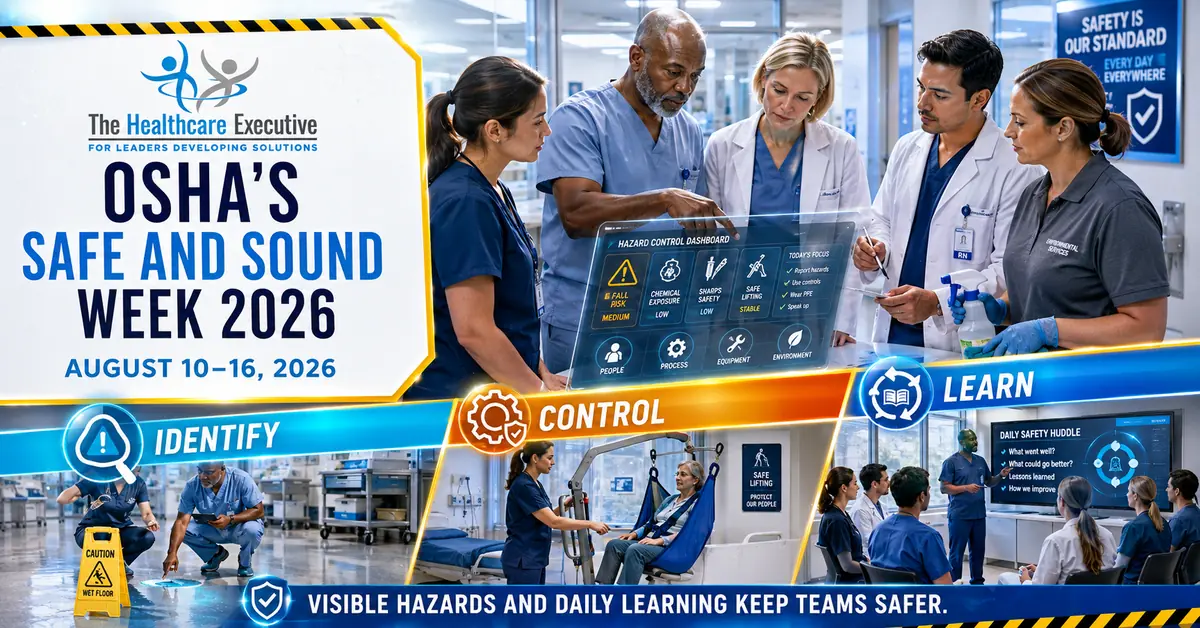
Safe + Sound Week | August 10-16, 2026
Safe + Sound Week 2026: Build a Worker Safety Operating System
An executive evidence brief for turning recognition into visible leadership, protected worker participation, effective controls, and closed-loop learning across every healthcare role and shift.
The Occupational Safety and Health Administration identifies August 10-16 as Safe + Sound Week 2026. OSHA describes the observance as a nationwide opportunity to recognize successful safety and health programs, share ideas, and strengthen year-round prevention. Its 2026 materials emphasize teamwork and recognition of the people, teams, and programs that help create safer workplaces.
Recognize the work, then strengthen the system behind it.
Safe + Sound Week creates a visible moment for leaders to thank the people who prevent harm. In healthcare, that group extends far beyond clinicians. Environmental services staff encounter cleaning agents, contaminated surfaces, hazardous-drug residue, and physical workload. Facilities teams maintain ventilation, electrical systems, medical-gas infrastructure, lifts, doors, and alarms. Security staff respond to aggression. Sterile-processing employees work around heat, pressure, sharp devices, and equipment noise. Transporters, technicians, food-service workers, laboratory teams, pharmacists, nurses, physicians, and trainees each see different parts of the risk system. Recognition is credible when every role can identify how its knowledge reaches a decision.
The executive opportunity is therefore larger than a week of messages or training. A strong safety program makes four conditions visible. Leaders set priorities and provide resources. Workers participate without retaliation or avoidable friction. Hazards are found before injury whenever possible. Controls are selected, implemented, and checked at the point of work. Those conditions align with OSHA’s year-round safety and health program model, but they become real only through local operating decisions.
Recent research reinforces this systems view. A 2026 scoping review of 40 studies on patient- and visitor-perpetrated violence in emergency departments found organizational, environmental, and individual interventions, with training used most often and environmental strategies receiving less attention.4 A policy-surveillance study of safe patient handling found that state policies more often required training and committees than equipment availability or use, even though engineering controls directly change physical exposure.5 These studies address different hazards, yet both caution against treating education as the entire control strategy.
The same lesson appears in exposure and work-environment research. A mixed-methods study of 12 environmental services workers found gaps between self-reported and observed protective-equipment use, including underuse of gloves tested for hazardous-drug work.3 A small randomized trial of a positive nursing practice-environment program found modest improvements in work-environment perceptions, but no statistically significant change in safety climate and some decline after the immediate intervention period.13 A campaign, course, or toolkit can help. It cannot substitute for usable equipment, staffing, workflow design, protected voice, repeated reinforcement, and leadership follow-through.
Executives should frame the observance around one promise: a worker who identifies a risk will be heard, protected, and told what happened next. That promise requires a route. A concern must be easy to report through more than one channel. Immediate danger must trigger protection. Triage must consider severity and exposure, not only whether an injury already occurred. One owner must accept responsibility. The chosen control must fit the hierarchy of controls and local requirements. Implementation must be verified where the work occurs. The reporting worker and affected team must receive feedback.
Recognition should reinforce this route. Celebrate a transporter who spots a recurring equipment defect, an environmental services worker who questions an exposure-control gap, a nurse who reports a near miss, a facilities technician who redesigns a preventive-maintenance step, and a team that tests whether a control actually works. Avoid incentives that reward low reporting counts. A quiet dashboard can mean low risk, but it can also mean workers do not trust the system.
Executive starting point
Choose one recurring workforce hazard and make the complete route visible: signal, immediate protection, triage, owner, control, verification, feedback, and learning.
Use the evidence by mechanism, setting, and limitation.
The 15-source evidence set is intentionally varied because healthcare worker safety is not one exposure or one intervention. It includes violence prevention, safe patient handling, occupational noise, protective-equipment use, orientation, bullying, team conflict, infection-control performance, clinical supervision, near-miss reporting, incident-processing workflow, practice-environment redesign, needlestick prevention, and psychosocial safety climate. Every source is peer reviewed and available in full text. All were published in 2026, although several were electronically available in late 2025.
The set does not provide a single comparable outcome for a bar chart, histogram, Pareto chart, forest plot, or geographic map. Populations range from environmental services staff to nurses and physicians. Designs range from small mixed-methods work and qualitative content analysis to systematic reviews and a randomized trial. Settings span the United States, Finland, South Korea, Portugal, the Netherlands, and other countries. Combining their percentages into one ranking would create false comparability. Figure 2 therefore maps evidence to executive decisions without implying pooled effect, prevalence, or causal order.
Three signals are especially useful. First, prevention is layered. The emergency-department violence review categorized organizational, environmental, and individual strategies, while a five-year analysis of forensic psychiatric incident reports described clinical stabilization, staffing, anticipatory routines, de-escalation, environmental measures, information flow, debriefing, and learning as interconnected prevention factors.46 Leaders should resist a single-intervention story.
Second, implementation depends on the work environment. The protective-equipment study found observed practice did not always match self-report.3 The Finnish orientation survey found traditional topics were widely represented, while psychological safety, support after adverse events, self-monitoring, and safety-culture assessment were less consistently included.1 The randomized practice-environment trial reported modest, partly fading effects and no significant safety-climate change.13 Completion of training or orientation is an input. Leaders still need observation, feedback, reinforcement, and resource decisions.
Third, voice is shaped by leadership and process. In a cross-sectional study of 171 South Korean nurses, authentic leadership was associated with lower silence behavior, and silence was associated with lower near-miss reporting intention; the study identified an indirect rather than direct relationship between leadership and reporting intention.10 A qualitative study of 16 managers and a safety expert found that clear report-handling processes, feedback, manager behavior, communication, software terminology, and analysis tools shaped the reporting experience.12 These studies do not prove that a leadership workshop will raise reports. They identify mechanisms leaders can examine locally.
| Evidence signal | Population and design | Executive use | Transfer boundary |
|---|---|---|---|
| Violence prevention uses organizational, environmental, and individual strategies, with long-term effectiveness still uncertain.4 | Scoping review of 40 emergency-department studies in 11 countries | Build a layered portfolio before, during, and after incidents. | Heterogeneous interventions do not establish one superior program. |
| State safe-patient-handling policies favored training and committees over equipment requirements.5 | United States legal epidemiology and policy surveillance | Check whether policy is matched by engineering controls and equipment use. | Policy content is not direct evidence of local injury reduction. |
| Observed protective-equipment use differed from self-report among environmental services workers.3 | Mixed methods with 12 workers in hospital settings | Pair training records with respectful observation and supply checks. | Small sample and social-desirability concerns limit generalization. |
| Leadership, silence, and near-miss reporting intention were associated through an indirect pathway.10 | Cross-sectional predictive study of 171 nurses in South Korea | Test hierarchy, response behavior, and psychological safety. | Reporting intention is not observed reporting, and association is not causation. |
| Report handling depends on clear process, feedback, manager behavior, communication, terminology, and usable tools.12 | Qualitative interviews and focus groups with 16 participants | Design the response after submission, not only the reporting form. | Participants were mostly managers in one national context. |
| Practice-environment improvement showed modest change without a significant safety-climate effect.13 | Randomized trial with 48 primary-care nurses in Portugal | Plan reinforcement, institutional support, and repeated measurement. | Small sample and short follow-up limit certainty and transfer. |
The evidence should guide questions before it guides claims. What mechanism is being changed? Who was studied? Was exposure observed, self-reported, or inferred? Was the outcome an injury, perception, intention, knowledge score, or process measure? How long did follow-up last? What local control and regulatory requirements apply? The answers determine whether a source can support a design, a measurement choice, or only a discussion point.
Maintain an internal claim-to-source ledger during implementation. Record the source, study design, population, setting, supported claim, limitation, proposed local use, owner, and measure. If a local dashboard later supports a quantitative chart, retain the numerator, denominator, unit, time period, category definitions, and privacy review. Until those gates pass, use structured tables and qualitative diagrams rather than decorative statistics.
Make the hazard-to-control path explicit.
A reporting channel is only the entrance to a safety system. Workers judge the system by what follows. If reports disappear into a queue, definitions are confusing, high-risk issues wait for a routine committee, or the worker never receives feedback, the formal process teaches silence. The qualitative manager study found shortcomings across software and report handling, while participants emphasized transparency, feedback, communication, and organizational guidance.12
The future-state route in Figure 3 begins with any credible signal: an injury, near miss, exposure, observation, equipment defect, worker concern, pattern in absence or compensation data, or risk identified during rounding. The first decision is immediate protection. A dangerous environment may require stopping work, isolating equipment, changing staffing, moving a task, initiating exposure management, or activating an emergency response under local policy. This is not the moment to require a perfect form.
Triage should separate severity from certainty. A rare but potentially catastrophic exposure may need fast escalation even when cause is not yet established. A frequent lower-severity issue may reveal cumulative burden. Review who is exposed, how often, on which shifts, and whether temporary, contract, trainee, language, disability, or role differences affect access to reporting and protection. Do not wait for an injury count when a credible hazard can be controlled earlier.
Assignment means one accountable owner and a due date. Multiple contributors can support the work, but a shared inbox is not ownership. The owner should have authority to coordinate clinical, facilities, supply-chain, occupational-health, security, human-resources, legal, or information-technology decisions. When the required resource sits above the owner’s authority, the route needs a defined executive escalation.
Control selection should begin with elimination and substitution when feasible, then engineering and administrative controls, then personal protective equipment. The safe-patient-handling policy study provides a useful warning: committees and training were common, while equipment provisions appeared less often.5 The point is not that training is unnecessary. It is that education should not carry risk that could be reduced through design, equipment, staffing, or physical separation.
- Receive the signalConcern, near miss, injury, exposure, observation, defect, or trend
- Protect immediatelyStop, isolate, substitute, support, treat, or escalate under local policy
- Triage the riskSeverity, exposure, frequency, affected roles, and uncertainty
- Assign one ownerNamed accountability, authority, due date, and escalation route
- Select the controlEliminate, substitute, engineer, administer, and protect
- Verify at workAvailability, adoption, usability, exposure change, and unintended effects
- Close and learnWorker feedback, documented decision, shared lesson, and monitoring plan
Verification distinguishes activity from risk reduction. Ask whether the control was available on nights and weekends, whether equipment fit the workspace, whether workers used it under real workload, whether a workaround emerged, and whether exposure changed. The protective-equipment study shows why self-report alone may miss a practice gap.3 Observation should be respectful and improvement-focused, with confidentiality and labor protections preserved.
Closure requires feedback in language the worker can use. Explain what was found, what changed, what remains open, who owns the next step, and when the issue will be reviewed again. A confidential report may limit what can be shared, but silence should not be the default. Aggregate lessons can reach the broader workforce without identifying individuals.
Treat worker participation as decision infrastructure.
Frontline participation is not a comment box added after leaders select the solution. Workers hold practical knowledge about task sequence, room constraints, staffing, equipment access, handoffs, interruptions, language, aggressive behavior, and the workarounds used to keep care moving. Their knowledge becomes useful when the organization creates time, protection, access to decision makers, and a visible response.
Leadership behavior is part of the reporting environment. The study of authentic leadership, silence, and near-miss reporting intention found an indirect association through reduced silence behavior.10 Because the design was cross-sectional and measured intention, executives should not claim that authentic leadership causes higher reporting. They can still examine whether leaders invite dissent, respond without humiliation, explain decisions, and protect people who raise concerns.
Psychosocial safety climate broadens the view. A multilevel study of 604 Dutch physicians across 28 groups linked group-level climate with job resources and some job-demand and employability pathways, while also reporting unexpected moderation findings that require caution.15 The practical lesson is not a universal score target. It is that mental health, workload, harassment, resources, and leadership priorities belong inside work design, not outside the safety agenda.
A useful hazard huddle is short, interdisciplinary, and connected to action. Begin with one work area or process. Invite the people who perform, support, clean, maintain, schedule, and supervise the work. Review recent signals and observe the task. Ask what makes the safe path difficult, which workers or shifts are missing from the discussion, what can be controlled immediately, and which barrier requires escalation. End with named owners and dates.

Include people who are often missing from safety meetings. Environmental services, transport, food service, contractors, trainees, temporary staff, home-care workers, and off-shift teams may experience different risks and may have less access to committees. Offer multiple participation routes, including confidential reporting, manager conversation, digital submission, union or employee representation where applicable, rounding, and facilitated debriefs.
Do not ask workers to solve resource decisions they do not control. A team can identify that lift equipment is unavailable, a door layout creates violence risk, or workload blocks proper protective-equipment use. Leaders must decide about capital, staffing, procurement, maintenance, and policy. Participation without authority transfer can become unpaid problem ownership.
Close each huddle with a public ledger of what can be shared: issue, immediate protection, owner, next action, due date, status, and next review. Use plain language. Separate confidential personnel matters from system learning. At the next huddle, begin with old commitments before adding new ones. That cadence demonstrates whether the organization values worker knowledge.
Look for the system conditions that allow hazards to persist.
A reported problem can remain open for reasons that have little to do with worker motivation. Ownership may be split across departments. The person assigned may lack authority. A control may depend on capital approval. Data may not distinguish exposure from injury. Weekend practice may differ from weekday policy. Contract staff may not know the route. Leaders may receive lagging summaries long after a pattern becomes visible. A training module may be substituted for a needed engineering change.
Figure 5 organizes those conditions as a qualitative fishbone. Its branches draw on the recent evidence set, but they are not frequency estimates. The needlestick synthesis identified interacting individual, administrative, engineering, and environmental factors, including unpredictable patient movement, recapping, workload, equipment scarcity, inadequate training, fear, and workplace culture.14 The violence studies likewise described layered clinical, organizational, environmental, communication, and learning factors.46
Use the fishbone to guide inquiry, not to assign blame. Select one recent hazard and ask which branches contributed to delayed control. Verify with workers and direct observation. Record what evidence supports each local contributor. Remove any branch that does not apply. Add local causes only when the team can describe the mechanism.
Then decide at the highest useful level. A unit manager may change a huddle or restocking routine. Facilities may change a physical layout. Supply chain may standardize equipment. Occupational health may redesign exposure follow-up. Human resources and labor partners may need to address intimidation or retaliation. The executive team may need to fund engineering controls or change enterprise staffing expectations. The fishbone is complete only when it leads to ownership.
Design controls for the people who do the work.
Healthcare exposure controls often fail at interfaces. A policy may be written for clinicians while environmental services staff encounter residual hazards during cleaning. Protective equipment may exist but not in the correct type, size, location, or shift supply. Orientation may cover occupational safety but omit psychological safety or post-event support. A device may be available but blocked by room configuration or maintenance. Effective design begins with the whole task and every role involved.
The environmental services study is small, but its method is instructive. Researchers compared questionnaire responses with observation and found that participants often overestimated protective-equipment use; hazardous-drug-tested gloves were underused, particularly in oncology settings.3 Leaders should not convert that finding into a prevalence estimate for another organization. They can use it to justify triangulation: training records, supply availability, respectful observation, worker explanation, and exposure-control review.
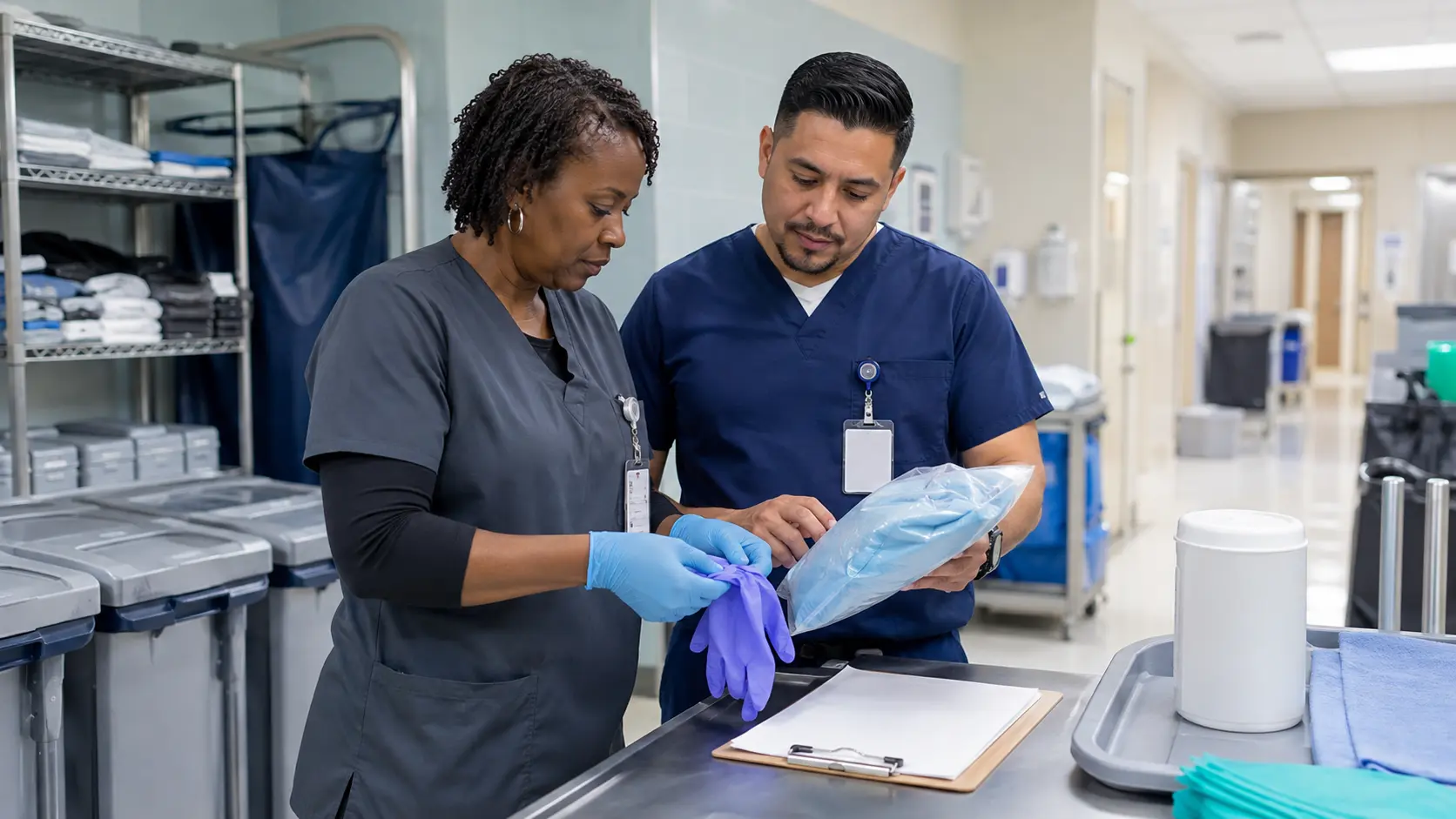
Build an exposure-control review around five questions. Is the hazard eliminated or substituted where feasible? Is an engineering control available and functional? Does the workflow make correct use practical under real demand? Do workers understand the control and receive fit, competency, or task-specific support where required? Does observation confirm adoption without turning the review into punishment?
Include environmental and ergonomic exposures that are easy to normalize. The occupational-noise review found only four peer-reviewed studies specific to central sterile supply departments and explicitly noted that evidence was nascent, cross-sectional in important areas, and not linked to sterilization failure or patient outcomes.2 That limitation should prevent dramatic claims. It should not prevent local measurement of noise sources, worker experience, equipment maintenance, room design, and feasible controls.
Infection control also operates across levels. The South Korean study of 227 emergency-department nurses found associations among communication, safety control, infrastructure, and self-reported infection-control performance.9 Cross-sectional self-report cannot establish causation. The multilevel structure is still useful: individual practice, team communication, organizational policy, and physical infrastructure should be reviewed together.
Do not let the observance create one-week observation theater. Tell workers why observation is occurring, what information will be recorded, how confidentiality will be protected, and how findings will be used. Share decisions and continue checks after the campaign. If a control is unavailable, inconvenient, or incompatible with the task, fix the system before judging compliance.
Run one worker safety system across functions and shifts.
Healthcare organizations often distribute worker safety across occupational health, infection prevention, facilities, nursing, medical staff, security, human resources, risk, quality, supply chain, legal, and local operations. Specialized expertise is necessary. Fragmented ownership is not. The worker should not have to diagnose which department owns a hazard before receiving help.
The proposed operating system in Figure 7 uses one visible coordination hub with several interfaces. The hub is not a new committee for every issue. It is a shared method for classifying signals, protecting workers, assigning owners, escalating barriers, and verifying closure. Existing committees and leaders can retain their authority while working from common definitions and status.
The operating compact should define who can declare immediate risk, who receives urgent notifications, how owners accept work, when issues move to executive review, what information workers receive, and what constitutes closure. It should also define exceptions. A security event, sharps exposure, chemical release, infectious exposure, ergonomic risk, and bullying report may require different confidential pathways. Common governance should not erase specialized response.
| Field | Required definition | Owner question | Closure evidence |
|---|---|---|---|
| Signal and scope | Hazard, location, task, roles, shift, immediate conditions | Who may still be exposed? | Scope confirmed without identifying people unnecessarily |
| Immediate protection | Stop, isolate, substitute, support, treatment, or emergency action | Is work safe to continue? | Protection activated and communicated |
| Risk triage | Severity, frequency, uncertainty, affected population, recurrence | What response time and escalation apply? | Triage basis and review date recorded |
| Accountable owner | One person, authority, contributors, due date, executive barrier | Can this owner obtain the needed resource? | Ownership accepted, not merely assigned |
| Control | Hierarchy level, design, training, equipment, workflow, maintenance | Does the control reduce exposure at its source? | Control available across affected shifts and sites |
| Verification | Observation, adoption, exposure measure, worker feedback, balancing effect | Does the control work during real demand? | Defined verification completed with limitations |
| Feedback and learning | Reporter update, team message, confidentiality, spread, monitoring | What should workers know now? | Feedback delivered and next review scheduled |
Review the ledger at two levels. Operational owners need case-level detail. Executives need high-severity open hazards, overdue controls, repeated barriers, resource decisions, and evidence that closure was verified. The board needs assurance about program reliability, legal duties, severe exposures, trends, culture, and management response, with privacy and labor protections maintained.
Connect worker safety to the broader operating rhythm. A hazard that requires equipment, staffing, space, or technology competes for the same resources as capacity and patient-care priorities. The organization’s strategic safety leadership approach and patient safety action planning can share escalation and review disciplines while preserving distinct worker-protection requirements.
Make work design and engineering controls visible.
Manual patient movement illustrates the difference between policy and control. Workers may know safe technique and still face a room without usable equipment, a device stored too far away, an unavailable sling size, insufficient staffing, urgent patient needs, or a maintenance problem. Telling people to lift safely does not remove the physical demand.
The 2026 policy-surveillance study identified 11 states that had enacted safe-patient-handling policies since 2006, with two later repeals. Policies tended to focus on higher-acuity settings and favored administrative over engineering controls.5 The article describes policy content, not the effectiveness of a specific local program. Its executive value is the contrast between a written requirement and a control that changes exposure.
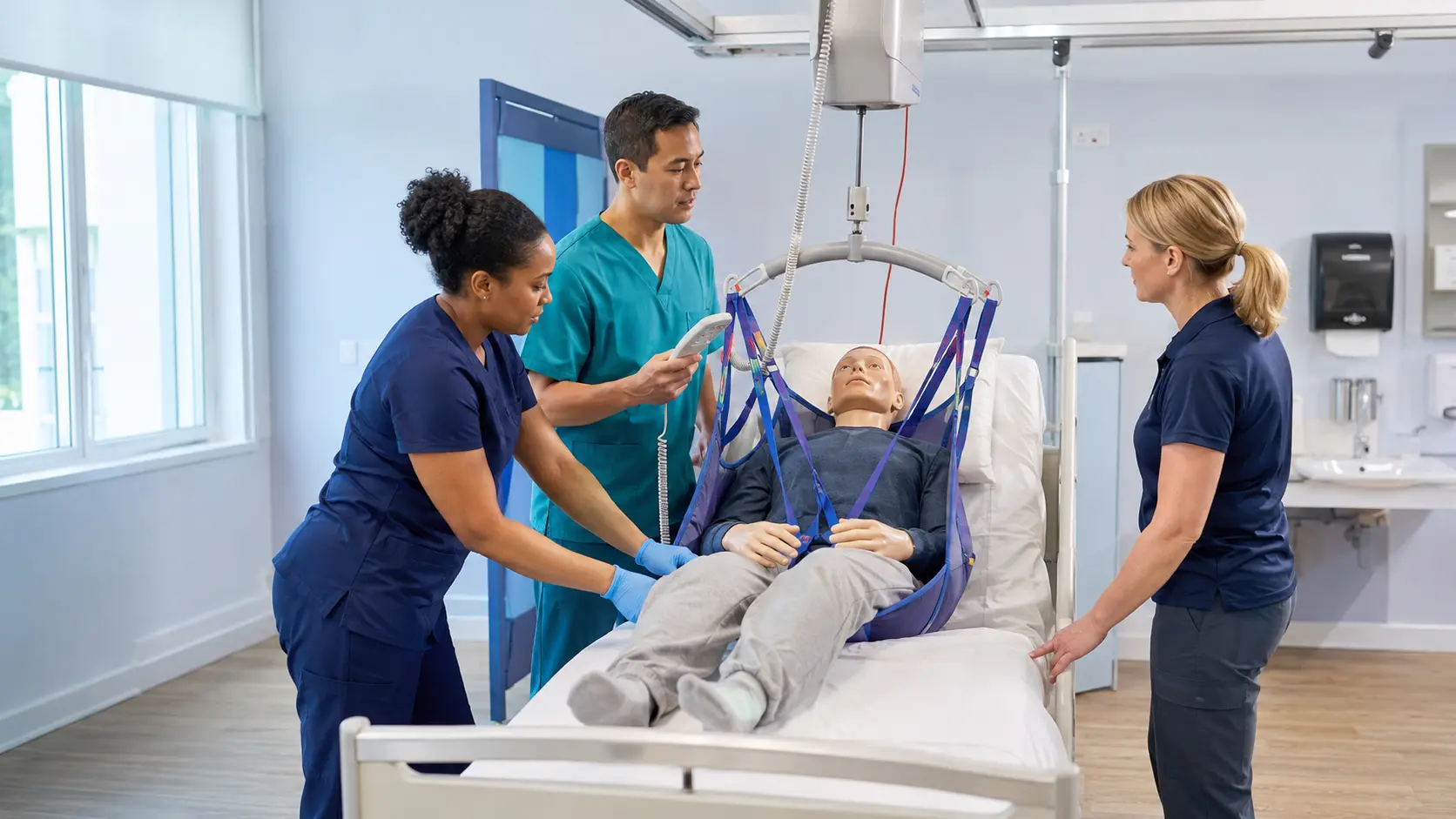
Use simulation to test the complete system. Can staff identify the correct device and sling? Is equipment charged, inspected, and reachable? Does the room allow safe movement? Are responsibilities clear? Can the team stop when conditions are unsafe? Does the approach work at night, during surge, and for patients with different mobility, size, communication, or clinical needs? Qualified clinical and safety leaders should define competency and stop rules.
Structured supervision can support technical and nontechnical competence. A 2026 systematic review of perioperative nursing found consistent themes around communication, leadership, teamwork, situational awareness, decision-making, feedback, protected time, supervisor preparation, and role clarity. It also concluded that evidence strength was moderate and objective outcome evidence was limited because most included designs were nonexperimental.11 Use supervision to observe and improve work, not to claim a proven injury reduction.
Apply the same work-design discipline to other hazards. For violence, examine room layout, exit access, communication, staffing, alarms, de-escalation, visitor processes, and post-event support, not only personal defense training. For sharps, examine device selection, disposal placement, workload, patient movement, recapping, equipment access, training, reporting, and fear of reprimand.14 For noise, examine source equipment, enclosure, maintenance, work rotation, monitoring, and communication demands.2
Temporary and newly onboarded staff need equal protection. The Finnish orientation survey shows that safety topics can be unevenly embedded across domains.1 Connect orientation to the actual unit, equipment, reporting route, emergency response, post-exposure support, and local contacts. The related National Locum Tenens Week executive brief offers a complementary integration model for temporary clinicians.
Measure exposure, response, control, and trust together.
Injury rates matter, but they are not a complete operating measure. They look backward, may combine different hazards, and can be affected by reporting practices. A credible scorecard includes leading measures that show whether the safety system is functioning: worker participation, time to immediate protection, time to triage, ownership acceptance, control availability, verified adoption, reporter feedback, and overdue high-risk work.
Every measure needs a definition. For a triage-time measure, define eligible signals, the start event, the completion event, urgent exclusions, business-hour handling, and missing timestamps. For verified control adoption, define the unit of observation, required behavior or condition, who observes, how often, and what counts as unavailable rather than noncompliant. For feedback completion, define what information must reach the reporter and how confidential reports are handled.
Stratify carefully. Role, department, site, shift, employment status, tenure, and language access may reveal participation or exposure differences. Small groups can identify individuals or invite retaliation. Establish suppression rules, role-based access, and a clear purpose before displaying a comparison. Do not use a low reporting rate to label a team safe or a high rate to label it unsafe without examining trust, exposure, and process.
| Domain | Candidate measure | Required definition | Balancing check |
|---|---|---|---|
| Participation | Workers and roles contributing signals, huddles, observations, or control tests | Eligible workforce, participation mode, time period, duplicate handling | Confidentiality, unpaid burden, excluded shifts, retaliation concern |
| Immediate protection | High-risk signals with timely documented protective action | Risk level, response window, start and completion events, exceptions | Work stopped unnecessarily, access disruption, delayed support |
| Ownership | Signals accepted by a named accountable owner within standard | Acceptance, reassignment, due date, escalation, reopened work | Nominal ownership without authority or resources |
| Control strength | Open hazards by elimination, substitution, engineering, administrative, or PPE level | Primary and supporting controls, implementation status, affected tasks | Training substituted for feasible source control |
| Verification | Controls with confirmed availability, adoption, and local effectiveness review | Observation unit, denominator, reviewer, cadence, outcome limitation | Observation bias, workarounds, off-shift and contract-worker gaps |
| Feedback | Reporters receiving a usable status or closure update within standard | Minimum update content, confidential route, unresolved status | Generic messages, privacy breach, closure without worker confirmation |
| Outcomes | Injury, exposure, violence, musculoskeletal, sharps, absence, and compensation trends | Case definition, numerator, denominator, work hours, severity, time period | Underreporting, coding change, case-mix change, small numbers |
Pair quantitative measures with qualitative learning. Incident narratives helped the forensic psychiatric study identify layered prevention factors that counts alone could not show.6 The report-processing study used interviews and focus groups to identify workflow and feedback problems.12 Numbers show where to look. Worker accounts explain how the system behaves.
Interpret change cautiously. A rise in near-miss reporting after leaders improve feedback may represent a healthier voice climate. A decline may represent improved control, reporting fatigue, or fear. A short intervention may improve perceptions and then fade, as seen in the small practice-environment trial.13 Use run charts only when definitions and denominators remain stable, and annotate changes in policy, staffing, reporting tools, or campaign activity.
Executives should review a compact set of decision questions rather than a dense dashboard. Which severe hazards remain open? Where are controls overdue? Which resource barriers recur? Are workers receiving feedback? Are engineering controls available on every affected shift? What has been verified at the point of work? Which decision requires executive or board action?
Use 90 days to prove one closed-loop safety route.
A focused improvement cycle is more credible than an enterprise promise without a test. Select one recurring hazard with clear workforce relevance, a willing local team, an executive barrier-removal sponsor, and enough recent signals to understand the current route. Good candidates may include patient-handling equipment access, a recurring violence exposure, hazardous-drug cleaning practice, sharps disposal, noise in a defined work area, or delayed feedback after near-miss reports.
During days 1 through 30, map the current state. Follow several signals from the worker’s first observation through closure or abandonment. Interview the people who reported and the people who handled the issue. Observe the work across at least two shifts when feasible. Document intake routes, immediate protection, triage, ownership, handoffs, resource decisions, control selection, verification, feedback, and unresolved steps.
Establish a baseline that the data can support. Count eligible signals, high-risk issues, time to triage, ownership acceptance, overdue work, control type, verification completion, and feedback. Record denominators and missing data. Do not infer that the absence of reports means the absence of exposure. Pair the baseline with worker listening and task observation.
During days 31 through 60, co-design the minimum reliable route. Define immediate stop or protection rules under local policy. Simplify intake. Establish severity and exposure criteria. Require one owner to accept work. Define the executive escalation for resources. Add hierarchy-of-controls documentation. Create a worker-facing status update. Specify what evidence is needed before closure.
Test the route through simulation. Use realistic conditions: a night-shift report, a contract worker who does not know the system, equipment that is temporarily unavailable, a concern involving more than one department, a confidential bullying allegation, and a high-severity signal with uncertain cause. Confirm that specialized legal, labor, clinical, security, occupational-health, and privacy pathways remain intact.
During days 61 through 90, run the route on a limited set of real signals. Hold short weekly exception reviews. Do not wait for the end of the pilot to address immediate danger. Observe whether controls are usable. Ask workers what created friction. Review open work with the executive sponsor. Track burden on frontline workers, managers, and support functions.
At day 90, decide rather than celebrate automatically. Continue when the route is usable, workers receive feedback, ownership is accepted, and controls are verified. Adapt when reporting friction, unclear authority, weak definitions, or excessive burden persists. Pause when required legal, labor, clinical, privacy, or regulatory review remains unresolved. Expand only when the local team can demonstrate reliable operation across affected roles and shifts.
Carry learning into the organization’s broader safety work. The World Day for Safety and Health at Work 2026 brief provides another checkpoint for prevention, response, and learning. Safe + Sound Week should not duplicate that work. It should create a visible annual test of whether leadership commitments reach the point of work.
Close the week by publishing what leaders heard, what was protected immediately, what control decisions were made, what remains open, and when workers will receive the next update. Protect confidentiality. Thank people for reporting, prevention, maintenance, design, and learning. Then keep the ledger active.
Leadership commitment
Protect speaking up, assign every credible hazard to one accountable owner, choose controls that change exposure, verify them where work occurs, and report back to the people whose knowledge made prevention possible.
References
Fifteen peer-reviewed full-text sources are ordered newest first by 2026 issue or publication date. Same-month sources do not imply day-level priority when a day was not assigned. Findings are applied within the population, design, setting, and limitations described in this brief. The observance name, dates, national scope, and 2026 focus are supported separately by OSHA.
- Ketola, S., Eloranta, S., & Seppänen, S. (2026). Building safety through orientation: Current practices of client and patient safety onboarding in Finland. Healthcare, 14(15), 2411. https://doi.org/10.3390/healthcare14152411
- Zhang, H. Q., Cheng, P., Ji, F. H., & Peng, K. (2026). Occupational noise in the central sterile supply department: A narrative review of exposure, mechanisms, and control. Healthcare, 14(15), 2358. https://doi.org/10.3390/healthcare14152358
- Betancur, S., Leak Bryant, A., & Lee Walton, A. (2026). Evaluation of personal protective equipment use among environmental services workers in hospital settings. Clinical Journal of Oncology Nursing, 30(4), 275-282. https://doi.org/10.1188/26.CJON.275-282
- Gammone, M., Cattani, D., Barbieri, M., Moro, A., Zanini, M., Catania, G., Sasso, L., Timmins, F., & Bagnasco, A. (2026). Interventions to prevent patient- and visitor-perpetrated violence against nurses in the emergency department: A scoping review. Journal of Advanced Nursing, 82(8), 7644-7667. https://doi.org/10.1111/jan.70338
- Moskowitz, A. F., Doran, E., Ramirez, M., Tschida, B., Wiggermann, N., & Schofield, K. (2026). Policy surveillance of safe patient handling and mobility laws to reduce injury among healthcare workers. New Solutions, 36(2), 200-210. https://doi.org/10.1177/10482911261447546
- Karvonen, M., Askola, R., Laukkanen, E., Kuosmanen, A., & Kuosmanen, L. (2026). Workplace violence prevention in forensic psychiatric nursing: A five-year qualitative content analysis of incident reports from a Finnish forensic psychiatric hospital. Journal of Psychiatric and Mental Health Nursing, 33(4), 731-743. https://doi.org/10.1111/jpm.70152
- Bashir, S., & Oetzel, J. G. (2026). Workplace bullying in healthcare organisations: A scoping review of the systematic reviews and meta-analyses on workplace bullying of healthcare workers. Journal of Advanced Nursing, 82(8), 7668-7687. https://doi.org/10.1111/jan.70339
- Sims, T., Bacchus, M., Jr., Johnson, S., Adigler, B., Howard, L., Thomas, S., Maldonado, M., Ayabazu-Okoye, N., Ali, M., Linscheid, Y., & Spikes, K. (2026). Impact of the Triple D Method on conflict management and workplace engagement. Critical Care Nurse, 46(4), 62-70. https://doi.org/10.4037/ccn2026391
- Park, Y. J., & Kim, H. Y. (2026). Infection control performance related to emerging infectious diseases among emergency department nurses: An ecological systems theory-based cross-sectional study. Journal of Nursing Management, 2026, 6160239. https://doi.org/10.1155/jonm/6160239
- Ku, I. H., & Ko, S. (2026). Nurses’ silence behavior as a mediator between authentic leadership and near-miss reporting intention: A cross-sectional study. Journal of Nursing Management, 2026, 3998732. https://doi.org/10.1155/jonm/3998732
- de Paula, M., Folgado, D., João, A., & Madeira, A. (2026). Structured clinical supervision in perioperative nursing: A systematic review of its impact on professional development and patient safety. Nursing Reports, 16(6), 197. https://doi.org/10.3390/nursrep16060197
- Koskiniemi, S., Jukarainen, L., Syyrilä, T., Manias, E., Hämeen-Anttila, K., & Härkänen, M. (2026). Nurse and other healthcare managers’ experiences and recommendations for patient incident reporting processes and real-time software development: A qualitative study. Journal of Advanced Nursing, 82(6), 6349-6361. https://doi.org/10.1111/jan.70220
- Pereira, S. C. A., Santos, E. J. F., Ferreira, R. A., Fassarella, C. S., Ribeiro, O. M. P. L., & Carmona-Torres, J. M. (2026). Promoting positive nursing practice environments: Outcomes of a randomized trial in primary care. Journal of Nursing Management, 2026, 4139767. https://doi.org/10.1155/jonm/4139767
- Issac, A., Nayak, S. G., Srivastava, S. P., & George, R. R. (2026). Exploring the causes, immediate responses and preventive measures of needle stick injuries among healthcare workers: A qualitative evidence synthesis. Journal of Clinical Nursing, 35(2), 889-906. https://doi.org/10.1111/jocn.70136
- van Duijnhoven, A., de Vries, J. D., Hulst, H. E., & van der Doef, M. P. (2026). Sustainable employability of Dutch medical doctors: A test of the role of psychosocial safety climate in the Job Demands-Resources model. Psychology, Health & Medicine, 31(1), 13-34. https://doi.org/10.1080/13548506.2025.2463031