

Executive evidence brief | August 19, 2026
World Humanitarian Day 2026: Build a Humanitarian Health Continuity Compact
Recognition is credible when leaders protect people, preserve access, fund the full care route, and give communities authority across preparedness, response, recovery, and resilience.
Observance verification. The United Nations observes World Humanitarian Day every August 19. The 2026 campaign continues the call to #ActForHumanity, with attention to protecting civilians and humanitarian workers, securing humanitarian access, strengthening accountability, and sustaining the resources required for action.
The leadership signal
Turn recognition into an operating obligation
World Humanitarian Day honors people who assist others in crises and calls attention to the dangers faced by civilians and humanitarian workers. For healthcare executives, the observance should also surface a demanding operational question: when violence, displacement, infrastructure failure, or extreme resource pressure interrupts ordinary care, can the health system preserve a safe route from need to treatment and follow-through?
A commemorative message cannot answer that question. A dependable answer requires a compact among health-system leaders, clinical and public-health teams, humanitarian partners, local organizations, communities, finance, logistics, security, and government. The compact is not a ceremonial pledge. It is a shared operating agreement that identifies essential services, decision rights, safety thresholds, access constraints, referral routes, supply dependencies, communication methods, measures, and escalation responsibilities before conditions deteriorate.
Conflict affects health through more than direct injury. A panel analysis of 42 conflict-affected countries from 2000 through 2019 found that relationships between conflict intensity and health outcomes became stronger when vulnerability and the functioning of healthcare services were considered.16 This ecological study cannot establish a local causal forecast, but it reinforces an executive principle: health outcomes reflect both the shock and the system's ability to keep functioning.
Recent humanitarian health literature repeatedly describes interacting constraints. Reviews and field studies identify insecurity, weak surveillance, workforce limitations, fragile referral pathways, transport barriers, financing gaps, disrupted supplies, limited community trust, and coordination problems.12914 No single organization controls every part of this environment. Each organization can still make its own decisions visible and connect them to a jointly governed route.
The compact begins with four commitments. Protect the people who protect care. Preserve essential services across scene, transport, facility, referral, and recovery. Give locally trusted communities real authority over priorities and communication. Finance the full route, including safety, coordination, information, workforce support, and continuity, rather than counting isolated activities.
Executives should resist language that overstates certainty. A positive association in one setting is not a guaranteed intervention effect in another. A qualitative theme is not a prevalence estimate. A model is not an observed result. Credible leadership distinguishes what the evidence shows, what it suggests, and what the organization is proposing to test locally.
Protect
Define practical safety, access, communications, and escalation controls for staff, partners, patients, and communities.
Preserve
Identify which services must continue, how they will be adapted, and which dependencies could break the care route.
Share authority
Place local organizations and affected communities in priority setting, governance, design, feedback, and review.
Fund continuity
Align money, contracts, supplies, data, transport, and workforce support with the complete route rather than a short activity list.
Protection and access
Protect the people who protect care
Healthcare cannot remain available when the people delivering it are exposed to unmanaged danger, when facilities are repeatedly disrupted, or when patients cannot travel safely. Protection must therefore sit inside healthcare operations, not beside it as a separate security topic. The executive agenda includes staff movement, facility access, communications redundancy, referral coordination, transport, incident reporting, psychosocial support, continuity decisions, and relationships with locally trusted partners.
A study of attacks on healthcare in Ukraine documented 397 attacks involving 281 facilities during 2022 and 2023, including 53 facilities that were reportedly attacked repeatedly.15 The analysis documents a pattern but cannot by itself prove intent. Its operational meaning is clear enough: a health continuity plan cannot treat a facility as a permanently available node. Leaders need alternate locations, communication pathways, transfer agreements, protected records, and explicit criteria for reducing, relocating, or suspending services.
Modeling evidence offers another perspective. A study combining 16 reports from 13 countries and 127,505 injured people estimated that a complete set of emergency-care interventions for victims of explosive ordnance could reduce mortality by 68 percent, with a 95 percent uncertainty interval from 57 to 79 percent.10 This is a simulated estimate, not an observed universal effect. It does not justify a promise. It does show why leaders should examine the complete chain from first response through transport and facility care instead of funding one isolated step.

Protection also means avoiding a false choice between staff safety and community access. A strong operating model makes tradeoffs visible. It specifies who can pause work, how changing risks are assessed, what information is required, which alternative route will be offered, and when executive or partner escalation is mandatory. It does not pressure workers to compensate for unsafe conditions through personal courage.
Leadership review should include near misses, denied access, cancelled movements, repeated service relocation, communication failures, unresolved threats, and staff reports of unsafe work. Counts alone require context. An increase may reflect worsening conditions, better reporting, or both. The review must pair trend data with narrative analysis, community feedback, and documented corrective action.
The continuity route
Design one visible route from need to recovery
Humanitarian health performance is often described through activities: consultations completed, kits delivered, facilities supported, or people reached. Those measures matter, but they can hide a broken route. A patient may be counted at first contact and still be unable to obtain transport, diagnostics, referral, medication, follow-up, or protection. Executives need a continuity view that traces essential care across connected decisions.
A 2025 multi-method study of relief-goods distribution combined a review of 18 studies with interviews, an expert panel, and Delphi work to develop four principles and 15 requirements.13 Its context and method do not create a universal distribution standard. They reinforce the need to connect assessment, prioritization, logistics, transparency, coordination, and monitoring. A qualitative systems inquiry in North Gaza similarly mapped 138 nodes, 231 edges, and 34,458 pathways across four pediatric cases, illustrating how health trajectories can be shaped by linked social and system conditions.9 Four cases cannot support population estimates, but the map shows why a single-service lens is inadequate.
Figure 1. Proposed humanitarian health continuity route
Every stage needs entry criteria, an accountable owner, a stop condition, an escalation route, and evidence that the next stage can receive the work. Safe access should not be assumed because a team departed. Referral should not be counted as complete because a request was sent. Recovery should not be declared because emergency volume fell. A continuity review asks whether the person, community, workforce, and local service can move through the full route.
| Control point | Required evidence | Primary owner | Escalation trigger |
|---|---|---|---|
| Need verified | Population, priority, source, uncertainty, and community interpretation documented | Assessment lead with community and local health partners | Conflicting data, excluded population, or inaccessible location |
| Access ready | Route, staffing, communications, consent, safety, and alternate option confirmed | Operations and protection leads | Changed conditions, lost communication, or unresolved staff concern |
| Essential care ready | Service scope, supplies, competent staff, infection prevention, and referral criteria available | Clinical or public-health lead | Critical shortage, demand beyond scope, or unsafe care environment |
| Referral complete | Receiving capacity, transport, records, medicine, accompaniment, and follow-up confirmed | Referral coordinator | No receiving acceptance, transport failure, or protection risk |
| Recovery owned | Local authority, workforce support, corrective actions, resources, and review date named | Local system and executive governance | Repeated workaround, unfunded dependency, or no accountable successor |
Applicability note: The ledger is a proposed executive control framework. It does not replace professional standards, humanitarian coordination mechanisms, local operating procedures, or affected-community decision making.
Local authority and trust
Move community engagement from consultation to governance
Community engagement is often treated as a communication task performed after a program has been designed. The stronger model gives affected people and locally rooted organizations authority over what matters, how services are adapted, which information channels are trusted, which risks are acceptable, and how feedback changes decisions.
An umbrella scoping review of community engagement for vaccine delivery in low- and middle-income countries and humanitarian settings included 39 reviews from 303 deduplicated records.4 Across the included literature, community engagement was associated with outcomes such as vaccine uptake and trust, but definitions and evaluation methods were heterogeneous. The review supports engagement as a serious implementation function. It does not provide one standardized intervention or effect size that leaders can transplant into every setting.
A qualitative study involving 30 Ukrainian parents and 21 key informants found that war reconfigured vaccination information ecosystems and trust.3 The findings are tied to particular participants and contexts. They nevertheless warn leaders against treating information as a simple broadcast problem. Trust depends on relationships, lived experience, institutional behavior, language, safety, and whether questions can affect decisions.
The Red Cross Access to People in Need experience in South Sudan and the Central African Republic drew on 15 key-informant interviews and 16 focus-group discussions, describing community engagement across preparedness, response, recovery, and resilience.7 This two-country qualitative study is not a comparative effectiveness trial. It offers a useful continuity concept: engagement should persist across phases rather than appearing only during message delivery or service uptake.
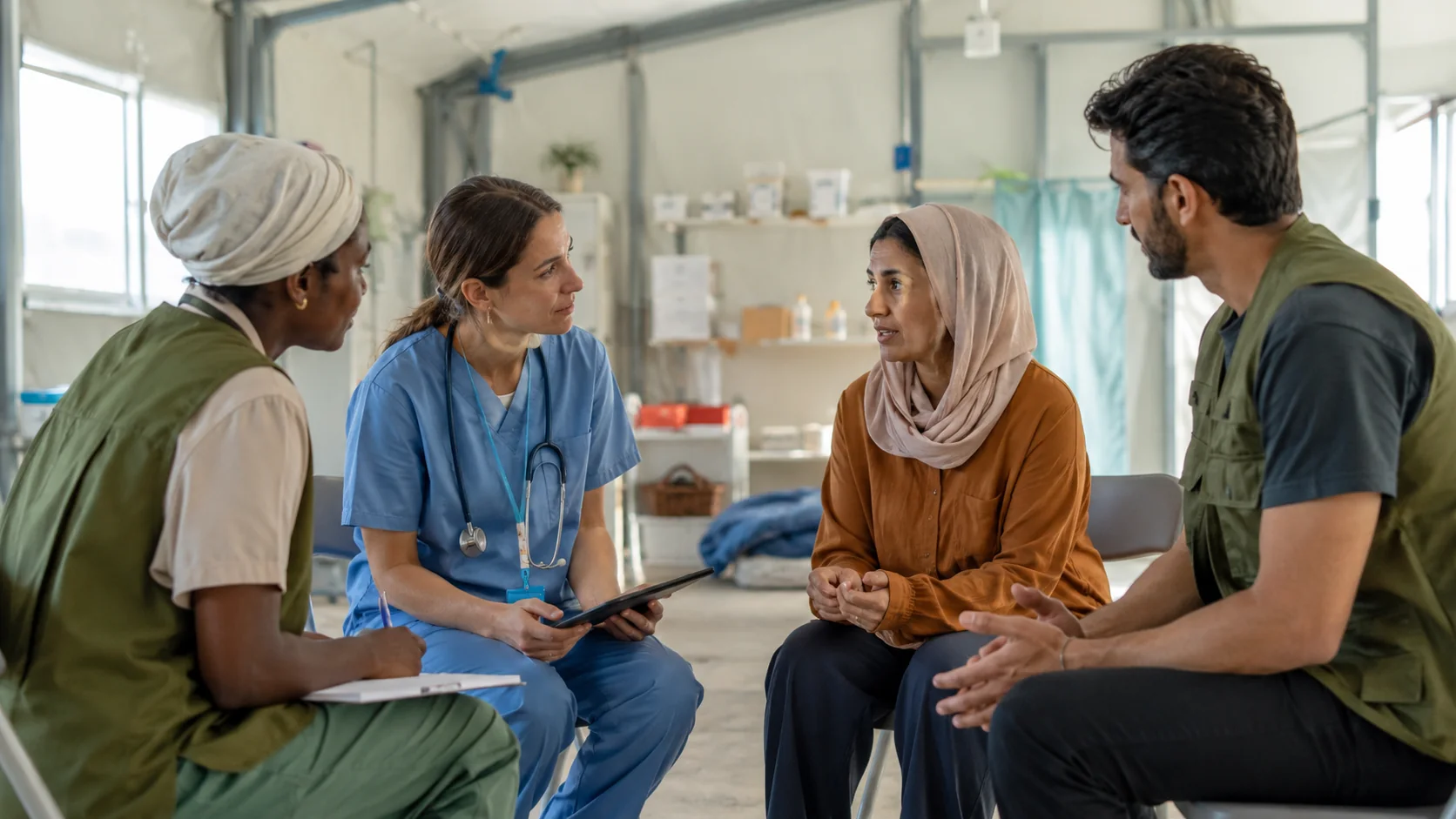
Executives can make this operational by reserving governance seats for credible local organizations and community representatives, paying for their time and participation, documenting which decisions they can influence, and publishing how feedback changed the plan. A meeting count is not evidence of authority. Stronger measures ask whether priorities were co-defined, whether an access concern changed an operation, whether locally preferred channels were funded, and whether disputes have a trusted resolution route.
Partnership also requires attention to institutional power. A qualitative study at the Health in Humanitarian Crises Centre at the London School of Hygiene and Tropical Medicine included 20 interviews and three focus-group discussions and examined efforts to dismantle colonial legacies in research and teaching.12 It is a study of one center and its partners, not a universal assessment of humanitarian organizations. It supports specific leadership questions about agenda setting, knowledge ownership, authorship, funding, teaching, and whose expertise is treated as authoritative.
For healthcare executives, localization is not accomplished by changing the logo on a subcontract. It requires decision rights, transparent financing, access to data, protection from unfunded risk, and durable capacity after the external funding cycle ends. The continuity compact should name which responsibilities will transfer, what support accompanies that transfer, and how the local partner can refuse unsafe or misaligned work.
Figure 2. Median precision achieved for four infant and young child feeding indicators in refugee-setting surveys
| Indicator | Median half-width of 95% confidence interval |
|---|---|
| Ever breastfed | 3.1 percentage points |
| Bottle feeding | 3.6 percentage points |
| Exclusive breastfeeding among infants younger than 6 months | 12.6 percentage points |
| Introduction of solid foods among infants 6 to 8 months | 18.2 percentage points |
The chart illustrates a measurement problem with direct governance consequences. A dashboard can show a percentage while concealing how uncertain it is. The narrower confidence intervals for common indicators do not make them more important. The wider intervals for age-specific indicators do not make them unusable. They require leaders to display denominators, uncertainty, and survey design before making comparisons or allocating resources.
Financing and coordination
Fund the full route, not a disconnected activity
Humanitarian health programs can meet an activity target while the person still cannot reach care. Transport, medicine, informal costs, childcare, documentation, communication, security, and lost income may determine whether a service is usable. Financing decisions should therefore be tested against the full continuity route and the distribution of risk.
A mixed-method pre-post study conducted in approximately 100 villages in Sindh, Pakistan examined cash-for-health assistance for families of pregnant women. The reported proportion with healthcare access increased from 58 percent to 98 percent after assistance, while the proportion reporting forgone care because of financial barriers also increased from 68 percent to 97 percent.8 The apparently conflicting movement demonstrates why a pre-post result requires careful interpretation. Temporal change, context, measurement, and program selection can affect results. The study should not be used to promise a universal cash effect. It supports examining affordability directly and pairing utilization measures with reported barriers.
Multi-country evaluations of cash assistance integrated into gender-based violence case management in Colombia, Jordan, and Indonesia offer another context-specific body of evidence.11 The pilots used quasi-experimental and pre-post approaches and cannot establish long-term universal outcomes. They do show why cash should be governed as part of case management, safety, ethics, and monitoring rather than as an isolated transaction.
Financing also affects coordination and system durability. A South Sudan study combining 41 interviews with 68 participants and review of 57 documents examined leadership and governance, financing, and coordination across the humanitarian-development nexus.14 It is qualitative and country specific. It supports an executive focus on formal coordination, alignment of funding cycles with health-system priorities, and the operating conditions required to move beyond repeated short-term response.
A continuity compact should therefore identify the costs hidden between funded outputs. Who pays for safe transport? Who funds local partner participation in governance? Who supports data stewardship and translation? Who absorbs price volatility or a delayed grant? Who pays staff while a site is inaccessible? Which recovery activities begin before emergency funding ends? If those questions have no owner, the route is not financed even when the project budget is fully spent.
Figure 3. Why essential care becomes unreachable or unsafe
The fishbone is useful only if it leads to action. Select one failed or fragile route, bring the people who experienced it into the review, identify evidence for each branch, and assign a control to the organization with authority to act. Do not force every problem into the health system's span of control. Record dependencies and escalation owners where another organization or public authority must respond.
Human infrastructure
Build capability without normalizing sacrifice
Humanitarian health work requires clinical skill, public-health judgment, cultural and linguistic capability, coordination, ethical reasoning, security awareness, information management, and the ability to work across disrupted systems. None of that makes unsafe work acceptable. A leadership model that celebrates resilience while leaving hazards, fatigue, ambiguous roles, or psychological distress unmanaged turns recognition into pressure.
A cross-sectional study of 134 healthcare professionals working in humanitarian crises and emergencies examined knowledge, attitudes, and learning preferences related to children's palliative care. Eighty-three percent of participants were locally recruited, and 98 percent wanted more training.5 These are self-reported findings and cannot establish competency or patient outcomes. They do show both the central role of locally recruited professionals and the demand for practice-relevant learning.
Preparedness evidence from Somalia identifies connected gaps in surveillance, laboratory capacity, infection prevention and control, workforce, coordination, and risk communication.1 The narrative review concerns Ebola preparedness in a country with no confirmed Ebola virus disease cases. It should not be interpreted as an outbreak evaluation. Its value for executives is the visibility of dependencies: disease readiness requires a network of capabilities rather than a training module.
A separate narrative review of maternal, newborn, and child health service use among internally displaced populations in Somalia identifies barriers and facilitators involving transport, insecurity, autonomy, workforce, referrals, and supplies.2 Because the review includes policy and humanitarian reports and is not a causal synthesis, it does not quantify one intervention effect. It supports designing workforce capacity together with referral and access conditions.
Executives should fund orientation, simulation, supervision, translation, protected learning, peer support, rest, psychosocial services, and after-action review as operating capacity. Competency assessment should include routine work and abnormal conditions. A team may know the standard procedure and still be unprepared for lost communications, an unsafe route, a referral refusal, an unexpected demand surge, or conflicting instructions. Practice those decisions without exposing people to real danger.
Psychological safety matters in two directions. Staff must be able to report that a route is unsafe, a service is outside capacity, a message is misleading, or a deadline is harmful. Communities and local partners must also be able to challenge the organization without losing access or funding. Leaders should document how concerns are protected, escalated, resolved, and fed back to the person who raised them.
The operating model
Govern the interfaces and measure completed continuity
The humanitarian health continuity compact needs one accountable forum that can see the whole route. Existing emergency management, quality, population health, community, or humanitarian coordination structures may provide that forum. The name matters less than the authority to connect safety, access, clinical priorities, referrals, supplies, funding, information, workforce, and recovery.

Figure 4. Humanitarian health continuity operating system
Access events, service gaps, community feedback, near misses, referral outcomes, supply interruptions, and workforce signals return to every interface for review and correction.
The central hub is community defined because continuity is not proven by internal activity alone. A service is continuous only if the people it is intended to reach can use it safely and complete the next necessary step. Community-defined priorities do not eliminate clinical standards or legal duties. They help leaders align those duties with lived constraints and legitimate local authority.
Measures should reveal denominators, missingness, and uncertainty. A referral rate needs a defined eligible population. An access measure needs a clear starting event and route. A stockout measure should identify which essential item and what service consequence followed. A worker-safety measure should protect confidentiality. Community-feedback measures should distinguish acknowledgment from action. Leaders should avoid external benchmark claims when definitions and contexts are not comparable.
Figure 5. Executive scorecard for humanitarian health continuity
| Measure | Definition and denominator | Owner and cadence | Data source | Interpretation limit |
|---|---|---|---|---|
| Verified essential-service availability | Essential services meeting locally defined staff, supply, access, and referral criteria divided by essential services designated for the period | Clinical operations, weekly during response | Service verification and partner reports | A service listed as open may still be unusable for some populations |
| Safe access completion | Planned service movements or delivery routes completed within defined safety controls divided by all planned movements or routes | Operations and protection interface, weekly | Movement, cancellation, and incident records | Do not reward unsafe completion or penalize justified stop-work decisions |
| Referral continuity | Eligible referrals with confirmed receiving acceptance and documented follow-up divided by all eligible referrals initiated | Referral coordinator, weekly | Referral register and receiving confirmation | Outcome depends on record linkage and may miss people who leave the network |
| Community decision influence | Governance decisions changed, paused, or initiated after documented community or local-partner input divided by decisions submitted for that review | Compact chair with local partners, monthly | Decision log and feedback record | A percentage cannot judge the quality or legitimacy of participation |
| Critical supply interruption | Service-hours affected by absence of a defined critical item divided by scheduled service-hours for that service | Logistics and clinical lead, weekly | Inventory, service, and incident records | Thresholds must be item and service specific |
| Worker protection action closure | Corrective actions closed by the agreed due date divided by actions arising from safety events and staff reports | Safety and workforce lead, monthly | Protected reporting and action ledger | Closure does not prove effectiveness without retesting and worker feedback |
| Continuity funding coverage | Costed route components with committed funding through the review horizon divided by all required route components | Finance and executive sponsor, monthly | Budget, grant, contract, and dependency ledger | Committed funding does not guarantee timely cash, access, or delivery |
Scorecards should be reviewed with short narratives about cause, consequence, and action. A lower service volume may reflect dangerous access, responsible suspension, supply failure, changing need, or a data problem. A higher incident count may reflect increased harm, improved reporting, or both. Executives should ask what changed, whose experience is missing, what action followed, and whether the action worked.
Public reporting deserves the same discipline. Report the denominator and time period. Separate people, visits, services, and items. State when estimates are modeled. Do not imply that a reach count proves access, continuity, quality, or outcome. Explain uncertainty in plain language. Trust grows when leaders are accurate about both progress and limits.
Action
A focused 90-day executive agenda
World Humanitarian Day can launch a practical improvement cycle without pretending that a complex humanitarian health system can be redesigned in one quarter. The first 90 days should create shared visibility, authority, and a small set of tested controls. Choose one priority population, service, route, or region where access risk, repeated disruption, or recovery need provides a clear reason to act.
Figure 6. Ninety-day implementation timeline
Days 1–30: see the route
Name an executive sponsor and a compact chair with authority to convene operations, clinical, community, local-partner, workforce, finance, logistics, and information leaders. Confirm who represents affected communities and what decisions they can influence. Map one current route from need detection through recovery. Record access failures, waiting, repeated workarounds, unsafe conditions, supply interruptions, referral gaps, and unfunded dependencies. Define a small measure set before building a dashboard.
Days 31–60: test the controls
Co-design entry criteria, stop conditions, alternate routes, and escalation responsibilities. Cost the full route. Resolve one critical financing or supply gap. Practice one abnormal condition, such as lost communication, a facility closure, referral refusal, demand surge, or unsafe movement. Run the first scorecard review with community and local partners. Correct definitions that hide uncertainty or exclude a population before using the results for accountability.
Days 61–90: prove learning
Test the improved route in a tabletop or controlled operating exercise, without exposing anyone to unnecessary risk. Close priority workforce and protection actions. Verify that feedback produced documented decisions. Confirm the funding and supply horizon. Review outcomes and limitations with executive leadership, community representatives, and the appropriate board committee. Publish only the commitments and results the organization can support with evidence.
The article can support a credible public observance message. Explain that World Humanitarian Day honors humanitarian workers and calls for protection of civilians and people delivering assistance. Connect the message to specific organizational commitments, such as a jointly governed continuity route, strengthened worker-safety reporting, local-partner decision rights, protected community feedback, referral agreements, or funding for a known access gap. Avoid images and language that turn crisis into spectacle or portray affected people as passive recipients.
Related observances can extend the work. World Lung Cancer Day 2026 examines a reliable screening-to-treatment route, and National Immunization Awareness Month 2026 addresses trusted access and immunization reliability. The context differs, but the leadership standard is consistent: awareness is useful when the operating system can deliver a safe, reachable, accountable response.
Leadership close
World Humanitarian Day should leave leaders with more than admiration for courage. It should leave the health system with a clearer route, safer working conditions, stronger local authority, more honest measurement, and funded responsibility from need through recovery. Recognition becomes credible when executives protect the people who protect care and build the conditions that allow essential services to remain reachable, trustworthy, and accountable under pressure.
Peer-reviewed evidence
References
References are ordered newest first. Every source was individually verified as peer reviewed. DOI links below are provided for durable public identification.
- Abdulahi, M. A., Mohamud, H. A., Mahamud, N. A., Omar, L. A., & Abdi, M. S. (2026). Health system preparedness for Ebola virus disease in Somalia: A narrative review of challenges and opportunities. Discover Public Health, 23(1), 1–15. https://doi.org/10.1186/s12982-026-02732-1
- Jimale, A. M., Ali, M. A., Osman, N. H., Moallim, A. A., Mohamud, A. A., Ahmed, I. D., Abdi, A. M., Adam, A. A., & Mohamud, O. M. (2026). Barriers and facilitators to maternal, newborn, and child health service utilization among internally displaced populations in Somalia. Frontiers in Global Women’s Health, 7, 1880329. https://doi.org/10.3389/fgwh.2026.1880329
- Dwyer, H., Beckmann, N., Palmer, J., Lapii, F., Kleszczewska, D., Sochon-Latuszek, A., Yahorava, H., Gatsenko, K., & Enria, L. (2026). “This is what a war does”: Trust, information ecosystems and childhood vaccination among Ukrainian parents: A qualitative study. PLOS Global Public Health, 6(7), e0006742. https://doi.org/10.1371/journal.pgph.0006742
- Polonsky, J. A., Burns, R., Odlum, A., Hamza, Y. A., Mulugeta, Y., Abramowitz, S., Enria, L., & Blanchet, K. (2026). Community engagement for vaccine delivery in low- and middle-income countries and humanitarian settings: A scoping umbrella review. PLOS Global Public Health, 6(4), e0006307. https://doi.org/10.1371/journal.pgph.0006307
- Blatman, Z., Rayala, S., Richardson, K., Risat, M. I. K., Yantzi, R., & Doherty, M. (2026). Children’s palliative care knowledge, attitudes, and learning preferences among healthcare professionals working in humanitarian crisis and emergency settings. Health Services Insights, 19, 11786329261445187. https://doi.org/10.1177/11786329261445187
- Leidman, E., Kianian, B., & Bilukha, O. (2026). Precision and sample sizes achieved for infant and young child feeding indicators evaluated in anthropometry assessments: A secondary analysis of population-representative surveys in refugee settings. Maternal & Child Nutrition, 22(1), e70078. https://doi.org/10.1111/mcn.70078
- Gebremeskel, A. T., Hossain, P., Ormel, I., Rab, F., Assefa, M., Angelakis, C., Kone, M., & Sohani, S. (2026). Continuum of community engagement to ensure access to health care in conflict-affected areas in South Sudan and Central African Republic: Lessons from the Red Cross. PLOS Global Public Health, 6(2), e0005794. https://doi.org/10.1371/journal.pgph.0005794
- Rab, F., Wehbi, A., Hasnat, A., Singeswaran, C., Ifftikar, M. A., & Sohani, S. (2025). Impact of cash for health assistance on healthcare access and health-seeking behaviors for families of pregnant women in Sindh, Pakistan. International Journal of Environmental Research and Public Health, 22(12), 1843. https://doi.org/10.3390/ijerph22121843
- Shaikh, Y., Hamouda, M. O. A., & Elnakib, S. (2025). Architecture of systems affecting disease trajectories in a conflict zone: A community-centered systems inquiry in North Gaza. PLOS Global Public Health, 5(9), e0004450. https://doi.org/10.1371/journal.pgph.0004450
- Wild, H. B. H., Huynh, B. Q., Kasack, S., Munyambabazi, A., Sanou, Y., Nacanabo, Y., Niaone, M., Cheran, A., Calvello Hynes, E., Meda, N., Kushner, A., & Stewart, B. T. (2025). Emergency care interventions for victims of explosive ordnance reduce mortality: A modeling study. Prehospital and Disaster Medicine, 40(4), 204–213. https://doi.org/10.1017/S1049023X25101283
- Lyles, E., Glass, N., Sidabutar, E., Roa, E. G., Hoyos, C., Pacheco, A., Sarria, D., Golay, A., Friedman, J., Argenti, E., Madani, M., Di Camillo, P., Cicognola, G., Bertola, E., & Doocy, S. (2025). Expanding the evidence on integration of cash assistance in gender-based violence case management in humanitarian settings: Lessons learned from multi-country evaluations. Conflict and Health, 19, 55. https://doi.org/10.1186/s13031-025-00691-z
- Hafez, S., Clarke, A., Richter, K., Lokot, M., Rivas, A. M., & Singh, N. S. (2025). Dismantling colonial legacies: Decolonising research and teaching at the Health in Humanitarian Crises Centre, London School of Hygiene and Tropical Medicine. PLOS Global Public Health, 5(7), e0004833. https://doi.org/10.1371/journal.pgph.0004833
- Rezapour, R., Doroudi, T., Azami-Aghdash, S., Jafarzadeh, D., & Derakhshani, N. (2025). Developing a conceptual framework for relief goods distribution during disasters: A multi-method qualitative study. Journal of Health, Population and Nutrition, 44, 255. https://doi.org/10.1186/s41043-025-01016-9
- Qaddour, A., Yan, L., Wendo, D., Elisama, L., Lindahl, C., & Spiegel, P. (2025). Leadership and governance, financing, and coordination and their impact on the operationalization of health interventions in the humanitarian-development nexus in South Sudan. PLOS ONE, 20(5), e0312788. https://doi.org/10.1371/journal.pone.0312788
- Barten, D. G., Tin, D., Granholm, F., Rusnak, D., van Osch, F., & Ciottone, G. (2025). Assessing intent: Repetitive strikes on Ukrainian health care facilities. Prehospital and Disaster Medicine, 40(2), 114–118. https://doi.org/10.1017/S1049023X2500024X
- David, S. D., & Eriksson, A. (2025). Association between conflict intensity and health outcomes in contemporary conflicts, while accounting for the vulnerability and functioning of healthcare services. Conflict and Health, 19, 14. https://doi.org/10.1186/s13031-025-00654-4