

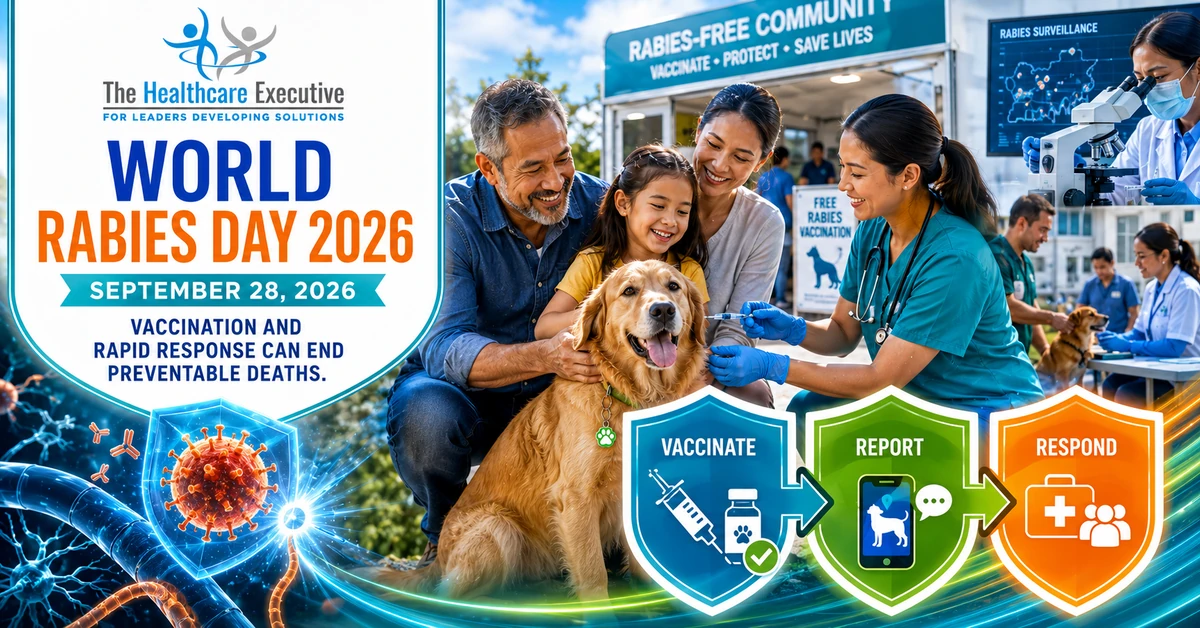
World Rabies Day | September 28, 2026
World Rabies Day 2026: Connect Communication, Partnership, and Follow-Through
An executive brief for building a reliable One Health operating system around exposure recognition, qualified assessment, timely access, coordinated follow-through, surveillance, and community trust.
Observance identity: The World Health Organization identifies World Rabies Day as September 28. No official 2026 campaign theme is claimed in this brief. Review the WHO observance page.
Recognition connected to a reliable response
Use September 28 to test the operating system behind the message
World Rabies Day creates a public moment around a disease whose prevention depends on time-sensitive action before illness develops. For healthcare executives, the useful question is not how many messages the organization distributes. It is whether a person with a possible exposure can recognize the need for help, find the correct entry point, receive a qualified assessment, reach indicated services, understand the next step, and remain connected until the pathway is complete or an accountable professional determines that no further action is needed.
That route crosses boundaries that are often managed separately. Emergency departments and urgent-care sites may receive the first call or visit. Primary care, infectious-disease teams, pharmacy, public health, laboratories, animal health, animal control, travel health, community organizations, communications teams, and supply-chain leaders may each hold part of the response. Reliability depends on how well those parts connect under pressure, after hours, across geography, and when information is incomplete.
A recent imported human rabies case involved 709 possible contacts who required risk assessment, and 60 were recommended to receive post-exposure prophylaxis. Most of those recommended recipients were healthcare workers. The report emphasized earlier clinical suspicion, public-health consultation, and consistent standard precautions.9 A case report cannot estimate the usual probability of such an event. It does expose the organizational consequences of delayed recognition and inconsistent routine controls.
Surveillance studies from Washington State and Maine found that reporting systems, emergency data, and immunization or provider records captured different views of possible exposures and prophylaxis administration.78 Those findings do not produce a national benchmark. They show why leaders should examine completeness, timeliness, data definitions, and the handoffs between clinical care and public health before assuming that one dataset describes the whole pathway.
Recognizable
Public and staff messages point to an urgent, current, and locally approved entry route without providing improvised clinical advice.
Reachable
Qualified assessment, public-health consultation, indicated biologics, referrals, language access, and after-hours support are available in practice.
Connected
Human health, animal health, public health, laboratories, and community partners transfer responsibility with acknowledgment.
Accountable
Every case has a visible status, next owner, escalation path, documentation standard, and closure signal.
Awareness can increase questions and care-seeking. That is valuable only if the receiving system is prepared. A campaign that directs people to a number that is not staffed, a facility without a verified supply plan, or a referral route that does not acknowledge receipt can widen uncertainty. Before publishing, leaders should verify public instructions, local and state contacts, hours, escalation routes, access to qualified consultation, pharmacy and supply processes, documentation expectations, and the method used to follow scheduled actions. Where capacity is limited, the message should be narrowed to what the organization can responsibly support.
The evidence also cautions against treating information as a stand-alone intervention. A cross-sectional study of 750 adults in rural Thailand found that rabies-related health-literacy skills and community reinforcement were associated with preventive behavior, while service readiness operated largely through community reinforcement in the authors’ structural model.4 Cross-sectional associations do not establish causality, and the setting matters. The leadership lesson is operational: trustworthy communication, accessible services, and community relationships should be designed together.

Evidence with controlled claims
Use the evidence to design the system without manufacturing certainty
The selected portfolio contains 18 individually verified, peer-reviewed records listed newest first in the references. Five primarily inform access, delivery, or completion of post-exposure services. Four inform surveillance, documentation, or preparedness. Five inform One Health implementation or economics. Four inform communication, workforce readiness, equity, or priority setting. These categories identify how each record is used here. They are not quality grades, effect sizes, or mutually exclusive summaries of everything a study contributes.
| Evidence group | Count | Appropriate use | Do not infer |
|---|---|---|---|
| Access, delivery, and completion | 5 | Identify practical barriers, referral choices, reminder options, documentation needs, and follow-up questions. | That a workflow will produce the same completion result in every population or health system. |
| Surveillance, documentation, and preparedness | 4 | Design shared definitions, case visibility, reconciliation, exception review, and preparedness exercises. | That one database captures every exposure, administration, contact, or unresolved action. |
| One Health implementation and economics | 5 | Structure partner roles, community participation, vaccination strategy, bite-case coordination, and resource discussions. | That a modeled cost-effectiveness result or local implementation finding transfers unchanged. |
| Communication, workforce, equity, and priority setting | 4 | Shape education, community reinforcement, decision processes, and review of unequal burden. | That training scores, modeled priorities, or global burden patterns prove local pathway performance. |
Chart boundary: The bars count selected records by primary use in this article. They do not represent certainty, study quality, disease burden, effect magnitude, or the relative importance of a domain.
Access is an operating condition, not a promise on a poster
A mixed-methods study of practitioners in Tanzania examined access to rabies post-exposure prophylaxis through a theory-informed implementation lens.3 A Cambodian study examined noncompletion after adoption of an abridged one-week protocol.10 The settings, health systems, and treatment arrangements differ from many United States organizations, and neither record establishes how often a local patient will encounter a barrier. Together, they reinforce the need to examine travel, cost, availability, information, scheduling, and follow-up as parts of the response rather than patient-level failures.
A quasi-experimental quality-improvement initiative at a rural primary health center in India reported improved vaccine-series completion after structured telephone reminders.1 Interrupted time-series analysis strengthens the assessment of change, but the study remains context-specific and cannot separate every concurrent influence. The transferable question is whether a locally approved reminder or navigation process can reduce preventable loss to follow-up without creating privacy problems, duplicate messages, or false reassurance.
A retrospective United States study of 89 emergency-department patients found that referral to an infectious-disease clinic shifted 105 follow-up vaccine administrations away from the emergency department. Insurance status was associated with clinic use and series completion.18 The single-system, small-sample design limits inference, and insurance may be related to other unmeasured factors. The study nevertheless makes the handoff visible: referral design, affordability, receiving capacity, and completion tracking belong in the operating model.
Documentation changes future decisions
In a prospective observational study of 200 patients at a tertiary anti-rabies clinic in North India, 61 reported a prior exposure and 78.7 percent of that group lacked documentation. The authors described added biologic use and cost among undocumented reexposures.6 The short, single-clinic study does not establish a universal rate or a preferred digital solution. It does show why a durable, portable record and clear instructions about where it can be retrieved may affect later assessment and resource use.
For leaders, documentation should support action, not merely completeness. Define which encounter details, professional recommendations, products, dates, and follow-up status need to be available to authorized teams. Reconcile discrepancies instead of silently choosing one source. Protect privacy and comply with applicable law. Test whether a receiving clinician or public-health professional can understand the record during an after-hours call, a transfer, a reexposure, or a visit in another organization.
Surveillance should reconcile different partial views
The Washington State evaluation compared reports of suspected exposure with syndromic and immunization-system data and found substantial variation across local health jurisdictions.8 The Maine evaluation found more PEP administrations in emergency-department data than in manual provider reports, while a meaningful share of emergency records lacked information about the exposing animal.7 Neither source alone answered every surveillance objective.
The executive response is not to create one enormous dashboard. It is to name the purpose of each dataset, define the reconciliation cadence, identify information that must travel with the case, and keep unresolved discrepancies visible. A public-health report, emergency record, pharmacy administration, laboratory result, animal-control finding, and patient follow-up call may each represent a different point in the same event. Governance must decide how those points connect and who acts when they do not.
One Health strategy must be implemented, not simply endorsed
A 2024 systematic review of economic evaluations concluded that One Health rabies-elimination programs should consider mass dog vaccination, integrated bite case management, efficient use of post-exposure prophylaxis, and implementation research.15 A Haiti-based model found integrated bite case management plus sustained dog vaccination more cost-effective than comparison scenarios under its assumptions.16 Economic models depend on costs, coverage, epidemiology, time horizon, and structural assumptions. They inform options; they do not deliver a budget answer for a different jurisdiction.
Implementation studies add the human and operational detail. A Tanzania process evaluation found that seasonality, roads, village size, local schedules, community involvement, implementer roles, training, resources, and supervision affected a decentralized dog-vaccination approach.2 A Peru study used the Consolidated Framework for Implementation Research to examine barriers to mass dog-vaccination coverage.13 A rural India feasibility study integrated canine vaccination with existing animal-health and public-health programs and reported substantial numbers of dogs vaccinated through both collaborations.17 These studies are not interchangeable, but they consistently point executives toward context, shared work, community participation, and practical delivery conditions.
Training is necessary and insufficient
A continuing-medical-education study of 50 healthcare professionals in northern India reported higher knowledge scores after a four-hour rabies program.5 A pretest-posttest design without a control group does not prove durable practice change or clinical outcomes. Leaders should therefore connect education to validated workflows, quick access to current guidance, consultation, observation, documentation review, and feedback. Completion of a module is a preparation signal, not evidence that the pathway works.
A closed-loop exposure-response continuum
Make the next owner and unresolved work visible at every transition
The route begins when a person, caregiver, staff member, veterinarian, animal-control officer, community partner, or public-health professional recognizes a possible exposure. It must work when the event is clear and when it is ambiguous, when the animal is available for appropriate evaluation and when it is not, during business hours and overnight, for local residents and travelers, and across language, disability, transportation, cost, and digital-access barriers.
Process boundary: This is an operating model, not a clinical algorithm. Qualified professionals must determine exposure risk, urgency, testing, treatment, product, dose, schedule, and special-population decisions using current guidance and local policy.
Recognition and approved first response
Public communication should make urgency understandable without turning the organization’s website into a substitute for assessment. Use plain language, accessible formats, current phone numbers, and a consistent after-hours route. Staff scripts should avoid categorical reassurance or alarm when facts are incomplete. The first receiving team should know whom to contact, what minimum information to collect, how to handle an urgent concern, and how to preserve the person’s ability to continue through the route.
Run simple tests before September 28. Call the public number during and after business hours. Ask a representative frontline employee to locate the approved guidance and public-health contact. Test the route from a rural site, a nonnetwork emergency department, a community clinic, and a person who uses an interpreter. If the first step depends on a specific individual’s memory, the process is not ready.
Qualified assessment and coordinated decision
The assessment stage must connect clinical judgment with relevant public-health, animal-health, laboratory, and situational information. Define which role is authorized to make each decision and how consultation is documented. Standardize the questions that support an assessment without freezing professional judgment. Where animal evaluation or testing is relevant, clarify how information reaches the clinician and how delays or inconclusive results are handled.
Every transition should carry a current status. The record should show whether consultation is pending, whether the animal pathway is unresolved, whether an indicated product is available, which location is expecting the person, and who will respond to a change. A referral message sent into a queue is not a completed handoff. The receiving service should acknowledge responsibility, reject it with a reason and alternate route, or escalate it.
Access, scheduling, and completion
When a qualified professional recommends post-exposure services, leaders must ensure that the plan can be delivered. Verify product availability, storage, after-hours access, administration capability, financial counseling, referral criteria, transportation supports, and alternatives when a site cannot serve the person. Do not rely on an outdated inventory list. The responsible team should confirm the location and expected process before transferring the person whenever local operations permit.
Follow-through should be proportional and respectful. Use the approved contact method and consent. Make reminders understandable, include a route for questions, and avoid messages that disclose sensitive information. When a scheduled action is missed, the system should create a visible exception for qualified review rather than automatically labeling the case noncompliant. Barriers may include cost, travel, misunderstanding, changing professional advice, product availability, caregiving responsibilities, work, or loss of contact.

Qualitative root-cause framing
Look beyond individual behavior when the route is delayed or incomplete
Leaders should not assume that an unresolved case reflects a single person’s choice. The evidence points to interacting conditions across communication, workforce knowledge, access, supply, documentation, and partner coordination. The fishbone below is a qualitative discussion tool. It is deliberately unranked because the selected studies do not provide compatible local frequencies for a Pareto analysis.
Fishbone boundary: The categories synthesize implementation themes from the selected evidence and executive pathway analysis. They are not prevalence estimates, causal proof, or a ranking. Validate causes locally with protected review of cases, staff experience, community input, and partner data.
Investigate the route, not the person
When a case is delayed, ask whether instructions matched, the public-health contact was reachable, the receiving site had capacity, the person understood the plan, transportation and cost were manageable, and the next owner knew the case was theirs. Review whether language and disability accommodations were offered, whether privacy rules were understood correctly, and whether a data interface hid the unresolved step. Separate a deliberate informed decision from an operational failure.
Community-based surveillance research in rural Kenya combined reporting with field diagnostics and identified confirmed rabies among tested alerts during a six-month pilot.14 The small pilot does not establish how the model would perform elsewhere. It demonstrates that people, reporting routes, field capacity, diagnostics, and feedback must work together. Community engagement should therefore be an operating relationship with response expectations, not a one-day request to amplify a message.
Burden research using Global Burden of Disease 2021 estimates reported continued disparities affecting children, older adults, and low-sociodemographic-index countries.12 Modeled burden estimates carry uncertainty and do not describe a local service population. They do remind executives to review who is least able to reach urgent assessment, reliable information, or prevention services and to avoid designing the route around the most resourced user.
A One Health operating model
Build shared governance around the person, not parallel programs
A dependable response does not require every partner to share one employer or one information system. It does require agreement about entry points, decision authority, data exchange, acknowledgment, escalation, supply readiness, public communication, and closure. The person with a possible exposure should not be expected to reconcile conflicting instructions from organizations that have not aligned their own roles.
Reliability rule: A transition is complete only when the receiving role acknowledges responsibility and the unresolved state remains visible until qualified closure.
System boundary: This is a governance model, not a claim that all partners need the same structure or technology. Adapt authority, reporting, privacy, clinical, laboratory, veterinary, and public-health roles to local law, policy, capacity, and qualified judgment.
Give the partnership an operating charter
The charter should name an executive sponsor, clinical owner, public-health contact, pharmacy and supply owner, animal-health and animal-control partners, laboratory route, communications lead, data steward, privacy and legal support, and a community-partnership method. Document who can approve clinical and public messages, how rapidly partner information is expected, what happens after hours, and who convenes a review after a serious delay or unusual event.
Do not reduce One Health to a logo cluster. A multi-criteria decision-analysis study in Burkina Faso was designed to prioritize interventions within a national strategy after stakeholders encountered implementation constraints.11 Such structured priority setting can make assumptions and tradeoffs visible, but the criteria and weights reflect a specific context. Local leaders should be explicit about objectives, constraints, stakeholder participation, equity, uncertainty, and who has authority to decide.

Decision-grade measurement
Measure pathway reliability without inventing a benchmark
External studies should not be converted into local targets without a valid denominator, comparable setting, and approved purpose. Begin with operational definitions. Specify the eligible population, observation window, data source, owner, exclusions, missing-data rule, review cadence, and action triggered by an exception. Pair quantitative signals with protected listening from people using and operating the route.
| Signal | Candidate local definition | Owner and action | Equity, safety, or burden check |
|---|---|---|---|
| Entry-route readiness | Tested public and staff channels with current hours, contact, accessibility, and after-hours instructions | Communications and operational owner correct failures before promotion | Language, disability, digital, rural, and travel-related access |
| Qualified consultation | Eligible cases in which the required clinical or public-health consultation is acknowledged within the locally approved window | Clinical and public-health owners review exceptions and staffing dependencies | Do not treat elapsed time alone as a quality judgment without case context |
| Access readiness | Locations with verified capability, current supply status, referral criteria, and alternate route | Pharmacy, supply, and service leaders maintain a versioned readiness view | Cost, insurance, transportation, geography, hours, and product constraints |
| Follow-through status | Cases with the next action completed, professionally changed, declined, missed, or unresolved | Named navigator or receiving service acts on unresolved states | Respect consent and distinguish operational barriers from informed choice |
| Record reconciliation | Cases whose clinical, pharmacy, public-health, laboratory, or animal information has a documented reconciliation status | Data steward routes discrepancies to the accountable operational role | Privacy, duplicate records, missing prior documentation, and reporting burden |
| One Health feedback | Partner requests with acknowledged receipt, usable information, current status, and a returned closure signal | Partnership owner reviews unaccepted or delayed handoffs | Jurisdiction, authority, incompatible systems, and small-partner capacity |
| Experience and trust | Structured feedback on clarity, respect, urgency, access, and confidence in the next step | Community and patient-experience leads preserve themes and contradictions | Sampling limits, fear, literacy, language, disability, and confidentiality |
| Workforce burden and safety | Duplicate work, after-hours load, alert burden, workarounds, exposure events, and unresolved ownership | Operational, infection-prevention, and workforce leaders repair hazards | Psychological safety and protection from punitive use of learning data |
Measurement boundary: These are candidate management signals, not clinical standards, national benchmarks, or reported results. Approve definitions, targets, denominators, privacy controls, and response expectations locally. Never use the table to make treatment decisions or grade an individual patient.
Reconcile before comparing
Surveillance evaluations show that systems may capture different numbers because they serve different purposes and contain different fields.78 Before interpreting variation, confirm whether records represent people, encounters, possible exposures, recommendations, doses, or reports. Review duplicate logic, lag, missing animal information, jurisdictional differences, and changes in reporting practice. An apparent decline may represent a process change rather than a safer population.
Pair counts with structured listening
Ask people whether they understood urgency, could reach the recommended site, received consistent instructions, and knew whom to contact next. Ask frontline teams whether current guidance was easy to locate and whether consultation was responsive. Ask pharmacy and supply leaders whether inventory status matched reality. Ask public-health, animal-health, laboratory, and community partners whether referrals contained usable information and whether feedback returned. Report themes as themes unless the sampling design supports estimates.
A bounded implementation agenda
Use 90 days to map, test, learn, and make an explicit decision
The pilot should strengthen one bounded route rather than attempt to redesign the entire regional rabies system. A practical scope might be emergency and urgent-care encounters across one network, after-hours exposure calls, transfers from a rural affiliate, or follow-up after a qualified recommendation. The charter should identify the population, locations, excluded scenarios, safety boundaries, partner roles, escalation rules, and stop conditions.
| Window | Primary owners | Dependencies | Milestone |
|---|---|---|---|
| Days 0 to 30 | Sponsor, clinical lead, public health, pharmacy, supply, laboratory, animal-health, operations, data, privacy, community partners | Current guidance; approved scope; partner authority; service and supply inventory; accessible public and staff routes | Signed charter, current-state map, ownership matrix, definitions, scenario tests, and stop rules |
| Days 31 to 60 | Frontline sites, qualified consultants, pharmacy, navigators, public health, laboratories, animal-health and community partners | Training complete; capability verified; queues active; receiving roles, alternatives, and escalation contacts confirmed | Bounded launch with weekly exception review and documented repairs |
| Days 61 to 90 | Sponsor, quality, safety, equity, privacy, workforce, finance, clinical, public-health, animal-health, and community leaders | Sufficient data quality; structured feedback; capacity, safety, access, and burden review | Documented scale, adapt, pause, or stop decision with named owners and dates |
Timeline boundary: Ninety days is an implementation learning window, not a promise of fewer exposures, cases, deaths, costs, or delays. Reduce scope, extend, pause, or stop when clinical governance, supply, workforce, partner authority, data quality, privacy, access, or safety prerequisites are not met.
Days 0 to 30: define the route and expose dependencies
Select the cohort and trace the journey from first contact to professional closure. Include public-health, animal-health, laboratory, pharmacy, communications, access, and community partners at the start. Review current public and staff instructions. Inventory qualified consultation, administration capability, products, storage, referral sites, after-hours contacts, language and disability access, financial support, transportation, reporting duties, and the mechanisms for returning animal or laboratory information.
Approve the minimum tools: a plain-language first-contact script, current guidance links, minimum information set, consultation pathway, capability and supply view, handoff standard, follow-up status field, exception queue, partner contact roster, and measurement dictionary. Test realistic scenarios, including a traveler, a rural resident, an unclear bat contact, a child and caregiver, a person without insurance, a language-access need, a weekend supply constraint, a missing animal report, prior vaccination documentation that cannot be found, and a recommendation that changes after new information.
Days 31 to 60: launch small and review every unresolved state
Begin with the bounded population. Review unacknowledged consultations, conflicting instructions, inability to reach a capable site, inventory discrepancies, missed scheduled actions, incomplete records, delayed partner feedback, data mismatches, and staff workarounds. Correct the route with version control over public messages, scripts, contacts, forms, supply status, partner agreements, and definitions. If demand exceeds capacity or guidance changes, narrow or pause the pilot instead of allowing hidden risk to accumulate.
Connect training to work. Staff should be able to locate the current route, describe their role, use standard precautions, initiate the appropriate consultation, and document the next owner. Knowledge assessment can identify learning needs, but it should be complemented by scenario observation, chart or case review, and frontline feedback. The 50-participant CME study supports education as a promising component, not proof of durable performance.5
Days 61 to 90: evaluate the system and decide
Review entry-route readiness, consultation acknowledgment, access, supply accuracy, follow-through status, record reconciliation, One Health feedback, experience, equity, safety, and workforce burden together. Examine missing data and denominator stability before interpreting change. A short uncontrolled pilot can show feasibility, adoption, process reliability, and burden. It usually cannot establish that the pathway caused a change in rabies incidence, mortality, or long-term cost.
Make the decision explicit. Scale when the route is safe, current, used, owned, reachable, measurable, and supported by partner and supply capacity. Adapt when the core model is sound but a tool, message, handoff, site, schedule, data element, or agreement failed. Pause when guidance, authority, product access, workforce, privacy, or data quality prevents responsible operation. Stop when risk or burden exceeds likely value. Every decision should name the next owner, resources, date, and conditions for reconsideration.
Leadership close: awareness is credible when follow-through is visible
World Rabies Day can focus attention on prevention, urgent assessment, partnership, and the global goal of ending dog-mediated human rabies deaths. For a healthcare organization, credibility comes from what happens after attention is raised. A person should not have to navigate disconnected instructions, uncertain responsibility, or invisible supply constraints during a time-sensitive event.
The evidence does not offer one universal blueprint. Surveillance systems capture different partial views. Access and completion findings are rooted in specific settings. Training studies do not prove sustained practice. Implementation studies reveal context rather than a transportable formula. Economic models depend on assumptions. Case reports demonstrate preparedness needs without estimating frequency. The executive opportunity is to build one bounded, current, accessible, and accountable route, test it with the people who use and operate it, and carry the learning beyond September 28.
For authoritative public information, review the WHO rabies health topic, the CDC overview of rabies, and the CDC post-exposure prophylaxis guidance for healthcare professionals. For a related executive systems perspective, see National Public Health Week 2026.
Peer-reviewed evidence
References
The 18 references are listed newest first. Each was individually checked for peer-reviewed status, citation metadata, design, population or setting, findings, and limitations. DOI links lead to public publisher or resolver records.
- Rajan SV, et al. Telephonic reminders for improving anti-rabies vaccination completion at a rural primary health centre: A quality improvement initiative. Indian Journal of Medical Research. 2026;164(1):29-36. doi:10.25259/IJMR_3376_2025.
- Duamor CT, Lankester F, Hampson K, et al. Implementing mass dog rabies vaccination through a community-based continuous approach: a socio-anthropological process evaluation. PLOS Neglected Tropical Diseases. 2026;20(6):e0014091. doi:10.1371/journal.pntd.0014091.
- Lushasi K, Rees EM, Barker C, et al. Practitioner's perspectives on access to Rabies Post-Exposure Prophylaxis in Tanzania: A mixed-methods and theoretically-informed study to inform policy and practice. PLOS Global Public Health. 2026;6(5):1-17. doi:10.1371/journal.pgph.0005595.
- Khumkaew J, et al. Health Literacy, Service Readiness, and Community Reinforcement of Rabies-Prevention Behaviors in Rural Thailand. International Journal of Environmental Research and Public Health. 2026;23(4):515. doi:10.3390/ijerph23040515.
- Ranakoti N, Naithani P, Diksha, Singh M. Effectiveness of Continuing Medical Education on Rabies Prevention and Post-Exposure Prophylaxis in Healthcare Professionals at a Northern Himalayan Tertiary Care Hospital. Indian Journal of Community Health. 2026;38(2):332-335. doi:10.47203/IJCH.2026.v38i02.021.
- Singh AD, et al. Documentation Gaps in Animal Bite Reexposure Cases: Economic and Public Health Implications in a Tertiary Anti-Rabies Clinic in North India. American Journal of Tropical Medicine and Hygiene. 2026;114(5):961-965. doi:10.4269/ajtmh.25-0773.
- Lamere L, Sohail H, Robinson S. Leveraging Syndromic Surveillance for Rabies Postexposure Prophylaxis Surveillance in Maine, 2018-2022. Public Health Reports. 2026;141(3):364-370. doi:10.1177/00333549251413549.
- Paris K, Hamlet A, Lipton B, Oltean H. Evaluation of Surveillance for Suspected Human Exposure to Rabies, Washington State, 2018-2023. Public Health Reports. 2026;141(1):63-70. doi:10.1177/00333549251376265.
- Barger A, et al. Imported Human Rabies: Kentucky and Ohio, 2024. MMWR Morbidity and Mortality Weekly Report. 2026;75(2):23-27. doi:10.15585/mmwr.mm7502a3.
- Banza Kongolo H, et al. Drivers of rabies post-exposure prophylaxis noncompletion in Cambodia, 2019 to 2022. PLOS Neglected Tropical Diseases. 2025;19(12):e0013813. doi:10.1371/journal.pntd.0013813.
- Savadogo M, et al. One health strategic planning: multi-criteria decision analysis to prioritize rabies interventions in Burkina Faso. BMC Public Health. 2025;25(1):3852. doi:10.1186/s12889-025-25163-0.
- Yang C, et al. Disparities in Global Rabies Burden from GBD 2021: Children, older adults, and low-SDI countries at continued risk. PLOS Neglected Tropical Diseases. 2025;19(10):e0013630. doi:10.1371/journal.pntd.0013630.
- Castillo-Neyra R, et al. An implementation science framework to understand low coverage in mass dog rabies vaccination. PLOS Neglected Tropical Diseases. 2025;19(7):e0012869. doi:10.1371/journal.pntd.0012869.
- Odinga CO, et al. Integrated Community-Based Reporting and Field Diagnostics for Improved Rabies Surveillance in Rural Laikipia, Kenya. Zoonoses and Public Health. 2025;72(2):194-199. doi:10.1111/zph.13193.
- Nujum ZT, et al. Cost-effectiveness of One Health interventions for rabies elimination: a systematic review. Transactions of the Royal Society of Tropical Medicine and Hygiene. 2024;118(4):223-233. doi:10.1093/trstmh/trad074.
- Taylor E, et al. Cost-Effectiveness Analysis of Integrated Bite Case Management and Sustained Dog Vaccination for Rabies Control. American Journal of Tropical Medicine and Hygiene. 2023;109(1):205-213. doi:10.4269/ajtmh.22-0308.
- Airikkala-Otter I, Fröchlich J, Porkodi S, Gibson A, Gamble L, Rayner E. Sharing the load by one health: integrating canine rabies vaccination with bovine foot-and-mouth vaccination program and community public health services in rural Nilgiris District, Tamil Nadu, India. Indian Journal of Community Medicine. 2022;47(4):600-603. doi:10.4103/ijcm.ijcm_1438_21.
- Frederickson JJ, Monroe AK, Hall GA, Weant KA. Characterization of Emergency Department Rabies Post-Exposure Prophylaxis Procedures with an Infectious Diseases Clinic Referral Process. Hospital Pharmacy. 2022;57(1):38-44. doi:10.1177/0018578720973889.