
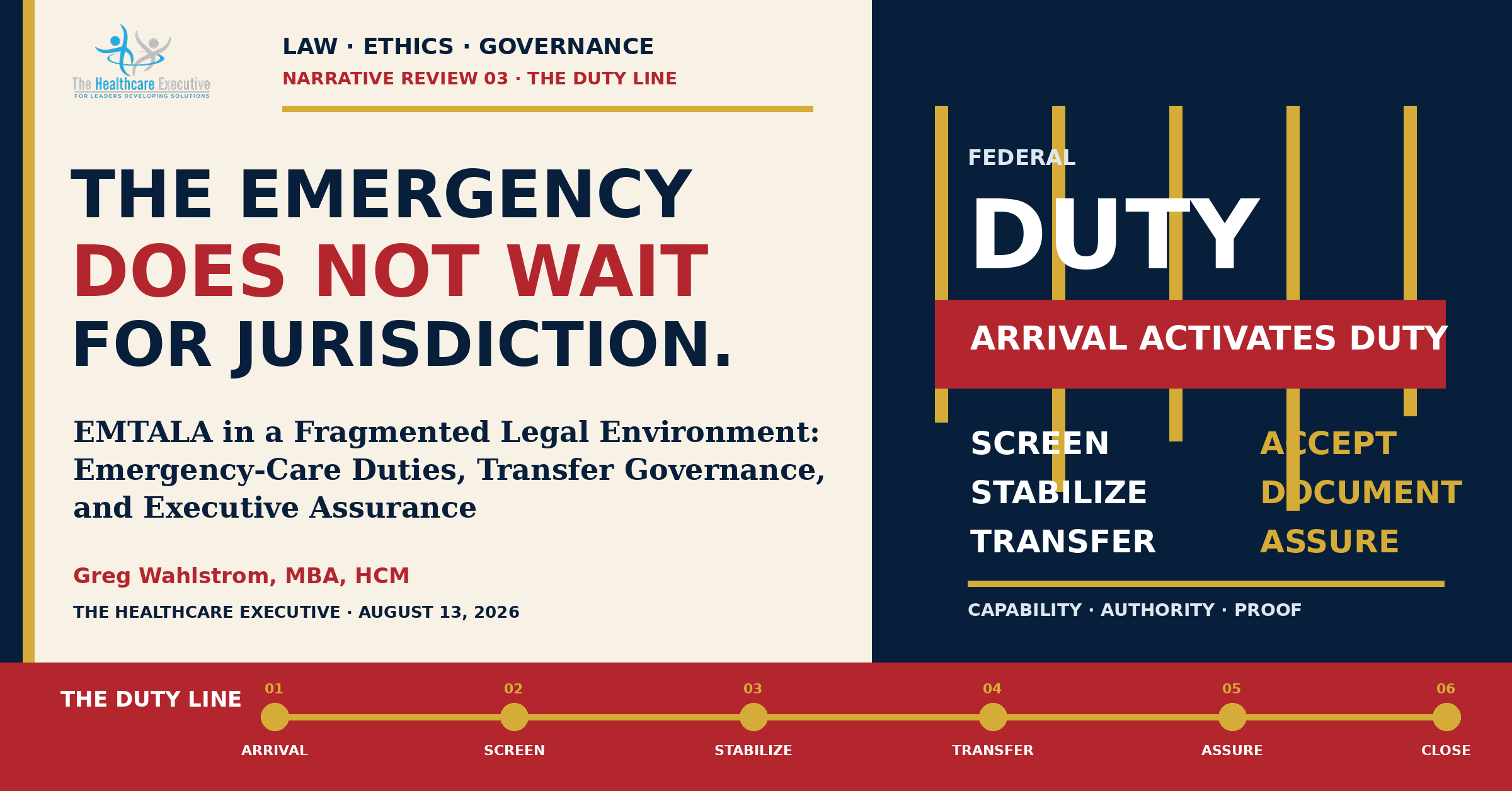

Executive Abstract
Background and Objective
The Emergency Medical Treatment and Labor Act (EMTALA) creates a national emergency-care floor, but hospitals perform its duties through local staffing, transfer networks, capacity decisions, documentation systems, and state legal environments. Failures often arise at operational handoffs rather than from an announced refusal of care. This review examines how hospital leaders can translate EMTALA into a reliable operating system for screening, stabilization, transfer, specialty response, and executive assurance.
Methods
A targeted PubMed/MEDLINE narrative search was completed on August 13, 2026 for English-language peer-reviewed research published from January 2000 through August 13, 2026. Eligible evidence addressed EMTALA enforcement, emergency screening, interhospital transfer, specialist access, psychiatric and obstetric emergencies, equity, documentation, implementation, or patient safety. Primary statutes, regulations, judicial decisions, and official agency materials were reviewed separately to describe controlling law and current federal policy.
Key Content and Findings
National studies show that EMTALA citations are uncommon per emergency visit but recurrent across hospitals and concentrated in identifiable organizational settings. Settlement reviews most often identify failures in medical screening, stabilization, or transfer. Transfer performance is constrained by recipient-hospital census, emergency-department boarding, specialist availability, rural capability, transport resources, and information continuity. Insurance-associated differences remain visible in several transfer populations. Psychiatric emergencies, minors, obstetric emergencies, and people arriving with law enforcement appear repeatedly in enforcement research. A defensible program requires consistent screening protocols, capability-based stabilization, documented capacity decisions, centralized transfer governance, enforceable on-call expectations, standardized handoffs, patient-centered consent, and board review of outcomes and unresolved risk.
Conclusions
EMTALA compliance should be managed as a patient-safety and access operating system, not as annual legal training. Every emergency-care transition should identify the duty, decision owner, clinical capability, time requirement, receiving agreement, transport plan, and retained proof. The emergency does not wait for jurisdiction, hierarchy, or administrative convenience.
Keywords: EMTALA; interhospital transfer; emergency care; hospital governance; patient safety
Introduction: The Emergency Does Not Wait for Jurisdiction
The Emergency Medical Treatment and Labor Act (EMTALA) establishes a federal duty to evaluate individuals who come to a covered hospital emergency department seeking examination or treatment and, when an emergency medical condition is identified, to provide stabilizing treatment within the hospital’s capability or an appropriate transfer [39,40]. The obligation is not limited to Medicare beneficiaries or people without insurance. It applies regardless of ability to pay, and screening or stabilizing treatment may not be delayed to obtain insurance authorization [39,40].
The statutory sequence appears simple. Hospital operations are not. A person may arrive at the main emergency department, an obstetric triage unit, a behavioral-health intake area, an off-campus dedicated emergency department, an ambulance entrance, a parking lot, or another part of hospital property. Screening may depend on laboratory, imaging, consultation, and qualified medical personnel. Stabilization depends on the staff and facilities actually available. Transfer depends on a physician’s risk-benefit judgment, receiving-hospital agreement, suitable personnel and transportation, complete records, and a shared understanding of the patient’s current condition. Recipient hospitals must distinguish a genuine lack of capacity from reluctance, service-line pressure, or financial preference.
Research demonstrates that these are operating-system problems. Between 2016 and 2022, investigators identified 3,889 deemed violations at 1,144 hospitals in 800 counties. Violations clustered geographically and among affiliated hospitals, and common findings included failures involving anti-dumping requirements and medical screening [1]. Earlier national research found that approximately 4.3% of covered hospitals were cited annually from 2005 through 2014, even though citations were rare when expressed per million emergency-department visits [3,4]. Qualitative research attributes noncompliance to financial incentives, weak knowledge, high referral burden, strained hospital-physician priorities, and reluctance to report transfer partners [2]. The pattern argues against treating every event as an isolated individual mistake.
This review advances a management premise: EMTALA is a real-time access and patient-safety operating system. Legal analysis defines the duty, but governance determines whether the duty reaches the patient at the right time. The objective is to synthesize peer-reviewed evidence and current primary legal authorities into an executive model for medical screening, stabilization, transfer, specialty response, documentation, equity, and assurance. This article is presented in accordance with the narrative review reporting checklist.
Methods
This narrative review used a purposive and reproducible search designed for hospital-management relevance. PubMed/MEDLINE was searched through August 13, 2026 for English-language peer-reviewed publications dated January 2000 through August 13, 2026. Search concepts combined EMTALA and the Emergency Medical Treatment and Labor Act with emergency medical screening, stabilization, civil monetary penalties, hospital citations, on-call specialists, psychiatric emergencies, obstetric emergencies, minors, law enforcement, interhospital or interfacility transfer, recipient-hospital acceptance, capacity, insurance, rural care, consent, documentation, handoff, transport, telemedicine, and patient safety.
Eligible evidence included empirical studies, mixed-methods research, systematic reviews, peer-reviewed implementation reports, and focused peer-reviewed clinical reviews that directly informed an executive decision, operating safeguard, or measurable risk. Priority was given to national, multisite, recent, or methodologically informative work. News reports, legal blogs, vendor marketing, unsupported commentary, and non-health-care analogies were excluded as evidence. Articles that described a proposed model without implementation or outcomes were not used to claim effectiveness.
The author conducted the search, relevance screening, selection, extraction, and citation verification. Reference lists and related PubMed records were reviewed for additional studies. Because the review was purposive, no duplicate independent screening, formal risk-of-bias instrument, or pooled effect estimate was used. Thirty-eight peer-reviewed articles were included in the final synthesis.
Legal research was conducted separately so that empirical findings would not be confused with statements of law. Primary sources included 42 U.S.C. § 1395dd, 42 CFR §§ 489.20 and 489.24, civil-money-penalty regulations, CMS interpretive guidance, and relevant judicial decisions and agency statements current through August 13, 2026 [39-46]. The review does not provide a fifty-state survey. Hospital counsel should evaluate state-specific emergency-care, transfer, consent, reproductive-health, behavioral-health, professional-licensure, and liability requirements.
| Element | Approach |
|---|---|
| Date of search | August 13, 2026 |
| Database and other sources | PubMed/MEDLINE; reference-list and related-record screening; primary legal authorities reviewed separately |
| Timeframe | January 1, 2000 through August 13, 2026 |
| Search concepts | EMTALA; emergency medical screening; stabilization; enforcement; transfer; recipient capacity; on-call coverage; psychiatric and obstetric emergencies; minors; law enforcement; rural access; insurance; consent; documentation; transport; telemedicine; assurance |
| Inclusion | English-language peer-reviewed empirical studies, mixed-methods research, systematic reviews, implementation reports, and focused clinical reviews relevant to hospital governance or emergency-care operations |
| Exclusion | News; legal blogs; vendor marketing; unsupported commentary; non-health-care examples; proposals used as proof of effectiveness; publications after the search date |
| Selection process | Single-author relevance screening and selection; no duplicate independent review; citation and DOI verification completed |
| Synthesis | Purposive narrative synthesis; no formal risk-of-bias instrument or pooled estimate |
The Duty Begins Before the Organization Is Ready
The operational trigger is broader than arrival at a registration desk. The regulation defines when an individual “comes to the emergency department,” including presentation at a dedicated emergency department, certain presentations elsewhere on hospital property, and specified ambulance circumstances [40]. The request for examination or treatment can be explicit or inferred when a prudent layperson would believe from appearance or behavior that emergency evaluation is needed [40]. A hospital cannot design its front door so narrowly that patients fall outside the process while remaining inside the legal trigger.
The Supreme Court has also held that an EMTALA stabilization claim does not require proof of an improper motive [43]. The operational question is therefore whether the required screening, stabilization, and transfer duties were performed—not whether someone admits to a discriminatory purpose.
This matters because enforcement cases repeatedly involve redirection. In a review of civil monetary penalty settlements from 2002 through 2015, 75% involved failure to screen, 42.7% involved failure to stabilize, and cases also involved inappropriate transfer, failure to transfer, refusal to accept transfer, on-call nonresponse, and inappropriate discharge [5]. Among settlements involving minors from 2002 through 2023, 86.8% involved failure to provide a medical screening examination, and nearly one-third involved staff directing a minor or guardian to another facility, commonly by private vehicle, or to an on-campus outpatient clinic without the required process [8]. Research involving patients who arrived with law enforcement found similar risks when staff treated police custody, behavioral disruption, or intoxication as a substitute for emergency evaluation [10].
Hospitals therefore need one arrival doctrine across registration, security, parking, labor and delivery, outpatient departments, urgent care, behavioral health, and ambulance operations. The policy should answer who activates the central log, who can initiate immediate clinical evaluation, when security or law enforcement remains present, and how staff respond if a patient leaves before completion. Scripts should never direct a person to another facility, physician office, or clinic before the legally required screening pathway has been completed.
The board should not receive only a count of substantiated violations. It should receive leading indicators: people redirected before screening, departures before evaluation, security-assisted removals, registration delays, repeat complaints, missing central-log entries, and cases in which staff were uncertain whether EMTALA applied. A low number of federal penalties does not prove a reliable process. National enforcement studies show that sanctions are an incomplete and delayed view of risk [3-5].
| Operating moment | Core federal duty | Named decision owner | Required proof | Escalation trigger |
|---|---|---|---|---|
| Arrival or request | Recognize presentation and enter the emergency pathway without financial delay | Charge clinician and registration leader | Central-log entry, arrival time, presenting request, disposition | Redirection, delayed triage, security involvement, or uncertain location status |
| Medical screening | Provide an appropriate examination within emergency-department capability by qualified personnel | Qualified medical person under hospital bylaws | Screening elements, reassessment, ancillary services, determination of emergency medical condition | Incomplete capability, inconsistent protocol, refusal, departure, or diagnostic uncertainty |
| Stabilization | Provide treatment within available capability to prevent material deterioration | Treating physician with clinical operations support | Condition, treatment, response, unresolved risk, capability limits | Required service unavailable, deterioration, time-critical condition, or on-call failure |
| Transfer | Meet every element of an appropriate transfer when an unstabilized patient must move | Treating physician and transfer-center leader | Risk-benefit certification, receiving acceptance, records, transport mode, personnel and equipment | No accepting facility, disputed capacity, transport delay, incomplete records, or patient refusal |
| Recipient decision | Accept an appropriate transfer requiring specialized capability when capacity exists | Receiving physician and administrator with authority | Capability, capacity, decision time, reason for decline, alternate pathway | Repeated decline, conflicting census data, financial discussion, or executive override |
| Closure | Verify arrival, handoff, outstanding results, event review, and corrective action | Transfer-center quality owner | Arrival confirmation, handoff completion, late records, adverse events, action closure | Unexpected deterioration, return transfer, lost information, complaint, or potential violation |
Presentation activates the duty
- Dedicated emergency departmentAn explicit request or a presentation that a prudent layperson would recognize enters the emergency pathway.
- Hospital propertyParking, entrances, security posts, and clinical departments cannot become ungoverned gaps.
- Ambulance circumstancesDiversion status and ownership do not replace condition-specific evaluation of the regulatory trigger.
- Observed needBehavior, appearance, custody, pregnancy, intoxication, or disability may communicate the request without scripted words.
Medical Screening Is a Clinical Process, Not a Triage Label
EMTALA requires an appropriate medical screening examination within the capability of the hospital’s emergency department, including ancillary services routinely available, to determine whether an emergency medical condition exists [39,40]. The examination must be performed by personnel whom the hospital has identified as qualified through its bylaws, rules, or regulations [40]. Triage prioritizes urgency. It does not by itself establish the absence of an emergency medical condition.
The word “appropriate” does not create a universal test panel for every complaint. It does require the hospital to apply a clinically credible and nondiscriminatory process within its capability. CMS interpretive guidance examines whether screening was comparable to that offered to people with similar signs and symptoms and whether the hospital used routinely available resources [42]. A policy that says “medical screening examination completed” without defining complaint-specific minimums, reassessment, and escalation invites inconsistency.
Vulnerable presentations expose weak screening design. Enforcement research involving psychiatric emergencies found that 84% of relevant settlements included failure to provide an appropriate screening examination [9]. Among cases involving law enforcement, patients with psychiatric concerns were sometimes sent elsewhere or to jail without adequate screening [10]. Obstetric settlement research likewise found screening failures in 82% of obstetric-related cases [7]. The common failure is premature categorization: “behavioral,” “pregnant,” “intoxicated,” “pediatric,” “uninsured,” or “belongs elsewhere.” The law requires an examination of the condition, not a disposition based on the label.
Hospitals should define screening pathways for high-risk presentations while preserving clinical judgment. Each pathway should specify qualified personnel, routinely available ancillary services, reassessment intervals, consultation triggers, refusal documentation, language support, and the point at which an emergency medical condition is ruled in or out. Rural screening and referral programs can redirect nonemergency care only after a compliant medical screening process and depend on consistent staff training and real alternative capacity [37].
Screening governance should also examine unwarranted variation. Leaders can compare the clinical workup, consultation pattern, disposition, and elapsed time for patients with similar presentations while adjusting for acuity and available capability. A difference is not automatically a violation; clinical judgment and patient circumstances matter. The purpose is to identify pathways in which insurance questions, arrival location, behavioral labels, disability, language, custody status, pregnancy, or service ownership repeatedly change what happens before a clinician determines whether an emergency condition exists. Case review should begin with the patient’s presentation and the hospital’s available capability, not with the eventual diagnosis. Sampling should include encounters without complaints or penalties, because a reliable program tests ordinary work before an adverse event exposes it. Findings should return to bylaws, staffing, order sets, consultation expectations, and front-door scripts so that review changes the operating system rather than producing another educational memo.
Stabilization Is a Capability Decision
When the hospital determines that an emergency medical condition exists, it must provide further examination and treatment within the capabilities of the staff and facilities available to stabilize the condition or complete an appropriate transfer [39,40]. “Stabilized” is tied to whether material deterioration is likely, within reasonable medical probability, to result from or occur during transfer [40]. The standard is therefore clinical and operational. It cannot be satisfied by a generic “stable for transport” field detached from the actual condition, route, personnel, equipment, and time.
Capability is not limited to a licensed service name. It includes the staff, facilities, and routinely available resources that can be brought to the patient. Leaders need a current capability registry covering imaging, laboratory support, blood products, respiratory support, operating rooms, obstetrics, pediatrics, behavioral health, critical care, and specialty response. The registry must distinguish a capability that does not exist from a capable service that is temporarily unavailable or unwilling to respond.
The growing acuity of transferred patients makes this distinction more important. A national analysis estimated nearly 9.9 million adult emergency-department transfers from 2018 through 2022; 6.6% involved at least one critical procedure, and the frequency of transfers involving most studied critical procedures increased over time [34]. In a 2026 mixed-methods study, adverse events were identified in 64.9% of 57 transfers with complete data, including clinical, logistical, and technical events. Clinicians identified equipment, organizational resources, preparation, and process complexity as barriers [33]. These studies do not establish that transfer itself caused every adverse event. They show that stabilization and transport readiness require more than acceptance and an ambulance.
Telemedicine can support capability but does not erase accountability. An eight-state burn telemedicine program found that images influenced transfer decisions and could support more informed triage [36]. The operating question is whether remote expertise changes the patient’s treatment, transfer destination, transport resources, or time to definitive care. A video connection without decision authority or local execution capacity adds consultation but may not add stabilization.
Executives should treat stabilization readiness as a time-sensitive capability portfolio. For each high-risk condition, the hospital should identify the actions that must occur immediately, the resources that can be mobilized within defined operational intervals, the point at which local capability is exhausted, and the person authorized to escalate. Drills should test blood, airway, imaging, operating-room, obstetric, pediatric, behavioral-health, pharmacy, and transport dependencies during nights, weekends, simultaneous emergencies, and downtime. The record should show not only what was ordered but when the need was recognized, when the resource was requested, when it arrived, what changed clinically, and why transfer timing remained reasonable. Rising national use of critical procedures among transferred patients and the frequency of clinical, logistical, and technical adverse events in transfer research support this broader readiness model [33,34]. A capability registry that is not reconciled with staffing, equipment, and actual response performance can create false reassurance.
Capability is a live fact
- Staff Who can respond now?
- Name qualified personnel, backup coverage, and response time—not merely a service on the medical-staff roster.
- Facilities What can be used now?
- Register imaging, operating capacity, blood products, respiratory support, specialty beds, and downtime constraints.
- Condition What risk remains?
- Connect capability to the emergency condition, treatment response, transport route, and foreseeable deterioration.
- Authority Who may decide?
- Make escalation authority explicit when the needed resource is delayed, disputed, temporarily unavailable, or unwilling.
A licensed service is not proof of available capability. A blank schedule is not proof that capability does not exist.
Appropriate Transfer Is an Evidence Chain
An unstabilized patient may be transferred only under defined conditions. The individual may request transfer after being informed of the hospital’s obligations and transfer risks, or a physician may certify that the reasonably expected medical benefits of treatment at another facility outweigh the increased risks of transfer [39,40]. An appropriate transfer further requires risk-minimizing treatment within the sending hospital’s capacity, acceptance by a receiving facility with available space and qualified personnel, transmission of relevant records, and transport by qualified personnel and equipment, including medically appropriate life support [40].
Each element must be true at the same time. A signed form does not cure a receiving hospital that never accepted the patient. A receiving physician’s name does not cure inadequate transport. An available ambulance does not cure unresolved airway, hemorrhage, hypertension, agitation, or labor risk. A patient signature does not prove meaningful participation when the conversation occurred during pain, stress, language discordance, or uncertainty about cost.
Patient-centered transfer consent needs improvement. A mixed-methods study of older adults and care partners found perceived lack of agency, logistical burden, family disruption, billing uncertainty, and variable trust. Direct observation showed considerable variation in transfer-consent practices and barriers involving privacy, support persons, pain, psychological stress, language, and health literacy [16]. Leaders should not reduce transfer communication to legal recitation. The patient or representative needs the reason for transfer, expected benefit, material risk, destination, transport plan, likely waiting, alternatives, and what happens if the transfer is refused.
Transfer governance should separate five decisions that are often collapsed into one telephone call: whether an emergency medical condition exists; what stabilization is possible locally; what capability is needed next; whether the proposed recipient has accepted and can provide it; and whether the transport plan is clinically appropriate. Each decision needs a named owner and time stamp. The transfer center can coordinate the chain, but it should not substitute an administrative preference for the treating clinician’s medical judgment or the recipient’s capacity determination. When delay accumulates, the sending team should reassess the patient, reconsider destination and transport resources, update the recipient, and document the response. The safest transfer packet is a living clinical record through departure, not a form completed once and left unchanged while the patient’s condition evolves. If a person refuses, the hospital should continue clinically indicated care within its capability, document the discussion, and provide a feasible safety plan rather than using refusal as administrative closure.
| Required element | Operational test | Retained evidence | Common failure mode |
|---|---|---|---|
| Risk-minimizing treatment | Has the sending hospital used its available capability to reduce deterioration risk? | Current examination, treatment, response, vital trends, unresolved risk | “Stable” documented without condition-specific preparation |
| Medical benefit outweighs risk | Is the anticipated higher-level benefit specific and greater than transport risk? | Physician certification with patient-specific benefits and risks | Generic certification, copied language, or missing reassessment |
| Receiving agreement | Has a facility with the needed capability, qualified personnel, and space agreed to accept? | Accepting facility, clinician, time, service, bed or pathway | Informal discussion mistaken for acceptance |
| Records | Will the receiving team have the information needed at or before arrival? | History, findings, diagnostics, treatment, pending results, images, consent or certification | Paper packet delayed, imaging unavailable, pending result never sent |
| Personnel and equipment | Can the transport team manage foreseeable deterioration throughout the route? | Mode, crew level, equipment, medications, monitoring, contingency plan | Transport chosen by availability rather than clinical need |
| Patient communication | Did the patient or representative understand purpose, risks, logistics, alternatives, and refusal consequences? | Conversation, interpreter, questions, consent or informed refusal | Signature without comprehension or meaningful choice |
| Closed-loop handoff | Did the patient arrive, and did responsibility and outstanding work transfer explicitly? | Departure and arrival times, verbal handoff, named receiver, late-record reconciliation | No arrival confirmation or unassigned pending results |
Every link must hold
- 01TreatMinimize risk using available capability.
- 02CertifyName the patient-specific benefit and transport risk.
- 03AcceptRecord the receiving clinician, service, and time.
- 04TransmitSend the record, images, and pending work.
- 05TransportMatch crew, equipment, and contingency to risk.
- 06CloseConfirm arrival, handoff, late results, and ownership.
Recipient Responsibility Requires a Defensible Capacity Decision
A participating hospital with specialized capabilities or facilities may not refuse an appropriate transfer of an individual who needs those capabilities when the receiving hospital has capacity [40]. The rule applies to specialized recipient hospitals even if they do not operate a dedicated emergency department [40]. Capacity includes the ability to accommodate the person, considering staff, beds, equipment, and the hospital’s past practices in accommodating patients beyond ordinary occupancy limits [40].
Capacity is dynamic, but it cannot be impressionistic. A 2025 study of 26,020 transfer requests found that 61.7% were accepted. Worse emergency-department boarding and higher inpatient census were strongly associated with lower acceptance, and rural requests had lower adjusted odds of acceptance than urban requests [15]. These findings reveal a real conflict: referral centers must protect patients already inside while serving regional patients who need specialized care. They do not support an unlimited acceptance duty. They do support accurate, time-stamped, service-specific capacity decisions and escalation when the clinical need is urgent.
A centralized transfer center can strengthen consistency. Earlier research found value in joint physician-administrator transfer decisions, with more than 90% of accepted adult transfers requiring tertiary care or meeting EMTALA criteria and a stable payer mix during the study period [13]. The lesson is not that administrators should veto clinical obligations. It is that one accountable operating forum can integrate capability, census, staffing, financial neutrality, and escalation rather than forcing clinicians to negotiate through scattered calls.
Every acceptance or decline should record requested service, patient condition, sending-hospital capability, receiving capability, real-time capacity, decision maker, decision time, and reason. Financial clearance should remain outside the screening, stabilization, and acceptance decision. Repeated declines from the same service, delayed callbacks, or discrepancies between recorded capacity and actual admissions should trigger independent review.
A defensible capacity process needs both a bedside view and an enterprise view. Bed status alone is insufficient if the required nurse, specialist, equipment, isolation capability, or procedural access is unavailable; conversely, a high census does not by itself prove that the hospital lacks capacity for a time-critical patient. The escalation pathway should permit rapid reconciliation among the accepting clinician, transfer center, bed management, nursing supervision, and an administrator empowered to resolve conflicting information. Leaders should track requests by origin, service, clinical urgency, decision time, acceptance, decline reason, later internal admissions, and patient outcome. Review should distinguish isolated operational constraints from patterned avoidance and should examine whether surge practices used for the hospital’s own patients were considered consistently for transfer patients. This makes capacity an auditable clinical-operating decision rather than an undocumented impression.
Capacity must survive review
or prove
the limit.
On-Call Coverage Is a Hospital Promise
Hospitals must maintain an on-call list and written policies addressing circumstances in which a specialty is unavailable or an on-call physician cannot respond [40]. Regulations also address elective surgery and simultaneous call while on call [40]. The legal structure recognizes that a hospital need not provide every specialty continuously. It does not permit a hospital to advertise or schedule a capability without a reliable response plan.
Specialty scarcity remains an operational threat. In a California survey, fewer than 60% of responding emergency departments reported on-call coverage for several surgical specialties, rural hospitals had less coverage, and more than 40% of transfers for selected specialties and mental health reportedly took longer than three hours [12]. Physician-penalty research found that seven of eight individual settlements involved on-call specialists, including failure to respond and failure to accept a higher-level transfer [6]. These findings are older, but the governance problem remains current: a coverage schedule is not the same as available care.
Medical-staff bylaws, employment agreements, transfer-center protocols, and service-line plans should use one definition of response. The standard should specify callback time, bedside time when requested, consultation content, authority to activate transfer, documentation, backup coverage, and escalation if the physician is in surgery, simultaneously on call, ill, or otherwise unable to respond. A service cannot solve persistent nonresponse by instructing the emergency physician to transfer every case without first using available hospital capability.
Education must include clinicians and administrators. A one-hour intervention improved trainee knowledge and comfort with medical and legal transfer concepts, while also revealing limited prior formal education despite frequent transfer involvement [14]. Training should use actual scenarios, disputed capacity, unavailable specialists, psychiatric emergencies, labor, minors, patient refusal, and late diagnostic results. Policy recall is not the goal. Timely execution is.
Psychiatric Emergencies Require the Same Governance Discipline
The federal definition of emergency medical condition expressly includes psychiatric disturbances and symptoms of substance abuse when the severity criteria are met [40]. Yet psychiatric care is frequently separated from the hospital’s main emergency operating system. Enforcement research found that 19% of studied civil monetary penalty settlements involved psychiatric emergencies. Common findings included failures in screening, stabilization, and transfer, and psychiatric-related settlements were larger on average than nonpsychiatric settlements in that sample [9]. Cases involving law enforcement demonstrate the danger of allowing custody, disruption, intoxication, or behavioral labeling to displace clinical evaluation [10].
Capacity constraints are substantial. National research found psychiatric patients had markedly higher odds of boarding and longer boarding than nonpsychiatric patients [28]. Another study found that psychiatric visits, severe illness, substance use, younger age, Black race, urban residence, and certain discharge destinations were associated with higher boarding risk; greater local mental-health resources were associated with reduced pressure through fewer psychiatric emergency visits [27]. A two-hospital study found especially long boarding among uninsured patients and people awaiting publicly funded psychiatric placement [29].
Boarding does not suspend the duty to reassess, treat coexisting conditions, protect dignity, and manage deterioration. “Medically cleared” should not be a terminal status. The record should state what emergency medical and psychiatric conditions were evaluated, what remains active, what treatment is continuing, what risks require observation, and what capability the receiving program must provide.
The operating plan for psychiatric boarding should specify ownership during every hour of the wait. Emergency clinicians retain responsibility for changing medical conditions; behavioral-health professionals should define the psychiatric evaluation and treatment plan; nursing should have clear observation, environmental-safety, medication, nutrition, hygiene, and communication standards; and leadership should remove barriers that cannot be solved at the bedside. Reassessment should occur after restraint, sedation, elopement attempts, medication changes, new symptoms, or a material transfer delay. Hospitals should review whether boarding location, security practices, communication, and access to therapeutic activity create preventable harm. Because local mental-health resources and telepsychiatry may change disposition and boarding pressure, regional contracting and capability investment belong in the same governance discussion as compliance [27,30]. A psychiatric patient waiting for placement remains a hospital patient with active clinical needs, not a completed transfer request.
Regional models and telepsychiatry can reduce unnecessary transfer or hospitalization for selected patients. In a statewide program, telepsychiatry availability was associated with more discharges home and fewer transfers to psychiatric facilities in defined length-of-stay groups [30]. The result supports capability expansion, not blanket discharge. Governance should measure timely psychiatric evaluation, restraint exposure, medication delays, repeat reassessment, boarding duration, patient injury, staff injury, transfer completion, and return visits.
Obstetric Emergencies Operate in a Fragmented Legal Environment
EMTALA’s definition of emergency medical condition expressly addresses pregnant patients and labor [39,40]. Hospitals without inpatient obstetric services still need an emergency pathway for screening, initial stabilization, unanticipated delivery, hemorrhage, hypertensive emergencies, neonatal resuscitation, and transfer to an appropriate obstetric level of care [35]. The decline of rural obstetric capability makes advance transfer relationships and readiness essential.
A systematic review of obstetric triage literature identified legal duties, acuity tools, patient flow, clinical decision support, education, and advanced nursing practice as connected elements of a reliable triage model [38]. That evidence supports an integrated pathway rather than treating EMTALA as a form completed after obstetric triage.
The empirical record identifies recurring failures. Among 232 civil monetary penalty settlements from 2002 through 2018, 39 involved labor or other obstetric emergencies. Screening, stabilization, and transfer failures were common, and 38% involved a provider directing a pregnant patient to another hospital, typically by private vehicle [7]. A later difference-in-differences study reported an increase in obstetric-related EMTALA violations in states that adopted abortion bans without a meaningful health exception, including a measurable change associated with Texas Senate Bill 8 during the study period [24]. A 2024 transport study further demonstrates why labor progression and transport risk require condition-specific assessment rather than a generic transfer decision [25].
Clinical uncertainty has increased after Dobbs. In a 2024 survey, 24% of emergency physicians in restrictive or semi-restrictive states reported delays in managing suspected or confirmed ectopic pregnancy, and 54% reported adaptations such as repeat testing or arranging alternative care [23]. National emergency-department research shows that early-pregnancy complications represent a substantial and clinically important emergency-care population [26]. These findings are observational and survey-based, but they document an operational consequence of legal uncertainty.
The federal legal landscape is unresolved in important respects. In Moyle v. United States, the Supreme Court dismissed review as improvidently granted and did not decide the merits of the asserted conflict between EMTALA and Idaho law [44]. The Fifth Circuit affirmed an injunction against enforcement of the federal government’s 2022 pregnancy-specific guidance against Texas and named plaintiffs, and the Supreme Court denied review [45]. CMS rescinded the 2022 pregnancy-specific guidance in 2025 while stating that it would continue to enforce EMTALA for all individuals, including identified emergency medical conditions that place the health of a pregnant woman or unborn child in serious jeopardy [46].
Hospital leaders should not ask bedside clinicians to resolve this fragmentation alone. The operating model should provide jurisdiction-specific counsel, a rapid legal-escalation pathway that does not delay necessary evaluation and treatment, protection for good-faith clinical judgment, obstetric and emergency-physician co-leadership, transport agreements, simulation, and retrospective review. A committee approval queue that predictably delays care is not a safety control.
Legal-change management should operate with the same discipline as a clinical safety alert. Counsel should identify what changed, the jurisdictions and services affected, the effective date, the bedside decision that may be altered, the interim rule, the escalation contact, and the evidence that staff received and understood the change. Emergency, obstetric, pharmacy, nursing, transfer-center, compliance, and medical-staff leaders should test the revised pathway together before relying on an email or policy acknowledgment. The review should include what clinicians must do while legal advice is being obtained and who has authority when delay could worsen the patient’s condition. After implementation, leaders should examine actual cases for treatment delay, repeat testing, unnecessary transfer, clinician uncertainty, and patient harm. This approach does not remove legal conflict, but it prevents conflicting interpretations from becoming an unmanaged bedside queue.
One clinical clock. Multiple legal layers.
Screen within capability. Stabilize within capability or complete an appropriate transfer.
Do not let financial clearance, committee queues, or jurisdictional uncertainty replace the patient-specific duty.
State emergency-care, transfer, consent, reproductive-health, behavioral-health, licensure, and liability requirements may alter the operating path.
Local counsel defines the current rule and the rapid escalation path before the case arrives.
Equity Must Be Tested in Both Directions
EMTALA was enacted to address access failures associated with patient dumping, but unequal transfer patterns remain. Among more than 703,000 admissions for critically ill patients with acute respiratory failure, uninsured patients had lower adjusted odds of interhospital transfer, slower transfer, and higher mortality or hospice discharge than commercially insured patients [19]. In contrast, a national study of emergency visits for ST-elevation myocardial infarction found uninsured patients were more likely to be transferred, potentially exposing them to longer time to definitive treatment [20]. These findings are not contradictory. Transfer can represent access to needed capability or displacement from a capable hospital. Equity analysis must evaluate appropriateness, timing, destination, and outcome, not transfer rate alone.
Potential overtransfer also burdens patients and systems. More than one-quarter of emergency-general-surgery transfers in one large study met the authors’ definition of potentially avoidable transfer, with hospital characteristics explaining substantial variation [21]. In the Veterans Health Administration, rural residents transferred more often, mental-health and cardiac conditions were common, and 22.8% of VHA-to-VHA transfers met the study’s potentially avoidable definition [22]. Telemedicine, local protocols, and specialist consultation may allow selected patients to remain closer to home, but undertransfer can be equally harmful.
An academic-center study found demographic differences across transfer eligibility and consent stages, illustrating why leaders must examine the complete pathway rather than only completed transfers [31]. The equity dashboard should stratify screening delay, transfer request, acceptance, time to acceptance, transport delay, distance, refusal, deterioration, and outcome by insurance, race and ethnicity, preferred language, disability, age, geography, and other lawful and methodologically appropriate variables. Small numbers and clinical differences require careful interpretation. The purpose is to find process inequity, not to infer motive from an unadjusted rate.
Documentation, Handoff, and Transport Carry the Duty Forward
The transfer record is not paperwork added after the clinical decision. It is part of the treatment and safety system. For unstabilized transfers, the regulation requires the sending hospital to transmit available records related to the emergency condition, including history, observations, preliminary diagnosis, diagnostic results, treatment, required consent or certification, and certain on-call information. Additional results must follow as soon as practicable [40].
Empirical work shows the gap. In transferred patients with acute aortic dissection, only 36.6% of records met the study’s standard for adequate clinical-care documentation and 57.8% met its EMTALA documentation standard. Inadequate EMTALA documentation was associated with a higher likelihood of missing the recommended departure blood-pressure target [11]. Qualitative research found that incomplete, inaccurate, excessive, or late information created uncertainty about responsibility, delays, and inappropriate triage at the receiving hospital [17].
Standardization can improve performance. A Veterans Affairs quality-improvement project reduced median time to electronic document availability from 33 days to zero days for the covered workflow, although the proportion with uploaded records remained incomplete and after-hours transfers remained a gap [18]. A pediatric electronic-handoff initiative reduced monthly calls routed through a telecommunications center by 81.5% without reported balancing-measure harm during the project [32]. These interventions show that the transfer record should be designed as a shared clinical product, not an incidental packet.
Hospitals should define a minimum transfer data set: patient identity; decision-capable representative; sending and receiving clinicians; emergency condition; current severity; treatment and response; allergies; medications and infusions; airway and access; relevant images and diagnostics; pending results; infection precautions; behavioral or elopement risk; transport requirements; code status when known; and the next action expected after arrival. Verbal handoff and electronic transfer should be complementary. One should not be assumed to replace the other.
Information governance must also assign ownership for records that become available after departure. A pending laboratory, imaging, culture, or consultant result should have a named sender, transmission method, receiving contact, time expectation, and escalation rule if acknowledgment is not obtained. Downtime plans should specify the minimum paper record, image-transfer alternative, secure communication channel, and reconciliation process after systems recover. Transfer documentation metrics should measure clinical availability at the receiving bedside, not merely whether a file was sent from the sending system.
The duty closes only when the organization confirms departure, safe arrival, assumption of responsibility, delivery of late results, and review of unexpected deterioration. Transfer-center data should connect request, acceptance, transport, clinical outcome, patient complaint, and corrective action.
The duty travels with the patient
An Executive EMTALA Assurance System
Reliable compliance requires a named accountable executive and clear division of work among emergency medicine, nursing, medical staff, transfer center, bed management, obstetrics, behavioral health, security, emergency medical services, compliance, risk, legal counsel, quality, and information technology. The accountable executive should not make every bedside decision. The role is to ensure that the duty, authority, evidence, and escalation path remain connected.
The operating system should have six components:
Routine review should be continuous, not annual. Daily operations should surface unresolved transfers, specialist delay, and capacity disputes. Weekly review should examine redirections, departures, delayed screening, incomplete transfer packets, and adverse transport events. Monthly review should test service-level patterns, payer neutrality, equity, and repeat failures. Quarterly executive review should reconcile complaints, quality events, compliance referrals, and transfer-center data. Annual board assurance should test the design and operation of the entire pathway.
Assurance should combine data review with direct process testing. Tracers can begin with a real presentation and follow the central log, screening documentation, capability decision, on-call response, transfer request, acceptance, transport, record transmission, arrival confirmation, complaint history, and corrective-action closure. The sample should deliberately include nights, weekends, psychiatric and obstetric presentations, minors, people in custody, departures before completion, declined transfers, long-distance transports, and cases without an adverse outcome. Interviews should test whether staff know who can act when the policy does not fit the case. Leaders should compare the written capability registry with actual staffing and response times, and should verify that a corrective action changed performance rather than merely closing an item in software. A credible program protects good-faith reporting and avoids incentives that reward fewer escalations or complaints without proving safer care.
| Domain | Primary proof | Balancing measure |
|---|---|---|
| Arrival and screening | Central-log completeness; time to qualified screening; redirections; departures before completion; complaint review | Triage burden; left-without-being-seen rate; language and disability access |
| Stabilization | Condition-specific treatment and reassessment; unresolved-risk documentation; capability use | Deterioration, unplanned escalation, delayed definitive care |
| Transfer | Request-to-decision time; acceptance; transport delay; complete certification and records; arrival confirmation | Avoidable transfer, undertransfer, patient travel burden, return transfer |
| Recipient capacity | Declines by service and reason; census and staffing evidence; executive overrides; repeated sending hospitals | Harm to patients already present; surge reserve; staff workload |
| On-call response | Call-back and bedside response time; backup activation; failure-to-appear events | Specialist burden, simultaneous coverage, unavailable capability |
| Psychiatric and obstetric readiness | Screening, stabilization, boarding, transfer completion, simulation, legal escalation | Restraint, elopement, treatment delay, transport risk, staff safety |
| Equity | Screening and transfer performance by insurance, race and ethnicity, language, age, disability, and geography where appropriate | Case-mix distortion, small-number instability, stigmatizing interpretation |
| Documentation and learning | Record completeness; late-result closure; complaint linkage; corrective-action aging | Documentation burden, duplicate work, alert fatigue |
The governing question is not “Did staff complete EMTALA training?” It is “Can the hospital prove that every material emergency-care transition had a recognized duty, qualified decision maker, available capability assessment, timely action, safe transfer when needed, and closed-loop evidence?”
Assurance is continuous
Strengths and Limitations
This review integrates 38 peer-reviewed publications with current primary federal legal authorities and translates them into an executive operating model. It separates empirical findings from statements of law, includes recent enforcement and transfer research, and addresses medical, psychiatric, obstetric, pediatric, rural, equity, and information-continuity risks.
Several limitations apply. This was a purposive narrative review using one bibliographic database, not a systematic review. Selection and extraction were conducted by one author without duplicate screening or formal risk-of-bias scoring. The evidence is heterogeneous and includes retrospective cohorts, surveys, qualitative studies, settlement reviews, implementation reports, systematic reviews, and single-system projects. Enforcement settlements represent selected events and do not estimate the incidence of all violations. Transfer studies use different definitions of appropriateness, capacity, boarding, stabilization, and adverse events. Associations involving insurance, geography, or hospital characteristics do not establish discriminatory intent or causation.
The law continues to evolve. This review is not a fifty-state analysis, and federal litigation concerning emergency pregnancy care has not produced one nationwide merits rule resolving every conflict. Local counsel must evaluate current jurisdiction-specific requirements. The article does not substitute for bedside clinical judgment, legal advice, or CMS survey guidance.
Conclusions
EMTALA protects access through a sequence of operational promises: recognize the presentation, provide an appropriate medical screening examination, use available capability to stabilize an emergency medical condition, transfer safely when necessary, accept appropriate transfers when specialized capability and capacity exist, and preserve proof.
Hospitals fail when that sequence is divided among unconnected departments. The corrective strategy is one accountable emergency-care operating system with a central arrival doctrine, consistent screening, a live capability registry, enforceable on-call response, disciplined transfer-center governance, patient-centered communication, complete handoffs, equity review, and board assurance. Training supports the system but cannot replace it.
The emergency does not wait for jurisdiction, hierarchy, bed meetings, financial clearance, or administrative convenience. Hospital leaders must ensure that authority and capability reach the patient before delay becomes harm.
Acknowledgments
None.
Publication Statements
Reporting Checklist: The author has completed the narrative review reporting checklist.
Funding: None.
Conflicts of Interest: The author has completed the ICMJE uniform disclosure form. The author is President and Chief Executive Officer of The Healthcare Executive. No other conflicts of interest are declared.
Ethical Statement: The author is accountable for all aspects of the work in ensuring that questions related to the accuracy or integrity of any part of the work are appropriately investigated and resolved. This narrative review did not involve human participants or animals; institutional review board approval and informed consent were not applicable.
Data Sharing Statement: No original datasets were generated or analyzed for this narrative review. The search strategy and evidence sources are reported in the manuscript and supplementary material.
Disclaimer: The views expressed are those of the author and are intended for executive education. This article does not constitute legal, regulatory, clinical, reimbursement, labor, accounting, insurance, or investment advice. Organizations should obtain advice specific to their facts and jurisdiction.
References
- Planey AM, Singer E, Lewis JA, Shaffer J. The spatial patterning of recent Emergency Medical Treatment and Labor Act violations in the United States. Ann Emerg Med. 2025;86(3):215-224. doi:10.1016/j.annemergmed.2025.04.019.
- Hsuan C, Horwitz JR, Ponce NA, Hsia RY, Needleman J. Complying with the Emergency Medical Treatment and Labor Act (EMTALA): challenges and solutions. J Healthc Risk Manag. 2018;37(3):31-41. doi:10.1002/jhrm.21288.
- Terp S, Seabury SA, Axeen S, Pines JM, Lam CN, Arientyl V, et al. The association between hospital characteristics and Emergency Medical Treatment and Labor Act citation events. Med Care. 2020;58(9):793-799. doi:10.1097/MLR.0000000000001360.
- Terp S, Seabury SA, Arora S, Eads A, Lam CN, Menchine M. Enforcement of the Emergency Medical Treatment and Labor Act, 2005 to 2014. Ann Emerg Med. 2017;69(2):155-162.e1. doi:10.1016/j.annemergmed.2016.05.021.
- Zuabi N, Weiss LD, Langdorf MI. Emergency Medical Treatment and Labor Act (EMTALA) 2002-15: review of Office of Inspector General patient dumping settlements. West J Emerg Med. 2016;17(3):245-251. doi:10.5811/westjem.2016.3.29705.
- Terp S, Wang B, Raffetto B, Seabury SA, Menchine M. Individual physician penalties resulting from violation of Emergency Medical Treatment and Labor Act: a review of Office of the Inspector General patient dumping settlements, 2002-2015. Acad Emerg Med. 2017;24(4):442-446. doi:10.1111/acem.13159.
- Terp S, Wang B, Burner E, Arora S, Menchine M. Penalties for Emergency Medical Treatment and Labor Act violations involving obstetrical emergencies. West J Emerg Med. 2020;21(2):235-243. doi:10.5811/westjem.2019.10.40892.
- Terp S, Ahmed S, Reichert Z, Calero K, Sison O, Axeen S, et al. Civil monetary penalties for EMTALA violations involving minors, 2002-2023. Hosp Pediatr. 2024;14(8):674-681. doi:10.1542/hpeds.2024-007732.
- Terp S, Wang B, Burner E, Connor D, Seabury SA, Menchine M. Civil monetary penalties resulting from violations of the Emergency Medical Treatment and Labor Act involving psychiatric emergencies, 2002 to 2018. Acad Emerg Med. 2019;26(5):470-478. doi:10.1111/acem.13710.
- Ahmed S, Reichert Z, Santillanes G, Toomer C, Tyler-Mills S, Vontela N, et al. Civil monetary penalties from violations of the Emergency Medical Treatment and Labor Act for patients arriving or leaving with law enforcement. West J Emerg Med. 2025;26(3):712-719. doi:10.5811/westjem.39677.
- Rose M, Newton C, Boualam B, Bogne N, Ketchum A, Shah U, et al. Assessing adequacy of emergency provider documentation among interhospital transferred patients with acute aortic dissection. World J Emerg Med. 2019;10(2):94-100. doi:10.5847/wjem.j.1920-8642.2019.02.005.
- Menchine MD, Baraff LJ. On-call specialists and higher level of care transfers in California emergency departments. Acad Emerg Med. 2008;15(4):329-336. doi:10.1111/j.1553-2712.2008.00071.x.
- Southard PA, Hedges JR, Hunter JG, Ungerleider RM. Impact of a transfer center on interhospital referrals and transfers to a tertiary care center. Acad Emerg Med. 2005;12(7):653-657. doi:10.1197/j.aem.2005.03.515.
- Becker TK, Skiba JF, Sozener CB. An educational measure to significantly increase critical knowledge regarding interfacility patient transfers. Prehosp Disaster Med. 2015;30(3):244-248. doi:10.1017/S1049023X15000266.
- Greenwood-Ericksen M, Kamdar N, Swenson K, Pruitt P, McCrum ML, Paul G, et al. Emergency department boarding, inpatient census, and interhospital transfer acceptances. JAMA Netw Open. 2025;8(5):e2512299. doi:10.1001/jamanetworkopen.2025.12299.
- Stewart LK, Bille D, Fields B, Kemper L, Pappa C, Orman ES, et al. Mixed methods study of the interfacility transfer system utilizing both patient-reported experiences and direct observation of the transfer consent process. Jt Comm J Qual Patient Saf. 2025;51(5):331-341. doi:10.1016/j.jcjq.2025.01.005.
- Yu A, McBeth L, Westcott C, Nicklas JM, Mueller S, Dorsey Holliman B, et al. Information exchange, responsibilities and expectation management in interhospital transfers: a qualitative study of hospital medicine physicians and advanced practice providers. BMJ Open Qual. 2024;13(3):e002768. doi:10.1136/bmjoq-2024-002768.
- Jordano JO, Fausone M, Cauley MR, Rubenstein M, Swanson T, Sopko K, et al. Enhancing electronic availability of hospital records following interhospital transfer from emergency departments to a Veterans Affairs hospital. Mil Med. 2026;191(3-4):e886-e890. doi:10.1093/milmed/usaf288.
- Harlan EA, Ghous M, Cortinas N, Nadig NR, Vranas KC, Armstrong-Hough M, et al. Health insurance and interhospital transfer for critically ill patients with respiratory failure. JAMA Netw Open. 2025;8(8):e2528889. doi:10.1001/jamanetworkopen.2025.28889.
- Ward MJ, Kripalani S, Zhu Y, Storrow AB, Wang TJ, Speroff T, et al. Role of health insurance status in interfacility transfers of patients with ST-elevation myocardial infarction. Am J Cardiol. 2016;118(3):332-337. doi:10.1016/j.amjcard.2016.05.007.
- Teng CY, Davis BS, Kahn JM, Rosengart MR, Brown JB. Factors associated with potentially avoidable interhospital transfers in emergency general surgery: a call for quality improvement efforts. Surgery. 2021;170(5):1298-1307. doi:10.1016/j.surg.2021.05.021.
- Mohr NM, Wu C, Ward MJ, McNaughton CD, Richardson K, Kaboli PJ. Potentially avoidable inter-facility transfer from Veterans Health Administration emergency departments: a cohort study. BMC Health Serv Res. 2020;20(1):110. doi:10.1186/s12913-020-4956-6.
- Saxena M, Kass D, Choo E. Impact of Dobbs on evaluation and treatment of ectopic pregnancy: national survey of emergency physicians. West J Emerg Med. 2025;26(4):1021-1024. doi:10.5811/westjem.41205.
- Woskie LR, Brower N, Shaffer J, Ladin K. Obstetric-related Emergency Medical Treatment and Labor Act violations and no health exception bans. JAMA Health Forum. 2025;6(12):e254726. doi:10.1001/jamahealthforum.2025.4726.
- Lardaro T, Balaji A, Yang D, Kuhn D, Glober N, Brent CM, et al. Assessing the risk of interfacility transport in pregnant patients due to progression of labor: lessons from a specialized maternal-fetal transport program. Cureus. 2024;16(9):e70542. doi:10.7759/cureus.70542.
- Goodwin G, Marra E, Ramdin C, Alexander AB, Ye PP, Nelson LS, et al. A national analysis of ED presentations for early pregnancy and complications: implications for post-Roe America. Am J Emerg Med. 2023;70:90-95. doi:10.1016/j.ajem.2023.05.011.
- Yoon J, Bui LN, Govier DJ, Cahn MA, Luck J. Determinants of boarding of patients with severe mental illness in hospital emergency departments. J Ment Health Policy Econ. 2020;23(2):61-75. PMID:32621726.
- Nolan JM, Fee C, Cooper BA, Rankin SH, Blegen MA. Psychiatric boarding incidence, duration, and associated factors in United States emergency departments. J Emerg Nurs. 2015;41(1):57-64. doi:10.1016/j.jen.2014.05.004.
- Misek RK, DeBarba AE, Brill A. Predictors of psychiatric boarding in the emergency department. West J Emerg Med. 2015;16(1):71-75. doi:10.5811/westjem.2014.10.23011.
- Kothadia RJ, Jones K, Saeed SA, Torres MJ. The impact of the North Carolina Statewide Telepsychiatry Program on patients’ dispositions from emergency departments. Psychiatr Serv. 2020;71(12):1239-1244. doi:10.1176/appi.ps.201900431.
- Lee AH, Mayes KD, Marsh R, Toledo-Cornell C, Goralnick E, Wilson M, et al. Analysis of health inequities in transfers of admitted patients from an academic emergency department to partner community hospital. Am J Emerg Med. 2024;75:143-147. doi:10.1016/j.ajem.2023.11.002.
- Wolski TP, Kunka S, Smith E, Carter R, Rajbhandari P. Streamlining telecommunications center and interfacility patient throughput to a pediatric emergency department by utilizing an electronic handoff: a quality improvement initiative. Pediatr Emerg Care. 2024;40(12):910-914. doi:10.1097/PEC.0000000000003151.
- Severino F, Gallani MC, Mercier É, Tremblay-Roy JS, Ouellet S, Poulin-Moore LF, et al. Interhospital transfers from the emergency department: a mixed-methods study on their characteristics and contextual factors influencing their quality. CJEM. 2026. doi:10.1007/s43678-026-01128-z.
- Nikolla DA, Ahuja A, Frack E, Battista A, Colleran CA, Poremba M, et al. Emergency department interfacility transfers requiring critical procedures are increasing: a United States nationwide analysis. J Emerg Med. 2026;84:125-136. doi:10.1016/j.jemermed.2025.12.020.
- Erekson E, Nuki G, Mick N, Conroy K, Padin MD, Watson E, et al. Evaluation, stabilization, and transfer of pregnant and postpartum patients presenting to emergency departments without inpatient obstetric services. Ann Emerg Med. 2026;87(3):365-373. doi:10.1016/j.annemergmed.2025.09.011.
- Garber RN, Garcia E, Goodwin CW, Deeter LA. Pictures do influence the decision to transfer: outcomes of a telemedicine program serving an eight-state rural population. J Burn Care Res. 2020;41(3):690-694. doi:10.1093/jbcr/iraa017.
- Menser TL, Radcliff TA, Schuller KA. Implementing a medical screening and referral program for rural emergency departments. J Rural Health. 2015;31(2):126-134. doi:10.1111/jrh.12085.
- Angelini D, Howard E. Obstetric triage: a systematic review of the past fifteen years, 1998-2013. MCN Am J Matern Child Nurs. 2014;39(5):284-297. doi:10.1097/NMC.0000000000000069.
- Emergency Medical Treatment and Labor Act, 42 U.S.C. § 1395dd. Official source.
- 42 C.F.R. §§ 489.20(r), 489.24. Official source.
- 42 C.F.R. part 1003, Civil Money Penalties, Assessments and Exclusions. Official source.
- Centers for Medicare & Medicaid Services. State Operations Manual, Appendix V: Interpretive Guidelines, Responsibilities of Medicare Participating Hospitals in Emergency Cases. Official source.
- Roberts v. Galen of Virginia, Inc., 525 U.S. 249 (1999). Official source.
- Moyle v. United States, 603 U.S. 324 (2024). Official source.
- Texas v. Becerra, 89 F.4th 529 (5th Cir. 2024), cert. denied, No. 23-1076 (Oct. 7, 2024). Official source.
- Centers for Medicare & Medicaid Services. CMS statement on Emergency Medical Treatment and Labor Act. June 3, 2025. Official source.
Supplementary Table S1 · Detailed PubMed/MEDLINE search strategy
| Search concept | Example query syntax | Limits | Purpose |
|---|---|---|---|
| Core EMTALA | (“Emergency Medical Treatment and Labor Act”[Title/Abstract] OR EMTALA[Title/Abstract]) | English; 2000/01/01-2026/08/13 | Identify enforcement, screening, stabilization, specialty-response, and population-specific evidence |
| Emergency transfer | (“interhospital transfer”[Title/Abstract] OR “interfacility transfer”[Title/Abstract]) AND (“emergency department”[Title/Abstract] OR “emergency care”[Title/Abstract]) | English; 2000/01/01-2026/08/13 | Identify transfer outcomes, acceptance, capacity, consent, and safety evidence |
| Enforcement | EMTALA[Title/Abstract] AND (violation*[Title/Abstract] OR enforcement[Title/Abstract] OR citation*[Title/Abstract] OR “civil monetary penalt*”[Title/Abstract]) | English; 2000/01/01-2026/08/13 | Characterize organizational failure patterns and penalties |
| Psychiatric emergencies | (EMTALA[Title/Abstract] OR “interhospital transfer”[Title/Abstract]) AND (psychiatr*[Title/Abstract] OR “mental health”[Title/Abstract] OR boarding[Title/Abstract]) | English; 2000/01/01-2026/08/13 | Identify screening, stabilization, boarding, transfer, and telepsychiatry evidence |
| Obstetric emergencies | EMTALA[Title/Abstract] AND (pregnan*[Title/Abstract] OR obstetric*[Title/Abstract] OR abortion[Title/Abstract] OR Dobbs[Title/Abstract]) | English; 2000/01/01-2026/08/13 | Identify obstetric enforcement, transport, and post-Dobbs operational evidence |
| Equity and regional access | (“interhospital transfer”[Title/Abstract] OR “interfacility transfer”[Title/Abstract]) AND (insurance[Title/Abstract] OR equity[Title/Abstract] OR rural[Title/Abstract] OR disparit*[Title/Abstract]) | English; 2000/01/01-2026/08/13 | Identify payer, geography, and potentially avoidable transfer patterns |
| Handoff and transport | (“interhospital transfer”[Title/Abstract] OR “interfacility transfer”[Title/Abstract]) AND (documentation[Title/Abstract] OR handoff[Title/Abstract] OR consent[Title/Abstract] OR transport[Title/Abstract]) | English; 2000/01/01-2026/08/13 | Identify information continuity, patient communication, and transport risk |