
Executive perspective
A hospital emergency plan becomes consequential when a service can no longer operate as expected. Municipal water stops. Smoke closes an evacuation route. A receiving hospital reports available beds, but the transport team and receiving clinician have not confirmed a transfer. At that point, leaders need a defensible decision about the care that can continue, the support that is actually available, and the next action if conditions deteriorate. A signed plan helps establish responsibility. It does not, by itself, demonstrate that these decisions can be executed.
The hospital emergency preparedness condition in 42 C.F.R. § 482.15 supplies a framework for this work: an all-hazards emergency plan, implementing policies and procedures, a communication plan, training and testing, and hospital-specific emergency power provisions. CMS’s interpretive guidance connects those requirements to patient needs, continuity of operations, authority, evacuation, sheltering, and coordination. Leadership should therefore ask for evidence that the program functions across departments and receiving organizations, as well as evidence that required documents exist. L1
The research supports a practical emphasis on coordination, infrastructure, staff capability, and patient movement. It offers less certainty about a universal readiness score or a single intervention that prevents harm across disasters. Reviews of evacuation personnel and fire evacuation identify multiple interacting factors. Reports from actual events show that an apparently successful move can still expose weaknesses in tracking, communications, or ongoing care. The executive task is to make those dependencies visible and test the decisions that rely on them. 11, 14, 24
This review proposes an operating standard: identify the threatened clinical service; establish current capability and uncertainty; assign decision authority; arrange continuity around the patient’s needs; and verify the repair after the event. The proposed decision tools are management aids derived from the literature and legal framework. They are not validated clinical triage instruments, regulatory safe harbors, or substitutes for incident-specific judgment.
Scope and evidence boundaries
This focused narrative review examines hospital continuity, evacuation, infrastructure disruption, and exercise design. It is not a systematic review or meta-analysis. The evidence spans different healthcare systems and disaster conditions, so local applicability requires judgment.
Twenty-five relevant journal records were selected for their contribution to hospital continuity, evacuation, assessment, or exercise design. The evidence includes systematic and narrative reviews, surveys, qualitative studies, simulation reports, event accounts, a case report, and an energy-infrastructure commentary. Key evacuation, water-interruption, dialysis-continuity, and surge-planning sources were examined in full text. Some supporting sources were assessed through their indexed abstracts; claims from those sources are limited to what the abstracts report. No pooled effects, formal risk-of-bias scores, or comprehensive search-coverage claims are presented.
Legal analysis is based on CMS’s official emergency preparedness rule page and the hospital provisions reproduced in State Operations Manual Appendix Z, Revision 204, issued April 16, 2021, retrieved September 12, 2026. The CMS rule page was last modified June 29, 2026. The consolidated eCFR text could not be independently retrieved during this review. The legal summary should consequently be checked against the operative regulation and applicable state requirements before a hospital changes policy. This limitation does not justify transferring another provider type’s schedule or requirements to hospitals. L1, L2
The hospital-specific legal foundation
The emergency preparedness condition applies within a broader legal environment. It does not replace fire safety requirements, applicable state and local law, professional duties, or other hospital conditions of participation. CMS specifically distinguishes provider types. An outpatient facility’s exercise schedule cannot be adopted as the hospital’s schedule simply because both appear in Appendix Z. A health system should maintain an obligation map by certified provider and location. L1, L2
For hospitals, the emergency plan must be based on a documented facility-based and community-based risk assessment using an all-hazards approach. It must address strategies for identified emergencies, the patient population, the services that can be provided in an emergency, continuity of operations, delegation of authority, succession, and cooperation with emergency preparedness officials. The plan is to be reviewed and updated at least every two years. A two-year minimum is not a reason to retain assumptions known to be wrong after a service change or event. L1
Implementing policies and procedures must address subsistence needs for patients and staff, including food, water, and medical and pharmaceutical supplies. They also address alternate energy for specified functions, patient and staff tracking, safe evacuation, sheltering, documentation, volunteers or other emergency staffing strategies, and arrangements with other facilities and providers to receive patients when operations are limited or cease. The legal requirement to develop receiving arrangements does not mean that a named partner can accept every patient during a regional emergency. Current capability still needs operational confirmation. L1
| Hospital program element | Requirement summarized from CMS guidance | Useful operational evidence |
|---|---|---|
| Risk assessment and emergency plan | Facility and community assessment; all hazards; patient needs; continuity and succession; review at least every two years | A current service dependency assessment and an identified decision owner |
| Policies and communication plan | Implement the plan; address evacuation, sheltering, tracking, continuity arrangements, information sharing, and primary and alternate communications; review at least every two years | A traceable patient movement record and a demonstrated alternate communication route |
| Training | Initial role-appropriate training; at least every two years; documented training and demonstrated knowledge; training after significant policy changes | Staff show what they do when the usual system is unavailable |
| Testing | Two exercises per year, including the specified annual full-scale community exercise or facility-based functional alternative when a community exercise is inaccessible, plus an additional annual exercise | Observations of decisions, execution, failures, and corrective actions |
| Emergency and standby power | Systems based on the emergency plan; applicable location, inspection, testing, maintenance, and fuel-planning provisions | Evidence that critical clinical dependencies are supported under the tested configuration |
The testing provision includes an exemption from the next required full-scale community-based or individual facility-based functional exercise following an actual natural or human-made emergency that requires activation of the emergency plan. It does not simply cancel all training and testing obligations. The additional annual exercise and the requirement to analyze responses, retain documentation, and revise the plan as needed remain important distinctions. Compliance staff should document the event, activation, exercise cycle, and precise exemption being used. L1
An integrated health system can use a unified program subject to the conditions CMS describes, including facility participation and attention to each facility’s circumstances and patient population. Central templates can support consistency. They cannot establish that an individual campus has usable water connections, accessible transport routes, compatible equipment, or an effective overnight succession arrangement. The facility’s operating evidence must remain visible within the system program. L1
Begin with the care that must continue
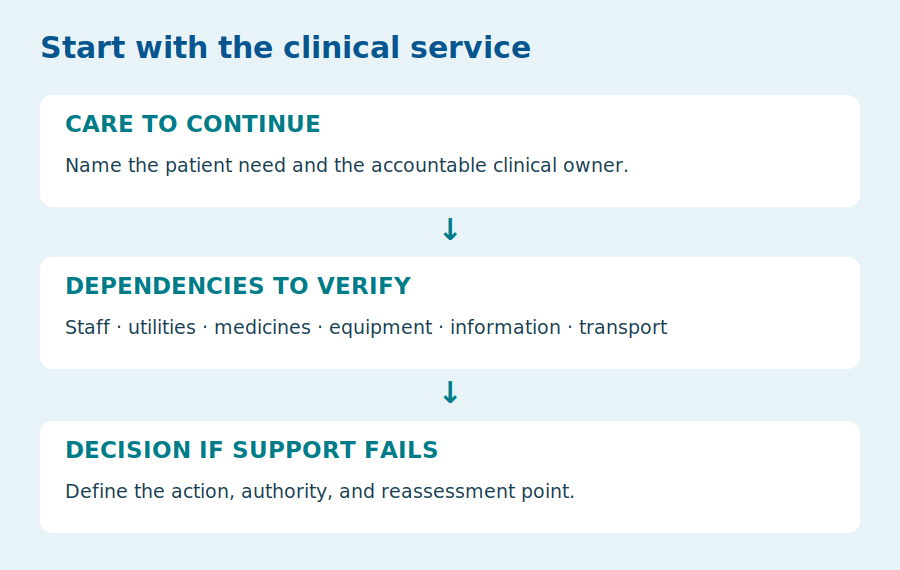
Dependency mapping is most useful when it starts with a clinical service rather than an inventory of equipment. For each priority service, ask what must remain available for the next interval of care: appropriately skilled staff, usable space, utilities, medicines, equipment, information, and transport. Then ask which of those dependencies share a failure point. A generator may support electrical loads while a separate water problem limits cleaning or processing. A functioning electronic record does not make a receiving team available.
Kameli and colleagues’ qualitative study of hospital water crises in Iran identified challenges in planning, coordination, monitoring, resources, and proactive understanding. The twenty expert interviews support attention to organizational arrangements as well as physical supply. They do not establish a universal reserve volume or safe operating duration for US hospitals. Leaders should require estimates tied to the actual service mix, water quality, consumption, usable storage, delivery connections, and alternatives at the facility. 6
The report from three sterile processing departments affected by the Rio Grande do Sul climate catastrophe provides a concrete example of coupled dependencies. The institutions described restricted hospital activity, generator use, outsourced water or processing, staff transportation adjustments, and temporary closure at one institution. This is an experience report, not a comparative effectiveness trial. Its value is showing how water, processing capacity, personnel, and the clinical operating schedule become one continuity problem. 5
Emergency power planning also needs a clinical interpretation. CMS specifies systems and applicable inspection, testing, maintenance, and fuel provisions. An equipment test answers a defined technical question. Leadership additionally needs to know which services the tested configuration supports, what it excludes, and how a disrupted fuel supply affects continuity. Granholm and colleagues’ commentary draws attention to wider electrical infrastructure vulnerability and effects extending into community care. It is a planning argument, not a quantified estimate of a particular hospital’s risk. L1, 16
The proposed dependency visual therefore has three parts: clinical service, enabling resources, and the action if support becomes inadequate. An entry should name the owner who can verify the resource and the clinical owner who determines the implications for care. Record the time of verification. Label an estimate as an estimate, an exercise observation as an exercise observation, and a condition confirmed during the current event as current evidence. A single reassuring color should not erase these differences.
Authority must remain usable during disruption
The plan should make delegation and succession usable when the first person on the list is unavailable. Staff need to know who may activate incident arrangements, restrict a service, request external assistance, initiate relocation under the local plan, and authorize recovery. Those decisions may sit with different roles. A contact directory without decision boundaries can produce repeated referrals while conditions change. L1
National and regional surveys show why a common template is not enough. Söderin and colleagues found variation in disaster planning, training, key functions, and triage among participating Swedish hospitals. Adhikari and colleagues’ assessment of Nepal’s hub hospitals found that the presence of a disaster plan did not imply that every relevant component was included. These are setting-specific assessments, with participation and measurement limitations. They support inspecting plan content and operational roles rather than treating plan availability as a sufficient readiness measure. 20, 4
Command should connect technical information to clinical consequences. Facilities staff may report pressure, power availability, or system restoration estimates. Clinical leaders determine what those conditions mean for patients. Logistics verifies procurement, equipment, and transport. The incident leadership function reconciles these inputs, identifies unresolved assumptions, and records a decision with a reassessment point. This is a proposed operating arrangement, not a claim that every hospital must use identical job titles.
The John Sealy Hospital fire report illustrates the cost of disconnected information. It describes radio coverage problems, separate hospital and fire command arrangements, and difficulty confirming the patient census after evacuation. The hospital subsequently addressed communications and coordination weaknesses. The account also reports a neonate requiring intubation after movement, so a rapid evacuation should not be described as a harm-free event. The lesson is to examine the entire episode of care, including movement, receiving locations, and post-move needs. 14
Shelter, relocate, or evacuate
These choices require attention to the hazard, the patient’s needs, the condition of the current care setting, and the feasibility of alternatives. There is no universal number of minutes without water or power that resolves the decision for every hospital. Nor is there a general rule that evacuation is always safer than staying. The decision must be made through the hospital’s emergency procedures, clinical judgment, relevant authorities, and evolving information. L1, 11, 24
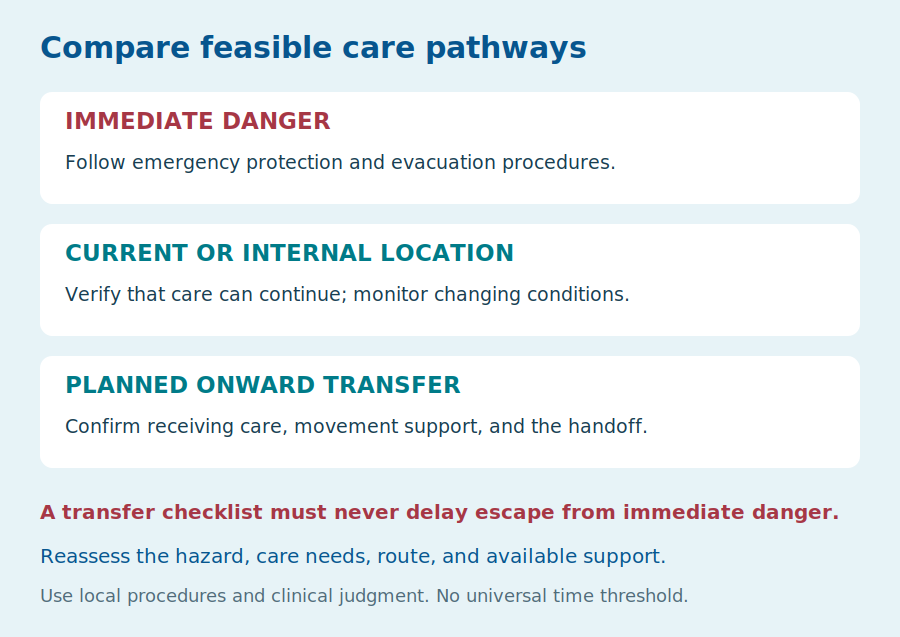
Immediate escape from danger and planned interfacility transfer must be distinguished. When there is an immediate threat such as fire or smoke, staff follow the applicable emergency response and evacuation procedures. Completing transfer paperwork or finding a distant accepting bed must not delay movement out of immediate danger. Once patients are in a safer location, onward care, transport, tracking, and destination coordination remain essential. The proposed transfer tool in this review addresses that onward coordination; it is not an obstacle to emergency escape.
A review of wildfire information and neonatal intensive care describes simultaneous preparation for evacuation and sheltering as routes, air quality, and fire conditions change. A hospital may need to prepare alternatives while continuing to reassess the current location. This does not mean leaving every option indefinitely unresolved. The team should document what would trigger a change, who is watching the condition, and how that observation reaches the decision-maker. 25
Fukushima accounts emphasize the risk of disrupted care both before and during movement. Nonaka and colleagues describe staff shortages, utilities and logistics problems, unclear criteria, and limited preparation time across three hospitals. Yoshida and colleagues report a patient who died before evacuation amid severe care and infrastructure disruption. A single case cannot isolate causation or quantify evacuation risk, but it makes ongoing care before departure impossible to ignore. Zhao and Tsubokura’s research summary similarly cautions that protective evacuation can introduce substantial health risks for vulnerable people. 12, 21, 15
The practical comparison is therefore between feasible care pathways. Can the current setting sustain required care while arrangements proceed? Is a safer internal location usable? Is the route to an external destination accessible? What clinical support is needed during movement? What changes if the anticipated restoration does not occur? Each answer should be revisited as the incident changes. The reasoning should be concise enough to communicate during operations and specific enough to reconstruct later.
A receiving bed is only one part of continuity
CMS requires arrangements to receive patients when operations are limited or cease, together with evacuation, communication, and tracking provisions. Operationally, a bed report is an input to a transfer arrangement. For planned onward transfer, the sending team still needs confirmation of appropriate receiving capability, acceptance, transport, accompanying support, necessary equipment and medicines, relevant records, and a way to account for arrival. L1
The 2026 account of a cyclone-related dialysis service evacuation in Southeast Queensland shows how these dependencies interact. Staff coordinated treatment at another unit, adjusted rosters, addressed disrupted island transport, maintained patient contact information, and managed medicines and equipment. The receiving service’s existing workload mattered. The authors describe the benefit of available local capacity, but also communication interruptions and patients who did not initially relocate. The report should not be converted into a claim that all patients received every treatment exactly as scheduled. 1
For hospital executives, the central question is what the receiving organization has actually accepted. A general agreement signed before the event does not specify the current staffing, equipment, or transport for a particular patient’s needs. Regional incidents can place several organizations under pressure simultaneously. The status record should distinguish an inquiry, a capacity report, clinical acceptance, transport readiness, departure, and confirmed arrival. These are proposed operational states, not new regulatory categories.
Patient tracking must remain workable if the usual digital tools are unavailable. The CMS guidance calls for tracking on-duty staff and sheltered patients in the hospital’s care and documenting the specific receiving facility or other location when they are relocated. It also addresses information and medical documentation sharing necessary for continuity, within applicable law. A downtime method should preserve identity and the essential handoff while protecting information. It should also support reconciliation when normal systems return. L1
Family communication is part of that continuity work. Assign responsibility for updates, interpreter or accessibility needs, and resolving conflicting location information. An operational board may use restricted identifiers, while clinical records retain the information required for care. Public updates should not expose individual patient information. The hospital’s privacy and clinical procedures determine the permitted method and recipient; an emergency is not a blanket authorization for unrestricted disclosure. L1
Applied situation: the bed that was not yet a transfer
This fictional example concerns a municipal water interruption. It illustrates one decision within the article. It is not a real patient report, clinical protocol, or account of measured improvement.
The hospital activates its local response. Facilities and clinical leaders assess the affected services and confirm that current patients can receive safe interim care in their present locations while arrangements proceed. There is no immediate threat requiring escape in this scenario. Staff restrict affected activity under the local plan and establish a reassessment point. If the interim care conditions deteriorate, the team must escalate and relocate as appropriate rather than wait for the example’s transfer sequence.
A partner hospital reports available beds. An incident board entry is changed to “transfer available.” The nurse supervisor asks, “Have they accepted these patients for the care they need, and is transport confirmed?” The answer is incomplete. The receiving service has reported space, but the sending team has not confirmed all of the care and movement arrangements.
Incident leadership assigns one transfer coordination lead. That person works with the clinical teams to confirm acceptance, receiving capability, transport, staff or equipment needs during movement, and the information and medicines that must accompany the handoff. The board now distinguishes reported capacity from an accepted arrangement. A missing transport assignment remains visible as “pending,” with an owner and next update time.
The bedside team continues the verified interim care while the incident team reassesses the water situation. When the required arrangement is complete, the patient moves under the local transfer procedures. Departure and arrival are reconciled, and the assigned team updates the patient’s representative. The story does not imply that an administrative checklist takes priority over an urgent clinical or safety need.
In the after-action discussion, leaders identify the misleading board label as an operating problem. The repair is to separate capacity reports from accepted transfer arrangements, make the coordination role explicit, and test the revised process. The next exercise should deliberately include a reported bed without confirmed transport. The team must demonstrate that it identifies the gap and acts on it. No patient-outcome improvement is claimed from this fictional repair.
Read the video transcript
A water outage. An available bed. But is the transfer actually ready?
This fictional hospital case shows why reported capacity is only the start of an arrangement.
The hospital activates its local response to a municipal water interruption.
Clinical and facilities leaders confirm safe interim care while they arrange alternatives and monitor conditions.
There is no immediate danger in this example. Emergency escape must never wait for transfer paperwork.
A partner reports available beds. Someone changes the incident board to: transfer available.
The nurse supervisor asks: Have they accepted these patients for the care they need? Is transport confirmed?
The answer is incomplete. Reported space does not yet establish the receiving care and movement arrangements.
The board now distinguishes reported capacity from an accepted transfer. The missing transport assignment stays visible.
Incident leadership assigns one transfer coordination lead to work with the clinical teams.
They confirm receiving acceptance, required care, transport, accompanying support, and the information and medicines for the handoff.
Transport is still pending. A named owner and next update time are recorded.
The bedside team continues verified interim care. If conditions deteriorate, the team escalates and relocates under the local plan.
Once the arrangement is ready, the patient moves under local transfer procedures.
The team reconciles departure and arrival, and the assigned person updates the patient's representative.
Afterward, leaders repair the misleading board label and clarify who confirms transfer readiness.
The next exercise includes a reported bed without transport. The team must identify the gap and act on it.
Ask what the receiving team has accepted, what remains unresolved, and who owns the next action.
Read The Emergency Operations Standard by Greg Wahlstrom, MBA, HCM, at The Healthcare Executive.
This is an educational example, not a clinical protocol or evidence of improved patient outcomes.
Exercises should expose a consequential decision
CMS’s exercise requirements provide a minimum structure, including analysis, documentation, and revision. An exercise becomes more useful when it poses a decision that the organization may otherwise avoid testing. Examples include a failed receiving arrangement, unavailable overnight decision-maker, inaccessible evacuation route, or water supply that cannot support an assumed clinical service. The test should be safe and designed by the relevant clinical and emergency management staff. L1
Rådestad and colleagues used simulation models in evacuation exercises at two Swedish emergency hospitals. Their approach represented patients, staff, and transport while participants acted in their usual roles. Observations and post-exercise feedback identified issues in management, communication, logistics, medical care and prioritization, and resource use. This supports using exercises to reveal interdependencies. It does not establish that the same simulation produces a specified reduction in patient harm. 19
Phattharapornjaroen and colleagues’ mixed-method study used scenario-based hospital evacuation exercises with forty participants from response organizations and communities in Thailand. Self-evaluation and observation addressed collaboration and leadership, including communication and resource gaps. Campanale and colleagues’ work in Matera describes revising emergency arrangements and training through simulations, with improvements in participants’ reported knowledge and capacity. Both are informative for exercise design, while their settings and outcome measures limit broad causal claims. 18, 22
The hospital pharmacy study by Zhu and colleagues is particularly relevant to utility and information interruptions. It examined simulations of system downtime, power outage, and a major water leak. Staff reported improved perceived preparedness and interest in further simulations. Those findings describe participant perceptions. They should not be presented as proof that dispensing errors, treatment delays, or patient harm declined during a subsequent real emergency. A local program should decide separately which execution outcomes to observe. 10
For the proposed water-interruption exercise, observers could document when the affected service was recognized, whether the responsible decision-maker was reached, whether interim care assumptions were checked, and whether the receiving arrangement was accurately represented. The exercise should test a usable alternate communication channel, not just ask whether one exists. It should include reconciliation of the patient’s destination and review of what the receiving team actually received.
Do not make raw speed the only success measure. A fast transfer entry with an incorrect destination is not a good result. Record the accuracy of the decision, the required coordination, and any clinically meaningful delay in context. Local thresholds should be justified by the service and scenario, with clear definitions of the start and end points. Invented universal time targets would add precision without evidence.
Close the failure by testing the repair
The after-action record should distinguish what happened, why the response was vulnerable, and what will change. A generic action such as “re-educate staff” is inadequate when the failure arose from a missing authority, inaccessible system, or unrealistic receiving assumption. Education may be part of the response. The corrective action should also address the mechanism that allowed the failure.
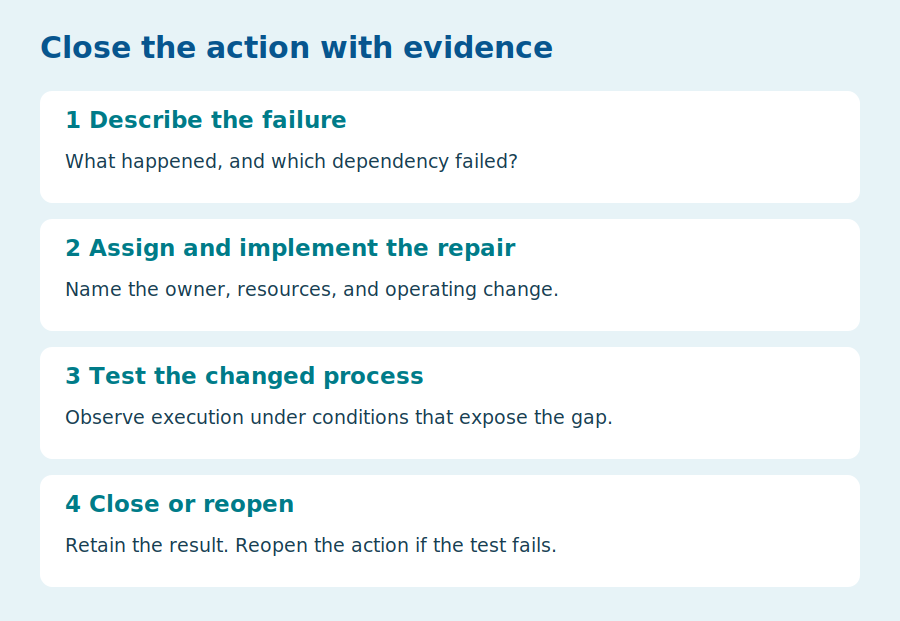
CMS requires analysis and documentation of exercises and emergency events and revision of the emergency plan as needed. The proposed closure method extends that requirement into a practical management routine: describe the failure; name an accountable owner; identify the change and required resources; test the change under relevant conditions; and retain the evidence supporting closure. If the retest fails, reopen the action with an explanation. This particular sequence is the author’s synthesis, not a separately mandated CMS form. L1
The John Sealy account describes concrete communications and coordination changes after the fire. Qzih and Ahmad’s systematic review of CBRNE preparedness identifies personal, technological, and structural domains, with uneven attention to some functions. Together, these sources reinforce that preparedness weaknesses can span people, equipment, and arrangements. They do not support closing a complex gap merely because one department has completed a training session. 14, 13
A useful closure record for the fictional transfer problem would include the revised status definitions, the role authorized to confirm the arrangement, and an exercise observation showing that a reported bed without transport remains unresolved. The record should show who monitored the pending patient, what escalation occurred, and how the eventual handoff was reconciled. Attendance sheets alone cannot demonstrate that this repair works.
Board oversight without misleading readiness scores
Boards need a concise account of material exposure, demonstrated capability, and unfinished corrective work. A readiness dashboard should not combine every measure into one apparently objective number. It should distinguish estimates based on plans, observations from exercises, and actual-event performance. A high aggregate score can conceal a single dependency that prevents an essential service from continuing.
Mishra and colleagues’ assessment of thirteen hospitals in Eastern India found variation across preparedness dimensions, including communication and evacuation arrangements. Rojsaengroeng and colleagues’ qualitative study in Thailand identified concerns about the Hospital Safety Index’s technical complexity, scoring ambiguity, and comparability across differently resourced hospitals. Karaiskos and colleagues examined a short staff assessment tool in Greece, reporting internal reliability and construct-related findings. None of these studies establishes a universal score that guarantees US hospital performance in a future disaster. 7, 3, 17
A board report can instead organize parallel questions: Which critical services rely on unverified continuity assumptions? Which decisions failed in the latest exercise or event? Which corrective actions remain open because a repair has not passed its test? Which disruptions affected care, staff, or receiving partners? Who owns each unresolved exposure, and what support or decision is required from leadership? Report trends only when definitions and measurement methods remain comparable.
Petanidis and colleagues’ systematic review of surge planning describes a diverse literature across staffing, space, supplies, systems, forecasting, and ethical or policy issues. It also notes fragmented approaches to readiness measurement. Patel and colleagues’ US emergency department narrative review places disasters in the context of disrupted operations and changing demand. These sources support examining readiness as a set of interacting capabilities, while avoiding a single unsupported formula for resilience. 8, 2
The board’s role is to make unresolved dependencies and resource choices visible, not to direct bedside incident decisions. An executive report should identify decisions requiring investment, agreements, or authority changes and distinguish them from actions that the operating team can complete. It should also show whether corrective work improves the receiving side of a handoff or merely moves the burden elsewhere.
Staff support and recovery are continuity decisions
Staff availability is an operating dependency, not a fixed number copied from the normal roster. A regional disruption may affect employees’ homes, transport, schools, or family responsibilities at the same time that the hospital needs additional coverage. The Queensland dialysis account describes school closures affecting staffing and the need to coordinate personnel across the sending and receiving units. The Brazilian sterile processing report also describes transport and work-hour adjustments. These accounts support explicitly examining practical availability rather than assuming every scheduled employee can reach the assigned site. 1, 5
The proposed planning discussion should include who can perform the required work, how relief will be arranged, what supervision is needed, and whether the receiving team has capacity to absorb unfamiliar staff. Moving responsibility without those checks can create a new gap at the destination. Record unresolved staffing constraints alongside equipment and transport constraints. An incident roster should make the assigned location and reporting relationship clear enough to support both clinical coordination and staff accounting.
Recovery likewise requires more than a utility provider’s announcement that service has returned. The hospital needs the appropriate technical and clinical teams to determine whether affected systems and services can resume safely. For a water interruption, that means following the facility’s applicable restoration and water-safety procedures, rather than assuming that restored pressure alone establishes suitability for every use. The water-crisis study’s emphasis on monitoring and coordination supports planning for these responsibilities, but does not supply a universal technical restoration protocol. 6
Before reopening a restricted service, the responsible team should reconcile outstanding patient needs, diverted or postponed work, supplies, staff assignments, and receiving arrangements. Define who authorizes the restart and what evidence that person requires. If the organization restores a service in stages, communicate the actual scope of operation so staff do not mistake partial recovery for normal capability. The article’s proposed recovery record includes the service restored, relevant checks completed, restrictions remaining, decision owner, and next review point.
Recovery also creates a learning opportunity that can disappear quickly. Capture differences between the expected and observed endurance of resources, the partners that were reachable, and the work that continued only through exceptional staff effort. Exceptional improvisation may protect patients during one event while concealing an arrangement that is unreliable over repeated events. The after-action review should recognize the work and still examine the underlying dependency. Neither staff dedication nor a successful outcome eliminates the need to repair a process that failed.
A focused ninety-day improvement cycle
During the first thirty days, select one material continuity problem from the hospital’s risk assessment, recent event, or failed exercise. Define the clinical service, its dependencies, and the responsible decision roles. Verify the receiving and external support assumptions with the relevant partners. Include overnight coverage, downtime communications, staff constraints, and patient accessibility needs. Do not attempt to redesign the entire program in one meeting.
During the next thirty days, run a focused exercise with a consequential uncertainty. For the water example, a partner reports beds while transport is unavailable. Observe whether the team distinguishes capacity from an accepted transfer and whether current care remains actively monitored. Debrief with sending and receiving participants. Identify whether the gap is in information, authority, resources, or execution, then assign a specific repair.
During the final thirty days, test the repaired process under conditions that could expose the same failure. Include the alternate shift or communication route if it contributed to the original problem. Close only actions supported by the retest evidence; escalate those that require additional resources. Present the board with the changed capability, the remaining limitations, and the next priority. This ninety-day schedule is a proposed implementation cadence, not a federal deadline.
Climate-related disruption will continue to require coordination beyond a single hospital. Rattanakanlaya and colleagues’ interviews with Thai hospital personnel identify hospital, provincial, and national contributions to flood preparedness. Thomson and colleagues’ Canadian acute-care framework connects clinical operations with broader climate resilience and adaptation. Their value for this review is the emphasis on connected responsibilities. Neither substitutes for the US hospital’s own legal requirements or an assessment of local hazards. 23, 9
The emergency operations standard is ultimately demonstrated in a sequence of usable decisions: the team recognizes a threatened service, understands current care capability, reaches an authorized decision-maker, arranges continuity around the patient, and verifies that a failed process has been repaired. A complete plan is necessary evidence. Reliable execution requires its assumptions to survive contact with the people, infrastructure, and partner organizations on which care depends.
Limitations and important disclaimer
The selected evidence is heterogeneous and largely observational, qualitative, descriptive, or based on exercises. Several sources concern specific countries, events, provider settings, or patient groups. Related Fukushima reports may describe overlapping circumstances and must not be counted as independent confirmations of an effect. Review findings and participant perceptions are not equivalent to patient-outcome evidence. Some supporting claims rely on indexed abstracts, and the narrative selection process is vulnerable to selection and availability bias.
The decision aids, board questions, ninety-day cycle, and video are original educational syntheses. They have not been validated as clinical tools or as measures of regulatory compliance. Hospitals should use their approved emergency procedures, incident command arrangements, clinical judgment, and relevant public authorities. Immediate protection from danger takes priority over completing the illustrative onward-transfer workflow.
This article provides general educational information, not legal advice, individual medical advice, or an operational directive for an active emergency. Requirements and circumstances vary. Confirm the operative federal, state, and local requirements, including applicable fire and life safety provisions, with qualified counsel and emergency management leadership before changing policy. The CMS source revision and current-law retrieval limitation are identified above so the legal basis can be checked precisely.
Peer-reviewed literature
- Latcham, Patrice; Chow, Vivien; Mudge, David W.; Wesley, Hannah. The Impact of a Tropical Cyclone on the Evacuation of a 12‐Chair Dialysis Service in Southeast Queensland. Advances in Public Health 6/17/2026; 2026: 1-7. (7p) 10.1155/adph/1072718.
- Patel A, Foster AA, Popovsky EY, Fawcett A, Hoffmann JA. US Emergency Department Use and Operations Amid Natural Disasters: A Narrative Review. The western journal of emergency medicine [West J Emerg Med] 2026 Feb 22; Vol. 27 (2), pp. 419-430. Date of Electronic Publication: 2026 Feb 22. 10.5811/westjem.49118.
- Rojsaengroeng R, Pintatham K, Wuthisuthimethawee P, Soontorn T, Huabbangyang T, Pongvirat K. Hospital Safety Index in Thailand: Emergency Staff Perspectives on Preparedness and Trust. Nursing open [Nurs Open] 2026 Jul; Vol. 13 (7), pp. e70703. 10.1002/nop2.70703.
- Adhikari SK, Shrestha A, Phuyal N, Bajracharya S, Shah PK, Katwal S, Adhikari A, Pandav RS, Gocotano AE, Neupane S, Prajapati B, Joshi I, Devkota G, Tikhatri D. Assessment of Disaster Preparedness Planning in 25 Hub Hospitals of Nepal. Journal of Nepal Health Research Council [J Nepal Health Res Counc] 2025 Oct 17; Vol. 23 (2), pp. 369-376. Date of Electronic Publication: 2025 Oct 17. 10.33314/jnhrc.v23i02.4703.
- Conzatti, Patricia; Rodrigues, Sílvia Viviane; Carrazzoni dos Reis, Francine Ullrich; Caloni Oliveira, Stefani Rodrigues; Costa de Almeida, Sophia; Aquino Caregnato, Rita Catalina. Climate catastrophe in Rio Grande do Sul: impact on sterile processing departments. Revista SOBECC (SOBECC REV), 2025; 30: 1-7. (7p) 10.5327/Z1414-44252025291020.
- Kameli A, Naddafi K, Saeedi R, Hosseinzadeh-Attar MJ, Ostadtaghizadeh A. Water crisis in hospitals: challenges, and recommendations- a qualitative study in Iran. BMC health services research [BMC Health Serv Res] 2025 Jul 03; Vol. 25 (1), pp. 903. Date of Electronic Publication: 2025 Jul 03. 10.1186/s12913-025-12989-y.
- Mishra KG, Patnaik N, Pradhan NR, Mohapatra A, Saleem SM. Comparative descriptive analysis of hospital disaster preparedness using WHO safety index: a multi-center study from Eastern India. BMC emergency medicine [BMC Emerg Med] 2025 Oct 08; Vol. 25 (1), pp. 201. Date of Electronic Publication: 2025 Oct 08. 10.1186/s12873-025-01248-2.
- Petanidis, Savvas; Chandramouli, Krishna; Floros, George; Nifakos, Sokratis; Kolomvatsos, Kostas; Tsekeridou, Sofia; Magalini, Sabina; Gui, Daniele; Kosmidis, Christoforos. Optimizing Emergency Response in Hospitals: A Systematic Review of Surge Capacity Planning and Crisis Resource Management. Healthcare (2227-9032) Nov2025; 13(21): 2819. (25p) 10.3390/healthcare13212819.
- Thomson, Denise; Zimmermann, Gabrielle L.; Gohel, Bhavini. Climate-resilient acute care clinical operations: A framework that informs how operations within acute care build climate-resilient health systems. Healthcare Management Forum (HEALTHC MANAGE FORUM), Jul2025; 38(4): 323-330. (8p) 10.1177/08404704251334920.
- Zhu ZJJ, Deng A, Mabasa VH, Geng D, Peralta J. Assessing the Benefits of Simulation-Based Learning for Emergency Preparedness Training in the Hospital Pharmacy Dispensary. The Canadian journal of hospital pharmacy [Can J Hosp Pharm] 2025 Apr 09; Vol. 78 (2), pp. e3576. Date of Electronic Publication: 2025 Apr 09 (Print Publication: 2025). 10.4212/cjhp.3576.
- Moslehi S, Masbi M, Noori N, Taheri F, Soleimanpour S, Narimani S. Components of hospital personnel preparedness to evacuate patients in disasters: a systematic review. BMC emergency medicine [BMC Emerg Med] 2024 Feb 06; Vol. 24 (1), pp. 21. Date of Electronic Publication: 2024 Feb 06. 10.1186/s12873-024-00942-x.
- Nonaka S, Sawano T, Oikawa T, Murakami M, Ozaki A, Zhao T, Yoshida M, Yamamoto C, Tsubokura M. Difficulties faced by three hospitals evacuated from the urgent protective action planning zone after the 2011 Fukushima Daiichi Nuclear power plant accident. Journal of radiation research [J Radiat Res] 2024 Dec 16; Vol. 65 (Supplement_1), pp. i67-i79. 10.1093/jrr/rrae015.
- Qzih, Eman S; Ahmad, Muayyad M. Hospital-Based Preparedness Measures for CBRNE Disasters: A Systematic Review. Environmental Health Insights (ENVIRON HEALTH INSIGHTS), 10/7/2024; 1-12. (12p) 10.1177/11786302241288859.
- Wheeler-McAnally, Rachel. The John Sealy Hospital Fire Evacuation. Critical Care Nurse (CRIT CARE NURSE), Oct2024; 44(5): 64-70. (7p) 10.4037/ccn2024469.
- Zhao T, Tsubokura M. Risks associated with evacuation and disaster-related death after a radiation disaster: summary of research results from Hamadori region, Fukushima. Radiation protection dosimetry [Radiat Prot Dosimetry] 2024 Nov 13; Vol. 200 (16-18), pp. 1524-1527. 10.1093/rpd/ncae078.
- Granholm, Fredrik; Tin, Derrick; Ciottone, Gregory R.. Critical Energy Infrastructure and Health: How Loss of Power May Kill. Prehospital & Disaster Medicine (PREHOSPITAL DISASTER MED), Apr2023; 38(2): 279-280. (2p) 10.1017/S1049023X23000274.
- Karaiskos, Konstantinos; Talias, Michael; Kalogeropoulos, Athanassios; Pikoulis, Emmanouel. A Short Assessment Tool for Management of Knowledge and Alertness in Greek Hospitals. International Journal of Caring Sciences (INT J CARING SCI), Sep-Dec2023; 16(3): 1433-1440. (8p) Institutional record.
- Phattharapornjaroen P, Carlström E, Atiksawedparit P, Holmqvist LD, Pitidhammabhorn D, Sittichanbuncha Y, Khorram-Manesh A. The impact of the three-level collaboration exercise on collaboration and leadership during scenario-based hospital evacuation exercises using flexible surge capacity concept: a mixed method cross-sectional study. BMC health services research [BMC Health Serv Res] 2023 Aug 14; Vol. 23 (1), pp. 862. Date of Electronic Publication: 2023 Aug 14. 10.1186/s12913-023-09882-x.
- Rådestad M, Holmgren C, Blidegård EL, Montán KL. Use of simulation models when developing and testing hospital evacuation plans: a tool for improving emergency preparedness. Scandinavian journal of trauma, resuscitation and emergency medicine [Scand J Trauma Resusc Emerg Med] 2023 Aug 29; Vol. 31 (1), pp. 43. Date of Electronic Publication: 2023 Aug 29. 10.1186/s13049-023-01105-w.
- Söderin, Louise; Agri, Joakim; Hammarberg, Elsa; Lennquist-Montán, Kristina; Montán, Carl. Hospital preparedness for major incidents in Sweden: a national survey with focus on mass casualty incidents. European Journal of Trauma & Emergency Surgery (EUR J TRAUMA EMERG SURG), Apr2023; 49(2): 635-651. (17p) 10.1007/s00068-022-02170-z.
- Yoshida M, Sawano T, Kobashi Y, Hori A, Nishikawa Y, Ozaki A, Nonaka S, Tsuboi M, Tsubokura M. Importance of continuing health care before emergency hospital evacuation: a fatal case of a hospitalized patient in a hospital within 5 km radius of Fukushima Daiichi Nuclear Power Plant: a case report. Journal of medical case reports [J Med Case Rep] 2023 Feb 07; Vol. 17 (1), pp. 37. Date of Electronic Publication: 2023 Feb 07. 10.1186/s13256-022-03744-6.
- Campanale, Erasmo Roberto; Maragno, Margherita; Annese, Gaetano; Cafarelli, Angela; Coretti, Rosario; Argemì, Josepmaria; Cibelli, Maria Teresa; Sannicandro, Riccardo; Montan, Carl; Faccincani, Roberto. Hospital preparedness for mass gathering events and mass casualty incidents in Matera, Italy, European Capital of Culture 2019. European Journal of Trauma & Emergency Surgery (EUR J TRAUMA EMERG SURG), Oct2022; 48(5): 3831-3836. (6p) 10.1007/s00068-021-01775-0.
- Rattanakanlaya, Kanittha; Sukonthasarn, Achara; Wangsrikhun, Suparat; Chanprasit, Chawapornpan. Improving flood disaster preparedness of hospitals in Central Thailand: Hospital personnel perspectives. Journal of Clinical Nursing (John Wiley & Sons, Inc.) Apr2022; 31(7/8): 1073-1081. (9p) 10.1111/jocn.15971.
- Sahebi A, Jahangiri K, Alibabaei A, Khorasani-Zavareh D. Factors Influencing Hospital Emergency Evacuation during Fire: A Systematic Literature Review. International journal of preventive medicine [Int J Prev Med] 2021 Oct 26; Vol. 12, pp. 147. Date of Electronic Publication: 2021 Oct 26 (Print Publication: 2021). 10.4103/ijpvm.IJPVM_653_20.
- van Stralen, Daved; McKay, Sean D.; Mercer, Thomas A.. Disaster Series: The Use of Information for Wildland Fire and the NICU: Combined Evacuation and Sheltering. Neonatology Today Nov2021; 16(11): 105-113. (9p) 10.51362/neonatology.today/2021111611105113.
Primary legal and agency sources
L1. Centers for Medicare & Medicaid Services. State Operations Manual, Appendix Z: Emergency Preparedness for All Provider and Certified Supplier Types. Revision 204, April 16, 2021. Hospital provisions of 42 C.F.R. § 482.15 and interpretive guidance. Retrieved September 12, 2026. Official CMS PDF.
L2. Centers for Medicare & Medicaid Services. Emergency Preparedness Rule. Page last modified June 29, 2026; retrieved September 12, 2026. CMS rule page.