


Michael is ready
The deadline is only part of the decision
A request can receive a prompt electronic response while the patient is still waiting for a decision. It can receive eventual approval after the useful treatment window has narrowed. It can also be stopped before submission because the hospital cannot determine which requirements apply. These are different failures. An executive dashboard that reduces all three to an average turnaround time will miss the work needed to resolve them.
CMS-0057-F gives hospital leaders a reason to examine that work closely. Its prior-authorization provisions establish operating requirements for affected payers and a later program of electronic exchange. Hospitals need to understand those requirements without confusing the payer’s legal obligations with the hospital’s own management responsibilities. The hospital controls the quality of its request, its evidence of receipt, its clinical escalation and its communication with the patient. It does not control the payer’s adjudication. [L1–L3]
The central distinction is between the patient’s clinical need and the maximum administrative decision period. A legally applicable maximum is not permission to wait until the last hour. CMS requires decisions as expeditiously as the patient’s condition requires. A sound hospital process preserves both facts: when the request must receive a decision and when the patient needs action. [L2]
This review examines the finalized rule, CMS implementation guidance and selected peer-reviewed studies of authorization policy, access and workflow. It proposes an operating approach built around verified receipt, accountable follow-up and the care that follows a decision. The management tools and fictional case are author synthesis. They are not additional CMS requirements or validated clinical instruments.
What the evidence can support
The literature does not describe one uniform authorization system. Plans, benefits, service categories and implementation settings differ. A 2026 comparison of three commercial insurers’ published manuals found substantial variation in the services subject to authorization. Only 638 of 4,645 unique procedure codes identified across the manuals appeared in all three insurers’ sets. This was a document-based comparison with exclusions, including external vendor rules. It describes fragmentation; it is not a current coverage lookup for an individual patient. [E4]
Differences in exposure also matter. A Medicare Advantage analysis using 2021 data found an association between higher contract-level authorization exposure and greater disenrollment. A separate county-level study using 2022 data found greater authorization requirements in more socially vulnerable counties. Neither establishes that a particular authorization caused an individual beneficiary to leave a plan or that county-level associations demonstrate individual discrimination. Both support examining who is exposed to the process, rather than assuming that every patient faces the same burden. [E1, E2]
The research base also has important boundaries. Much of it concerns medication authorization, retrospective data or a small number of practices. Those studies can identify operational problems and inform implementation questions. They do not establish the effect of CMS-0057-F’s non-drug requirements, which began after many of the underlying observations. Historical Medicare Advantage findings should likewise be labeled by their data years, rather than presented as estimates of 2026 prevalence. [E13]
For this narrative review, an institutional EBSCO search through the University of Phoenix library used the phrase “prior authorization,” peer-reviewed and full-text availability filters, and a September 2021 to September 2026 date window. Seventeen relevant journal records were selected from the first 50 results for their contribution to scope, workflow, access or measurement. Indexed abstracts were reviewed for all selected records, with fuller record or text assessment for selected studies. This was a targeted narrative search, not a systematic review, exhaustive evidence census or formal risk-of-bias assessment. Full-text availability in a database should not be mistaken for full-text appraisal of every included paper.
Start with scope before starting a timer
CMS-0057-F addresses Medicare Advantage organizations, state Medicaid and Children’s Health Insurance Program fee-for-service programs, Medicaid managed care plans, CHIP managed care entities and qualified health plan issuers on federally facilitated exchanges. Requirements differ across these groups. The finalized decision-timeframe provisions exclude those exchange QHP issuers, even though other parts of the rule apply to them. The rule’s prior-authorization provisions exclude drugs. [L1, L2]
For requests covered by the decision-timeframe requirements, the baseline maximum is 72 hours for expedited requests and seven calendar days for standard requests. Program-specific extensions may be available when the relevant conditions are satisfied. A portal’s revised date, a missing document or an internal queue convention does not by itself establish a valid extension. The record should identify the payer program, service, urgency classification, governing requirement and any extension basis. [L2]
| Question at intake | What the hospital needs to establish |
|---|---|
| Which coverage applies? | The actual payer, product and benefit, including any delegated administrator. A familiar insurer logo is insufficient. |
| What is being requested? | The service and benefit category, including whether the request concerns a drug. |
| Which timing requirement applies? | The relevant program and request type, with applicable state or contractual requirements reviewed by the appropriate team. |
| Is expedited review appropriate? | A documented clinical basis and the applicable process for requesting expedited treatment. |
| Has a valid extension been invoked? | Its stated basis, notice, revised deadline and supporting record, rather than an unexplained portal change. |
Urgency classification requires clinical judgment. A scheduling preference does not automatically make a request expedited. Conversely, a default setting must not leave a clinically urgent request in a standard queue. A clinician should document the patient’s needs and use the applicable expedited-review process. Deterioration calls for immediate clinical assessment and the appropriate care pathway; it should not wait for an authorization dashboard to change color.
Scope errors often originate upstream. A scheduling team may use last month’s requirements, a specialty office may submit under the wrong benefit, or an interface may route to the correct insurer but the wrong product. Correcting such errors requires an authoritative requirements source with a revision date and an owner. The variation documented across commercial manuals reinforces the need for product-specific verification. It does not justify asking patients to solve the organization’s routing problem. [E4]
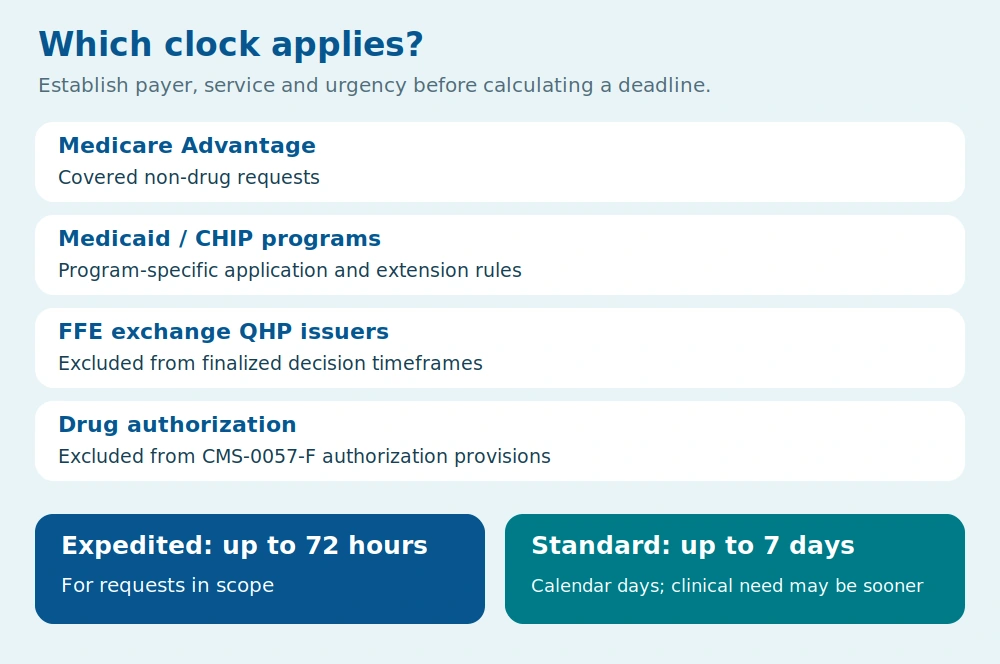
Read figure 1 as text
Which clock applies?
Establish payer, service and urgency before calculating a deadline.
Medicare Advantage
Covered non-drug requests
Medicaid / CHIP programs
Program-specific application and extension rules
FFE exchange QHP issuers
Excluded from finalized decision timeframes
Drug authorization
Excluded from CMS-0057-F authorization provisions
Expedited: up to 72 hours
For requests in scope
Standard: up to 7 days
Calendar days; clinical need may be sooner
Preserve the event that starts the clock
CMS’s FAQ states that the decision clock starts when the payer receives the prior-authorization request. A coverage-requirements inquiry is a different event. Checking whether authorization is necessary, including a Coverage Requirements Discovery response, does not itself submit an authorization request. A hospital can therefore have a successful requirements transaction without having started a decision clock. [L2]
The local record should distinguish the clinician’s order, coverage inquiry, request submission, evidence of payer receipt and substantive decision. These events may occur in different systems. Preserve the linkage between them. A fax report records a transmission event, but its relationship to payer receipt must be understood. A portal confirmation should retain its transaction identifier and timestamp. An interface should preserve its acknowledgment and error state. Staff need a way to identify requests that were prepared but never successfully received.
The operational record also needs a consistent time convention. Store the source timestamp and time zone, and make any local display conversion explicit. Test overnight and daylight-saving transitions when relevant. A date without a time may be inadequate for a 72-hour interval. These are proposed data-quality controls; the purpose is to reconstruct the actual receipt event rather than manufacture precision from incomplete information.
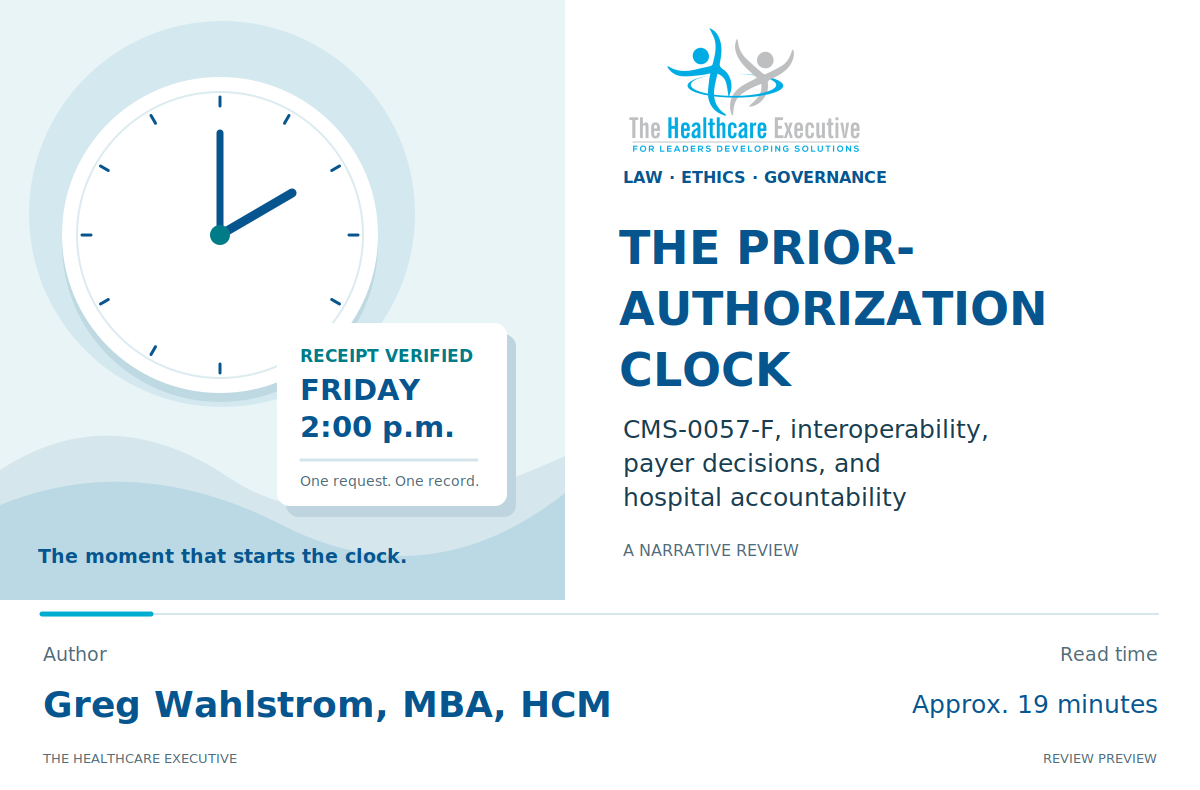
Calendar time includes weekends. CMS gives the example of an expedited request received at 1:00 a.m. on Sunday requiring a response no later than 1:00 a.m. on Wednesday, subject to the patient’s need for a faster response. A Friday work queue therefore needs a weekend owner whenever follow-up or clinical escalation may be required before Monday. Merely assigning a request to an office that is closed does not create coverage. [L2]
Corrections should retain an audit trail. If staff discover an earlier failed transmission or find that two identifiers refer to different requests, they should correct the linkage and explain the change. Silently replacing an original receipt date with the latest activity date can hide an unresolved delay. The record should describe what happened, including failed submissions and corrections, even when those facts make performance look less favorable.
Additional documentation and the disputed reset
CMS specifically addresses requests for additional documentation that was not disclosed to the provider when the original request was submitted. The clock does not stop or restart simply because the payer asks for that material. A payer may use an extension when its program permits one. The additional request must be communicated in time for supplementation and the substantive decision and notice within the applicable adjudication period. [L2]
The practical response has two parts. Send needed documentation promptly and preserve the original receipt. Record what was requested, whether that requirement had previously been disclosed, when the hospital responded and whether the payer asserted an extension. The team should not withhold clinically relevant information because it disputes the portal’s date. It should resolve the documentation need and the timing discrepancy through their appropriate channels.
An information request also needs a specific recipient. “Waiting on clinical” is not an adequate assignment if the authorizing clinician is away. The hospital should identify the person or coverage team able to supply the information, the date needed and an escalation route. The clinician needs enough context to answer the actual issue; forwarding an unexplained denial code can create another cycle of incomplete responses.
The following fictional case applies this distinction to one expedited Medicare Advantage request for a non-drug medical service. It assumes the request qualifies for expedited handling and no valid extension has been invoked. It is not an emergency-care protocol or a promise that every disputed deadline will be resolved the same way.
The weekend deadline dispute
Read the case transcript
Friday, two p.m. A Medicare Advantage payer receives an expedited request for a non-drug medical service.
In this example, the maximum decision period ends Monday at two. The patient may need an earlier answer.
On Sunday, the payer asks for documentation that was not disclosed when the request was submitted.
Its portal now shows Wednesday. The hospital has two conflicting dates.
The coordinator sends the needed document promptly and preserves the original receipt.
Additional documentation does not automatically restart the clock. Any permitted extension needs the applicable program basis.
The weekend lead asks the payer to reconcile its date and records the exchange.
The clinical team reassesses the patient. A seventy-two-hour maximum is not permission to delay care that needs a faster response.
Later Sunday, the payer sends a substantive decision. The team records it, informs the patient, and coordinates the next step.
A message requesting information would not have closed this work item.
The operating repair is simple. Preserve receipt, separate information requests from decisions, and assign weekend ownership.
Check the payer, service, urgency, and extension rules before using a timer. This is a fictional educational example.
The case turns on preserving receipt while acting on the document request. A new portal date needs reconciliation, not automatic acceptance as a legal reset. The separate clinical reassessment prevents the administrative maximum from becoming a reason to postpone necessary action. The useful result is a traceable decision and an accountable next step, rather than a visually green queue entry.
A response is not necessarily a decision
A system can acknowledge a request, ask for information, approve it, deny it or report a transmission error. These states mean different things. A hospital that marks any payer message as completion can conceal unresolved access work. An information request should remain linked to an open work item. A transmission error needs correction and receipt verification. Neither should enter the denominator as a completed substantive decision.
CMS requires a specific reason for denial, regardless of the channel used for the request. Existing notice and appeal requirements continue to matter. The reason should reach the team able to act on it, and the patient should receive clear information through the applicable process. A more specific reason does not remove appeal rights or guarantee that a revised submission will be approved. [L1, L2]
The distinction between correction, resubmission, peer-to-peer review and appeal deserves explicit local guidance. These are not interchangeable labels for the same activity. Staff need to determine the available pathway, its deadline, who can initiate it and whether a new transaction represents a new request. Preserve links to earlier decisions. Do not treat repeated submissions as a way to erase the history of a denied or delayed request.
In one orthopedic practice, a prospective study examined 62 initial CT or MRI denials requiring peer-to-peer review. One was approved before review; 58 of the remaining 61 reviews were approved. The median interval from the visit to peer-to-peer review was nine days. This selected, single-practice sample cannot establish the approval rate for all authorization requests. It does illustrate why eventual approval and time spent obtaining it must be examined separately. [E12]
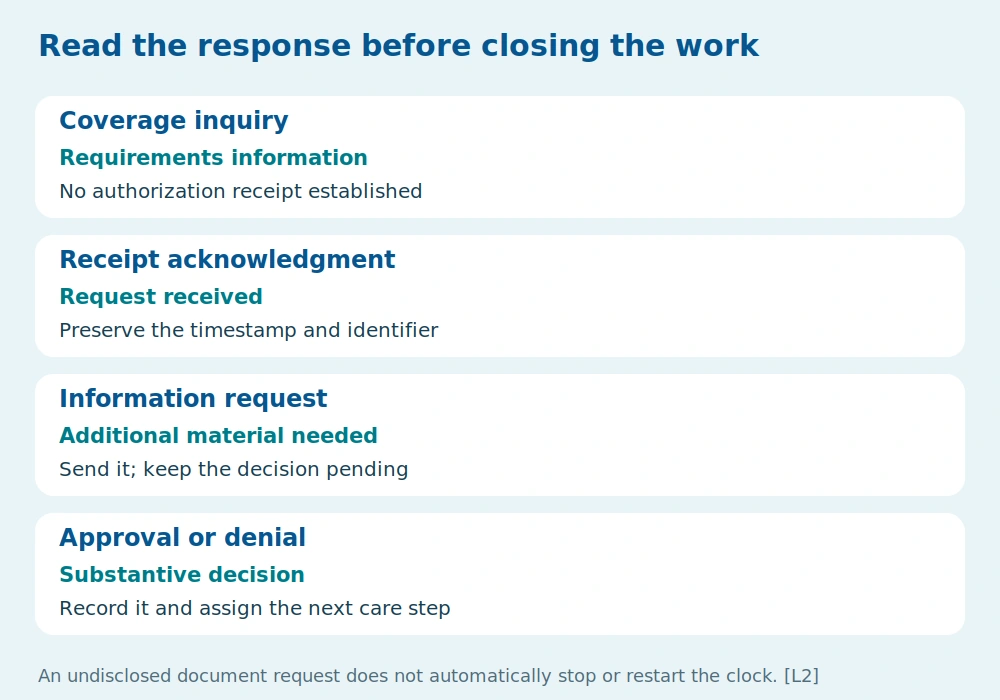
Read figure 2 as text
Read the response before closing the work
Coverage inquiry
Requirements information
No authorization receipt established
Receipt acknowledgment
Request received
Preserve the timestamp and identifier
Information request
Additional material needed
Send it; keep the decision pending
Approval or denial
Substantive decision
Record it and assign the next care step
An undisclosed document request does not automatically stop or restart the clock. [L2]
For an approval, closure of the authorization task should trigger confirmation that the intended service can proceed under the approved terms. Check the authorized service, provider or site restrictions where relevant, validity period and scheduling dependencies. Authorization should not be represented to the patient as an unconditional payment guarantee. Eligibility, benefit terms and other claim requirements can still matter. The organization should explain known next steps without promising what it cannot verify.
Patient access continues after adjudication
The strongest reason to measure beyond the payer decision is practical: an approved service can remain unscheduled. Transport, staffing, a changed clinical plan, an inaccessible appointment offer or a patient’s uncertainty about cost may still prevent care. Track those barriers separately. Otherwise the authorization team can appear successful while the patient remains in the same position.
The patient should know what is pending, who is acting and when the next update will occur. Use language support and accessible communication as needed. Avoid telling the patient merely to “call insurance” when the hospital holds the missing clinical information or transaction record. When the patient has a role in an appeal or other process, explain that role and available assistance without implying that the administrative burden is theirs alone.
A qualitative study of residential substance-use treatment in West Virginia found that administrators, clinicians and peer support staff described burdens and perceived effects on treatment duration. The study captures experiences in a particular setting; it does not establish a causal effect on relapse. It nevertheless highlights a management concern: the consequences of administrative decisions may appear in clinical teams’ daily work before they appear in a revenue report. [E7]
Medication studies supply additional context while remaining outside the finalized rule’s drug exclusion. A scoping review of neurologic medication authorization found reports of delay and other consequences across heterogeneous studies. A large analysis of initially rejected branded-medication dispensations also documented delays and eventual adjudication outcomes. These are not estimates for all prescriptions or for hospital non-drug authorization. Their contribution is to identify stages at which an apparently completed administrative exchange can coexist with unfinished access. [E10, E8]
A study of diabetes technology in an underserved population offers a related caution. Access improved during a period without prior authorization, but delays persisted. Its retrospective, sequential-period design limits causal interpretation, particularly because the policy change occurred in the context of a computer-system failure. Removing one barrier does not establish that every other barrier has disappeared. [E3]
Evaluate burden without assuming that every review is waste
Authorization is intended to support coverage and utilization decisions. Assessing its burden does not require assuming that every requested service is appropriate or that every denial is wrong. An executive review should examine access, clinical appropriateness, administrative effort and the consequences of alternative policies together.
Research on a nondenial authorization program for peripheral artery revascularization found lower subsequent procedure use among patients whose orders were withdrawn, without a detected association with intermittent-claudication claims during the reported follow-up. This observational claims analysis cannot prove that all avoided procedures were unnecessary or that no patient was harmed. It offers a reason to examine decision pathways and outcomes rather than equating lower use with success by definition. [E15]
Null findings also belong in the discussion. A study of state authorization prohibitions and buprenorphine retention among privately insured patients did not find a statistically significant association with 180-day retention. That result does not demonstrate that authorization is harmless or that policy reform cannot help. It indicates that treatment retention has multiple determinants and that a policy change should be evaluated against its intended outcome. [E9]
Provider surveys can identify adaptation, including reported changes in prescribing or diagnostic decisions to avoid administrative work. Their interpretation must account for self-report, participation and response bias. The clinical decision-making survey included here had a low response rate and does not independently establish whether the reported changes improved or worsened appropriateness. Hospital leaders should investigate analogous local behavior with clinical review, rather than turn a survey finding into an accusation about individual clinicians. [E14]
An effective governance forum therefore includes clinical leadership, patient access, utilization management, revenue cycle, information technology and a patient-experience perspective. It should distinguish disputed medical necessity from missing evidence, benefit exclusions and transmission failures. These categories need different repairs. Combining them into a single denial percentage may produce a target without an actionable explanation.
Build the electronic workflow around meaning
CMS identifies operational provisions generally beginning January 1, 2026 and principal API requirements generally beginning January 1, 2027, with precise applicability dates varying by payer type. The first public metrics posting was due March 31, 2026 and covers calendar-year 2025 requests. That posting deadline was not the start of data collection. [L1, L2]
Hospitals should run the operating and technology work together. The current work concerns scope, urgency, receipt, documentation, reasons, escalation and communication. The API work concerns the exchange and interpretation of requests and responses. Waiting for an interface deployment does not remove a current process obligation. A successful phone workaround likewise does not establish electronic readiness.
The rule does not require every authorization decision to occur in real time. Technical testing should include approval, denial, information requests, duplicate submissions, transmission errors and manual follow-up. Test the business meaning of each message. A successful network response is not proof that the correct payer received a usable request, and a technically valid response is not necessarily a substantive decision. [L2]
Experience with medication electronic authorization reinforces this implementation distinction. One large health-system study did not find evidence that its electronic authorization implementation improved medication adherence as measured through filling. Results differed across comparison approaches, and workflow problems included fragmentation. This was an earlier medication implementation, not an evaluation of the CMS-0057-F API program. It supports testing actual work and access, rather than assuming that digitization by itself produces the desired outcome. [E17]
A separate implementation study described staff views of a shared authorization record and specialty-pharmacy routing. Adoption differed by setting. Local acceptability and feasibility can help explain uptake, but interviews do not demonstrate a patient-outcome effect. The transfer lesson is to test whether the proposed workflow fits each receiving team, including who notices and handles an exception. [E16]
Security and privacy belong in that design. Use appropriate role-based access, traceable changes and the information needed for the request. Build a reliable path for correcting misrouted information and resolving identity mismatches. Define when staff may move to a manual channel, how they preserve receipt evidence and how they reconcile the manual work with the electronic record. A downtime process that produces a second invisible queue will recreate the original problem.
Make the business case with honest denominators
Administrative time is a real resource, but published estimates vary by setting and measurement method. A review of prescription authorization costs found inconsistent time and cost measurement across included studies. Leaders should resist converting a selected specialty estimate into a universal cost per request. Use a local method that separates staff time, clinician time, rework and the cost of maintaining the process. [E6]
In a multicenter retina-practice study, most included anti-VEGF requests were approved, and many approvals involved delay. This is medication-specific evidence with practice and sample limitations. Its value for hospital management is the question it raises: how much work and waiting occur on requests that are eventually approved? It does not establish that all authorization is unnecessary or estimate the effect of the non-drug final rule. [E11]
A community health system’s infusion-clinic centralization report described reductions in workflow-related denials and associated amounts after implementation. A before-and-after operational report can inform a staffing and workflow hypothesis. It should not be translated automatically into net cash savings or a causal return on technology. Denied charges, prevented write-offs, collected revenue and the cost of a new team are different quantities. [E5]
The hospital’s business case should show these quantities separately. Identify which amounts are billed, expected, denied, appealed and ultimately collected. Account for added staff or vendor costs. If authorization work moves from clinics to a central team, distinguish a genuine reduction in work from a transfer of work. Measure clinician time recovered only with a defensible method; do not assume that every administrative minute released becomes a billable clinical minute.
The board needs a paired view of timeliness and access
CMS’s public reporting framework counts individual authorization requests rather than treating a whole episode as one request. An admission and later service requests may represent separate authorizations. Preserve episode relationships locally without collapsing distinct requests into one denominator. Local oversight measures should be clearly distinguished from the specific regulatory measures that payers must report. [L2]
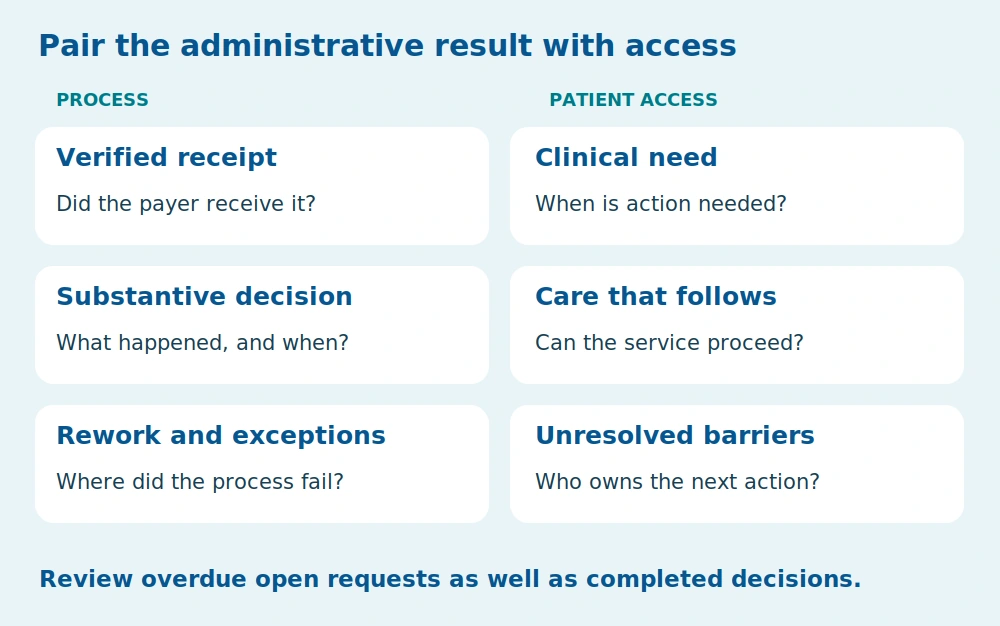
Read figure 3 as text
Pair the administrative result with access
PROCESS
PATIENT ACCESS
Verified receipt
Did the payer receive it?
Clinical need
When is action needed?
Substantive decision
What happened, and when?
Care that follows
Can the service proceed?
Rework and exceptions
Where did the process fail?
Unresolved barriers
Who owns the next action?
Review overdue open requests as well as completed decisions.
| Management question | Suggested measure | Interpretation safeguard |
|---|---|---|
| Did the request reach the payer? | Requests with verified receipt; failed or unconfirmed submissions | Do not infer receipt from a completed local form. |
| Is a substantive decision timely? | Time from receipt to decision, overdue open requests and recorded extensions | Apply the correct scope and urgency; do not count an information request as a decision. |
| Can the patient obtain the service? | Time from approval to service; unresolved scheduling or access barriers | Separate clinical changes and patient choices from administrative barriers. |
| Where does avoidable work occur? | Repeat document requests, corrected submissions and staff or clinician effort | Distinguish defects from legitimate new clinical information. |
| Who experiences the burden? | Access and delay patterns across relevant services and patient groups | Review data completeness, small numbers and confounding before drawing conclusions. |
| Did the repair work? | Repeated observation of the specific failure and the intended outcome | Compare like requests and retain adverse or null results. |
Report distributions and exceptions, not only averages. A short mean can coexist with a small group of severely delayed requests. Review open work as well as completed decisions so that unresolved cases do not vanish from the report. Explain any exclusions, missing timestamps and differences between payer definitions before making comparisons.
The board does not need a list of every portal problem. It needs to know which failures threaten access, who is responsible for correcting them and what evidence shows improvement. A useful review follows a sample of requests from order through care, reconciles unexpected dates and checks the patient’s communication record. Pair that case review with aggregate data. Neither anecdotes alone nor a high-level dashboard alone supplies the full picture.
A focused first 90 days
During the first month, select a service line with enough volume to reveal recurring problems and enough clinical leadership to act on them. Map its major payer products, receipt evidence, urgency process and weekend coverage. Review recent requests across approvals, denials, information requests and failed submissions. Establish the data definitions before setting performance targets. A baseline with visible gaps is more useful than an apparently precise report built from inconsistent events.
During the second month, test the operating changes on that service line. Preserve the original receipt, assign document follow-up, record extension claims and separate substantive decisions from other responses. Use the fictional weekend case as a tabletop prompt, then test with locally applicable program rules and actual staff roles. Verify that the patient communication process works when the usual coordinator or clinician is absent.
During the third month, inspect what changed. Look for reduced unresolved work and better access as well as faster decisions. Examine whether the intervention shifted burden to another team or generated duplicate requests. Retest the failure that prompted the work, then decide whether the process is ready to extend to another service. Do not spread an interface configuration simply because its first demonstration succeeded.
Keep policy monitoring specific to the provision. CMS’s April 2026 proposal addressed drug authorization, standards and additional changes. The August 4, 2026 FY 2027 IPPS/LTCH final rule subsequently finalized certain ONC health IT standards provisions from that proposal, with an October 1, 2026 effective date. It continued to describe the proposed payer requirements separately. It would therefore be inaccurate to label the entire April package either wholly proposed or wholly operative. Standards adoption also should not be treated as proof that every proposed drug or payer-timing obligation has been finalized. Verify the particular final action, effective and compliance dates, payer scope and relevant legal developments before applying a requirement. [L4, L5]
Hospital accountability follows the request to care
Prior authorization becomes an executive issue when no one can reconstruct the request, explain the current deadline or identify the person responsible for the next action. The response is a disciplined operating record supported by clinical judgment: establish scope, preserve receipt, interpret the response correctly and follow the patient through the next step.
The evidence supports attention to burden and access while leaving substantial uncertainty about the effects of particular reforms. That uncertainty is a reason to measure carefully. The hospital should be able to show what it changed, which failure the change addresses and whether patients can obtain the intended care with less unresolved work. A faster electronic exchange is useful when it contributes to that result.
Important disclaimer
This narrative review provides educational and management information. It is not legal advice, clinical guidance for an individual patient or a substitute for payer-specific, program-specific and jurisdiction-specific review. Regulatory descriptions are based on the cited materials reviewed on September 13, 2026. The evidence search was targeted, included substantial abstract-level assessment and did not establish causal effects of CMS-0057-F. The applied case is fictional. No patient information is used and no outcome improvement is claimed for the proposed tools.
Selected peer-reviewed literature
Journal citations were matched by title to PubMed metadata. The evidence matrix records assessment depth and limitations.
E1. Marr J, Trivedi AN, Meyers DJ. Prior Authorization In Medicare Advantage: Beneficiary Exposure And Plan Disenrollment In 2021. Health Aff (Millwood). 2026;45(7):756-763. Source
E2. Shin E, Lei L. Prior Authorization Requirements in Medicare Advantage and County Social Vulnerability. Am J Manag Care. 2026;32(8):444-451. Source
E3. Ruelas V, Bernstein M, Flores Garcia J, Topalis K, Peters AL. Impact of Prior Authorization Suspension on Access to Diabetes Technology in an Underserved Population: A Retrospective Analysis. Diabetes Care. 2026;49(8):1467-1473. Source
E4. Zaari Jabri A, Asher J, Sandling J, Schulman K, Scheinker D. Variation in Commercial Insurer Prior Authorization Rules. Ann Intern Med. 2026;179(7):1059-1061. Source
E6. Carroll NV, Carroll NW, Brody ER. Prescription drug prior authorization: costs to pharmacies and physicians. Am J Manag Care. 2026;32(6):359-364. Source
E7. Wallis R, Allen L, M Davis S, Linn H, Ngo A, Cai Y, et al. Clinical and Administrative Perspectives on Prior Authorization for Residential Substance Use Disorder Treatment: A Qualitative Analysis. J Behav Health Serv Res. 2026;53(2):300-312. Source
E8. Wang Y, Levy JF, Mattingly TJ, Anderson G. Prior Authorization and Associated Delays and Denials of Branded Medication Dispensation. JAMA Health Forum. 2026;7(4):e260760. Source
E9. Hu JC, Kapadia SN, Zhang H, Jalali A, Underhill K, Andrews CM, et al. State Prior Authorization Prohibitions and Buprenorphine Retention Among Privately Insured Patients. JAMA Health Forum. 2026;7(3):e260012. Source
E10. Gotlieb E, Joseph B, Blank L, Jetté N. Barriers and Consequences of Prior Authorization for Neurologic Medications: A Scoping Review. JAMA Neurol. 2026;83(2):181-192. Source
E5. Taylor P, Kulwicki BD, Farwig LM, Cynova R, Cannon M, Hu Y. Centralization of prior authorization services at a community health system’s infusion clinics. Am J Health Syst Pharm. 2025;82(15):e710-e715. Source
E11. Dang S, Parke DW, Sodhi GS, Eichenbaum D, Nielsen J, Danzig C, et al. Anti-VEGF Pharmaceutical Prior Authorization in Retina Practices. JAMA Ophthalmol. 2024;142(8):716-721. Source
E12. Imam N, Zaifman JM, Bassora R, Cherian C, Kohan EM, Alberta FG, et al. Nearly All Peer-to-Peer Reviews for CT and MRI Prior Authorization Denials for Orthopedic Specialists Are Approved. Orthopedics. 2024;47(3):141-146. Source
E13. Neprash HT, Mulcahy JF, Golberstein E. The Extent and Growth of Prior Authorization in Medicare Advantage. Am J Manag Care. 2024;30(3):e85-e92. Source
E14. Salzbrenner SG, Lydiatt M, Helding B, Scheier LM, Greene H, Hill PW, et al. Influence of prior authorization requirements on provider clinical decision-making. Am J Manag Care. 2023;29(7):331-337. Source
E15. Powell AC, Lugo CT, Dietrich CL, Lucas ER, Long JW, DeFrance A, et al. A Description of Outcomes Experienced by Patients Whose Orders for Peripheral Artery Revascularization Were Reviewed by a Nondenial Prior Authorization Program. Vasc Endovascular Surg. 2022;56(4):393-400. Source
E16. Jones LK, Ladd IG, Gregor C, Evans MA, Graham J, Gionfriddo MR. Evaluating implementation outcomes (acceptability, adoption, and feasibility) of two initiatives to improve the medication prior authorization process. BMC Health Serv Res. 2021;21(1):1259. Source
E17. Lauffenburger JC, Stults CD, Mudiganti S, Yan X, Dean-Gilley LM, He M, et al. Impact of implementing electronic prior authorization on medication filling in an electronic health record system in a large healthcare system. J Am Med Inform Assoc. 2021;28(10):2233-2240. Source
Primary legal and policy sources
L1. CMS. CMS Interoperability and Prior Authorization Final Rule CMS-0057-F, fact sheet. Source
L2. CMS. Prior Authorization API frequently asked questions. Source
L3. CMS. Final rule, 89 FR 8758. February 8, 2024. Source
L4. CMS. 2026 CMS Interoperability Standards and Prior Authorization for Drugs Proposed Rule, fact sheet. April 10, 2026. Source
L5. CMS and ONC. FY 2027 IPPS/LTCH final rule, section X.E and adopted health IT standards provisions. August 4, 2026. Source