

· Executive Brief
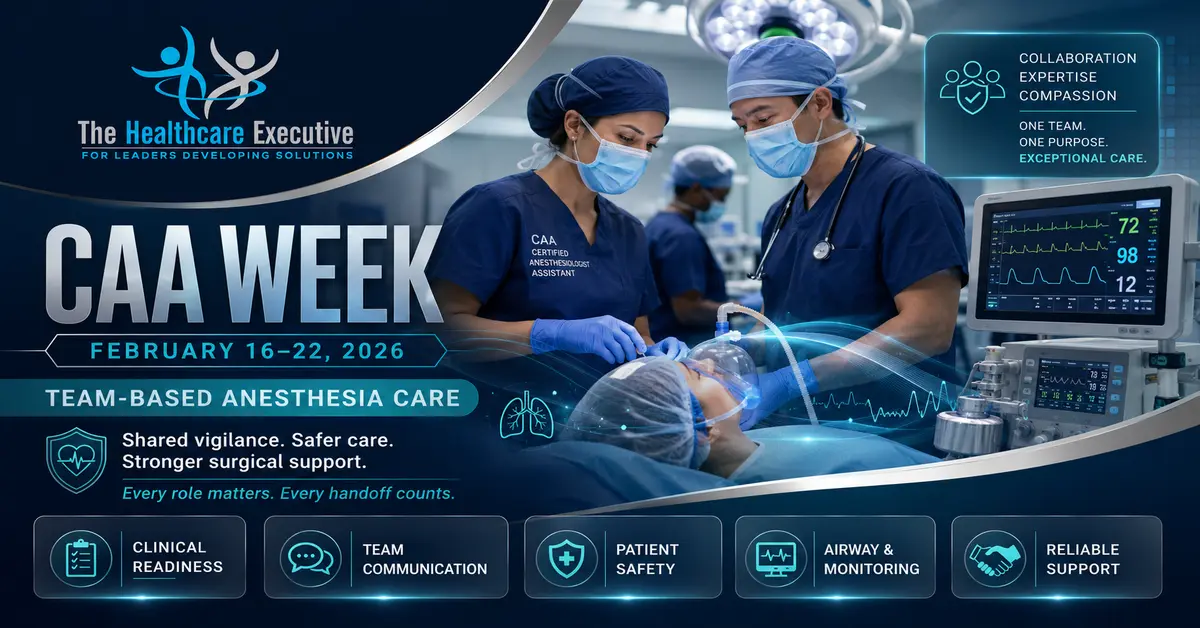
CAA Week 2026
Build a safe anesthesia workforce model with clear credentials, roles, supervision, and team communication.

The 2026 leadership signal
A workforce role becomes capacity only when the operating model is ready.
Certified Anesthesiologist Assistants are educated and certified for practice within the anesthesia care team. Adding or expanding the role requires more than recruitment. State authorization, medical staff governance, credential verification, privileging, supervision, orientation, scheduling, and team communication must align.
CAA Week gives executives a focused checkpoint for that infrastructure. Recognition should make the profession understandable to patients and colleagues while making local accountability unmistakable.
A mature model also distinguishes workforce expansion from workforce readiness. A vacancy count can justify recruitment, but it cannot prove that the medical staff office, anesthesia department, scheduling team, and supervising anesthesiologists can absorb another clinician safely. Leaders should therefore pair every growth target with a readiness standard: current source verification, approved privileges, orientation completion, a named supervision plan, and a documented pathway for concerns. That standard protects the individual clinician from role ambiguity while helping the organization convert additional capacity into dependable patient care.
Patient-facing language matters as well. Registration, consent, preoperative education, and bedside introductions should explain who is on the anesthesia care team and how responsibility is coordinated. The goal is not a script that oversimplifies professional roles. It is a consistent explanation that supports informed questions and prevents patients from learning the team structure only after care is underway.
Audit one CAA employment pathway from workforce planning through credentialing, privileging, onboarding, schedule placement, and ongoing competency.
NCCAA-certified CAAs
4,382
The National Commission for Certification of Anesthesiologist Assistants reported 4,382 NCCAA-certified CAAs as of October 1, 2025.
Figures are summarized from the authoritative sources linked below. Definitions and denominators should be read with each source.
Executive opening
Anesthesia capacity is built from people, pathways and handoffs
CAA Week recognizes one profession, but the operating question behind it is broader. Anesthesia now supports care far beyond the main operating room. A recent review reported that 30% to 50% of anesthesia cases have moved to nonoperating room sites.[6] Each of those cases depends on a team that is staffed, trained, credentialed and able to communicate under pressure. Recognizing Certified Anesthesiologist Assistants is therefore also a review of the system those clinicians join, from licensure and credentialing to supervision and team practice.
The supply of that team is tight in many health systems. A national survey in Israel counted 1,313 anesthesiologists in 36 acute care hospitals and found that 22.6% will reach retirement age within ten years.[11] In Germany, 49.6% of intensive care and anesthesia nursing leaders reported vacant positions.[3] These are not U.S. figures, but they show how retirement, training capacity and licensing rules can reshape anesthesia supply quickly.
Care team design is one lever executives control. In a sample of 45,757 veterans who had surgery in a national health system, anesthesia care models and supervision ratios were not significantly associated with overall satisfaction or hospital ratings.[10] That result gives leaders room to judge team models on access, safety and reliability, rather than on an assumption that patient experience will swing sharply.
Transitions are the second lever. A meta-analysis of 14 studies associated intraoperative anesthesia handovers with higher composite in-hospital mortality and morbidity.[1] The sections below summarize peer-reviewed evidence on supply, training, handoffs, team communication and measurement. They are written to sit beside the executive guidance already on this page, giving boards and operating leaders a shared factual base for workforce decisions. Each section ends with a practical question leaders can bring to their next operating review.
Current evidence
What the research shows about supply, handoffs and team reliability
Workforce supply is the first constraint. The Israeli survey found a ratio of 14.2 anesthesiologists per 100,000 population, yet the authors still expect the shortage to worsen over the next ten years.[11] They pointed to retirements, shortened call hours and a licensing reform that bars graduates of certain overseas medical schools.[11] Israeli medical school graduates rose to 18.1% of the workforce from 12.2% in 2005, while non-citizens and non-permanent residents made up 8.5%.[11] The lesson for executives is that a single headcount ratio can hide a fragile pipeline. Age profile, training origin and licensing exposure belong in the same review as vacancies.
The gap is far wider in low-resource settings. A national assessment of 55 surgical facilities in Somalia found 22 anesthesia specialists, a ratio of 0.2 per 100,000 population.[12] In Ecuador, seven universities offer postgraduate anesthesiology training with a combined capacity of 112 residents, and program directors and senior residents both described low faculty-to-resident ratios.[4] These settings differ from U.S. hospitals, but they show how training capacity sets the ceiling on anesthesia access.
Handoffs are the second constraint, and the evidence is consistent in direction. In the meta-analysis of 14 studies, intraoperative anesthesia handovers were associated with higher in-hospital mortality (adjusted risk ratio 1.49) and morbidity (adjusted risk ratio 1.35).[1] Handovers were also associated with longer intensive care unit stays, while the association with readmission within 30 days was not significant.[1] Subgroup analyses found that the association was not modified by surgical severity or by the level of handover.[1] The underlying studies were observational and highly heterogeneous, so these are associations rather than proof of harm.
Handoff reliability can be improved and measured. At one children’s hospital, 10 adverse events tied to operating room to pediatric intensive care unit handover were reported within one year.[13] After a simplified visual handover tool was built across surgery, anesthesia and intensive care, adherence to standardized handover rose from 69% to 92% at six months.[13] Staff self-reports of safety concerns during handover fell from 69% to 13% at six months and to 0% at three years.[13]
Taken together, the evidence describes two linked risks. Supply is thin and slow to rebuild, which raises the number of transitions each clinician must manage. Transitions carry measurable risk, but structured tools can reduce it.[1][13] For executives, workforce planning and handoff design are therefore one agenda, not two. A shortage plan that adds transitions without adding standards may trade one risk for another.
Figure 1
A standardized handover tool raised adherence and reduced staff safety concerns
Percent of audited handovers meeting the standard, and percent of staff reporting safety concerns during handover. Values are copied from the cited studies [13]; none is estimated.
Data note. All four values come from one quality improvement project in one unit, so before and after values can be read together, but without a control group the change cannot be attributed to the tool alone.
Limitation. Single-center before-after design in pediatric intensive care; results may not transfer directly to adult anesthesia or recovery handoffs.
Figure data (4 rows)
| Measure | Value | Population, setting and year as reported | Source |
|---|---|---|---|
| Adherence to standardized handover, before the tool | 69% | Operating room to pediatric intensive care unit handover, one children’s hospital, baseline | [13] |
| Adherence to standardized handover, six months after | 92% | Same unit six months after the simplified visual tool; improvement sustained at 12 months and three years | [13] |
| Staff reporting safety concerns during handover, before | 69% | Staff self-report, same unit, baseline | [13] |
| Staff reporting safety concerns during handover, six months after | 13% | Staff self-report at six months; 0% at three years | [13] |

Continuum of care
Where anesthesia responsibility changes hands across the perioperative path
Anesthesia care is a chain of transfers rather than a single episode. Responsibility moves from preoperative teams to the procedure room, between clinicians during long cases, and then to recovery and inpatient units. The meta-analysis of handovers found an association with emergency department visits within 90 days of the index surgery (adjusted risk ratio 1.08).[1] That outcome sits well outside the operating room, which is why the handoff deserves enterprise attention rather than departmental tolerance.
The recovery-to-ward transfer is a common weak point. A hospital in Singapore tested a virtual nursing handover from the post-anesthesia care unit to inpatient wards in late 2024.[2] All 31 safety audits met at least 15 of 17 handover criteria, and the model saved an estimated 4.7 hours per day of recovery nurse time.[2] No major technical failures occurred, but nurses rated usability below average, with a mean System Usability Scale score of 41.9.[2] A safe workflow can still fail to scale if the people using it find it hard to use.
Nonoperating room locations add a different kind of transition. Teams in these settings often work with unfamiliar colleagues in spaces not designed for anesthesia, and equipment or personnel may differ from the operating room.[6] The review found widespread consensus that crisis simulation training improves team behaviors, role clarity and timeliness of care, although few studies test it directly in these sites.[6] For executives, the expansion of procedural areas is also an expansion of handoff points.
Good handoff design also spreads. The handover tool built at the children’s hospital moved to six other units and to one adult teaching hospital.[13] Its developers concluded that a simplified tool built collaboratively across departments can improve handover quality and adapt to other settings.[13] That pattern matters for anesthesia care teams that include physicians, anesthesiologist assistants, nurse anesthetists and recovery nurses, because each role sees a different part of the patient journey. A shared tool gives every role the same checklist and the same language at the moment of transfer.
The continuum question for leaders is therefore practical. Which transfers in our anesthesia pathway lack a standard, and which standards lack an audit? The studies above show that handoff standards can be audited and tracked over a period of months.[2][13] Starting with the highest-volume transfer gives the fastest signal.
Figure 3
Why the pathway breaks
People
- Retirement wave in the anesthesia workforce
- Thin subspecialty pipeline
- Leaders without protected time for development
Process
- Intraoperative and recovery handoffs without a standard
- Onboarding that depends on individual managers
- Unfamiliar teams in nonoperating room sites
Technology
- Handover tools with poor usability
- Limited simulation capacity for rare events
Environment
- Procedure spaces not designed for anesthesia
- Declining case volume for high-risk skills
Policy
- Licensing rules that narrow recruitment channels
- Supervision and scope rules that vary by state
Measurement
- No routine handover adherence audit
- Patient experience not stratified by team model
Unranked qualitative cause-and-effect diagram for the outcome in the box: Anesthesia care team cannot deliver reliable, timely coverage across operating room and nonoperating room sites Causes are assembled from the cited literature [1], [2], [3], [5], [6], [11], [13]; categories are not weighted and their order carries no meaning.
Data note. Qualitative; no frequencies are implied.
Limitation. Causes drawn from published studies may not all apply locally; validate them with frontline teams.
Figure data (6 rows)
| Category | Causes drawn from the cited literature |
|---|---|
| People | Retirement wave in the anesthesia workforce; Thin subspecialty pipeline; Leaders without protected time for development |
| Process | Intraoperative and recovery handoffs without a standard; Onboarding that depends on individual managers; Unfamiliar teams in nonoperating room sites |
| Technology | Handover tools with poor usability; Limited simulation capacity for rare events |
| Environment | Procedure spaces not designed for anesthesia; Declining case volume for high-risk skills |
| Policy | Licensing rules that narrow recruitment channels; Supervision and scope rules that vary by state |
| Measurement | No routine handover adherence audit; Patient experience not stratified by team model |
Access
How anesthesia supply shapes access to procedures
Anesthesia supply directly limits procedural access. In Israel, the authors reported that the shortage of anesthesiologists was already limiting surgeries and other procedures in many hospitals.[11] They also noted that the existing workforce had compensated by enlisting non-Israeli trainees from overseas.[11] A health system that depends on a narrow recruitment channel carries an access risk that does not appear on a vacancy report.
Subspecialty capacity is especially fragile. A national U.S. survey of anesthesiology residents, with 201 responses, examined interest in pediatric anesthesiology fellowships amid a projected shortage of fellowship-trained physicians.[14] Residents who reported adequate exposure to high-acuity cases and advanced procedures were more likely to plan a fellowship (adjusted odds ratio 8.47).[14] Perceived faculty teaching and mentor availability were not significantly associated with that intention.[14] Case mix during training, in other words, appears to shape tomorrow’s specialist supply.
Volume shifts can erode training exposure. In Taiwan, a declining birthrate has reduced obstetric case volume, and a national survey examined what that means for obstetric anesthesia training.[5] Among 145 respondents, confidence was lower for managing cardiac parturients (mean 6.21) and neonatal resuscitation (mean 5.89) than for neuraxial anesthesia for cesarean delivery (mean 7.93).[5] The authors called for simulation of rare critical events and for inter-institutional collaboration.[5] U.S. systems that consolidate obstetric services face a similar question about where clinicians maintain high-risk skills. Rotations, shared simulation programs and regional partnerships are practical answers that leaders can fund and track.
The broader global picture reinforces the point. The Somalia assessment compared its workforce with a target of 20 surgery, anesthesia and obstetric providers per 100,000 population by 2030 and concluded the country is unlikely to meet it.[12] In Ecuador, the limited number of postgraduate programs was described as contributing to a shortage of anesthesia-trained physicians.[4]
For U.S. executives, access planning should combine demand forecasts with pipeline signals. Those signals include retirement age profiles, training exposure, case volume trends and the share of the workforce recruited through a single channel.[11][14] Anesthesia care team models, including the anesthesiologist assistant role, are part of that plan only when the supervising and onboarding capacity exists to support them. A role added without that capacity adds a name to the schedule but not dependable coverage.
System route
Connect authorization, credential, privilege, and team practice.
The route should reflect current state requirements, medical staff governance, certification status, and local anesthesia care team policy.
The route at a glance
- Verify the practice environment
- Standardize credentialing
- Define privileges and supervision
- Integrate the team
Verify the practice environment
Confirm current state law, regulation, payer requirements, and organizational policy with qualified legal, compliance, and clinical leadership before workforce deployment.
Standardize credentialing
Verify accredited education, NCCAA certification, state authorization, required life-support credentials, and other locally approved qualifications through primary sources.
Define privileges and supervision
Use explicit privilege criteria, supervision expectations, escalation rules, and documentation standards that match the approved care team model.
Integrate the team
Orient physicians, CAAs, nurses, technicians, schedulers, and leaders to roles, handoffs, emergency response, and how patients receive clear information about the team.
Reliability rule: This brief does not provide legal or credentialing advice. Organizations must validate requirements in the states and facilities where CAAs will practice.
Figure 2
The system route as one flow
The five stages of the system route described in this brief, drawn as one flow with a learning loop back to the start. The stages are the page’s original executive guidance, not a clinical protocol.
Data note. Shows sequence and handoffs only; it carries no counts or rates.
Limitation. Local processes may add, merge or reorder stages under organizational policy.
Figure data (4 rows)
| Stage | What the stage requires |
|---|---|
| Verify the practice environment | Confirm current state law, regulation, payer requirements, and organizational policy with qualified legal, compliance, and clinical leadership before workforce deployment. |
| Standardize credentialing | Verify accredited education, NCCAA certification, state authorization, required life-support credentials, and other locally approved qualifications through primary sources. |
| Define privileges and supervision | Use explicit privilege criteria, supervision expectations, escalation rules, and documentation standards that match the approved care team model. |
| Integrate the team | Orient physicians, CAAs, nurses, technicians, schedulers, and leaders to roles, handoffs, emergency response, and how patients receive clear information about the team. |
Equity and trust
Fair distribution of anesthesia capacity and honest communication
Workforce shortages rarely fall evenly. In Somalia, 288 of the 474 surgery, anesthesia and obstetric providers identified were in one region, Banadir.[12] Of the 55 facilities surveyed, 28 (50.9%) were public and mainly in urban areas.[12] Concentration of this kind is familiar to U.S. leaders who manage rural hospitals, ambulatory centers and urban campuses from one anesthesia department. When a few campuses hold most of the capacity, smaller sites can face longer waits, more cancellations or heavier reliance on temporary staff. Tracking anesthesia coverage by site, not only in aggregate, makes that pattern visible to the board.
Equity also concerns who enters and stays in the profession. In the Israeli workforce, the proportion of female anesthesiologists was 28.7%.[11] The Taiwan survey found that obstetric anesthesia competence and confidence gaps persisted in high-risk and emergency domains and differed by gender.[5] Leaders who track workforce composition alongside training exposure can see whether some groups receive fewer opportunities to build high-acuity skills. The same review should include anesthesiologist assistants, nurse anesthetists and residents, since each group reaches complex cases through different scheduling rules.
Trust depends on how teams handle error and uncertainty. In the Ecuador study, only 33.3% of senior residents reported competence in revealing medical errors or complications.[4] Competence in using echocardiography for patient monitoring was reported by 14.8%.[4] Both findings point to skills that formal evaluation processes should capture, because disclosure and monitoring shape patient trust and safety.
Patients’ views of care team models offer some reassurance. In the veteran study, satisfaction was high across all provider types, and findings held after excluding COVID-19 data and lower-complexity cases.[10] The authors observed small positive effects of nurse anesthetist involvement on provider attentiveness and respect.[10] The study did not examine anesthesiologist assistants, so leaders should not extend its findings to that role without local data. A health system adding anesthesiologist assistants can collect the same satisfaction items before and after the change.
An equitable anesthesia workforce plan therefore asks three things. Is capacity distributed to match need across sites? Do all clinicians receive fair access to the case mix that builds competence? Are error disclosure and patient communication treated as core skills that are taught, assessed and supported? The evidence above shows that each question can be measured.[4][12]

Human infrastructure
Training, credentials and leadership that make the care team work
Simulation is one of the clearest tools for building competence before patients are involved. In a randomized study of 36 novice anesthesiology residents, those trained on a low-cost three-dimensional printed spine model reached a simulator-based epidural success rate of 94.4% at six hours.[8] Residents who received audiovisual teaching only reached 50.0%.[8] The authors noted that long-term retention and clinical performance still need study.[8]
Transfer to real patients is the harder test. In a randomized pilot of 20 anesthesiology interns, haptic virtual reality training produced higher clinical performance scores on the first supervised combined spinal-epidural procedure.[7] The mean difference was 4.50 points on a 100-point scale.[7] Manikin training better supported aseptic practice, so the authors recommended a blended curriculum.[7] Training programs work best when each tool is matched to the skill it builds. Education budgets should follow that logic rather than favoring a single technology.
Selection and credentialing start before training. At one anesthesiologist assistant program, pre-admission science grade point averages showed a moderately strong correlation with performance in the science curriculum (r=0.522).[15] Grade point averages also showed a moderate correlation with performance at graduation (r=0.484).[15] The authors described the profession as relatively young and the evidence on admission metrics as limited.[15] Health systems that partner with anesthesiologist assistant programs can help build that evidence through shared outcome tracking.
Leadership capacity is part of human infrastructure. In the German survey, 550 of 749 responses from intensive care and anesthesia nursing leaders were analyzed.[3] State-certified specialist nurses assumed extended responsibilities in 17.1% of departments.[3] Structures for education, development and leadership varied widely and often depended on the personal commitment of individual managers.[3] A care team model that relies on individual goodwill is not a durable operating model. Clear role definitions and protected leadership time make the model less dependent on any one manager.
Team training needs protected time. The review of nonoperating room crisis management suggested that the scarcity of studies may reflect how hard it is to run interprofessional training in production-driven settings.[6] Executives decide whether simulation, orientation and team drills are scheduled work or optional extras. That choice shapes whether new anesthesia roles join a prepared team. Protected time for drills that include anesthesiologists, anesthesiologist assistants, nurse anesthetists, nurses and technicians builds the shared habits that crisis care depends on.
Operating dashboard
Measure workforce readiness and team reliability.
Use governance-approved definitions and keep credential, privilege, schedule, and competency data synchronized.
Four operating signals
Each signal pairs an executive question with one candidate local measure, set out below.
01
Credential completeness
Track whether every required primary-source verification is current before practice begins or continues.
- Measure
- CAAs with complete current credentials divided by active CAAs
02
Time to readiness
Monitor the full interval from accepted offer to approved, oriented, and schedulable clinician.
- Measure
- Median days by credentialing and onboarding stage
03
Competency coverage
Compare scheduled assignments with approved privileges, current competencies, and supervision capacity.
- Measure
- Assignments meeting all requirements divided by audited assignments
04
Team escalation
Review whether clinical or operational concerns reach the right physician and leader within the expected time.
- Measure
- Timely acknowledged escalations divided by audited escalations
Figure 4
The operating system behind the dashboard
The four operating signals from this brief’s dashboard, each tied to the candidate owner named in the executive scorecard, around one accountable route. Drawn from the page’s original executive guidance.
Data note. Structural diagram; no measured values.
Limitation. Owners are candidates to be confirmed locally.
Figure data (4 rows)
| Operating signal | Candidate owner |
|---|---|
| Credential completeness | Legal, compliance, and medical staff leadership |
| Time to readiness | Credentialing and medical staff services |
| Competency coverage | Anesthesia department leadership |
| Team escalation | Anesthesia operations and finance |
Warm handoff
Make role, patient state, and next decision explicit.
Reliable anesthesia teamwork depends on shared situational awareness and clear acceptance of responsibility.
How responsibility moves
Lane
Credentialing to clinical department
- Confirm primary-source verification, approved privileges, and practice conditions.
- Transfer any restrictions, proctoring, or focused review requirements.
- Require department acknowledgment before scheduling.
Lane
Anesthesia care team alignment
- Confirm patient, procedure, risk profile, team roles, and supervision plan.
- State anticipated transitions and emergency contingencies.
- Use closed-loop communication for changes or concerns.
Lane
Anesthesia team to recovery
- Transfer the anesthesia course, airway considerations, medications, lines, pain plan, and immediate risks.
- Name monitoring and escalation priorities.
- Confirm receiver understanding before disengagement.
Job titles never replace the need for explicit clinical responsibility at the point of care.
Executive scorecard
Ask whether the CAA workforce model is compliant, clear, and usable.
Review the model with anesthesia, medical staff, credentialing, compliance, nursing, human resources, and operations.
Who reviews what
- Legal, compliance, and medical staff leadership
- Credentialing and medical staff services
- Anesthesia department leadership
- Anesthesia operations and finance
Candidate owners named in the scorecard, confirmed locally.
| Signal | Executive question | Accountable owner | Review cadence |
|---|---|---|---|
| Authorization | Have current state and organizational requirements been validated for every practice site? | Legal, compliance, and medical staff leadership | At launch and at least annually |
| Credentials | Are certification, state authorization, privileges, and continuing requirements current and synchronized? | Credentialing and medical staff services | Continuous monitoring |
| Integration | Can every team member describe CAA roles, supervision, and escalation pathways? | Anesthesia department leadership | Quarterly |
| Capacity | Is the workforce model improving reliable coverage without exceeding supervision or onboarding capacity? | Anesthesia operations and finance | Monthly |
Figure 5
Control points for a reliable anesthesia care team
| Control point | Risk if missing | Owner | Evidence of control |
|---|---|---|---|
| Workforce age and pipeline review | Retirements outpace replacement and procedures are limited | Chief operating officer and anesthesia chair | Annual retirement-age profile and recruitment channel mix |
| Standardized intraoperative handover | Information loss when responsibility changes mid-case | Anesthesia department leadership | Audited handover adherence rate |
| Recovery-to-ward handover standard | Omitted information and delayed transfers | Perioperative nursing leadership | Audit against a structured handover checklist plus usability score |
| Simulation and crisis training schedule | Teams meet rare events unprepared, especially outside the operating room | Chief medical officer and education leads | Protected training hours completed per clinician |
| Credential and competency verification | Assignments exceed approved privileges or skills | Medical staff services | Assignments matched to current privileges in periodic audit |
| Patient-facing team explanation | Patients unclear who is responsible for anesthesia care | Patient experience leadership | Attentiveness and respect items tracked by site and team model |
Control points derived from the cited evidence [2], [6], [7], [10], [11], [13] and this brief’s executive guidance.
Data note. Each row is a control to verify, not a measured result.
Limitation. Owners and evidence of control must follow local policy and applicable requirements.
Public communication
Explaining the anesthesia care team to patients and staff
Patients often meet their anesthesia team only minutes before a procedure. Communication before that moment can change what patients expect and choose. In a pre-post study of 142 women scheduled for cesarean delivery, 71.1% initially preferred general anesthesia.[9] After video-based simulation training that showed spinal and general anesthesia, 78.9% preferred regional anesthesia.[9] The pretraining anxiety score related to anesthesia was 51.5, and the authors reported that anxiety decreased after the training.[9]
The lesson is not that a video should steer a clinical decision. It is that clear, visual explanation of what will happen helps patients engage with the team. The same principle applies to explaining who is on the anesthesia care team. Patients should hear how responsibility is shared before care begins, in plain language and in a consistent format. Registration staff, surgeons and nurses should be able to give the same short explanation, so the message does not depend on who happens to meet the patient first.
Communication quality is visible in patient experience data. In the veteran study, involvement of nurse anesthetists was associated with small gains in whether patients felt the provider was attentive and respectful.[10] Those items reflect bedside behavior rather than credentials. Leaders can track the same items by site and team model to see whether introductions and explanations are landing. Low scores at one site are a prompt to observe how teams introduce themselves, not a verdict on any profession.
Internal communication tools must be usable to be trusted. The virtual handover in Singapore met safety standards, yet nurses rated its usability below average.[2] The authors concluded that suboptimal usability may limit technology acceptance.[2] When anesthesia teams adopt new communication tools, frontline usability should be measured with the same discipline as safety and efficiency.
Public recognition during CAA Week is also a communication act. Recognition is most credible when it is paired with transparent measures of team reliability, such as handover adherence and staff-reported safety concerns.[13] The children’s hospital example shows that such measures can be simple and still move over time.[13] Sharing them with staff and boards signals that the care team is supported by a system, not only celebrated for a week. Short updates on progress at staff meetings and in board packets keep that commitment visible after the observance ends.

90-day plan
Make one CAA workforce pathway deployment-ready.
Use a cross-functional team and validate every legal, clinical, credentialing, and operational assumption before expansion.
Ninety days, three moves
- Days 1–30Validate the model
- Days 31–60Test readiness
- Days 61–90Govern and improve
Days 1–30
Validate the model
- Confirm state, payer, medical staff, and policy requirements.
- Map credentialing, privileging, onboarding, and schedule workflows.
- Define role, supervision, and escalation standards.
Days 31–60
Test readiness
- Run a tabletop review of a new-hire file and clinical assignment.
- Orient the multidisciplinary team using realistic handoff scenarios.
- Resolve ownership gaps before clinical deployment.
Days 61–90
Govern and improve
- Measure time to readiness, credential completeness, and schedule fit.
- Review clinical and operational feedback with CAAs and anesthesiologists.
- Approve expansion only after governance confirms the model is reliable.
Figure 6
The 90-day plan on one timeline
The 90-day plan from this brief drawn as a timeline: each action sits in the 30-day window the plan assigns it. The full wording of each action is in the figure data and in the plan above.
Data note. Time boxes are a management framework, not a clinical timeline.
Limitation. Durations are uniform 30-day windows; real tasks may span windows.
Figure data (9 rows)
| Window | Action |
|---|---|
| Days 1–30 | Confirm state, payer, medical staff, and policy requirements. |
| Days 1–30 | Map credentialing, privileging, onboarding, and schedule workflows. |
| Days 1–30 | Define role, supervision, and escalation standards. |
| Days 31–60 | Run a tabletop review of a new-hire file and clinical assignment. |
| Days 31–60 | Orient the multidisciplinary team using realistic handoff scenarios. |
| Days 31–60 | Resolve ownership gaps before clinical deployment. |
| Days 61–90 | Measure time to readiness, credential completeness, and schedule fit. |
| Days 61–90 | Review clinical and operational feedback with CAAs and anesthesiologists. |
| Days 61–90 | Approve expansion only after governance confirms the model is reliable. |
Recognition is credible when the system understands the profession and supports the team.
CAA Week can help leaders make a growing anesthesia profession visible while reinforcing the infrastructure that protects patients, clinicians, and organizational trust. The durable result is an operating model in which qualified people enter practice through a reliable pathway, understand their scope, and can raise a concern without uncertainty about who must respond.
Executive action
Order a cross-functional CAA workforce audit and close the highest-risk gap in credentialing, role clarity, or team integration within 90 days.
Authoritative resources
- CAA Week 2026, American Academy of Anesthesiologist Assistants
- Hire a CAA, American Academy of Anesthesiologist Assistants
- NCCAA Certification and Registry, National Commission for Certification of Anesthesiologist Assistants
- NCCAA Certification Overview, National Commission for Certification of Anesthesiologist Assistants
- Anesthesiologist Assistant Education Accreditation, Accreditation Review Committee for the Anesthesiologist Assistant
- CAA and CRNA Education and Practice Statement, American Society of Anesthesiologists
Source note: Healthgrades lists “National Certified Anesthesiologist Assistant Week” as February 16–20. The American Academy of Anesthesiologist Assistants, the professional organizer, calls the observance “CAA Week” and confirms February 16–22, 2026. Use the AAAA name and full seven-day range.
AAAA confirms the organizer name and the February 16–22 dates. The #CAAre activity is a 2026 social campaign, not labeled as an official theme, so the theme field remains null.
Peer-reviewed references
References
Fifteen peer-reviewed sources, newest first. Each was individually verified through authenticated academic research databases. Bracketed numbers in the text link here; the original executive guidance on this page carries no citations because it is guidance, not a sourced claim. Sources last checked in those databases on .
- 1.Zou C, Chen H, Zhang W. Does intraoperative anesthesia handovers associated with adverse outcomes? A systematic review and meta-analysis. Frontiers in Medicine. 2026;13:1815524. https://doi.org/10.3389/fmed.2026.1815524
- 2.Ang DSY, Lim T, Choh ACL, Ng SC, Tan MY, Aloweni F, et al. Evaluating the Safety, Feasibility, and Usability of a Virtual Nursing Handover From the Post‐Anesthesia Care Unit to the Ward. Journal of Evaluation in Clinical Practice. 2026;32(3):e70442. https://doi.org/10.1111/jep.70442
- 3.Müller-Wolff T, Krüger L, Ufelmann M, Schäfer A, Teichert J, Schindele D. Strukturen und Perspektiven der Intensiv- und Anästhesiepflege in Deutschland: eine bundesweite Querschnitterhebung. Die Anaesthesiologie. 2026;75(10):705-715. https://doi.org/10.1007/s00101-026-01728-5
- 4.Romo S, Hernández K, Sisa I. Training of Anesthesiologists in Low‐ and Middle‐Income Countries: A Case Study From Ecuador. World Journal of Surgery. 2026;50(3):626-635. https://doi.org/10.1002/wjs.70269
- 5.Hu LM, Liao CC, Chang FC, Chao WH, Cheng WS, Chaou CH. Evaluating perceived obstetric anesthesia training needs in residency education: a Taiwanese national survey. Medical Education Online. 2026;31(1):2731792. https://doi.org/10.1080/10872981.2026.2731792
- 6.Wen L, Schroeck H. Crisis resource management in nonoperating room anesthesia. Current Opinion in Anaesthesiology. 2026;39(4):484-489. https://doi.org/10.1097/aco.0000000000001673
- 7.Xie H, Lin W, Zheng Y, Lin M, Fang X, Ma S, et al. Haptic Virtual Reality Training for Combined Spinal-Epidural Anesthesia in Anesthesiology Trainees: Prospective Randomized Controlled Pilot Trial. JMIR Serious Games. 2026;14:e92207-e92207. https://doi.org/10.2196/92207
- 8.Sertoz N, Sahutoglu C, Ozgul KK, Ozer MA, Govsa F. Effectiveness of three-dimensional printed lumbar spine-model-based training for epidural anesthesia in novice anesthesiology residents. Surgical and Radiologic Anatomy. 2026;48(1):165. https://doi.org/10.1007/s00276-026-03933-8
- 9.Yetkin H, Demirkiran H. The Impact of Video–based Simulation Training on Preoperative Anxiety and Anesthesia Preferences in Women Scheduled for Cesarean Section Delivery. Journal of PeriAnesthesia Nursing. 2026;41(2):359-362.e1. https://doi.org/10.1016/j.jopan.2025.07.008
- 10.Griffith KN, Harris J, Darna J, Dutton RP, Mull HJ. Does Anesthesia Provider Type Affect Veteran Satisfaction With Care?. Medical Care. 2025;64(2):59-67. https://doi.org/10.1097/mlr.0000000000002253
- 11.Wimpfheimer A, Ginosar Y, Fein S, Goldberger E, Weissman C, the Israel Anesthesiology Workforce Study Group, et al. The Israeli anesthesiology workforce crisis: a reassessment survey. Israel Journal of Health Policy Research. 2024;13(1):48. https://doi.org/10.1186/s13584-024-00620-0
- 12.Omar MA, Osman MM, Mohamud AM, Hashi AS, Mohamed SA, Kifle F, et al. Assessment of surgical, anesthesia, and obstetric workforce in Somalia. World Journal of Surgery. 2024;48(9):2199-2206. https://doi.org/10.1002/wjs.12283
- 13.Subramonian D, Krahn G, Wlodarczak J, Lamb L, Malherbe S, Skarsgard E, et al. Improved patient safety with a simplified operating room to pediatric intensive care unit handover tool (PATHQS). Frontiers in Pediatrics. 2024;12:1327381. https://doi.org/10.3389/fped.2024.1327381
- 14.Carullo P, Khan S, Nause‐Osthoff R, Gupta R, Xie J, Azamfirei R, et al. Understanding Pediatric Anesthesiology Fellowship Interest: A National Survey of the Resident Experience. Pediatric Anesthesia. 2024;35(3):223-231. https://doi.org/10.1111/pan.15049
- 15.Monroe K, Bundy W, Greene Y, Jarvis G, Stever J, Patel G. Impact of Pre-Admission Grade Point Averages on Anesthesiologist Assistant Student Performance at Emory University School of Medicine. Advances in Medical Education and Practice. 2024;Volume 15:611-614. https://doi.org/10.2147/amep.s465374
Claim-to-source matrix
What each source supports
Every sourced claim in the new sections maps to the references that support it, the section where it is used, and the limitation a reader should keep in mind. Original executive guidance carries no sources because it is guidance, not a finding.
| Claim group | Sources | Years | Used in | Limitation |
|---|---|---|---|---|
| Anesthesiologist workforce composition, retirement and shortage outlook | [11] | 2024 | Current evidence | Single-country survey of department chairs in 2021; Israeli licensing and training context. |
| Anesthesia workforce density and training capacity in low-resource settings | [12] [4] | 2026, 2024 | Current evidence | Cross-sectional national assessments in Somalia and Ecuador; small respondent numbers in Ecuador. |
| Intraoperative anesthesia handovers and adverse outcomes | [1] | 2026 | Current evidence | Meta-analysis of 14 observational studies with very high heterogeneity; association only. |
| Standardized operating room to intensive care handover and safety events | [13] | 2024 | Current evidence | Single-center quality improvement project with before-after design. |
| Virtual recovery-to-ward nursing handover safety, time and usability | [2] | 2026 | Continuum of care | One hospital in Singapore over two months; 31 audits; time saving is an estimate. |
| Crisis resource management in nonoperating room anesthesia | [6] | 2026 | Continuum of care | Narrative review; few studies directly evaluate crisis training in these settings. |
| Training exposure and subspecialty and obstetric anesthesia pipelines | [14] [5] | 2026, 2024 | Access | Voluntary surveys with modest or low response rates; self-reported intentions and confidence. |
| Anesthesia care team model and patient satisfaction | [10] | 2025 | Equity and trust | Veterans Health Administration survey respondents; did not include anesthesiologist assistants. |
| Simulation-based procedural training for anesthesia trainees | [8] [7] | 2026 | Human infrastructure | Small single-center randomized studies; short-term outcomes. |
| Admission metrics and anesthesiologist assistant student performance | [15] | 2024 | Human infrastructure | Single program; correlation analysis only. |
| Anesthesia and intensive care nursing leadership structures | [3] | 2026 | Human infrastructure | Cross-sectional survey of German nursing leaders recruited through professional networks. |
| Preoperative video simulation, anxiety and anesthesia preference | [9] | 2026 | Public communication | Single-group pre-post design in elective cesarean patients; no control group. |
About the author
Greg Wahlstrom
MBAHCM
President and Chief Executive Officer, The Healthcare Executive
View Greg’s profile©2014 – 2026 The Healthcare Executive. All rights reserved.