
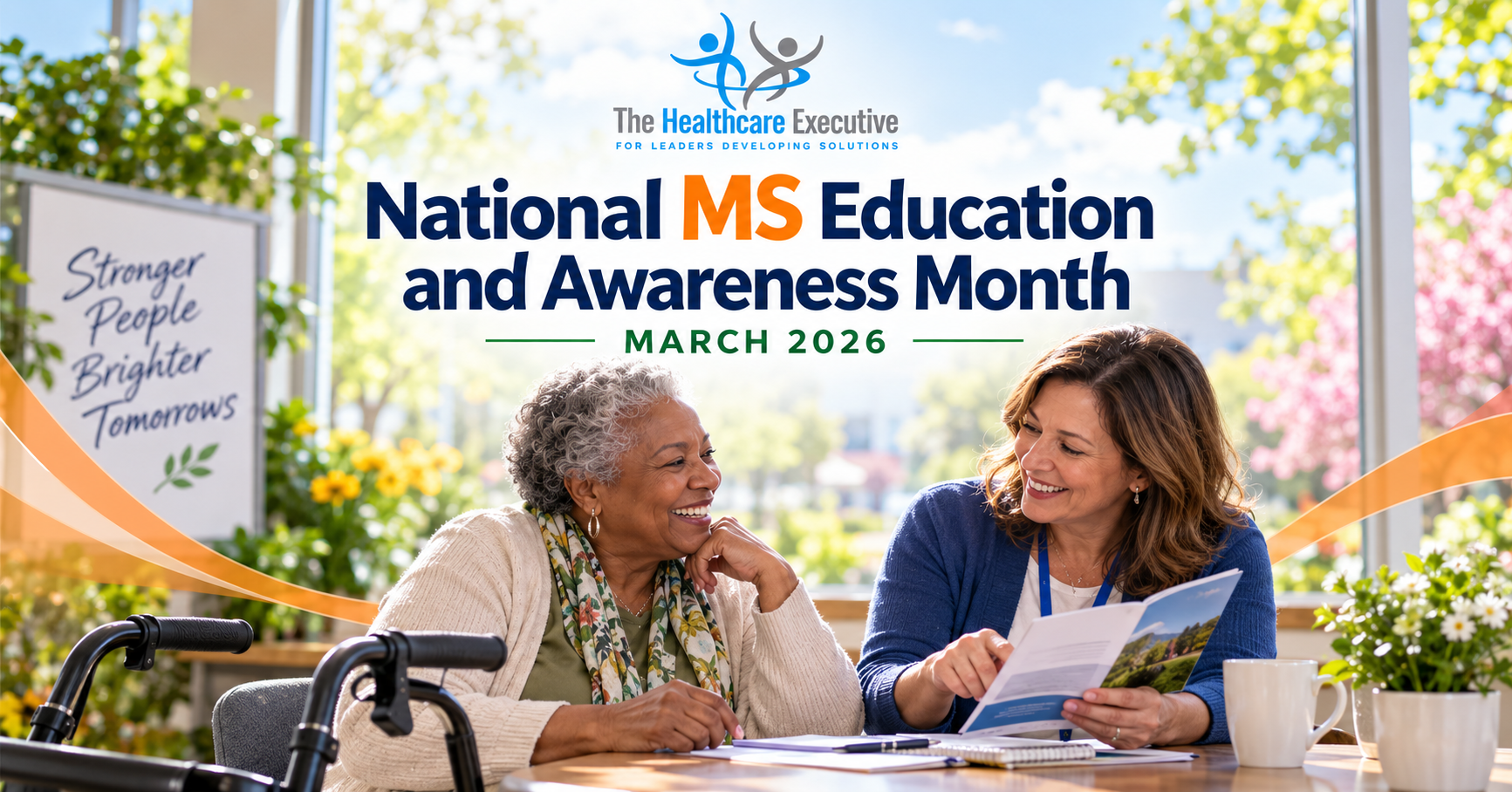


National MS Education and Awareness Month® 2026
Connect four decades of progress to the next reliable step in diagnosis, treatment, function, and daily life.
Four decades of progress only matter when the next step is reliable.
The Multiple Sclerosis Foundation’s 2026 theme, “Yesterday, Today, Tomorrow: Four decades of MS Focus,” puts attention on 40 years of breakthroughs in diagnosis, treatment options, and access. For health-system leaders, the useful question is not how far MS care has come in principle, but whether a person with new neurological symptoms in their community can move through diagnosis, treatment, and support without avoidable waits or dropped handoffs.
The population is significant and concentrated in working-age adults. The Multiple Sclerosis Foundation reports that close to 1 million people in the United States live with MS, and that it is most commonly diagnosed between ages 20 and 40. That profile means MS care intersects with employment, family responsibilities, insurance transitions, and long-term planning, not only with neurology clinic capacity.
Diagnosis is rarely a single event. WHO describes MS as a diagnosis of exclusion with no definitive diagnostic test, supported by tools such as MRI and lumbar puncture. That makes the path from first symptom to neurology evaluation, imaging, and a confirmed care plan an operational sequence that leaders can map, staff, and measure, rather than a black box inside a specialty service.
Treatment and function now depend on continuity. The Multiple Sclerosis Foundation notes more than a dozen treatments for relapsing forms of MS, and WHO highlights rehabilitation as a way to improve functioning and quality of life. Health systems add value by coordinating therapy access, monitoring, rehabilitation, mental health support, and practical help with daily life, so progress in the science reaches the person consistently.
Map and measure the route from first neurological symptoms to a confirmed MS care plan, then close the largest delay in that route this year.
The Multiple Sclerosis Foundation reports that close to 1 million people in the United States are living with MS.
WHO reports that over 1.8 million people have MS worldwide.
The Multiple Sclerosis Foundation reports that MS is most commonly diagnosed in people between the ages of 20 and 40.
Figures are summarized from the authoritative sources linked below. Definitions and denominators should be read with each source.
Connect each stage of MS care to the next.
A dependable MS route links primary care, neurology, imaging, pharmacy, rehabilitation, and community support.
-
Refer and evaluate
Route people with suspected MS symptoms to timely neurology evaluation with clear referral criteria and scheduling ownership.
-
Confirm diagnosis
Coordinate imaging and other diagnostic steps so results return to a named clinician who communicates the plan.
-
Start and sustain treatment
Support therapy decisions, prior authorization, pharmacy access, and monitoring as one coordinated service.
-
Protect function and daily life
Connect rehabilitation, mental health, employment, and social support to the ongoing care plan.
Reliability rule: No person with suspected or confirmed MS should wait on a step that has no named owner.
Measure the gaps people actually feel.
These instruments are local management prompts that help leaders see where the route slows down.
Referral to neurology
Track how long people wait from referral for suspected MS to a completed neurology visit.
Diagnostic completion
Track whether ordered imaging and diagnostic steps are completed and reviewed.
Therapy access
Track the time from a treatment decision to the person actually starting therapy.
Function and support
Track whether people with MS have rehabilitation and support needs assessed and addressed.
Strengthen the handoffs that shape the experience.
Most MS delays happen between services rather than within them.
From primary care to neurology
- Describe the symptoms, their timing, and any prior episodes.
- Include relevant history and previous imaging.
- Confirm who schedules the visit and informs the person.
From neurology to pharmacy and access teams
- Share the treatment decision and required monitoring.
- Start benefits verification and authorization promptly.
- Tell the person who to contact if access stalls.
From specialty care to rehabilitation and community support
- Share functional goals and current limitations.
- Refer to rehabilitation, mental health, or social work as needed.
- Return updates to the neurology team and primary care.
People with MS often manage their own coordination; every handoff that the system owns is one less burden on them.
Keep four questions in front of leadership.
A short scorecard ties the 2026 theme to measurable operations.
| Signal | Executive question | Accountable owner | Review cadence |
|---|---|---|---|
| Access | Can people with suspected MS see neurology in a timely way? | Neurology and access leaders | Monthly |
| Diagnosis | Are diagnostic steps completed and communicated without avoidable delay? | Neurology and imaging leaders | Monthly |
| Treatment | Do people start and stay on agreed therapy without access barriers? | Specialty pharmacy and revenue cycle leaders | Quarterly |
| Function | Are rehabilitation and daily-life needs assessed and met? | Rehabilitation and care management leaders | Quarterly |
Use March to start a 90-day improvement cycle.
National MS Education and Awareness Month® is a natural moment to test and improve the route.
Pick one segment of the MS route where people wait longest. Review recent cases with neurology, pharmacy, and access staff. Make one change to ownership or scheduling and measure its effect. Report the result and choose the next segment.
Days 1–30: Map
- Map the route from referral to confirmed care plan.
- Pull baseline intervals for referral, diagnosis, and therapy start.
- Name an executive sponsor and clinical lead.
Days 31–60: Fix
- Assign owners for the slowest handoff.
- Standardize referral and authorization information.
- Add a rehabilitation and support needs review to routine visits.
Days 61–90: Report
- Compare intervals to baseline.
- Gather feedback from people with MS and families.
- Publish results and select the next improvement target.
Progress should reach the next person on time.
National MS Education and Awareness Month® 2026 marks four decades of MS Focus; health systems honour that progress by making diagnosis, treatment, and support dependable.
Turn National MS Education and Awareness Month® into accountable action.
Connect four decades of progress to the next reliable step in diagnosis, treatment, function, and daily life.
Leadership focus
Connect four decades of MS progress to reliable diagnosis, treatment, function, and daily life.
Workforce lens
Brief primary care, neurology, imaging, pharmacy, and rehabilitation teams on the shared MS route and who owns each step.
Patient and community lens
Give people with MS a single contact for access problems and ask what support would make daily life easier.
Equity and access lens
Review whether distance, insurance type, language, or disability access affects time to neurology, diagnosis, and therapy.
Inspect the operating sequence
The Multiple Sclerosis Foundation’s 2026 theme marks four decades of progress in MS diagnosis, treatment, and access. Our contribution is to make sure that progress arrives reliably. This month we will measure and improve one part of the MS route.
- 01Refer and evaluate
- 02Confirm diagnosis
- 03Start and sustain treatment
- 04Protect function and daily life
Leadership actions for this week
- Name an executive sponsor and frontline operating owner.
- Ask people using and operating the pathway where ownership becomes unclear.
- Test one representative route from first question to acknowledged next step.
- Select one barrier that can be corrected without overstating the evidence.
- Set a review date and define how completion will be verified.
Candidate measures
Define every numerator, denominator where relevant, owner, data source, exclusions, cadence, and limitation locally. These are management prompts, not external benchmarks.
- Median and 90th-percentile days from referral to completed neurology visit
- Median days from neurology visit to completed and reviewed imaging
- Median days from treatment decision to first dose or infusion
Department readiness checklist
- The public and staff entry points match the actual approved process.
- A specific role accepts each request, referral, or escalation.
- Handoffs include acknowledgment and a visible unresolved state.
- Language, disability, digital, transportation, and trust barriers receive explicit review.
- Communications do not introduce unsupported themes, statistics, or clinical advice.
- A named leader will review what changed after the observance.
Intended audiences
- Executive and Operational Leaders
- Public Health and Community Partners
Staff communication template
During National MS Education and Awareness Month®, our organization will review how people move from first symptoms to a confirmed MS care plan. Please share where you see delays or unclear ownership.
Community communication template
March is National MS Education and Awareness Month®. We join the Multiple Sclerosis Foundation in recognizing four decades of progress and in supporting people living with MS and their families.
Measurement worksheet
- Signal
- What observable condition will show whether the route works?
- Definition
- What is included, excluded, and counted?
- Owner
- Who reviews the signal and acts on exceptions?
- Cadence
- When will leaders review it?
- Equity check
- Which differences require protected, locally appropriate review?
- Closure
- What evidence will confirm the improvement was completed?
Authoritative resources
- National MS Education and Awareness Month®, Multiple Sclerosis Foundation
- Common Questions, Multiple Sclerosis Foundation
- Multiple sclerosis fact sheet, World Health Organization
Verification note: The Multiple Sclerosis Foundation confirms the 2026 theme, “Yesterday, Today, Tomorrow: Four decades of MS Focus,” for National MS Education and Awareness Month®, a registered mark of the Foundation. The Foundation’s page did not state specific 2026 dates; the March calendar date is retained as given.