

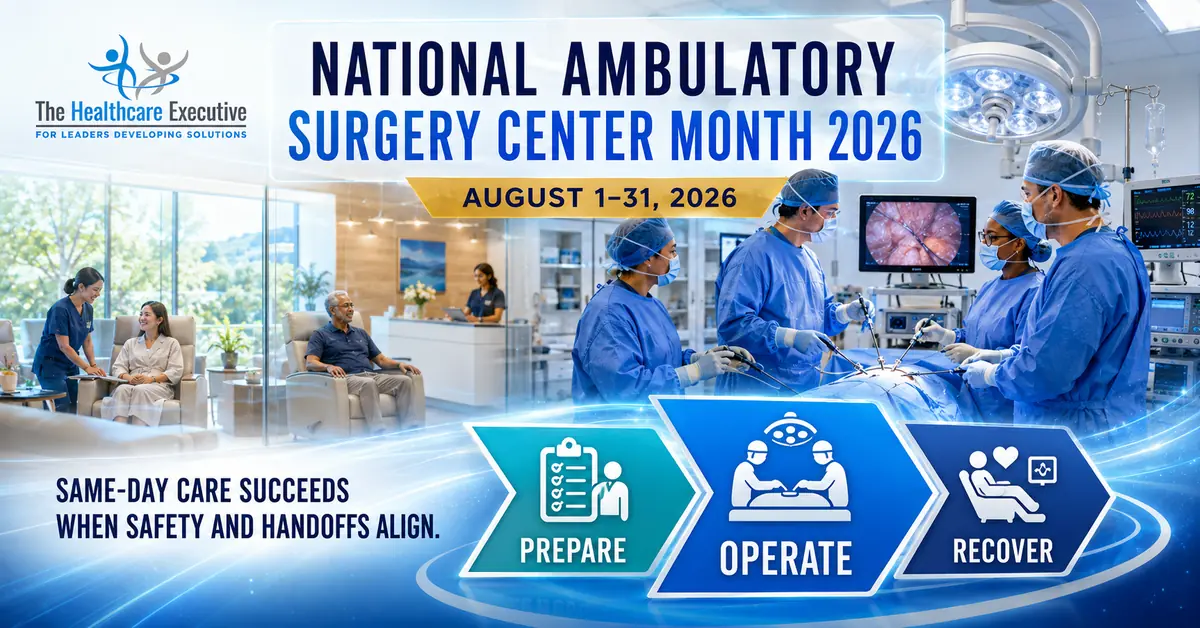
Health Observance | August 2026
National Ambulatory Surgery Center Month 2026: Govern the Entire Surgical Episode
Use National ASC Month as an operating checkpoint for governance, patient selection, anesthesia, infection prevention, escalation, recovery, equity, and decision-grade measurement across the complete surgical episode.
The site of service is changing, but accountability does not move away
The Ambulatory Surgery Center Association recognizes August as National ASC Month. This article preserves the existing expanded editorial title, National Ambulatory Surgery Center Month, while using ASCA’s official program name when referring to the observance itself.
Ambulatory surgery can make care more accessible, focused, and affordable for appropriately selected patients. It can also compress complex work into a smaller setting and move much of recovery to the patient, caregiver, and community. National Ambulatory Surgery Center Month gives boards and executive teams a practical reason to examine whether the full episode is governed as carefully as the procedure itself.
Ambulatory surgery centers occupy an important place in the care continuum. They concentrate teams, equipment, and workflows around planned procedures and same-day recovery. That focus can reduce unnecessary complexity. Yet a smaller footprint does not create a smaller duty of care. The duty changes shape.
In a hospital, emergency response, diagnostics, specialty consultation, blood products, inpatient beds, pharmacy support, and other capabilities may be close at hand. A freestanding center works within a different boundary. It must know exactly which services it can support, which patients fit that environment, what rescue capability exists on site, when a case must move to a hospital, and who remains accountable after discharge.
Recent research shows why the boundary deserves executive attention. A national database study of primary total knee arthroplasty reported a marked movement from hospital to outpatient settings between 2019 and 2022. The ASC population in that study was younger, had fewer comorbidities, and differed by race and insurance status from the hospital population [9]. Those differences matter. A raw comparison of outcomes across settings can mislead when patient mix and selection are not visible.
A separate institutional registry study followed 5,000 hip and knee arthroplasties during a transition that moved substantial volume to a stand-alone ASC. The investigators did not detect an increase in selected readmission, reoperation, or complication outcomes, including among a more medically complex post-transition cohort [15]. That is useful implementation evidence, but it remains one observational program spanning a period affected by the pandemic. It does not establish that every procedure, center, or population can make the same move with the same results.
The correct executive response is neither automatic enthusiasm nor automatic resistance. It is disciplined governance. Each site-of-service decision should connect clinical readiness, organizational capability, patient preference, access, affordability, recovery support, and transparent outcome review.
National Ambulatory Surgery Center Month should therefore be more than a celebration of efficiency. It should be an annual operating checkpoint. Leaders can use August to test whether the center’s public promise matches its actual route of care, whether exceptions become visible, and whether the board can see what happens before, during, and after the procedure.
Governance begins before a case reaches the schedule
The governing body sets the boundary of the ASC. It approves the services offered, the qualifications needed to perform them, the anesthesia and recovery capabilities that support them, the emergency plan, and the measures used to assess performance. If those decisions live in separate binders or committees, the center may satisfy documentation requirements while leaving the operating system fragmented.
Start with procedural scope. Every approved service should have an explicit readiness profile that answers five questions:
- What patient conditions and procedural characteristics fit the center’s current capabilities?
- What professional qualifications, privileges, team competencies, equipment, medications, supplies, and implants does the procedure require?
- What events must the team be able to recognize and manage on site?
- Which events trigger cancellation, higher-acuity placement, extended observation, or hospital transfer?
- What follow-up, rehabilitation, pathology, medication, and after-hours access does the complete episode require?
Credentialing and privileging should connect directly to this readiness profile. A current license, board status, or case log may be necessary, but no single document establishes readiness for the full scope of work. Leaders should be able to show how initial appointment, focused professional practice evaluation, ongoing evaluation, procedural privileges, anesthesia privileges, emergency competencies, peer review, and corrective action connect to the services the center actually performs.
The same standard applies when a new procedure, device, implant, anesthesia technique, or higher-acuity patient group is proposed. The proposal should not enter the schedule only because a clinician is interested, a payer will cover it, or the equipment is available. The governing body needs a defined review that addresses evidence, staffing, training, space, sterile-processing requirements, supply resilience, rescue capability, transfer implications, discharge needs, and measurement.
Ownership adds another governance question. A 2026 peer-reviewed viewpoint on surgeon ownership in ambulatory arthroplasty argues for standardized ownership disclosure, risk-adjusted site-of-service reporting, independent case review, and transparent equity life-cycle planning [1]. The article is a governance proposal, not an outcome trial. Its central concern is still practical: financial participation can coexist with professional judgment, but the organization should make conflicts visible and protect the neutrality of patient selection.
An effective governance design therefore includes:
- documented ownership and conflict disclosure;
- separation between financial incentives and individual eligibility decisions;
- procedure-specific criteria approved through medical and governing-body review;
- independent review for exceptions, adverse trends, and contested site-of-service choices;
- risk-adjusted reporting when patient mix differs;
- a clear process for adding, restricting, suspending, or retiring privileges;
- recurring review of emergency, transfer, and after-hours responsibilities; and
- board reporting that includes access, safety, experience, equity, and total-episode outcomes.
Governance is not the final signature on a policy. It is the operating discipline that keeps capability, incentives, and accountability aligned.
Patient selection is a care-setting decision, not a gatekeeping exercise
Patient selection often receives attention because it protects same-day flow. That framing is too narrow. Selection should identify the setting that can best support the person and procedure. It should also identify what the organization can change to make access possible.
Evidence from joint arthroplasty illustrates the need for risk-sensitive review. A national surgical database study examined 22,575 patients who received same-day discharge after total hip arthroplasty. Within that cohort, 1.6% were readmitted within 30 days. Readmission was associated with older age, frailty, and general rather than neuraxial anesthesia [7]. The findings do not prove that one anesthesia choice caused readmission, and they do not provide a universal eligibility cutoff. They do show why selection, anesthesia planning, and recovery readiness should be reviewed together.
Transfer studies add another view. One institutional arthroplasty program reported seven direct hospital transfers among 6,379 ASC cases over more than a decade. The events involved systemic medical conditions, including hemodynamic and cardiopulmonary concerns [4]. A separate ophthalmology ASC reviewed 22 transfers among 24,960 admissions. Most concerns were first identified before anesthesia induction, and the reviewers considered some transfers preventable [14]. These results come from different specialties and should not be combined into one rate. Together, they support a common management question: does the preoperative process surface information early enough to change the plan before the patient enters an unsafe route?
A reliable selection process covers more than a problem list. It considers:
- procedure complexity and expected duration;
- anesthesia plan and airway considerations;
- comorbid conditions, frailty, function, and prior response to surgery or anesthesia;
- medication management and access to postoperative prescriptions;
- mobility, fall risk, and home environment;
- travel distance and the ability to return if symptoms change;
- caregiver availability and the caregiver’s actual readiness;
- language, hearing, vision, cognitive, and communication needs;
- disability accommodation and trauma-informed preparation;
- health literacy and the patient’s understanding of same-day recovery;
- primary care, specialty, rehabilitation, and pharmacy connections; and
- patient preference after a balanced discussion of setting options.
Social needs should not become hidden exclusion criteria. If a patient lacks transportation, a caregiver, accessible instructions, or a nearby pharmacy, the first executive question should be whether navigation, transportation support, lodging, home health, interpreter access, or a different schedule can close the gap. When the gap cannot be closed, a hospital setting may be appropriate. The reason should be documented accurately, and the organization should analyze whether the same barriers repeatedly restrict access for particular groups.

The study of outpatient total knee arthroplasty found differences in race, insurance, and comorbidity between ASC and hospital populations [9]. A propensity-matched study of 120,240 same-day plastic surgery patients also found site-of-service differences in charge trends, access patterns, and unexpected postoperative visits [13]. Neither study proves that an ASC is inherently more or less equitable. They show why access must be measured by who is offered the option, who accepts it, who is deferred, why decisions change, and what happens afterward.
The governing body should receive an exceptions view, not only an approval rate. An exception log can reveal recurring issues in medical optimization, test completion, transportation, language support, medication access, caregiver readiness, equipment availability, or receiving-hospital coordination. That makes selection a source of system learning rather than a one-time pass or fail.
Figure 1. Implementation framework
Shared review before the final site-of-service decision
-
Confirm procedure scope
Match the planned procedure to the center's approved capability and resources.
-
Review clinical readiness
Consider comorbidity, function, medications, and complete-episode needs.
-
Review anesthesia needs
Align the plan with monitoring, rescue, and recovery capability.
-
Review recovery environment
Address caregiver support, transportation, home needs, and after-hours escalation.
-
Provide accommodations
Plan language, disability, sensory, mobility, and communication support.
-
Document the next state
Schedule the ASC, select a hospital setting, or complete further review without automatic exclusion.
Source and denominator: Not applicable; this is a qualitative implementation framework. The pathway synthesizes evidence on selection, anesthesia, recovery, access, and site-of-service transition. Evidence: [4], [7], [9], [12], [16]
Evidence boundary: The figure does not assign a universal eligibility score, risk cutoff, or transfer rule. Local governance and patient-specific judgment control the decision.
Anesthesia, infection prevention, and sterile processing must operate as one safety system
The patient experiences one episode. The organization should manage it the same way. Anesthesia, nursing, infection prevention, sterile processing, pharmacy, supply chain, facilities, and the procedural team cannot function as isolated departments that meet only at the time of the case.
Anesthesia capability must match procedural scope
Anesthesia planning shapes selection, postoperative symptoms, recovery time, staffing, and rescue readiness. A 2026 qualitative study of 14 certified registered nurse anesthetists working in outpatient orthopedics found that institutional factors, policy, employment context, and practice variation affected the use of regional anesthesia [5]. Because this was a small interview study, it does not establish one preferred workforce or scope model. It does show that training alone does not guarantee consistent practice. Policy, privileges, equipment, scheduling, professional relationships, and organizational support influence what the team can deliver.
A small prospective cohort compared deep intravenous sedation at an ASC with general anesthesia at a community hospital for mostly rhinoplasty procedures. The groups differed in recovery measures, but the study included only 39 relatively healthy adults, was not randomized, and compared patients across two settings [20]. Leaders should not use it to claim that one technique is superior across services. Its more durable lesson is that any sedation or anesthesia model requires careful patient selection, vigilant monitoring, dose control, airway rescue capability, and a recovery plan matched to the technique.
The anesthesia operating standard should define:
- who may deliver each technique and under which privileges;
- minimum monitoring and documentation;
- medication storage, access, reconciliation, and emergency availability;
- difficult-airway and cardiopulmonary rescue resources;
- postoperative pain, nausea, hydration, mobility, and discharge criteria;
- handoff requirements among anesthesia, PACU, and the discharging clinician;
- staffing when cases overlap or recovery needs exceed the planned window; and
- the conditions that trigger cancellation, observation, or transfer.
Enhanced-recovery principles can help organize this work. A peer-reviewed review describes coordinated counseling and optimization, multimodal analgesia, prevention of nausea, infection, and thrombosis, fluid management, early mobility, and interdisciplinary teamwork as core ambulatory recovery elements [19]. These elements should be tailored to the procedure and patient. They should not become a generic checklist copied across specialties.
Infection prevention extends beyond the operating room
Infection surveillance should connect preoperative preparation, environmental cleaning, hand hygiene, medication practices, sterile processing, antibiotic processes when applicable, post-discharge symptom reporting, and procedure-level outcomes. A transfer-only dashboard cannot show whether this system works.
A single-center review of 100 ankle fracture repairs found that surgical-site infection was the most common short-term complication in its cohort [17]. The study was retrospective, involved one surgeon, and used historical comparisons. Its reported rate is not a benchmark. It is a reminder that same-day discharge does not eliminate the need to capture infections and other complications that emerge after the patient leaves.
Sterile processing is one of the most visible tests of operating discipline. A study of staff-reported instrument errors across three operating sites served by one processing facility reviewed 368 safety notices containing 419 errors. Most reported errors involved inspection or identification problems, including bioburden and missing instruments. Reports were often incomplete or delayed [18]. Voluntary reporting likely undercounted events, so the findings should not be treated as a true incidence rate. They do identify practical failure modes that ASC leaders can examine locally.
The center should be able to trace each instrument set from decontamination through cleaning verification, inspection, assembly, sterilization, storage, transport, room use, and return. Leaders should ask whether lighting, magnification, work design, staffing, training, instructions for use, loaner-instrument timing, water quality, equipment maintenance, and reporting systems support the staff expected to find defects.
Supply management belongs in the same conversation. A 2026 comparison of 100 breast-conserving operations at two hospitals and one ASC found less unused equipment and lower waste weight at the ASC [2]. The study was limited to three Arizona facilities and one procedure family. It does not promise the same savings elsewhere. It supports reviewing trays and preference cards at the procedure level instead of treating unused supplies as an unavoidable cost.
An operations-research model also found value in integrating surgical scheduling with reusable-instrument inventory decisions [3]. This was a mathematical model, not a clinical trial, so its savings estimates depend on assumptions. The management insight is sound: scheduling, tray availability, processing time, rentals, case length, and room capacity interact. A schedule is not feasible merely because a room and clinician are available.
Figure 3. Cause-and-effect diagram
Contributors to case-readiness failure or unsafe disruption
-
Scope and selection
Procedure needs and patient readiness exceed the approved operating boundary.
-
Staffing and competency
Assigned roles, training, or rescue capability do not match acuity.
-
Anesthesia and rescue
Assessment, monitoring, equipment, medication, or escalation readiness is incomplete.
-
Sterile processing and supplies
Instrumentation, traceability, reprocessing, or supply continuity fails before the case.
-
Recovery and discharge
Criteria, caregiver readiness, after-hours access, or follow-up ownership is unclear.
-
Transfer and handoff
Stabilization, transport activation, receiving communication, or event learning is unreliable.
Source and denominator: Not applicable; this is a qualitative cause-and-effect diagram. The branches synthesize evidence on governance, selection, anesthesia, sterile processing, recovery, and transfer readiness. Evidence: [1], [2], [3], [5], [18]
Evidence boundary: The branches are not ranked. A Pareto chart requires comparable locally coded event counts, stable definitions, and a complete case denominator.
Transfers and escalation are designed endpoints, not operational failures to hide
An ASC should seek to prevent avoidable transfers, but it should never create pressure to delay a necessary transfer. The transfer rate alone cannot distinguish good selection, weak detection, appropriate escalation, or unsafe reluctance to move a patient.
A dependable transfer route includes:
- recognition criteria understood by every relevant role;
- immediate stabilization within the center’s capability;
- a clear activation method for emergency medical services or the receiving hospital;
- identified responsibility for clinical handoff and record transmission;
- current medication, procedure, anesthesia, allergy, and event information;
- communication with the patient and family;
- confirmation that the receiving team accepted the handoff;
- follow-up on disposition and outcome when permitted;
- review of timing, cause, preventability, and process performance; and
- corrective action that returns to selection, staffing, equipment, or policy when needed.

The transfer studies in arthroplasty and cataract surgery show why timing matters [4], [14]. A concern detected before induction points to a different improvement opportunity than an airway event, hemodynamic change, procedural complication, or recovery deterioration. Reporting should therefore separate preoperative cancellation, pre-induction transfer, intraoperative transfer, PACU transfer, and post-discharge acute care.
The denominator also matters. Executives need the number of completed cases in the relevant procedure group and time period. They should review transfer reasons, not just totals, and avoid comparing specialties with different patient profiles and risk. Small numbers may require narrative review rather than a ranking.
Transfer readiness should be tested. Tabletop exercises can examine daytime and late-day scenarios, missing records, communication failure, delayed transport, family questions, and the receiving facility’s information needs. A live drill can test roles and timing without staging a clinical emergency. After any real event, the center should review both clinical judgment and system support.
The board should view an appropriate transfer as evidence that the boundary worked when the patient needed more capability. The improvement question is whether the need was recognized, the patient was stabilized, the handoff was complete, and any preventable conditions were addressed.
Figure 2. Comparative evidence figure
Seven direct transfers occurred among 6,379 selected ASC arthroplasty cases in one program
Source and denominator: n = 6,379 selected ASC hip and knee arthroplasty cases in one institutional program from 2012 through July 2025. The displayed percentage is 7 divided by 6,379 and rounded to two decimal places. Evidence: [4]
Evidence boundary: The horizontal scale is limited to 0%–1% so the small value remains visible. This selected single-program rate is not a universal benchmark and must not be compared directly with other specialties or centers.
Equity and affordability require more than a lower facility charge
Ambulatory surgery may offer cost and access advantages, but those advantages are not automatic for every patient. Affordability includes the patient’s out-of-pocket responsibility, network status, professional fees, implants, anesthesia, medications, transportation, lodging, caregiver time, lost wages, and any unexpected care after discharge.
The propensity-matched plastic-surgery study found differences in charge trends and access by facility type, with lower unexpected postoperative visit odds in the ASC groups for its selected procedures and data [13]. It used state administrative records from 2016 through 2019. Charges are not the same as total cost or the patient’s bill, and residual confounding remains possible. Leaders can use the study to frame questions, not to promise that a local ASC will always cost less or produce fewer unexpected visits.
Equity review should examine the entire offer-to-outcome route:
- who receives an ASC option;
- who is screened out and for what reason;
- who cancels because of cost, transportation, work, or caregiver needs;
- who needs interpreter, hearing, vision, cognitive, mobility, or trauma-informed accommodation;
- who cannot obtain medications or follow-up services;
- who experiences an unexpected visit, admission, infection, or delayed recovery; and
- who completes patient-reported outcome and experience measures.
The organization should stratify these measures when sample size and privacy permit. Race, ethnicity, language, disability, insurance, geography, age, and socioeconomic context can reveal patterns hidden in an overall average. Small numbers should be handled carefully to protect identity and avoid unstable conclusions.
Access for people with intellectual disability shows why accommodation belongs in the operating model. A small South Australian quality-assurance study described a hospital-based multidisciplinary anesthesia service for ten adults with moderate to profound intellectual disability. The service used person-centered and trauma-informed preparation to enable needed preventive and diagnostic care [12]. The study is small, hospital based, and not a direct ASC evaluation. Its relevance is the design principle: the organization should prepare the pathway around the person rather than labeling the person “unsuitable” before accommodations are considered.
That principle can guide communication, scheduling, environmental adjustments, caregiver involvement, pre-visit familiarization, sensory needs, consent support, and recovery planning. When a hospital remains the safer setting, leaders should still ask whether the decision reflects clinical need or an avoidable system barrier.
Workforce reliability is built around acuity, not room count alone
An ASC can have a full schedule and still lack the human capacity to deliver it reliably. Room count, case count, and staffed hours do not capture procedural complexity, anesthesia intensity, recovery demand, sterile-processing load, orientation needs, breaks, handoffs, or unexpected extensions.
Workforce planning should begin with the service portfolio. For each procedure group, leaders should define the qualified roles needed before, during, and after the case; the competencies required; and the backup plan when demand changes. Staffing should account for late cases, slower recovery, complex discharge teaching, translation, mobility needs, and a transfer that removes a team member from normal work.
The CRNA interview study found that institutional and policy factors shaped practice variation [5]. The sterile-processing error study showed that high-throughput work and cumbersome reporting can leave inspection and event information incomplete [18]. These findings point to a shared executive obligation: design the work so qualified people can perform it as intended.
One outpatient center used an eight-week Plan-Do-Study-Act initiative to improve adherence to a thermoregulation care bundle. Chart audits, field notes, staff feedback, and repeated tests were part of the intervention [11]. The project was brief and single site, so it does not establish long-term clinical effects. It does illustrate a practical improvement method. Make the desired work visible, measure it, learn with the people doing it, and adjust the process.
The workforce dashboard should therefore include more than vacancies and turnover. Useful signals include:
- competency completion by role and procedure;
- orientation and preceptor capacity;
- overtime, missed breaks, and unplanned extensions;
- recovery holds and staffing-related delays;
- tray defects, missing instruments, and rework;
- near misses and event-report completeness;
- use of agency or temporary staff by service;
- interpreter and accommodation availability;
- handoff quality and discharge-teaching completion; and
- staff-reported barriers that remain unresolved.
Leaders should protect reporting from retaliation and from the assumption that every deviation is an individual failure. A pattern of missing instruments, late cases, incomplete reports, or delayed discharge may signal a scheduling, supply, staffing, interface, or leadership problem.
Figure 4. Operating-system diagram
Four accountable interfaces around the complete surgical episode
Selection through recovery, follow-up, and escalation
-
Procedure and anesthesia
Own scope, selection, plan, monitoring, rescue, and setting decisions.
-
Nursing and sterile processing
Align readiness, instrumentation, supplies, infection prevention, and recovery capability.
-
Discharge and follow-up
Confirm understanding, caregiver readiness, after-hours access, and continuity.
-
Transfer and governance
Stabilize, hand off, review events, and assign corrective work across settings.
Source and denominator: Not applicable; this is a qualitative operating-system diagram. The interfaces synthesize evidence on selection, workforce readiness, recovery, continuity, transfer, and governance. Evidence: [4], [5], [7], [10], [12], [14], [18]
Evidence boundary: The diagram defines operating functions, not fixed staffing ratios, universal eligibility thresholds, or a substitute for local regulatory requirements.
Discharge is a transfer of responsibility, not the end of the episode
Same-day surgery changes where recovery occurs. The patient and caregiver take on symptom monitoring, mobility, nutrition, wound care, medication use, transportation, and decisions about when to seek help. The organization remains responsible for making that work understandable and connected.
A qualitative systematic review of 34 studies found that patients’ expectations of day surgery shaped their experience. Patients could feel surprise, insecurity, and a heavy sense of responsibility during postoperative recovery. Family and professional support were recurring themes [10]. The review synthesized studies from different contexts and does not quantify the effect of one intervention. It does show that “minor” or “same day” can be interpreted as “easy,” even when recovery is demanding.
Preoperative counseling should therefore describe the real recovery workload. It should confirm what the patient and caregiver need to know, do, obtain, and watch for. Discharge should verify understanding in a way that matches language, cognition, hearing, vision, and health literacy. A signature on a form does not establish readiness.

Fast-track recovery also needs caution. A 2026 systematic review found that selected patients in seven studies had shorter postoperative stays without an apparent increase in the outcomes reported by those studies [6]. Yet all seven studies were judged low quality or high risk of bias, and five were published before 2005. Leaders should not turn PACU bypass or accelerated discharge into a productivity target. Criteria, nursing capability, symptom control, mobility, caregiver readiness, and escalation access must lead.
A closed-loop discharge route includes:
- medication access confirmed before departure;
- procedure-specific instructions in the patient’s preferred language and accessible format;
- teach-back or another method that verifies understanding;
- caregiver role and transportation confirmed;
- clear symptom thresholds and a reachable after-hours route;
- pathology, laboratory, imaging, and referral ownership when applicable;
- a defined postoperative contact or check-in;
- rehabilitation and equipment coordination;
- communication with primary or specialty clinicians when needed; and
- collection of recovery, experience, and patient-reported outcome data.
Patient-reported outcome measurement is becoming more prominent in outpatient and ASC care. A 2026 review of the total hip and knee arthroplasty patient-reported outcome performance measure describes the workflow needed to collect preoperative and postoperative data, risk variables, and sufficient responses [8]. The measure applies to a defined clinical and policy context. Its broader lesson is that outcome collection cannot be added at the end. It must be designed into scheduling, contact information, follow-up, data ownership, and nonresponse review.
When patients do not respond, the organization should not simply remove them from the story. Nonresponse may reflect recovery burden, technology access, language, changed contact information, dissatisfaction, readmission, or other barriers. The dashboard should show both outcomes and completion rates.
Decision-grade measurement must follow the whole episode
Executives need a balanced view. Volume, on-time starts, turnover time, and contribution margin describe part of the operation. They do not establish that the right patients received care, that the center remained within capability, that recovery succeeded, or that access was fair.
An executive ASC scorecard should cover eight domains:
| Domain | Decision-grade questions |
|---|---|
| Access | Who was offered the ASC option, how long did they wait, and where did access fail? |
| Selection | Which cases were deferred, cancelled, moved, or granted an exception, and why? |
| Reliability | Did staffing, supplies, instruments, equipment, and records support the planned case? |
| Safety | What infections, medication events, anesthesia events, falls, transfers, unexpected visits, readmissions, reoperations, or deaths occurred within the defined follow-up window? |
| Continuity | Were medications, follow-up, pathology, rehabilitation, and after-hours needs closed? |
| Experience | Did patients and caregivers understand the route, feel prepared, and receive help when needed? |
| Equity | Did access, cancellation, outcomes, or follow-up differ across meaningful patient groups? |
| Value | What did the complete episode cost the organization, payer, and patient, and what outcomes accompanied that cost? |
Every measure needs a written definition, denominator, time window, owner, data source, stratifiers, review cadence, and escalation threshold. Transfer data should distinguish timing and cause. Infection data should use a defined surveillance window. Readmission should identify whether the return was related to the procedure. Cancellation should separate patient choice, clinical change, incomplete preparation, financial barrier, transportation, and center capacity.
The board should receive trends and narratives together. A single event may reveal a serious system issue even when the rate remains low. A favorable average may conceal a subgroup with poor access or incomplete follow-up. Small denominators may make month-to-month rates unstable. Use rolling views, confidence intervals when appropriate, and case review rather than turning every number into a league table.
Comparisons across hospitals and ASCs require risk context. The national TKA study found meaningful differences in patient mix by setting [9]. The ownership viewpoint warns that site-of-service shifts can distort outcome comparisons when higher-risk patients remain hospital based [1]. Public or board reporting should therefore disclose who is included, what adjustment was used, and what the measure cannot show.
Measurement should lead to action. Each dashboard exception needs an owner, review date, corrective step, and method for verifying whether the change worked. Otherwise the scorecard becomes a reporting ritual detached from care.
Figure 5. Structured data table
Minimum definitions for complete-episode ASC governance
| Measure | Operational definition | Denominator | Accountable owner | Review cadence |
|---|---|---|---|---|
| Selection disposition | Cases approved for the ASC, moved to a hospital, or held for further review with a documented reason | All cases entering the site-of-service review | Medical director and anesthesia lead | Monthly |
| Readiness reliability | Cases meeting approved staffing, equipment, sterile-processing, supply, and recovery requirements before start | All scheduled ASC cases | COO and clinical operations lead | Weekly operations; monthly governance |
| Transfer response | Transfers reviewed for recognition, stabilization, activation, handoff, timing, and corrective action | All direct or post-discharge transfers under the approved definition | Medical director and quality lead | Every event; quarterly trend |
| Discharge continuity | Patients with documented understanding, caregiver readiness when required, after-hours route, and completed follow-up | All discharged ASC patients under each measure definition | Nursing and ambulatory follow-up owner | Monthly |
| Experience, affordability, and equity | Burden, access, cancellations, setting changes, and outcomes stratified by validated factors | All eligible cases or respondents for each defined measure | Experience, finance, and equity leads | Quarterly |
Source and denominator: Each row specifies its own local denominator; no external benchmark values are supplied. The table translates evidence on selection, safety, transfer, continuity, affordability, and equity into proposed governance definitions. Evidence: [5], [7], [8], [9], [10], [12], [15], [18], [19]
Evidence boundary: These are proposed operational definitions, not measured results. Cross-setting comparison requires transparent case mix, exclusions, and consistent time windows.
Public communication must point to a real and usable route
Awareness campaigns can increase questions and demand. Communication teams should not promote access that operations cannot deliver. Before publishing a message, executives should confirm the destination behind it.
The public route should explain:
- which services the center provides;
- how patients enter the referral or scheduling process;
- how eligibility and site of service are decided;
- which insurance information and cost estimates are available;
- what accessibility and language support can be requested;
- what the patient needs before and after the procedure;
- how emergencies and hospital transfers are handled at a high level;
- who answers questions before surgery;
- where postoperative concerns go; and
- how patients can share experience or outcome information.
Avoid unsupported superlatives. “Faster,” “safer,” “less expensive,” and “better outcomes” require local definitions, a valid comparison, and current data. A center may have strong results and still need to explain limitations, selection, and what the measure includes.
Ownership and financial relationships should be disclosed in a clear, usable form. The disclosure should not be buried in dense legal language. Patients should be able to understand who owns the facility, whether other setting choices exist, and whom to contact with questions. The governance concerns raised in the 2026 ownership article make transparency part of trust, not merely a form requirement [1].
Communication also belongs inside the organization. Frontline staff should know what the observance message says, what questions it may generate, and where to route them. If marketing announces a service before scheduling, clinical review, interpreter support, or cost-estimate workflows are ready, the campaign creates friction and distrust.
A 90-day executive agenda
National Ambulatory Surgery Center Month can launch a focused improvement cycle without creating another disconnected initiative. Select one center or procedure family, assign executive and operational owners, and follow the route from offer through recovery.
Days 1–30: Establish the boundary and baseline
- Confirm the governing body’s approved service scope and identify any mismatch with current scheduling.
- Review credentialing, privileging, competency, ownership disclosure, and exception processes for the selected procedure group.
- Map patient selection, anesthesia review, infection prevention, sterile processing, supply readiness, transfer, discharge, and follow-up.
- Sample recent cancellations, transfers, unexpected visits, infections, readmissions, reoperations, and incomplete follow-up.
- Identify access barriers related to cost, transportation, caregiver support, language, disability, geography, and medication access.
- Define a balanced scorecard with clear denominators, owners, and limitations.
- Ask frontline staff, patients, and caregivers where the route creates uncertainty or rework.
Deliverable: A governing-body-ready map of the current episode, its capability boundary, three priority failure modes, and baseline measures.
Days 31–60: Test the operating system
- Test one patient-selection or preoperative-review improvement.
- Conduct a transfer tabletop exercise and verify record, medication, handoff, and family-communication steps.
- Audit one instrument pathway from decontamination through case use and return.
- Review procedure trays and preference cards with sterile-processing, nursing, supply, and clinicians.
- Test an accessible discharge process with teach-back and a clear after-hours route.
- Pilot one postoperative contact process and monitor who cannot be reached.
- Review exceptions weekly with clinical, operational, equity, and patient-experience perspectives present.
Deliverable: Documented tests, observed failures, corrective actions, and early process measures. Do not claim outcome improvement from a small test.
Days 61–90: Make accountability durable
- Present results and unresolved risks to the governing body.
- Update procedure readiness, selection, staffing, transfer, sterile-processing, or discharge standards where the tests support change.
- Assign owners and dates for issues that need longer investment.
- Add equity stratification and follow-up completion to the recurring dashboard where data quality permits.
- Establish a review cadence for privileges, procedure expansion, ownership disclosure, transfer events, infections, patient-reported outcomes, and access barriers.
- Align public messaging with the verified operating route and current capacity.
- Tell staff, patients, and caregivers what changed, what remains unresolved, and how progress will be checked.
Deliverable: An approved improvement plan, recurring scorecard, assigned owners, and a date for the next governing-body review.
Figure 6. Implementation timeline
Proposed 90-day sequence for complete-episode governance
| Workstream | Days 1–30 | Days 31–60 | Days 61–90 |
|---|---|---|---|
| Scope and selection | Confirm boundaries and exceptions | Test shared review | Approve and monitor |
| Readiness and sterile processing | Map dependencies | Run failure scenarios | Review corrective work |
| Discharge and transfer | Confirm destinations and owners | Simulate handoffs | Audit closure |
| Measurement and governance | Define denominators | Establish baseline | Report and assign action |
Source and denominator: Not applicable; the cells show planned work periods rather than measured outcomes. The sequence operationalizes the article's 30-, 60-, and 90-day agenda. Evidence: [1], [3], [5], [10], [12], [18]
Evidence boundary: This is a proposed administrative sequence, not a tested intervention or promised performance result.
The executive standard is a complete episode
Ambulatory surgery centers can expand access and deliver focused procedural care. Their value should be judged across the whole episode, not by speed or setting alone.
The governing body defines the boundary. Credentialing and privileging connect professional capability to procedural scope. Patient selection matches people and procedures with the right setting. Anesthesia, nursing, infection prevention, sterile processing, supply chain, and facilities support the planned work. Transfers move without hesitation when the patient needs more capability. Discharge prepares the patient and caregiver for the real work of recovery. Measurement follows access, outcomes, experience, equity, and value through completion.
That is the opportunity of National Ambulatory Surgery Center Month. Use August to make ownership visible, test the care route, correct one recurring failure, and show the board what happened. Awareness becomes useful when it strengthens a system patients can enter, understand, and trust.
Related resources from The Healthcare Executive
- PeriAnesthesia Nurse Awareness Week 2026: Make readiness, recovery, and safe discharge one continuous operating pathway
- National CRNA Week 2026: Treat Anesthesia Capacity as an Enterprise Operating System
- Governing Hospital Credentialing and Clinical Privileging: Peer Review, Due Process, NPDB Reporting, and Patient Safety
- Patient Flow as an Enterprise Operating System: Demand, Capacity, and Throughput Management Across Acute Care
Authoritative observance resource
This executive brief supports organizational governance and improvement. It does not provide individual medical advice or replace applicable law, accreditation requirements, organizational policy, or qualified clinical judgment.
Scholarly references
- Siddiqi, A., Jacob, P. B., & Yousuf, K. M. (2026). Surgeon ownership in the ambulatory arthroplasty era: Preserving transparency and clinical neutrality as site-of-service shifts. The Journal of Bone and Joint Surgery. American Volume, 108(16), 1230–1232. https://doi.org/10.2106/JBJS.26.00332
- Komenaka, M., Mehta, D., Robinson, D., Hsu, C. H., Keane, C. A., WintonLi, L. M., & Davis, J. (2026). The difference in surgical waste and unused surgical supplies in breast surgery done at ambulatory surgical center vs hospital. The American Surgeon, 92(8), 2100–2106. https://doi.org/10.1177/00031348261429428
- Bhosekar, A., Isik, T., & Eksioglu, S. D. (2026). Integrated operating room scheduling and surgical instrument inventory management: Models, algorithms, and cost-saving insights. Computers & Operations Research, 191, 107427. https://doi.org/10.1016/j.cor.2026.107427
- Jaicks, C. M., Ray, J. R., Olson, N. R., Fricka, K. B., Hamilton, W. G., & Sershon, R. A. (2026). Incidence and reasons for direct transfers among hip and knee arthroplasties performed at ambulatory surgical centers. Arthroplasty Today, 39, 101994. https://doi.org/10.1016/j.artd.2026.101994
- Robert, H. M., Stasinski, J. O., Sauri, A., & Simonovich, S. D. (2026). Examining certified registered nurse anesthetists’ perspective on the utilization of regional anesthesia in outpatient orthopedic surgery. Pain Management Nursing, 27(3), e279–e286. https://doi.org/10.1016/j.pmn.2025.12.011
- Hermie, E., Van Der Vekens, N., Hofman, H., Van Damme, A., Verheggen, A., Van Hecke, A., & Beeckman, D. (2026). Patient outcomes of a post-anaesthesia fast-track pathway after outpatient surgery: A systematic review. International Journal of Nursing Studies Advances, 10, 100458. https://doi.org/10.1016/j.ijnsa.2025.100458
- Sareini, M.-A., Farley, K. X., Beydoun, R. S., Hefelfinger, D. C., Dean, R. S., Karadsheh, M., & Moore, D. D. (2026). Increasing patient age and general anesthesia are risk factors for readmission after same-day discharge in total hip arthroplasty. Arthroplasty Today, 38, 101955. https://doi.org/10.1016/j.artd.2026.101955
- Pasqualini, I., Elmenawi, K. A., Khan, S. T., Gudapati, L. S., & Piuzzi, N. S. (2026). Implementing the total hip and knee arthroplasty patient-reported outcome-based performance measure in outpatient and ambulatory surgical center settings: A practical review of new Centers for Medicare and Medicaid Services policies. The Journal of Arthroplasty, 41(3), 668–673. https://doi.org/10.1016/j.arth.2025.10.023
- Stern, J. M., Geller, J. S., Fernandez-Perez, A. M., Cruz-Ossa, N., & D’Apuzzo, M. R. (2026). Migration of primary total knee arthroplasty from inpatient to outpatient facilities in the United States (2019 to 2022): Trends, demographics, and comorbidities. The Journal of Arthroplasty. Advance online publication. https://doi.org/10.1016/j.arth.2026.01.004
- Sig, J. R., Nielsen, C., Bille, C., Thomsen, J. B., & Sørensen, J. A. (2026). Patients’ experiences of day surgery: A qualitative systematic review. Journal of Advanced Nursing, 82(1), 247–271. https://doi.org/10.1111/jan.16930
- Young, J. M., & Couch, K. (2025). Improving safe thermoregulation practices in an urban outpatient surgery center through a quality improvement initiative. Journal of PeriAnesthesia Nursing, 40(5), 1147–1153. https://doi.org/10.1016/j.jopan.2025.01.010
- Bellon, M., Forooziya, F., Mitchell, R., Liberali, S., Welsh, M., Jones, P., & Searle, S. (2025). Access to health care: Implementation and outcomes of a hospital-based anaesthesia protocol for people with intellectual disability. Journal of Applied Research in Intellectual Disabilities, 38(4), 1–8. https://doi.org/10.1111/jar.70100
- Fahmy, J. N., Benítez, T. M., Ouyang, Z., Wang, L., & Chung, K. C. (2025). Access and cost trends for same-day plastic surgery among propensity-matched patients by site of service. Plastic and Reconstructive Surgery, 155(6), 1043–1052. https://doi.org/10.1097/PRS.0000000000011757
- Stange, N. R., & Rauen, M. P. (2025). Evaluating ASC-4 transfer rates in cataract surgery: Insights into timing and causes of hospital transfers. Journal of Cataract and Refractive Surgery, 51(5), 376–381. https://doi.org/10.1097/j.jcrs.0000000000001613
- Mika, A. P., Pennings, J., Wilson, J. M., Engstrom, S. M., Polkowski, G. G., & Martin, J. R. (2025). Rapid and safe transition to a stand-alone ambulatory surgical center at a major academic medical center. Journal of Orthopaedic Reports, 4(1), 100370. https://doi.org/10.1016/j.jorep.2024.100370
- Plancher, K. D., Braun, G. E., & Petterson, S. C. (2024). The outpatient experience in unicompartmental knee arthroplasty: How to perform safely in the ambulatory surgery center. Journal of ISAKOS, 9(6), 100350. https://doi.org/10.1016/j.jisako.2024.100350
- Hollawell, S. M., Yancovitz, S., Casciato, D. J., & Coleman, M. R. (2024). Safety and outcome measures of ankle open reduction and internal fixation in an ambulatory surgical center. The Journal of Foot and Ankle Surgery, 63(3), 376–379. https://doi.org/10.1053/j.jfas.2024.01.009
- Nichol, P. F., & Saari, M. J. (2023). Patterns in staff reported surgical instrument errors point to failures in visualization as a critically weak point in sterile processing of surgical instruments. Perioperative Care and Operating Room Management, 33, 100356. https://doi.org/10.1016/j.pcorm.2023.100356
- Cukierman, D. S., Cata, J. P., & Gan, T. J. (2023). Enhanced recovery protocols for ambulatory surgery. Best Practice & Research Clinical Anaesthesiology, 37(3), 285–303. https://doi.org/10.1016/j.bpa.2023.04.007
- Jumaily, J. S., Jumaily, M., Donnelly, T., & Asaria, J. (2022). Quality of recovery and safety of deep intravenous sedation compared to general anesthesia in facial plastic surgery: A prospective cohort study. American Journal of Otolaryngology, 43(2), 103352. https://doi.org/10.1016/j.amjoto.2021.103352