

- Evidence
- Federal rule or official guidance
- Operational implication
Abstract
Hospital credentialing and clinical privileging are often described as administrative functions. That description understates their purpose and risk. Together, credential verification, privilege-specific competence assessment, longitudinal performance monitoring, professional review, fair procedure, and external reporting form a patient-safety and governance system for deciding who may deliver which services, under what conditions, and with what continuing oversight.
This narrative review integrates current federal statutes and regulations, selected judicial decisions, official agency guidance, and peer-reviewed evidence relevant to U.S. acute-care hospitals and health systems. It distinguishes credentialing, medical-staff appointment, clinical privileges, employment, and payer enrollment; maps the respective roles of the governing body, organized medical staff, medical executive committee, chief executive, and quality program; and examines the Health Care Quality Improvement Act (HCQIA), National Practitioner Data Bank (NPDB) duties, medical-staff procedural rights, confidentiality and privilege, and antitrust and discrimination interfaces.
The review finds that a defensible decision depends on a traceable record, not a single committee vote or metric. HCQIA is principally a damages-immunity framework, not a universal constitutional due-process statute. An NPDB action-duration threshold of more than 30 days means 31 days or longer, while a separate 30-day filing clock applies after a reportable action. Appeals do not ordinarily postpone reporting. Constitutional process at a private hospital is limited by the state-action requirement, while bylaws and state law vary. HCQIA immunity, NPDB confidentiality, state peer-review privilege, and Patient Safety and Quality Improvement Act protection are distinct doctrines. The proposed operating model combines individualized criteria, corroborated longitudinal evidence, conflict-screened review, proportionate response, fair procedure, board accountability, and separate federal and state reporting controls. This review is not a 50-state survey and does not provide legal advice.
Keywords: hospital credentialing; clinical privileging; medical staff governance; physician peer review; HCQIA; National Practitioner Data Bank; patient safety; governing body
1. Executive thesis: credentialing is a sequenced governance system
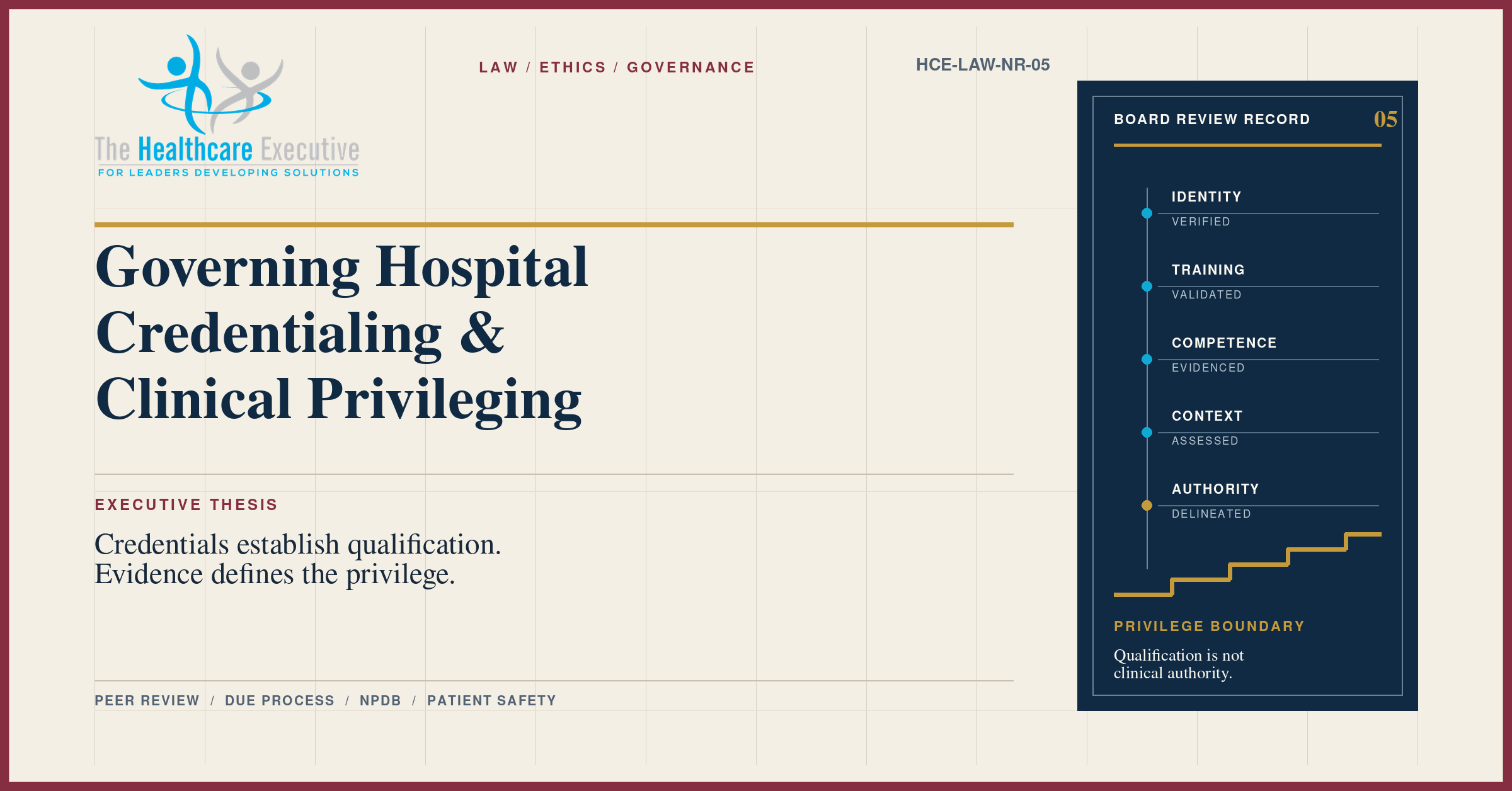
Credentialing is not paperwork, and privileging is not a reward for training. Credentialing verifies and evaluates identity, licensure, education, experience, competence, professional conduct, and other lawful eligibility criteria. Privileging authorizes a practitioner to perform specified services based on individualized evidence and approved criteria. Medical-staff appointment, employment, and payer enrollment are separate decisions even when one application supports all of them.
A reliable system connects these decisions across time. It begins with primary-source verification and privilege delineation, continues through focused and longitudinal evaluation, validates performance signals, provides remediation or formal review in proportion to risk, preserves a fair and conflict-screened process, and ends with a reasoned governing-body decision and accurate reporting. The executive task is to make the entire chain visible. A board cannot fulfill final accountability from an unexplained recommendation, and a medical staff cannot protect patients if administrative leverage silently replaces clinical review.
The legal vocabulary must also remain disciplined. HCQIA immunity, NPDB confidentiality, state peer-review privilege, federal patient-safety privilege, procedural rights, and board authority answer different questions. Treating one as shorthand for another creates avoidable litigation, reporting, and patient-safety risk.
2. Methods, authority hierarchy, and scope
This single-author narrative review used separate legal and empirical searches completed through August 14, 2026. The legal review prioritized current U.S. Code and electronic Code of Federal Regulations text, followed by controlling and illustrative judicial decisions and official federal materials. The NPDB Guidebook is cited as official, nonbinding operational guidance rather than binding law. Selected state statutes and cases illustrate variation; they do not form a state-by-state survey.
The empirical search used PubMed and targeted citation tracing for credentialing, privileging, professional practice evaluation, clinical peer review, patient and coworker reports, malpractice-claim concentration, audit and feedback, reviewer reliability, and reporting behavior. English-language U.S. studies and systematic reviews with operational relevance were prioritized. No meta-analysis was performed, one author screened the sources, and no formal risk-of-bias tool was applied. The evidence supports triangulation and better process design; it does not validate a universal case-volume, complaint, claim, or outcome threshold.
The review addresses U.S. acute-care hospitals. It does not resolve every state requirement, accreditation standard, practitioner category, collective-bargaining right, public-employment rule, or contractual provision. Fact-specific legal advice remains necessary.
3. Five decisions that should not be collapsed
An application can produce five legally and operationally distinct outcomes.
First, credentialing asks whether claimed qualifications and relevant history are verified and acceptable. Second, appointment determines a practitioner’s status within the organized medical staff. Third, privileging determines which defined services the practitioner may perform and under what supervision, location, technology, or patient-population limits. Fourth, employment allocates work, compensation, and managerial rights. Fifth, payer enrollment determines whether claims may be submitted under a program or contract.
The distinctions matter during adverse action. Employment and clinical privileges are analytically distinct, although bylaws or contracts may link them. Operational, schedule, access, or contract changes require separate analysis when they alter clinical authority; they become an HCQIA or NPDB professional-review matter only if the governing statutory elements are satisfied. Conversely, a purely economic or business decision unrelated to professional competence or conduct affecting patient welfare is not automatically an HCQIA professional-review action or a federal NPDB clinical-privileges report. Labels do not control; authority, purpose, process, and actual effect do.
Hospital policy should therefore identify a decision owner, criteria, record, appeal path, and reporting analysis for each domain. A combined application is efficient only if it does not erase these boundaries.
ACT I · AUTHORITY
Who decides?
Federal conditions, board accountability, medical-staff expertise, and management execution.
4. Federal governance architecture
The Medicare hospital Conditions of Participation establish an accountability structure rather than a detailed credentialing manual. The governing body is legally responsible for hospital conduct. It determines, consistent with state law, which practitioner categories may receive privileges; appoints the medical staff after considering existing staff recommendations; approves medical-staff bylaws; ensures that the medical staff is accountable for quality; and appoints a chief executive responsible for hospital management. Practitioner selection must consider character, competence, training, experience, and judgment and may not depend solely on specialty certification, fellowship, or society membership [1].
The organized medical staff examines credentials, periodically appraises its members, recommends appointments and privileges, and adopts and enforces bylaws approved by the governing body. Those bylaws must address organization, qualifications, and a process for granting privileges based on individual character, competence, training, experience, and judgment. If a medical executive committee is used, a majority must be doctors of medicine or osteopathy. The staff remains accountable to the governing body [2].
The chief executive manages operations, but the federal rules do not make management the unilateral clinical-privileging authority. Administration should maintain reliable records, staffing, contracts, and execution while preserving the medical staff’s defined evaluative role. The board, medical staff, and administration share accountability through the hospital-wide, data-driven quality assessment and performance improvement program [3]. These participation standards guide survey compliance; they do not themselves create a private damages cause of action or constitutional process.
For telemedicine, the receiving hospital may rely on credentialing and privileging decisions of a distant-site hospital or telemedicine entity only through the specified written arrangements and conditions. State licensure, distant-site status, practitioner privilege information, and performance feedback remain material. Multi-hospital efficiency does not eliminate hospital-specific accountability [2].
When separately certified hospitals choose a unified and integrated medical staff, each hospital’s medical staff must first approve the arrangement by majority vote, retain the ability to opt out, adopt bylaws that include the required governance and due-process provisions, account for local circumstances, and provide a mechanism for staff concerns unique to the hospital [2].

ACT II · EVIDENCE
What proves competence?
Privilege-specific evidence, longitudinal monitoring, and careful validation of every signal.
5. From application to reappointment: building a competence record
A defensible initial file establishes identity and qualifications, but it also answers a forward-looking question: what evidence shows that this practitioner can safely perform each requested service in this setting? Training and certification are relevant, yet neither is a complete proxy for current competence. Criteria should be service specific, approved in advance, consistently applied, and capable of addressing low-volume, new-technology, returning-to-practice, and cross-specialty requests without inventing a numerical threshold after the application arrives.
Governance synthesis
Record 01
From application to reentry
A defensible privilege decision is a sequence of owned decisions, not a single credentialing vote.
Eight-step credentialing governance lifecycle: verify qualifications; define the privilege request; evaluate initial practice; monitor longitudinally; validate any signal; choose a proportionate response or formal investigation; use fair process and make a governing-body decision; then conduct reporting, revision, and reentry analysis. Each step names its principal hospital owners.
Source: Governance synthesis based on 42 C.F.R. §§482.12, 482.21, and 482.22; 42 U.S.C. §§11111–11112; 45 C.F.R. Part 60; and the NPDB Guidebook.
Limitation: This is an editorial control model, not a workflow issued by CMS or the NPDB. State law, bylaws, contracts, accreditation requirements, and the facts may change the sequence or decision rights.
Published policy reviews show why local numbers require caution. In 42 U.S. hospitals, robotic-surgery policies required an average of 3.24 initial proctored cases, ranging from 1 to 10. Annual maintenance requirements averaged 7.19 cases and ranged from 1 to 15; only 26% addressed a maximum practice gap [24]. A five-system study of gynecologic surgery likewise found wide variation and frequent absence of explicit criteria across procedure categories [25]. These studies reviewed policies; they did not validate a case number that predicts safety.
Empirical evidence
Record 03
Credentialing policies vary
Across 42 hospitals, robotic-surgery requirements varied widely. Variation does not identify the correct safety threshold.
Among 42 hospital robotic-surgery policies, initial proctoring averaged 3.24 cases and ranged from 1 to 10; annual maintenance averaged 7.19 cases and ranged from 1 to 15; 11 of 42 policies, or 26 percent, addressed a maximum gap between robotic cases. The study did not validate a safety threshold.
View data table
| Policy measure | Minimum | Mean / share | Maximum |
|---|---|---|---|
| Initial proctored cases | 1 | 3.24 | 10 |
| Annual maintenance cases | 1 | 7.19 | 15 |
| Policies addressing maximum practice gap | 11 of 42 | 26% | Not applicable |
Source: Huffman et al., Surgical Endoscopy (2021), reviewed robotic-surgery credentialing policies from 42 geographically dispersed U.S. hospitals. PMID 32377839.
Limitation: Policy review only. The study did not test patient outcomes and did not validate a safe proctoring, maintenance, or practice-gap threshold.
Initial focused evaluation should test the competencies implicated by the privilege rather than merely count cases. Evidence may include direct observation, simulation where appropriate, outcomes, documentation quality, consultation use, team performance, and adherence to defined care processes. Proctoring terms should state whether the practitioner retains independent judgment. Under NPDB guidance, proctoring imposed through a professional review action based on competence or conduct is reportable when it requires proctor approval or presence before the practitioner may proceed independently and lasts more than 30 days. Routine observation, retrospective review, and routine proctoring of a new practitioner are not reportable on that basis [6].
OPPE and FPPE are Joint Commission accreditation terms, not CMS regulatory labels. Current Joint Commission guidance requires FPPE for every newly granted privilege and permits the organized medical staff to set OPPE data-collection frequency, but the review interval may not exceed 12 months [49,50].
Reappointment should integrate longitudinal evidence, changes in scope or health where lawfully relevant, licensure and sanctions, claims history, peer and patient information, activity denominators, and performance-improvement results. The record should explain the judgment made; a checklist alone shows completion, not competence.
6. A signal is not a verdict
Every monitoring source has both value and error. A complication rate without denominator integrity, case-mix adjustment, attribution rules, and confidence intervals can punish physicians who accept complex patients. A complaint may identify a pattern of communication failure or may reflect expectations, access problems, or bias. A coworker report may reveal unsafe conduct or a conflict. A paid malpractice claim is a selected, delayed event, not a finding of negligence or present incompetence. A low case count may signal skill decay, referral patterns, leave, or an uncommon procedure. The correct response to an initial signal is validation, not automatic exoneration or restriction.
Evidence control
Record 02
A signal is not a verdict
Outcomes, complaints, reports, volume, ratings, and NPDB history can identify a question. They cannot answer it without verification and context.
A six-stage cascade shows that a raw performance signal must pass through data-quality checks, contextual adjustment, corroboration, and structured conflict-screened review before a proportionate response. Only after that should the hospital analyze formal action and reportability.
Source: Evidence-informed synthesis drawing on Cooper et al., Hofer et al., structured implicit-review research, and the cited patient-rating analysis.
Limitation: This is not a validated predictive algorithm, federal test, or automatic escalation rule. Any high-stakes conclusion remains fact-, privilege-, and jurisdiction-specific.
Empirical findings support escalation based on patterns while warning against stand-alone cutoffs. In seven academic centers, patients of surgeons in the highest quartile of unsolicited patient observations had a 13.9% higher adjusted complication rate than patients of surgeons in the lowest quartile [27]. At two academic centers, unadjusted complication rates were 10.7%, 12.6%, and 14.1% among patients of surgeons with zero, one to three, and four or more prior coworker reports, respectively [28]. Both studies were observational; neither makes a complaint count a competence finding.
Observational evidence
Record 05
Coworker reports were associated with complications
The unadjusted rate rose across report groups, but the study does not establish causation or a cutoff for privileges.
Unadjusted complication rates were 10.7 percent for patients of surgeons with zero prior coworker reports, 12.6 percent with one to three reports, and 14.1 percent with four or more reports. The two-center observational study does not prove causation or establish a privilege cutoff.
View data table
| Prior coworker reports | Patients with any complication |
|---|---|
| 0 reports | 10.7% |
| 1–3 reports | 12.6% |
| 4+ reports | 14.1% |
Source: Cooper et al., JAMA Surgery (2019). Rates shown are the study’s unadjusted “any complication” results by number of prior coworker reports.
Limitation: Observational association at two academic centers. Reports may reflect reporting behavior, opportunity, specialty, exposure, and residual confounding. These categories are not validated privilege-action thresholds.
NPDB paid-claim data similarly showed that approximately 1% of physicians accounted for 32% of paid claims. Among physicians with three prior paid claims, the estimated probability of another within two years was 24% [29]. Concentration supports careful follow-up, but payments reflect many legal and insurance processes and cannot substitute for current clinical evidence.
Even formal peer review can be unreliable. In one record-review study, discussion improved agreement within reviewer pairs, yet agreement across pairs remained poor [33]. A systematic review found heterogeneous clinical-care review processes and no widely implemented comprehensive standard [31]. A survey of U.S. programs found improvement in a structured quality-improvement score, but only 35% reached 60 of 80 possible points; the measures included self-report and perceived impact rather than patient outcomes [32].
NPDB evidence
Record 04
Repeated paid claims concentrate
Paid claims can identify a longitudinal signal. A payment is not a competence finding.
Approximately 1 percent of physicians accounted for 32 percent of paid malpractice claims in the study. Physicians with three prior paid claims had an estimated 24 percent probability of another paid claim within two years, with a 95 percent confidence interval of 22 to 26 percent. Paid claims are not competence findings.
View data table
| Metric | Value |
|---|---|
| Approximate share of physicians | 1% |
| Share of paid claims associated with that group | 32% |
| Probability of another paid claim within 2 years after 3 prior claims | 24% (95% CI, 22%–26%) |
Source: Studdert et al., New England Journal of Medicine (2016), analysis of National Practitioner Data Bank paid-claim records. PMID 26816012.
Limitation: Paid claims are delayed and selected events. They are not findings of negligence, incompetence, or current risk and must not become an automatic privilege threshold.
Routine metric production also should not be confused with effective detection. Six health systems reviewed 12,854 privileged providers and reported that no provider identified solely through their ongoing professional practice evaluation metrics had privileges denied, limited, or revoked [26]. The convenience sample does not prove that such monitoring has no value, and its national cost extrapolation should not be treated as established. It does show why a dashboard requires an explicit path from signal validation to action.
The control implication is triangulation: verify data definitions and denominators; risk-adjust where appropriate; separate technical, cognitive, behavioral, and systems questions; obtain records and context; use structured criteria; disclose conflicts; add trained reviewers as stakes rise; and choose a proportionate response. Collegial feedback, education, observation, or a time-limited improvement plan may be appropriate before formal investigation unless immediate danger requires faster action. Audit and feedback can improve desired practice, but a 2026 Cochrane review found a median absolute improvement of 2.7 percentage points, with an interquartile range of 0.0 to 8.6, across 558 dichotomous outcomes in 177 studies comparing audit and feedback with control [30]. The full review included 292 studies and 678 treatment arms. Improvement tools are useful; they are not proof that a credentialing metric causes safer care.
Bias testing is part of reliability. Patient ratings differed by physician race and specialty in a two-institution study, with small absolute differences [35]. Criteria and escalation rates should be audited for inconsistent treatment across race, sex, disability, age, national origin, specialty, employment status, and economic competition. Equity review should test the evidence, not suppress legitimate safety concerns.

ACT III · FAIR PROCESS
How should review proceed?
Proportionate action, conflict control, hearing safeguards, and documented reasons.
7. HCQIA: a damages-immunity framework with fair-process conditions
HCQIA encourages effective professional review by offering specified participants protection from damages when a professional review action satisfies federal standards. It is not blanket immunity from suit, a merits determination, a general evidentiary privilege, or a universal federal due-process cause of action. Injunctive and declaratory claims, government enforcement, and other non-damages remedies require separate analysis. Federal civil-rights damages are expressly excluded from the principal immunity provision [7].
For HCQIA, a professional review action is an action or recommendation of a professional review body, taken or made in the conduct of professional review activity, based on a physician’s competence or professional conduct that affects or could adversely affect patient health or welfare, and that affects or may adversely affect the physician’s clinical privileges or professional-society membership [44].
Under 42 U.S.C. §11112(a), a professional review action must be taken in the reasonable belief that it furthers quality health care; after a reasonable effort to obtain the facts; after adequate notice and hearing procedures or another procedure fair to the practitioner under the circumstances; and in the reasonable belief that the action is warranted by the known facts. The statute presumes these standards are met unless rebutted by a preponderance of the evidence. Courts generally apply an objective reasonableness analysis rather than asking whether reviewers acted with perfect judgment or subjective goodwill [8–10]. A bylaw violation may create other liability, but it does not automatically defeat HCQIA immunity.
Section 11112(b) provides a deemed-compliance safe harbor. It includes notice of the proposed action and reasons; at least 30 days to request a hearing; if a hearing is requested, notice stating the place, time, and date, with the hearing date at least 30 days after the notice; and a hearing before a mutually acceptable arbitrator, an entity-appointed hearing officer who is not in direct economic competition with the physician, or an entity-appointed panel whose members are not in direct economic competition with the physician. The practitioner has the right to representation by an attorney or another person of the practitioner’s choice, a record, relevant evidence, witness examination and cross-examination, and a closing statement. The process produces a written recommendation and final decision with reasons. Failure to follow every safe-harbor detail does not alone establish that the procedure was unfair; §11112(a) remains the governing test [7].
Federal rule
Record 06
HCQIA’s fair-process safe-harbor path
The statute describes a deemed-compliance route for one immunity condition. It is not a universal constitutional due-process guarantee.
Six-step HCQIA safe-harbor timeline: establish a quality rationale and gather facts; issue proposed-action notice and reasons; allow at least 30 days to request a hearing; if requested, give at least 30 days’ notice of the hearing; conduct a fair hearing before a noncompeting decision maker with representation, a record, witnesses and evidence; then provide a written recommendation and decision with reasons. The timeline concerns damages-immunity standards, not universal constitutional due process.
Source: 42 U.S.C. §11112(a)–(c). Subsection (b) is a deemed-compliance safe harbor for the adequate-procedure condition; subsection (a) also recognizes “such other procedures as are fair to the physician under the circumstances.”
Limitation: HCQIA generally conditions specified damages immunity. It does not immunize every claim or remedy, displace bylaws or state law, or create a federal constitutional hearing right for every private-hospital dispute.
Hospitals should nonetheless treat the safe harbor as a useful process design, not a tactical minimum. The record should identify the quality rationale, factual sources, credibility decisions, conflicts, evidentiary standard, authority for the recommendation, and reason for the final action. Competitive motive, inconsistent criteria, retaliation, or a predetermined hearing can undermine other claims even when an HCQIA defense remains disputed.
8. Emergency restrictions, investigations, and later process
Patient safety sometimes cannot wait for a complete hearing. HCQIA does not require the referenced procedures when no adverse professional-review action is taken or for an investigatory suspension or restriction lasting no longer than 14 days while the entity determines whether professional review should proceed. It also permits immediate suspension or restriction when failure to act may result in imminent danger, subject to subsequent notice and hearing or another fair procedure [7]. State law and bylaws may impose additional or faster requirements.
The emergency record should therefore state the specific risk, information available at the time, scope of restriction, decision-maker, conflict screen, review date, and conditions for modification. “Summary suspension” should not become an indefinite substitute for adjudication. Operations need a timekeeper independent of the merits reviewers to monitor the 14-day process issue, the separate NPDB duration, notice and hearing dates, state reporting, and appeal events.
An investigation should have a written question, authority, scope, start date, evidence plan, and formal closure. Under official NPDB guidance, an investigation is a targeted, nonroutine inquiry focused on a specific practitioner’s professional competence or conduct, generally as a precursor to professional review action; it begins when the entity starts the inquiry and continues until final action or formal closure. The statute and regulation do not define the term, and the Guidebook interpretation is nonbinding guidance [6]. Routine quality review is not automatically an investigation, but avoiding the word does not prevent one from existing.
ACT IV · REPORTING & ASSURANCE
What must the record show?
NPDB analysis, state reporting, legal distinctions, reentry, and board-level assurance.
9. NPDB: duration, filing, appeals, and source records
The NPDB analysis is separate from the merits of the credentialing decision and from HCQIA immunity. For the federal Title IV duty discussed here, a hospital or other health-care entity reports a professional review action that adversely affects a physician’s or dentist’s clinical privileges for more than 30 days. In operational terms, that duration threshold is 31 days or longer, not 30. A separate rule requires the report to be submitted within 30 days after the reportable action. Confusing these clocks is a common control failure [4–6]. Other practitioner categories and reporting authorities require separate analysis.
The duration test is not the only path. Under 45 C.F.R. §60.12, the Title IV duty is mandatory for qualifying actions involving physicians and dentists; a health care entity may voluntarily report comparable qualifying actions involving other health care practitioners, although separate federal or state mandates may apply. A physician’s or dentist’s surrender or restriction of privileges while under investigation for possible incompetence or improper professional conduct, or in return for the entity not conducting an investigation, can be reportable without a 31-day duration requirement. An investigation itself is not reported. A denial based only on a neutral eligibility threshold may differ from a competence- or conduct-based professional review action; the actual rationale and effect govern. Medical-staff membership is included within the federal definition of clinical privileges [4–6].
Federal rule + guidance
Record 07
NPDB reportability is a decision tree, not a label
Duration, investigation, surrender, practitioner type, and the competence-or-conduct nexus must be analyzed separately.
NPDB reportability first identifies the practitioner and reporting category, then asks whether competence or conduct affects or could affect patient welfare. It next separates an adverse privilege action lasting 31 days or longer from surrender or restriction during or to avoid an investigation. A reportable event must be filed within 30 days, with later correction, revision, or void analysis. The investigation and filing clocks are distinct.
- WHO AND WHICH REPORTING CATEGORY?
For the Title IV clinical-privileges category, physician and dentist actions are mandatory when the elements below are met. For another practitioner, analyze voluntary Title IV reporting, other mandatory NPDB categories, and state law separately.
- PATIENT-WELFARE NEXUS?
Is the action based on professional competence or conduct that adversely affects or could adversely affect patient welfare?
- NO
Generally not a mandatory Title IV clinical-privileges report.
- YES
Continue to the two distinct paths.
- NO
- WHICH PATH?
- PATH A · ADVERSE PRIVILEGE EFFECT
Does the action adversely affect clinical privileges for more than 30 days, that is, 31 days or longer?
- PATH B · INVESTIGATION-RELATED SURRENDER OR RESTRICTION
Were privileges surrendered or restricted while under investigation or in exchange for not conducting an investigation? Duration does not control this path.
- PATH A · ADVERSE PRIVILEGE EFFECT
- REPORTABLE UNDER PATH A OR B?
File within 30 days after the reportable action. An otherwise due report is not held until an appeal ends.
- KEEP THE RECORD CURRENT
Apply correction, revision, or void procedures as facts and final action change; complete separate state-reporting analysis.
31 DAYS OR LONGER
Federal adverse-action duration threshold.
WITHIN 30 DAYS
Filing clock after a reportable action.
- An investigation alone is not reported.
- Routine or general quality review is not automatically an NPDB investigation.
- Labels do not control whether a targeted, nonroutine inquiry is an investigation.
- A threshold-eligibility decision is generally distinct from an adverse professional-review action, subject to the facts.
- Proctoring can be reportable if it restricts independent practice for more than 30 days.
Source: 42 U.S.C. §11133; 45 C.F.R. §§60.3, 60.5, and 60.12. Investigation, eligibility, proctoring, appeal, revision, and void notes follow the official NPDB Guidebook, which is agency guidance rather than statutory or regulatory text.
Limitation: Reportability is fact-specific. State deadlines and categories may be broader or faster, and other NPDB reporting categories may apply even when this Title IV path does not.
An internal appeal does not postpone a report that is otherwise due. If the action is later modified, lifted, reversed, or found nonreportable, the reporting entity must submit the appropriate revision or void. The practitioner may add a statement and use the NPDB dispute process, but the Secretary’s review addresses accuracy and reportability, not whether the hospital reached the clinically correct result or afforded adequate process [5,6]. A 2025 federal district decision illustrates the distinction between revising and voiding a report after a summary suspension is lifted; it is useful current authority but not nationwide precedent [11].
Hospitals must query the NPDB when a physician, dentist, or other covered health-care practitioner applies for medical-staff appointment or clinical privileges and every two years for practitioners on staff or with privileges. Failure can create a presumption of knowledge in a malpractice action; hospitals generally may rely on the information unless they know it is false [4]. NPDB guidance states that Continuous Query meets legal and accreditation requirements for querying; enrollment must remain active and be renewed to maintain continuous monitoring [51].
NPDB confidentiality protects the report and information obtained from the NPDB. It does not transform independently maintained complaints, minutes, evaluations, medical records, emails, or credentialing materials into privileged documents [4,5]. Federal and state reporting systems also differ. A state may require a shorter filing period, a different duration threshold, or reports for different practitioners and events. The reporting file should therefore contain two documented analyses—federal and applicable state—plus an appeal calendar and revision-or-void control.
10. Board, medical staff, MEC, and CEO disagreements
Federal law places final legal accountability with the governing body while requiring a meaningful medical-staff role. The board appoints after considering medical-staff recommendations; the regulation does not say the board must accept every recommendation. Nor does final accountability authorize arbitrary action, clinical fact-finding by unqualified directors, or disregard of bylaws and state law [1,2].
When the board and medical staff disagree, the record should identify the issue rather than force a binary choice. Is the dispute about verified facts, clinical judgment, criteria, proportionality, conflict, process, or organizational policy? The board can request clarification, remand for defined fact development, obtain independent expertise, or state reasoned findings within its authority. Direct competitors should not control an adverse process, and economic concerns should not be disguised as competence findings.
The CEO should assure execution, resources, deadlines, and escalation while avoiding unilateral privilege restrictions through employment tools unless law, bylaws, delegation, or an emergency provision authorizes them. The medical executive committee should not assume that clinical expertise makes its recommendation unreviewable. A defensible disagreement ends with a written decision that connects the authorized decision-maker, evidence, quality rationale, process, and reporting consequence.
11. Bylaws and procedural rights vary by jurisdiction
Constitutional due process generally requires both state action and a protected liberty or property interest. A public or governmental hospital may be a state actor, but the claimed entitlement still must arise from an independent source such as statute, contract, or binding rules. A private nonprofit hospital does not become a state actor merely because it receives Medicare or Medicaid funds or is extensively regulated [12–14]. HCQIA and the CMS Conditions of Participation do not change that threshold.
Private-hospital practitioners may nevertheless have substantial procedural rights under state statutes, medical-staff bylaws, contracts, common law, or organizational documents. Courts differ on whether and when bylaws constitute an enforceable contract. Tennessee and Minnesota decisions have enforced bylaws on their records, while a West Virginia decision rejected automatic contract status absent express language but recognized narrower fair-procedure obligations [15–17]. California provides a detailed statutory hearing structure and separate reporting duties; other states allocate authority and review differently [18].
The safe executive statement is therefore not “physicians have no due process at private hospitals” or “the bylaws always are a contract.” It is that constitutional, statutory, contractual, and organizational rights must be identified separately for the hospital type, jurisdiction, practitioner status, bylaw text, and action. Final board authority must be exercised through those applicable rules.
12. Immunity, confidentiality, and privilege are not interchangeable
Four doctrines should be shown in separate columns in every policy and training program.
Legal distinctions
Record 08
Four doctrines are not interchangeable
Immunity, confidentiality, evidentiary privilege, and patient-safety protection answer different questions.
Four entries distinguish HCQIA damages immunity, NPDB confidentiality, state peer-review evidentiary privilege, and PSQIA patient safety work product. Each entry states what the doctrine may protect and what it does not automatically protect.
HCQIA DAMAGES IMMUNITY
Protects: Qualifying professional-review participants and entities from specified damages liability when statutory standards are met.
Does not mean: Immunity from suit, injunctions, government enforcement, federal civil-rights damages, or every legal theory.
Authority: 42 U.S.C. §§11111–11115
NPDB CONFIDENTIALITY
Protects: Reports and information reported to or furnished by the NPDB, subject to statutory access and disclosure rules.
Does not mean: Every independently existing hospital source record becomes privileged because related information appears in an NPDB report.
Authority: 42 U.S.C. §11137; 45 C.F.R. Part 60
STATE PEER-REVIEW PRIVILEGE
Protects: Materials and activities within the jurisdiction’s statute and case law, subject to its definitions and exceptions.
Does not mean: A uniform national privilege. Coverage can vary by claim, forum, source, purpose, and exception.
Authority: Applicable state statute and controlling decisions
PSQIA / PATIENT SAFETY WORK PRODUCT
Protects: Qualifying patient safety work product created, assembled, or developed within the federal patient-safety framework.
Does not mean: Original medical, billing, discharge, credentialing, or other source records become protected merely because a copy enters a patient safety evaluation system.
Authority: 42 U.S.C. §§299b-21–299b-22
Source: The matrix separates distinct federal and state doctrines. It is a governance aid, not a conclusion that a particular document, person, action, claim, or remedy is protected.
Limitation: State privilege and waiver rules vary. PSQIA treatment depends on the source, purpose, required reporting duties, and the organization’s actual patient safety evaluation system.
- HCQIA immunity can protect qualifying participants from damages for a compliant professional review action.
- NPDB confidentiality restricts disclosure and use of NPDB reports and information; it does not cloak hospital source files.
- State peer-review privilege may limit discovery or testimony, but its scope, exceptions, covered bodies, claims, waiver rules, and treatment of original facts vary.
- Patient Safety and Quality Improvement Act protection applies only to information meeting the statutory and regulatory definition of patient safety work product, including qualifying material assembled or developed by a provider for reporting to a patient safety organization and actually reported, material developed by a patient safety organization for patient-safety activities, and qualifying deliberations or analysis of a patient safety evaluation system. Original patient records and information collected, maintained, or developed separately remain outside patient safety work product; reporting a copy does not convert the source original [19,52].
HCQIA does not create a general federal medical peer-review evidentiary privilege. In federal-question civil-rights and antitrust litigation, federal courts have generally rejected a broad freestanding privilege, consistent with the Supreme Court’s reluctance to create a peer-review privilege Congress did not enact in an analogous federal enforcement context [20–23,45]. In diversity or state-law litigation, Federal Rule of Evidence 501 may make state privilege controlling, but mixed claims and document-specific exceptions require careful analysis. California protects specified committee proceedings subject to exceptions, while Washington expressly excepts actions arising from privilege recommendations [42,43].
Hospitals should not promise absolute confidentiality to reporters or reviewers. They should explain the protections that may apply, limit access by role, preserve source identity where lawful, segregate NPDB and patient-safety-system materials, and avoid copying protected reports into uncontrolled files. Good information governance supports candor without making an assurance the law cannot keep.
13. Antitrust, discrimination, disability, and retaliation guardrails
Professional review can protect patients and also affect livelihood and competition. In Patrick v. Burget, the Supreme Court held that state regulation did not automatically supply active state supervision for private peer-review conduct. In Summit Health v. Pinhas, the Court recognized that exclusion through peer review could satisfy the Sherman Act’s interstate-commerce requirement [36,37]. These decisions do not make every adverse action anticompetitive. A claimant must still prove the elements of the asserted theory, including concerted action where required, unreasonable restraint, market and injury questions, causation, and standing. HCQIA may protect damages on a qualifying antitrust claim, but not injunctive relief or government enforcement.
The civil-rights analysis is claim specific. HCQIA expressly preserves federal civil-rights damages. Title VII, the ADA, and the ADEA ordinarily require an employment relationship, which is fact sensitive for independent and medical-staff practitioners under common-law control principles [38]. A 2026 Fourth Circuit decision illustrates the distinction: hospital quality-control requirements applicable to all practitioners did not, without more, make the hospital a joint employer of certified registered nurse anesthetists employed by an anesthesia group [53]. Section 1981 may protect contractual rights independently of Title VII status, but the plaintiff must establish that race was a but-for cause of the injury [46]. Title VI prohibits intentional race, color, and national-origin discrimination in covered programs, but 42 U.S.C. §2000d-3 limits agency action concerning employment practices unless a primary objective of the federal assistance is to provide employment. Alexander v. Sandoval forecloses a private action to enforce disparate-impact regulations [39,47]. Effective July 24, 2026, HHS rescinded its Title VI regulatory effects provisions and stated that its Title VI enforcement will address intentional discrimination [40]. Section 1557 applies to covered health programs and activities. On October 22, 2025, Tennessee v. Kennedy vacated the 2024 rule’s gender-identity provisions to the extent they expanded Title IX’s definition of sex discrimination. HHS stated on June 1, 2026 that it will not investigate or enforce those vacated provisions, while continuing to enforce protections based on race, color, national origin, age, disability, and aspects of sex discrimination not affected by the judgment [41,48]. State nondiscrimination, disability, whistleblower, and retaliation laws may be broader.
Patient-safety reporting also requires protection against retaliation. PSQIA prohibits a provider from taking an adverse employment action because an individual in good faith reported information to the provider with the intention that it be reported to a patient safety organization, or reported directly to one. The statute expressly includes adverse credentialing and licensing decisions within “adverse employment action” [19]. In a national physician survey, 17% reported direct knowledge of an incompetent colleague, and only 67% of that group reported the colleague to a relevant authority; cited barriers included futility and fear of retribution [34]. A reliable system monitors not only termination but schedule, access, evaluation, referral, leadership, and credentialing changes after a concern is raised.
14. A practical credentialing and professional-review control model
The following model is an evidence-informed governance design, not a new legal standard.
1. Define the decision. Separate appointment, privileges, employment, enrollment, and coverage decisions. Identify the authorized body and governing document.
2. Establish privilege-specific criteria. Approve criteria before an individual request arrives. Use training, experience, direct evidence, technology, patient population, and setting; do not rely solely on board certification or a universal volume number.
3. Verify and evaluate. Complete primary-source checks, queries, references, claims and sanctions review, and lawful health or impairment assessment. Document discrepancies and their resolution.
4. Focus initial evaluation. Match observation or proctoring to the requested service, define independent-practice limits, assign qualified reviewers, and calendar completion and potential reporting consequences.
5. Monitor longitudinally. Use multiple signals with verified denominators, risk adjustment, attribution, trend, and peer context. Include outcomes, process measures, patient and coworker information, activity, documentation, and improvement response.
6. Validate and triage. Distinguish data error, system failure, education need, behavioral pattern, health concern, and possible competence issue. Screen conflicts and economic competition. Use more than one trained reviewer when consequence and uncertainty rise.
7. Respond proportionately. Choose feedback, education, support, focused review, monitoring, voluntary modification, or formal investigation. Protect patients immediately when necessary, but define scope and later process.
8. Preserve fair procedure. Give meaningful notice, reasons, access to the case permitted by law, a neutral decision-maker, opportunity to respond and present evidence, a reliable record, and written findings. Track HCQIA, bylaws, contracts, and state law separately.
9. Make the authorized decision. The medical staff develops and recommends from the clinical record; the governing body exercises final accountability with reasoned findings; the CEO executes without silently reallocating authority.
10. Report and maintain. Analyze NPDB and state duties independently, file on time, query as required, and monitor appeals. Correct errors or omissions as soon as possible; file a revision when the reported action or status materially changes; and void only when the report should not exist, such as when it was submitted in error, was not reportable, or the action was overturned. Preserve source records according to their actual legal status.
The board should receive assurance about system reliability rather than confidential case detail beyond its role. Useful measures include primary-source and query completion; reappointments due and overdue; focused evaluations open and aging; data-quality failures; unresolved reviewer conflicts; emergency restrictions and elapsed days; hearing milestones; NPDB and state reports filed on time; revisions pending after appeal; disparity analyses; substantiated retaliation; and overdue corrective actions. No single “green” percentage proves that privileges are safe.
15. Executive assurance questions
Leaders should be able to answer the following without reconstructing the process from email:
- Can the hospital identify who holds each privilege and the evidence supporting it?
- Are criteria individualized, current, consistently applied, and free from sole reliance on certification or volume?
- Can quality signals be reproduced from verified data with appropriate denominators and context?
- Are reviewers trained, conflict screened, and sufficiently independent?
- Is the line between collegial improvement, formal investigation, and adverse action documented?
- Can an imminent-risk restriction trigger immediate protection and a timely later process?
- Do leaders distinguish the 31-day NPDB duration threshold from the 30-day filing deadline?
- Does an appeal trigger tracking and revision controls without delaying an otherwise due report?
- Are federal and state reports analyzed separately?
- Can the board disagree with a recommendation through defined, reasoned, and lawful steps?
- Are HCQIA immunity, NPDB confidentiality, state privilege, and PSQIA protection kept separate?
- Are employment, antitrust, discrimination, disability, and retaliation risks reviewed without diluting the patient-safety inquiry?
An unresolved “no” should have an owner, due date, interim safeguard, and board-visible escalation.
16. Limitations
This narrative review is not a systematic review, meta-analysis, or 50-state survey. It does not assess every practitioner type, public-employment rule, accreditation requirement, payer condition, or contractual right. The empirical studies are heterogeneous and frequently observational, policy based, self-reported, or confined to a small number of systems. Associations among complaints, conduct reports, claims, and outcomes do not establish causation or a privilege cutoff. Federal guidance is not binding law, and NPDB reportability remains fact specific. Section 1557 litigation and state law require refresh immediately before publication and before an actual decision.
17. Conclusion
Credentialing and privileging work when the hospital can show more than completed forms and committee votes. The defensible system links verified qualifications, privilege-specific criteria, reliable longitudinal evidence, proportionate response, conflict-screened review, fair procedure, governing-body accountability, and accurate reporting in one traceable record. It also resists false shortcuts: a signal is not a verdict; HCQIA is not blanket immunity or constitutional due process; 31 days is not the 30-day filing clock; a confidential NPDB report does not make source records privileged; and final board accountability does not erase bylaws or state law. The aim is neither effortless exclusion nor procedural paralysis. It is a governance system capable of acting early enough to protect patients and carefully enough to be trusted.
Acknowledgments
The author acknowledges the clinicians, medical-staff professionals, board members, quality leaders, and patient-safety personnel whose work informs the governance questions examined in this review. No individual contributed to the drafting or qualifies for authorship.
Funding
No external funding was received for this review.
Conflicts of interest
The author declares no conflicts of interest.
Ethics statement
This article reviews publicly available legal authorities and published literature and did not involve human participants, identifiable private information, or animal subjects. Institutional review board approval was not required.
Data-sharing statement
No original dataset was created or analyzed. Sources are identified in the references.
Disclaimer
This article is for education and governance discussion. It is not legal, clinical, credentialing, or compliance advice and does not create an attorney-client relationship. Hospitals should obtain current advice for the relevant jurisdiction, facts, bylaws, contracts, practitioner category, and reporting system before acting.
References
- 42 C.F.R. §482.12. Condition of participation: Governing body. Electronic Code of Federal Regulations. Current through August 12, 2026. https://www.ecfr.gov/current/title-42/chapter-IV/subchapter-G/part-482/subpart-B/section-482.12
- 42 C.F.R. §482.22. Condition of participation: Medical staff. Electronic Code of Federal Regulations. Current through August 12, 2026. https://www.ecfr.gov/current/title-42/chapter-IV/subchapter-G/part-482/subpart-C/section-482.22
- 42 C.F.R. §482.21. Condition of participation: Quality assessment and performance improvement program. Electronic Code of Federal Regulations. Current through August 12, 2026. https://www.ecfr.gov/current/title-42/chapter-IV/subchapter-G/part-482/subpart-C/section-482.21
- 42 U.S.C. §§11133, 11135, 11137. Clinical-privileges reporting, hospital query duties, and confidentiality. https://www.govinfo.gov/link/uscode/42/11133; https://www.govinfo.gov/link/uscode/42/11135; https://www.govinfo.gov/link/uscode/42/11137
- 45 C.F.R. Part 60. National Practitioner Data Bank. Electronic Code of Federal Regulations. Current through August 12, 2026. https://www.ecfr.gov/current/title-45/subtitle-A/subchapter-A/part-60
- National Practitioner Data Bank. NPDB Guidebook, Clinical Privileges Actions. Official nonbinding guidance. https://www.npdb.hrsa.gov/guidebook/EClinicalPrivileges.jsp
- 42 U.S.C. §§11111–11115. Health Care Quality Improvement Act immunity and professional-review standards. https://www.govinfo.gov/link/uscode/42/11111; https://www.govinfo.gov/link/uscode/42/11112
- Bryan v. Holmes Regional Medical Center, 33 F.3d 1318 (11th Cir. 1994).
- Poliner v. Texas Health Systems, 537 F.3d 368 (5th Cir. 2008).
- Weiner v. St. Peter’s Health, 2025 MT 28 (Mont. Feb. 11, 2025). https://juddocumentservice.mt.gov/getDocByCTrackId?DocId=507576
- Hoedt v. Vanderbilt University, No. 3:24-cv-00310, Doc. 94 (M.D. Tenn. Sept. 9, 2025). https://www.govinfo.gov/app/details/USCOURTS-tnmd-3_24-cv-00310
- Lugar v. Edmondson Oil Co., 457 U.S. 922 (1982). https://www.govinfo.gov/app/details/USREPORTS-457/USREPORTS-457-922
- Blum v. Yaretsky, 457 U.S. 991 (1982). https://www.govinfo.gov/app/details/USREPORTS-457/USREPORTS-457-991
- Board of Regents v. Roth, 408 U.S. 564 (1972). https://www.govinfo.gov/app/details/USREPORTS-408/USREPORTS-408-564
- Lewisburg Community Hospital v. Alfredson, 805 S.W.2d 756 (Tenn. 1991).
- Medical Staff of Avera Marshall Regional Medical Center v. Avera Marshall, 857 N.W.2d 695 (Minn. 2014).
- Kessel v. Monongalia County General Hospital Co., 600 S.E.2d 321 (W. Va. 2004).
- California Business and Professions Code §§805, 809–809.8. https://leginfo.legislature.ca.gov/faces/codes_displaySection.xhtml?lawCode=BPC§ionNum=805.; https://leginfo.legislature.ca.gov/faces/codes_displayText.xhtml?article=11.&chapter=1.&division=2.&lawCode=BPC
- 42 U.S.C. §§299b-21–299b-22. Patient Safety and Quality Improvement Act definitions, privilege, confidentiality, and retaliation protection. https://www.govinfo.gov/link/uscode/42/299b-21; https://www.govinfo.gov/link/uscode/42/299b-22
- University of Pennsylvania v. EEOC, 493 U.S. 182 (1990). https://www.govinfo.gov/app/details/USREPORTS-493/USREPORTS-493-182
- Virmani v. Novant Health Inc., 259 F.3d 284 (4th Cir. 2001).
- Adkins v. Christie, 488 F.3d 1324 (11th Cir. 2007).
- Memorial Hospital for McHenry County v. Shadur, 664 F.2d 1058 (7th Cir. 1981).
- Huffman EM, Rosen SA, Levy JS, Martino MA, Stefanidis D. Are current credentialing requirements for robotic surgery adequate to ensure surgeon proficiency? Surg Endosc. 2021;35(5):2104–2109. doi:10.1007/s00464-020-07608-2. PMID:32377839. https://pubmed.ncbi.nlm.nih.gov/32377839/
- Siddique M, Shah N, Park A, et al. Core privileging and credentialing: hospitals’ approach to gynecologic surgery. J Minim Invasive Gynecol. 2016;23(7):1088–1106.e1. doi:10.1016/j.jmig.2016.08.001. PMID:27521980. https://pubmed.ncbi.nlm.nih.gov/27521980/
- Donnelly LF, Podberesky DJ, Towbin AJ, et al. The Joint Commission’s ongoing professional practice evaluation process: costly, ineffective, and potentially harmful to safety culture. J Am Coll Radiol. 2024;21(1):61–69. doi:10.1016/j.jacr.2023.08.031. PMID:37683817. https://pubmed.ncbi.nlm.nih.gov/37683817/
- Cooper WO, Guillamondegui O, Hines OJ, et al. Use of unsolicited patient observations to identify surgeons with increased risk for postoperative complications. JAMA Surg. 2017;152(6):522–529. doi:10.1001/jamasurg.2016.5703. PMID:28199477. https://pubmed.ncbi.nlm.nih.gov/28199477/
- Cooper WO, Spain DA, Guillamondegui O, et al. Association of coworker reports about unprofessional behavior by surgeons with surgical complications in their patients. JAMA Surg. 2019;154(9):828–834. doi:10.1001/jamasurg.2019.1738. PMID:31215973. https://pubmed.ncbi.nlm.nih.gov/31215973/
- Studdert DM, Bismark MM, Mello MM, Singh H, Spittal MJ. Prevalence and characteristics of physicians prone to malpractice claims. N Engl J Med. 2016;374(4):354–362. doi:10.1056/NEJMsa1506137. PMID:26816012. https://pubmed.ncbi.nlm.nih.gov/26816012/
- Ivers N, Yogasingam S, Lacroix M, et al. Audit and feedback: effects on professional practice. Cochrane Database Syst Rev. 2026;6(6):CD000259. doi:10.1002/14651858.CD000259.pub5. PMID:42325158. https://pubmed.ncbi.nlm.nih.gov/42325158/
- Walker LE, Nestler DM, Laack TA, et al. Clinical care review systems in healthcare: a systematic review. Int J Emerg Med. 2018;11(1):6. doi:10.1186/s12245-018-0166-y. PMID:29423602. https://pubmed.ncbi.nlm.nih.gov/29423602/
- Edwards MT. In pursuit of quality and safety: an 8-year study of clinical peer review best practices in US hospitals. Int J Qual Health Care. 2018;30(8):602–607. doi:10.1093/intqhc/mzy069. PMID:29635470. https://pubmed.ncbi.nlm.nih.gov/29635470/
- Hofer TP, Bernstein SJ, DeMonner S, Hayward RA. Discussion between reviewers does not improve reliability of peer review of hospital quality. Med Care. 2000;38(2):152–161. doi:10.1097/00005650-200002000-00005. PMID:10659689. https://pubmed.ncbi.nlm.nih.gov/10659689/
- DesRoches CM, Rao SR, Fromson JA, et al. Physicians’ perceptions, preparedness for reporting, and experiences related to impaired and incompetent colleagues. JAMA. 2010;304(2):187–193. doi:10.1001/jama.2010.921. PMID:20628132. https://pubmed.ncbi.nlm.nih.gov/20628132/
- DeLoughery EP. Physician race and specialty influence Press Ganey survey results. Neth J Med. 2019;77(10):366–369. PMID:31880269. https://pubmed.ncbi.nlm.nih.gov/31880269/
- Patrick v. Burget, 486 U.S. 94 (1988). https://www.govinfo.gov/app/details/USREPORTS-486/USREPORTS-486-94
- Summit Health, Ltd. v. Pinhas, 500 U.S. 322 (1991). https://www.govinfo.gov/app/details/USREPORTS-500/USREPORTS-500-322
- Clackamas Gastroenterology Associates, P.C. v. Wells, 538 U.S. 440 (2003). https://www.govinfo.gov/app/details/USREPORTS-538/USREPORTS-538-440
- Alexander v. Sandoval, 532 U.S. 275 (2001). https://www.govinfo.gov/app/details/USREPORTS-532/USREPORTS-532-275
- U.S. Department of Health and Human Services. Rescinding Portions of the Department’s Title VI Regulations To Align With the Civil Rights Act of 1964. 91 Fed. Reg. 46746 (July 24, 2026). https://www.federalregister.gov/documents/2026/07/24/2026-15000/rescinding-portions-of-the-us-department-of-health-and-human-services-title-vi-regulations-to-align
- U.S. Department of Health and Human Services. HHS informs covered entities of partial vacatur of 2024 ACA Section 1557 final rule. June 1, 2026. https://www.hhs.gov/press-room/informs-covered-entities-partial-vacatur-2024-aca-nondiscrimination-final-rule-tennessee-v-kennedy.html
- California Evidence Code §1157. https://leginfo.legislature.ca.gov/faces/codes_displaySection.xhtml?lawCode=EVID§ionNum=1157.
- Revised Code of Washington §4.24.250. https://app.leg.wa.gov/RCW/default.aspx?cite=4.24.250
- 42 U.S.C. §11151. Definitions for professional review and clinical privileges. https://www.govinfo.gov/link/uscode/42/11151
- Agster v. Maricopa County, 422 F.3d 836 (9th Cir. 2005).
- Comcast Corp. v. National Association of African American-Owned Media, 589 U.S. 327 (2020). https://www.govinfo.gov/app/details/USREPORTS-589/USREPORTS-589-327
- 42 U.S.C. §2000d-3. Title VI employment-practice limitation. https://www.govinfo.gov/link/uscode/42/2000d-3
- 42 U.S.C. §18116. Nondiscrimination in health programs and activities. https://www.govinfo.gov/link/uscode/42/18116
- The Joint Commission. Focused Professional Practice Evaluation FAQ. Updated January 7, 2026. https://www.jointcommission.org/en-us/knowledge-library/support-center/standards-interpretation/standards-faqs/000001115
- The Joint Commission. Ongoing Professional Practice Evaluation FAQ. Updated January 7, 2026. https://www.jointcommission.org/en-us/knowledge-library/support-center/standards-interpretation/standards-faqs/000001322
- National Practitioner Data Bank. Continuous Query. https://www.npdb.hrsa.gov/hcorg/pds.jsp
- 42 C.F.R. Part 3, especially §3.20. Patient Safety Organization protections and definitions. https://www.ecfr.gov/current/title-42/chapter-I/subchapter-A/part-3
- Hoffman v. Inova Health Care Services, Nos. 24-1510 and 24-1518 (4th Cir. Mar. 3, 2026). https://www.ca4.uscourts.gov/opinions/241510.P.pdf