



Management Atlas · Law, Ethics & Governance
The Overpayment Clock
Medicare’s 60-Day Rule, Knowledge, Investigation, and Hospital Accountability, a Narrative Review
September 28, 2026 · 22-minute read
Narrative evidence review
The first identified overpayment can be the start of a wider investigation. A defensible response keeps the knowledge decision, related-claim scope, deadline, and repayment route connected.
Full article narration
Executive synthesis
The overpayment clock is a decision process before it is a countdown. A hospital must evaluate what it knows, identify the applicable program and legal standard, investigate related claims when appropriate, quantify the amount, and use the correct reporting and return route. Delay, unclear ownership, and a record of unsupported assumptions can turn a correctable billing problem into a more serious compliance failure.
The current Medicare fee-for-service rule addresses identification using the False Claims Act knowledge standard and provides a conditional suspension for a timely, good-faith investigation of related overpayments. Twenty-five peer-reviewed sources show why payment patterns need careful validation: incentives can affect coding, clinical complexity can change, documentation can be incomplete, and some suspected systematic effects are not supported by the evidence. The executive framework keeps a suspected issue, an identified overpayment, and a completed remediation distinct.
Identification requires a legal and factual decision
Under 42 CFR 401.305, a person has identified an overpayment when the person knowingly receives or retains an overpayment, using the knowledge standard in 31 USC 3729(b)(1). That standard includes actual knowledge, deliberate ignorance, and reckless disregard; it does not require proof of a specific intent to defraud. The organization should therefore evaluate credible information promptly and preserve the facts supporting its conclusion. A dashboard label cannot determine the legal trigger by itself. 1,2
The general reporting and return deadline is the later of 60 days after identification or the date a corresponding cost report is due, if applicable. The rule’s six-year lookback concerns overpayments received within the specified period before identification. These concepts answer different questions: when the duty is triggered, when action is due, and which payments fall within the lookback. 1
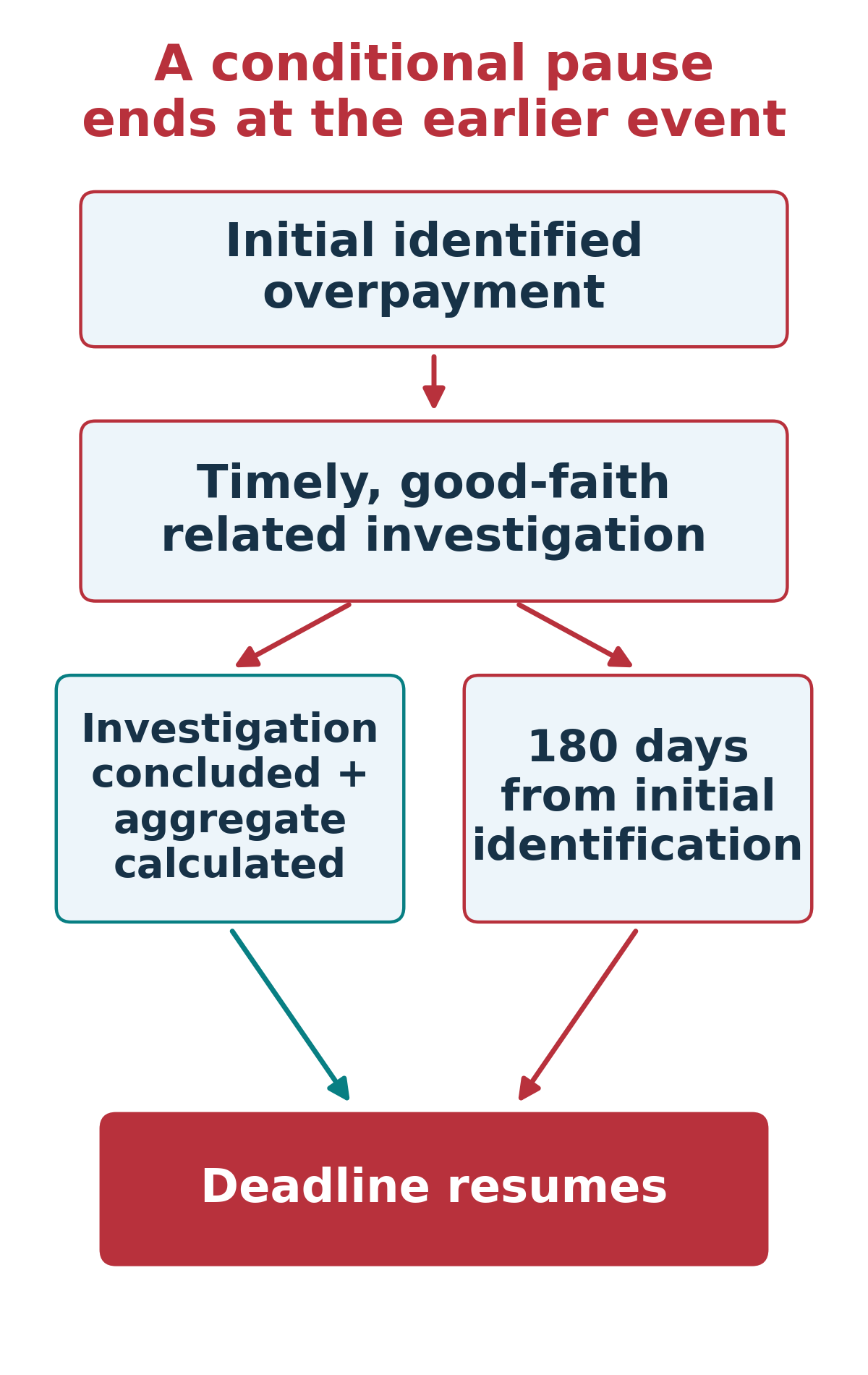
A timely, good-faith investigation of related overpayments arising from the same or a similar cause can suspend the reporting and return deadline under the rule’s conditions. The suspension ends at the earlier of completion of the investigation with calculation of the aggregate amount, or 180 days after the initial identified overpayment. It is not an automatic six-month extension for every open issue. Document the relationship among claims, the investigation’s progress, and the basis for applying the provision. 1
Create a record that preserves what changed
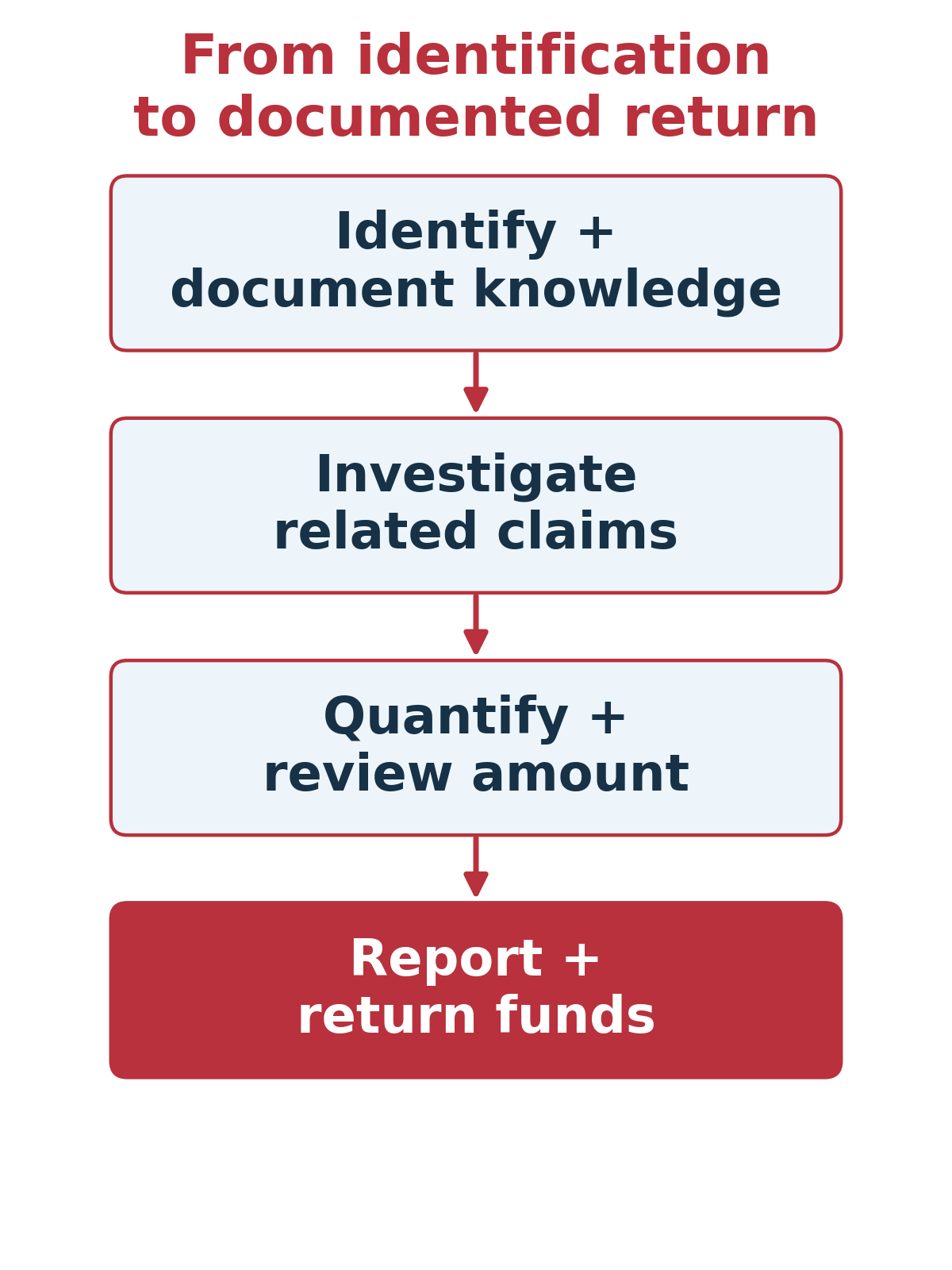
At intake, record the source of the concern, affected program, service dates, alleged mechanism, available evidence, and responsible reviewer. Use clear decision states: information received, evaluation underway, overpayment identified, related-claim investigation, amount quantified, reported and returned, and correction verified. The transition between states should record the decision and supporting facts.
Define the population before selecting a review method. A shared code does not necessarily mean a shared error, and a shared root cause may affect several codes or locations. Preserve query logic, exclusions, reviewer instructions, and sampling decisions. When the population or interpretation changes, retain the earlier version and explain why. Statistical extrapolation, where appropriate and permitted, requires a defensible method and qualified review; it should not be improvised from a convenience sample.
Separate the clinical judgment, coding determination, coverage rule, payment calculation, and legal conclusion. Each may need a different reviewer. A denied claim is not automatically an overpayment, and a supported diagnosis is not automatically payable in every context. The aim is a traceable conclusion for the actual transaction, not a presumption in favor of either revenue retention or repayment.
What the payment and coding evidence can establish
A billing opportunity is a signal requiring validation
A Vascular Quality Initiative analysis used registry data to identify potentially missed billing opportunities. Its findings suggest that clinical registries can reveal documentation and coding gaps, but a model output does not authorize a claim change. A 2026 Australian diagnostic-accuracy study of infective endocarditis showed that administrative data can perform differently for case identification, organisms, and outcomes. A Portuguese survey of clinical coders linked perceived data-quality variation to documentation and workflow problems. Together these studies support tracing a billing signal back to the clinical record and applicable coding rules before quantifying an amount owed in either direction.4,20,26
Payment incentives affect behavior, but not every intensity change is improper
Research on Medicare payment incentives has documented changes in coding and organizational behavior after reimbursement structures changed. A five-state study of highest-intensity discharges estimated a substantial contribution from coding changes to growth over 2011–2019. Earlier studies examined the 2007 diagnosis-related-group restructuring, ownership differences, and adoption of revenue-generating practices. Historical work separating case-mix change from DRG creep also found that real patient complexity explained part of observed change. These studies justify focused review of unusual patterns. They do not establish that every higher-weight diagnosis, documentation improvement, or increase in case-mix index is false.5,7,8,12,16
Negative findings are part of a balanced audit program
A matched analysis found no evidence that hospital adoption of electronic health records increased Medicare reimbursements in the manner alleged. A regression-discontinuity analysis of anesthesia physical-status coding also found no evidence of systematic upcoding at the examined payer-incentive threshold. These findings matter because a review designed only to confirm suspected misconduct can misclassify legitimate clinical complexity or documentation. An audit should specify what evidence would refute the concern, use an appropriate comparator, and distinguish the absence of detected systematic behavior from proof that no individual error occurred.6,21
The clinical record and the claim answer different questions
Studies of case-mix index, inadequate documentation, Medicare diagnostic accuracy, cardiac-arrest reimbursement, and obstetric hemorrhage coding show why claims cannot be treated as a complete clinical record. Some coding errors favor the hospital; others omit supported diagnoses or services. A condition may be clinically present without satisfying the requirements for a particular code, sequencing position, or payment treatment. Conversely, a code can be entered without sufficient supporting documentation. The appropriate review compares the contemporaneous record, coding convention, claim, and payment. Historical error percentages should not be imported as a presumed current error rate for a different hospital.9,10,11,13,19,27
Risk adjustment and payment review need the right program boundary
Research on skilled-nursing payment incentives, Medicare Advantage chart reviews, quality-measure coding, and accountable-care risk adjustment shows that documentation can affect several financial and performance systems. The effects are not interchangeable. Medicare Advantage risk-adjustment payments operate under a different framework from hospital fee-for-service claims. Historical skilled-nursing findings may concern payment methods that have since changed. Quality-measure coding proxies do not automatically reveal a false claim. The executive implication is to route each signal to the appropriate program, contract, and legal standard before applying a deadline or a calculation method.14,15,17,18
Technology-assisted coding needs independent checks
An ICD-11 pilot in China and a comparison of ICD-11 with ICD-10 examined the consequences of coding-system design, training, and transition. An Australian obesity audit found gaps between clinical information and diagnostic coding. A Scandinavian crossover randomized study evaluated artificial intelligence assistance using a limited set of notes and participants. These studies support controlled testing of coding tools against independently reviewed records. They do not establish a requirement for US hospitals to adopt ICD-11 or demonstrate that an AI suggestion is suitable for billing. Tool evaluations should include unsupported additions, missed conditions, reviewer disagreement, and the effect of local documentation practices.22,23,24,25
Recovery audit experience is operational evidence, not a legal trigger
A study of the Recovery Audit Contractor program documented its impact on hospitals. That historical experience supports planning for the staff work required to retrieve records, evaluate determinations, handle appeals, and reconcile balances. It does not define when an overpayment is identified under the current regulation. The trigger must be evaluated from the current legal standard and the facts known to the organization. An audit determination, an internal finding, and an unresolved allegation should therefore enter the same tracking system with different decision states.3
An investigation needs a scope and an end point
A written investigation plan should identify the suspected cause, related population, work steps, decision owners, and checkpoints. If the organization relies on the conditional suspension, the record should show timely progress and the relationship to the initial finding. An idle queue, missing records, or a vendor delay should trigger escalation rather than silently move the deadline.
Quantification should reconcile the claim-level conclusion with payments, adjustments, prior refunds, recoupments, and any applicable cost-report treatment. This prevents both retaining an amount due and returning the same amount twice. The reviewer should be able to identify which claims were included, how the amount was calculated, and which unresolved questions remain.
Use the appropriate reporting and return process and retain confirmation. A spreadsheet marked “sent” is insufficient when the receiving route rejects the submission or does not apply it to the intended balance. Finance and compliance should reconcile the transaction through completion. If disclosure to a different government program is being considered, evaluate that program’s requirements separately rather than assuming one submission satisfies every obligation.
Repair the cause and protect the learning
Correction should reach the workflow that produced the error. If the cause is an order set, coding instruction, interface, contract interpretation, or documentation practice, assigning a refund alone does not close the issue. Establish the repaired rule, its effective date, the staff affected, and a test showing that new claims behave as intended.
Audit design should include evidence that can disconfirm the initial concern. Independent review of a sample of both flagged and unflagged claims can reveal overinclusive alerts and missed errors. Track reviewer disagreement and the reasons for overrides. A system that rewards only recovered dollars can encourage findings that are difficult to defend; a system that rewards only revenue protection can discourage timely recognition.
For board oversight, report issue age by decision state, material unresolved amounts, progress on related-claim investigations, missed checkpoints, completed returns, and recurrence after correction. Explain the basis for estimates and avoid presenting an unvalidated model output as a confirmed liability. Counsel should determine the appropriate treatment of legal advice and privileged work; an ordinary operational record should remain factual and accurate.
Make the first report easy to evaluate
The operating practices below are recommendations for organizing a response. They do not replace the legal identification standard or determine a deadline for a particular matter. Those conclusions depend on the facts, applicable program, and qualified legal analysis. The objective is to keep relevant information moving to the people who can make and implement a defensible decision.
An intake process should accept a concern before the reporter can prove it. A clinician may notice a documentation problem, a coder may identify a recurring mapping error, or a patient may question a service on a bill. The initial report should preserve what was observed, the affected service or claim if known, when the concern arose, and any supporting material. Requiring the reporter to calculate a complete repayment amount before accepting the concern can prevent useful information from reaching compliance personnel.
Separate the reported observation from the reporter’s interpretation. “These claims include a service that the record does not support” is different from “the hospital owes this entire payer population a refund.” The first may be supported by the available records while the second requires further analysis. Preserve both when relevant, but label them accurately. A clear intake record helps the reviewer identify what is known and which questions remain open.
Assign an accountable owner and an initial review route. Identify the relevant program, payment arrangement, clinical or coding issue, and personnel needed to evaluate it. If the concern crosses programs, do not assume that one program’s return process or deadline governs every claim. Coordinate the work while preserving the distinctions. A central register can connect related workstreams without erasing their different legal and operational requirements.
Escalate uncertainty rather than leaving a matter in an unowned queue. The person receiving a concern need not decide a complex knowledge-standard question alone. They do need a clear route to the people responsible for that assessment. Record material decisions, their factual basis, and changes as additional information becomes available. An administrative label such as “preliminary” does not itself determine the legal significance of information the organization possesses.
Define the population before estimating the amount
A confirmed claim-level error creates a question about related claims, but it does not automatically establish that every similar-looking claim is wrong. Define the suspected mechanism. Is the issue a code mapping, an unsupported documentation practice, a contract interpretation, a duplicated transaction, or another cause? The mechanism helps determine which claims may share the problem and which merely resemble the initial example.
Use a written population definition that can be implemented and challenged. Specify the relevant dates, services, locations, practitioners, system versions, payer or program, and inclusion or exclusion rules as appropriate to the matter. Explain why each boundary is relevant. A broad population may waste effort on unrelated claims; an unjustifiably narrow population may omit affected claims. The aim is a defensible relationship between the suspected cause and the claims selected for review.
Validate the data extraction before relying on it. Reconcile record counts and payment totals to appropriate source systems, inspect duplicates and reversals, and verify selected claims against the underlying record. Determine whether the dataset represents billed charges, allowed amounts, paid amounts, adjustments, or another financial concept. Those values answer different questions. A technically successful query can still extract the wrong population or the wrong measure of payment.
When sampling or extrapolation is considered, involve qualified statistical and legal personnel and follow the applicable program requirements. State the purpose of the sample and the inference it is intended to support. A judgmental set selected because it appears suspicious does not automatically support an estimate for the entire universe. Preserve the sampling design, assumptions, exclusions, and limitations so another qualified reviewer can assess the conclusion.
Document scope changes as findings develop. If the initial problem is tied to one software release and later evidence reveals an earlier manual process with the same effect, explain the revised population. If a suspected subgroup is excluded after review, preserve the reason. Scope should respond to evidence. It should not expand indefinitely without an endpoint or contract merely because a deadline is approaching.
Run legal assessment and operational work together
The legal assessment, claim review, financial calculation, and system correction are related but distinct tasks. A reliable response coordinates them without requiring every team to wait for every other team to finish. Counsel and compliance personnel can assess the evolving facts while analysts validate the population and operational leaders address a confirmed ongoing defect. Each workstream should know which decisions it can make and which require escalation.
Maintain a matter-specific calendar that records the relevant events and the basis for any calculated date. Distinguish the date a concern arrived, the date particular facts became known, the identification assessment, investigation milestones, and reporting or return actions. The calendar should reflect the applicable legal analysis. It should not treat the maximum conditional investigation period as an automatic entitlement or restart a clock whenever the issue changes hands.
A short recurring review can focus on new evidence, unresolved decisions, scope, and remaining actions. Ask whether the investigation continues to satisfy the conditions on which the organization is relying, whether the endpoint remains appropriate, and whether a report or return is due. Escalate a material obstacle while there is still time to act. A status meeting that merely repeats “analysis ongoing” does not provide meaningful control.
Separate preservation from broad circulation. Relevant records should be retained through approved processes, while access should remain appropriate to the investigation. Legal privilege is not created simply by marking every document privileged or copying an attorney. Qualified counsel should determine how legal work and ordinary operational records are handled. Staff need practical instructions that preserve useful evidence without turning routine communication into an uncontrolled distribution of sensitive information.
Continue appropriate correction while the retrospective amount is being determined. If a confirmed configuration error is causing new incorrect claims, leaving it active can enlarge the problem. Test the proposed correction before release and monitor its effect. The retrospective investigation and prospective repair may use the same evidence, but completion of one does not establish completion of the other.
Reconcile the return through the receiving process
A repayment decision is not complete when someone approves a number in a spreadsheet. The organization needs to use the applicable reporting and return route, provide the required information, and retain evidence of what was submitted and processed. The correct route depends on the program and circumstances. Staff should verify current instructions for the matter rather than reuse an old form solely because it worked in a different case.
Reconcile the approved calculation to the submitted amount and then to the financial system. Explain differences caused by claim adjustments, reversals, prior recoveries, or other relevant transactions. Avoid both undercounting and duplicate return of the same amount. A claim-level reconciliation, where appropriate, helps connect the investigation’s conclusion to the actual financial action. It also provides a basis for answering later questions from a contractor, auditor, or internal reviewer.
Track acknowledgments and unresolved processing issues. Evidence that a submission was sent may differ from evidence that it was received or applied as intended. Follow up through the appropriate channel when the result is unclear. Record the issue, the communication, and the resolution. Do not describe a matter as financially reconciled while a material discrepancy remains unexplained.
Consider related patient-account effects through the proper process. A payment correction may have implications for cost sharing or other account activity, depending on the facts and applicable requirements. The investigation team should identify the need for that assessment rather than assuming that a payer return automatically resolves every associated account. Coordinate with revenue cycle and patient financial services while preserving the specific legal analysis.
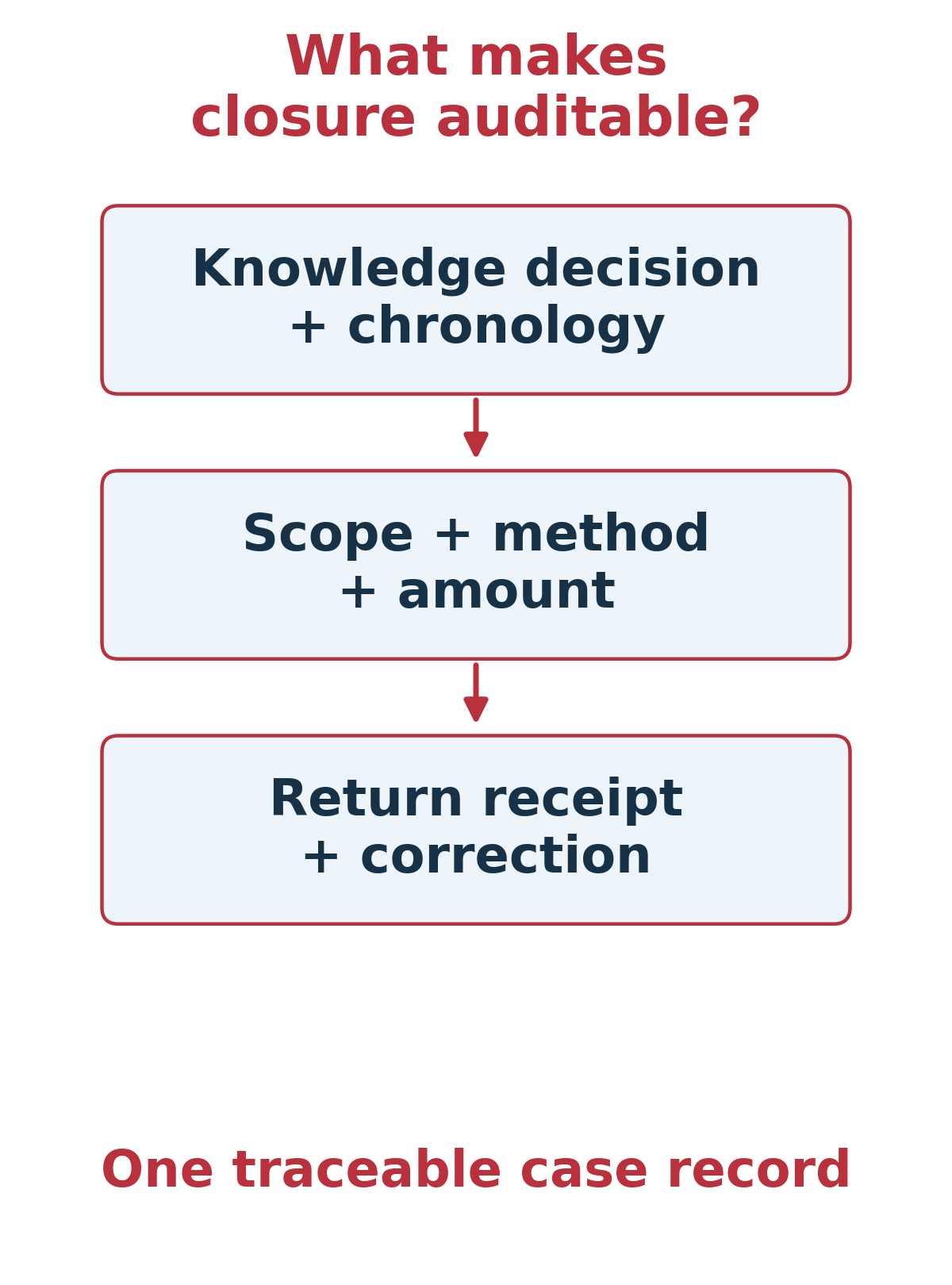
A closure memorandum can state the issue, population, analysis, amount, reporting and return actions, unresolved limitations, and prospective correction. Its detail should match the matter’s complexity. The purpose is not to create an impressive archive; it is to let a qualified person understand what the organization concluded and what evidence supports that conclusion. Assign ownership for any continuing monitoring instead of leaving it implied.
Measure whether the underlying problem stays corrected
Monitoring should test the mechanism that caused the error. If a mapping defect was corrected, review claims generated through the revised mapping. If documentation was insufficient, examine whether the relevant information is now recorded and whether coding decisions use it appropriately. A general education attendance rate cannot establish that the original billing problem stopped. Select measures that connect the corrective action to the observed failure.
Include a check for unintended consequences. A change intended to prevent unsupported billing may also suppress appropriate claims, shift work into a manual queue, or create a new documentation burden. These possibilities do not justify retaining an incorrect process. They do justify monitoring both correctness and operational effects after a repair. Clinical, coding, billing, and compliance perspectives can help identify tradeoffs that one team would miss.
Interpret recurrence carefully. A new error may indicate that the correction failed, that another pathway shares the same cause, or that the original investigation did not capture the full population. Determine which explanation fits the evidence. Reopening a matter should follow the facts and applicable obligations, not an assumption that the previous closure immunizes later findings from review.
For leadership, report the age and status of matters, unresolved decision points, reconciliation progress, and recurrence of corrected defects with clear definitions. Do not use a low number of reports as proof of an effective program; it may also reflect weak detection or reluctance to raise concerns. The desired capability is prompt recognition, defensible assessment, appropriate return, and sustained correction. A useful dashboard makes those activities visible without pretending that one metric can establish compliance.
Make handovers preserve the decision record
A long investigation may outlast an analyst’s assignment, a manager’s tenure, or an outside adviser’s engagement. Prepare for that possibility before a handover becomes urgent. Keep the population definition, data versions, open questions, material decisions, and applicable calendar in an organized matter record. Identify which calculations are final and which remain provisional. A successor should be able to continue the work without interpreting an unlabeled spreadsheet or relying on a former employee’s memory of why claims were excluded.
During the handover, review the next required action and its owner explicitly. Confirm access to the relevant evidence and explain unresolved dependencies, including information expected from another organization. Transfer of responsibility does not reset the legal analysis or create additional time. The receiving team should understand the basis for the current position and know whom to contact if new facts change it. Document that understanding through the ordinary matter-management process. A reliable handover protects both timeliness and analytical continuity: it reduces the chance that completed work will be unnecessarily repeated while an important unresolved issue is overlooked. It also makes the eventual closure record more coherent because changes in personnel do not erase the history of the investigation.
Review automated alerts for both usefulness and blind spots. An alert can prioritize claims for assessment, but its threshold does not establish the legal identification standard. Record what the rule detects, which populations it omits, and how staff should evaluate a positive result. Examine a suitable set of alerts to determine whether they lead to meaningful findings or repeatedly reproduce a known benign pattern. Also consider how concerns outside the automated rule can enter the process. Otherwise, the organization may develop confidence in a dashboard that monitors only the errors its designers already anticipated. Changes to the alert should be documented and tested so that a decline in flagged claims is not mistaken for improved billing when the detection logic simply became narrower. Report detection performance and confirmed findings separately, and preserve an accessible route for people to raise concerns that the software does not recognize.
Evidence boundaries and executive conclusion
This targeted narrative review uses verified bibliographic records and indexed abstracts, alongside primary federal sources checked through September 28, 2026. It is not a systematic review or a full-text appraisal of every source. The research spans decades, countries, coding systems, and payment programs. It informs audit design and interpretation, but does not determine whether an individual hospital has identified an overpayment or calculate its deadline.
The reliable response is prompt evaluation, a defensible decision, a documented investigation where appropriate, and reconciliation through return and correction. The clock should be visible, but the evidence behind each date matters just as much.
References
- 42 CFR 401.305. Requirements for reporting and returning overpayments. Accessed September 14, 2026. Official source.
- 31 USC 3729. False claims. Accessed September 14, 2026. Official source.
- Harrison JP, Barksdale RM. The impact of RAC audits on US hospitals. Journal of health care finance [J Health Care Finance] 2013 Summer; Vol. 39 (4), pp. 1-14. Journal record.
- Bellamkonda KS, Goodney PP, Powell RJ, Zhou W, Menard MT, Farber A, Cronenwett JL. Optimizing hospital billing by using data from the Vascular Quality Initiative. Journal of vascular surgery [J Vasc Surg] 2025 Dec; Vol. 82 (6), pp. 2234-2241. doi:10.1016/j.jvs.2025.08.007.
- Cook A, Averett S. Do hospitals respond to changing incentive structures? Evidence from Medicare’s 2007 DRG restructuring. Journal of health economics [J Health Econ] 2020 Sep; Vol. 73, pp. 102319. doi:10.1016/j.jhealeco.2020.102319.
- Adler-Milstein J, Jha AK. No evidence found that hospitals are using new electronic health records to increase Medicare reimbursements. Health affairs (Project Hope) [Health Aff (Millwood)] 2014 Jul; Vol. 33 (7), pp. 1271-7. doi:10.1377/hlthaff.2014.0023.
- Crespin D, Dworsky M, Levin J, Ruder T, Whaley CM. Upcoding Linked To Up To Two-Thirds Of Growth In Highest-Intensity Hospital Discharges In 5 States, 2011-19. Health affairs (Project Hope) [Health Aff (Millwood)] 2024 Dec; Vol. 43 (12), pp. 1619-1627. doi:10.1377/hlthaff.2024.00596.
- Silverman E, Skinner J. Medicare upcoding and hospital ownership. Journal of health economics [J Health Econ] 2004 Mar; Vol. 23 (2), pp. 369-89. doi:10.1016/j.jhealeco.2003.09.007.
- Mendez, Carmen M.; Harrington, Darrell W.; Christenson, Peter; Spellberg, Brad. Impact of Hospital Variables on Case Mix Index as a Marker of Disease Severity. Population Health Management (POPUL HEALTH MANAGE), Feb2014; 17(1): 28-34. (7p) doi:10.1089/pop.2013.0002.
- Cheng P; Gilchrist A; Robinson KM; Paul L. The risk and consequences of clinical miscoding due to inadequate medical documentation: a case study of the impact on health services funding. Health Information Management Journal (HEALTH INF MANAGE J), 2009; 38(1): 35-46. (12p) doi:10.1177/183335830903800105.
- Hsia DC. Accuracy of Medicare reimbursement for cardiac arrest. JAMA [JAMA] 1990 Jul 04; Vol. 264 (1), pp. 59-62. Journal record.
- Sacarny A. Adoption and learning across hospitals: The case of a revenue-generating practice. Journal of health economics [J Health Econ] 2018 Jul; Vol. 60, pp. 142-164. doi:10.1016/j.jhealeco.2018.06.005.
- Fisher ES, Whaley FS, Krushat WM, Malenka DJ, Fleming C, Baron JA, Hsia DC. The accuracy of Medicare’s hospital claims data: progress has been made, but problems remain. American journal of public health [Am J Public Health] 1992 Feb; Vol. 82 (2), pp. 243-8. doi:10.2105/ajph.82.2.243.
- Bowblis JR, Brunt CS. Medicare skilled nursing facility reimbursement and upcoding. Health economics [Health Econ] 2014 Jul; Vol. 23 (7), pp. 821-40. doi:10.1002/hec.2959.
- Meyers DJ, Trivedi AN. Medicare Advantage Chart Reviews Are Associated With Billions in Additional Payments for Some Plans. Medical care [Med Care] 2021 Feb 01; Vol. 59 (2), pp. 96-100. doi:10.1097/MLR.0000000000001412.
- Carter GM, Newhouse JP, Relles DA. How much change in the case mix index is DRG creep? Journal of health economics [J Health Econ] 1990; Vol. 9 (4), pp. 411-28. doi:10.1016/0167-6296(90)90003-l.
- Rangachari P. Coding for quality measurement: the relationship between hospital structural characteristics and coding accuracy from the perspective of quality measurement. Perspectives in health information managemen [Perspect Health Inf Manag] 2007 Apr 16; Vol. 4, pp. 3. Journal record.
- Rose S, Zaslavsky AM, McWilliams JM. Variation In Accountable Care Organization Spending And Sensitivity To Risk Adjustment: Implications For Benchmarking. Health affairs (Project Hope) [Health Aff (Millwood)] 2016 Mar; Vol. 35 (3), pp. 440-8. doi:10.1377/hlthaff.2015.1026.
- Hsia DC, Krushat WM, Fagan AB, Tebbutt JA, Kusserow RP. Accuracy of diagnostic coding for Medicare patients under the prospective-payment system. The New England journal of medicine [N Engl J Med] 1988 Feb 11; Vol. 318 (6), pp. 352-5. doi:10.1056/NEJM198802113180604.
- Vaidya R, Kataria N, Zou J, Li Q, Khawaja S, Dang T, Smith S, Lau K, Denman R, Wee Y, Learmouth B, Janoschka B, Sedgwick J, Horvath R, Ranasinghe I. Accuracy of data routinely collected by Australian hospitals for identifying infective endocarditis, causative organisms and clinical outcomes: a diagnostic accuracy study. Internal medicine journal [Intern Med J] 2026 Sep; Vol. 56 (9), pp. 1544-1552. doi:10.1111/imj.70498.
- Schonberger RB, Dutton RP, Dai F. Is There Evidence for Systematic Upcoding of ASA Physical Status Coincident with Payer Incentives? A Regression Discontinuity Analysis of the National Anesthesia Clinical Outcomes Registry. Anesthesia and analgesia [Anesth Analg] 2016 Jan; Vol. 122 (1), pp. 243-50. doi:10.1213/ANE.0000000000000917.
- Zhang M, Wang Y, Jakob R, Su S, Bai X, Jing X, Xue X, Liao A, Li N, Wang Y. Methodologies and key considerations for implementing the International Classification of Diseases-11th revision morbidity coding: insights from a national pilot study in China. Journal of the American Medical Informatics Association : JAMIA [J Am Med Inform Assoc] 2024 Apr 19; Vol. 31 (5), pp. 1084-1092. doi:10.1093/jamia/ocae031.
- Chomutare T, Svenning TO, Hernández MÁT, Ngo PD, Budrionis A, Markljung K, Hind LI, Torsvik T, Mikalsen KØ, Babic A, Dalianis H. Artificial Intelligence to Improve Clinical Coding Practice in Scandinavia: crossover Randomized Controlled Trial Journal of medical Internet research 2025 27, e71904 (e71904) doi:10.2196/71904.
- McCLEAN, KIM; CROSS, MARTYN; REED, SUE. An audit of obesity data and concordance with diagnostic coding for patients admitted to Western Australian Country Health Service hospitals. Australian Journal of Advanced Nursing (AUST J ADV NURS), Dec2020-Feb2021; 38(1): 45-52. (8p) doi:10.37464/2020.381.99.
- Zarei, Javad; Golpira, Reza; Hashemi, Nasim; Azadmanjir, Zahra; Meidani, Zahra; Vahedi, Akram; Bakhshandeh, Hooman; Fakharian, Esmaeil; Sheikhtaheri, Abbas. Comparison of the accuracy of inpatient morbidity coding with ICD-11 and ICD-10. Health Information Management Journal (HEALTH INF MANAGE J), Jan2025; 54(1): 14-24. (11p) doi:10.1177/18333583231185355.
- Santos JV, Silva Pimenta I, Santos Martins F, Pinheiro V, Kalynka Feldens T, Lopes F, Souza J, Freitas A. Why is the data quality of hospital morbidity so heterogeneous? A nationwide survey of Portuguese clinical coders. Archives of public health = Archives belges de sante publique [Arch Public Health] 2026 Jul 07. doi:10.1186/s13690-026-01985-1.
- Friedman AM, Oberhardt M, Sheen JJ, Kessler A, Vawdrey D, Green R, D’Alton ME, Goffman D. Measurement of hemorrhage-related severe maternal morbidity with billing versus electronic medical record data. The journal of maternal-fetal & neonatal medicine : the official journal of the European Association of Perinatal Medicine, the Federation of Asia and Oceania Perinatal Societies, the International Society of Perinatal Obstetricians [J Matern Fetal Neonatal Med] 2022 Jun; Vol. 35 (12), pp. 2234-2240. doi:10.1080/14767058.2020.1783229.