


Management Atlas · Law, Ethics & Governance
Between Care and the Bill
The No Surprises Act, Consent, Estimates, Dispute Resolution, and Hospital Accountability, a Narrative Review
September 28, 2026 · 22-minute read
Narrative evidence review
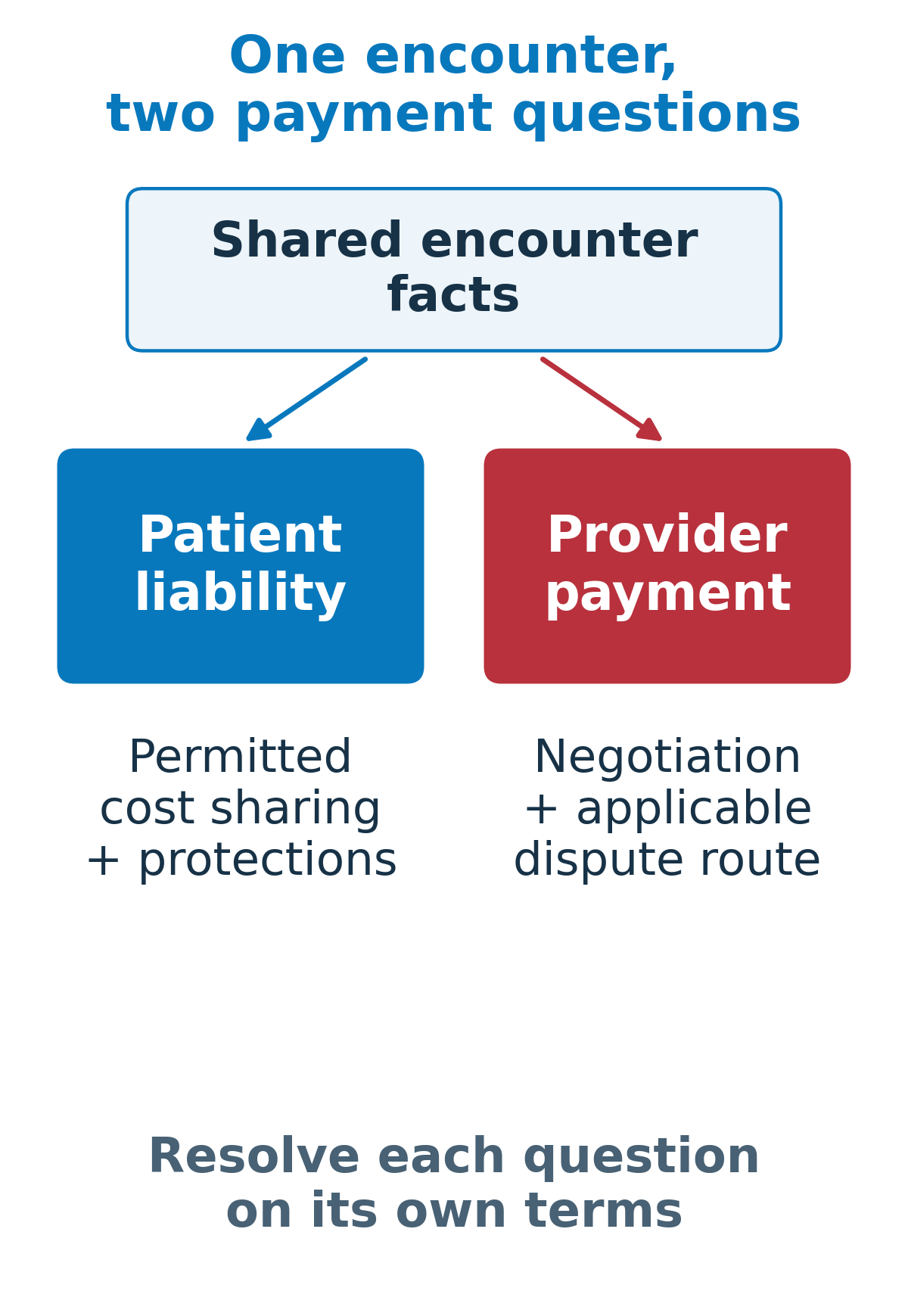
One encounter can create two legal questions. What may the patient owe? How should the payer and provider resolve payment? Keeping those questions separate protects the patient and improves the payment record.
Full article narration
Executive synthesis
A patient receives care at an in-network hospital, but one clinician is outside the plan’s network. The clinician and payer disagree about payment. The hospital’s task is to preserve the patient’s applicable protections while the parties resolve their separate dispute. If the unresolved amount moves into the patient’s collection pathway without a legal check, a contracting problem becomes a patient problem.
The No Surprises Act addresses specified emergency services, nonemergency services at participating facilities, and air ambulance services, with important conditions and exceptions. Good faith estimates and the patient-provider dispute route serve a different population and purpose. This narrative review combines the current architecture with 25 peer-reviewed studies of spending, contracting, patient experience, and arbitration. The central control is to determine lawful patient liability separately from the amount a provider seeks from a payer.
Define the protected encounter before calculating the bill
The federal protections apply to specified services and health coverage. They generally limit out-of-network cost sharing and prohibit balance billing for covered emergency services, certain nonemergency services furnished by nonparticipating providers at participating facilities, and covered air ambulance services. The facility and service definitions matter. Medicare and Medicaid have their own protections; the Act should not be described as the source of every patient’s billing rights. 1
The federal framework does not create a general equivalent protection for ground ambulances, and care at a nonparticipating facility does not automatically fit the nonemergency participating-facility rule. State law and plan terms can add relevant protections. The intake record should therefore preserve the patient’s coverage, the facility’s status, each relevant provider’s status, the service type, and the timing of the encounter. 1
When the encounter is protected, the provider-payer payment dispute does not authorize an additional charge to the patient beyond permitted liability. The qualifying payment amount, recognized amount, out-of-network rate, initial payment, and patient cost sharing are related but distinct concepts. Label each amount and its source. A disputed arbitration offer should never be placed in a patient-balance field merely because the amounts have not yet reconciled. 1,2
Notice and consent is an exception with conditions
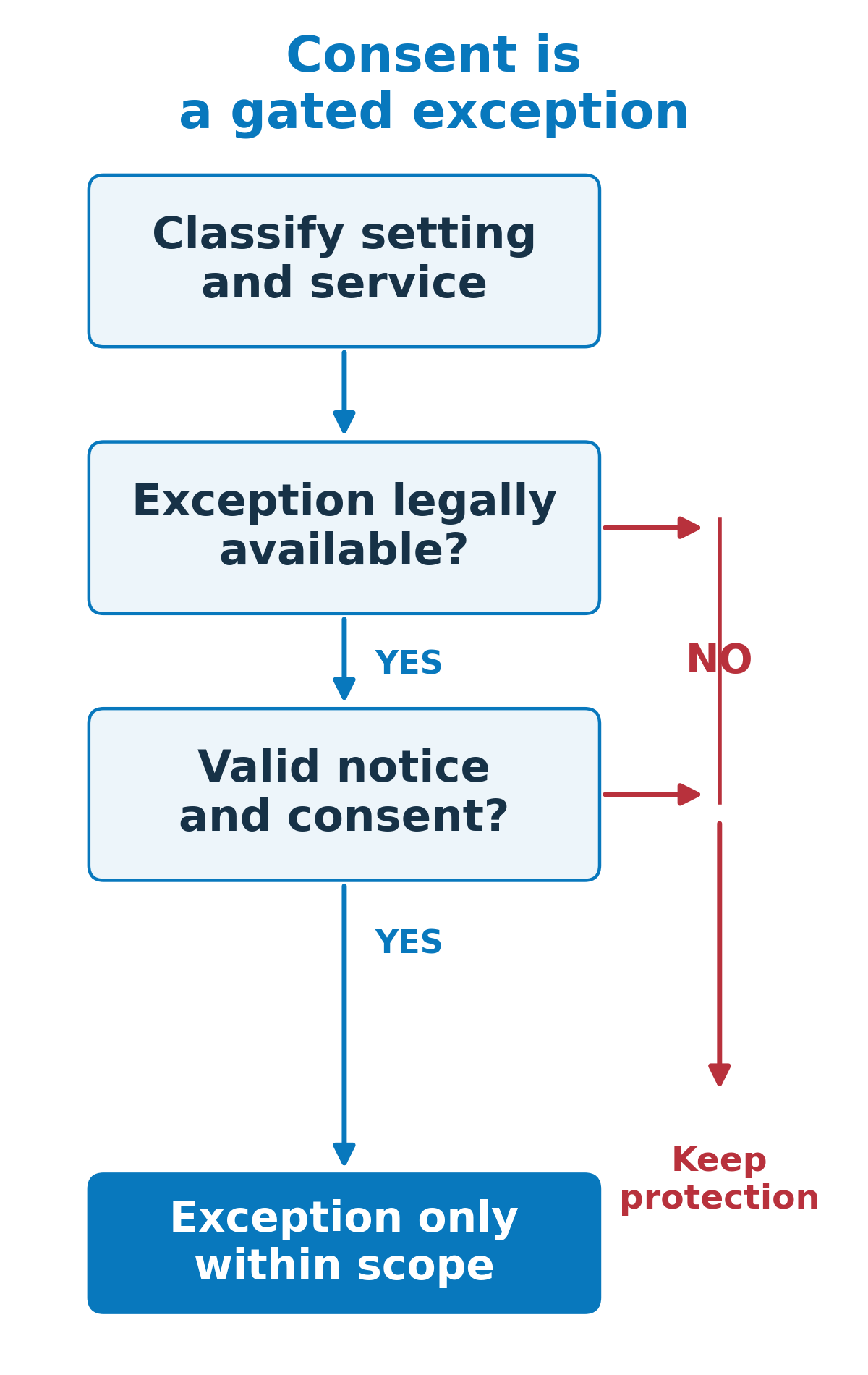
Notice and consent may permit a patient to waive certain protections in limited circumstances. It is not available for specified ancillary services, including emergency medicine, anesthesiology, pathology, radiology, and neonatology, among other protected categories. It also cannot be used as a routine waiver for emergency care before stabilization. A general financial-responsibility form is not a substitute for the required process. 1,3
For eligible scheduled care, timing, content, delivery, language access, voluntariness, and documentation all matter. When an appointment is scheduled at least 72 hours in advance, the notice must be furnished at least 72 hours before the appointment. Shorter scheduling intervals have specific rules, including a three-hour minimum for same-day services. Post-stabilization care has additional clinical and access conditions. The organization should use the current requirements and forms for the actual scenario, not a single checkbox called “consent obtained.” 1,3
The record should identify the specific provider and services, the estimate given, when the patient received the notice, when consent was signed, and whether it was revoked before care. Test whether staff can explain the alternative without pressure. A technically complete form cannot cure an exception that was unavailable for the service in the first place. 1,3
Keep the estimate pathway separate from payer arbitration
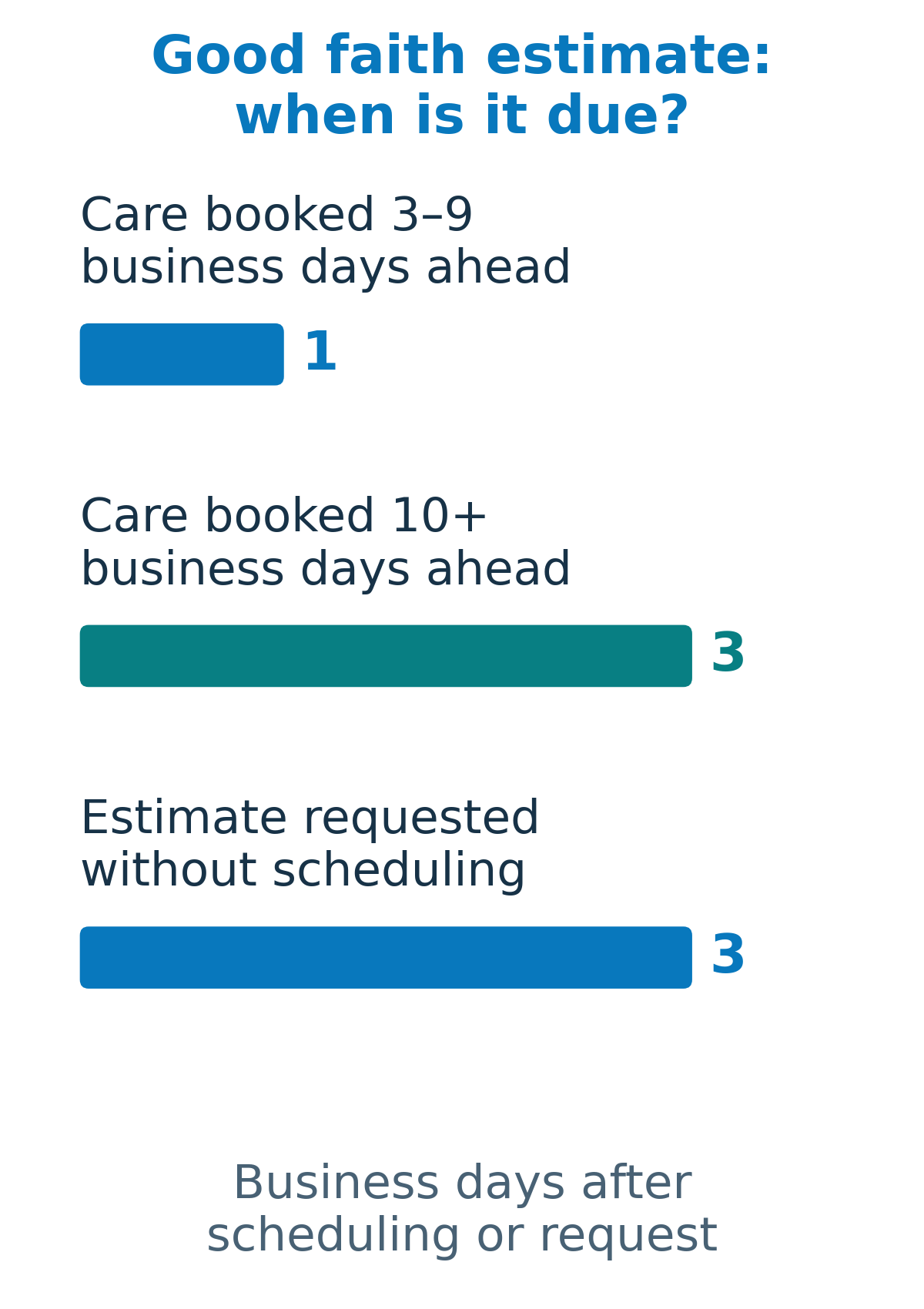
Uninsured or self-pay individuals generally must receive a good faith estimate when scheduling eligible services at least three business days in advance or requesting an estimate. For care scheduled three to nine business days ahead, the estimate is due no later than one business day after scheduling. For scheduling at least ten business days ahead, or an estimate requested without scheduling, the relevant deadline is generally three business days. These business-day rules should not be confused with the notice-and-consent clock. 1,4
The patient-provider dispute-resolution process can apply when a provider’s or facility’s billed charges are at least $400 above its expected charges in the estimate, subject to eligibility requirements. The patient generally must initiate the dispute within 120 calendar days of the initial bill. This is a patient-facing route; federal independent dispute resolution between a provider and payer is a different process. Staff should route the request according to the actual parties and issue. 1
An estimate is not a universal promise that no other circumstance can affect the bill. It should clearly identify the expected services and relevant limitations while meeting the applicable requirements. When a patient reports a discrepancy, retrieve the version actually provided, compare it with the services and charges, and explain the available review or dispute route in plain language.
The 2026 IDR transition needs its own calendar
The Federal Independent Dispute Resolution Operations final rule was published June 4, 2026 and generally became effective August 3. The reduced administrative fee of $15 per party per dispute applies to disputes initiated on or after June 11, 2026. The certified IDR entity’s fee is a separate amount. A historical financial model based on an earlier administrative fee should not be used unchanged for a current decision. 2
The rule’s provisions do not all share the same applicability date. The revised batched-dispute definition applies to disputes with open-negotiation periods beginning 90 days after the rule’s effective date. Many portal-dependent procedural changes apply 90 days after guidance announcing the supporting functionality, while the registry requirements use 90 business days after the relevant guidance. Track the actual guidance and dispute dates before selecting a workflow. A provision can be final without yet governing every dispute in the queue. 2
CMS opened IDR Gateway account creation on September 15, 2026. Participants in the Federal IDR process can register now, while existing web forms remain available during the transition. CMS states that most forms will no longer be available outside the Gateway after January 15, 2027, with an exception for the Notice of IDR Initiation – Resubmission. This registration milestone is distinct from the separate applicability dates for the final rule’s procedural changes. See the CMS September 15, 2026 notice.
CMS has set November 1, 2026 applicability for the new batching and cooling-off provisions for disputes whose open negotiation begins on or after that date. Its August 13 notice also reports the Fifth Circuit’s August 11 en banc decision affirming portions of the judgment invalidating QPA provisions. The departments were reviewing the decision and indicated that further guidance would follow. The Federal IDR process remained operational. Check the CMS notices before relying on a QPA methodology or procedural deadline.
The payment team should preserve the initial payment or denial, required qualifying-payment-amount information, plan identity, open-negotiation notices, dispute eligibility analysis, offers, determinations, and payment confirmation. The purpose is to establish the correct parties, process, and deadlines. Throughout that work, patient financial services should maintain the separately validated patient balance.
What the evidence supports
The strongest patient-spending result has a defined population
A 2025 quasi-experimental study examined privately insured people who purchased coverage directly in 24 states. It associated the No Surprises Act with lower out-of-pocket spending relative to the comparison trend, while not finding corresponding changes in premiums or the study’s high-burden measure. This is evidence about a defined insurance population, not every insured person. A separate analysis of state protections and emergency-department use offered potential implications for the federal law; it did not observe the federal law’s effect. Descriptive research on professional-service prices and cost sharing through 2022 provides context but cannot by itself isolate the Act’s causal contribution.5,6,17
State laws show that payment design can change contracting incentives
Studies of emergency services, hospital-based physician prices, anesthesiology, provider charges, and neonatology found heterogeneous responses to state balance-billing protections. Some reported greater network participation or lower prices in selected settings. New York and California charge patterns also differed. The findings support attention to payment benchmarks, bargaining conditions, and specialty-specific contracting. They do not support a universal claim that every balance-billing law lowers every price. State designs, covered populations, and preexisting market conditions differ from each other and from the federal independent dispute resolution process.10,12,13,14,16
Arbitration outcomes describe selected disputes
Analyses of federal independent dispute resolution for emergency services and air ambulances reported frequent provider wins and awards above the qualifying payment amount in the disputes studied. A separate analysis involving one insurer compared settlements with both the qualifying payment amount and actual in-network rates. These are selected contested claims, not representative samples of all services. A financial-modeling study explored when pursuing arbitration might be viable, using assumptions about fees and claim values. Because the administrative fee changed in 2026, older model outputs are not a current calculator. None of these studies means a provider can transfer an arbitration shortfall to a protected patient.11,23,27,15
Unexpected bills and prohibited balance bills are different measures
Studies in joint arthroplasty and shoulder surgery reported patients’ experiences of unexpected bills and their relationship with satisfaction. Claims analyses in otolaryngology, intensive care, hand trauma, and tracheostomy identified potential out-of-network exposure or patient cost-sharing patterns. A patient can be surprised by an ordinary deductible, and an out-of-network claim does not prove that a prohibited balance bill was collected. Several studies use data largely predating the federal protections. These findings justify reconciling the bill with the encounter and insurance rules; they should not be presented as current violation rates under the No Surprises Act.7,8,9,21,22,26
Ground ambulance exposure requires a separate route
Research on ground-ambulance ownership and the site of origin found variation in prices and out-of-network billing exposure. A study of New York’s ground-ambulance balance-billing regulation examined a state policy response. These studies explain why ambulance routing belongs in a hospital’s financial-navigation work, even though the federal Act’s air-ambulance protections do not create an equivalent general ground-ambulance protection. An out-of-network indicator remains a proxy for potential exposure. Local teams must check applicable state law and plan terms before advising a patient about a particular transport bill.18,20,24
Network information and cost explanations need active maintenance
An emergency-department survey found that patients often overestimated costs and rarely sought price information before the visit. That does not mean patients can safely shop during an emergency. A study following previously inaccurate Pennsylvania provider-directory entries found that many remained inaccurate after extended follow-up. Because those entries were selected for known errors, the result is not a prevalence estimate for all directory listings. The operational response is to preserve the directory information supplied to a patient, correct known inaccuracies, and provide a clear route for reconciling the resulting bill.19,25
Historical exposure establishes the problem, not today’s failure rate
Garmon and Chartock estimated potential surprise-billing exposure across several types of hospital encounters in 2014. Sun and colleagues examined privately insured inpatient admissions and emergency visits at in-network hospitals over 2010–2016, documenting substantial out-of-network exposure and potential financial consequences. These studies help explain why protection at an in-network facility became a policy priority. Their dates are essential to interpretation. They cannot establish how often the federal protections are violated in 2026, and estimates of potential liability should not be restated as verified amounts actually collected from patients.28,29
Make the handoff visible
At registration or scheduling, record the coverage and network information used to explain the encounter. At the clinical transition, preserve facts relevant to emergency status, stabilization, and any permissible consent process. At billing, compare the explanation of benefits, contractual treatment, statutory protections, and patient responsibility. At dispute intake, identify whether the issue concerns a patient estimate, a protected balance bill, a coverage determination, or provider-payer payment.
Assign a named owner for a bill held for review, with an escalation date and a clear collection status. An unresolved legal or factual question should not disappear into a generic denial queue. When the review identifies an error, correct downstream statements and collection instructions, reconcile any affected payments, and give the patient a coherent explanation. Keep enough information to determine whether the same cause affected other encounters.
Measure protected-balance accuracy, time to resolve patient complaints, repeated directory defects, estimate delivery, consent exceptions, and disputes routed to the wrong process. Use separate denominators. A high provider win rate in arbitration is not a patient-protection measure. A low complaint count can also reflect difficulty reaching the organization rather than the absence of billing problems.
Design the patient account around the protection decision
The following workflow recommendations are proposed management controls. They do not expand the statute’s scope or resolve the legal status of an individual encounter. Hospitals must apply the relevant federal and state requirements, plan context, and facts. The practical objective is to prevent uncertainty between a provider and payer from becoming an unsupported demand on the patient.
Begin with an encounter-level record of the coverage analysis. Identify the service, setting, relevant network relationships, and the protection or exception being considered. Preserve the evidence used to reach the decision. A generic account flag reading “surprise billing” may help route work, but it does not explain why a particular patient liability is permitted or prohibited. Staff reviewing the account later need enough information to understand the basis for the action.
Separate payer follow-up from patient-account activity. A disputed provider payment can require substantial work while the patient’s applicable liability remains governed by its own rules. The system should not treat an unresolved payer balance as automatically collectible from the patient. Define which account actions require review and who can authorize them. Test the actual statement, payment-plan, and collection workflows rather than assuming that a policy label controls every downstream system.
Use a clear exception route when information is missing or conflicting. A patient may have received inconsistent network information, the service may have changed, or a claim may lack the data needed to determine the correct pathway. Staff should preserve the uncertainty and obtain qualified review. They should not resolve it by asking the patient to pay first and challenge the amount later. The eventual account decision should be supported by the applicable analysis.
Confirm that corrected decisions reach all affected systems. If a patient balance is adjusted, check the next statement, portal display, outsourced billing queue, and any relevant collection activity. A correction visible to an internal analyst may not yet be visible to the patient. Close the issue only after the appropriate account actions have been reconciled and the patient receives an understandable explanation of the result.
Test the front-end conversation before the service
Registration and scheduling staff often encounter questions before anyone knows the final clinical episode. Their explanations should distinguish what is known from what remains uncertain. A patient asking “Is this covered?” may mean network participation, benefit coverage, prior authorization, an estimate, or final out-of-pocket responsibility. Asking a clarifying question can prevent a technically accurate answer to the wrong question.
Give staff usable language about the limits of an estimate. An estimate can support planning while still depending on the anticipated services and available information. It should not be presented as a guarantee when the organization cannot support that promise. Conversely, uncertainty should not become a reason to provide no assistance. Explain the next step, the responsible contact, and how the patient can obtain or correct relevant information.
Keep notice-and-consent review distinct from routine registration paperwork. Where the exception is legally available, the applicable content, timing, and other conditions require careful implementation. A signature embedded in a general packet does not by itself establish that those conditions were met. Staff should know when to escalate the question and should not improvise a waiver for a service or circumstance in which the exception is unavailable.
Test comprehension with realistic scenarios. One patient wants a planned service at a participating facility; another arrives for emergency care; another is uninsured or self-pay and requests a good faith estimate. Ask staff to identify the appropriate pathway and explain it in ordinary language. The exercise should reveal where the hospital’s scripts, forms, or scheduling tools blur legal distinctions that matter to the patient.
Include accessibility and language needs in the test. A process that works only for a patient who reads a long English form on a desktop computer is not a dependable communication process. Evaluate the materials and available assistance through the hospital’s applicable accessibility and language-access practices. Record recurring questions and revise confusing explanations without removing legally required information.
Build a dispute file that preserves the right question
A dispute file should identify which dispute is being addressed. A patient-provider dispute involving a good faith estimate is different from federal provider-payer independent dispute resolution. A complaint about a balance bill may require another review route. These processes can arise around related care, but they have different participants, eligibility conditions, evidence, and deadlines. One shared document folder should not obscure those distinctions.
Assign a process owner who tracks the applicable current requirements and transition dates. The 2026 changes make version control particularly useful: a form, portal instruction, or batching rule may apply differently depending on the relevant event date. Record the basis for the chosen pathway and verify current agency instructions when a matter is initiated. A saved checklist should support judgment, not substitute for checking a changed requirement.
Preserve the claim and payment history, relevant communications, network information, and other evidence required for the particular process. Keep the information organized around the question under review. More documents do not necessarily produce a clearer submission. An evidence index can identify what each item establishes and where uncertainty remains, while the responsible specialist determines what the process actually requires.
Reconcile the dispute outcome to the account. A decision or settlement may require follow-up in the billing system, communications with another party, and confirmation that the patient’s applicable liability remains correct. Do not assume that the dispute platform updates the hospital’s systems automatically. Identify who performs each action and what evidence establishes completion. This is where a legal outcome becomes an operational result.
Measure the patient result separately from payment performance
A hospital can improve dispute recovery while still delivering a poor patient experience. It can also protect a patient correctly while losing a payment dispute. Report these outcomes separately. Measures of provider-payer payment, patient-account accuracy, communication, and complaint resolution answer different questions and should retain their own definitions.
For account accuracy, consider a review of selected protected encounters from the initial liability decision through the final patient statement. Check whether the account followed the intended route and whether corrections reached downstream systems. State how the sample was selected. A targeted sample of complaints can reveal failure modes, but its error proportion should not be presented as the rate across all hospital encounters.
For patient experience, examine whether people understood the explanation, knew whom to contact, and received a response that addressed their question. A complaint closed in the tracking system may remain unresolved from the patient’s perspective. Review the substance of the response, not just its speed. Explain an adverse determination clearly when the applicable analysis does not support the patient’s requested outcome.
For operational performance, track handoffs that repeatedly fail: missing network information, unreviewed account transfers, inconsistent estimates, delayed corrections, or unresolved ownership between departments. Use these findings to choose a specific repair. A new script may address confusing language; a system change may be needed when a protected balance repeatedly enters the wrong queue. Match the intervention to the demonstrated cause.
Leadership should also examine what the measures leave out. A low complaint count may reflect low exposure, successful communication, or barriers to reporting. A high dispute success rate may describe a selected population rather than the quality of all claims. Present counts, denominators, selection rules, and limitations together. The purpose is to understand performance well enough to improve it, not to produce a favorable summary at the expense of meaning.
Use one accountable contact for an unresolved account
A patient should not have to reconstruct the hospital’s organizational chart to obtain an answer. For a complex account, designate a contact who can coordinate the relevant internal teams and explain the next step. That person need not personally decide every legal or payment question. Their responsibility is to keep the question moving, preserve the information already supplied, and avoid asking the patient to repeat the same account history at each transfer. Define how another staff member will continue the work if the designated contact is unavailable.
Test this arrangement by following an unresolved account from the patient’s perspective. Can the patient learn what information is still needed, who is reviewing it, and how they will receive the result? Does the explanation distinguish the patient’s balance from the provider-payer dispute? Are prior communications available to the next person who answers the call? These checks provide concrete evidence about coordination. They also reveal whether a nominal single-contact policy is supported by the records and authority needed to make it useful. When the issue closes, preserve the explanation and the resulting account action together so a later statement or inquiry does not reopen the same confusion.
Include outsourced partners in the account review. A hospital may have a sound internal decision while a statement vendor, call center, or collection partner acts on an older balance or an incomplete status field. Define how corrected instructions are transmitted and acknowledged. Test a small number of actual workflow transitions using appropriately protected records and confirm what the patient would see at each stage. The review should identify the point at which a disputed or corrected amount becomes eligible for the next action and the controls that govern that decision. If the partner cannot implement the required distinction, escalate the limitation as an operational problem requiring resolution. Contract language describing compliance responsibilities is useful, but it does not demonstrate that the day-to-day data exchange produces the intended account behavior. Retain the test result and repeat the relevant check after a material interface or vendor change.
Evidence boundaries and executive conclusion
This targeted narrative review uses verified bibliographic records and indexed abstracts, with primary federal sources checked through September 28, 2026. It is not a systematic review or a full-text appraisal of every source. Many studies evaluate predecessor state laws or pre-2022 claims. Selected arbitration cases, potential out-of-network exposure, self-reported surprise, and proven statutory violations are different populations and outcomes.
The decisive operating principle is to protect the patient while the payment question is resolved through its proper route. A reliable hospital can show how it determined coverage, applied the relevant exception or protection, calculated patient liability, and corrected an error. That record is the bridge between the law’s promise and the bill the patient actually receives.
References
- 45 CFR part 149. Surprise billing and transparency requirements. Accessed September 14, 2026. Official source.
- Departments of the Treasury, Labor, and Health and Human Services; OPM. Federal Independent Dispute Resolution Operations. 91 FR 33900. June 4, 2026. Accessed September 14, 2026. Official source.
- CMS. Decision tree: notice and consent. Accessed September 14, 2026. Official source.
- CMS. Decision tree: good faith estimates for uninsured or self-pay individuals. Accessed September 14, 2026. Official source.
- Liu M, Kadakia KT, Mein SA, Wadhera RK. Patient healthcare spending after the No Surprises Act: quasi-experimental difference-in-differences study. BMJ (Clinical research ed.) [BMJ] 2025 Aug 27; Vol. 390, pp. e084803. doi:10.1136/bmj-2025-084803.
- Encinosa, William; Lane, Keanan; Cornelio, Noelle. How State Surprise Billing Protections Increased ED Visits, 2007-2018: Potential Implications for the No Surprises Act. American Journal of Managed Care (AM J MANAGE CARE), Sep2022; 28(9): e333-19. (25p) doi:10.37765/ajmc.2022.89226.
- McCahon JAS, Cheesman QT, Radack TM, Ong AC, Post ZD, Deirmengian GK. Surprise Billing Is Common in Total Joint Arthroplasty and Negatively Impacts Patient Satisfaction. Orthopedics [Orthopedics] 2024 Sep-Oct; Vol. 47 (5), pp. 283-288. doi:10.3928/01477447-20240718-06.
- Lenze NR, Perera CD, Chhabra KR, Scott JW, Dedhia RC, Brenner MJ. Out-of-Pocket Costs and Surprise Billing in Otolaryngology: A National Database Analysis. Otolaryngology–head and neck surgery : official journal of American Academy of Otolaryngology-Head and Neck Surgery [Otolaryngol Head Neck Surg] 2025 Dec; Vol. 173 (6), pp. 1393-1402. doi:10.1002/ohn.70035.
- Kannan S, Song Z. Surprise billing in intensive care unit (ICU) hospitalizations. Health affairs scholar [Health Aff Sch] 2024 Feb 27; Vol. 2 (3), pp. qxae025. doi:10.1093/haschl/qxae025.
- Garmon C, Li Y, Retchin SM, Xu WY. The impact of surprise billing laws on emergency services. Health economics [Health Econ] 2024 Nov; Vol. 33 (11), pp. 2450-2462. doi:10.1002/hec.4874.
- Duffy EL, Garmon C, Adler L, Biener A, Trish E. No Surprises Act independent dispute resolution outcomes for emergency services. Health affairs scholar [Health Aff Sch] 2024 Oct 17; Vol. 2 (11), pp. qxae132. doi:10.1093/haschl/qxae132.
- Garmon C, Li Y, Retchin SM, Xu WY. The impact of surprise billing laws on hospital-based physician prices and network participation. Health economics, policy, and law [Health Econ Policy Law] 2024 Dec 11, pp. 1-39. doi:10.1017/S1744133124000239.
- Gordon AS, Liu Y, Chartock BL, Chi WC. Provider Charges And State Surprise Billing Laws: Evidence From New York And California. Health affairs (Project Hope) [Health Aff (Millwood)] 2022 Sep; Vol. 41 (9), pp. 1316-1323. doi:10.1377/hlthaff.2021.01332.
- La Forgia A, Bond AM, Braun RT, Kjaer K, Zhang M, Casalino LP. Association of Surprise-Billing Legislation with Prices Paid to In-Network and Out-of-Network Anesthesiologists in California, Florida, and New York: An Economic Analysis. JAMA internal medicine [JAMA Intern Med] 2021 Oct 01; Vol. 181 (10), pp. 1324-1331. doi:10.1001/jamainternmed.2021.4564.
- Christensen EW, Waid MD, Hirsch JA, Parikh JR, Raja AS, Rathmell JP, Rula EY. Financial Viability of the No Surprises Act Independent Dispute Resolution Process: Radiology and Other Hospital-Based Specialties. AJR. American journal of roentgenology [AJR Am J Roentgenol] 2024 Apr; Vol. 222 (4), pp. e2330687. doi:10.2214/AJR.23.30687.
- Xu WY, Garmon C, Retchin SM, Li Y. Neonatology pricing and network participation under state balance billing regulations. The American journal of managed care [Am J Manag Care] 2025 Oct; Vol. 31 (10), pp. 562-568. doi:10.37765/ajmc.2025.89806.
- Duffy E, Garmon C, Ly B. Recent trends in private health insurance prices and cost-sharing for hospital-based professional services. Health economics, policy, and law [Health Econ Policy Law] 2026 Jul 07, pp. 1-28. doi:10.1017/S1744133126100565.
- Xu WY, Garmon C, Retchin SM, Li Y. The impacts of New York’s balance billing regulation on ground ambulance pricing. Health services research [Health Serv Res] 2025 Apr; Vol. 60 (2), pp. e14387. doi:10.1111/1475-6773.14387.
- Gaylor JM, Chan E, Parwani V, Ulrich A, Rothenberg C, Venkatesh A. Patient cost consciousness in the emergency department. The American journal of emergency medicine [Am J Emerg Med] 2022 Nov; Vol. 61, pp. 61-63. doi:10.1016/j.ajem.2022.08.039.
- Adler L, Ly B, Duffy E, Hannick K, Hall M, Trish E. Ground Ambulance Billing And Prices Differ By Ownership Structure. Health affairs (Project Hope) [Health Aff (Millwood)] 2023 Feb; Vol. 42 (2), pp. 227-236. doi:10.1377/hlthaff.2022.00738.
- Long C, Zhang G, Sanghavi KK, Qiu C, Means KR Jr, Giladi AM. Surprise Out-of-Network Bills for Hand and Upper Extremity Trauma Patients. The Journal of hand surgery [J Hand Surg Am] 2022 Dec; Vol. 47 (12), pp. 1230.e1-1230.e17. doi:10.1016/j.jhsa.2021.09.015.
- McCahon JAS, Lynch JC, Radack T, Austin LS. Surprise Billing in Elective Shoulder Surgery and Its Effect on Patient Satisfaction. Orthopedics [Orthopedics] 2024 Mar-Apr; Vol. 47 (2), pp. 123-127. doi:10.3928/01477447-20230922-02.
- Ukert B, Gordon AS. “Arbitration Outcomes for Out-of-Network Medical Bills Under the No Surprises Act”. Inquiry : a journal of medical care organization, provision and financing [Inquiry] 2025 Jan-Dec; Vol. 62, pp. 469580251401475. doi:10.1177/00469580251401475.
- Gong JH, Azad CL, Zhang G, Means KR Jr, Aliu O, Giladi AM. Site of Ambulance Origination and Billing for Out-of-Network Services. JAMA network open [JAMA Netw Open] 2024 Feb 05; Vol. 7 (2), pp. e240118. doi:10.1001/jamanetworkopen.2024.0118.
- Haeder SF, Zhu JM. Persistence of provider directory inaccuracies after the No Surprises Act. The American journal of managed care [Am J Manag Care] 2024 Nov; Vol. 30 (11), pp. 584-588. doi:10.37765/ajmc.2024.89627.
- Lenze NR, Kler JS, Perera CD, Chhabra KR, Goldenberg D, Pandian V, Brenner MJ. Out-of-Pocket Costs and Potential Surprise Bills for Tracheostomy in Commercially Insured Patients. Tracheostomy (Warrenville, Ill.) [Tracheostomy] 2025; Vol. 2 (3), pp. 24-32. doi:10.62905/001c.147777.
- Duffy EL, Garmon C. No Surprises Act Independent Dispute Resolution Outcomes for Air Ambulances. JAMA network open [JAMA Netw Open] 2025 Mar 03; Vol. 8 (3), pp. e2462404. doi:10.1001/jamanetworkopen.2024.62404.
- Garmon C, Chartock B. One In Five Inpatient Emergency Department Cases May Lead To Surprise Bills. Health affairs (Project Hope) [Health Aff (Millwood)] 2017 Jan 01; Vol. 36 (1), pp. 177-181. doi:10.1377/hlthaff.2016.0970.
- Sun EC, Mello MM, Moshfegh J, Baker LC. Assessment of Out-of-Network Billing for Privately Insured Patients Receiving Care in In-Network Hospitals. JAMA internal medicine [JAMA Intern Med] 2019 Nov 01; Vol. 179 (11), pp. 1543-1550. doi:10.1001/jamainternmed.2019.3451.