



Management Atlas · Law, Ethics & Governance
The Machine-Readable Price
2026 Hospital Transparency, Attestation, Enforcement, and Hospital Accountability, a Narrative Review
September 28, 2026 · 22-minute read
Narrative evidence review
A hospital price file is a public promise about data. The executive task is to connect that promise to the payment record, the calculation, and the accountable sign-off.
Full article narration
Executive synthesis
The 2026 hospital price-transparency changes make a familiar executive problem more visible: a public number needs an accountable chain of evidence. A machine-readable file can pass a structural check while containing a value that finance cannot reproduce. Conversely, a defensible calculation can remain unusable if patients and analysts cannot find or interpret it. The operating objective is to connect the contract, source payment data, calculation, public file, consumer display, and responsible sign-off.
This narrative review combines the current federal requirements with 25 peer-reviewed studies of disclosure, price variation, data usability, and spending effects. The evidence supports attention to completeness and interpretation, but does not establish that the new 2026 distribution fields have already lowered patient spending. The proposed governance approach therefore treats compliance, usability, and affordability as separate outcomes.
What the 2026 requirements change
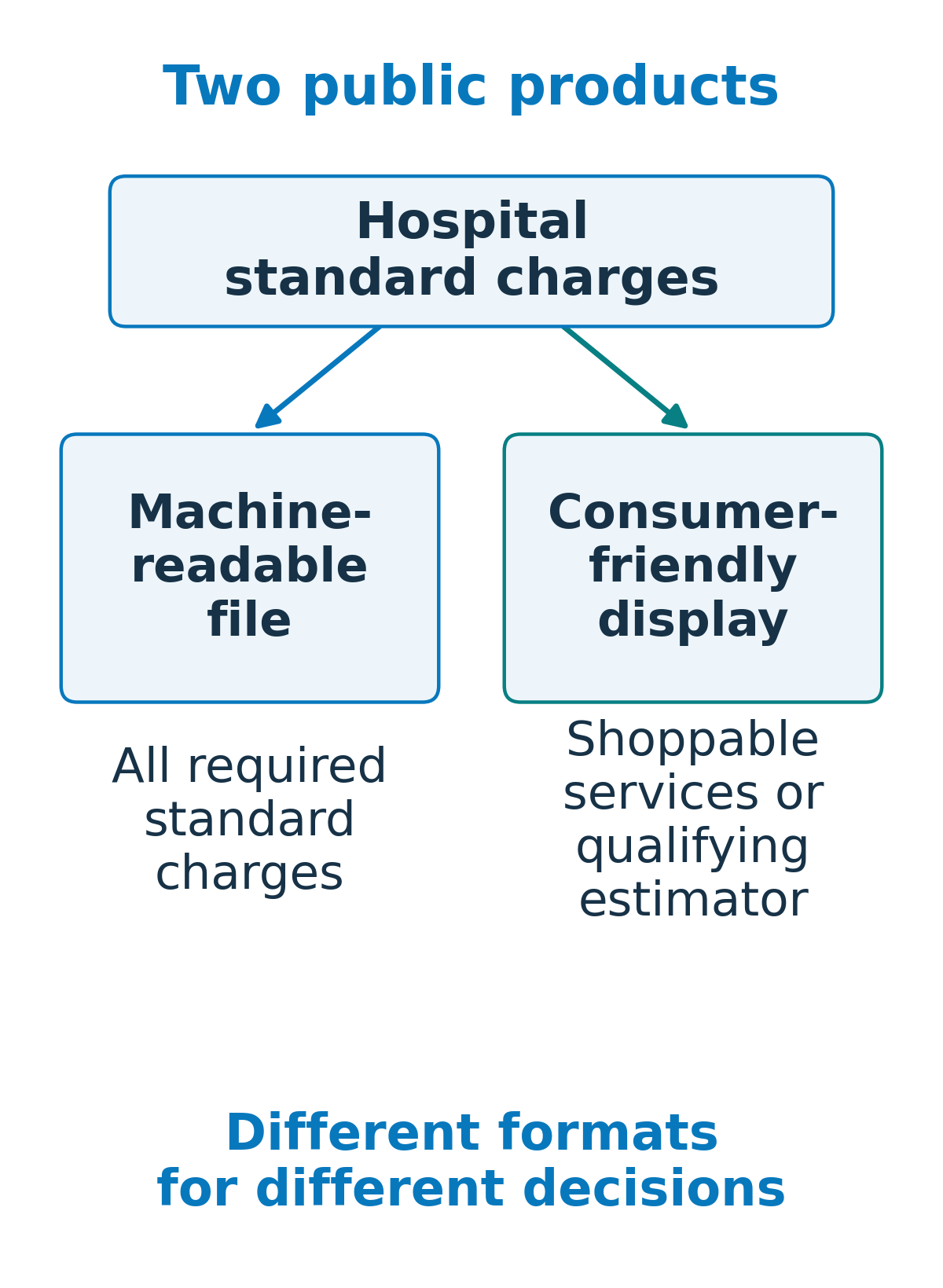
Hospital price-transparency duties remain in 45 CFR part 180. Hospitals must make required standard-charge information available in a machine-readable file and satisfy the separate consumer-friendly shoppable-services requirement. The 2026 changes took effect January 1, with enforcement of the new requirements beginning April 1. For payer-specific negotiated charges based on a percentage or algorithm, the rule requires dollar-denominated median, tenth-percentile, and ninetieth-percentile allowed amounts, together with the count of allowed amounts. The relevant distribution is not a distribution of gross charges or an estimate of individual patient liability. 1,2
The calculation uses the applicable historical allowed-amount data and a lookback period of no less than 12 and no more than 15 months. Electronic remittance advice transactions, or an equivalent source meeting the rule, support that calculation. Organizational Type 2 National Provider Identifiers and the required attestation add identity and accountability to the file. The attestation should be treated as a substantive review responsibility. A vendor’s assurance that a file uploaded successfully does not replace the hospital’s obligation to verify the information it publishes. 1,2
CMS can require corrective action and impose civil monetary penalties under the enforcement provisions. The 2026 rule also provides a conditional 35 percent penalty reduction when a hospital waives its right to an administrative-law-judge hearing, subject to specified exceptions. That mechanism should be evaluated on the actual notice and legal posture; it is not a reason to budget for noncompliance. 1,2
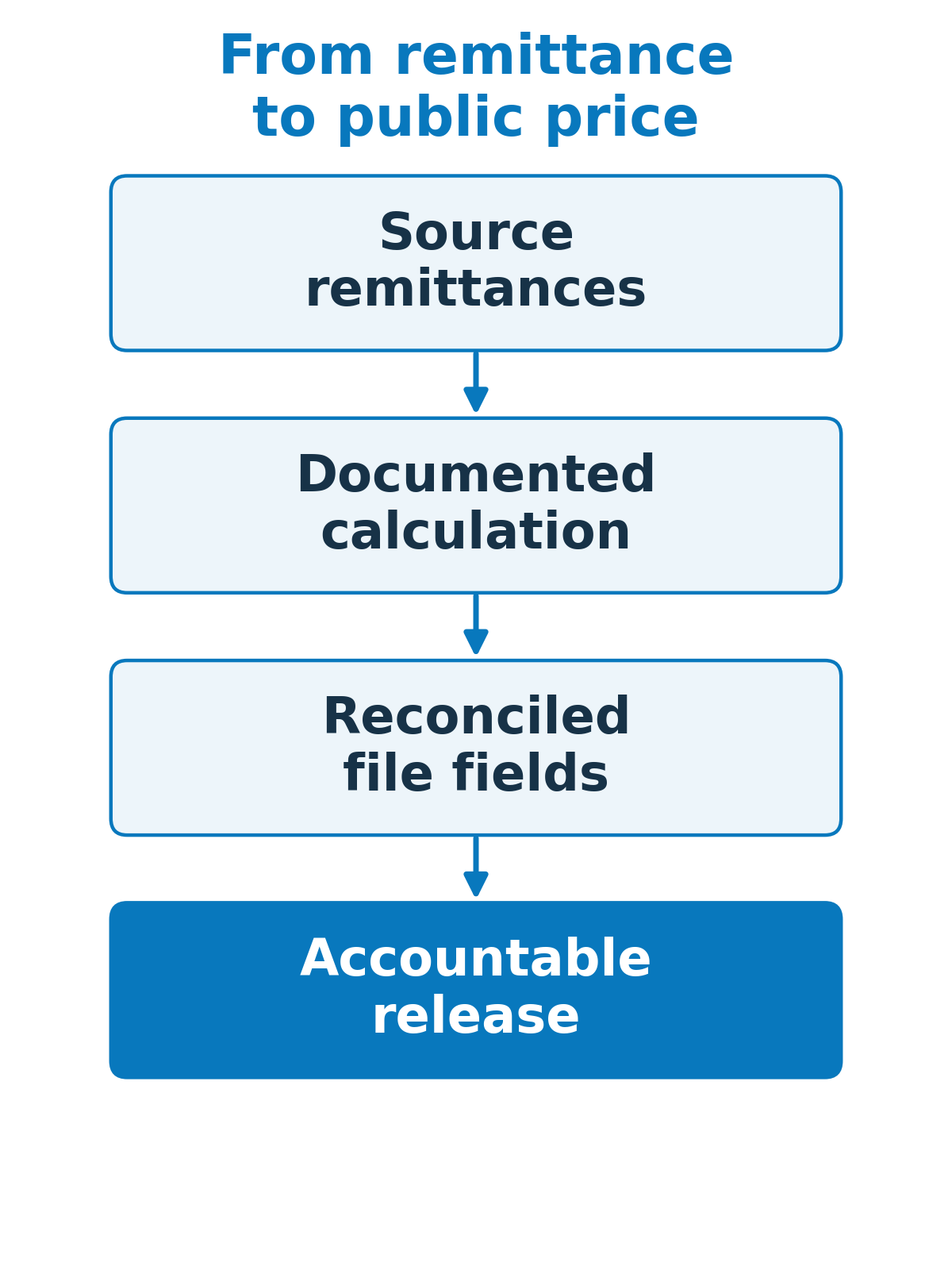
Design the release around one reproducible price
Start the acceptance test with a specific hospital, service, payer, plan, contract method, and period. Identify the source records that enter the calculation and the rules for exclusions, adjustments, reversals, and incomplete observations. Preserve the version of the extraction query and calculation logic. An independent reviewer should be able to reproduce the published result from that evidence without relying on the analyst who originally prepared it.
Reconcile the number at several levels. A file-level check confirms required fields and formatting. A service-level check confirms codes, descriptions, units, and care setting. A payer-level check confirms the contract method and plan labels. A distribution-level check confirms the population, count, and calculations. Finally, a public-access check confirms that the released file is the reviewed version and that a consumer can reach the shoppable-service information. These are recommended controls; no single test is a regulatory safe harbor.
Keep the consumer conversation distinct. A negotiated rate is not necessarily what a patient owes after deductibles, coinsurance, exclusions, coordination of benefits, or financial assistance. Patient financial services should explain which amount is being shown and what information is still needed. Escalate discrepancies between an online estimate and a telephone estimate with the service details preserved, so the organization can identify whether the cause is benefits, scope, timing, or an actual data defect.
Evidence and interpretation
A stronger disclosure rule still needs interpretable data
Recent studies show why a price file needs interpretation beyond its presence on a website. Koos and colleagues examined diagnosis-related-group contracts and found variation in how contracts define and price services. Mead and Ibrahim identified both overreporting and underreporting when comparing posted services with hospital activity. A 2026 Alabama audit examined practical access and barriers for spinal-surgery prices. These studies address different problems: contract definitions, correspondence with services, and usable access. Together they support testing whether an individual service, payer, and payment method can be followed through the file. They do not provide a common national compliance rate.4,24,25
Enforcement and adoption move together, with limits on causal interpretation
Kong and Ji found that hospital provision of price information increased after higher financial penalties took effect. Their national cohort and instrumental-variable analysis support an association between penalty exposure and disclosure, but cannot establish that penalties alone explain every improvement. Jiang and colleagues documented substantial early noncompliance and differences associated with hospital resources and market conditions. Nikpay and colleagues followed hospitals across the early implementation period, while Brant and colleagues documented later increases in disclosure. An earlier pulse survey and the Ji and Kong hospital-characteristics study add context about uneven implementation. The executive inference is to fund the recurring data work and monitor completion over time. None of these studies validates the new 2026 percentile calculations.3,5,9,12,16,26
Published does not mean reconcilable
Henderson and Mouslim compared insurer and hospital transparency records for maternity services in Mississippi. Limited overlap constrained comparisons even though many matched observations agreed. Thomas and colleagues compared online and telephone prices for childbirth and magnetic resonance imaging and found weak agreement. The two findings identify separate controls. First determine whether the same service and payer can be matched. Then evaluate whether matched values agree under a common definition. Reporting only the agreement among matched records can hide substantial missingness. A patient estimator also needs benefits and cost-sharing information that a negotiated hospital rate alone does not supply.7,27
Specialty audits expose operational friction
Audits in major orthopedic hospitals, pediatric orthopedics, Tennessee laboratory services, total joint arthroplasty, laparoscopic cholecystectomy, and head-and-neck radiotherapy repeatedly encountered incomplete, difficult-to-locate, or inconsistent price information. The studies by Kotlier, Belt, Hart, Burkhart, Green, Thompson, and Bhayana and their respective colleagues examine distinct service samples and policy periods. They support service-level testing rather than extrapolation of one specialty’s compliance percentage to the entire hospital. Radiotherapy technical charges, for example, should not be presented as the patient’s complete episode cost. An older audit conducted under a predecessor disclosure rule should not be scored as an evaluation of today’s requirements.6,8,10,17,21,22,23
A price is a payment concept before it is a comparison
Linde and Egede documented variation among chargemaster, cash, and negotiated prices for common procedures. Wang and colleagues found that insurer market power was associated with negotiated prices, with differences across service contexts. Xu and Polsky compared Medicare Advantage and traditional Medicare outpatient prices and found meaningful variation around traditional Medicare payment levels. D’Amore and colleagues did not establish that higher arthroplasty prices reliably signaled better clinical value. These findings argue for labeling the price type before comparing hospitals. A high gross charge, a negotiated rate, and a patient’s expected payment answer different questions; price rank alone is an inadequate quality measure.13,14,15,20
Transparency is a tool, not a demonstrated guarantee of lower spending
Chen and Miraldo’s systematic review found heterogeneous effects of price and quality transparency tools, with more favorable spending results for some laboratory and imaging uses than for all services. Han and colleagues examined all-payer claims databases and hospital costs, finding that transparency and competition did not translate into uniform cost reductions. Ward and colleagues’ North Carolina evaluation likewise did not establish a statistically significant general price decline. These findings support a measured objective: make information accurate, accessible, and useful, then evaluate its effect. A hospital should not promise that a compliant file will automatically lower total spending or eliminate differences in patient affordability.11,18,19
A public correction is a controlled release
When a defect is found, preserve the prior version and determine its reach. Was the problem limited to one field, one payer, an entire service family, or the method used throughout the file? Identify whether the consumer display, downloaded files, estimates, and communications used the same value. A corrected upload should carry an internal release record linking the issue, calculation, reviewer, publication time, and verification of the public result.
The control should also decide what follow-up is necessary for people who relied on the information. A price-file correction does not automatically establish a refund obligation, but it can reveal an inaccurate estimate or billing issue requiring review. Patient communication should explain the relevant change without suggesting that a published negotiated price was a guaranteed total bill. Legal and revenue-cycle staff should evaluate the actual transaction and applicable obligations.
Vendor contracts should identify access to source data, calculation documentation, correction timeframes, export formats, and continuity arrangements. The hospital should be able to maintain its disclosures when the vendor relationship changes. Security review should also confirm that public files contain the required price information without exposing patient identifiers from source remittances. The publication dataset and the clinical or payment evidence supporting it need different access controls.
What the board should ask to see
The board needs an exception report that separates missing information, calculation defects, and usability problems. Each category should have a denominator: required records, tested calculations, or sampled patient journeys. A single percentage labeled “compliant” can conceal a material unresolved error. Report the age of exceptions, the affected services and payers, the last successful independent reproduction, and who accepted any residual risk.
Measure usability with realistic tasks. Ask a reviewer to locate the price for a defined service, identify the price concept, and explain what the value does and does not include. Include people using mobile devices, assistive technology, and languages relevant to the service population. A successful download is one technical outcome. A correct explanation is a different outcome, and affordability requires still another measure.
For the first 30 days of a remediation effort, inventory the current requirements and reproduce a risk-based sample. During days 31–60, correct recurring extraction and interpretation problems and reconcile the consumer display. During days 61–90, retest the repaired pathway and present unresolved issues with owners and dates. This is a proposed local implementation agenda, not a federal timetable.
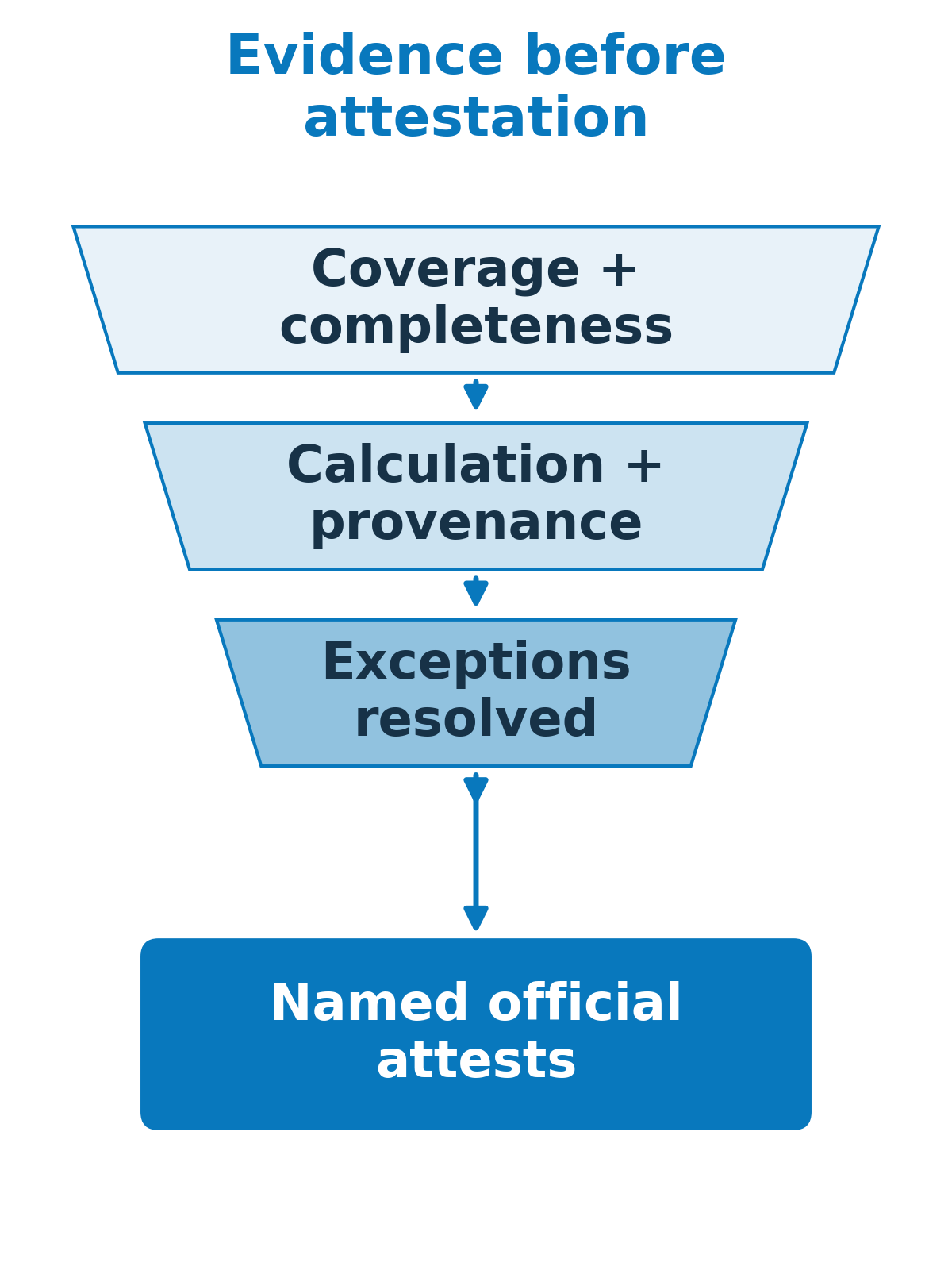
Build an operating model that survives a staff change
The following operating model is an executive recommendation, not an additional federal reporting requirement. Its purpose is to make the required publication dependable after a contract amendment, software release, vendor change, or departure of the analyst who built the file. A process that depends on one person’s memory is difficult to inspect and expensive to repair. A documented process should let a qualified replacement trace a selected public value without reconstructing the entire project.
Begin with a service inventory that connects the public representation to the hospital’s own organization. Record which locations, identifiers, service descriptions, billing codes, and charging arrangements belong in each release. Give every mapping a responsible owner. A mismatch between a public hospital name and a source-system entity should generate a reconciliation question, not an improvised translation during publication. The inventory also helps distinguish a legitimate difference between locations from an accidental duplication.
Separate preparation, review, and authorization even when a small team performs several roles. The preparer assembles the data and explains exceptions. The reviewer tests selected calculations and confirms that the specified source population was used. The authorizing official receives the results, unresolved limitations, and proposed release decision. These activities can occur in one meeting, but their outputs should remain distinguishable. A signature becomes more meaningful when the signer can see what was tested and what remains uncertain.
Vendor participation should fit into that structure. Ask the vendor to identify transformations, exclusions, rounding, and version changes that affect reported values. Keep sufficient local evidence to understand the deliverable. A vendor’s successful validation result may establish that a file meets a technical specification; it does not independently establish that the hospital supplied the right contracts or complete payment data. The hospital needs a way to investigate discrepancies without waiting for a vendor employee who alone understands the calculation.
Maintain a release register with the file version, preparation date, source periods, responsible people, validation results, and location of supporting material. Retain previous public versions according to the organization’s applicable retention practices. This register is a proposed management control, not a claim that every listed field is federally mandated. Its practical value appears when a patient, researcher, payer, or regulator asks which file was available on a particular date and why a value changed.
Make comparisons answer a defined question
A useful comparison starts with a decision. A patient considering a planned service needs a different answer from an employer studying negotiated rates or a hospital assessing contract performance. Combining those audiences into one unexplained ranking encourages readers to treat different payment concepts as interchangeable. The public file can support several analyses, but the analyst must specify the unit, payer arrangement, setting, and time period before interpreting a difference.
Consider an illustrative comparison of two imaging prices. One hospital’s entry may represent a facility component while another analyst’s dataset combines facility and professional services. The numbers may both be accurately transcribed, yet the comparison answers no coherent purchasing question. Before presenting a percentage difference, establish whether the codes, service setting, included components, and applicable contract terms are comparable. If they are not, describe the mismatch instead of converting it into a performance judgment.
The new distribution fields create another interpretation task. A median based on an applicable payment-data population is not a promise that the next patient will owe that amount. The distribution describes the specified historical observations under the reporting framework. Benefit design, remaining deductible, covered services, and the eventual episode can change patient responsibility. A clear explanation should distinguish the hospital’s disclosed payment information from a personalized estimate and from a final adjudicated bill.
Counts deserve attention alongside percentiles. A distribution drawn from relatively few observations may be less informative about future experience than a larger, stable population, even when both are reported correctly. Changes in case mix, contract design, or service delivery can also alter a distribution. The executive review should ask what changed in the underlying population before interpreting a movement as a successful negotiation or a pricing problem. These are analytical cautions, not invented minimum-volume exemptions from reporting.
Use a short interpretation note wherever the organization publishes its own derived comparisons. State the question, population, calculation, and limitations in ordinary language. Avoid a broad claim such as “lowest cost” when the analysis covers only one component or payer arrangement. If the hospital cannot make a fair comparison, a precise statement of the available information is more useful than a polished ranking that depends on unstated assumptions.
Test semantic accuracy as well as file structure
A practical assurance program uses several kinds of checks because each detects a different failure. Structural checks identify formatting and required-field problems. Reconciliation checks compare the release with source inventories and expected populations. Calculation checks reproduce selected values. Access checks confirm that an outside visitor can reach the intended file and consumer information. Interpretation checks ask whether a knowledgeable reader understands what a displayed value represents. Success in one category should not be reported as success in all five.
Choose review samples deliberately. Include high-volume services, complex contract arrangements, amended agreements, newly added locations, and entries affected by a recent correction. Include ordinary cases as well, so the review does not become exclusively a search for exotic problems. Document the sampling rationale and avoid implying that a judgmental sample provides a statistically valid estimate of the entire file’s error rate. Its initial purpose is to expose consequential failure modes and guide further investigation.
For one selected entry, have a reviewer begin with the public value and work backward. Can the reviewer locate the applicable source records, identify the period, understand exclusions, and reproduce the calculation? Then work forward from a source contract or service inventory to the public file. Does the expected entry exist, and does it retain the intended meaning? These two directions can reveal different defects: an unexplained published value and an omitted required representation.
Record exceptions at the level needed for action. “Data quality issue” is too broad to assign or close. A useful exception identifies the affected entries, suspected cause, evidence, owner, corrective action, and retest. Group related exceptions when a common transformation caused them, but preserve the ability to determine the affected population. Closure should depend on a successful retest or a documented resolution, not merely on the passage of a target date.
Report coverage honestly. If only selected contract types have been independently reproduced, say so. If a vendor performed the structural validation while hospital staff tested access and reconciliation, identify those responsibilities. A concise assurance statement can be candid about scope while still supporting a release decision. Unsupported statements that the file is “fully verified” create an expectation that the underlying work may not justify.
Connect the public release to the patient conversation
Publication and patient assistance should use compatible definitions. When a patient calls about an entry, the financial counselor needs a route to someone who can explain the service and payment concept. The counselor should not have to interpret a large machine-readable file unaided or promise a final liability from a negotiated-rate field. Provide a short internal guide explaining the information available, the limits of that information, and the next step for a personalized estimate.
Use an illustrative service journey to test the handoff. A patient finds a hospital price, asks whether it includes the clinician, and wants to know what insurance will cover. The exercise should reveal who confirms the intended service, who checks included components, who discusses benefits, and how uncertainties are documented. Evaluate whether the patient leaves with a usable next action. A technically accurate explanation that ends with several disconnected telephone numbers may still fail the practical purpose of transparency.
Complaints can function as a source of release defects. Tag a reported mismatch so analysts can distinguish an incorrect public entry, an estimate limitation, a changed clinical episode, a benefits issue, or a misunderstanding of the payment concept. These categories are proposed local workflow tools. They should support investigation without prematurely deciding that the patient is mistaken. Repeated confusion about the same field may justify a clearer explanation even when the underlying value is correct.
Close the loop with the person who raised the question when appropriate. Explain what was found, whether the public information changed, and which team can address any remaining billing issue. Do not imply that correcting a transparency file automatically resolves an individual account. The two processes may share evidence, but each needs its own accountable conclusion. This distinction protects both the integrity of the release and the quality of the patient response.
Use the first review cycle to choose the next investment
An initial improvement cycle can be organized around discovery, testing, and correction without presenting a local project calendar as a regulatory extension. First establish the inventory, owners, and current release evidence. Next reproduce selected values and test outside access. Then correct confirmed defects, retest, and bring unresolved resource decisions to leadership. Existing legal obligations continue throughout that work; an improvement plan does not suspend them.
The final review should connect findings to a specific investment. Repeated source omissions may require better interfaces or clearer ownership. Unreproducible calculations may require vendor documentation or analyst capacity. Recurrent patient confusion may require revised explanations and counselor training. Avoid treating every problem as a need for a new platform. A smaller change with a named owner and an observable outcome can be more useful than a broad technology purchase whose success criteria remain undefined.
Track the time needed to explain and correct a reported discrepancy, the proportion of selected values successfully reproduced, and the recurrence of previously closed defects. Define each denominator and distinguish internal measures from federal compliance determinations. Together, these measures show whether the organization is becoming more capable of maintaining a trustworthy release. They do not, by themselves, establish reduced prices, improved competition, or lower patient spending.
Preserve continuity during a vendor transition
A change of transparency vendor should include an explicit handover of definitions, source mappings, unresolved exceptions, and prior release evidence. Compare the outgoing and incoming outputs for selected entries before interpreting differences as improvements. A changed number may reflect a corrected error, a different source period, or a transformation that no longer preserves the intended meaning. Require an explanation for material differences and identify the person responsible for accepting the new result. The goal is continuity of accountability while the technology changes.
Plan how the public location and patient-assistance process will remain usable during the transition. Verify the links from the hospital website, the accessibility of the published material, and the internal contacts who answer questions. Keep the previous release evidence available through the organization’s approved retention arrangements. A vendor contract ending should not make the hospital unable to explain a number that was publicly available the week before. After the transition, review the first correction request as a test of the new operating model: can staff identify the source, reproduce the value, contact the right specialist, and publish an appropriate correction with a clear record of what changed?
Keep technical availability separate from practical discoverability. An analyst who knows the exact file address may retrieve it while an ordinary visitor cannot find the link from the hospital’s website. Test the route from the public home page and from the consumer information page, using the hospital’s intended navigation. Confirm that a changed filename or vendor location has not left an obsolete link in another part of the site. Record the actual destination and release version reached through each route. A successful internal download should not be generalized to every public entry point. When a problem is found, correct the affected links and retest the path a visitor would take. This modest access check complements the more demanding calculation review and helps ensure that the hospital’s investment in producing the file results in information that its intended audiences can actually locate and use.
Evidence boundaries and executive conclusion
This targeted narrative review uses verified bibliographic records and indexed abstracts, with primary legal sources checked through September 28, 2026. It is not a systematic search or full-text appraisal of every study. Studies differ in period, service, sample, price definition, and outcome; their estimates should not be pooled informally. Historical disclosure studies cannot establish the effect of a requirement that became enforceable in 2026.
The practical test is whether an accountable person can explain a published price, reproduce it, correct it, and help a patient understand its limits. That capability makes transparency a maintained operating responsibility. It also gives the hospital a defensible basis for evaluating whether better information is actually improving decisions and patient experience.
References
- 45 CFR part 180. Hospital price transparency. Accessed September 14, 2026. Official source.
- CMS. CY 2026 OPPS and ASC final rule: hospital price transparency policy changes. November 21, 2025. Accessed September 14, 2026. Official source.
- Kong E, Ji Y. Provision of Hospital Price Information After Increases in Financial Penalties for Failure to Comply With a US Federal Hospital Price Transparency Rule. JAMA network open [JAMA Netw Open] 2023 Jun 01; Vol. 6 (6), pp. e2320694. doi:10.1001/jamanetworkopen.2023.20694.
- Koos H, Scheinker D, Schulman K, Baker L. Who Contracts on Diagnosis Related Groups and How Are They Priced? Evidence From Hospital Price Transparency. Health Services Research. 2026;61(2):e70059. doi:10.1111/1475-6773.70059.
- Brant A, Lewicki P, Rhodes S, Zhu A, Shoag J. Trends in hospital price transparency after implementation of the CMS Final Rule. Health services research [Health Serv Res] 2024 Aug; Vol. 59 (4), pp. e14329. doi:10.1111/1475-6773.14329.
- Kotlier JL, Fathi A, Yazditabar JM, Ong MY, Valenzuela J, Yang A, Ahmad A, Freshman RD, Liu JN, Petrigliano FA. Most Major Hospitals Fail to Comply With Federal Price Transparency Regulations. Arthroscopy : the journal of arthroscopic & related surgery : official publication of the Arthroscopy Association of North America and the International Arthroscopy Association [Arthroscopy] 2025 Jan; Vol. 41 (1), pp. 119-127. doi:10.1016/j.arthro.2024.04.033.
- Henderson, Morgan A.; Mouslim, Morgane C. Cross-Validation of Insurer and Hospital Price Transparency Data. American Journal of Managed Care (AM J MANAGE CARE), Aug2024; 30(8): e247-e250. (11p) doi:10.37765/ajmc.2024.89594.
- Belt NG, Lee A, Moyal A, Burkhart R, Nedder V, Liu R. One-Tenth of the Top 50 Pediatric Orthopedic Hospitals Provide Compliant Price Transparency Information for 15 Common Pediatric Orthopedic Procedures. Cureus [Cureus] 2025 Mar 10; Vol. 17 (3), pp. e80355. doi:10.7759/cureus.80355.
- Nikpay, Sayeh; Carroll, Caitlin; Golberstein, Ezra; Abraham, Jean Marie. Playing by the Rules? Tracking U.S. Hospitals’ Responses to Federal Price Transparency Regulation. Journal of Healthcare Management (J HEALTHC MANAGE), Jan/Feb2024; 69(1): 45-58. (14p) doi:10.1097/JHM-D-23-00014.
- Hart SA, Khan A, Booth GS, Wiencek JR. Tennessee hospital noncompliance with price transparency legislation for 8 common laboratory tests. American journal of clinical pathology [Am J Clin Pathol] 2024 Nov 04; Vol. 162 (5), pp. 450-454. doi:10.1093/ajcp/aqae057.
- Han A, Lee KH, Park J. The impact of price transparency and competition on hospital costs: a research on all-payer claims databases. BMC health services research [BMC Health Serv Res] 2022 Nov 05; Vol. 22 (1), pp. 1321. doi:10.1186/s12913-022-08711-x.
- Jiang JX, Polsky D, Littlejohn J, Wang Y, Zare H, Bai G. Factors Associated with Compliance to the Hospital Price Transparency Final Rule: a National Landscape Study. Journal of general internal medicine [J Gen Intern Med] 2022 Nov; Vol. 37 (14), pp. 3577-3584. doi:10.1007/s11606-021-07237-y.
- Xu J, Polsky D. Comparing Medicare Advantage and Traditional Medicare Prices for Hospital Outpatient Services With Hospital Price Transparency Data. Medical care research and review : MCRR [Med Care Res Rev] 2023 Aug; Vol. 80 (4), pp. 455-461. doi:10.1177/10775587231153003.
- Linde, Sebastian; Egede, Leonard E. Hospital Price Transparency in the United States: An Examination of Chargemaster, Cash, and Negotiated, Price Variation for 14 Common Procedures. Medical Care (MED CARE), Oct2022; 60(10): 768-774. (7p) doi:10.1097/MLR.0000000000001761.
- Wang Y, Meiselbach MK, Xu J, Bai G, Anderson G. Do Insurers With Greater Market Power Negotiate Consistently Lower Prices for Hospital Care? Evidence From Hospital Price Transparency Data. Medical care research and review : MCRR [Med Care Res Rev] 2024 Feb; Vol. 81 (1), pp. 78-84. doi:10.1177/10775587231193475.
- Nikpay S, Golberstein E, Neprash HT, Carroll C, Abraham JM. Taking the Pulse of Hospitals’ Response to the New Price Transparency Rule. Medical care research and review : MCRR [Med Care Res Rev] 2022 Jun; Vol. 79 (3), pp. 428-434. doi:10.1177/10775587211024786.
- Burkhart RJ, Hecht CJ 2nd, Acuña AJ, Kamath AF. Less Than One-third of Hospitals Provide Compliant Price Transparency Information for Total Joint Arthroplasty Procedures. Clinical orthopaedics and related research [Clin Orthop Relat Res] 2022 Dec 01; Vol. 480 (12), pp. 2316-2326. doi:10.1097/CORR.0000000000002288.
- Ward C, Reeder T. The Evolution and Impact of Hospital Price Transparency in North Carolina. North Carolina medical journal [N C Med J] 2020 Mar-Apr; Vol. 81 (2), pp. 95-99. doi:10.18043/ncm.81.2.95.
- Chen J, Miraldo M. The impact of hospital price and quality transparency tools on healthcare spending: a systematic review. Health economics review [Health Econ Rev] 2022 Dec 14; Vol. 12 (1), pp. 62. doi:10.1186/s13561-022-00409-4.
- D’Amore, Taylor; Goh, Graham S.; Courtney, P. Maxwell; Klein, Gregg R. Do New Hospital Price Transparency Regulations Reflect Value in Arthroplasty? Journal of the American Academy of Orthopaedic Surgeons (J AM ACAD ORTHOP SURG), 4/15/2022; 30(8): e658-e663. (6p) doi:10.5435/JAAOS-D-21-00696.
- Green RL, Dunham P, Kling SM, Kuo LE. Not Clearing the Air: Hospital Price Transparency for a Laparoscopic Cholecystectomy. The Journal of surgical research [J Surg Res] 2022 Dec; Vol. 280, pp. 501-509. doi:10.1016/j.jss.2022.07.037.
- Thompson S, Lewis L, Takiar V. Hospital Price Transparency Rule Exposes Muddied Costs for Head and Neck Radiotherapy in One State. American journal of clinical oncology [Am J Clin Oncol] 2022 Jun 01; Vol. 45 (6), pp. 268-272. doi:10.1097/COC.0000000000000917.
- Bhayana, Kovid; Ghodasra, Jason H.; Sanghavi, Kavya K.; Aliu, Oluseyi; Giladi, Aviram M. Compliance and Variability of Hospital Price Transparency in Total Knee and Hip Arthroplasty in the United States. Journal of the American Academy of Orthopaedic Surgeons (J AM ACAD ORTHOP SURG), 6/15/2022; 30(12): e886-e893. (8p) doi:10.5435/JAAOS-D-21-00767.
- Mead M, Ibrahim AM. Over- and underreporting of prices: most hospitals are not compliant with the Hospital Price Transparency Rule. Health affairs scholar [Health Aff Sch] 2024 Aug 19; Vol. 2 (9), pp. qxae099. doi:10.1093/haschl/qxae099.
- Ogles C, Cooper C, Dyess G, Menger RP. Compliance and Barriers in Hospital Price Transparency: A Cross-Sectional Evaluation of Alabama Hospitals With Emphasis on Spinal Surgery. Cureus [Cureus] 2026 Feb 27; Vol. 18 (2), pp. e104406. doi:10.7759/cureus.104406.
- Ji Y, Kong E. US Hospital Characteristics Associated With Price Transparency Regulation Compliance. JAMA health forum [JAMA Health Forum] 2022 Jun 24; Vol. 3 (6), pp. e221702. doi:10.1001/jamahealthforum.2022.1702.
- Thomas M, Flaherty J, Wang J, Henderson M, Ho V, Cuban M, Cram P. Comparison of Hospital Online Price and Telephone Price for Shoppable Services. JAMA internal medicine [JAMA Intern Med] 2023 Nov 01; Vol. 183 (11), pp. 1214-1220. doi:10.1001/jamainternmed.2023.4753.