



Management Atlas · Law, Ethics & Governance
The Obstetrical Services Condition
2026 Organization, Staffing, Emergency Readiness, and Hospital Accountability, a Narrative Review
September 28, 2026 · 22-minute read
Narrative evidence review
Safe obstetrical care depends on the connection between people, equipment, escalation, and the receiving team. Governance makes those connections visible before an emergency tests them.
Full article narration
Executive synthesis
An obstetrical emergency tests the whole organization: recognition, clinical response, staffing, supplies, communication, and transfer. A current protocol can coexist with an unusable contact number or an unavailable resource. The executive responsibility is to make the pathway work on the actual shift, including in hospitals whose routine service model does not include planned births.
The federal requirements now distinguish emergency readiness, obstetrical-service organization, and later training and quality-improvement duties. Twenty-five peer-reviewed studies help explain how bundles, simulation, implementation support, and measurement can contribute to readiness. Their results also show why a completed training roster or a favorable average is insufficient evidence of safer care. The proposed framework tests the pathway, validates the outcome data, and closes identified defects.
Three dates, three different obligations
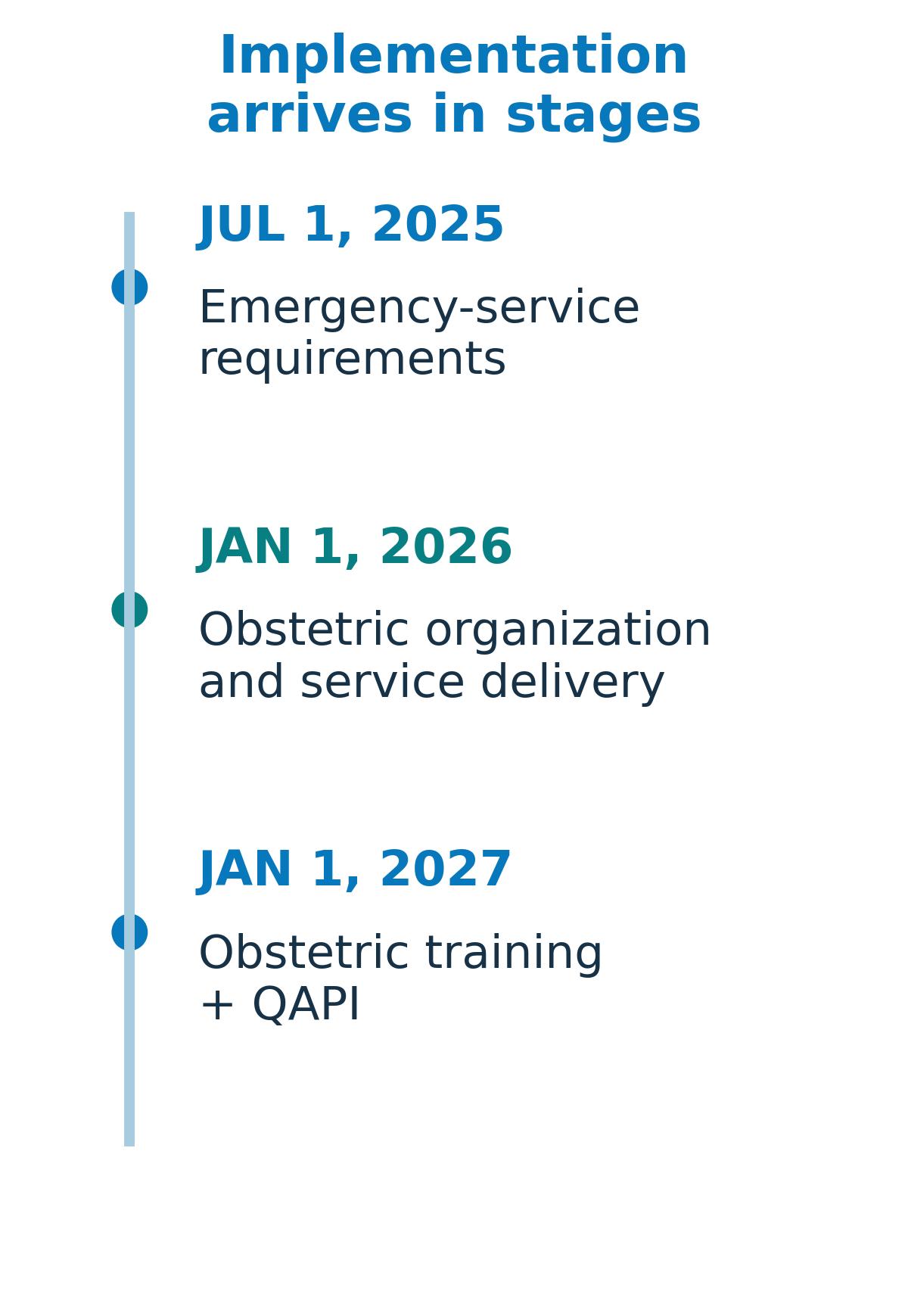
CMS’s emergency-services readiness provisions took effect July 1, 2025 and apply to hospitals and critical access hospitals within their scope, including those that do not provide routine obstetrical services. The March 27, 2026 survey guidance addresses protocols, provisions, and staff training for emergency care consistent with a facility’s services and patient population. The executive question is what the hospital can recognize, stabilize, and arrange safely within its actual capabilities. 3
For hospitals providing obstetrical services, 42 CFR 482.59 establishes organization, staffing, and delivery requirements effective January 1, 2026. These include appropriate supervision, personnel qualifications and competence, and necessary equipment and provisions. The rule should be translated into specific responsibilities for the service rather than a generic statement that maternity care is available. Coverage plans must identify who is responsible and how additional help is summoned. 1
The maternal-care staff-training provisions in section 482.59 and the obstetrical quality-assessment and performance-improvement provisions in section 482.21 have a January 1, 2027 implementation date. The latter include using data to examine outcomes and disparities, selecting measurable improvement work, and addressing relevant maternal mortality review committee recommendations. Preparation belongs on the current agenda, but those later requirements should not be described as already operative in September 2026. Existing emergency-readiness duties remain active. 1,2,3
Test the pathway across departments
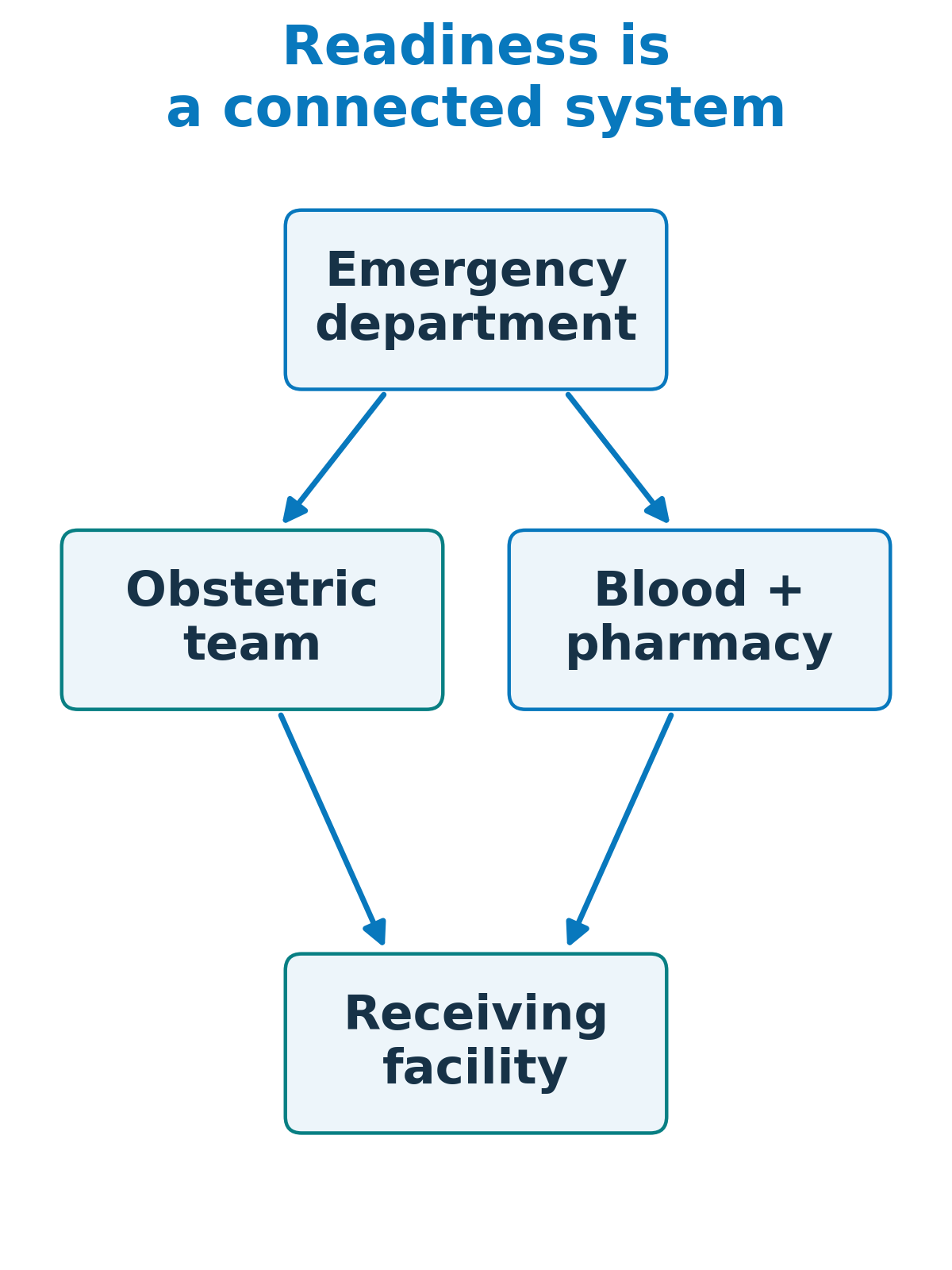
Use a scenario that requires more than recalling a protocol. The team should locate equipment, contact the responsible clinician, activate support, obtain necessary resources, and establish a receiving route when transfer is indicated. Record the time and the point of failure. A directory entry is not a confirmed handoff, and an on-call schedule is not evidence that a response is available under real conditions.
Low-volume hospitals need particular attention to skill maintenance and resource availability. Their readiness plan should match their capabilities while addressing emergencies that can still present at the door. A transfer arrangement should specify how to reach an accepting team, how to escalate a failed contact, what information accompanies the patient, and who remains responsible during the handoff. Clinical leaders determine the clinical content; executives provide the staffing, agreements, and infrastructure that make it usable.
Treat each exercise as a test of a defined system. Identify the intended observation, the staff and shift represented, the resources actually used, and any simulation substitutions. A successful daytime exercise with extra personnel should not be recorded as proof of overnight readiness. Retest material repairs in the setting where the gap was found. The proposed standard is demonstrated correction, not an exercise count.
What the clinical and implementation evidence supports
Bundles can improve outcomes, but results depend on implementation
Main and colleagues’ California collaborative reported a larger reduction in severe hemorrhage-related maternal morbidity among participating hospitals than among comparison hospitals. Early New York implementation and a single academic-center postpartum-hemorrhage initiative did not show an immediate morbidity reduction. A later New York statewide evaluation found improvements after a longer implementation period, followed by a less uniform later pattern. These results are compatible with a system that needs time, resources, and sustained practice. They do not justify treating a signed bundle policy as proof of safer care, or attributing every temporal change to the bundle without considering patient mix and concurrent work.28,10,13,16
Randomized evidence supports a specific hemorrhage intervention
The E-MOTIVE cluster-randomized trial evaluated early detection and a bundled response to postpartum hemorrhage in 80 hospitals in Kenya, Nigeria, South Africa, and Tanzania. The composite of severe bleeding, laparotomy for bleeding, or death from bleeding occurred less often in the intervention group. This is stronger evidence for the tested intervention than a simple before-and-after comparison. Its setting, vaginal-birth population, implementation support, and composite outcome still matter. It informs the importance of recognition and a coordinated response; it does not establish that every element of a United States participation requirement independently improves outcomes.11
Hypertension pathways need time measures and patient outcomes
An Illinois statewide initiative reported improvement in timely treatment of severe hypertension alongside lower severe maternal morbidity. Urban-hospital studies also associated timely treatment with better maternal outcomes. A Canadian improvement project increased appropriate antihypertensive treatment, while not every measured timing change was statistically significant. A 2026 New York statewide analysis described improvement followed by later increases in adverse outcomes. The combined management lesson is to monitor recognition, escalation, treatment timeliness, and outcomes together. A favorable process measure does not settle whether the population benefited, and deteriorating outcomes require renewed investigation even when an earlier initiative was successful.17,19,20,15,23
Training outcomes and patient outcomes must be reported separately
The randomized Obstetric Life Support education study improved clinician knowledge and skills relevant to maternal cardiac arrest. A randomized simulation study of obstetric emergency checklists examined team performance under controlled scenarios. Rural Texas simulation work found improvements in clinicians’ reported knowledge and confidence. By contrast, a stepped-wedge trial of mono-professional simulation training in Uganda did not demonstrate a reduction in its mortality outcome. These studies answer different questions. A hospital can reasonably use simulation to test competence and expose failure points, while continuing to measure actual clinical outcomes rather than claiming that attendance or confidence demonstrates mortality benefit.4,5,6,7
Readiness is constrained by the organization around the team
A health-system gap analysis found weaknesses in hemorrhage protocols, including challenges in lower-volume units. Oklahoma and Texas assessments documented variation in teamwork, communication, and quality-improvement activities. The Arkansas evaluation found that readiness elements were more widely implemented than reporting and learning elements, with staffing related to implementation. These findings support a readiness review that examines the resources behind the protocol: the personnel available on a particular shift, access to blood and equipment, escalation contacts, and the ability to learn from events. Self-reported readiness should be checked against observed performance and records.8,14,18
Equity measurement must survive the move from clinical record to dashboard
Quality-improvement analyses of racial disparities, including hemorrhage collaboratives, show the value of stratifying outcomes rather than relying on an overall average. Language-based research raises additional questions about transfusion patterns and access to communication. However, a study comparing billing data with electronic clinical records found that transfusion coding missed some clinically documented events and varied across hospitals. A 2026 analysis of maternal levels of care also illustrates the importance of referral patterns and patient acuity when comparing facilities. Leaders should combine stratification with case review and data validation. Neither a lower coded event rate nor loss of statistical significance proves that inequity has been eliminated.9,12,22,24,21
Simulation can test the system before a real emergency
A randomized comparison of in-situ and off-site obstetric anesthesia training found similar individual and team outcomes, while in-situ work generated more organizational improvement suggestions. Simulation used before opening an obstetrics unit exposed problems involving equipment, staffing, orders, and transfusion processes. Teleobstetric implementation work used simulation to test consultation arrangements in rural and community hospitals. These studies support rehearsing a pathway where it will operate. Their practical value is the defect discovered and corrected, not the location of the exercise itself. Teleconsultation comfort and intended use also should not be represented as demonstrated improvement in maternal outcomes.25,26,27
Measure the sequence before judging the result
Build measures around recognition, escalation, response, and outcome. For a time measure, define the starting event, stopping event, eligible population, exclusions, and source of each timestamp. Missing timestamps are a data-quality finding, not evidence that care occurred on time. Review cases that fall outside the expected pathway, including those with transfer, limited records, or an atypical presentation.
Validate severe maternal morbidity measures against clinical records before using them for strong comparisons. Changes in documentation, transfusion coding, referral patterns, or patient acuity can change the reported rate. Show denominators and uncertainty for smaller groups. When outcomes are stratified by race, ethnicity, language, geography, payer, or another locally relevant characteristic, involve people who can interpret the care context and assess whether the classification is reliable.
Do not close an equity concern because a comparison no longer reaches statistical significance. Small numbers can reduce statistical power. Examine the direction and magnitude of differences, process failures, patient accounts, and access to timely escalation. When a difference is identified, assign an intervention with a plausible mechanism and assess whether it reaches the affected group.
An executive review that produces a resource decision
The governing review should connect each material gap to a decision about staffing, training time, equipment, blood access, consultation, transfer, or data quality. A clinical committee can identify a need without having authority to fund it. The escalation record should make that boundary visible and state who can resolve the resource question.
In an initial 90-day improvement cycle, inventory the relevant requirements and compare them with observed capability. Select a small number of high-consequence scenarios for testing across shifts. Correct failed contact routes and unavailable resources first, then evaluate whether training addresses the remaining performance gaps. Report both the improvement achieved and the capability the hospital still cannot reliably provide. This cycle is a management proposal and does not replace required clinical policies or regulatory deadlines.
The board should receive unresolved readiness defects, their age, the population potentially affected, and the date of the last successful retest. It should also see patient outcomes and the limitations of the underlying data. A count of completed policies or modules can support that report, but should not be its central evidence.
Translate readiness into a shift-level responsibility
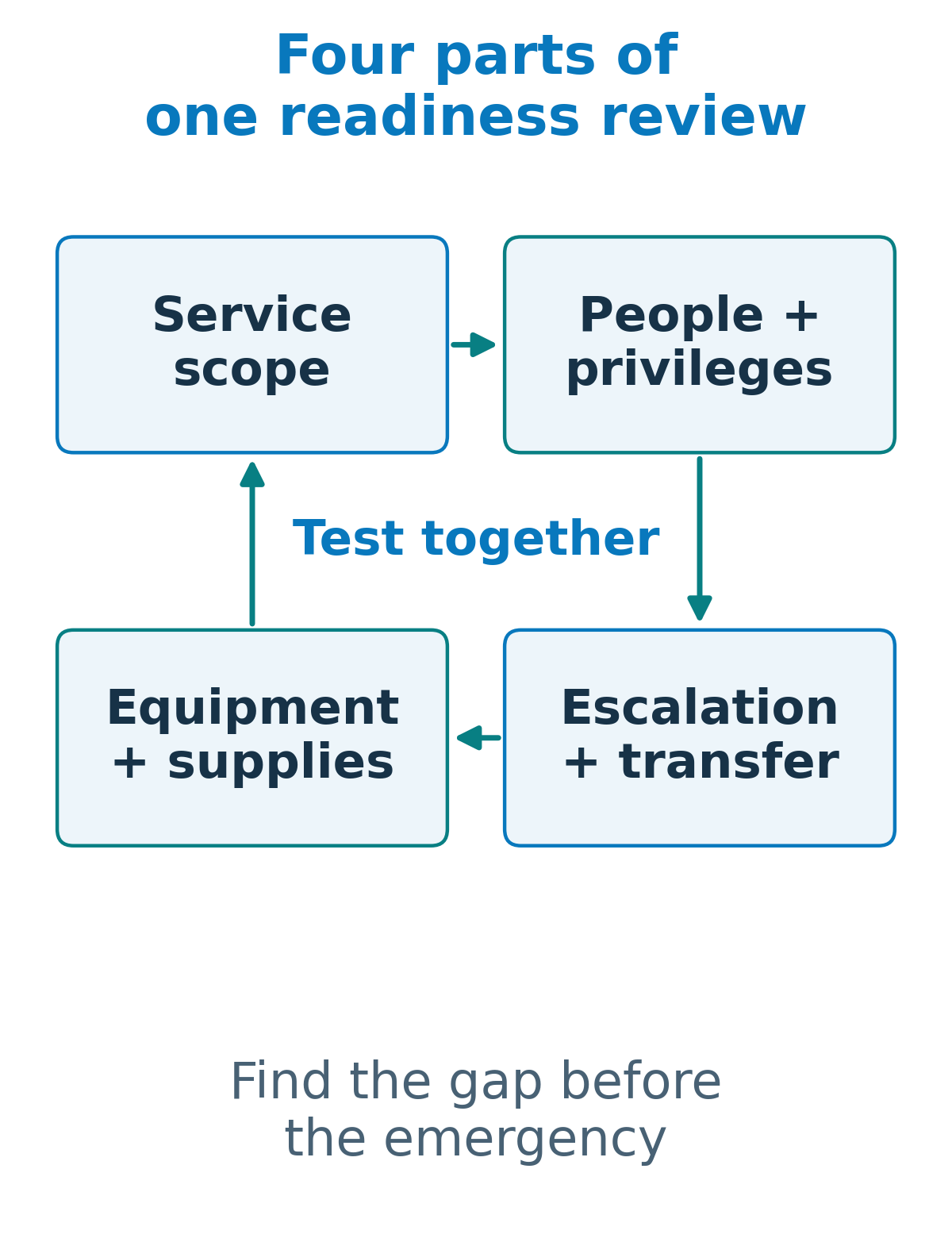
The following operating recommendations translate the legal and research discussion into management questions. They do not prescribe treatment or add federal staffing ratios. Clinical leaders must determine the appropriate response under applicable standards and local capabilities. The executive contribution is to make responsibilities, resources, and escalation routes explicit enough that a team can use them under pressure.
Start by asking what is available on the least-resourced shift. A committee roster describes governance; a shift roster describes the people who can respond. Identify who leads the initial response, who activates additional help, who coordinates transfer when indicated, and who communicates with the patient and support person. Clarify how responsibilities change when the first clinician is occupied with another emergency. The plan should describe a workable sequence rather than assume simultaneous availability of everyone named in a policy.
Map dependencies outside the obstetrical unit. Emergency medicine, anesthesia, the laboratory, blood bank, pharmacy, imaging, transport, environmental services, and registration may all affect the pathway. Their involvement should follow the hospital’s actual services and clinical plan. A resource listed in a protocol may have a different availability window from the team requesting it. Readiness review should expose that difference before a time-sensitive event turns it into a negotiation between departments.
Make escalation authority understandable. If the expected resource is unavailable, staff should know who can authorize an alternative, activate an additional team, or resolve competing demands. This is particularly important when a pathway crosses organizational boundaries. An agreement with another institution should be tested against the current contact process and actual acceptance workflow. Possessing a signed agreement is useful evidence of planning, but it does not prove that a telephone number works or that staff understand the next step.
Include temporary and rotating personnel in the operating picture. A locum clinician, traveler, or newly reassigned staff member may understand the clinical emergency while being unfamiliar with local activation procedures. A short orientation to emergency contacts, equipment locations, communication conventions, and escalation routes can address that organizational gap. Record what was provided and test comprehension through an appropriate demonstration rather than treating receipt of a document as proof of readiness.
Design a simulation to reveal system defects
A useful simulation starts with a specific question. Can the team locate the necessary equipment? Does an urgent request reach the correct responder? Can a transfer be coordinated when the usual contact is unavailable? A scenario that attempts to test every clinical skill and every organizational process at once may produce an impressive event but an unclear improvement plan. Select a manageable set of objectives and specify the observations that will answer them.
Use the real environment when appropriate and safe. A tabletop discussion can test role clarity and decisions; an in-situ exercise can reveal a locked cabinet, an inaudible page, or incompatible equipment. The choice should match the question and the resources available. Clearly identify simulated communications so an exercise does not create confusion for actual patients or emergency services. Protect clinical operations through a locally approved exercise plan.
Observers should record sequence and context, not simply assign a pass or fail. Note when a need was recognized, when help was requested, what information accompanied the request, and what happened next. Distinguish a knowledge gap from an unavailable resource or unclear responsibility. A delayed response caused by an incorrect contact list calls for a different remedy from a delay caused by uncertainty about whom to call.
Debrief with psychological safety and operational precision. Ask participants what information they had at each decision point and which constraints shaped their actions. Avoid reconstructing the event as if everyone knew the eventual outcome. At the same time, do not allow a supportive discussion to end without accountable corrections. Each material defect needs an owner, an action, and a way to establish that the action worked.
Retest the changed process. If the exercise revealed a communication failure, a revised policy alone is incomplete evidence of correction. Repeat the relevant activation step and observe whether the message reaches the intended person. If equipment access failed, verify access on another shift. The retest can be narrower than the original exercise. Its purpose is to establish that the specific defect was repaired, not to stage a second elaborate event.
Build measures that can support a fair conclusion
A maternal quality dashboard should distinguish readiness, care processes, outcomes, and patient experience. Training completion is a readiness measure. Performance of a defined response step is a process measure. A maternal complication is an outcome. The patient’s account of communication is a different source of information. Placing these measures together can support interpretation, but none should be relabeled as another merely because leaders prefer a single overall score.
Specify the population before calculating a rate. Does a measure cover all deliveries, patients meeting a defined clinical criterion, transfers, or emergency presentations? Where do patients who arrive after giving birth elsewhere belong? How are duplicate encounters and missing data handled? These questions should be settled through a documented definition with clinical and data expertise. Otherwise, a change in extraction logic can appear to be a change in safety.
Examine the data pathway from the clinical record to the dashboard. Select a small group of records and verify that the relevant events, timestamps, and outcomes were represented correctly. Pay attention to whether a timestamp records an order, administration, documentation, or another event. These are not automatically interchangeable. Validation is especially important when a measure is used to judge a time-sensitive process or compare units with different documentation practices.
Interpret small numbers cautiously. A hospital with few births or infrequent severe events can experience large percentage changes from a small number of cases. Report counts and denominators alongside rates, use appropriate analytic support, and avoid declaring improvement from one favorable interval. Case review can still reveal actionable defects when the quantitative trend is uncertain. Statistical uncertainty is a reason to describe the evidence accurately, not a reason to ignore an individual patient’s experience.
For subgroup review, examine missingness and classification as well as outcomes. Differences by race, ethnicity, language, insurance, geography, or other locally relevant characteristics may warrant investigation, but a dashboard cannot explain their causes by itself. Assess access, communication, referral patterns, clinical factors, and process reliability with the affected communities and clinical teams. Avoid presenting a demographic category as the mechanism of harm or implying that an unadjusted comparison establishes discrimination in a particular case.
Treat transfer as a continuing care process
For hospitals that transfer patients, readiness includes the period before departure and the handoff to the receiving team. The sending organization needs a clear clinical and operational plan for recognition, stabilization within its capabilities, consultation, acceptance, transport coordination, and information transfer. These recommendations must be applied alongside the hospital’s existing emergency-care obligations and clinician judgment. They do not create a substitute pathway for required emergency evaluation and care.
An illustrative exercise can begin with a patient whose needs exceed local capabilities while transport availability is uncertain. Ask which clinician maintains responsibility, who updates the receiving team, how changes in condition are communicated, and how the transport plan is reassessed. The executive objective is to reveal coordination gaps. The exercise should not impose a universal clinical timetable or assume that the fastest transport option is appropriate for every patient.
The handoff should support continuity rather than merely document departure. Confirm what information the receiving clinicians need, how it will reach them, and how critical updates will be communicated if the record transfer is delayed. A complete chart sent through an unfamiliar channel may be less useful in the moment than a clear clinician-to-clinician exchange supported by the relevant documentation. Test the reliability of both the verbal and electronic components.
Include the patient and support person in communication to the extent appropriate to the situation. Explain what is happening, why another level of care is needed, and how the team will maintain continuity. Consider language access, disability-related communication needs, and the practical consequences of separation from family. These concerns should not be postponed automatically until after transport; they may shape whether the patient understands and can participate in the plan.
Review the completed transfer with the receiving organization when feasible. Determine whether the initial information was adequate, whether delays had identifiable causes, and whether responsibilities were understood. Separate issues within the hospital’s control from regional capacity constraints, then decide which require local correction and which require a broader partnership. Repeatedly labeling a problem “external” without an escalation strategy leaves the same vulnerability in place.
Turn the review into an accountable resource decision
An executive meeting should end with a decision that matches the evidence. If a response fails because equipment is unavailable, another training module may not solve it. If equipment is present but staff cannot locate it, purchasing more equipment may not solve that problem either. Present the observed failure, its likely mechanism, the proposed correction, and the evidence that would demonstrate success.
Prioritize material gaps without hiding the remainder. A working register can identify immediate corrective actions, changes requiring budget or partnership approval, and issues needing further investigation. Explain the interim arrangements for unresolved risks. Those arrangements require clinical and operational approval; they should not be improvised by the dashboard team. Leadership should know which capabilities are dependable today and which remain contingent on an uncertain resource.
Connect the review to the phased federal requirements without collapsing the dates. Current obligations require current performance. Preparation for later training and QAPI duties should build on the same evidence, including documented responsibilities and measurable improvement work, while preserving the specific applicability of each provision. A forward-looking project plan is useful only if it also identifies what the organization must already be doing.
Finally, report back to the teams that identified the defects. Staff are more likely to provide useful operational information when they can see that an issue was investigated and a decision followed. A concise report can state what changed, what remains unresolved, and when the result will be reassessed. The test of governance is whether it improves the conditions under which care is delivered, not simply whether the committee met.
Plan for turnover and service changes
Readiness is not fixed when a policy is approved. Staffing turnover, a changed call arrangement, new equipment, or a revised regional transfer relationship can alter the response pathway. Assign responsibility for identifying these changes and determining whether orientation, contact lists, exercises, or resource plans need revision. A small change can have a large operational effect when it removes the person or connection on which an emergency process quietly depended.
Use a focused review after a material service change. Ask what capability was added or removed, which departments now depend on a different resource, and what evidence supports the revised plan. Include night and weekend operations rather than testing only during a well-staffed planning meeting. Communicate the result to affected teams and retire obsolete instructions through the hospital’s document-control process. Staff should not have to choose between two apparently current contact lists during an emergency. A maintained pathway has a named owner who can explain the current arrangement, demonstrate that it works, and identify the next review trigger. That responsibility connects policy governance to the practical conditions of care without turning every minor administrative change into an unnecessary hospital-wide exercise.
Include the patient’s account in the learning process when appropriate. A chart can document clinical actions while missing whether the person understood an urgent transfer, knew who was leading the response, or felt able to raise a concern. Use the hospital’s established patient-experience and quality processes to obtain and evaluate that information respectfully. Participation should not require the patient to become the investigator of their own care. Combine the account with other evidence and distinguish an identified communication problem from conclusions that require further clinical review. When the organization changes a process in response, explain the change through an appropriate channel. Patient input can reveal defects in coordination that a technically focused exercise overlooks, but it should not be treated as a substitute for clinical outcome review or as proof of causation. Its value is the additional perspective it brings to understanding how the pathway actually worked.
Evidence boundaries and executive conclusion
This targeted narrative review uses verified bibliographic records and indexed abstracts, alongside current federal sources checked through September 28, 2026. It is not a systematic review or a full-text appraisal of every included study. Many studies are observational, and several assess simulation performance, confidence, or implementation rather than patient outcomes. International evidence requires careful adaptation to local staffing, resources, and clinical practice.
The operational goal is a pathway that works when the hospital needs it. Demonstrate the response, examine the outcome, and repair the gap. Maintaining those connections is more informative than declaring readiness from the existence of a bundle, a policy, or a training record.
References
- 42 CFR 482.59. Condition of participation: obstetrical services. Accessed September 14, 2026. Official source.
- 42 CFR 482.21. Quality assessment and performance improvement. Accessed September 14, 2026. Official source.
- CMS. QSO-26-07-Hospitals/CAHs. Emergency services readiness. March 27, 2026. Accessed September 14, 2026. Official source.
- van Tetering AAC, de Vries EL, Ntuyo P, van den Heuvel ER, Fransen AF, van der Hout-van der Jagt MB, Namagembe I, Byamugisha J, Oei SG. Mono-Professional Simulation-Based Obstetric Training in a Low-Resource Setting: stepped-Wedge Cluster Randomized Trial JMIR medical education 2025 11, e54911 (e54911) doi:10.2196/54911.
- Bajaj K, Rivera-Chiauzzi EY, Lee C, Shepard C, Bernstein PS, Moore-Murray T, Smith H, Nathan L, Walker K, Chazotte C, Goffman D. Validating Obstetric Emergency Checklists using Simulation: a Randomized Controlled Trial American journal of perinatology 2016 33 12, 1182 (1182-1190) doi:10.1055/s-0036-1586118.
- Shields AD, Vidosh J, Minard C, Thomson B, Annis-Brayne K, Murphy M, Kavanagh L, Roth CK, Lutgendorf MA, Birsner ML, Rahm SJ, Becker LR, Mosesso V, Schaeffer B, Streitz M, Bhalala U, Gresens A, Phelps J, Sutton B, Wagner R, Melvin LM, Zacherl K, Karwoski L, Behme J, Hoeger A, Nielsen PE. Obstetric Life Support Education for Maternal Cardiac Arrest: a Randomized Clinical Trial JAMA network open 2024 7 11, e2445295 (e2445295) doi:10.1001/jamanetworkopen.2024.45295.
- Keel, Brooke; Sundin, Courtney. Maternity Care Simulation in Rural Texas to Improve Clinician Knowledge and Skills. MCN: The American Journal of Maternal Child Nursing (MCN), Nov/Dec2025; 50(6): 357-361. (5p) doi:10.1097/NMC.0000000000001146.
- Hacker, Francis M.; Linkov, Faina; Serra, Allison E.; Petticord, Vivian; Zabielski, Mary T.; Simhan, Hyagriv N.; Sakamoto, Sara B. Lessons Learned From a Gap Analysis of Obstetric Hemorrhage Protocols across a Health System. Maternal & Child Health Journal (MATERN CHILD HEALTH J), Jan2021; 25(1): 59-65. (7p) doi:10.1007/s10995-020-03050-x.
- Davidson, Christina; Denning, Stacie; Thorp, Kristin; Tyer-Viola, Lynda; Belfort, Michael; Sangi-Haghpeykar, Haleh; Gandhi, Manisha. Examining the effect of quality improvement initiatives on decreasing racial disparities in maternal morbidity. BMJ Quality & Safety (BMJ QUAL SAF), Sep2022; 31(9): 670-678. (9p) doi:10.1136/bmjqs-2021-014225.
- Goffman D, Ananth CV, Fleischer A, D’Alton M, Lavery JA, Smiley R, Zielinski K, Chazotte C; Safe Motherhood Initiative Obstetric Hemorrhage Work Group. The New York State Safe Motherhood Initiative: Early Impact of Obstetric Hemorrhage Bundle Implementation. American Journal of Perinatology (AM J PERINATOL), 2019; 36(13): 1344-1350. (7p) doi:10.1055/s-0038-1676976.
- Gallos I, Devall A, Martin J, Middleton L, Beeson L, Galadanci H, Alwy Al-Beity F, Qureshi Z, Hofmeyr GJ, Moran N, Fawcus S, Sheikh L, Gwako G, Osoti A, Aswat A, Mammoliti KM, Sindhu KN, Podesek M, Horne I, Timms R, Yunas I, Okore J, Singata-Madliki M, Arends E, Wakili AA, Mwampashi A, Nausheen S, Muhammad S, Latthe P, Evans C, Akter S, Forbes G, Lissauer D, Meher S, Weeks A, Shennan A, Ammerdorffer A, Williams E, Roberts T, Widmer M, Oladapo OT, Lorencatto F, Bohren MA, Miller S, Althabe F, Gülmezoglu M, Smith JM, Hemming K, Coomarasamy A. Randomized Trial of Early Detection and Treatment of Postpartum Hemorrhage New England journal of medicine 2023 389 1, 11 (11-21) doi:10.1056/NEJMoa2303966.
- Main, Elliott K.; Chang, Shen-Chih; Dhurjati, Ravi; Cape, Valerie; Profit, Jochen; Gould, Jeffrey B. Reduction in racial disparities in severe maternal morbidity from hemorrhage in a large-scale quality improvement collaborative. American Journal of Obstetrics & Gynecology (AM J OBSTET GYNECOL), Jul2020; 223(1): 123.e1-123.e14. (1p) doi:10.1016/j.ajog.2020.01.026.
- Hamm RF, Wang E, O’Rourke K, Romanos A, Srinivas SK. Institution of a Comprehensive Postpartum Hemorrhage Bundle at a Large Academic Center does not Immediately Reduce Maternal Morbidity. American Journal of Perinatology (AM J PERINATOL), 2019; 36(1): 15-21. (7p) doi:10.1055/s-0038-1629910.
- Stierman, Elizabeth K.; O’Brien, Barbara T.; Stagg, Julie; Ouk, Elizabeth; Alon, Natanya; Engineer, Lilly D.; Fabiyi, Camille A.; Liu, Tasnuva M.; Chew, Emily; Benishek, Lauren E.; Harding, Brenda; Terhorst II, Raymond G.; Latif, Asad; Berenholtz, Sean M.; Mistry, Kamila B.; Creanga, Andreea A. Statewide Perinatal Quality Improvement, Teamwork, and Communication Activities in Oklahoma and Texas. Quality Management in Health Care (QUAL MANAGE HEALTH CARE), Jul-Sep2023; 32(3): 177-188. (12p) doi:10.1097/QMH.0000000000000407.
- Vuncannon DM, Platner MH, Boulet SL. Timely treatment of severe hypertension and risk of severe maternal morbidity at an urban hospital. American journal of obstetrics & gynecology MFM [Am J Obstet Gynecol MFM] 2023 Feb; Vol. 5 (2), pp. 100809. doi:10.1016/j.ajogmf.2022.100809.
- Winter EE, Wen T, Goffman D, D’Alton ME, Simpson LL, Andrikopoulou M, Friedman AM. Maternal Outcomes Associated With a Statewide Obstetric Hemorrhage Quality-Improvement Initiative. Obstetrics and gynecology [Obstet Gynecol] 2026 Aug 01; Vol. 148 (2), pp. 217-228. doi:10.1097/AOG.0000000000006320.
- Borders A, Keenan-Devlin L, Oh EH, Young D, Grobman W, Lee King P. Reducing severe maternal morbidity for birthing persons with severe hypertension through a statewide quality improvement initiative. American journal of obstetrics and gynecology [Am J Obstet Gynecol] 2025 Jan; Vol. 232 (1), pp. 128.e1-128.e9. doi:10.1016/j.ajog.2024.04.026.
- Peng C, Acharya M, Khattab B, Callaghan-Koru JA, Brown D, Perkins R, Eswaran H. Evaluating the implementation of maternal safety bundles for obstetric hemorrhage and severe hypertension during pregnancy in Arkansas. BMC pregnancy and childbirth [BMC Pregnancy Childbirth] 2025 Jul 28; Vol. 25 (1), pp. 793. doi:10.1186/s12884-025-07896-3.
- Grayson H, Friedman AM, Simpson L, Goffman D, D’Alton M, Andrikopoulou M, Wen T. Maternal Outcomes Associated with a Statewide Severe Hypertension Obstetric Quality Improvement Initiative. American journal of perinatology [Am J Perinatol] 2026 Jun 17. doi:10.1055/a-2891-3037.
- Trahan MJ, Plourde M, Clouatre A, Wou K, Pavilanis A, Fortune RL, Haas S, Pepin J, Kapellas S, Morency AM, Aucoin G, Flannery A, Monast PO, Hassan N, Koolian M, Oudanonh T, Almeida N, Suarthana E, Daskalopoulou SS, Malhamé I. A quality improvement intervention to optimize the management of severe hypertension during pregnancy and postpartum. Pregnancy hypertension [Pregnancy Hypertens] 2025 Mar; Vol. 39, pp. 101192. doi:10.1016/j.preghy.2025.101192.
- Handley SC, Passarella M, Radack J, Amuzie O, Hsu JY, Srinivas SK, Phibbs CS, Lorch SA. Maternal levels of care and association with severe maternal morbidity during birth hospitalizations. PloS one [PLoS One] 2026 Jul 23; Vol. 21 (7), pp. e0353016. doi:10.1371/journal.pone.0353016.
- Friedman AM, Oberhardt M, Sheen JJ, Kessler A, Vawdrey D, Green R, D’Alton ME, Goffman D. Measurement of hemorrhage-related severe maternal morbidity with billing versus electronic medical record data. The journal of maternal-fetal & neonatal medicine : the official journal of the European Association of Perinatal Medicine, the Federation of Asia and Oceania Perinatal Societies, the International Society of Perinatal Obstetricians [J Matern Fetal Neonatal Med] 2022 Jun; Vol. 35 (12), pp. 2234-2240. doi:10.1080/14767058.2020.1783229.
- Gupta, Megha; Greene, Naomi; Kilpatrick, Sarah J. Timely treatment of severe maternal hypertension and reduction in severe maternal morbidity. Pregnancy Hypertension (PREGNANCY HYPERTENS), Oct2018; 14: 55-58. (4p) doi:10.1016/j.preghy.2018.07.010.
- Cohen, Alexa; Goulding, Samantha; Pickett, Carly; Lynch, Beatrice; Obanor, Osaro; Peskin-Stolze, Melissa; Dar, Pe’er; Doulaveris, Georgios. Language-Based Inequities in Transfusion Practices with Obstetric Hemorrhage. Maternal & Child Health Journal (MATERN CHILD HEALTH J), Jul2025; 29(7): 948-953. (6p) doi:10.1007/s10995-025-04118-2.
- Sørensen JL, van der Vleuten C, Rosthøj S, Østergaard D, LeBlanc V, Johansen M, Ekelund K, Starkopf L, Lindschou J, Gluud C, Weikop P, Ottesen B. Simulation-based multiprofessional obstetric anaesthesia training conducted in situ versus off-site leads to similar individual and team outcomes: a randomised educational trial. BMJ open [BMJ Open] 2015 Oct 06; Vol. 5 (10), pp. e008344. doi:10.1136/bmjopen-2015-008344.
- Schoen JC, Klipfel JM, Torbenson VE, DeWitt JJ, Sadosty AT, Theiler RN. Leveraging In Situ Simulation for Implementation of Teleobstetric Consultation Services in Rural and Community Hospitals. Telemedicine journal and e-health : the official journal of the American Telemedicine Association [Telemed J E Health] 2024 Aug; Vol. 30 (8), pp. e2392-e2398. doi:10.1089/tmj.2023.0649.
- Ventre KM, Barry JS, Davis D, Baiamonte VL, Wentworth AC, Pietras M, Coughlin L, Barley G. Using in situ simulation to evaluate operational readiness of a children’s hospital-based obstetrics unit. Simulation in healthcare : journal of the Society for Simulation in Healthcare [Simul Healthc] 2014 Apr; Vol. 9 (2), pp. 102-11. doi:10.1097/SIH.0000000000000005.
- Main EK, Cape V, Abreo A, Vasher J, Woods A, Carpenter A, Gould JB. Reduction of severe maternal morbidity from hemorrhage using a state perinatal quality collaborative. American journal of obstetrics and gynecology [Am J Obstet Gynecol] 2017 Mar; Vol. 216 (3), pp. 298.e1-298.e11. doi:10.1016/j.ajog.2017.01.017.