
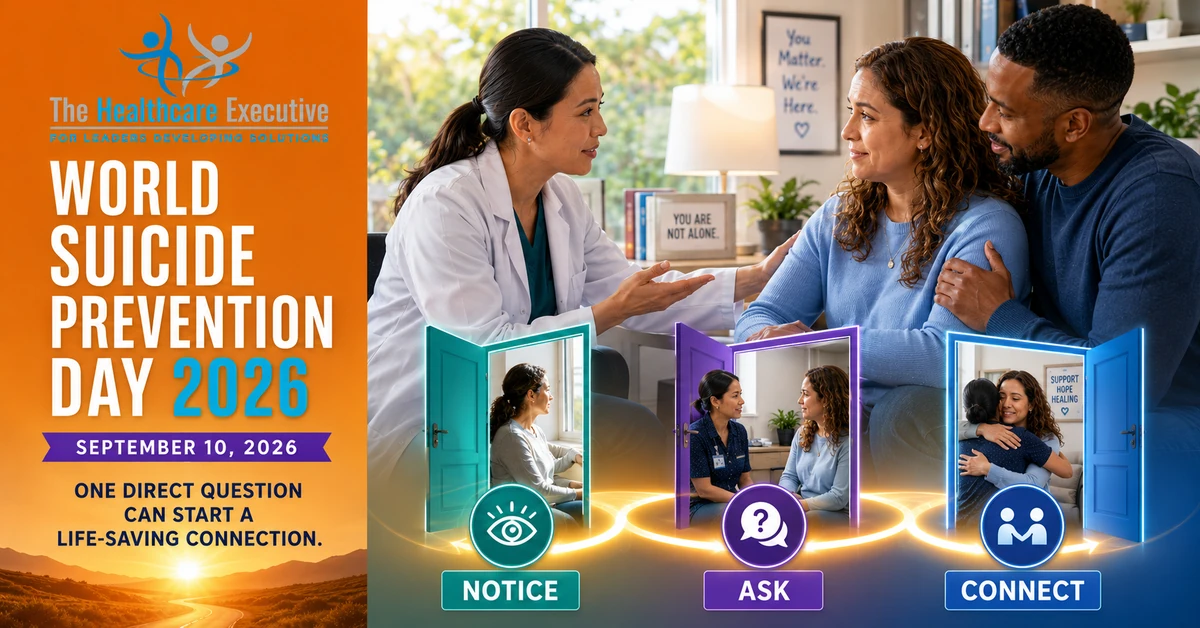

World Suicide Prevention Day · September 10, 2026
Build a clear, private, and accountable route to help
A health system does not become safer because it owns a screening tool. It becomes safer when every person who raises a concern, discloses suicidal thoughts, or arrives during a crisis meets a prepared team, a compassionate response, a reliable next step, and follow-up that does not depend on luck.
Observance context. World Suicide Prevention Day is observed on September 10. The 2024-2026 international theme, “Changing the narrative on suicide,” calls communities to start open, honest conversations about suicide and suicidal behavior. For healthcare leaders, that conversation should lead to a dependable operating system for recognition, response, transition, and learning. The date is confirmed by the World Health Organization, and the 2026 campaign theme is confirmed by the International Association for Suicide Prevention.
The executive responsibility
Move from isolated activity to an accountable system
Suicide prevention is often discussed as a clinician skill or a behavioral health program. Those are important, but they are not sufficient. People who may be at risk enter through many doors: primary care, emergency care, inpatient units, specialty clinics, virtual care, contact centers, mobile crisis services, employee health, and community partnerships. A dependable response therefore depends on enterprise design. Leaders set the conditions under which staff can notice a concern, create privacy, ask a direct and respectful question, obtain qualified clinical support, document the response, complete a warm handoff, and confirm that follow-up occurred.
The clearest leadership principle is simple: screening is an entry point, not care. A positive screen can identify a need for further assessment, but it does not establish a diagnosis, predict an individual outcome, or complete an intervention. A negative screen does not erase clinical concern. Policies should state what happens next, who owns each next step, how urgent situations are escalated, and what staff should do when the expected resource is unavailable. Without those details, a screening requirement can increase documentation while leaving the human support route unreliable.
Recent implementation research supports a systems view. In 19 primary care practices, an implementation package combined practice facilitation, electronic decision support, performance monitoring, depression screening, risk assessment, and safety planning. The intervention period was associated with more documented safety planning and a lower 90-day suicide-attempt rate than usual care. Because suicide care was implemented alongside depression and substance-use work, the result should be understood as evidence for an integrated package, not proof that one isolated step caused the change.11
Emergency department evidence points in the same direction. The ED-SAFE 2 trial did not test a single form or a one-time training class. It used continuous quality improvement, local teams, workflow redesign, universal screening, and collaborative safety planning. Improvement emerged in the maintenance phase, after sites had time to make the process part of routine operations.15 This matters for executives: implementation maturity is an outcome. A promising practice that cannot survive staffing changes, busy shifts, handoffs, and local variation is not yet a reliable safety system.
Evidence chart
ED-SAFE 2 composite outcome across three phases
Horizontal scale: 0% to 25%. Unit: percent of included encounters with the six-month composite outcome.
| Phase | Composite events | Included encounters | Six-month rate |
|---|---|---|---|
| Baseline | 216 | 1,030 | 21.0% |
| Implementation | 213 | 967 | 22.0% |
| Maintenance | 117 | 764 | 15.3% |
Board-level question
Can the organization demonstrate, with both data and case review, that a person who signals possible suicide risk receives a timely assessment, a collaborative plan, a completed transition, and an accountable follow-up across every covered setting?
The route to support
Make the next right action obvious
People disclose distress in different ways. Some answer a screening question. Some mention hopelessness, unbearable pain, or a wish not to wake up. Others arrive after a recent crisis or are noticed by a family member, colleague, or clinician. A safe operating model must accept all of these signals. It should not require a person to know the right department, repeat the same painful story to multiple strangers, or navigate a complex directory while distressed.
Design begins with private access. Reception areas, check-in desks, shared rooms, and telehealth waiting spaces can make disclosure difficult. Organizations should provide a quiet location, a discreet way to request help, and a process for moving from public intake to private conversation without delay. Remote workflows need equivalent protections: confirmation that the person can speak privately, verification of current location when clinically necessary, and a clear plan if the connection fails. Privacy should never become isolation. The person should know who is staying with them, who is being contacted, and what will happen next.
Direct inquiry should be compassionate, plain, and connected to action. Staff need scripts that normalize the question without sounding mechanical, plus permission to pause routine workflow. A useful opening may acknowledge what was heard, ask whether the person is having thoughts of suicide, and explain that the purpose is to understand what support is needed. Staff should avoid arguing, minimizing, demanding reassurance, or making promises that cannot be kept. They should also avoid turning a scored instrument into a verdict. The score informs a response; it does not replace clinical judgment or a collaborative conversation.
Standardization is valuable when it reduces missed steps, but standardization should govern the pathway rather than flatten the person. A nursing policy review published in 2026 emphasizes consistent screening, documentation, escalation, and follow-up across settings while preserving autonomy and lived experience.2 Health systems can standardize who asks, where the response is recorded, when a qualified assessor is contacted, and who confirms follow-up. They should not standardize empathy into a script that ignores context.
Process flow
A closed-loop support route
- RecognizeAccept a screen, disclosure, observed concern, or family signal.
- Create privacyMove to a calm setting and explain what will happen next.
- Assess togetherUse qualified clinical judgment, direct inquiry, and the person’s context.
- PlanBuild a personalized safety and support plan, not a generic handout.
- ConnectComplete a warm handoff with named ownership and contingency steps.
- ConfirmFollow up, document completion, learn from gaps, and adjust the plan.
Collaborative care
Personalize the plan and protect the relationship
A safety plan is most useful when it is created with the person, written in their language, accessible in the format they can use, and connected to real people and services. It should help the person recognize their own warning signs, identify internal coping strategies, name supportive people and places, reach professional help, and make the environment safer. It should also state what to do if the first option is unavailable. Completion of a template is not the goal. The goal is a usable bridge from a period of intense distress to connection and care.
Co-produced research with adults who had lived experience of suicidality and practitioners across primary care, secondary care, emergency services, and community settings found two central themes: personalization and process. Participants emphasized collaboration, involvement of family or friends when wanted and appropriate, flexible formats, clear purpose, and a workforce able to respond with confidence. The authors explicitly caution that their prototype framework still requires testing across settings.4 Leaders should therefore treat personalization as a design requirement while continuing to measure whether local practice improves engagement and outcomes.
Emergency department interviews reinforce the same point. Patients and clinicians recommended personalizing content, offering different formats, avoiding periods of overwhelming emotional intensity, engaging a broader range of professionals, using limited time meaningfully, and offering alternative interventions when a safety plan is not the right fit.10 This is operationally important. A mandatory field may increase recorded completion while reducing usefulness if it is rushed, copied forward, or completed without the person’s participation.
Evidence also requires age-specific restraint. A 2025 systematic review and meta-analysis found that safety planning used as a standalone intervention for children and adolescents was not associated with significant reductions in the examined suicide-related outcomes, and most included studies had moderate to high risk of bias.6 An earlier scoping review described the youth evidence as promising but limited, with major demographic gaps and a need for developmentally appropriate collaboration, trained staff, and support for parents or caregivers.14 A 2025 meta-review of pediatric emergency department interventions likewise found few informative trials, small samples, high heterogeneity, and limited stakeholder perspectives.5 The practical conclusion is not to abandon safety planning. It is to avoid presenting it as sufficient treatment, particularly for young people, and to embed it within comprehensive, developmentally responsive care.
Digital tools can improve portability, revision, and access, but they introduce privacy, usability, and equity questions. A 2024 systematic review found that most reviewed mobile safety-planning apps included core components and that usability was often positive, yet only a minority of studies examined effectiveness for suicide-related outcomes. The authors called for stronger trials before widespread adoption.12 Executives should require a clinical owner, privacy and security review, accessibility testing, a paper or low-tech alternative, and a workflow for responding when a digital plan signals a need for help. An app must not become an unattended endpoint.

Operational boundary
Do not measure quality only by whether a plan exists. Review whether it was collaborative, personalized, accessible, updated, connected to follow-up, and appropriate for the person’s age, language, culture, abilities, and care setting.
Continuity after the encounter
Treat every transition as a high-reliability handoff
The period after an emergency visit, inpatient stay, urgent assessment, or other crisis encounter demands deliberate continuity. A list of telephone numbers is not a handoff. A referral placed into a queue is not a completed connection. A safe transition has a named sender, a named receiver, a known time frame, a way to reach the person, and an escalation route when contact is not made.
A warm handoff means the sending team helps establish the next relationship. Depending on the setting, that may include scheduling before departure, introducing the next professional by phone or video, sharing an agreed summary, confirming transportation or technology needs, and telling the person exactly what to expect. Consent and minimum-necessary information sharing remain essential. The goal is continuity without making the person repeat everything again.
Outpatient mental health nurses describe follow-up as relational and demanding work. In a qualitative study, nurses emphasized connecting with and understanding patients, having adequate conditions for follow-up, and feeling competent yet vulnerable in complex situations. The study supports structured training, team-based follow-up, collaboration, and involvement of lived-experience expertise.8 Leaders should translate that evidence into protected time, supervisory access, coverage, and a protocol for difficult-to-reach patients. Follow-up cannot be added as invisible labor to an already full assignment.
Mobile crisis teams illustrate another implementation gap. In a national survey of 120 clinicians, nearly all reported using validated screening tools and generic safety planning, but a sizeable minority also reported practices that were not evidence-based. Respondents identified client, family, clinician, and system barriers. The authors call for tailored implementation support and de-implementation of ineffective or potentially harmful practices.13 This is a useful reminder that adding a new practice is only half the work. Organizations must also identify what should stop.

Qualitative fishbone
Why a support route fails in practice
Workforce and governance
Train for the conversation, the decision, and the handoff
Many education programs teach recognition and assessment more consistently than management and coordination. A 2026 survey of graduate psychology programs found that most participating programs offered training in suicide risk assessment and management, yet representatives perceived stronger preparation for assessment than for intervention and safety planning. Coordination across professionals and work with minority or neurodivergent populations were also described as insufficiently covered, with cost and time as barriers.1 Health systems should not assume that licensure or general mental health training guarantees readiness for the local pathway.
Competency should be role-specific. Front-desk staff need to recognize a request for private help and summon the right team without public disclosure. Nurses and medical assistants need to know when and how to ask, document, and escalate. Prescribers and qualified clinicians need assessment, collaborative planning, and treatment competencies. Contact-center and virtual-care staff need location, disconnection, and emergency escalation protocols. Managers need staffing, supervision, and case-review skills. Executives and boards need to understand measures, equity cuts, serious-event learning, and resource constraints.
Training also needs practice. Brief lectures can introduce principles, but teams need simulation, feedback, observation, coaching, and refreshers. A small rural study of Collaborative Assessment and Management of Suicidality training reported improved self-efficacy and a more collaborative, empathic stance among 11 nurses after training.9 The sample was small and the design cannot establish patient outcomes, so the finding is best used to justify competency assessment and further evaluation, not to promise clinical effect.
Governance connects these roles. An executive sponsor should remove cross-setting barriers. A clinical owner should maintain standards and escalation criteria. An operational owner should monitor reliability across locations and shifts. Information technology should support structured documentation without forcing sensitive conversations into rigid fields. Privacy, legal, compliance, quality, and risk teams should agree on information-sharing rules and review signals. People with lived experience should participate with compensation, preparation, choice, and support, not as symbolic reviewers at the end.
Operating-system diagram
Six connected capabilities
The route is only as reliable as its weakest connection. Every capability needs an owner, a standard, and a feedback loop.

Equity, privacy, and communication
Design for people the default pathway misses
Average performance can conceal unequal access. A health system may report high screening completion while people using interpretation services wait longer for assessment, rural patients cannot reach follow-up, disabled people receive inaccessible instructions, young people get adult-oriented plans, or patients without stable phones are marked unreachable. Leaders should segment measures by age, language, race and ethnicity where appropriate and lawful, disability, geography, payer, care setting, and other locally relevant factors. Small numbers require careful privacy protection and interpretation, but they should not become a reason to avoid equity review.
Co-design can improve cultural responsiveness and usability. A 2026 pre-post study involving international students from 18 countries and sector stakeholders found the co-design workshops feasible, acceptable, and safe, with increased confidence and perceived benefits among participating students. The study evaluated the co-design process, not clinical effectiveness of the resulting app.3 That distinction is useful. Lived-experience partnership can strengthen design quality, but leaders still need outcome evaluation.
Privacy deserves operational specificity. A discreet request for help may still be exposed through an intake screen, portal notification, shared device, mailed document, or follow-up message. Teams should ask the person which channels are safe, what may be left in a voicemail, whether text messages are acceptable, and who may be contacted. Digital plans should have clear access controls and a way to print or use an offline version. Staff should know what information may be shared during an urgent safety response and how to document the minimum necessary rationale.
Public communication should use safe, non-stigmatizing language. Use “died by suicide,” avoid explicit descriptions of methods, avoid reducing a death to a single cause, and do not present suicide as inevitable or romantic. Pair messages with help resources and emphasize that support and treatment are available. World Suicide Prevention Day should not be a one-day burst of awareness detached from operations. It is an opportunity to explain the support route, test whether it works, and report what the organization is improving.
Measurement and learning
Measure the chain, not just the first link
Measurement should tell leaders whether the support route works from the person’s perspective. Screening completion is easy to count, but it answers only whether an instrument was recorded. A balanced set includes process measures for each transition, outcome measures that matter to people, balancing measures for unintended consequences, and equity views that reveal variation.
Electronic records can support this work, but documentation must be validated before it is treated as performance. A study across six integrated healthcare systems developed and validated electronic measures of safety-planning practices using structured templates, narrative notes, chart review, and natural language processing. Accuracy for selected practices was high, yet documentation and template use varied substantially across health systems.7 A dashboard should therefore start with a data dictionary and validation sample. “Not found in the record” may mean “not done,” “done but not documented,” or “documented somewhere the measure cannot see.” Each possibility calls for a different intervention.
Case review adds meaning that a dashboard cannot. Teams should select cases across settings, including completed transitions, delayed connections, failed contacts, repeat acute-care visits, complaints, and near misses. Review should ask what the person experienced, where responsibility became ambiguous, whether privacy and choice were respected, what staffing or technology conditions mattered, and which change would make the next case safer. The purpose is learning and redesign, not individual blame.
Structured control table
A balanced measurement set
| Measure | Definition | Owner | Balancing or equity check | Review rhythm |
|---|---|---|---|---|
| Private response time | Minutes from concern recorded to private conversation started. | Site operations | Compare by entry route, shift, language need, and location. | Weekly |
| Qualified assessment | Eligible encounters with assessment completed or documented clinical rationale. | Clinical lead | Audit false reassurance from scores and avoid coercive over-response. | Monthly |
| Collaborative plan quality | Sampled plans meeting personalization, usability, and contingency criteria. | Behavioral health quality | Include youth, disability, language, and low-tech accessibility checks. | Monthly sample |
| Warm handoff completion | Next provider accepts responsibility before departure or within defined time. | Transition owner | Track distance, transportation, broadband, payer, and after-hours gaps. | Weekly |
| Follow-up reached | Person contacted within the locally defined interval, with escalation after failure. | Follow-up team | Separate unreachable from declined; review safe contact preferences. | Daily queue, monthly trend |
| Person-reported experience | Felt heard, respected, involved, and clear about the next step. | Patient experience | Offer accessible, confidential ways to respond without affecting care. | Quarterly |
| Acute-care reuse | Repeat suicide-related urgent or emergency care within a defined period. | Quality analytics | Interpret as a learning signal, not automatic evidence of poor care. | Quarterly |
| Workforce readiness | Role-based competency observed, coaching completed, and supervision available. | Clinical education | Monitor workload, burnout, moral distress, and time diverted from other care. | Quarterly |
Implementation roadmap
Use 90 days to build reliability, not declare completion
A 90-day plan should produce a governed pathway, a tested pilot, and a learning system. It should not promise that a complex prevention strategy is finished. Start with one representative pathway where leaders can observe the work closely, such as the connection from emergency or primary care to behavioral health follow-up. Include nights, weekends, virtual care, and community partners from the beginning so the pilot does not succeed only under ideal daytime conditions.
During the first 30 days, map the current state using real cases. Identify every point where a person waits, repeats information, loses privacy, changes teams, or receives an unconfirmed referral. Inventory screening tools, documentation fields, training, community agreements, after-hours coverage, interpreter access, digital platforms, and measures. Establish executive, clinical, operational, analytic, and lived-experience ownership. Agree on language and the escalation standard.
During days 31 through 60, build and test the minimum reliable route. Write role-specific scripts and job aids. Configure a visible handoff and follow-up queue. Create contingency steps for unavailable services and failed contact. Run simulations with different ages, languages, abilities, settings, and technology access. Train the pilot team, observe competency, and give supervisors a coaching method. Validate a small set of electronic measures against chart review.
During days 61 through 90, run the pilot, review cases weekly, and adjust quickly. Use both numbers and narrative feedback. Confirm that improvement in one step does not create delays or coercive responses elsewhere. Present the governing group with observed reliability, equity variation, staffing and technology constraints, and a staged scale plan. Scale only after the receiving services, follow-up capacity, and measurement system can support the added demand.
30/60/90 Gantt
A staged launch for one accountable pathway
The leadership commitment
Make it easier to ask, safer to answer, and harder to lose the connection
World Suicide Prevention Day can start a conversation, but healthcare leadership must build what comes after the conversation. The practical test is whether a person can reach help privately, be met with skill and respect, receive care matched to their context, leave with a real connection, and know who will follow up.
The evidence does not support a single magic tool. It supports disciplined implementation: integrated workflows, collaborative care, qualified teams, protected follow-up, validated measurement, continuous learning, and clear boundaries around what is still uncertain. Leaders can act now without overstating the science. Map the route. Name the owners. Test the handoffs. Listen to people with lived experience. Measure the whole chain. Then keep improving until safe, compassionate continuity is ordinary practice on every shift.
Scholarly references
Peer-reviewed evidence
References are listed newest first. All 15 records were individually verified as peer reviewed through authenticated scholarly databases. Official campaign and crisis-service links are provided separately in the article and are not counted in this evidence set.
- Guindon, J., Spodenkiewicz, M., Beland, K., et al. (2026). Suicide prevention training within graduate psychology programs in Quebec, Canada: A quantitative and qualitative survey. Canadian Psychology / Psychologie Canadienne, 67(3), 228-237.
- Ling, A., Kim, D., & Garcia, G. (2026). The role of nursing policy in standardizing suicide risk screening across healthcare settings. Issues in Mental Health Nursing, 47(6), 549-556. https://doi.org/10.1080/01612840.2026.2632767
- Ng, C., Shaikh, T., Robinson, J., et al. (2026). A pre-post study of the feasibility, acceptability and benefits of a co-design approach for the development of a digital suicide prevention app for international students. Health Expectations, 29(2), 1-11. https://doi.org/10.1111/hex.70669
- McGleenan, K., Gordon, I., Smith, H., et al. (2025). Developing a co-produced practice framework to support personalised safety planning for adults experiencing suicidality. Health Expectations, 28(5), 1-10. https://doi.org/10.1111/hex.70423
- Radunz, M., Johnson, C., O’Dea, B., & Wade, T. D. (2025). Interventions for self-harm and suicidality in paediatric emergency departments: A meta-review. European Child & Adolescent Psychiatry, 34(9), 2649-2658. https://doi.org/10.1007/s00787-025-02706-9
- Albaum, C., Irwin, S. H., Muha, J., et al. (2025). Safety planning interventions for suicide prevention in children and adolescents: A systematic review and meta-analysis. JAMA Pediatrics, 179(8), 886-895. https://doi.org/10.1001/jamapediatrics.2025.1012
- Boggs, J. M., Yarborough, B. J. H., Clarke, G., et al. (2025). Development and validation of electronic health record measures of safety planning practices as part of Zero Suicide implementation. Archives of Suicide Research, 29(3), 654-667. https://doi.org/10.1080/13811118.2024.2394676
- Hultsjö, S., Jormfeldt, H., Allstrin, E., & Karlsson, A. (2025). Outpatient mental health nurses’ experiences of suicide follow-up interventions: A qualitative interview study. Journal of Psychiatric and Mental Health Nursing, 32(3), 740-750. https://doi.org/10.1111/jpm.13150
- Norrod, P. E., MacDonald, M., Link, K., & Ickes, M. J. (2025). Evaluating implementation of the Collaborative Assessment and Management of Suicidality training for rural suicide prevention among mental health and healthcare professionals. Issues in Mental Health Nursing, 46(5), 436-443. https://doi.org/10.1080/01612840.2025.2474117
- Brousseau-Paradis, C., Genest, C., Maltais, N., Séguin, M., & Rassy, J. (2025). Towards a better use of safety planning in emergency departments: An exploratory study of patients and clinicians’ perspectives. Community Mental Health Journal, 61(4), 724-733. https://doi.org/10.1007/s10597-024-01394-0
- Angerhofer Richards, J., Cruz, M., Stewart, C., et al. (2024). Effectiveness of integrating suicide care in primary care: Secondary analysis of a stepped-wedge, cluster randomized implementation trial. Annals of Internal Medicine. https://doi.org/10.7326/M24-0024
- Gryglewicz, K., Orr, V. L., McNeil, M. J., et al. (2024). Translating suicide safety planning components into the design of mHealth app features: Systematic review. JMIR Mental Health, 11, 1-16. https://doi.org/10.2196/52763
- Becker-Haimes, E. M., Schaechter, T., Green, K. L., Bridges, K., & Jager-Hyman, S. (2024). Mobile crisis services: A clinician survey of current suicide prevention practices and barriers to care delivery. Community Mental Health Journal, 60(3), 562-571. https://doi.org/10.1007/s10597-023-01208-9
- Abbott-Smith, S., Ring, N., Dougall, N., & Davey, J. (2023). Suicide prevention: What does the evidence show for the effectiveness of safety planning for children and young people? A systematic scoping review. Journal of Psychiatric and Mental Health Nursing, 30(5), 899-910. https://doi.org/10.1111/jpm.12928
- Boudreaux, E. D., Larkin, C., Vallejo Sefair, A., et al. (2023). Effect of an emergency department process improvement package on suicide prevention: The ED-SAFE 2 cluster randomized clinical trial. JAMA Psychiatry, 80(7), 665-674. https://doi.org/10.1001/jamapsychiatry.2023.1304