
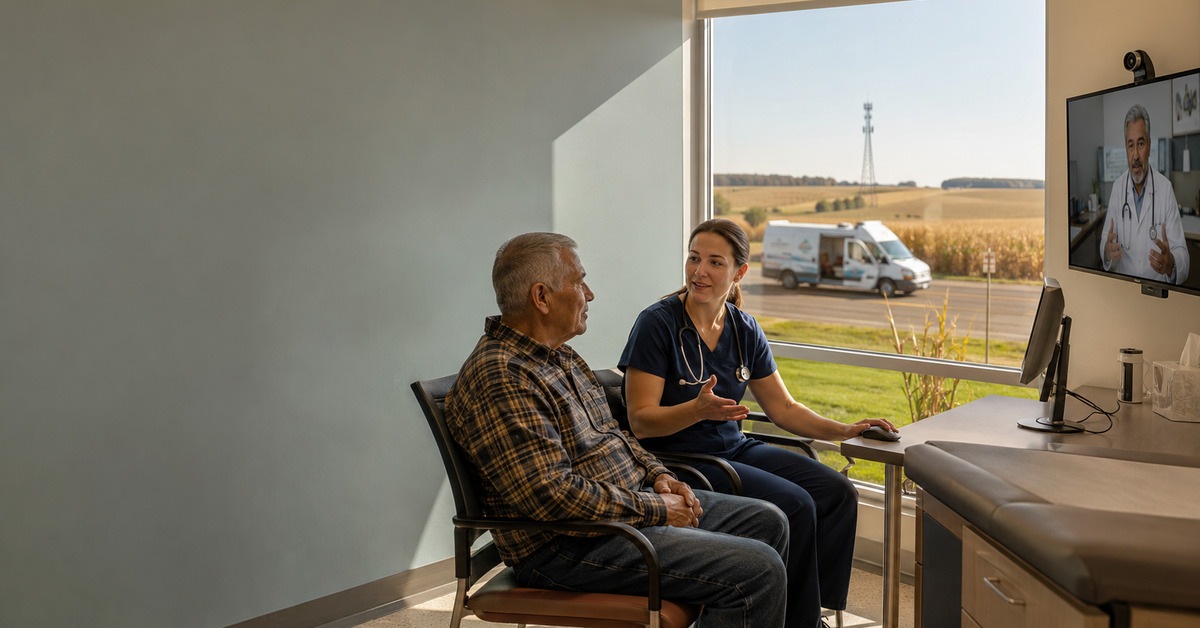

Build a rural care relay, not a video channel.
The rural care relay
Treat telehealth as a care-delivery network
Rural telehealth is often introduced as a technology project: select a platform, equip examination rooms, credential distant clinicians, and promote virtual appointments. That sequence can produce activity without creating access. A video connection does not solve a referral that never reaches the specialist, a patient who lacks a private place to speak, a clinic that has no staff to prepare the encounter, or a result that never returns to the local care plan.
The strategic unit is a clinical service, not a call. Leaders should define which patients need help, which decision or intervention telehealth enables, what the local team must do before and after the encounter, and how the patient moves to hands-on care when necessary. This turns telehealth from a digital door into a coordinated pathway.
The network may include a patient at home, a rural health clinic, critical access hospital, pharmacy, school, library, tribal facility, mobile unit, emergency medical service, community health worker, regional health system, and independent specialist. Not every service needs every node. The executive task is to design the minimum reliable chain for each clinical use case, then assign ownership at every handoff.
Set an enterprise purpose that is specific enough to govern investment. Examples include reducing avoidable travel for stable specialty follow-up, shortening time to behavioral health care, keeping high-risk pregnancies connected to specialty expertise, supporting rural emergency clinicians, or expanding chronic-disease management between visits. A statement such as “grow telehealth” is too broad. It rewards volume without defining value.
A service has expanded access only when the intended patient can complete the encounter, receive an appropriate decision, obtain the next step, and return to local care without becoming the coordinator.
Design from geography and lived conditions
“Rural” does not describe one operating environment. A frontier county, agricultural town, mountain community, reservation, island, and rural region near a metropolitan center may have different travel patterns, broadband availability, workforce capacity, languages, referral markets, and trust relationships. A single enterprise template can miss the people it is intended to serve.
Build a service-area map using patient addresses or appropriate geographic groupings, travel time, referral leakage, appointment delay, no-show patterns, specialist availability, emergency transfers, broadband reliability, cellular coverage, and community assets. Add qualitative insight from patients, local clinicians, community health workers, libraries, schools, emergency responders, public health departments, tribal leaders, employers, faith communities, and social-service organizations. Data can show where care is delayed. Local voices often explain why.
Segment patients by the support required to complete care. One person may need only a secure link and a reminder. Another may need a loaned device, interpreter, caregiver proxy, transportation to an access point, digital navigation, accessible technology, or a local clinical presenter who can collect vital signs and assist with an examination. Track these requirements as service-design inputs, not as reasons to exclude patients from virtual care.
Examine modality rather than assuming that live video is the default. Audio-only care, asynchronous specialist review, remote patient monitoring, secure messaging, image exchange, store-and-forward consultation, and clinician-to-clinician support can each solve different problems. The right modality depends on clinical purpose, evidence, patient preference, regulatory requirements, and available connectivity.
Clinical need
Condition, acuity, decision, examination requirements, follow-up interval, and escalation risk.
Access reality
Travel time, broadband, device, privacy, language, disability, caregiving, and work constraints.
Local capacity
Trusted sites, staff, diagnostics, pharmacy, transportation, emergency response, and referral partners.
Prioritize services where virtual care changes the pathway
Not every specialty or visit type belongs in the first wave. Choose use cases where unmet need is material, clinical work can be performed safely at a distance, local follow-up exists, specialist partners can supply reliable capacity, and the payment model can support the service. A small portfolio with clear ownership is more useful than a catalog of intermittently available clinics.
Behavioral health often fits because conversation is central to many encounters and rural shortages can be severe. Dermatology may use high-quality images and asynchronous review. Stroke, critical care, and emergency consultation can support local clinicians during time-sensitive decisions. Maternal health networks can connect rural teams with higher-level expertise while preserving local prenatal and postpartum relationships. Chronic-disease programs can combine virtual visits, monitoring, education, and local laboratory or pharmacy services.
Define inclusion and exclusion criteria for each service. Specify which conditions, ages, acuity levels, visit types, technologies, and patient supports are appropriate. Identify examinations or diagnostics that must occur locally. State when the patient should be scheduled in person, transferred urgently, or redirected to emergency care. These rules should be easy for schedulers and clinicians to use.
Protect continuity. A one-time consultation can answer a question, but rural patients often need longitudinal coordination. Decide whether the distant specialist is consulting to the local clinician, assuming ongoing management, or sharing care. Clarify responsibility for medications, orders, test follow-up, prior authorization, patient questions, and surveillance. Put the agreement into workflow and contracts.
Offer a ladder of participation, not one digital doorway
Home-based access is convenient when a patient has reliable connectivity, a usable device, enough digital confidence, and an appropriate private setting. Leaders should preserve that option while recognizing that it will not work for everyone. An equitable strategy provides multiple ways to reach the same care team.
Create supported access points in trusted, practical locations. Rural clinics and hospitals can provide examination equipment and clinical staff. Pharmacies may support medication-focused services. Schools can connect children with appropriate consent and privacy safeguards. Libraries or community centers may provide a private room, broadband, and basic technical assistance, although they should not be expected to perform clinical functions. Mobile clinics can bring connected space and diagnostic capability to remote communities on a dependable schedule.
Specify what each site provides: private room, accessible entrance, lighting, camera, microphone, interpreter connection, peripheral devices, infection prevention, check-in, identity verification, clinical support, and emergency procedures. Test the entire visit from the patient’s perspective. A technically connected room can still fail because signage is confusing, sound carries, the chair does not fit mobility needs, or no one knows how to recover after a dropped session.
Build a digital-navigation function. Navigators can confirm device readiness, rehearse the connection, explain consent and privacy, arrange language or accessibility support, and identify a backup modality. The goal is not to make patients become technology experts. It is to remove predictable friction before it consumes clinician time or causes missed care.
Home route
Offer simple instructions, a pre-visit test, live support, accessible design, interpreter access, a phone backup, and a clear plan when the patient cannot connect privately.
Community route
Offer trusted locations, posted availability, private space, trained support, maintained equipment, reliable scheduling, transportation information, and local escalation.
Design for the last mile and the failed connection
Broadband investment is necessary, but a health system cannot treat broadband availability as proof that a patient can use telehealth. Coverage maps, household affordability, data limits, equipment quality, cellular dead zones, seasonal conditions, power reliability, and shared devices all affect the encounter. Measure connection success by location, not only platform uptime.
Establish a low-bandwidth standard. Test applications under constrained conditions. Reduce unnecessary visual effects, offer dial-in audio, allow patients to upload information in advance, and avoid requiring large downloads. When video adds clinical value, permit adaptive quality instead of failing the entire visit. A fallback protocol should tell staff when to switch modality, reschedule at a supported site, or move to in-person care.
Engineer clinical sites for resilience. Use separate, managed networks for care delivery where appropriate. Monitor latency, packet loss, device health, and room availability. Maintain backup connectivity for critical services, uninterruptible power where risk warrants it, spare peripherals, and support coverage during clinic hours. Tele-emergency and tele-critical-care connections require a higher reliability standard than a routine follow-up.
Pursue infrastructure support as part of a broader capital plan. The Federal Communications Commission’s Rural Health Care Program can support eligible providers with telecommunications and broadband costs. The USDA Distance Learning and Telemedicine program has supported equipment and related infrastructure for eligible rural projects, although funding windows and terms change. HRSA-funded Telehealth Resource Centers offer technical assistance. Leaders should verify current eligibility and program rules before building grant assumptions into the budget.
Every virtual service needs a clinically appropriate degraded mode. “Try the link again” is not a continuity plan.
Make every handoff visible and owned
A virtual encounter touches scheduling, registration, consent, eligibility, records, medication reconciliation, technology preparation, rooming, clinical assessment, orders, prescriptions, documentation, billing, follow-up, and escalation. If those steps are divided across organizations, ambiguity multiplies. Map the current and future workflow with the people who perform it.
Before the visit, confirm patient location, identity, consent requirements, modality, language, accessibility needs, caregiver participation, device readiness, clinical information, and any local examination or testing. The distant clinician should receive relevant records early enough to review them. The local team should know whether a presenter is needed and which equipment to prepare.
During the encounter, verify location again because it can affect licensure and emergency response. Introduce every participant and role. Confirm how to reconnect if the session drops. If a local presenter assists, define what that person can do within scope and protocol. Document the same clinical essentials expected in person, including the limitations of the remote examination when relevant.
After the encounter, return a usable plan to the patient and local team. Route orders to places the patient can reach. Assign responsibility for test results, referrals, medications, and unanswered questions. Schedule the next step before the patient leaves the supported site when possible. Closed-loop communication is especially important when the distant specialist and local clinicians use different records.
Maintain a living rules engine
Telehealth requirements change across payer, service, practitioner type, patient location, provider location, modality, facility, and state. Medicare policies can change through legislation and annual rulemaking. Medicaid and commercial coverage vary. State rules may address consent, prescribing, documentation, payment parity, establishment of a clinician-patient relationship, and professional practice. Leaders should not rely on an old launch checklist.
Create a cross-functional policy group with compliance, legal, revenue cycle, credentialing, medical staff, clinical operations, information technology, pharmacy, and contracting. Maintain a controlled matrix for each service line that identifies allowed practitioners, locations, modalities, codes, modifiers, documentation, consent, supervision, facility billing, prior authorization, and payer-specific rules. Date every rule and name the source.
Licensure deserves operational attention. HHS notes that the ability to practice across state lines varies by state and may involve a full license, temporary practice law, reciprocity, compact, or telehealth registration. A telehealth appointment generally occurs in the state where the patient is located. Build location verification into scheduling and the visit, track clinician authority by state, and prevent appointments that fall outside approved scope.
Model economics by service rather than assuming virtual care is inherently inexpensive. Include specialist time, local presenter time, navigation, platform and device costs, connectivity, credentialing, malpractice, interpretation, support, space, revenue-cycle work, uncompensated failures, and in-person conversion. Then include value that may appear elsewhere, such as avoided transfer, retained referral, reduced travel support, improved capacity, or earlier intervention.
Review current CMS resources before making Medicare claims. CMS maintains the list of payable Medicare telehealth services and updates policy through the physician fee schedule and other guidance. Build monitoring into governance and communicate rule changes to scheduling, clinical, and billing teams before they reach the claim queue.
Make virtual care understandable, voluntary, and human
Adoption is not simply a marketing problem. Patients may worry about the quality of remote care, privacy in a small community, technology difficulty, unexpected cost, loss of a local clinician, or a distant organization that does not understand local life. Those concerns are rational and should shape the model.
Explain what telehealth can and cannot do, who will participate, what the patient may pay, how information is protected, whether the session will be recorded, and what happens if an in-person examination is needed. Use plain language and preferred languages. Provide the choice of an appropriate in-person route when available. Consent should be a meaningful conversation or process, not a buried click.
Use trusted messengers. Local clinicians, nurses, pharmacists, community health workers, tribal health staff, school health personnel, and patient advisors can introduce services and surface concerns. Keep those partners involved after launch. They can identify when a new workflow conflicts with transportation, seasonal work, caregiver responsibilities, community events, or local expectations.
Design for language, disability, age, and health literacy from the start. Test captioning, interpreter integration, screen-reader behavior, keyboard access, contrast, hearing support, caregiver or proxy access, and instructions on common mobile devices. Do not treat a failed digital interaction as patient refusal. Record the barrier and offer another route.
Preserve relationship continuity. When possible, let patients see a consistent clinician or team. Introduce the distant specialist as part of the local network rather than a disconnected vendor. Send a clear summary to the local clinician. A strong virtual program should increase the patient’s confidence in the care system around them.
Hold remote care to a defined clinical standard
Virtual care should be evaluated as care. Platform connection rates and appointment counts describe operations, but they do not establish clinical quality. Each service line needs protocols for patient selection, remote examination, diagnostic uncertainty, escalation, documentation, follow-up, and emergency response.
Build escalation before launch. Determine which symptoms or findings require same-day in-person evaluation, emergency services, transfer, or specialty escalation. Confirm the patient’s physical location and local emergency contact at the start of relevant encounters. Give the distant clinician a rapid way to reach the local site or emergency response. Train teams through scenarios, including disconnection during a crisis.
Monitor diagnostic and treatment outcomes appropriate to the service. Compare completion, follow-up, medication safety, adverse events, emergency use, transfer, readmission, and patient-reported outcomes with reasonable in-person or historical benchmarks. Review conversions from virtual to in-person care. A conversion is not automatically a failure. It may demonstrate correct triage. The concern is delayed or avoidable conversion caused by weak selection or incomplete preparation.
Use structured case review for harm, near misses, failed handoffs, technical interruptions, and complaints. Include both distant and local teams. Ask whether technology, policy, staffing, environment, training, information flow, or role clarity contributed. Feed improvements back into protocol and configuration.
Clinical reliability
Right patient, modality, information, examination support, decision, escalation, and follow-up.
Operational reliability
Connection, staffing, room, interpreter, scheduling, records, orders, and exception recovery.
Equitable reliability
Completion and outcomes across geography, language, age, disability, payer, race, ethnicity, and digital support needs.
Protect privacy without making care unusable
Telehealth extends the care environment into homes, community sites, mobile units, clinician workspaces, networks, devices, applications, and vendor services. Security must cover the full system, including scheduling messages, images, remote-monitoring data, recordings or transcripts, support tools, identity, and interfaces to the health record.
Use platforms and workflows that meet applicable privacy and security requirements. HHS guidance states that covered entities must apply reasonable safeguards to protect health information during telehealth. Electronic communication technologies that create, receive, maintain, or transmit electronic protected health information may bring Security Rule obligations, including risk analysis and risk management. Audio-only care is not a universal exception because modern voice services may use electronic technologies.
Inventory data flows and vendors. Determine what data is collected, where it travels, where it is stored, who can access it, whether sessions are recorded or transcribed, how long information is retained, and how it is deleted. Review business associate responsibilities where applicable. Limit access by role, require strong authentication, encrypt data appropriately, monitor anomalous activity, patch managed devices, and establish incident-response procedures.
Protect privacy at both ends. Clinicians should use private settings and prevent unauthorized observation or listening. Supported community sites need sound privacy, screen positioning, secure sign-in and sign-out, device reset, and a process for printed material. Patients need clear guidance about private space, headphones, secure connections, device updates, suspicious links, and how to ask for another setting.
Design security controls around human use. A complicated sign-in process can exclude patients or encourage unsafe workarounds. Test identity verification, proxy access, password recovery, interpreter participation, caregiver roles, and support access. Security and access are joint design constraints, not competing departments.
Build capacity on both sides of the connection
A distant specialist does not replace the rural workforce. Virtual care often creates new local work: identifying patients, preparing records, supporting technology, collecting measurements, presenting the patient, coordinating orders, handling referrals, and following up. If this work is invisible, it will be absorbed by already constrained teams.
Define roles for clinicians, nurses, medical assistants, navigators, schedulers, interpreters, pharmacists, community health workers, information technology staff, credentialing, revenue cycle, and partner organizations. Estimate time by visit type. Put responsibilities into staffing plans, job expectations, training, contracts, and performance measures. Reassess after observing actual demand.
Train for virtual clinical practice, not only software use. Clinicians need skills in remote communication, camera-based observation, patient-directed examination where appropriate, recognition of modality limits, documentation, informed consent, privacy, equity, and escalation. Local presenters need protocols, scope clarity, equipment competency, and a direct route for help.
Use telehealth to strengthen rural capability. Clinician-to-clinician consultation, case conferences, mentoring, and continuing education can support local confidence and retention. When distant specialists explain reasoning and share follow-up, knowledge remains in the community. A model that bypasses local clinicians can weaken the very network rural patients depend on.
Create sustainable specialist capacity. Define response times, clinic schedules, backup coverage, documentation expectations, communication standards, and demand limits. Monitor cancellation patterns and clinician workload. Intermittent access that disappears when volume rises can damage trust more than a clearly bounded service.
Virtual care should distribute expertise. It should not transfer invisible coordination work to the smallest rural team.
Use a scorecard that follows the patient journey
Measure the complete pathway from need to completed care. Start with a baseline for wait time, travel burden, referral completion, transfer, specialist access, clinical outcome, patient cost, workforce capacity, and disparities. Without a baseline, growth in virtual visits may be mistaken for improvement.
Track reach by service area and population. Measure referrals offered telehealth, acceptance, successful connection, supported-site use, audio-only use where permitted, cancellations, no-shows, technical failures, in-person conversions, and abandonment. Stratify measures by geography, language, age, disability, payer, race, ethnicity, device or connectivity support, and other locally relevant factors. Small numbers require careful privacy protection and interpretation.
Track clinical and operational reliability. Monitor time to appointment, result closure, referral closure, escalation, emergency response, adverse events, repeat contact, continuity with local clinicians, specialist response, and patient understanding. Track staff time and workarounds. A service that improves patient access by creating unsustainable local burden will not remain reliable.
Track economics across the network. Include reimbursement, denials, total service cost, grant dependence, retained care, avoided transfer, capacity released, partner payments, and patient travel or time saved where measurable. Make assumptions explicit. Some programs produce strategic community value that will not appear in a single departmental margin, but leaders still need a transparent funding decision.
Scale only after the service demonstrates safety, access, workflow reliability, equity, and an operating model. Expansion may mean more sites, more appointment capacity, a broader population, a new modality, or another service line. Change one major dimension at a time when possible so the team can see what affects performance.
Discover
Map need, patients, local assets, connectivity, policy, referral flow, baseline performance, and community priorities.
Design
Select one service, define roles and protocols, contract capacity, test technology, train staff, and build the scorecard.
Prove
Launch a controlled cohort, run daily exception review, validate handoffs, gather patient input, and decide whether to adapt or scale.
Conclusion
Telehealth can make expertise reachable without asking every rural patient to leave work, find transportation, and travel hours for care that can be delivered safely closer to home. That promise is real, but it does not come from a platform alone. It comes from a dependable care relay.
Healthcare executives should begin with a defined access problem, map the local conditions, choose a focused clinical portfolio, create multiple participation routes, engineer for weak connectivity, assign every handoff, maintain current policy controls, protect privacy, staff both sides of the connection, and measure whether the patient actually received complete care.
The strongest rural strategy does more than import distant expertise. It strengthens trusted local teams, keeps responsibility visible, and gives patients a clear path from first contact through follow-up and escalation. When the network is designed that way, virtual care becomes part of the community’s clinical infrastructure rather than a separate digital program.
Sources and further reading
Leaders should confirm current federal, state, payer, and professional requirements for every service line. These primary resources provide a starting point.
- HHS Telehealth: Getting started with telehealth
- HHS Telehealth: Licensing across state lines
- Centers for Medicare & Medicaid Services: List of telehealth services
- Centers for Medicare & Medicaid Services: Medicare telehealth policy and resources
- HHS Office for Civil Rights: HIPAA guidance for audio-only telehealth
- HHS Office for Civil Rights: Telehealth privacy and security guidance
- Health Resources and Services Administration: Rural health resources
- Health Resources and Services Administration: Telehealth Resource Centers
- USDA Rural Development: Distance Learning and Telemedicine Grants
- Federal Communications Commission: Rural Health Care Program