


Listen to this articleListen with THCE · 41 minutesOpen player +Close player −
A successful operation still needs a successful handoff
The procedure is complete. The patient is clinically ready for discharge. A home health referral has been sent, the family has received instructions, and the hospital’s dashboard shows a shorter stay. Yet the receiving agency has not accepted the referral, the caregiver cannot be present until tomorrow, and no one has confirmed who will answer a medication question tonight.
This is where episode accountability becomes concrete. A discharge order records a clinical decision. It does not establish that the next part of recovery can occur as planned. The executive task is to make that distinction visible, assign responsibility for unresolved needs, and keep financial incentives from substituting for clinical judgment.
Medicare’s Transforming Episode Accountability Model, or TEAM, began January 1, 2026. It holds selected hospitals accountable for specified surgical episodes extending through 30 days after hospital discharge. Its promise depends on work that crosses service lines, organizations, and payment systems. Its risks arise at those same boundaries. [26]
The central governance question is therefore practical: Can the hospital show that necessary care was delivered, the patient’s choices were respected, and the next team actually received responsibility? A favorable spending result is one part of that answer.
What TEAM makes the hospital accountable for
TEAM runs through December 31, 2030. Mandatory participation applies to eligible hospitals in selected geographic areas, with a defined voluntary pathway for certain former participants in predecessor models. Leaders should verify the hospital’s actual CMS participation status and CMS Certification Number. A general description of the region or health system is insufficient. [26, 33]
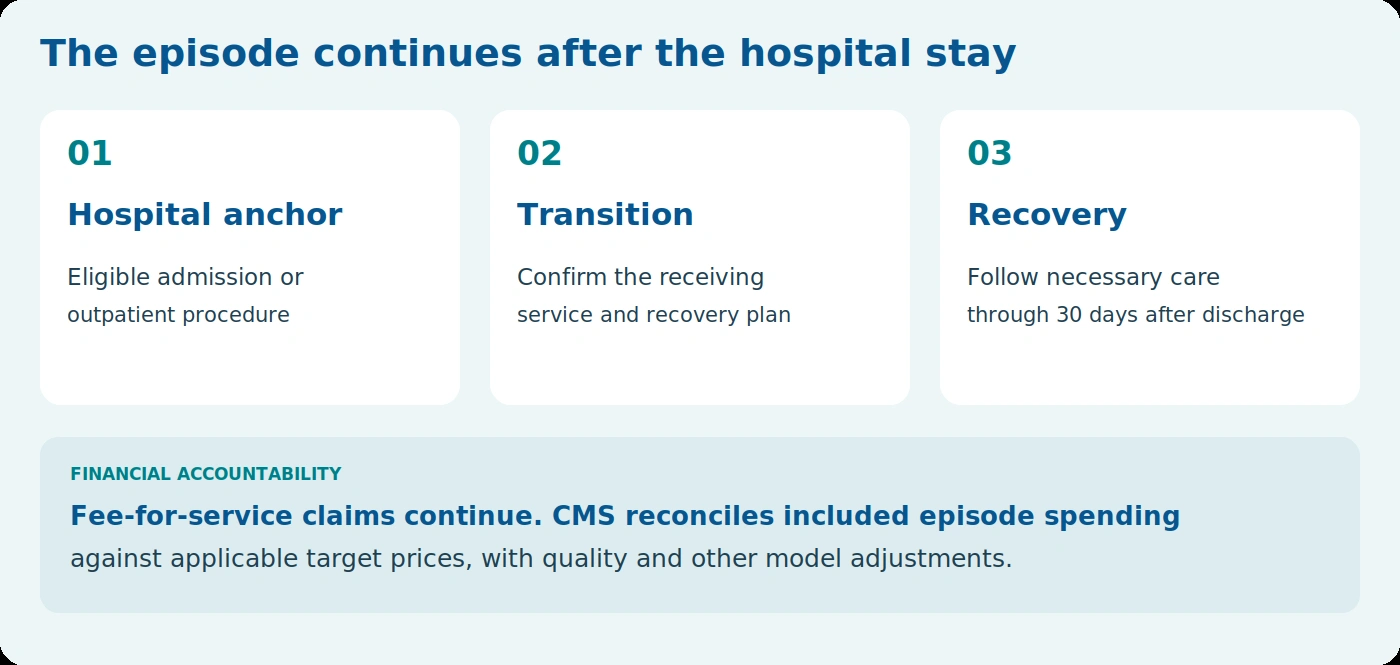
The five episode categories are lower extremity joint replacement, surgical hip and femur fracture treatment, spinal fusion, coronary artery bypass graft surgery, and major bowel procedures. The applicable inpatient admission or hospital outpatient procedure anchors the episode. The episode then continues through the first 30 days after leaving the hospital. Detailed eligibility, triggering codes, exclusions, and attribution rules determine which cases enter the model. A service line’s internal procedure label does not determine eligibility by itself. [26, 28]
Providers continue submitting Medicare fee-for-service claims. TEAM does not replace every claim with a single prospective payment to the hospital. CMS compares included episode spending with applicable target prices and determines reconciliation under the model’s quality, risk, and other adjustment rules. Finance should distinguish the hospital’s own accounting costs from Medicare episode spending and from the eventual reconciliation payment or repayment. These are related measures with different meanings. [26, 28, 29]
The episode can include covered services furnished by clinicians and organizations beyond the hospital. Consequently, a hospital may influence spending that it does not directly control. A skilled nursing facility’s capacity, a home health agency’s staffing, a patient’s preferences, and the availability of community services all affect the pathway. The response should be coordination with clear responsibilities, not an assumption that an affiliated provider can accept every patient. [26, 31]
Read figure 1 as text
The episode continues after the hospital stay
01
Hospital anchor
Eligible admission or
outpatient procedure
02
Transition
Confirm the receiving
service and recovery plan
03
Recovery
Follow necessary care
through 30 days after discharge
FINANCIAL ACCOUNTABILITY
Fee-for-service claims continue. CMS reconciles included episode spending
against applicable target prices, with quality and other model adjustments.
Risk tracks are a governance decision
CMS’s three participation tracks provide different levels of financial exposure. Track 1 is available to all participants in the first performance year and remains available to eligible safety-net hospitals in years two and three. Track 2 is available in years two through five to specified hospital types, including eligible safety-net, rural, Medicare-dependent, sole community, and essential access community hospitals. Track 3 is available throughout the model. Eligibility depends on the model’s definitions. [30]
| Track | Financial structure | What the board should understand |
|---|---|---|
| 1 | Upside only; 10% stop-gain limit | A period without downside reconciliation does not remove the obligation to build reliable clinical operations. |
| 2 | Upside and downside; 5% stop-gain and stop-loss limits | Eligibility is limited. Lower exposure still requires adequate data, reserves, and operational oversight. |
| 3 | Upside and downside; 20% stop-gain and stop-loss limits | Greater exposure warrants explicit review of uncertainty, episode mix, quality, and the hospital’s capacity to absorb losses. |
These limits summarize CMS’s track fact sheet. They are not a complete reconciliation formula or a percentage of an individual patient’s bill. Quality adjustments and other model provisions also matter. Track selection should be documented with the hospital’s current eligibility and official CMS information. [30]
The 2026 rules cannot be treated as a frozen specification
The FY 2027 inpatient prospective payment system final rule contains substantive TEAM updates. Its fiscal-year label should not lead an organization to assume that every change begins on January 1, 2027. An implementation register should give each change its own effective or applicable date, affected process, accountable owner, and verification evidence. [27]
One immediate example is spinal fusion. CMS finalized the addition of MS-DRGs 523, 524, and 525 to the TEAM spinal fusion episode category beginning October 1, 2026. Coding, episode identification, forecasting, and reporting teams need the same version of that change. A dashboard that continues using an earlier code list could give leaders an incomplete view of the population for which they are accountable. [27]
The rule also finalized a concurrent baseline approach for the composite quality score, beginning with TEAM performance year one. The applicable baseline is aligned with the measure’s measurement period. Several measures use July-to-June periods. Quality staff should therefore distinguish the TEAM performance year from the measurement period and from the baseline used in score calculation. “Our 2026 results” is too imprecise for a reconciliation discussion. [27, 32]
Other changes address pricing calculations, including payment-system update factors and the use of baseline clinical episodes for certain risk-adjustment and normalization calculations beginning in performance year two. These details belong in the hospital’s calculation controls. A preliminary target price should carry a version, an applicable period, and a clear statement of what remains subject to reconciliation. [27, 29]
The rule establishes an overlap provision involving the future Comprehensive Care for Joint Replacement Expanded model, or CJR-X, which begins in 2028. That future coordination requirement should be tracked without presenting CJR-X as a program already operating in 2026. Similarly, discussion of ambulatory surgical center episodes and future physician-owned hospital participation should not be converted into a current entitlement or finalized expansion when CMS has only requested information or indicated future rulemaking. [27]
What the evidence supports, and where it stops
The literature supports taking episode coordination seriously. It also cautions against promising that a payment model will automatically improve every outcome. Much of the available evidence concerns earlier, often voluntary, 90-day bundled payment programs. TEAM uses a different participation structure and a 30-day post-discharge window. Historical findings inform implementation; they do not establish TEAM’s results. [1, 7, 8, 9]
Lower spending is not the same as net savings
A 2026 analysis by Ryan and colleagues examined BPCI Advanced using Medicare data through 2021. Across 883 participating hospitals and 1,772 comparison hospitals, the authors estimated an average $324 reduction in 90-day episode spending. However, incentive payments produced estimated net CMS losses of $171 million over the study period, despite net savings in model year four. Those results concern a predecessor model and its particular years, but the accounting lesson is directly relevant: gross spending reductions and net program savings must be reported separately. [9]
An earlier analysis of BPCI Advanced’s first two model years similarly found that incentive payments exceeded the estimated reduction in clinical spending. Research on physician groups also found substantial bonuses and a relationship between target prices and reconciliation payments. An attractive reconciliation result can therefore reflect both care delivery and the design of the benchmark. Leaders should ask which component changed before crediting a redesign effort with the entire financial result. [14, 16]
Physician participation and episode type matter
Crowley and colleagues’ 2025 study of joint replacement found lower episode spending associated with BPCI Advanced participation by both physician groups and hospitals. The study did not detect differential changes in mortality, readmissions, or complications. Participating physicians were also associated with more outpatient visits shortly after discharge. Because physician groups accounted for a large share of the participating joint replacement episodes, the findings support deliberate hospital-physician coordination in models that place formal accountability on hospitals. They do not prove that a particular gainsharing contract causes better care. [1]
A separate comparison of physician groups and hospitals found that performance varied between medical and surgical episodes. Research on predictors of savings likewise found substantial differences across clinical conditions and baseline spending. A hospital should not take a successful joint replacement pathway and assume that the same intervention, staffing model, or savings estimate will work for spinal fusion or major bowel surgery. [2, 15]
The importance of clinical specificity is especially clear in spine research. A 2025 study found spending reductions for outpatient back and neck procedures excluding spinal fusion, while similar inpatient procedures did not show the same spending change. Those findings cannot be presented as evidence that TEAM spinal fusion episodes will achieve the same result. [7]
Postacute redesign requires a clinical explanation
In a study of TEAM hospitals conducted before implementation, the share of 30-day episode spending attributable to skilled nursing, inpatient rehabilitation, and home health varied substantially by surgical category. That historical analysis also found differences in the characteristics of selected hospitals, including a greater representation of safety-net institutions. These observations argue for category-specific planning and attention to local resources. They are not current performance results for TEAM. [8]
An observational study of hospital skilled nursing referral networks found fewer skilled nursing referrals and small improvements in one dimension of the quality of receiving facilities, without a narrowing of referral networks. A study of a coronary bypass program linked structured functional assessment, rehabilitation, and patient-family engagement with lower institutional postacute care use. Both suggest mechanisms worth evaluating. Neither supports a blanket policy that every patient should recover at home. [4, 19]
For major bowel surgery, a small single-institution study found substantial variation in episode costs and highlighted the importance of postacute care. Its bundled-payment group included only 29 patients. That scale is useful for identifying local operational questions, but insufficient for setting a universal cost target or a safe discharge rule. [11]
Make the transition a confirmed transfer of responsibility
The hospital should define the minimum information and actions needed for a safe transition according to the procedure and the patient’s clinical circumstances. The responsible clinician determines clinical readiness. Case management, nursing, rehabilitation, pharmacy, and the receiving team then establish whether the proposed plan can actually be delivered.
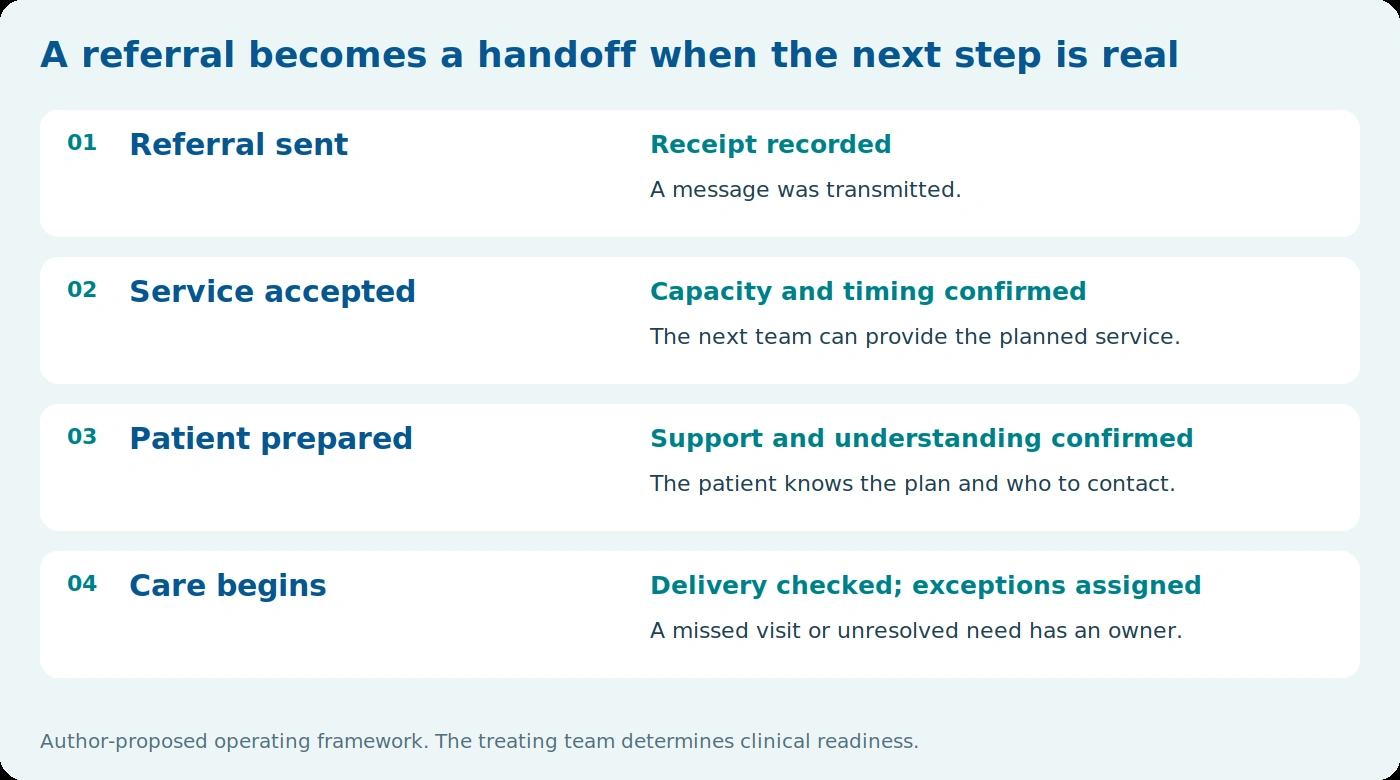
“Referral sent” and “service accepted” should be distinct states. An electronic message can establish transmission while leaving capacity, timing, and clinical responsibility unresolved. The receiving provider should know the reason for the referral, the patient’s relevant needs, the planned start of care, and how to contact the hospital about a discrepancy. The hospital needs a defined owner for any response that does not arrive.
APPLIED CASE
Read the case transcript
It is Friday afternoon. A patient recovering from hip fracture surgery is preparing to leave the hospital. This is a fictional case.
The plan says home health, with help from the patient’s daughter. The referral has been sent, so the discharge board shows the transition as complete.
Then the nurse asks one question. Has the home health agency accepted the patient and confirmed when care will begin?
The answer is no. The agency has not responded. The daughter also says she cannot provide the planned help tonight.
The team has a decision to make. Does the current plan meet the patient’s needs with the support that is actually available?
The transition coordinator marks the handoff as unresolved. The treating clinician and rehabilitation team reassess the plan with the patient.
The coordinator confirms available services and a start time with a receiving agency. The patient is offered clinically appropriate choices.
The team confirms the caregiver’s availability, reconciles the medication plan, and checks that the patient understands whom to contact if a problem develops.
Only after the revised plan is clinically acceptable and its support is confirmed does the team close the handoff. A named coordinator checks that the next service begins.
The lesson for leaders is specific. Referral sent, service accepted, and care started are different events. Track the gap and give someone responsibility for closing it.
Under episode accountability, a shorter hospital stay is only useful when it supports safe recovery. This case illustrates an operating process, not a clinical discharge protocol.
These operational recommendations are the author’s synthesis, not a verbatim list of TEAM requirements. They are consistent with evidence showing variation in hospitals’ care-management capacity and with reports that many hospitals pursue similar redesign strategies regardless of bundled-payment participation. Joining a model does not itself establish that the necessary work occurs reliably. [3, 17]
| Before the handoff closes | Evidence the team should be able to show | Who resolves a gap |
|---|---|---|
| The recovery destination fits the patient | Clinical and functional assessment, patient preferences, and an individualized plan | Treating clinician with rehabilitation and case management |
| The next service is available | Receiving provider’s acceptance and an agreed start or appointment | Named transition coordinator |
| Medicines and instructions are usable | Reconciled plan, access to needed medicines, and patient or caregiver understanding | Nursing and pharmacy, with the treating team |
| Help at home is realistic | Confirmed availability, ability, willingness, and unresolved support needs | Case management with the patient and caregiver |
| There is a route for deterioration or confusion | Clear contact and escalation instructions appropriate to the clinical situation | Treating service and receiving team |
Applied case: the discharge that was not yet a handoff
In this fictional case, a patient recovering from hip fracture surgery is preparing to go home. The discharge plan depends on home health services and help from a daughter who has not agreed that she can provide the required support. The team must decide whether the proposed plan is deliverable and who will close the remaining gaps.
The lesson is to expose the unresolved dependency before it becomes the patient’s problem. The coordinator confirms the agency’s response, the clinical team reassesses the plan in light of available support, and the patient participates in the decision. A completed discharge document does not excuse an unconfirmed service. The case illustrates a management process; it is not a clinical discharge protocol or an account of a real patient.
Read figure 2 as text
A referral becomes a handoff when the next step is real
01
Referral sent
Receipt recorded
A message was transmitted.
02
Service accepted
Capacity and timing confirmed
The next team can provide the planned service.
03
Patient prepared
Support and understanding confirmed
The patient knows the plan and who to contact.
04
Care begins
Delivery checked; exceptions assigned
A missed visit or unresolved need has an owner.
Author-proposed operating framework. The treating team determines clinical readiness.
Protect choice, function, and the people providing care
CMS’s beneficiary notice explains that TEAM does not remove Medicare benefits, rights, or protections. Medically necessary services remain covered, and beneficiaries retain freedom of provider choice. Patients cannot individually opt out of TEAM while receiving applicable services from a participating hospital, but they retain the ability to seek care from another hospital. The notice also explains that the model does not change what the beneficiary pays. Staff should be prepared to explain these points accurately and without pressuring the patient. [31]
A preferred postacute relationship can improve information exchange and create a reliable escalation route. It should also preserve the patient’s choice and a clinically appropriate alternative when the preferred provider lacks capacity. Referral materials and conversations should distinguish the reason for a recommendation from the hospital’s financial relationship with a collaborator. Compliance and legal teams should review the applicable arrangement and model requirements. [26, 31]
The possibility of shifting work onto families deserves explicit attention. Werner and colleagues studied mandatory joint replacement bundled payment and found increases in the need for and receipt of help with daily activities at the end of a home health episode. The estimated absolute changes were about one to two percentage points. The study connects payment reform to a consequence that a hospital’s claims-based spending dashboard may miss: work performed by unpaid caregivers. It does not mean every home discharge creates an inappropriate burden. It means that the burden should be assessed rather than presumed away. [20]
Rehabilitation should be treated as part of recovery, not simply as a reducible expense. Research on acute occupational therapy under CJR found no increase in its provision, even though higher provision was associated with larger financial rewards. That association does not establish a return on investment for every additional therapy session. It does support evaluating whether the hospital’s redesign effort has overlooked clinically useful services. [5]
Patient-reported experience supplies another necessary perspective. In a survey of beneficiaries in physician-group BPCI episodes, several measures of care experience were less favorable than in the comparison group, despite no detected differences in overall satisfaction with recovery or measured functional change. A small study of age-friendly care also illustrates why days at home can be informative while requiring cautious interpretation: its primary analyses did not show significant differences between groups, and favorable findings arose in sensitivity analyses. Neither study justifies treating one utilization measure as a complete account of recovery. [13, 24]
Equity needs denominators, not assurances
Mandatory participation changes which hospitals must build episode-management capabilities. A study of voluntary BPCI Advanced participation found that communities with larger shares of beneficiaries dually eligible for Medicare and Medicaid were less likely to be served by a participating hospital. The relationship was not the same for every racial or ethnic group. Organizations should avoid compressing these distinct findings into a claim that all marginalized populations experienced the same participation gap. [10]
Available outcome research is more nuanced than a simple prediction of harm. One study associated mandatory CJR participation with a reduction in the complication disparity between dual-eligible and other beneficiaries, without differential changes in readmissions or mortality. Another found no disproportionate reduction in joint replacement use among beneficiaries with Alzheimer disease and related dementias during the first two years of CJR. Research on BPCI Advanced also found no consistent adverse selection or differential worsening of clinical outcomes among the examined higher-risk groups. These findings are reassuring within their studied settings and periods. They do not remove the need to monitor TEAM. [12, 21, 22]
The hospital’s analysis should include who reaches the surgical pathway, whose procedure is deferred, and why a recommended service cannot be obtained. Looking only at completed episodes can conceal patients who never entered the denominator. Review results by relevant clinical and social factors where data quality and sample sizes permit, protect privacy in small groups, and investigate differences before assigning a causal explanation.
Hospital resources matter as well. A California study found that CJR’s association with inpatient length of stay differed by hospital ownership, with public hospitals experiencing a different pattern from nonprofit and for-profit institutions. A national analysis of hospitals reporting bundled-payment participation found little change in overall length of stay. Together, these studies caution against imposing a universal shorter-stay target and calling it evidence-based episode management. [6, 18]
Give finance, quality, and operations a shared view
The executive report should make it possible to distinguish a genuine improvement from a change in coding, patient mix, benchmark, provider utilization, or incomplete claims. A single reconciliation number cannot do this. The finance leader should identify the source and maturity of each estimate, while clinical leaders explain the changes in care that plausibly contributed to it.
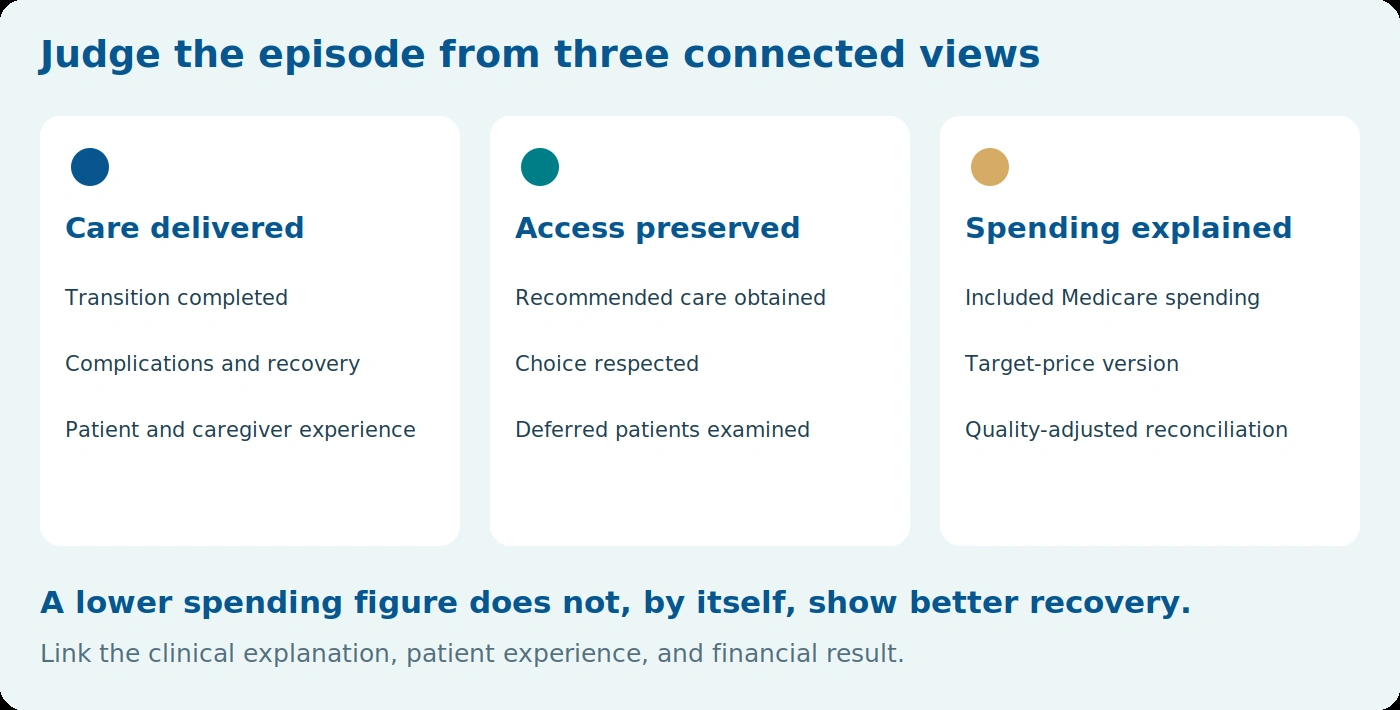
Three views should remain linked. First, the episode view identifies eligible patients, procedures, dates, attributed claims, and exceptions. Second, the care view tracks whether the planned transition occurred and whether recovery was safe and acceptable. Third, the financial view distinguishes included Medicare spending, the hospital’s own costs, target-price versions, and expected reconciliation. The organization should be able to move from a concerning aggregate result to a sample of cases that explains it. [27, 28, 29]
Read figure 3 as text
Judge the episode from three connected views
Care delivered
Transition completed
Complications and recovery
Patient and caregiver experience
Access preserved
Recommended care obtained
Choice respected
Deferred patients examined
Spending explained
Included Medicare spending
Target-price version
Quality-adjusted reconciliation
A lower spending figure does not, by itself, show better recovery.
Link the clinical explanation, patient experience, and financial result.
ACO alignment is relevant but does not replace this work. A 2025 observational study of TEAM-targeted surgeries before the model began associated ACO assignment with lower mortality and slightly higher episode spending. The authors concluded that primary-care alignment alone was unlikely to produce significant surgical savings. The practical implication is to define how surgeons, hospital teams, and primary care will share information and respond to problems, rather than assume that an organizational affiliation guarantees coordination. [25]
Hospitals should also look beyond the formal Medicare population when evaluating a redesigned pathway. Research on CJR found spillover changes affecting other payer groups and some related procedures. An organization can standardize helpful clinical processes while still maintaining accurate distinctions between model eligibility, payer rules, and the outcomes of different populations. [23]
An executive scorecard with useful questions
| View | Measure or review question | Interpretation guardrail |
|---|---|---|
| Eligibility | Are triggering episodes, exclusions, and code versions correct? | A denominator error can resemble a performance change. |
| Transition | Was the next service accepted and started as planned? | A referral transmission is not evidence of service delivery. |
| Recovery | What happened to complications, readmissions, function, and patient experience? | A lower utilization rate alone does not establish better recovery. |
| Access | Who was deferred, redirected, or unable to obtain recommended care? | Completed episodes exclude people who never entered the pathway. |
| Caregiver support | Could the identified helper provide the agreed assistance? | Informal care has real costs even when no Medicare claim appears. |
| Finance | What explains changes in episode spending and reconciliation? | Separate clinical change, benchmark change, and payment transfers. |
This proposed scorecard supplements the official measures. It should not be described as CMS’s required reporting list. Each local measure needs a stable definition, an owner, a denominator, and an escalation rule. The hospital should select a manageable set that leads to decisions rather than add measures that nobody reviews.
What leaders should do next
In the first month of a focused improvement effort, confirm the accountable hospital, current track, episode rules, and impending code changes. Reconcile a sample of internally identified episodes with the available CMS information. Map how a patient moves from the operation to the receiving provider, including evenings, weekends, and failed referrals. Ask staff to show the actual records used to close a handoff.
In the second month, test a limited change within one episode category. A useful initial target is the gap between sending a postacute referral and confirming that care can begin. Specify who owns the gap, how long the team can wait given the patient’s needs, and who changes the plan if capacity is unavailable. Include the patient and caregiver in the evaluation. Review unintended effects alongside the intended result.
In the third month, assess whether the process works consistently and whether the result is clinically credible. Review spending with appropriate claims lag and case-mix context. Examine exceptions and access differences. If the change appears useful, adapt it to another category after accounting for that category’s clinical needs. If the evidence is mixed, revise the process before expanding it.
Board oversight should focus on whether the organization can demonstrate this learning cycle and respond to a failed transition. TEAM creates financial accountability for an episode. Leadership must translate that accountability into reliable care, informed choices, and a clear answer when the next step in recovery does not happen.
Review approach and limitations
This narrative review integrates 25 individually checked peer-reviewed publications with CMS model materials and the FY 2027 final rule. Scholarship was selected for relevance to bundled payment, surgical episodes, organizational capacity, care transitions, caregiver effects, patient experience, or equitable access. Source records and abstracts were reviewed; full-text methods, results, and limitations were examined where available for the claims developed here. This was a focused narrative synthesis, not a systematic review or meta-analysis.
Most outcome studies evaluated predecessor models and historical cohorts. Voluntary participation, residual confounding, differences in episode windows, local program designs, and changes in policy limit transfer to TEAM. Descriptive studies identify characteristics and operational questions; they do not establish causal effects. The case and management frameworks are author-created illustrations. They should be adapted to the hospital’s population and resources and evaluated in practice.
Important disclaimer
This article is for educational discussion and does not provide legal, financial, coding, or patient-specific clinical advice. CMS regulations, current model documents, and applicable agreements govern participation. Clinical decisions must reflect the individual patient’s needs, informed preferences, and the judgment of the treating professionals.
References
- Crowley AP, Kilaru AS, Huang QE, et al. Physician and Hospital Performance in Medicare’s Updated Bundled-Payment Model for Joint Replacement. JAMA Health Forum. 2025;6(7):e251930.Source
- Liao JM, Huang Q, Wang E, et al. Performance of Physician Groups and Hospitals Participating in Bundled Payments Among Medicare Beneficiaries. JAMA Health Forum. 2022;3(12):e224889.Source
- Urwin J, Navathe AS, Zhou L, et al. Organizational Capacity Among Hospitals in Medicare and Commercial Bundled Payments. American Journal of Managed Care. 2022;28(12):678–683.Source
- Lin SC, Funk RJ, Ryan AM, et al. Bundled Payments Lead to Quality Improvements in Hospitals’ Skilled Nursing Facility Referral Networks. American Journal of Managed Care. 2024;30(6):e184–e190.Source
- Li J, Monti Y, Ryan A. Hospitals Did Not Increase Acute Occupational Therapy Provision Despite Positive Associations With Hospital Performance Under Medicare’s Comprehensive Care for Joint Replacement Program. American Journal of Occupational Therapy. 2025;79(1).Source
- Tian Y, He J, Ryskina K. Length of Stay in Hospitals Reporting Participation in Bundled Payment Programs: 2016 to 2022. Inquiry. 2025;62:00469580251384529.Source
- Kilaru AS, Ng GY, Wang E, et al. Savings Associated With Bundled Payments for Outpatient Spine Surgery Among Medicare Beneficiaries. JAMA Health Forum. 2025;6(7):e251907.Source
- Shashikumar SA, Zheng J, Tsai TC, et al. Characteristics of Hospitals Participating in the Transforming Episode Accountability Model. JAMA Health Forum. 2025;6(7):e251996.Source
- Ryan AM, Lin Y, Buxbaum JD, et al. Bundled Payments For Care Improvement Advanced: Effects On Hospital And CMS Spending, 2018-21. Health Affairs. 2026;45(2):121–128.Source
- Crowley AP, Neville S, Sun C, et al. Differential Hospital Participation in Bundled Payments in Communities with Higher Shares of Marginalized Populations. Journal of General Internal Medicine. 2024;39(7):1180–1187.Source
- Sibia US, Klune JR, Saiolghalam S, et al. Early Experiences With Bundled Payments for Care Improvement for Major Bowel Surgery. The American Surgeon. 2024;90(6):1390–1396.Source
- Kilaru AS, Liao JM, Wang E, et al. Association between mandatory bundled payments and changes in socioeconomic disparities for joint replacement outcomes. Health Services Research. 2024;59(5):e14369.Source
- Drago K, De Lima B, Rasmussen S, et al. Effect of Age-Friendly Care on Days at Home Post-Hospital Discharge for Traditional Medicare Patients: A Cross-Sectional Study. Inquiry. 2025;62:00469580251324408.Source
- Shashikumar SA, Chopra Z, Buxbaum JD, et al. Physician Group Practices Accrued Large Bonuses Under Medicare’s Bundled Payment Model, 2018-20. Health Affairs. 2024;43(5):623–631.Source
- Wolfe JD, Epstein AM, Zheng J, et al. Predictors of Success in the Bundled Payments for Care Improvement Program. Journal of General Internal Medicine. 2022;37(3):513–520.Source
- Shashikumar SA, Gulseren B, Berlin NL, et al. Association of Hospital Participation in Bundled Payments for Care Improvement Advanced With Medicare Spending and Hospital Incentive Payments. JAMA. 2022;328(16):1616–1623.Source
- Hammond G, Lanter T, Wang F, et al. Hospitals’ Strategies to Reduce Costs and Improve Quality: Survey of Hospital Leaders. American Journal of Managed Care. 2024;30(8):e240–e246.Source
- Kim N, Jacobson M. Medicare’s comprehensive care for joint replacement model increased public hospitals’ inpatient length of stay. BMC Health Services Research. 2024;24:1495.Source
- Snow RJ, McKown L, Blossom G, et al. Impact of Functional Recovery on Patients Having Heart Surgery. American Journal of Managed Care. 2024;30(10):504–509.Source
- Werner RM, Coe NB, Kim S, et al. The Effects of Post-Acute Care Payment Reform on the Need For and Receipt of Caregiving. American Journal of Health Economics. 2025;11(2):247–273.Source
- Joynt Maddox KE, Orav EJ, Zheng J, et al. Medicare’s Bundled Payments For Care Improvement Advanced Model: Impact On High-Risk Beneficiaries. Health Affairs. 2022;41(11):1661–1669.Source
- Thirukumaran CP, Ricciardi BF, Cai X, et al. Association of Medicare Mandatory Bundled Payment Reform With Joint Replacement Surgery Use for Beneficiaries With Alzheimer Disease and Related Dementias. JAMA Health Forum. 2022;3(2):e215111.Source
- Chen AJ, Richards MR, Whaley CM, et al. The Extent of Externalities from Medicare Payment Policy. American Journal of Health Economics. 2022;8(2):181–215.Source
- McClellan SR, Trombley MJ, Marshall J, et al. Bundled Payment Episodes Initiated by Physician Group Practices: Medicare Beneficiary Perceptions of Care Quality. Journal of General Internal Medicine. 2022;37(5):1052–1059.Source
- Berlin NL, Ma Y, Zheng J, et al. Accountable Care Organization Assignment and Outcomes and Spending for TEAM Surgical Conditions. JAMA. 2025;334(17):1553–1555.Source
- Centers for Medicare & Medicaid Services. Transforming Episode Accountability Model (TEAM). CMS. Current model page, updated September 9, 2026.Source
- Centers for Medicare & Medicaid Services. FY 2027 IPPS/LTCH PPS final rule, TEAM and CJR-X provisions. CMS. Federal Register, August 4, 2026; document 2026-15833.Source
- Centers for Medicare & Medicaid Services. TEAM Clinical Episode Construction Specifications. CMS. September 2025; read with subsequent final-rule changes.Source
- Centers for Medicare & Medicaid Services. TEAM Risk Adjustment and Preliminary Target Price Specifications. CMS. September 2025; read with subsequent final-rule changes.Source
- Centers for Medicare & Medicaid Services. Participation Tracks in TEAM. CMS. Model fact sheet.Source
- Centers for Medicare & Medicaid Services. TEAM Beneficiary Notification Letter. CMS. November 2025.Source
- Centers for Medicare & Medicaid Services. Introduction to TEAM Quality Measures. CMS. Read with FY 2027 updates to baseline and measurement periods.Source
- Centers for Medicare & Medicaid Services. TEAM Frequently Asked Questions. CMS. Updated April 23, 2026; read with subsequent rulemaking.Source