
A Finding Is Not a Handoff.
Capture. Validate. Interpret. Close the loop.
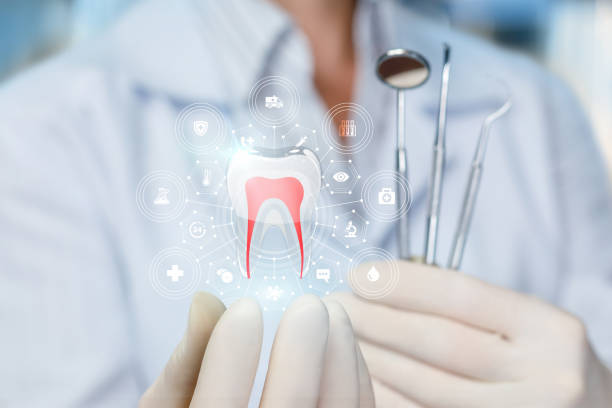
Dental technologies can reveal anatomy, quantify change, support pattern recognition, capture a digital impression, manufacture a patient-matched device, extend a consultation, and transmit structured information. None of those functions by itself proves a diagnosis, completes treatment, coordinates medical and dental care, or improves whole-person health.
The integration gap appears after capture. The image may lack a reproducible protocol, the algorithm may be used beyond its intended purpose, the printed device may lose material or process traceability, the virtual visit may be insufficient for the question, the referral may omit the evidence a medical recipient needs, or a result may enter the record without acknowledgment, action, or return.
The Oral Signal Relay is an operating model for moving one bounded oral-health signal into a safe decision. Its Oral Health Signal Chain Record captures the care question, technology and version, intended use, patient and setting, capture protocol, data quality, interpretation, uncertainty, patient explanation, minimum handoff dataset, recipient, acceptance, action, due date, follow-up, and returned outcome.
A dental technology matters beyond the operatory only when its signal survives the handoff and changes a safe care decision.
The mouth is not a sidecar to health, and a device is not integration. Oral and systemic conditions can share risks, influence care planning, and require coordination. Association or common risk is not proof that a dental technology prevents or treats a systemic disease. Keep the exact finding, mechanism, evidence, and decision boundary visible.
This Relay and Chain Record are editorial operating models, not NIDCR, CDC, ADA, FDA, HHS, HL7, legal, regulatory, diagnostic, radiologic, infection-control, licensure, privacy, interoperability, medical-device, or clinical standards. They do not establish status, safety, diagnosis, necessity, coverage, competence, consent, privacy compliance, referral duty, systemic benefit, or a closed loop. Apply current requirements and qualified judgment to the exact patient, technology, use, setting, recipient, and jurisdiction.
The sections below move the signal through fifteen relay stages, from the care question to a measured, governed closed loop.
Begin with the decision the signal must support.
Write the care question before selecting the technology. Identify the oral condition or process, the patient decision or coordination need, what uncertainty is being reduced, which action could change, who can act, how quickly a response is needed, and what outcome or process measure will show the loop worked.
Separate detection, classification support, diagnosis, treatment planning, fabrication, monitoring, education, consultation, referral, and whole-person coordination. A technology that performs one step should not inherit the claims of the later steps. Define the handoff only when another role or setting is needed to answer the question.
NIDCR’s Oral Health in America resources place oral health within broader health and well-being and describe substantial access, disease, workforce, and research challenges. They support whole-person attention, not a claim that a particular dental device prevents systemic disease or makes a coordination pathway complete.
Name the exact tool, version, role, and status.
Record manufacturer, product, model, software, algorithm, accessory, material, file format, imaging source, build equipment, configuration, version, intended use, user, environment, regulatory status where applicable, and what the technology is not intended to do. Do not approve a category such as dental AI, digital dentistry, 3D printing, or teledentistry.
Separate capture devices, image viewers, measurement tools, AI-enabled medical devices, administrative automation, digital impression systems, design software, milling, additive manufacturing, communication platforms, patient portals, and data exchange. Each changes a different step and has different validation, training, status, cybersecurity, privacy, failure, and monitoring needs.
FDA’s public list of AI-enabled medical devices is noncomprehensive and changes over time. Confirm the exact device, version, intended use, status, labeling, and current source. Presence on a list does not establish local performance, patient fit, comparative benefit, coverage, or permission to use another model or claim.
Match the technology to the person, indication, and care environment.
Define age, dentition and anatomy, condition, symptoms, prior treatment, medical history, medication, pregnancy status where relevant, disability, sensory and communication needs, ability to tolerate positioning, infection-control needs, urgency, and access to follow-up. Record only factors needed for the decision and protect sensitive information.
Define the setting: dental office, community clinic, mobile site, school, long-term-care setting, home, hospital, specialty center, or remote encounter. Lighting, network, sensor, calibration, display, positioning, image quality, trained support, emergency response, privacy, and referral access can change whether the same technology is sufficient.
CDC oral-health data describe common conditions and unequal burdens in the United States. Population facts can identify a need for access and prevention, but they do not determine an individual diagnosis, justify a specific image or device, or show that a technology closes a local disparity.
Confirm that the setting can complete the downstream work before increasing capture. More screening or image access can lengthen queues when interpretation, specialty referral, treatment, fabrication, or medical consultation capacity does not grow with it. Report the time from eligible signal to completed care, not only the number of new findings.
Qualify the signal before it reaches interpretation.
Specify patient identity, order or clinical question, device and version, operator, calibration, preparation, positioning, field, exposure or acquisition settings, environmental conditions, file type, compression, enhancement, metadata, time, and repeat criteria. Preserve the original and the transformations used to create any derived view or model input.
Define acceptable coverage, resolution, contrast, focus, distortion, artifact, completeness, and patient tolerance for the intended decision. A beautiful image can omit necessary anatomy; a technically imperfect image can still be sufficient for a narrower question. The qualified interpreter, not an automated quality score alone, determines whether to proceed, recapture, use another method, or escalate.
Track repeats and rejected captures by device, operator, setting, indication, patient group, and cause with appropriate privacy. A new technology can reduce one kind of failure while increasing motion artifact, incomplete fields, repeated exposure, processing delay, or reliance on a higher-cost fallback.
Choose the least exposure that can answer the question.
Imaging decisions are individualized after clinical examination and review of health and dental history. Name the diagnostic or treatment question, required anatomy and resolution, prior usable images, lower-exposure alternatives, expected change in care, and reason a repeat or larger field is necessary. More information is not automatically better care.
ADA’s radiography resource emphasizes patient-specific selection rather than fixed schedules. FDA’s dental cone-beam CT resource explains that CBCT should be used only when necessary to answer a clinical question that cannot be answered adequately with a lower-exposure option. Apply pediatric sensitivity, field-of-view control, positioning, dose reduction, quality assurance, and current professional guidance. Do not apply legacy patient shielding by default; follow current recommendations and applicable state requirements for the exact setting.
Do not let an AI feature create demand for additional images beyond the patient’s justified care. If the model requires a different field, modality, resolution, or repeat, justify the exposure independently and consider whether another clinical route can answer the question.
Maintain modality and operator quality assurance, display and viewing conditions, equipment checks, protocol review, and the required interpretation of the acquired field. ADA patient-selection recommendations are professional resources rather than one-size requirements or regulations; state law and the exact clinical context continue to govern.
Keep the model inside a monitored human decision.
Define what the model does: quality check, segmentation, measurement, detection support, prioritization, classification support, planning, documentation, or another bounded function. State its input requirements, output, intended user, intended-use population, threshold, uncertainty, prohibited uses, and the clinical decision that remains with a qualified professional.
Validate the exact version locally before reliance. Include representative devices, acquisition protocols, image quality, settings, ages, anatomy, conditions, relevant demographic and disability groups, disease prevalence, outside images, and users. Measure false positives, false negatives, failure to process, calibration, agreement, overrides, downstream actions, and harm, not accuracy alone.
FDA’s current GMLP page points to the January 2025 IMDRF final document and its ten lifecycle guiding principles. Use the principles as lifecycle input without converting them into proof that a specific dental model is valid, unbiased, clinically beneficial, or authorized for the proposed use.
Design the interface to preserve dissent. Show when the model did not evaluate an area, how the output was produced and changed, what the user confirmed or rejected, and whether a later reviewer can see the original. Do not punish appropriate overrides or allow the model’s confidence display to replace clinical reasoning.
Preserve identity from impression through fit.
A digital impression, design, milled part, or printed device carries a chain of patient identity, capture, file, segmentation, design decision, material, machine, build orientation, process parameters, support removal, cleaning, curing or sintering, inspection, fit, release, and delivery. A defect can enter at any handoff while the final object still appears finished.
FDA’s 3D-printing process overview describes design, software workflow, printing, and post-processing. Regulatory status and controls depend on the exact device, material, intended use, manufacturer, and process. Do not transfer clearance, evidence, or a validated build from one material, machine, parameter set, laboratory, or clinical use to another.
Measure the full outcome chain: acceptable capture, design approval, first-pass build, fit without unsafe adjustment, function, patient experience, remake, repair, adverse event, and durability. Faster manufacture or fewer appointments does not prove equivalent fit, material performance, or long-term outcome.
Set rebuild and recapture rules before delivery. A changed prescription, corrected segmentation, software update, substituted material, machine maintenance, failed post-process, altered fit, or lost file can invalidate part of the digital thread. Preserve the released version and every superseding decision so a later complaint can be traced.
Keep every digital surface inside infection control.
Map sensors, holders, scanners, cameras, handpieces, keyboards, touchscreens, mobile devices, printers, resin or powder handling, post-processing tools, storage, cables, covers, mounts, and shared workstations. Identify patient-contact class, manufacturer instructions, cleaning, disinfection or sterilization, barriers, clean and contaminated flow, storage, transport, waste, and staff exposure.
CDC’s Summary of Infection Prevention Practices in Dental Settings supports foundational program, equipment, environmental, reprocessing, and occupational controls. Digital does not mean clean. Do not adopt a sensor, scanner, device, material, or workflow until the team can follow current instructions and maintain separation, competency, monitoring, and incident response.
Include IPC burden and failure in technology evaluation. A faster capture can still add barrier changes, difficult-to-clean surfaces, damaged sensors, transport, printer hazards, post-processing, or shared-screen work. Measure safe cycle time and functional availability, not only acquisition speed.
Coordinate shared risk without claiming unsupported causation.
An oral finding may matter to medical care because of symptoms, infection, inflammation, medication, planned procedure, pregnancy, diabetes management context, tobacco or substance use, nutrition, sleep, immune status, cancer care, bleeding risk, or another patient-specific pathway. State the exact reason for coordination and the evidence boundary.
NIDCR’s Oral Health in America section on integration discusses connections, shared risks, health-system fragmentation, and opportunities for coordination. Use that context to improve communication. Do not translate an association, common risk factor, or care-planning relationship into proof that a dental technology diagnoses, prevents, or treats a systemic condition.
Preserve ordinary care while the handoff is open. Urgent oral conditions require their appropriate dental or medical route; a coordination referral should not delay necessary treatment. Similarly, a systemic concern requires qualified medical evaluation rather than repeated dental imaging or algorithm output used beyond its role.
Tell the patient what the technology adds and what it cannot decide.
Explain the care question, technology role, alternatives, acquisition or exposure, output, uncertainty, false signals, need for professional interpretation, possible incidental information, data recipients, remote or vendor involvement, cost, and what changes if the patient declines. Use accessible language and teach-back rather than a generic technology consent.
Separate care-team access, proxy access, payer or vendor processing, cloud storage, remote consultation, quality improvement, research, marketing, model development, and patient-directed sharing. Record the legal and organizational basis for each use and the patient’s choices where applicable. Portal availability or a signed treatment consent does not authorize every secondary use.
Show the patient the qualified finding in context when useful, but do not let visualization become persuasion. An enlarged color map, confidence score, 3D model, or simulation can feel definitive. Explain scale, enhancement, prediction, uncertainty, and whether the display represents measured anatomy, a derived model, or a proposed design.
Use teledentistry only for questions the encounter can safely answer.
Define whether the encounter is synchronous, asynchronous, remote monitoring, consultation, triage, education, follow-up, or another service. Name the patient and clinician locations, current licensure and scope requirements, identity, consent, privacy, technology, documentation, image quality, prescribing or ordering boundaries, emergency route, and local in-person follow-up.
ADA’s teledentistry policy is a professional policy, not law. Check current state licensure, scope, standard of care, prescribing, supervision, consent, record, privacy, payer, and facility requirements for the exact service. A virtual connection does not make an insufficient examination sufficient.
HHS telehealth privacy guidance explains HIPAA considerations for covered providers. The COVID-era enforcement discretion for remote communications expired August 9, 2023. Use current privacy and security requirements, vendor arrangements, and organizational policy rather than relying on temporary flexibilities.
Measure time to local care, not only virtual access. A remote visit can reduce travel for one step while adding image capture, portal setup, repeated explanation, delayed referral, separate billing, or another trip. Report who cannot connect or find an accepting local provider.
Send the smallest complete signal a recipient can use.
Define a minimum referral dataset for the exact question: patient identity and contact, consent or authorization basis, oral finding, symptoms, examination, relevant history and medication, image or measurement with protocol and provenance, interpretation, uncertainty, urgency, action already taken, requested response, sender, recipient, due date, and safe contact route.
HL7 U.S. Dental Data Exchange version 1.0.0 STU1, based on FHIR R4, is the current published version generated November 2, 2021. Technical conformance does not prove that codes carry the intended meaning, the dataset is complete, the recipient accepted responsibility, or the clinical loop closed.
Do not send every available dental datum in place of choosing what matters. Excess data can obscure urgency and transfer privacy and review burden. Send enough to answer the question, preserve provenance for deeper review, and make missing information explicit.
Require acceptance, action, and a returned outcome.
A referral becomes a handoff only when a specific recipient accepts the question and responsibility. Name the dental and medical roles, urgency, accepted communication channel, expected response, due date, failed-contact route, patient contact, and the event that returns the loop to the initiating team.
Quarantine failures at the stage where they occur. A corrupted image remains a capture failure; an unsupported algorithm output remains unqualified; a technically delivered message with no responsible recipient remains unaccepted; a scheduled visit without an outcome remains open. Do not promote these events into downstream success counts.
Measure time between every relay state. A fast capture can coexist with a slow interpretation, an accepted referral can wait months, and a completed medical visit can fail to return the information dentistry needs. Report the bottleneck and the people lost at each transition.
Measure who can enter and complete the relay.
Audit technology and pathway access by language, disability, age, geography, payer, device and connectivity access, setting, transportation, appointment availability, and relevant validation subgroup with appropriate privacy. Offering the same portal, scanner, algorithm, or virtual visit does not create the same ability to complete the care chain.
Test accessible positioning, sensory and communication support, plain-language explanation, interpreter workflow, proxy controls, low-bandwidth option, nondigital route, local capture, in-person escalation, and receipt confirmation. Do not make a patient supply an expensive device, broadband, technical helper, or repeated travel without counting the burden.
Monitor model and image-quality performance across the population actually served. Lower capture quality or higher no-result rates in one setting can create more repeats, exposure, travel, cost, or delayed care even when aggregate algorithm performance appears stable.
Pair access expansion with recipient capacity and financial navigation. A low-cost remote capture can still end in an unaffordable image, specialist visit, restoration, device, transportation need, or lost work. Report out-of-pocket estimates, accepting providers, time to appointment, and completion rather than treating referral availability as care access.
Prove one signal chain before adding another technology.
In days one through thirty, choose one bounded medical-dental question and one existing technology-supported pathway at one site. Map ten recent cases. Approve the Chain Record, technology and version register, capture protocol, sufficiency criteria, interpretation boundary, patient explanation, minimum handoff dataset, recipient agreement, escalation, returned outcome, and equity measures.
In days thirty-one through sixty, apply the relay to every consecutive eligible case under existing care authority. Hold a weekly review of rejected captures, imaging justification, model overrides, build defects, IPC issues, privacy incidents, remote insufficiency, rejected or unaccepted referrals, overdue actions, missed follow-up, and returned outcomes. Preserve an alternate route when the technology fails.
In days sixty-one through ninety, reconcile every open handoff and stratify completion, delay, repeats, exposure, cost, burden, and outcome. Simulate a wrong patient, corrupted image, AI outage, printer material recall, privacy issue, and unavailable referral recipient. Decide continue, modify, or stop. Expand only after every relay state has an owner and failure quarantine works.
Govern the relay through a dental clinical owner, imaging and radiation-safety expertise, technology or AI owner, laboratory and fabrication owner, infection prevention, privacy and security, interoperability, medical liaison, quality, equity, operations, credentialing, and patient advisor as applicable. Vendors support products but do not decide patient fit, local validity, or closure.
Reopen the relay after a technology, software, algorithm, material, device status, intended use, capture protocol, imaging recommendation, privacy rule, licensure requirement, data standard, recipient, referral capacity, or population change. Version the decision and preserve a rollback route so an update cannot silently inherit the prior pathway’s evidence.
Retire the technology counts that impersonate coordinated care.
Stop calling a finding a diagnosis, an image a completed interpretation, an AI flag a decision, a digital impression a successful device, a printed object a validated fit, a virtual connection sufficient care, a FHIR transaction semantic understanding, a referral an accepted handoff, or an appointment a closed outcome.
Stop fixed imaging schedules, technology-driven exposure, category approval for AI, inherited validation across versions, invisible overrides, broken fabrication provenance, dirty digital surfaces, oral-systemic causal overclaim, generic consent, expired privacy flexibility, teledentistry without local escalation, data dumping, and equity claims that exclude people unable to complete the relay.
The correction is a chain with proof at every transition: exact question, technology, patient, capture, justification, interpretation, build, IPC, meaning, choice, remote sufficiency, minimum dataset, acceptance, action, equity, and returned outcome.
Conclusion: Make the signal survive the handoff.
Dental technology can strengthen whole-person care when it captures a needed signal safely, preserves provenance, supports qualified interpretation, explains uncertainty, reaches a responsible recipient, produces an owned action or no-action decision, and returns the result to the patient and originating team.
The durable innovation is not another disconnected device. It is an Oral Health Signal Chain Record that can show where the relay succeeded, where it stopped, who owns the next step, and whether the loop genuinely closed.
Sources and further reading
- National Institute of Dental and Craniofacial Research: Oral Health in America. Official NIH report released December 21, 2021 with published errata; national background rather than a current device-market catalog or proof of systemic outcome.
- National Institute of Dental and Craniofacial Research: Section 6 Summary. December 2022 bulletin, last reviewed July 2024; forward-looking technology and integration context that calls for validation, translation, diversity, access, and equity.
- Centers for Disease Control and Prevention: Oral Health Facts and Statistics. Dated May 15, 2024; population burden and integration context, not an individual diagnosis, device-specific causal claim, or return-on-investment proof.
- American Dental Association: X-Rays and Radiographs. Topic updated March 26, 2026 and checked August 3, 2026; incorporates 2024 safety and 2026 patient-selection guidance, is informational rather than a standard, and does not replace state law.
- U.S. Food and Drug Administration: Dental Cone-Beam Computed Tomography. Live page checked August 3, 2026; justify and optimize CBCT, including pediatric sensitivity, when needed information cannot come from a lower-exposure modality.
- U.S. Food and Drug Administration: Artificial Intelligence-Enabled Medical Devices. Noncomprehensive list checked August 3, 2026, with final decisions through March 30, 2026; authorization remains submission, device, version, and intended-use specific.
- U.S. Food and Drug Administration: Good Machine Learning Practice Guiding Principles. Live page checked August 3, 2026 and citing the January 2025 IMDRF final document; lifecycle development principles rather than a hospital rule or local validation result.
- U.S. Food and Drug Administration: Process of 3D Printing Medical Devices. Live page checked August 3, 2026; design, software, material, printing, post-processing, validation, and testing remain exact-device and intended-use specific.
- American Dental Association: Policy on Teledentistry. Policy updated 2020; professional policy rather than law, with current state licensure, scope, supervision, privacy, and local follow-up still controlling.
- U.S. Department of Health and Human Services: HIPAA and Telehealth. Last reviewed October 18, 2023; COVID-era enforcement-discretion transition expired August 9, 2023 and current HIPAA obligations apply.
- Centers for Disease Control and Prevention: Summary of Infection Prevention Practices in Dental Settings. Page dated May 15, 2024 and guide citation October 2016; it relies mainly on an archived 2003 guideline CDC says continues as a standard of practice and does not replace full guidelines.
- HL7: U.S. Dental Data Exchange 1.0.0 STU1. FHIR R4 current published version generated November 2, 2021; conformance does not prove semantic completeness, transport success, receipt, action, or closure.