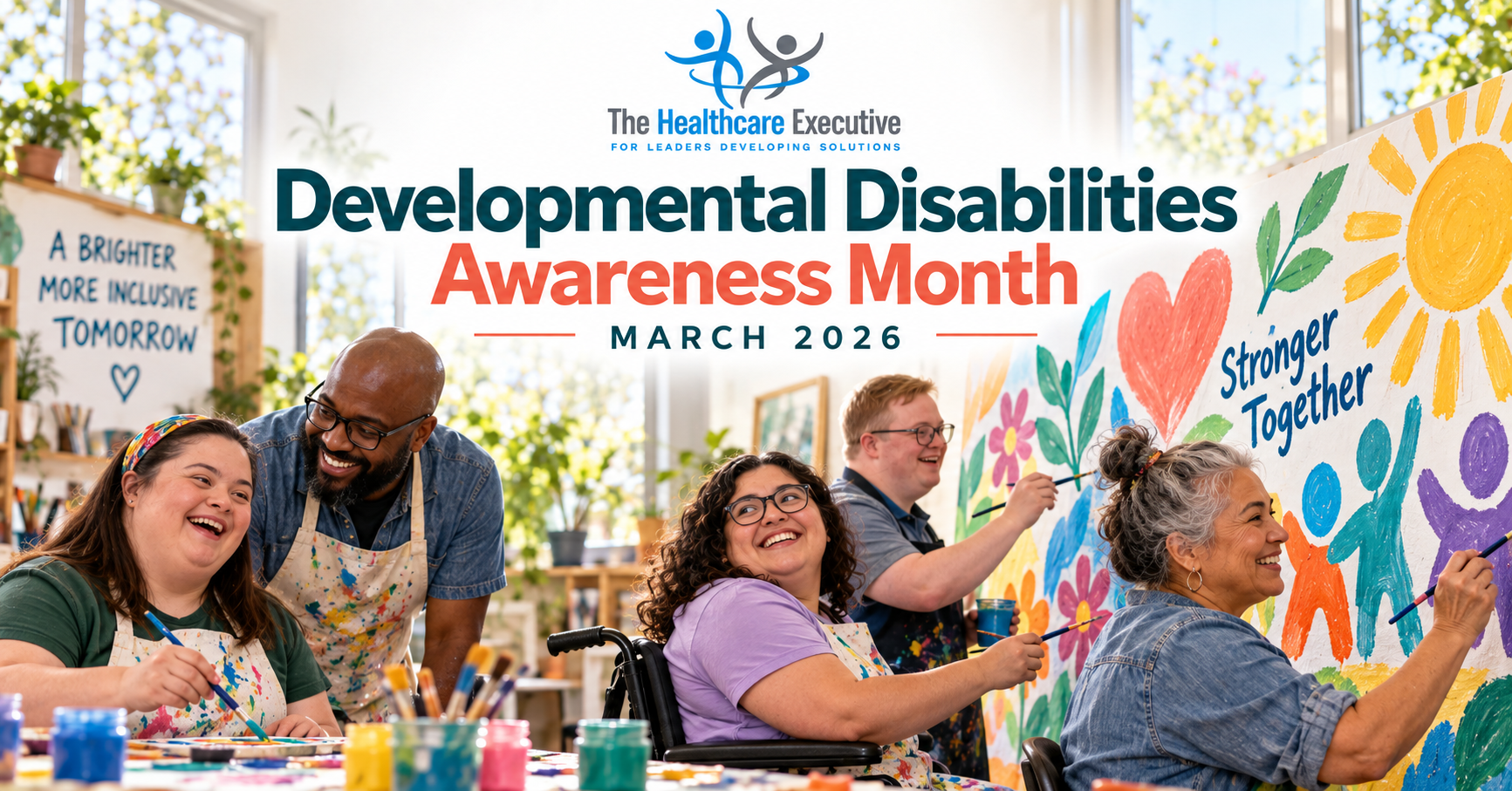


Developmental Disabilities Awareness Month 2026
Design healthcare and community systems with people with developmental disabilities as decision-makers, not after-the-fact reviewers.
People who use the system should help design it.
People with developmental disabilities use every part of the health system: primary care, emergency departments, surgery, behavioral health, dental care, maternity care, and long-term services. Too often they meet a system designed without them, then reviewed after the fact for accessibility. The result is predictable. Appointments are too short, environments are overwhelming, communication supports are missing, and decisions are made about people rather than with them.
The numbers are not small. CDC’s National Center for Health Statistics reports that the prevalence of any diagnosed developmental disability among U.S. children aged 3–17 years rose from 7.40% in 2019 to 8.56% in 2021. CDC’s autism surveillance network reports that about 1 in 31 children aged 8 years has been identified with autism spectrum disorder. These children become adults who will need reliable care for decades.
NICHD describes developmental disabilities as a broad category of often lifelong challenges that can be intellectual, physical, or both. Lifelong means the health system cannot treat access as a one-time accommodation. It needs a standing way to learn each person’s communication, sensory, mobility, and decision-support needs, record them once, and have every team honor them at every visit and admission.
Coordination is where reliability most often breaks down. A person may move between pediatric and adult services, hospital and home, clinic and community provider, or health system and school, employer, and residential support. Each transition is a chance to lose what the person has already told the system about how they communicate, who supports their decisions, and what matters to them.
The National Association of Councils on Developmental Disabilities frames Developmental Disabilities Awareness Month 2026 around the theme “We’re Here: Then, Now, Always.” For health-system leaders, that theme is an operating standard. People with developmental disabilities have always been part of the communities hospitals serve. The practical question is whether they have a seat where access, care pathways, and community partnerships are designed.
Seat people with developmental disabilities and their chosen supporters on the committees that design access, care pathways, and discharge planning, and report on their recommendations quarterly.
CDC’s National Center for Health Statistics reports that 8.56% of U.S. children aged 3–17 years had a diagnosed developmental disability in 2021, up from 7.40% in 2019.
CDC’s Autism and Developmental Disabilities Monitoring Network reports that about 1 in 31 children aged 8 years has been identified with autism spectrum disorder.
CDC’s National Center for Health Statistics reports that 1.65% of U.S. children aged 3–17 years had a diagnosed intellectual disability in 2021.
Figures are summarized from the authoritative sources linked below. Definitions and denominators should be read with each source.
The route from access to full participation
Four steps turn inclusion from a principle into dependable care.
-
Prepare access
Ask about communication, sensory, mobility, and decision-support needs before the visit, and record them where every team will see them.
-
Deliver person-led care
Plan care with the person and the supporters they choose, using plain language, adequate time, and the communication methods they use.
-
Coordinate across settings
Carry the person’s needs, supporters, and goals across pediatric and adult services, hospital and home, and community partners.
-
Support full participation
Involve people with developmental disabilities in designing services, reviewing complaints, and evaluating whether changes worked.
Reliability rule: No team schedules, admits, or discharges a person with a documented developmental disability without first checking the recorded accommodations and the supporters the person has chosen.
What leaders should watch
Four instruments show whether people with developmental disabilities can use the system as designed.
Recorded accommodations
Track whether communication, sensory, and mobility needs are captured once and visible to every team.
Supported decision-making
See whether the people who support the person’s decisions are identified and documented.
Transition continuity
Monitor whether pediatric-to-adult and hospital-to-community transitions carry the person’s plan forward.
Lived-experience voice
Check that people with developmental disabilities are shaping the services that affect them.
Handoffs that carry what the person has already told us
A person should not have to explain their needs again at every door.
From community supports to hospital care
- Share the person’s communication methods, sensory needs, and usual routines.
- Identify the supporters the person has chosen and how to reach them.
- Transfer current medications, equipment, and any existing care plan.
From pediatric to adult services
- Start transition planning early with the person and family.
- Send a summary of accommodations, goals, and decision-support arrangements.
- Confirm the adult clinician has accepted care before pediatric follow-up ends.
From hospital to home or residential support
- Review the discharge plan with the person in a format they can use.
- Confirm the community provider, supporter, or residential team has the plan and equipment.
- Name who the person and supporters can call with questions after discharge.
A handoff is complete when the receiving team confirms it can meet the person’s recorded accommodations, not when a note is sent.
A quarterly scorecard for inclusive design
Four questions keep leadership attention on access, decisions, continuity, and participation.
| Signal | Executive question | Accountable owner | Review cadence |
|---|---|---|---|
| Access | Are accommodations recorded before visits and honored when people arrive? | Access and patient experience leaders | Quarterly |
| Decisions | Are people’s chosen supporters and decision-making preferences documented and respected? | Clinical, ethics, and informatics leaders | Quarterly |
| Continuity | Do transitions carry the person’s plan to the next setting without gaps? | Care management and service line leaders | Monthly |
| Participation | Are people with developmental disabilities shaping design decisions, and are their recommendations acted on? | Executive sponsor and community partnership leaders | Quarterly |
A 90-day plan
Use Developmental Disabilities Awareness Month to start one improvement cycle that people will notice.
Start by asking people with developmental disabilities and their supporters where the system fails them. Map how accommodations and decision-support information move today. Fix the capture-and-carry gaps before writing new policy. Compensate advisors for their time, and report progress to executive leadership.
Days 1–30: See the route
- Recruit people with developmental disabilities and supporters as paid advisors.
- Map how accommodations are asked about, recorded, and found across settings.
- Establish baselines for recorded accommodations, documented supporters, and transition continuity.
Days 31–60: Build the structure
- Adopt a standard accommodation and decision-support section in the record.
- Agree on pre-visit outreach and scheduling adjustments with access teams.
- Define transition expectations with pediatric, adult, and community partners.
Days 61–90: Sustain and report
- Review measures with advisors and service line leaders.
- Stratify results by language, payer, age group, and geography and assign owners for gaps.
- Publish a short progress summary to executive leadership and to advisors.
Being here means being part of the design.
Developmental Disabilities Awareness Month and its 2026 theme, “We’re Here: Then, Now, Always,” are a reminder that inclusion is built into systems, not added afterward. That is an operating commitment, not only a message.
Turn Developmental Disabilities Awareness Month into accountable action.
Design healthcare and community systems with people with developmental disabilities as decision-makers, not after-the-fact reviewers.
Leadership focus
Design healthcare and community systems with people with developmental disabilities as decision-makers: prepare access, deliver person-led care, coordinate across settings, and support full participation.
Workforce lens
Equip scheduling, clinical, and discharge teams to ask about, record, and honor communication, sensory, mobility, and decision-support needs.
Patient and community lens
Make sure people and their chosen supporters know how to share accommodations once and see them honored at every visit.
Equity and access lens
Review access, recorded accommodations, and transition continuity by language, payer, age group, and geography, and act on the gaps.
Inspect the operating sequence
Developmental disabilities are common and often lifelong, so reliable access depends on systems rather than individual goodwill. This quarter we will seat people with developmental disabilities in design work and measure whether accommodations are recorded and honored.
- 01Prepare access
- 02Deliver person-led care
- 03Coordinate across settings
- 04Support full participation
Leadership actions for this week
- Name an executive sponsor and frontline operating owner.
- Ask people using and operating the pathway where ownership becomes unclear.
- Test one representative route from first question to acknowledged next step.
- Select one barrier that can be corrected without overstating the evidence.
- Set a review date and define how completion will be verified.
Candidate measures
Define every numerator, denominator where relevant, owner, data source, exclusions, cadence, and limitation locally. These are management prompts, not external benchmarks.
- Share of patients with a documented developmental disability who have current accommodations recorded in the record
- Share of identified patients with a documented decision-support preference or designated supporter
- Share of transitions with a documented transfer of accommodations, supporters, and goals
Department readiness checklist
- The public and staff entry points match the actual approved process.
- A specific role accepts each request, referral, or escalation.
- Handoffs include acknowledgment and a visible unresolved state.
- Language, disability, digital, transportation, and trust barriers receive explicit review.
- Communications do not introduce unsupported themes, statistics, or clinical advice.
- A named leader will review what changed after the observance.
Intended audiences
- Executive and Operational Leaders
- Public Health and Community Partners
- Patient Experience and Access Leaders
Staff communication template
During Developmental Disabilities Awareness Month, our organization will review how we prepare access and plan care with people with developmental disabilities. Please ask about and record accommodations and chosen supporters so every team can honor them.
Community communication template
March is Developmental Disabilities Awareness Month, and this year’s theme is “We’re Here: Then, Now, Always.” We invite people with developmental disabilities and their supporters to help us design services that work for them.
Measurement worksheet
- Signal
- What observable condition will show whether the route works?
- Definition
- What is included, excluded, and counted?
- Owner
- Who reviews the signal and acts on exceptions?
- Cadence
- When will leaders review it?
- Equity check
- Which differences require protected, locally appropriate review?
- Closure
- What evidence will confirm the improvement was completed?
Authoritative resources
- 2026 DD Awareness Month: We’re Here: Then, Now, Always., National Association of Councils on Developmental Disabilities
- Diagnosed Developmental Disabilities in Children Aged 3–17 Years: United States, 2019–2021 (NCHS Data Brief No. 473), CDC National Center for Health Statistics
- Data and Statistics on Autism Spectrum Disorder, Centers for Disease Control and Prevention
- About Intellectual and Developmental Disabilities (IDDs), Eunice Kennedy Shriver National Institute of Child Health and Human Development, NIH
Verification note: NACDD’s campaign page confirms the 2026 theme “We’re Here: Then, Now, Always” and states that the campaign launches in March 2026 and runs until February 2027; the observance month remains March 1–31, 2026 as listed on the calendar.