
Keep the last reliable care promise visible.
The Last-Light Protocol turns preparedness from a plan on a shelf into tested limits, named decisions, alternate paths, field evidence, and corrective action that closes.
A disaster plan can be current, complete, approved, and still fail the first night that ordinary support disappears.
Preparedness becomes operational when the hospital knows which care promises must continue, the minimum conditions each promise requires, what will change as resources deteriorate, and who can make those decisions. The answer cannot live only in a command chart. It must reach the bedside, loading dock, laboratory, pharmacy, utility plant, transfer center, security post, and every partner expected to help.
Disasters are not one category of event. A severe storm, extreme heat, infectious-disease surge, cyber incident, utility failure, hazardous-material release, violence, structural damage, supply interruption, transportation failure, or regional evacuation can produce overlapping consequences. A hospital may retain power but lose water pressure. Communications may work while staff cannot travel. The building may remain open while critical vendors, receiving hospitals, or community services cannot perform.
The practical unit of planning is therefore mission continuity. What function must occur, for which patients, at what minimum safe level, with which dependencies, for how long, and under whose authority? The plan should define how the organization recognizes that a limit is approaching, adapts care, requests help, communicates change, protects workers, tracks people, and eventually reconstitutes ordinary operations.
The federal sources in this guide have different legal force. CMS emergency-preparedness Conditions of Participation and applicable OSHA standards create binding duties within their scope. Current Hospital Preparedness Program terms describe a federal cooperative-agreement program, not a general entitlement or a permanent rule for every hospital. NIMS, FEMA continuity guidance, CDC tools, HHS cybersecurity goals, ASPR TRACIE resources, and coalition capability materials provide frameworks or guidance whose use and applicability must be described accurately.
The Last-Light Protocol: define the last safe, supportable state for every essential function before the event, then give teams the triggers, communications, authority, alternate paths, and evidence needed to move deliberately toward it or away from it.
The Continuity Field Binder in this guide contains eleven working records: a mission spine, all-hazards boundary, essential-functions triage, power and water tolerance sheet, patient-tracking chain, alternate-communications test, mutual-aid reality check, worker-protection envelope, exercise inject deck, corrective-action closure, and reconstitution certificate. None proves readiness by itself. Together they create evidence leaders can challenge and improve.
Build a mission-continuity spine before writing incident procedures.
Emergency plans often expand by hazard and department. The result can be hundreds of pages that repeat contacts and procedures without clarifying the choices leaders face when capacity falls. A mission-continuity spine organizes the binder around the work the hospital must protect.
Start with essential functions, not everything the organization normally does. Functions may include emergency assessment, time-critical treatment, inpatient care, medication access, diagnostics, infection prevention, utilities, information, security, patient movement, and communication with families and partners. The exact list depends on the hospital’s services, patient population, risk assessment, community role, and dependencies.
Define time. A function may be sustainable for minutes, hours, or days depending on stored resources, staffing, patient needs, and resupply. Avoid a single endurance number for the whole facility. Generator runtime does not equal hospital continuity if pharmacy refrigeration, medical gases, communications, sewage, cooling, staffing, or food fails first.
Connect the spine to decision rights. Who may restrict admissions, consolidate units, postpone services, relocate patients, shift documentation methods, request evacuation support, or activate alternate sites? Name successors and off-hours paths. A role on an organization chart is not enough when the role lacks current information or authority at the moment of decision.
Keep the spine short and available in multiple usable forms. Detailed procedures can attach beneath it, but the core record should survive a network outage and make sense to trained staff outside the planning office. Review it whenever services, spaces, dependencies, vendors, or the community role changes.
Draw an all-hazards boundary around cascading failure.
An all-hazards approach does not mean one generic plan for every event. It means the organization assesses likely hazards and shared consequences, then develops specific controls where the response differs. The most reusable questions concern loss of staff, space, utilities, information, access, supply, transport, communication, or community capacity.
Map hazards outside and inside the facility. Use local evidence, public hazard information, infrastructure dependencies, climate trends, supplier locations, public-health intelligence, cyber exposure, and experience from exercises and incidents. Include the patient population and people who may need mobility, communication, medication, power, behavioral-health, pediatric, or other support.
Cyber belongs inside this analysis as one hazard that can impair identity, records, diagnostics, communications, devices, payments, building controls, or supply coordination. It should have specific response and recovery plans, but it should not replace the all-hazards framework. A physical event can create digital failure, and a cyber event can create physical and clinical consequences.
Plan for combinations. Extreme heat may increase demand while reducing grid stability. Flooding may block staff and fuel routes. An infectious surge may coincide with supply disruption. A regional telecommunications failure can impair mutual aid when it is most needed. Use compound scenarios to expose assumptions hidden in single-hazard plans.
Record uncertainty. Risk ranking is a decision aid, not a prediction. Low-likelihood, high-consequence conditions may still require a basic alternate. High-likelihood conditions may reveal chronic weaknesses that should be corrected before they become emergencies. Update the assessment after incidents, major changes, and new community evidence.
Triage functions before scarcity forces improvised choices.
Continuity planning is not only about keeping services on. It is about changing them deliberately when the normal operating model is no longer supportable. Essential-functions triage defines which work must continue, which can adapt, which can pause, and which enables the rest.
Make the categories conditional. A service may be deferrable during a short utility interruption and essential during a prolonged regional event. Diagnostic capacity may be conserved for time-critical use. Ambulatory work may shift channels or locations. Support functions such as sterile processing, environmental services, pharmacy, oxygen, food, security, and transport may become the binding constraint.
Use clinical and ethical oversight. Scarcity decisions can change access, risk, staff burden, and patient outcomes. Criteria should be consistent, documented, reviewable, and communicated in a usable way. The binder should point to the appropriate clinical, legal, ethics, incident-command, and executive processes without pretending that one field sheet resolves every allocation question.
Define triggers with leading indicators. Waiting until a resource is gone narrows choices. Monitor burn rate, replenishment confidence, staffing reach, utility quality, transport access, receiving capacity, and the number of patients whose needs depend on the resource. State who verifies the data and how often the decision is revisited.
Plan the backlog when work pauses. Delayed visits, procedures, maintenance, billing, reporting, and staff education do not disappear. Assign how patients will be contacted, urgency reassessed, records reconciled, and work resequenced. Continuity includes the consequences created by necessary deferral.
Test power and water as clinical supply chains.
Emergency power and water planning must move beyond the presence of a generator or stored volume. Care depends on generation, transfer, distribution, quality, pressure, temperature, fuel, treatment, monitoring, maintenance, staff, and physical access. A component may work while the clinical endpoint does not.
Map each essential function to its actual utility path. Verify which receptacles, systems, elevators, environmental controls, pumps, sterilization processes, laboratories, pharmacies, communications, food services, and sanitation functions are supported. Include loads that change during heat, cold, surge, construction, or service relocation.
Set endurance from consumption and resupply evidence. Name assumptions about fuel delivery, tanker access, vendor priority, storage condition, treatment, testing, and regional competition. A contract does not make a route passable or a supplier immune to the same disaster.
Plan water as both quantity and quality. Drinking, hand hygiene, food preparation, dialysis, sterile processing, laboratory work, environmental cleaning, heating and cooling, fire protection, toilets, and waste systems have different requirements. CDC’s emergency water toolkit can support planning, but local public-health, utility, engineering, infection-control, and regulatory requirements govern decisions.
Witness endpoint tests under realistic load and record the configuration tested. Correct weak transfers, mislabeled outlets, inaccessible connections, incompatible fittings, unpowered support systems, and procedures that require absent specialists. Never convert a successful annual test into a claim that every duration or compound failure is covered.
Hold an unbroken patient-tracking chain.
Routine patient-location systems can fail precisely when people move fastest. Units consolidate, temporary care areas open, electronic records become unavailable, patients transfer through unfamiliar routes, and receiving facilities change. Tracking must preserve more than a count. It must connect the right person to the right clinical state, destination, records, medicines, equipment, and responsible team.
Define the authoritative identifier and a downtime alternative that staff can produce, read, and reconcile. Plan for unidentified people, duplicate names, separated families, minors, people who cannot communicate, and records created in multiple systems. Use visible status carefully so urgency is clear without exposing unnecessary information.
Test the handoff at boundaries: emergency department to temporary area, unit to unit, hospital to alternate site, ambulance to receiving facility, and paper record back to the electronic environment. A dispatch confirmation is not receipt. The chain closes when the receiving role accepts the person and essential information, and the sending record reflects the transfer.
Include equipment and support that travel with the patient. Oxygen, infusion, mobility devices, interpreters, communication aids, power-dependent equipment, infection precautions, security considerations, and caregiver information can determine whether the receiving setting is appropriate. Build these elements into the movement record rather than relying on memory during surge.
Plan a patient inquiry and family communication process that works when normal lines are congested. Define authorized disclosures, identity checks, approved messages, accessibility, language support, and coordination with public information. Privacy requirements remain in force, but privacy should not be reduced to silence. Use applicable permissions and safeguards to communicate accurately.
After the incident, reconcile every temporary record, movement, order, result, medication action, property item, and unresolved contact. Set an owner and completion evidence. A patient-tracking chain that ends when transportation leaves creates clinical and legal uncertainty at the point where recovery begins.
Run an alternate-communications test, not a contact-list review.
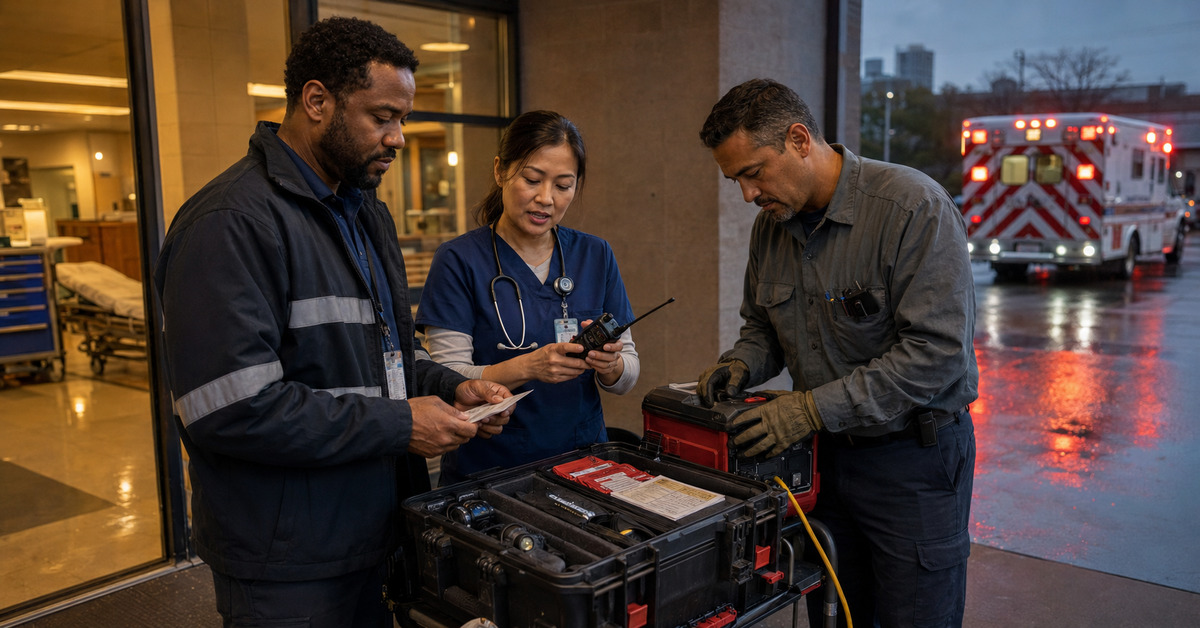
A backup channel is not available because a radio, satellite phone, mass-notification platform, or paper form exists. It is available when trained people can find it, power it, authenticate, select the correct recipient, send a priority message, receive acknowledgement, and preserve the decision under the conditions that disabled the primary path.
Define messages before tools. Teams need to communicate operational status, resource requests, patient movement, protective action, staffing instructions, public information, and executive decisions. Specify message owner, urgency, required fields, approval, recipient, acknowledgement time, and escalation. Common forms reduce ambiguity when agencies use different systems.
Reduce common-mode failure. Two applications on the same network, identity service, power source, or carrier may be one channel in practice. Map dependencies and establish a progressively simpler path, which may include radio, runner, posted status, or prearranged meeting point. Protect sensitive information appropriate to the channel.
Use plain language and defined resource terms when working with partners. The National Incident Management System, Third Edition, was published in October 2017 and provides a common framework for incident management. NIMS supports shared concepts and coordination; citing it does not prove that local teams can communicate or that every hospital is subject to the same adoption condition.
Test from the actual work location at difficult times. Confirm batteries, accessories, call signs, frequencies, contact ownership, licensing or authorization where applicable, signal reach, acoustic conditions, and written instructions. A monthly radio check can prove connectivity while missing whether a complex resource request is understood.
Close the loop. Record who acknowledged, what they understood, what action was assigned, and when an unanswered message escalated. After restoration, transfer decisions and messages into the authoritative record. Communications continuity is not the ability to broadcast. It is the ability to coordinate accountable work.
Run a mutual-aid reality check.
Mutual-aid agreements, health care coalitions, public-health agencies, emergency management, emergency medical services, vendors, and neighboring providers are essential partners. They are not an inventory that the hospital controls. The same incident may affect every party, and a resource discussed during planning may be committed elsewhere when requested.
Convert each dependency into an activation path. Define who calls, what information is required, who approves, how the resource is typed, where it reports, how it travels, who receives it, and what conditions limit its use. Include credentialing, privileges, supervision, liability, reimbursement, security, infection prevention, documentation, and demobilization as applicable.
Exercise the weakest seam. Request a real resource description, exchange a patient-transfer file, test a communications path, verify an alternate delivery route, or walk through receiving unfamiliar staff. Discussion is useful, but observed performance exposes incompatible fittings, missing permissions, unreachable contacts, unclear costs, and assumptions about transport.
Health Care Preparedness and Response Capabilities can support coalition planning and coordination. Hospital Preparedness Program notices describe current cooperative-agreement objectives, eligibility, funding periods, and award terms. These materials are not standing promises that a specific resource, waiver, bed, vehicle, or payment will be available to every hospital during an incident.
Maintain local alternatives. Regional coordination can expand options, but the hospital remains responsible for understanding its own limits and activating assistance early enough to matter. Record declined or delayed requests because they improve future risk assessment and reveal where agreements need revision.
Define a worker-protection envelope for each operational state.
A continuity strategy fails when it assumes workers can absorb unlimited exposure, fatigue, uncertainty, moral distress, travel difficulty, family disruption, or unfamiliar duties. Worker protection must be designed into every adapted service, not added after staffing becomes critical.
Identify hazards by task and setting. Consider infectious exposure, hazardous substances, smoke, heat, violence, structural conditions, electrical and utility risks, lifting, extended shifts, unfamiliar equipment, impaired communication, and psychological strain. Match controls to the hazard using elimination or substitution where possible, engineering and administrative controls, safe work practices, and personal protective equipment as applicable.
Apply law precisely. OSHA’s 29 CFR 1910.120 creates binding requirements for employees and operations within its HAZWOPER scope, including specified emergency response to hazardous-substance releases. It is not a universal standard for every hospital emergency. Other OSHA standards, state-plan requirements, emergency-action planning, respiratory protection, personal protective equipment, recordkeeping, and general employer duties may apply based on the work and jurisdiction.
Maintain core infection-prevention practices even as locations and workflows change. Hand hygiene, environmental cleaning, injection and medication safety, risk-based protective equipment, respiratory hygiene, reprocessing, and occupational-health practices still require supplies, space, training, monitoring, and accountability. CDC core practices are recommendations; applicable laws and facility policies determine duties.
Give staff a safe route to report an assignment they do not understand, cannot perform, or believe exceeds current protections. Pair surge staffing with supervision and role boundaries. Track exposures and injuries through established processes. Do not call a staffing plan resilient when it depends on chronic exhaustion, concealed work, or untrained substitution.
Use an exercise inject deck to test the mission, not perform the plan.
An exercise should create evidence about decisions, coordination, and work. Reading the plan aloud can confirm awareness. A functional exercise should force participants to recognize changing conditions, obtain information, set priorities, communicate, request resources, adapt operations, and account for consequences.
Write objectives before the scenario. Test a limited number of capabilities deeply enough to observe them. Examples include declaring a utility limit, relocating a service, using alternate communications, tracking patients, receiving mutual aid, protecting workers, or reconciling records after restoration. Align the exercise with the risk assessment, patient population, current services, and weaknesses from prior events.
Give each inject an expected decision, evidence target, and observer. Record when the team recognized the condition, what information it sought, who had authority, what alternatives were considered, which message was sent, and whether the action closed. Do not grade people for acting outside an undisclosed expected answer.
Include off-hours and role substitution. Exercise the person who would actually answer the phone, operate equipment, make the transfer, or document on paper, not only leaders in a conference room. Use safety controls, clear boundaries, controller authority, and real-world emergency interruption procedures.
For hospitals subject to 42 CFR 482.15, training and testing are binding components of the emergency-preparedness Condition of Participation. The precise exercise types, frequency, exemptions, and documentation should be checked against the current rule and CMS guidance for the facility. A local exercise framework can support that duty but does not rewrite it.
Never report completion as proof of readiness. Exercises sample designed conditions. They cannot reproduce every hazard, duration, staffing state, dependency, or behavior. Their value is the quality of evidence and correction they produce.
Mark corrective action until the field condition changes.
After-action reports often describe what happened, list recommendations, and then lose momentum as attention returns to daily operations. Corrective action needs the same discipline as clinical follow-up: a specific finding, immediate containment where needed, accountable owner, resources, due date, test, and closure evidence.
Write the finding as a failed capability, not a vague aspiration. “Improve communication” gives no one a test. “Night supervisors could not activate the satellite handset because the current access code was unavailable” identifies a condition that can be corrected and retested. Describe consequence and the essential function exposed.
Separate immediate containment from durable correction. Moving a radio to another cabinet may restore access today. Sustainable correction may require ownership, inventory, charging, access control, job aids, redundant codes, training, and recurring tests. Closing the ticket after the first action hides the remaining system defect.
Review actions across incidents, exercises, inspections, staff reports, partner feedback, and near misses. Patterns often reveal enterprise problems: unreliable contacts, inaccessible procedures, fragile resupply, unclear decision rights, paper processes that do not reconcile, or adaptations that exceed worker protections.
Give leaders a short view of overdue high-consequence actions and barriers needing authority or capital. Do not reward closure counts without reviewing evidence. A closed item that cannot survive a retest is administrative completion, not operational improvement.
Issue a reconstitution certificate before declaring normal operations.
Reconstitution is the controlled transition from emergency adaptations to a stable operating model. It is not a switch that flips when the primary utility, building, network, or staffing level returns. Temporary records, delayed care, transferred patients, exposed workers, exhausted teams, depleted supplies, altered configurations, financial decisions, and public messages may still require resolution.
Set criteria for returning each function. Verify physical and digital integrity, environmental conditions, equipment, staffing, supply, infection prevention, records, security, vendor services, and partner capacity. Remove temporary routes and permissions deliberately so that emergency access, duplicate queues, paper work, and improvised spaces do not persist unnoticed.
Treat Section 1135 waivers accurately. Authorization generally depends on both an applicable Presidential emergency or disaster declaration and an HHS Secretary public-health-emergency declaration. Actual waivers or modifications are conditional, incident-specific, and limited by their stated scope, geography, recipients, dates, and documentation expectations. They do not automatically suspend every requirement.
Assign someone to track when each flexibility begins, what it permits, which patients and claims it affects, and when it ends. Confirm current CMS instructions rather than relying on language from a prior event. A waiver may create room to operate; it does not guarantee payment, resources, safety, or operational feasibility.
Sequence return based on evidence and staff capacity, not pressure to announce recovery. Preserve an incident record, complete required reporting, communicate with affected patients and partners, and feed residual risks back into the mission spine. The certificate should state what was verified, by whom, for which service and time. It should never claim that every future disruption will behave the same way.
Conclusion
Healthcare disaster preparedness is the discipline of preserving essential care through changing conditions without pretending that a written plan controls the event. The Last-Light Protocol starts with the last safe, supportable state and works backward to the triggers, dependencies, alternate paths, communications, authority, and worker protections that state requires.
The Continuity Field Binder keeps those decisions visible. It links all-hazards analysis to essential functions, utilities to clinical endpoints, patient movement to receipt, mutual aid to verified activation, exercises to observed work, and findings to retested correction. Reconstitution completes the cycle by reconciling what the emergency changed.
Binding CMS and OSHA requirements should be applied within scope. Current program terms, federal guidance, and voluntary frameworks should be labeled for what they are. Cyber should be planned as one consequential hazard within a wider continuity system.
No binder can promise readiness, lives saved, cost avoidance, or recovery speed. It can make assumptions testable, limits visible, decisions accountable, and unresolved risk harder to ignore. That is useful evidence for the next improvement and the next shift that may have to carry the mission.
Sources and further reading
Updated through August 3, 2026. The original 2024 title has been retained. These sources have different legal force, scope, dates, and intended users; applicability should be confirmed for the organization, workforce, event, program, and jurisdiction.
Binding requirements, program terms, and voluntary guidance are not interchangeable. The cited CMS regulation and applicable OSHA standards are binding within scope. HPP award materials describe current cooperative-agreement terms. NIMS, FEMA, CDC, ASPR TRACIE, and HHS cybersecurity resources provide frameworks, recommendations, or tools unless a cited law or program condition states otherwise.
- Electronic Code of Federal Regulations: 42 CFR 482.15, Emergency Preparedness. This binding Condition of Participation requires covered hospitals to maintain an all-hazards emergency program addressing risk assessment, continuity, policies, communications, and training and testing. Facility-specific applicability and current exercise provisions should be verified.
- ASPR TRACIE: Health Care Preparedness and Response Capabilities for Health Care Coalitions. This official capability resource supports coalition preparedness, response, recovery, and health-care delivery system resilience. It is program guidance and a planning framework, not a general federal preparedness regulation for every hospital.
- Administration for Strategic Preparedness and Response: Fiscal Year 2026 Budget Period 3 Hospital Preparedness Program Release. This March 2026 notice describes current HPP cooperative-agreement funding and program priorities. Award terms apply to eligible recipients and do not guarantee resources to an individual hospital during an incident.
- U.S. Fire Administration: National Incident Management System. The current published NIMS is the Third Edition, dated October 2017. It provides a common incident-management vocabulary and framework. Local adoption obligations and implementation context vary; citation alone does not demonstrate capability.
- Federal Emergency Management Agency: Continuity Guidance Circular. This official federal continuity resource supports whole-community continuity planning for essential functions. It is guidance, not a hospital-specific regulation, and should be adapted to applicable health-care duties and local conditions.
- Centers for Medicare & Medicaid Services: Section 1135 Waivers. Section 1135 authorities require specified declarations and are used through defined blanket or individual waivers or modifications. Flexibilities are conditional and incident-specific, not an automatic suspension of all Medicare, Medicaid, or CHIP requirements.
- Centers for Disease Control and Prevention: Core Infection Prevention and Control Practices for Safe Healthcare Delivery in All Settings. These evidence-based recommendations support infection prevention across care settings, including during altered operations. They are federal guidance, not a replacement for binding OSHA, CMS, state, or local requirements.
- Centers for Disease Control and Prevention: Emergency Water Supply Planning Guide for Hospitals and Healthcare Facilities. This planning toolkit supports assessment of water use, response, and alternative supply. It is guidance and does not replace utility direction, public-health orders, engineering evaluation, or applicable codes.
- Occupational Safety and Health Administration: 29 CFR 1910.120, Hazardous Waste Operations and Emergency Response. This binding standard applies to defined hazardous-waste and hazardous-substance operations, including covered emergency response. It is not a universal rule for every hospital disaster, and state-plan or other OSHA requirements may also apply.
- Occupational Safety and Health Administration: Emergency Preparedness and Response, Getting Started. This official overview links employers to applicable worker-protection standards and planning resources. The page is guidance; the regulations and duties it cites carry their own scope and legal force.
- ASPR TRACIE: Climate Resilience for Health Care Toolkit. This voluntary toolkit supports assessment of climate-related threats and practical resilience actions for health-care organizations. It does not certify preparedness or replace required emergency planning.
- HHS: Healthcare and Public Health Cybersecurity Performance Goals. These voluntary health-sector cybersecurity goals identify essential and enhanced practices. They can support one part of an all-hazards program but are not, by themselves, a regulation, certification, or complete continuity framework.